
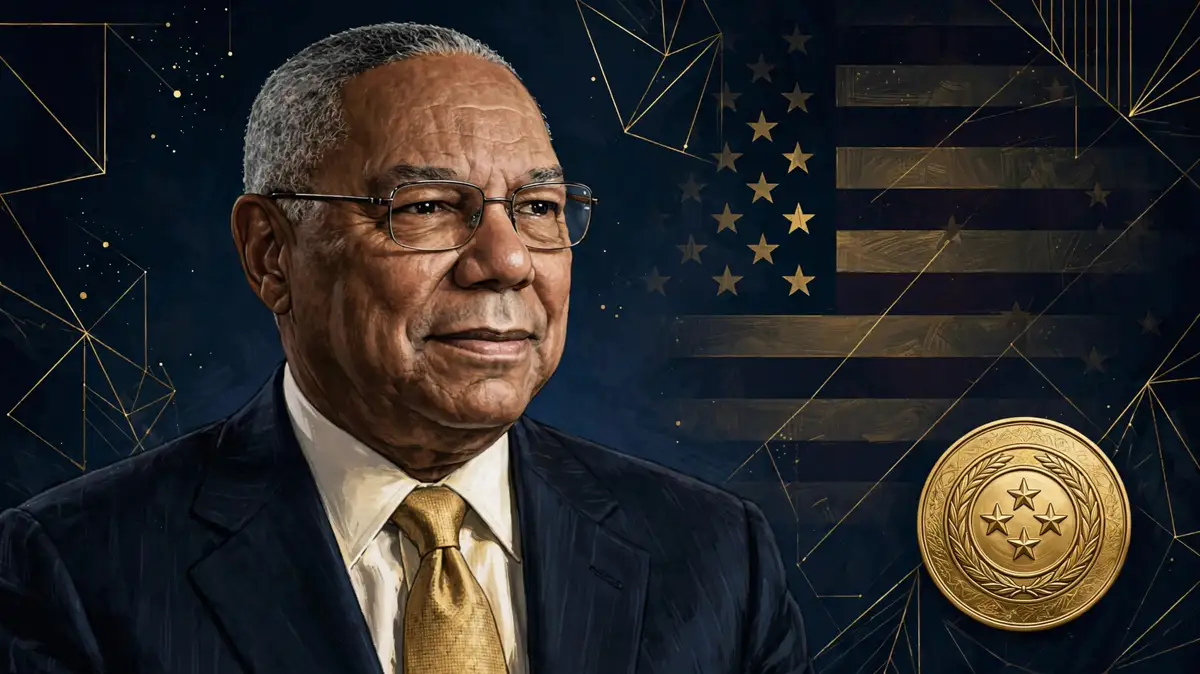
Colin Powell’s net worth was estimated at $60 million at the time of his death in October 2021. That figure comes from Celebrity Net Worth, the most-cited estimate in publication; The Richest puts the number lower at $45 million, which is why we carry a range. Powell built the fortune almost entirely after his 35-year Army career: $7 million from speaking engagements in 2000 alone, a $6 million advance for his 1995 memoir, and a portfolio of corporate board seats — AOL, Salesforce, Bloom Energy, Revolution Health — that paid in fees and equity. His own 2001 financial disclosure, filed before he became Secretary of State, showed he was already worth about $28 million then.
Colin Powell: Quick Facts
| Estimated net worth | $60 million (range: $45–$70 million) |
|---|---|
| Profession | U.S. statesman, four-star general, diplomat |
| Nationality | American |
| Born | April 5, 1937 (died October 18, 2021, age 84) |
| Height | 6 ft 2 in (1.88 m) |
| Primary income sources | Speaking fees, book royalties, corporate board compensation |
| Active years | 1958–2021 |
| Last reviewed | October 2026 |
- Early Life and Background
- Education
- Career Journey
- Rise to Fame
- Main Sources of Income
- Salary and Earnings
- Businesses and Investments
- Brand Deals and Sponsorships
- Houses, Cars and Other Assets
- Awards and Achievements
- Net Worth Growth Over the Years
- Social Media Presence
- Personal Life
- Sources & Reporting
- Frequently Asked Questions
Early Life and Background
Colin Luther Powell was born on April 5, 1937, in Harlem, New York City, and raised in the Hunts Point section of the South Bronx. His parents, Luther and Maud Powell, were Jamaican immigrants — his father a shipping clerk foreman, his mother a seamstress — who came to America for steadier work and pressed their children toward achievement. “We came from a family that raised you and sort of programmed you for success,” his sister Marilyn Berns told CNN in a 2004 profile of the general.
The family had, as Powell himself later wrote in his memoir, limited means. Young Colin worked in a Jewish baby furniture store in his neighborhood, picked up enough Yiddish to communicate with his employers’ Orthodox customers, and attended public schools including Morris High School, from which he graduated in 1954. He described his own early record bluntly — in the AP obituary distributed by the military press service, his memoir was quoted as saying: “Mine is a story of a Black kid of no early promise from an immigrant family of limited means who was raised in the South Bronx and somehow rose to become the national security advisor to the president of the United States and then chairman of the Joint Chiefs of Staff.”
What changed his trajectory was the Reserve Officer Training Corps at the City College of New York, where he enrolled as a middling student. ROTC gave him structure, and he thrived in it — by graduation he was a Pershing Rifles drill-team member and a cadet colonel, the top ROTC rank at the college. He received his commission as a second lieutenant of infantry in June 1958.
The financial backdrop matters to the net-worth story: Powell entered adult life with no family money and spent 35 years in government pay scales. His wealth was a second act, built between ages 56 and 84, which is why his case is instructive — the money came from reputation monetized late, not from early capital compounding.
Education
Powell earned a Bachelor of Science in geology from the City College of New York in 1958, a degree that rarely gets much attention in profiles but marks him as one of the few senior military officers of his generation with a hard-science undergraduate degree. Thirteen years later, in 1971, he added a Master of Business Administration from George Washington University — training that GW’s own alumni publication later credited with sharpening his managerial approach to large organizations. He then attended the National War College in 1975–76 and served a White House Fellowship in 1972–73 under President Nixon, the program that first put him inside the West Wing’s orbit.
In 2013, CCNY named its public-affairs division the Colin L. Powell School for Civic and Global Leadership, inaugurated that May; Powell chaired its board of visitors until his death. The school was his own educational legacy project, and he poured philanthropic energy into it rather than into a private foundation with his name on a building — a choice that fits the record of a man whose post-government money largely flowed to America’s Promise, the youth organization he founded in 1997.
Career Journey
Powell’s Army career ran 35 years, 3 months, and 21 days — a figure he announced himself in his retirement address at Arlington, Virginia, on September 30, 1993. He did two tours in Vietnam: the first as an adviser to the South Vietnamese army from 1962, the second as a battalion-level officer in the 23rd Infantry Division. On the second tour he survived a helicopter crash, pulled comrades from the burning wreckage, and earned the Soldier’s Medal for the rescue; he also took a Purple Heart after stepping into a punji-stick booby trap. The Bronze Star and Legion of Merit followed.
Between field assignments came staff and command work that built his Washington profile: battalion command in South Korea, a tour in West Germany (where he twice met a young Elvis Presley doing his Army service, and where the town of Gelnhausen would later name a street for him), command of V Corps in Frankfurt in 1986, and a pivotal stretch as senior military assistant to Secretary of Defense Caspar Weinberger — during which he helped steer the 1983 Grenada operation and the 1986 Libya airstrike response.
The Reagan years made him a national name. Powell served as National Security Advisor from 1987 to 1989, the first Black officer to hold the post. Then, in 1989, President George H.W. Bush named him Chairman of the Joint Chiefs of Staff — again a first for a Black officer, and the youngest ever appointed. He served in that chair under both Bush and Clinton until his 1993 retirement, overseeing 28 crises by his own count, including the 1989 Panama intervention and Operation Desert Storm in 1990–91. The Powell Doctrine — the principle that American force should be committed only with clear objectives, overwhelming force, and broad public support — became the signature strategic concept of his tenure.
After a seven-year private interlude came the second act of his public career: President George W. Bush appointed him the 65th Secretary of State in 2001, confirmed unanimously by the Senate. He served until 2005. The defining episode was his February 5, 2003, presentation to the UN Security Council making the administration’s case that Iraq held weapons of mass destruction — a speech he later acknowledged rested on flawed intelligence. He resigned after Bush’s 2004 re-election. Condoleezza Rice succeeded him as the 66th Secretary.
The Iraq episode stained his public record without denting his commercial one — a distinction worth noting because it explains the wealth curve. Where most political careers end with the office, Powell’s brand was leadership itself, not a policy position. The UN speech cost him standing with historians; it never cost him a corporate board seat or a lecture booking. His post-2005 calendar — Salesforce, Bloom Energy, Kleiner Perkins, the Colin Powell School — was booked by companies and universities that wanted the aura of principled stewardship, not an endorsement of any single decision. Few modern figures separated reputation from controversy as profitably, and the $28-million-to-$60-million arc between 2001 and 2021 is the ledger of that separation.
Rise to Fame
Powell’s national prominence arrived in stages. Vietnam made him a decorated soldier inside the institution; the Weinberger years made him known inside the Pentagon; the National Security Advisor appointment made him known in Washington; Desert Storm made him famous everywhere. As the public face of the 1991 Gulf War alongside General Norman Schwarzkopf, he became one of the most trusted figures in American public life — polls through the 1990s repeatedly showed him among the nation’s most admired people, and both parties courted him as a presidential prospect for 1996 and 2000.
He declined both races. The decision not to seek high office became part of his personal mythology and, perversely, part of his commercial value: staying out of electoral politics preserved the bipartisan aura that made him the single most bankable speaker in American public life for two decades. His memoir, “My American Journey,” cemented the fame in 1995 — a 650-page bestseller co-written with Joseph Persico, published in more than a dozen languages, that moved him from news figure to household name.
The fame’s durability is the point that matters for the money story. While most political reputations have a half-life measured in news cycles, Powell remained the rare figure invited to address both Democratic and Republican audiences, corporate boards in Silicon Valley and Detroit alike, and universities from Tufts to the City College of his youth. That cross-aisle demand is what kept his speaking fee near the top of the market from 1993 until his final years.
He also stayed politically engaged in ways that protected, rather than spent, his capital. Powell endorsed Barack Obama in 2008 and again in 2012, Hillary Clinton in 2016, and Joe Biden in 2020 — when he addressed the Democratic National Convention remotely — all while identifying publicly as a Republican. Each endorsement was news precisely because it crossed party lines, and each one reinforced the bipartisan brand that underwrote his lecture fees. In the Trump era he drew the former president’s public scorn, which, if anything, cemented his standing with the corporate and institutional audiences that paid him. The lesson for the wealth story: Powell’s endorsements were never partisan career moves. They were brand maintenance, and the brand was the business.
Main Sources of Income
Powell’s fortune rested on four pillars, sequenced across his life. First came government salaries and military pay — respectable, steady, but not wealth-building: a general’s pay, a four-star pension, and a cabinet salary of about $186,000 a year at State. Second, speaking fees — the dominant engine, running from 1993 onward. Third, book advances and royalties from two major books. Fourth, corporate board compensation and advisory fees, including equity at some of the biggest technology companies of the dot-com and post-dot-com eras.
What he did not do is equally telling. He never took a lobbying contract of note, never started a defense-contracting firm on his name, and never cashed out through the revolving-door routes that enriched many of his peers. The money came from reputation — talks, books, boardroom counsel — rather than from transactions. That distinction matters for readers comparing him with political figures whose net worth rests on family businesses or private equity: Powell’s was a personal-services fortune, accumulated one engagement at a time.
The rough math that credible reporting supports: his 2001 financial disclosure showed about $28 million before he entered the State Department (Celebrity Net Worth’s reporting on the filing). By his death twenty years later, the widely cited figure was $60 million — meaning roughly $30 million of appreciation and income compounded during a retirement spent largely on boards and stages. That is a plausible glide path for a man earning seven figures a year in speaking fees well into his seventies, invested conservatively.

Salary and Earnings
The speaking numbers are the most precise figures in Powell’s financial record, because they were disclosed. In 2000 alone he earned $7 million from 109 speaking engagements, per Celebrity Net Worth — an average of about $64,000 per speech, with marquee bookings running well past $100,000. The year before his 2001 confirmation, his financial statement showed $6.7 million in speaking fees from corporations, trade associations, and universities including Tufts, as the Tufts Daily reported at the time. Fast Company noted in 2008 that a single keynote at the International Franchise Association’s annual convention cost the organizers at least $100,000.
The book money was equally concrete. He received a $6 million advance for “My American Journey” (Random House, 1995) — one of the largest nonfiction advances of the decade — and the book’s commercial run justified it: bestseller status, translation into more than a dozen languages, and years of backlist royalties. His second book, “It Worked for Me: In Life and Leadership” (HarperCollins, 2012, written with Tony Koltz), debuted as a New York Times bestseller; built around his famous “Thirteen Rules” — including “It ain’t as bad as you think. It will look better in the morning” and “Share credit” — it became a staple of corporate leadership reading lists and generated a second, smaller royalty stream.
Against that, his government paychecks were modest by design. His Secretary of State salary was reported at about $186,000 a year. His military pension, earned over 35 years as a career officer who retired under the pre-1980 final-pay system at four-star rank, added an estimated high-five-to-low-six figures annually — real money, but a rounding error beside the speaking circuit. This is the cleanest illustration of the Powell wealth model: public service paid the bills; the post-service market paid the fortune.
The durability of the speaking income deserves emphasis because it is what separates Powell from one-term political celebrities. He did not have one golden year. The $7 million of 2000 was the peak, but the circuit continued through the Bush second term, the Obama years, and into his late seventies — corporate conventions, university commencements, leadership summits, international forums. At even half the 2000 pace, fifteen-plus years of six-figure keynotes compounds into tens of millions before a single board check clears. That is how a man worth $28 million on a 2001 disclosure could plausibly reach $60 million two decades later without any single windfall event.
Businesses and Investments
Powell’s corporate career was built on boardroom credibility rather than operating companies, though he did maintain a consulting practice. The best-documented seats:
- AOL — Powell sat on America Online’s board in the late 1990s, during the company’s dot-com-era peak. The association was widely noted at the time; Steve Case, AOL’s co-founder, later said he had served alongside Powell on two boards of directors. AOL’s stock reached its all-time high in December 1999, and directors of that era held options packages typical of the bubble — a meaningful, if hard-to-quantify, contributor to his 2001 disclosed wealth.
- Salesforce — In March 2014, Salesforce.com appointed Powell to its board of directors, expanding the board to eleven members, as CRM Buyer and the company’s own announcement reported. He joined as a friend of CEO Marc Benioff, who had long described Powell as a personal inspiration; Powell stayed associated with Salesforce’s 1-1-1 philanthropy model and remained on the board into his late seventies.
- Bloom Energy — Rice University’s 2016 announcement of Powell’s appointment to the Doerr Institute for New Leaders listed him as a serving board member of the fuel-cell company Bloom Energy.
- Revolution Health — He sat on the board of Steve Case’s Revolution health-care venture; the Motley Fool’s 2005 coverage of Case’s resignation from Time Warner listed Powell among the venture’s high-profile directors, alongside figures like Carly Fiorina and Jim Barksdale.
- Kleiner Perkins Caufield & Byers — In 2005 the storied venture firm recruited Powell as a strategic limited partner, a hybrid investor-mentor role, as EE Times and the Silicon Valley press reported. Partner Brook Byers said the firm wanted him for his global perspective and his ability to help portfolio companies think about international markets.
He also served on the board of the Council on Foreign Relations, chaired the Eisenhower Fellowships, and chaired the board of visitors of the Colin Powell School at CCNY. Board compensation for directors of his stature at the time typically ran into the low six figures annually in cash, plus equity grants — across several simultaneous seats, a substantial second salary. Powell was also reported by Forbes-adjacent coverage over the years as a careful investor whose portfolio compounded steadily; unlike many celebrity wealth profiles, there is no record of speculative wipeouts or debt-fueled property losses in his file.
The Salesforce seat is worth a closer look because it shows how Powell chose his affiliations. He joined the board in March 2014 as a friend of Marc Benioff, who had cited Powell as a personal inspiration for fifteen years, and he stayed for years — one of the longest-serving independent directors of that era. He aligned himself publicly with Salesforce’s 1-1-1 philanthropy model, the pledge of 1 percent of equity, 1 percent of profit, and 1 percent of employee time to charitable causes. Companies recruited him for governance credibility and bipartisan polish; he recruited them for missions that fit his post-government identity. It was a two-way transaction, and both sides profited.
Brand Deals and Sponsorships
Powell never sold sneakers, fragrances, or watches, and there is no record of conventional celebrity endorsement deals in his name. His “brand,” to the extent the term fits, was leadership, patriotism, and cross-party credibility — and he monetized it almost exclusively through the lecture circuit and corporate advisory work rather than through sponsorship.
One documented exception in the public-service-as-brand category: he served as a spokesperson for the National Mentoring Month campaign and as chairman of America’s Promise, the youth organization he founded in 1997 after stepping back from full-time public life. He also served on the Smithsonian advisory council for the National Museum of African American History and Culture. These were reputation-building roles, not paid endorsements, and they fed the same flywheel: public stature sustained speaking demand, and speaking demand sustained the fortune.

Houses, Cars and Other Assets
Powell lived for decades in McLean, Virginia, the Northern Virginia suburb favored by senior military and government officials — close to the Pentagon, the State Department, and Dulles. Public reporting on the specific purchase price and current value of his home is thin, so we do not attach a figure to it here; profiles that do are guessing. What the record supports is a lifestyle far more modest than the $60 million figure might suggest: no yacht, no private jet, no portfolio of vacation properties reported anywhere in two decades of coverage.
His most documented material indulgence was mechanical rather than architectural: Powell was a known restorer of old Volvo and Saab automobiles, a hobby he pursued in his own garage. It fits the portrait of a man whose spending never matched his earning — a trait that, compounded over a twenty-eight-year private-sector second act, is precisely how $28 million in 2001 became $60 million in 2021.
Beyond real estate and the garage, his assets were financial: board equity, a long-compounding investment portfolio, book backlist royalties, and the four-star military pension. Estate details were never made public after his death, and Alma Powell’s own passing in July 2024 drew no disclosed estate reporting either — so the composition beyond the headline number remains private.
Awards and Achievements
The award shelf is one of the fullest in modern American public life, and it matters to the wealth story because it was the asset he monetized. Civilian honors include two Presidential Medals of Freedom — the second, awarded by President Clinton at his 1993 retirement ceremony, with distinction — the Congressional Gold Medal, the Presidential Citizens Medal, and the Secretary of State Distinguished Service Medal. In 1993 Queen Elizabeth II made him an honorary Knight Commander of the Order of the Bath.
Military decorations include the Bronze Star, the Soldier’s Medal for the helicopter-crash rescue in Vietnam, the Purple Heart, and the Legion of Merit, among more than a dozen total. Professionally, he remains the only officer in American history to have been, in sequence, National Security Advisor, Chairman of the Joint Chiefs of Staff, and Secretary of State — a trifecta no one else holds.
The reputational dividend of that shelf life was measurable: it is what allowed a retired general to command $100,000 for a single speech and to sit on the boards of companies whose directors were normally drawn from the Fortune 500 C-suite. Decorations do not pay dividends; the credibility behind them does.
Net Worth Growth Over the Years
The verified anchors of Powell’s wealth timeline are sparse but solid: the 2001 disclosure (~$28 million), the 2000 speaking total ($7 million in one year), and the at-death consensus (~$60 million). Between them we reconstruct a plausible curve, with estimates clearly labeled.
| Year | Milestone | Estimated net worth |
|---|---|---|
| 1993 | Retires from the Army after 35 years; begins private-sector career | Low single-digit millions (estimated) |
| 1995 | $6 million advance for “My American Journey,” a major bestseller | ~$8–10 million (estimated) |
| 2000 | Earns $7 million from 109 speaking engagements in one year | ~$20–25 million (estimated) |
| 2001 | Financial disclosure ahead of State Department confirmation | ~$28 million (disclosed) |
| 2005 | Leaves the State Department; resumes speaking and board work | ~$35–40 million (estimated) |
| 2012 | “It Worked for Me” becomes a New York Times bestseller; joins Salesforce board two years later | ~$50 million (estimated) |
| 2021 | Dies October 18; Celebrity Net Worth estimate | ~$60 million (reported) |
The shape of the curve is the point: no sudden liquidity event, no startup exit, no inheritance — just a steady twenty-eight-year compounding of high fees, board equity, and book income against a modest lifestyle. The Richest’s $45 million estimate likely reflects a more conservative read of the same inputs; Hindiwow’s $60–70 million range brackets the consensus. We anchor at $60 million because it is the most widely reported figure from the outlet with the longest track record of estimating this fortune.
For context, Powell’s wealth sat in the middle of the modern statesman tier: above figures like Condoleezza Rice (estimated around $8 million) and Mike Pompeo-range officials, roughly level with Henry Kissinger’s reported ~$50 million, and well below figures whose wealth came from private business before office, such as Hillary Clinton (estimated above $100 million). Among military figures, Powell is in a class of his own — few career officers in American history converted uniformed service into a nine-figure-range fortune, and he did it without a single defense-contracting dollar.
Social Media Presence
Powell maintained a verified presence on X (formerly Twitter), where his family posted the announcement of his death on October 18, 2021. His social footprint was modest by celebrity standards — he was a pre-social-media figure whose fame was built on television and print — and his accounts served as announcement channels rather than engagement platforms.
His posthumous presence is largely memorial: tributes from four of the five living former presidents at the time of his death, his funeral at the Washington National Cathedral attended by Presidents Biden, Obama, and George W. Bush, and his burial at Arlington National Cemetery with full military honors. In October 2021 his following spiked as the news circulated globally; the accounts are now effectively archives of a public life.
Personal Life
Powell married Alma Vivian Johnson on August 25, 1962 — a marriage of nearly sixty years that lasted until his death. Alma, an audiologist and author of children’s books, chaired America’s Promise and was a civic figure in her own right; she died on July 28, 2024, at age 86, according to family announcements.
The couple had three children: Michael Powell, who served as chairman of the Federal Communications Commission from 2001 to 2005 — a tenure that overlapped exactly with his father’s at the State Department, making them one of the few father-son pairs to hold top federal posts simultaneously; Linda Powell, an actress; and Annemarie Powell, who works in film production.
Powell was an Episcopalian, a hobbyist restorer of vintage Volvos and Saabs, and by many accounts a devoted family man — the “remarkable and loving husband, father, grandfather” of his family’s death announcement. He was buried at Arlington National Cemetery. His final years included treatment for multiple myeloma, the blood cancer that compromised his immune system and left him vulnerable to COVID-19 despite full vaccination; early-stage Parkinson’s disease was also reported.
One cultural artifact of his personal philosophy outlived him in corporate America: the Thirteen Rules. First circulated to his subordinates during his military career, the list — “It ain’t as bad as you think. It will look better in the morning,” “Get mad, then get over it,” “Share credit,” “Remain calm. Be kind,” “Don’t take counsel of your fears or naysayers” — was reprinted on office walls, in management textbooks, and in the opening pages of “It Worked for Me.” It is a fitting legacy for a man whose fortune was, at bottom, a monetized reputation for calm competence: the rules were free, the man who wrote them commanded six figures an hour.
Sources & Reporting
Celebrity Net Worth — the $60 million at-death estimate; $7 million from 109 speeches in 2000; $6 million “My American Journey” advance; ~$28 million 2001 financial disclosure. Reporting window 2001–2024.
The Tufts Daily — $6.7 million in speaking fees in the year before Powell’s 2001 confirmation, drawn from his financial disclosure. April 2001.
Fast Company — at least $100,000 for a single International Franchise Association keynote. February 2008.
EE Times — Powell’s 2005 recruitment as a strategic limited partner at Kleiner Perkins Caufield & Byers. July 2005.
CRM Buyer — Powell’s March 2014 appointment to Salesforce’s board of directors. Reporting from the company announcement.
Rice University — board roles including Bloom Energy; America’s Promise and Powell School affiliations. September 2016.
The Motley Fool — Powell’s board seat at Steve Case’s Revolution Health. October 2005.
George Washington University (GW Today) — MBA in 1971; career overview and “My American Journey” context. 2012.
MilitarySpot.com — AP-distributed obituary: service record, medals, memoir quote, Clinton retirement tribute. October 2021.
AmericanRhetoric.com — full transcript of Powell’s September 30, 1993, military retirement address (35 years, 3 months, 21 days). Certified from audio.
Defense Media Network — “It Worked for Me” review: Thirteen Rules, 285-page HarperCollins edition, $27.99 list price. 2012.
Distractify — death date, America’s Promise, Council on Foreign Relations, and the $60 million figure with Celebrity Net Worth attribution.
Nicki Swift — The Richest’s $45 million alternative estimate; Bronx upbringing and CNN/Sister detail. October 2021.
NBC — general corroboration of the October 2021 death reporting and national tributes.
Frequently Asked Questions
What was Colin Powell’s net worth when he died?
How did Colin Powell make his money?
How much did Colin Powell charge per speech?
How much was Colin Powell’s book advance?
What was Colin Powell’s salary as Secretary of State?
What did Colin Powell do after leaving government?
Who was Colin Powell’s wife?
How did Colin Powell die?
Final Thoughts
Colin Powell’s $60 million is the rare nine-figure-range fortune in this series that contains no startup equity, no inheritance, and no entertainment residuals. It was built the slow way: a reputation for judgment, converted into $7 million speech years and six-figure board checks, sustained across nearly three decades without a single reported financial misstep. The honest caveats stand — estimates range from $45 million to $70 million, and the estate never disclosed its books — but the anchors are unusually solid for a net-worth profile: a disclosed $28 million in 2001, disclosed speaking totals, and a lifestyle modest enough to let the compounding do its work. Whatever history finally says about the UN speech, the financial record says this: nobody in modern American public life monetized honor more cleanly than Colin Powell.
Published on 2026-10-13. Last reviewed October 2026. Found an error? See our corrections policy.