
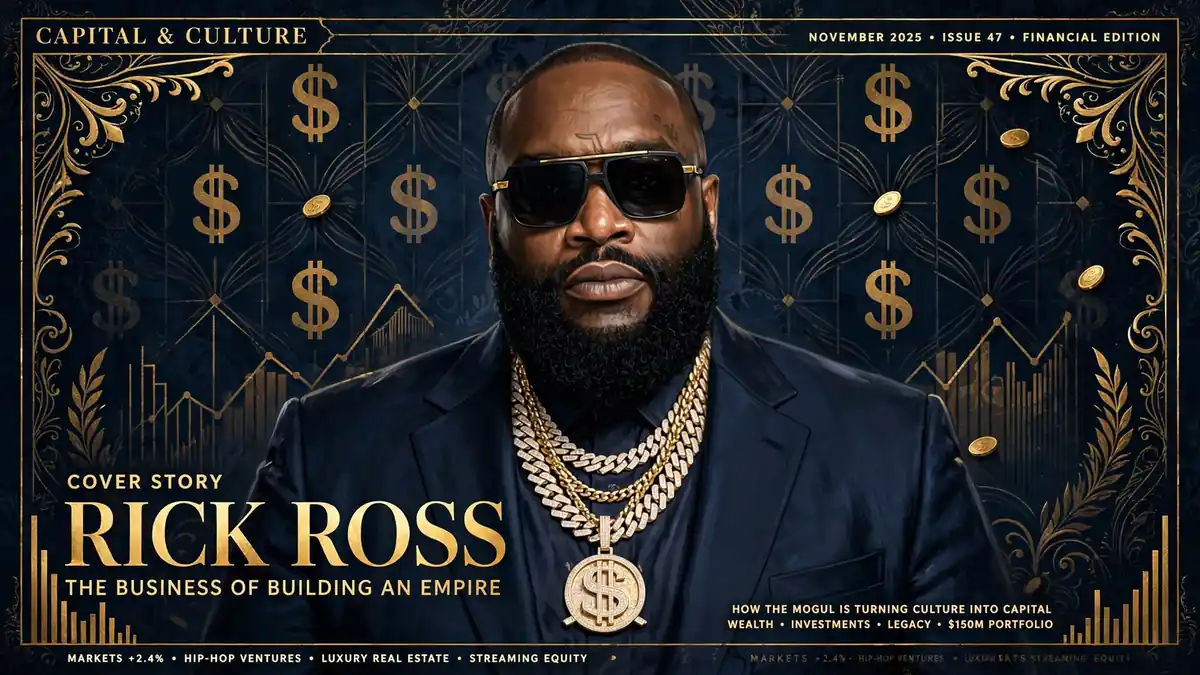
Rick Ross‘s net worth is estimated at $150 million to $180 million as of October 2026. The Miami rapper born William Leonard Roberts II built one of hip-hop’s most diversified fortunes — more than $90 million from music alone, according to Celebrity Net Worth — then converted rap earnings into equity: nearly 30 Wingstop franchises, a stake in Luc Belaire sparkling wine and Bumbu rum, and a real estate portfolio crowned by a $37 million Star Island mansion and the 322-acre Promise Land estate in Georgia. In 2026 he released his 12th studio album Set in Stone, celebrated 20 years of Port of Miami with an orchestral tour, and joined a 670-unit Miami Gardens condo development — even as a late-September arrest kept his name in the headlines.
Rick Ross: Quick Facts
| Estimated net worth | $150M–$180M (range: $150 million to $180 million) |
|---|---|
| Profession | Rapper, songwriter, record executive, entrepreneur |
| Nationality | American |
| Born | January 28, 1976 (age 50) |
| Height | 5’11” (180 cm) |
| Primary income sources | Music catalog and royalties, Wingstop and Checkers franchises, spirits brand equity (Luc Belaire, Bumbu), Maybach Music Group, real estate |
| Active years | 2000 – present |
| Last reviewed | October 2026 |
- Early Life and Background
- Education
- Career Journey
- Rise to Fame
- Main Sources of Income
- Salary and Earnings
- Businesses and Investments
- Brand Deals and Sponsorships
- Houses, Cars and Other Assets
- Awards and Achievements
- Net Worth Growth Over the Years
- Social Media Presence
- Personal Life
- Sources & Reporting
- Frequently Asked Questions
Early Life and Background
William Leonard Roberts II was born on January 28, 1976, in Clarksdale, Mississippi, and raised in Carol City, Florida — the Miami Gardens neighborhood whose streets would shape his entire artistic identity. The most examined 18 months of his biography have nothing to do with music. From December 1995 to June 1997, the future rapper worked as a correctional officer at the South Florida Reception Center in Doral, Florida, a detail first documented by reporting on his employment records and later confirmed across his Wikipedia biography. He has never hidden it. Where other rappers buried inconvenient day jobs, Ross eventually folded the chapter into his mythology: the discipline of institutional work, applied to the business of rap.
Before the fame he performed in Miami’s underground scene as Teflon Da Don, recording early material with Suave House Records. The name that made him famous came from somewhere else entirely. In the early 2000s he adopted the moniker Rick Ross, borrowed from Richard Donnell Ross — “Freeway” Rick Ross, the Los Angeles trafficker who built one of the country’s largest crack cocaine distribution networks in the 1980s. The borrowing became a lawsuit. In 2010, Freeway Rick Ross sued the rapper for $10 million, claiming the name and persona had been taken without permission. The case wound through California courts for three years until, on December 30, 2013, a judge ruled definitively for the rapper on First Amendment grounds — finding, as The Hollywood Reporter reported, that Ross had used the name and details of the trafficker’s life as “raw materials” for “original artistic works” rather than simply trading on another man’s identity. The public tension never fully cooled: as recently as 2026, Ross sparred with podcast host Patrick Bet-David on the PBD Podcast when the name’s origin came up, turning the question into a minutes-long rant, as covered by Baller Alert.
His father was William Leonard Roberts and his mother Tommie Roberts; his sister Tawanda Roberts would later become a business partner in the family’s Wingstop operation. Growing up, Ross watched his childhood home in Carol City burn down — a loss he referenced in his 2026 Architectural Digest home tour as the emotional counterpoint to the mansions he owns now.
Education
Ross graduated from Miami Carol City Senior High School, where football opened a door that music had not yet found. He earned a football scholarship to Albany State University, a historically Black college in Georgia, and played for the Golden Rams. The college football career was short-lived — Ross left Albany State before graduating — but the structure of the sport stuck with him. Teammates and early associates have described a young Roberts who treated practice schedules and training discipline the way he would later treat studio sessions and franchise operations. It is a through-line he returns to in interviews: the HBCU years gave him his first experience of performing for crowds, managing a team environment, and understanding that physical presence — he stands 5’11” with a frame that would become part of his stage persona — could be a tool.
Whatever the classroom gave him, the correctional-officer years and the football years together formed the two pillars of the “Boss” identity: institutional discipline on one side, competitive showmanship on the other. By the early 2000s, both were being pointed at music.
Career Journey
Ross’s first real industry traction came in the early 2000s under the Teflon Da Don alias, cutting tracks in Miami’s underground circuit. A stint with Suave House Records put him in professional studios, and by 2005 he was a lead member of the hip-hop group Triple C’s alongside fellow Florida rappers Gunplay and Torch. The group never broke nationally, but it sharpened his ear for collaboration — a skill that would later define his label.
The break came in 2006 with “Hustlin’,” a slow-rolling, bass-heavy single built on a hypnotic synth line and Ross’s gravel-throated hook. The record went platinum before he had a major-label deal, and it triggered a bidding war that remains one of the decade’s great label stories: offers arrived from Diddy’s Bad Boy Entertainment and Irv Gotti’s Murder Inc., but Ross signed a multimillion-dollar deal with Jay-Z at Def Jam Recordings. The debut album, Port of Miami, arrived in August 2006, debuted at number one on the Billboard 200, and sold 187,000 copies in its first week — an extraordinary opening for a rapper with no prior mainstream presence.
Trilla followed in 2008 and also hit number one, establishing that the debut was no accident. By the end of the decade Ross had built the foundation of a catalog that Celebrity Net Worth credits with generating more than $90 million in career music earnings.
Rise to Fame
The 2010s were Ross’s imperial decade. Deeper Than Rap (2009), Teflon Don (2010) — home to “Aston Martin Music” with Drake and Chrisette Michele, later certified triple platinum by the RIAA — and God Forgives, I Don’t (2012) all reached the top of the Billboard 200, the last of them moving 218,000 copies in its first week. Six of his albums have hit number one in total, a run that put him in rare company among Southern rappers of his generation.
The albums kept coming at a steady clip: Mastermind (2014), Hood Billionaire (2014), Black Market (2015), Rather You Than Me (2017), Port of Miami 2 (2019, which peaked at number two), and Richer Than I Ever Been (2021). Along the way Ross founded Maybach Music Group in 2008 and turned it into a genuine talent pipeline, signing Meek Mill, Wale, French Montana, and Omarion, and cutting joint ventures with Def Jam and later Epic Records. In 2011 MTV named him the Hottest MC in the Game; The Source named him Man of the Year in both 2010 and 2011. His Grammy record — nine nominations across categories from Best Rap Album (God Forgives, I Don’t, 2013) to Song of the Year (“God Did,” 2023) — has never produced a win, a quirk of his career that his fans treat as a badge of underdog credibility.
The 2020s brought a second act. The 2023 collaborative album Too Good to Be True with Meek Mill arrived through a new distribution arrangement with Gamma. In April 2024 he released “Champagne Moments,” a pointed diss single aimed at Drake that kept him at the center of hip-hop’s conversation. His 12th solo studio album, Set in Stone, landed on July 17, 2026, and in 2026 he marked the 20th anniversary of Port of Miami with a 17-city orchestral tour — black-tie shows featuring the Renaissance Orchestra and Sainted Trap Choir, as reported by Hypebeast. April 2026 also brought a characteristically bold business headline: Ross publicly offered $2 million to buy 50 Cent’s G-Unit catalog, a move covered by African entertainment press that doubled as marketing for his 2026 victory lap.
Main Sources of Income
Ross’s money arrives from more directions than almost any rapper of his generation. Music remains the foundation — album sales, streaming royalties, publishing, and touring from a catalog that Celebrity Net Worth values at more than $90 million in career earnings. But the modern fortune is built on ownership. The Wingstop franchise portfolio, held through his company Boss Wings Enterprises, is the most visible pillar: nearly 30 locations across the Southeast, bought one store at a time starting in 2011. Checkers franchises added a second quick-service line. The spirits portfolio — an equity stake in Luc Belaire sparkling wine and partnerships with Bumbu rum and McQueen and the Violet Fog gin, all under Brett Berish’s Sovereign Brands umbrella — turns his lifestyle branding into recurring revenue.
Maybach Music Group functions as both label and investment vehicle, generating executive income and artist royalties from its roster and its distribution deals. Real estate is the fourth pillar: the Promise Land estate, the Star Island mansion, and rental and event income from properties that double as content studios. Books — the 2019 memoir Hurricanes and 2021’s The Perfect Day to Boss Up: A Hustler’s Guide to Building Your Empire — added author income and extended the Boss brand into business literature. Endorsements, including his recurring “Chief Delivery Boss” role with Gopuff and a Slippery Soap car-care line sold in more than 4,000 AutoZone stores, round out the mix. And since 2022, his annual Rick Ross Car & Bike Show has become a ticketed cultural event at the Promise Land that Celebrity Net Worth notes generates millions per year in event revenue.
The through-line is deliberate. Ross has said in interviews, including a 2021 conversation with Complex, that sitting down with Wingstop’s CEO early on taught him the difference between being paid to promote something and being paid because he owns it. Nearly every deal since follows the ownership model.
Salary and Earnings
Rap is not a salaried profession, but Ross’s earnings have been unusually well documented. Forbes included him on its Hip-Hop Cash Kings ranking of the genre’s top earners in multiple years during his 2010s peak, when album cycles, touring, and early business income combined into eight-figure annual hauls. Celebrity Net Worth’s tally of more than $90 million in career music earnings remains the most cited single figure — and it predates the streaming era’s long tail, which continues to pay his catalog every month.
Touring has always been a major line item. The 2026 Port of Miami 20th anniversary tour, with its orchestra-backed arena format across 17 cities, represented a step up in ticket pricing from standard club and theater dates. Festival appearances and private bookings — Ross is a fixture on the luxury-event circuit — have historically commanded six-figure fees for top hip-hop headliners of his tier, though his exact asking price is not public. What is public is the shape of the income: by the mid-2020s, business outlets like Bisnow were describing his annual earnings in the $20 million-plus range in peak years, with franchises and spirits equity doing the heavy lifting that touring once did.
One underappreciated earner is the catalog itself. “Hustlin’,” “Aston Martin Music,” “B.M.F. (Blowin’ Money Fast),” and “Diced Pineapples” are permanent fixtures on hip-hop playlists, and Ross holds songwriter and performer stakes that pay publishing and master royalties in perpetuity. The 2026 G-Unit catalog bid — $2 million for 50 Cent’s masters — showed he thinks about catalogs as an acquirer now, not just a creator.
Businesses and Investments
Wingstop. The chicken-wing empire is Ross’s signature business move. He bought his first Wingstop franchise in 2011 after approaching the company as a genuine customer — he told Complex in 2021 that CEO Charlie Morrison “opened the doors for me” despite his lack of franchise experience. Today he owns at least 25 locations, and some reports put the count near 30, concentrated in Florida, Georgia, Mississippi, and Alabama and held through Boss Wings Enterprises alongside his mother Tammie Roberts and sister Tawanda Roberts. Industry data cited by franchise analysts puts average Wingstop unit sales at $1.5–2 million annually with margins of 15–20%, which makes a 25-plus-store portfolio a serious cash machine — one analyst estimate valued his holdings in the $7–8 million range at peak, though the equity value to Ross is higher given the brand’s growth. The business has not been controversy-free: in August 2022, the U.S. Department of Labor fined Ross and his family co-owners $114,427 for wage violations at Mississippi locations, after investigators found 244 workers had been made to pay for uniforms, training, and register shortages, as reported by XXL. Ross has also used the franchises as family wealth transfer — in September 2021 he gifted his 16-year-old son William Roberts III his own Wingstop franchise for his birthday, announcing it on Instagram via REVOLT’s coverage.
Checkers & Rally’s. Ross expanded into a second quick-service chain with Checkers franchises, adding burger-and-fries units to the restaurant portfolio. Exact store counts are less documented than the Wingstop holdings, but the move dates to the mid-2010s and multiple net-worth trackers treat it as a meaningful second franchise line.
Spirits equity. The Luc Belaire relationship is Ross’s longest-running brand play. He is not merely a spokesman for the French sparkling wine — Celebrity Net Worth describes him as an equity owner, and hip-hop press has long called him the brand’s most visible ambassador, popping the brand’s signature bottles in videos for over a decade. The label sits inside Sovereign Brands, the company run by CEO Brett Berish that also produces Bumbu rum — where Ross holds a partnership stake — and McQueen and the Violet Fog gin, which Ross promoted alongside Wiz Khalifa in Gopuff’s New Year’s Eve 2025 campaign. Equity in growing spirits brands is exactly the kind of asset that explains why Ross’s wealth kept climbing after his touring peak.
Maybach Music Group. Founded in 2008, MMG is Ross’s executive legacy. The label broke Meek Mill and Wale into stars, gave French Montana and Omarion a home, and moved through joint ventures with Def Jam and Epic before landing distribution with Gamma in 2023. Label economics — advances recouped, artist royalties, and Ross’s own releases flowing through the imprint — make MMG both a creative outlet and a balance-sheet asset.
Real estate development. In March 2026 Ross joined the development team of EnSima, a 670-unit, eight-story residential project with 165,000 square feet of retail in his hometown of Miami Gardens, near Hard Rock Stadium. The project — designed by Italy’s Pininfarina with construction led by TerraForm Development — lists one-bedroom units starting around $450,000, per Bisnow’s August 2026 reporting. It is his first ground-up development play and his most conventional real estate investment to date.
Other ventures. A partnership with Slippery Soap put his name on automotive detailing products sold in more than 4,000 AutoZone stores. His RICH by Rick Ross grooming line extended the brand into personal care. And the two books — Hurricanes (2019), his memoir, and The Perfect Day to Boss Up (2021), a business guide — turned his biography into a second revenue stream while cementing the mogul narrative.
Brand Deals and Sponsorships
Ross’s endorsement philosophy is simple: partner only with brands he can plausibly own a piece of or drink himself. The Luc Belaire relationship, now more than a decade old, is the template — a French sparkling wine brand whose bottles became visual shorthand for his videos and whose equity he holds. Bumbu rum and McQueen and the Violet Fog gin followed the same Sovereign Brands pipeline, with Ross appearing as the connective tissue between hip-hop culture and premium spirits.
The Gopuff partnership shows how the model scales. In December 2025, the delivery app named Ross its “Chief Delivery Boss” for a New Year’s Eve campaign alongside Wiz Khalifa, discounting Luc Belaire bottles and McQueen gin for app delivery — a press-release deal that put Ross’s face on a national retail moment. Earlier, the 2021 Complex interview revealed the origin logic: he sat down with Wingstop’s leadership as a fan first, and the business followed the passion. Few celebrity endorsements convert fandom into franchise ownership that literally; it is the detail that separates Ross’s deal sheet from a standard appearance-fee portfolio.

Houses, Cars and Other Assets
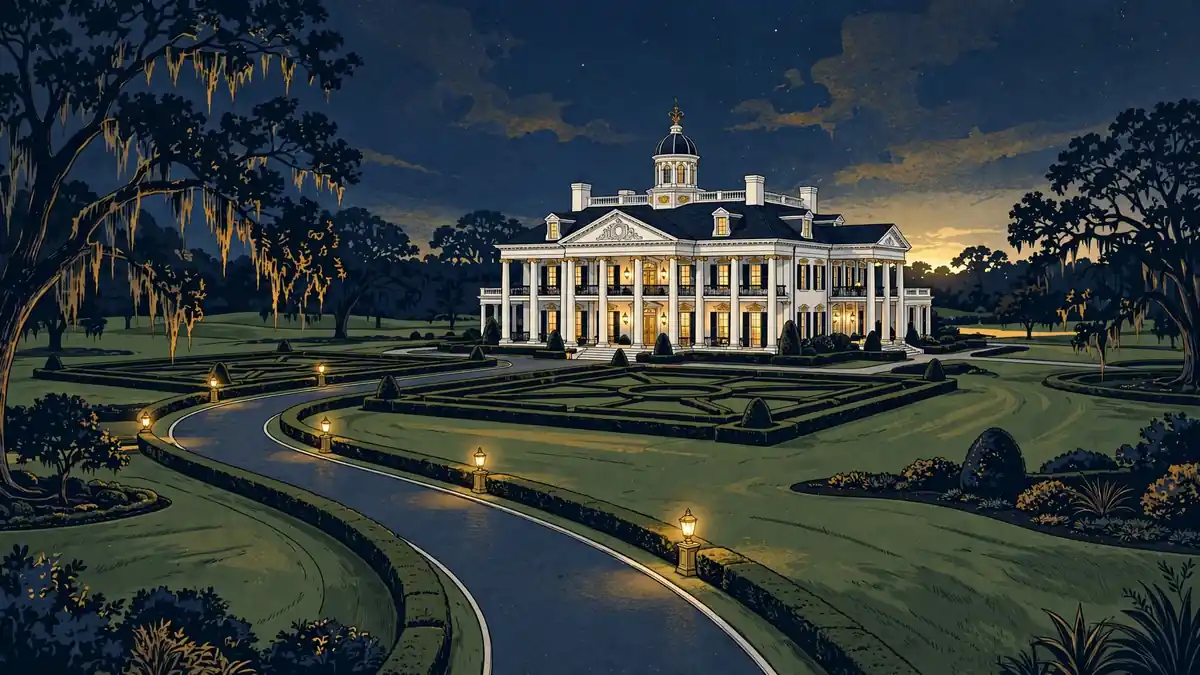
The Promise Land. In 2014 Ross paid a reported $5.8 million for the Fayetteville, Georgia estate of former heavyweight champion Evander Holyfield — a 54,000-square-foot, 109-room mansion originally known as Villa Vittoriosa, built by Holyfield in the 1990s for more than $20 million and later lost to foreclosure. Ross renamed it the Promise Land and made it his headquarters: 235 acres at purchase, expanded to 322 acres when he bought an additional 87 acres for $1 million in October 2020. The estate has 12 bedrooms and 21 bathrooms, and its grounds now house buffalo, horses, and a bull named Thor; Ross has said he applied for a zoo license with ambitions of adding elephants and giraffes. Film fans know the mansion as the Zamunda palace from Eddie Murphy’s Coming 2 America, which shot on the property. It is widely described as the largest single-family residence in Georgia.
Star Island. In 2023 Ross paid roughly $37 million in cash for a waterfront mansion on Miami’s Star Island — $37.5 million according to The Real Deal — planting his flag on one of America’s most exclusive addresses, where neighbors have included Gloria and Emilio Estefan. The nearly 15,000-square-foot home has six bedrooms, a private dock on Biscayne Bay, and interiors Ross has been renovating since purchase. A May 2026 Architectural Digest “Open Door” tour showed the results: 35 tons of marble, a koi-pond waterfall, a gym built around a Louis Vuitton punching bag, a Zen garden, and a pool with a mosaic art installation. Ross told AD the mansion was a full-circle moment after losing his childhood home to fire in Carol City.
Other properties. Also in 2023, Ross bought Meek Mill’s former Atlanta estate in Buckhead for $4.2 million in cash — an eight-bedroom property with a movie theater, tennis court, pool, and sauna, acquired from his own former MMG signee. Earlier holdings included a Fort Lauderdale waterfront mansion purchased in 2012. Celebrity Net Worth’s dashboard puts his luxury real estate footprint in the tens of millions, with the Star Island and Promise Land properties as the crown jewels.
The car collection. Ross owns one of hip-hop’s most famous garages — estimates range from over 100 to more than 200 vehicles. The irony that defined it for years: he did not hold a driver’s license until age 45, finally passing his test in 2021, as reported by PEOPLE. The collection spans a Maybach 57S, Ferrari 458, multiple custom 1955–1957 Chevrolet Bel Airs, Rolls-Royce Wraiths and Phantoms, Lamborghinis, modern McLarens, a camouflage Humvee, an M577 armored personnel carrier, and a fleet of John Deere tractors used to work the Promise Land acreage. Since 2022 he has hosted the annual Rick Ross Car & Bike Show on the estate grounds — the inaugural 2022 edition drew more than 6,000 attendees, per HotNewHipHop, and the fifth annual show took place in June 2026. Celebrity Net Worth credits the event with generating millions per year.
Private jet. Ross flies a Gulfstream G550 dubbed “Maybach Air,” valued at approximately $19.5 million according to Celebrity Net Worth’s asset breakdown.
Awards and Achievements
Ross’s trophy case is defined by a famous gap: nine Grammy nominations, zero wins. The nominations span his whole career — “I’m on One” with DJ Khaled, Drake, and Lil Wayne for Best Rap/Sung Collaboration in 2012; God Forgives, I Don’t for Best Rap Album in 2013; two nods for “New Flame” in 2015; “Purple Lamborghini” with Skrillex for Best Song Written for Visual Media in 2017; “Gold Roses” with Drake for Best Rap Song in 2020; and three nominations for “God Did” in 2023, including Song of the Year. He has fared better elsewhere: four BET Awards, MTV’s Hottest MC in the Game (2011), and The Source‘s Man of the Year in both 2010 and 2011. Six number-one albums on the Billboard 200 and a triple-platinum single in “Aston Martin Music” round out a commercial record that needs no Grammy to validate it.
Net Worth Growth Over the Years
The trajectory below is compiled from published estimates across the years — third-party figures, not audited statements — and shows how the fortune compounded as Ross shifted from music income to ownership:
| Year | Estimated Net Worth | Key Milestone |
|---|---|---|
| 2006 | ~$2 million | Port of Miami debuts at No. 1; first major touring income |
| 2009 | ~$10 million | Maybach Music Group founded; three No. 1 albums banked |
| 2012 | ~$40 million | God Forgives, I Don’t era; Wingstop portfolio expanding |
| 2015 | ~$80 million | Wingstop and Checkers franchises generating significant revenue |
| 2020 | ~$120 million | Promise Land expansion; luxury assets compounding |
| 2023 | ~$135 million | $37M Star Island purchase; Meek Mill estate acquisition |
| 2026 | $150M–$180M | Set in Stone released; EnSima development deal; diversified portfolio |
The jump from the mid-2010s onward tracks the equity story: franchises bought in the 2010s appreciated with the brands, the spirits stakes compounded, and the real estate — bought at foreclosure and pre-boom prices — appreciated while generating content and event income. That is why outlets that once listed him near $40–50 million now cluster at $150 million, with Celebrity Net Worth’s $180 million marking the high end.
Social Media Presence
Ross is among hip-hop’s most-followed figures, with tens of millions of followers across Instagram, X, and YouTube, and his feeds function as a second business channel. The Promise Land is a constant backdrop — car unveilings, Wingstop promotions, and estate life all play out on camera, turning the property into a media asset. He used Instagram to announce the Wingstop franchise gift to his son in 2021 and to document passing his driver’s test at 45 the same year. In 2026 his media footprint widened further: the Architectural Digest Star Island tour in May, a CNN interview naming Burna Boy, Fela Kuti, and Bob Marley as dream collaborators, and the PBD Podcast appearance that reignited the Freeway Rick Ross name debate. His social accounts double as a direct line to fans and a billboard for every venture he owns a piece of.
Personal Life
Ross has never married. He has four children widely documented in public reporting — daughter Toie Roberts and sons William Roberts III, Berkeley Hermes Roberts, and Billion Leonard Roberts — though some outlets list a fifth. Family is woven into the business: his mother and sister co-own the Wingstop franchises, and his son’s 16th-birthday franchise gift made headlines as a deliberate act of generational wealth transfer.
Health scares have punctuated the biography. He suffered seizures in 2011 and was hospitalized in 2018 after being found unresponsive at his Florida home, episodes he has discussed as wake-up calls about lifestyle and workload. A 2015 arrest in Georgia on assault and kidnapping charges was widely reported at the time.
More recently, The Real Deal reported on October 2, 2026 that Ross turned himself in after his ex-girlfriend accused him of attacking her on August 28 at his Star Island home. He faces charges of felony battery by strangulation and misdemeanor battery, was released on $5,000 bail, entered a not-guilty plea through his attorney, and is scheduled for arraignment on October 22, 2026. The same reporting noted that his position in the EnSima condo development remains unchanged. The case was in its early stages at the time of this article’s last review, and its outcome — and any financial impact — remains unknown.
Sources & Reporting
Our estimate and how we built it: The $150M–$180M range reflects Celebrity Net Worth‘s $180 million listing (plus its $90M+ career music earnings tally, Gulfstream jet valuation, and property breakdowns) against the ~$150 million consensus at outlets like BounceMojo (June 2026), WigWag Africa (April 2026), and JustWebWorld (September 2026). None of these figures is audited; Ross has never confirmed a number.
Real estate: The Star Island $37–37.5M purchase and renovation details come from The Real Deal and Architectural Digest‘s May 2026 home tour; the Promise Land’s $5.8M purchase price, Holyfield history, and acreage expansion are documented across real estate press; the $4.2M Meek Mill Buckhead purchase was reported in 2023 coverage.
Business: Wingstop franchise counts and the Boss Wings Enterprises structure via Bisnow (August 2026) and REVOLT (September 2021, son’s franchise gift); the 2022 Department of Labor $114,427 fine via XXL; the Complex (2021) interview for the Charlie Morrison origin story; spirits equity (Luc Belaire, Bumbu, McQueen and the Violet Fog) via Celebrity Net Worth, Bisnow, and AllHipHop (2026); the EnSima 670-unit development via Bisnow and The Real Deal (2026).
Music career: Chart positions and sales figures (187,000 first-week Port of Miami, 218,000 first-week God Forgives, I Don’t) via Billboard reporting; Grammy nomination history via the Recording Academy records as tabulated on Wikipedia; the Set in Stone July 2026 release and G-Unit catalog offer via 2026 entertainment press; the 20th-anniversary orchestral tour via Hypebeast (March 2026); the Freeway Rick Ross lawsuit ruling via The Hollywood Reporter and Consequence (December 2013–January 2014).
Legal and personal: The October 2026 arrest coverage via The Real Deal and The New York Times; the driver’s-license-at-45 story via PEOPLE (2021); the inaugural 2022 car show via HotNewHipHop; the CNN dream-collaboration interview via CNN (2026); the PBD Podcast name debate via Baller Alert (2026).
Reporting window: Primary research conducted October 2026, drawing on reporting from 2006–2026. Figures are estimates and will be corrected as new evidence emerges.
Frequently Asked Questions
What is Rick Ross’s net worth in 2026?
Rick Ross’s net worth is estimated at $150 million to $180 million as of October 2026. Most outlets land near $150 million, while Celebrity Net Worth lists $180 million. The figure is a third-party estimate — Ross has never confirmed his wealth publicly — and reflects music earnings, nearly 30 Wingstop franchises, spirits brand equity, and a large real estate portfolio.
How did Rick Ross make his money?
Music built the foundation — more than $90 million in career earnings from 12 studio albums, touring, and royalties, per Celebrity Net Worth. But the fortune grew through ownership: Wingstop and Checkers franchises (Boss Wings Enterprises), equity in Luc Belaire sparkling wine and Bumbu rum, his Maybach Music Group label, bestselling books, and real estate including the $37 million Star Island mansion and the 322-acre Promise Land estate.
Is Rick Ross a billionaire?
No. Despite the “Billionaire” album titles and Boss persona, published estimates put Rick Ross’s net worth at $150–180 million — wealthy, but well short of billionaire status. Among rappers, only Jay-Z has crossed the billion-dollar threshold on Forbes’ list.
How many Wingstop locations does Rick Ross own?
Rick Ross owns at least 25 Wingstop franchises, with some reports putting the count near 30, concentrated in the Southeast (Florida, Georgia, Mississippi, Alabama). He bought his first in 2011 and holds them through Boss Wings Enterprises with his mother and sister. In 2021 he gifted his 16-year-old son his own Wingstop franchise for his birthday.
What is Rick Ross’s real name, and was he really a correctional officer?
His real name is William Leonard Roberts II, born January 28, 1976, in Clarksdale, Mississippi. Yes — he worked as a correctional officer at the South Florida Reception Center in Doral, Florida, for 18 months, from December 1995 to June 1997, before his rap career took off. His stage name was borrowed from “Freeway” Rick Ross, the 1980s Los Angeles trafficker, who sued him for $10 million in 2010; the case was dismissed in 2013 on First Amendment grounds.
How old is Rick Ross and how tall is he?
Rick Ross is 50 years old in 2026 (born January 28, 1976) and stands 5’11” (180 cm). He famously did not get his driver’s license until age 45 in 2021 — despite owning one of hip-hop’s largest car collections.
Who is richer: Rick Ross or 50 Cent?
Rick Ross. Ross is estimated at $150–180 million, while 50 Cent’s net worth is generally estimated around $40–60 million in recent years (down from his Vitamin Water-era peak). In a twist, Ross publicly offered $2 million in April 2026 to buy 50 Cent’s G-Unit catalog.
What businesses does Rick Ross own?
Ross owns nearly 30 Wingstop franchises and Checkers locations through Boss Wings Enterprises; holds equity in Luc Belaire sparkling wine and partnerships with Bumbu rum and McQueen and the Violet Fog gin; runs Maybach Music Group (which signed Meek Mill, Wale, and French Montana); and joined the EnSima 670-unit condo development in Miami Gardens in 2026. His real estate includes the Promise Land estate and a $37 million Star Island mansion.
Final Thoughts
Rick Ross’s $150–180 million fortune is a case study in what happens when a rapper stops renting his lifestyle and starts owning it. The music — twelve albums, six Billboard 200 number ones, nine Grammy nominations — generated the seed capital, more than $90 million of it by Celebrity Net Worth’s count. Everything after 2011 was conversion: chicken wings into cash flow, champagne into equity, a foreclosed boxer’s mansion into a 322-acre content studio that hosts a car show generating millions a year.
That is also why the range matters more than the number. Nobody outside Ross’s accountant knows the real figure, and the outlets that publish one admit it. What the public record does show, consistently, is the shape: a diversified, ownership-heavy portfolio that keeps appreciating whether or not he records another verse. The 2026 headlines — a 12th album, an orchestral anniversary tour, a condo development, a catalog bid, and an arrest still working through the courts — all point the same direction. At 50, the Biggest Boss is not coasting on the catalog. He is still buying.
Published on 2026-10-14. Last reviewed October 2026. Found an error? See our corrections policy.