
Devin Hester‘s net worth is estimated at $8 million to $12 million as of October 2026, with most reporting landing near $10 million. The man everyone calls the greatest return specialist in NFL history banked roughly $29.3 million in NFL salary over 11 seasons, headlined by a 2008 Chicago Bears extension announced at more than $40 million that paid him far less in practice. Add the first-ever Hall of Fame enshrinement for a primary return specialist in 2024, and you get a fortune built on special teams — a position that almost never produces eight-figure wealth.
Devin Hester: Quick Facts
| Estimated net worth | $10 million (range: $8 million–$12 million) |
|---|---|
| Profession | Former NFL wide receiver / return specialist |
| Nationality | American |
| Born | November 4, 1982 (age 43) |
| Height | 5 ft 11 in |
| Primary income sources | NFL salaries ($29.3M career cash), endorsements (Under Armour), appearances, NFL pension |
| Active years | 2006–2016 (retired 2017) |
| Last reviewed | October 2026 |
- Early Life and Background
- Education
- Career Journey
- Rise to Fame
- Main Sources of Income
- Salary and Earnings
- Businesses and Investments
- Brand Deals and Sponsorships
- Houses, Cars and Other Assets
- Awards and Achievements
- Net Worth Growth Over the Years
- How Hester Compares to Other Return Legends
- Social Media Presence
- Personal Life
- Sources & Reporting
- Frequently Asked Questions
Early Life and Background
Devin Devorris Hester Sr. was born on November 4, 1982, in Riviera Beach, Florida, to Lenorris Hester Sr. and Juanita Brown. His childhood was marked by loss: his parents divorced when he was a toddler, his mother was badly hurt in a car crash, and his father died when Devin was still young. His stepfather, Derrick Brown, and his older brother Lenorris Jr. helped pull him through that stretch, and football became the outlet that carried him forward.
Hester grew up playing every skill position available — running back, cornerback, wide receiver — and returning kicks, because nobody on the other side of the field could catch him. That versatility would define his entire career: he was the rare player good enough to matter on offense, defense, and special teams at every level he played.
Education
Hester attended Suncoast High School in Riviera Beach before enrolling at the University of Miami, where he played for the Hurricanes from 2003 to 2005. Miami in that era was a factory for NFL defensive backs, and Hester became the first Hurricane in recent program history to line up on offense, defense, and special teams. He finished college with six return touchdowns, two offensive scores, and five interceptions as a defensive back — and a nickname, “Anytime,” a nod to his friend and idol Deion “Prime Time” Sanders. That nickname would follow him into Canton.
His first college touch set the tone: a 97-yard kickoff return touchdown on the opening kick of his freshman game against rival Florida in September 2003. Chicago Bears scouts filed that moment away. Three years later they drafted him 57th overall in the second round of the 2006 NFL Draft — as a cornerback, of all things. The Bears had no idea they’d just drafted the man who would redefine a position.
Career Journey
Hester’s 11-season NFL run (2006–2016) split across four teams. He spent his prime with the Chicago Bears (2006–2013), where he made all four Pro Bowls and built the highlight reel that got him into Canton. After the Bears let him walk in free agency, he signed with the Atlanta Falcons (2014–2015), where he broke Deion Sanders’ return-touchdown record. Short stints with the Baltimore Ravens and Seattle Seahawks in 2016 closed out his playing days, and he announced his retirement in December 2017 — eleven seasons, four teams, and a position permanently redefined.
The arc of the career tells you everything about return-specialist economics. Hester was the most electrifying player of his generation and never earned quarterback money — not close. His fortune comes from an unusually long run (eleven seasons is a lifetime for a return man), one enormous extension, and the compounding effect of a signing bonus that arrived when he was 24.
Rise to Fame
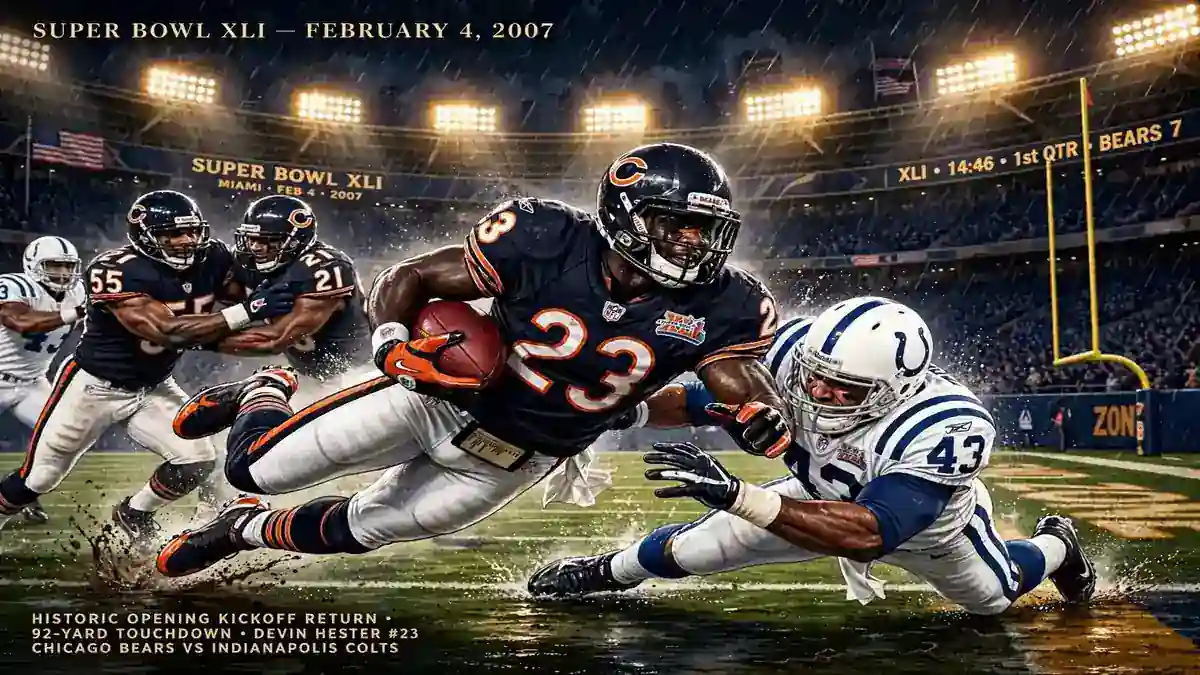
His rookie season in 2006 remains the most outrageous debut by a return man the league has ever seen. He scored six return touchdowns in one season, an NFL record, including a 108-yard return of a missed field goal against the New York Giants — the second-longest play in league history at the time. He was voted to the Pro Bowl as a rookie, then did something no player in league history had done: he returned the opening kickoff of Super Bowl XLI 92 yards for a touchdown against the Indianapolis Colts, the earliest lead ever recorded in a Super Bowl. The Colts spent the rest of that rain-soaked night in Miami kicking deliberately away from him; the Bears lost 29–17, but the play is immortal.
The 2007 season was somehow better statistically: six more return touchdowns — four on punts, two on kickoffs — while chipping in 20 receptions for 299 yards as a receiver. Opposing coaches started doing things they’d never done: kicking away from him entirely, punting out of bounds, squibbing kicks. The Bears’ special-teams weapon had become a strategic problem for the other 31 teams, and Hester made his second straight Pro Bowl.
Then came the contract fight. Before the 2008 season, Hester held out of training camp and told the Chicago Tribune, “I can’t go out and play this year making $445,000. Come on, man.” League insider Adam Schefter reported the Bears were genuinely puzzled about how to classify him — he was too good at returns to pay like a specialist and too raw as a receiver to pay like a star wideout. The team fined him $30,000 for two missed camp days, then gave him a four-year extension reported as worth more than $40 million. The team simultaneously started converting him into a full-time wide receiver — he caught 51 passes for a team-high 665 yards in 2008 — at the cost of his return production, which went quiet for the first time. His 6.2-yard punt-return average that year told the story: they had turned a weapon into a project.
He found the end zone again on returns in 2009 and 2010, made his third Pro Bowl in 2010, and remained Chicago’s most feared weapon through 2013, leading the league in kickoff return yards in 2013. The league itself adjusted to players like him in 2011, moving kickoffs up to the 35-yard line — officially a safety measure, but one that reduced return opportunities across the league and, analysts widely noted, clipped the wings of the game’s most dangerous return men. Hester adapted anyway: in 2013 and again in 2014, he led the NFL in kickoff return yards. The signature record fell on September 18, 2014, wearing a Falcons uniform: a 62-yard punt return touchdown against the Tampa Bay Buccaneers, his 20th career return score, breaking Deion Sanders’ mark of 19. He finished his career with 14 punt return touchdowns — still the NFL record — five kickoff return scores, and one missed-field-goal return: 20 total, more than any player in history.
Main Sources of Income
Hester’s money story is simpler than most athletes on this site: NFL salary is the fortune. About 95% of his lifetime earnings arrived via game checks, signing bonuses, and restructures. His documented endorsement income is modest — an Under Armour deal signed in 2008, with terms never disclosed — because return specialists, even legendary ones, don’t command the shoe-company bidding wars that quarterbacks and star receivers get.
Post-retirement income comes from the standard retired-player mix: autograph and memorabilia shows, corporate and speaking appearances, broadcasting spots, and a vested NFL pension (eleven credited seasons qualifies him for the league’s standard retirement benefit). He also runs the Devin Hester Foundation, his 2013-founded nonprofit for kids ages 6–18 — charitable work, not a revenue stream. There are no documented restaurant chains, clothing lines, or venture portfolios attached to his name; his wealth is the preserved residue of a long, well-paid playing career.
Salary and Earnings
This is where the record needs correcting, because much of the internet repeats the “$40 million contract” headline without the fine print. Here is what the money actually looked like, per Spotrac, which tracks $29,266,961 in career cash earnings across eleven seasons:
- Rookie deal (2006–2009): four years, $6.63 million, with a $5 million signing bonus. The bonus made 2006 his second-biggest cash year ($5.275 million) despite a $275,000 base salary.
- The 2008 extension (2010–2013): announced as four years and “over $40 million,” this is the deal that created the legend of Hester as a mega-earner. Spotrac’s books show the actual terms as four years, $21,956,025 — roughly half the headline number, with $5 million in guarantees. The 2010 season alone paid $8,499,999 in cash (signing bonus proration plus a $5 million restructure), the richest single season of his career and, at the time, about as rich as it ever got for a return specialist.
- Atlanta Falcons (2014–2016): three years, $9 million, with $3.5 million guaranteed at signing. He collected about $7.2 million over three Falcons seasons.
- Baltimore Ravens (2016): one year, $1.1 million to close out the career.
For the full picture, here is every season’s cash take-home, per Spotrac — the kind of year-by-year accounting most net worth pages skip:
| Season | Team | Cash earned | Cumulative |
|---|---|---|---|
| 2006 | Bears | $5,275,000 | $5,275,000 |
| 2007 | Bears | $350,000 | $5,625,000 |
| 2008 | Bears | $445,000 | $6,070,000 |
| 2009 | Bears | $550,000 | $6,620,000 |
| 2010 | Bears | $8,499,999 | $15,119,999 |
| 2011 | Bears | $1,833,500 | $16,953,499 |
| 2012 | Bears | $1,896,000 | $18,849,499 |
| 2013 | Bears | $2,107,523 | $20,957,022 |
| 2014 | Falcons | $3,500,000 | $24,457,022 |
| 2015 | Falcons | $2,876,605 | $27,333,627 |
| 2016 | Ravens / Seahawks | $1,933,334 | $29,266,961 |
Two things jump out. First, the $8.5 million season in 2010 — driven by a $2.5 million signing-bonus proration and a $5 million restructure — is the single richest cash year any pure return specialist had collected to that point, and it arrived two years after the extension was signed. Second, the 2007–2009 stretch shows how cheaply the Bears got his prime: $1.35 million total over three seasons, the years he set the return-touchdown records. That underpayment is exactly what triggered the 2008 holdout.
Over The Cap lists slightly higher career earnings — $32,352,023, split $24,877,023 from the Bears, $6,375,000 from the Falcons, and $1,100,000 from the Ravens — because it accounts cap charges differently than Spotrac’s cash accounting. Both sources agree on the order of magnitude: Hester earned roughly thirty million dollars playing football, gross, before taxes and the standard 3% agent cut.
Context matters here. Hester’s career earnings rank him well outside the NFL’s top 500 all-time earners. His 2006 draft classmates include Reggie Bush and Vince Young, quarterbacks who dwarfed his pay. He was never the highest-paid player on his own team — just the most dangerous one for six seconds at a time.
One more correction, because it matters for the estimate: several aggregator pages still list Hester’s net worth at $3 million. The salary table above shows why that figure can’t be right. By the end of the 2010 season he had collected $15.1 million in cash; by retirement, $29.3 million. Even assuming half of it went to taxes and fees and generous spending along the way, the floor sits far above $3 million — which is roughly what he earned in a single good season. The $3 million figure looks like a number copied from a decade-old page and never updated. Our range starts at $8 million because the documented money won’t support anything lower.
Businesses and Investments
There is no public record of Hester running significant businesses, and this is one of the cleanest gaps between him and the modern athlete-investor archetype. No documented stakes in startups, franchises, or real estate ventures appear in business-press coverage of him. What he did build is a nonprofit: the Devin Hester Foundation, founded in 2013 as the Anytime 23 Empowerment Center Inc., which serves children ages 6–18 with mentoring, education support, and a safe environment. The foundation grew out of Hester’s own story — a kid who lost his father young and credits football with pulling him out of a dark period. It runs on donations, not revenue, which is why it doesn’t appear on the income side of his ledger.
Fan-run finance pages credit him with a co-owned Atlanta fitness center and multiple properties, but those claims trace to thin content farms with no sourcing (one page lists his “total assets” at $20 million while pegging his net worth at $3 million on the same screen — the numbers don’t survive contact with each other). We treat those as unverified. The honest version: Hester appears to be a saver rather than an empire-builder, which, given how many NFL fortunes evaporate, may be the smartest business decision of all.
Brand Deals and Sponsorships
The one documented endorsement of Hester’s career is Under Armour, which signed him in 2008 — the same summer as the $40 million extension, when his marketability peaked. Terms were never disclosed, and Pro Football & Sports Network’s net worth reporting notes the deal only as a contributor to his overall figure. That’s it for the confirmed record: no national car commercials, no signature shoe, no long-running campaign.
This isn’t an accident or a snub. Return specialists — even the greatest one — don’t sell sneakers the way franchise quarterbacks do. Endorsement money for Hester was real but supplementary: likely in the low six figures per year at its peak, a rounding error against $29 million in salary. Modern content-farm pages sometimes pad this section with Nike, Gatorade, and EA Sports; none of those appear in credible reporting tied to Hester, so they don’t appear here either.

Houses, Cars and Other Assets
Hester has kept his property footprint private, and no verified property records are attached to his name in public reporting. Reporting from 2026 places the family in Windermere, Florida, near Orlando, where he and his wife raise their three sons. Less-sourced fan pages claim an Atlanta-area residence valued around $1.5 million and a Miami vacation home, plus luxury cars including a Rolls-Royce Wraith and a Lamborghini Aventador — claims we could not verify and include only to note their existence, not as fact.
The asset picture that matters is financial, not automotive: eleven years of NFL income, a vested pension, and no public record of bankruptcies, lawsuits, or fire sales. For a player who entered the league in 2006, still owning what he earned is itself the achievement.
Awards and Achievements
- Pro Football Hall of Fame, Class of 2024 — the first primary return specialist ever enshrined, after three straight years as a finalist (2022–2024). Announced at NFL Honors on February 8, 2024; enshrined in Canton on August 3, 2024, alongside fellow Bears Julius Peppers and Steve McMichael.
- NFL record: 20 career return touchdowns — 14 punt returns (NFL record), 5 kickoff returns, 1 missed field goal return.
- Only player to return the opening kickoff of a Super Bowl for a touchdown (Super Bowl XLI, 92 yards).
- 4× Pro Bowl (2006, 2007, 2010, 2013); 3× First-team All-Pro.
- NFL All-Decade Teams for both the 2000s and 2010s; NFL 100th Anniversary All-Time Team.
- NFL single-season record: 6 return touchdowns (2006).
- Two-time NFL punt return yards leader (2006, 2010); two-time NFL kickoff return yards leader (2013, 2014).
- NFL 2000s All-Decade and 2010s All-Decade return specialist — the only player to hold both designations at the position.
The Canton wait took three years: Hester was a finalist in 2022 and 2023 before the 2024 class announcement finally came at NFL Honors in Las Vegas on February 8, 2024. He was enshrined on August 3, 2024, in a ceremony thick with Bears history — fellow inductees Julius Peppers and Steve McMichael went in alongside him. His speech leaned personal rather than statistical: “I felt like football chose me,” he told the crowd, tracing the line from a fatherless kid in Riviera Beach to a bronze bust. It was the first time the Hall had ever made room for a man whose primary job was returning kicks, and it closed the book on any debate about where Hester ranks.
Net Worth Growth Over the Years
Hester never had a single liquidity event — no startup exit, no nine-figure deal. His wealth accumulated the old-fashioned way: one game check at a time, with the curve shaped by his contract timeline. All figures below are NetWorthCraft estimates unless sourced.
| Year | Milestone | Estimated net worth |
|---|---|---|
| 2010 | Peak cash season ($8.5M); career earnings pass $15M | $5–7 million |
| 2014 | Breaks Deion Sanders’ return-TD record; signs with Falcons | $7–9 million |
| 2017 | Retires with ~$29.3M in career cash earnings | $8–10 million |
| 2020 | Settled into retirement; appearances and pension income | $8–10 million |
| 2024 | Hall of Fame induction renews marketability | $9–11 million |
| 2026 | Current estimate | $8–12 million |
The flat curve after 2014 is the honest shape of a career that ended a decade ago with no documented business empire. The Hall of Fame class of 2024 added prestige and appearance fees, not a fortune — Canton pays in bronze, not cash.
How Hester Compares to Other Return Legends
Return specialists rarely get rich — which is exactly why Hester’s eight-figure fortune stands out at the position. Here’s how the record-holders stack up by the numbers that defined them:
| Player | Career return TDs | Era | Career NFL earnings (est.) |
|---|---|---|---|
| Devin Hester | 20 | 2006–2016 | ~$29.3M (Spotrac cash) |
| Deion Sanders | 19 | 1989–2005 | ~$60M+ (two-sport star, CB/WR pay) |
| Brian Mitchell | 13 | 1990–2003 | ~$20M (pre-salary-cap-boom era) |
| Dante Hall | 12 | 2000–2008 | ~$15M |
The takeaway: Hester outscored every return man who ever played and out-earned all the pure specialists, but still made less than half of what a two-way star like Deion Sanders collected — because teams pay for snaps at premium positions, not for six seconds of electricity on special teams.
Social Media Presence
Unlike the influencer-era athletes elsewhere on this site, Hester has kept a modest public profile since retiring. He maintains social media accounts used mainly for family moments, Bears nostalgia, and Hall of Fame–related appearances rather than daily content or brand promotion. His following is a fraction of active NFL stars’, which matches the economics of his career: his fame peaked in the pre-social-media era of the late 2000s, when the audience watched him on Sunday broadcasts instead of in their feeds.
Personal Life
Hester married Zingha Hester (née Walcott), an elementary school teacher, in 2010. They have three sons: Devin Jr., Drayton, and Denali. The family lives in Florida, and Hester has stayed close to the game through youth football work connected to his foundation. His Hall of Fame speech in August 2024 was notably personal — “I felt like football chose me,” he told the Canton crowd — a reflection on a path that ran from a difficult childhood in Riviera Beach to a bronze bust.
Sources & Reporting
- Spotrac — career cash earnings ($29,266,961), year-by-year salary table, and contract terms (rookie deal 4 yr/$6.63M; 2010–2013 extension 4 yr/$21,956,025; Falcons 3 yr/$9M; Ravens 1 yr/$1.1M); the primary earnings record used in this article. Reporting window: career 2006–2016, data current through 2026.
- Over The Cap — alternate career earnings total ($32,352,023), with team-by-team splits (Bears $24,877,023; Falcons $6,375,000; Ravens $1,100,000). Used to cross-check Spotrac; the difference is cash vs. cap accounting. Current through 2026.
- Pro Football & Sports Network — $10 million net worth estimate; Under Armour 2008 endorsement deal; Devin Hester Foundation (founded 2013, originally Anytime 23 Empowerment Center). Published 2024.
- CollegeNetWorth — $10 million net worth estimate; notes Hester’s three-team career and ~$29.3M earnings per Spotrac. Published 2025.
- Wikipedia — career biography: 2008 extension reported as four years “over $40 million” after the $445,000 holdout and $30,000 camp fine; draft position (57th overall, 2006); records and awards. Page current as of 2026.
- ND Insider — Hall of Fame class of 2024 announcement: Hester revealed at NFL Honors on February 8, 2024, as the first primary return specialist selected; enshrinement August 5, 2024 (ceremony held August 3). Published February 2024.
- NBC Sports — Hall of Fame context: Hester among the handful of special-teamers in Canton; class of 2024 members. Published February 2024.
- Athlon Sports — 20 return touchdowns and 11,000+ return yards; ESPN’s 25-year NFL team honor. Published 2025.
- NetWorthPost — $3 million estimate (stale); career background detail. Used as the low-end outlier and treated as outdated.
- CineNetWorth — $25 million estimate (high-end outlier); unverified asset claims ($1.5M Atlanta home, Miami vacation home, luxury cars) cited only as unverified. Treated as inflated.
Reporting window: earnings data current through the 2016 season (career complete); net worth estimates from 2024–2026 publications; biographical facts verified against Hall of Fame and league records as of October 2026.
Frequently Asked Questions
What is Devin Hester’s net worth in 2026?
Devin Hester’s net worth is estimated at $8 million to $12 million as of October 2026, with most credible reporting landing near $10 million. Pro Football & Sports Network and CollegeNetWorth both estimate $10 million; a 2026 ScoopMeadow profile puts it at $12 million. Lower figures ($3 million) come from stale aggregator pages, and the $25 million claim from CineNetWorth is not supported by his documented earnings.
How much money did Devin Hester make in the NFL?
Spotrac tracks $29,266,961 in career cash earnings over eleven seasons (2006–2016); Over The Cap lists $32,352,023 using cap accounting. His richest single season was 2010, when he collected $8,499,999 in cash from the Bears. After taxes, agent fees, and eleven years of living expenses, roughly a third of gross earnings remaining is typical — which is why the $10 million net worth estimate sits well below the $29 million headline.
Was Devin Hester’s contract really worth $40 million?
That was the reported value of his 2008 Chicago Bears extension — announced as four years and ‘over $40 million’ after his training-camp holdout. But Spotrac’s contract records show the actual deal paid $21,956,025 over 2010–2013, with about $5 million guaranteed. The headline number was real in the press release; the cash collected was roughly half.
Is Devin Hester in the Pro Football Hall of Fame?
Yes. Hester was elected to the Pro Football Hall of Fame as part of the Class of 2024, announced at NFL Honors on February 8, 2024, and enshrined in Canton on August 3, 2024. He is the first primary return specialist ever enshrined, and he had been a finalist three years running (2022, 2023, 2024) before getting the call.
How many return touchdowns did Devin Hester score?
Twenty — the most in NFL history. That breaks down to 14 punt return touchdowns (also an NFL record), five kickoff return touchdowns, and one missed-field-goal return. His 20th, a 62-yard punt return for the Falcons against Tampa Bay on September 18, 2014, broke Deion Sanders’ record of 19.
What teams did Devin Hester play for?
Hester played 11 NFL seasons for four teams: the Chicago Bears (2006–2013), where he made all four of his Pro Bowls; the Atlanta Falcons (2014–2015); the Baltimore Ravens (2016); and the Seattle Seahawks (2016). He was drafted 57th overall by Chicago in 2006 and announced his retirement in December 2017.
Who is Devin Hester’s wife?
Hester married Zingha Hester (née Walcott), an elementary school teacher, in 2010. The couple has three sons — Devin Jr., Drayton, and Denali — and the family lives in Florida.
What does Devin Hester do now?
Since retiring in 2017, Hester has kept a relatively low profile. He runs the Devin Hester Foundation (founded in 2013 for youth ages 6–18), makes autograph and corporate appearances, does occasional broadcasting spots, and draws a vested NFL pension from his eleven seasons. The 2024 Hall of Fame induction renewed his public visibility but added prestige more than income.
Final Thoughts
Devin Hester’s $8–12 million fortune is the best-paid version of a career archetype that almost never pays: the pure return specialist. He earned roughly $29.3 million in NFL cash — a lot of money and, by quarterback standards, almost nothing — and kept the bulk of it the boring way, without a documented business empire or a signature shoe deal. The “$40 million contract” the internet repeats was really a $22 million deal with a big headline, and the $25 million net worth some pages claim doesn’t survive contact with his actual paychecks.
What Canton certified in 2024 is the part money can’t quite measure: for about a decade, no player in football was more dangerous with the ball in his hands and eleven men chasing him. The gold jacket doesn’t pay a salary. But for the greatest return man who ever lived, $10 million in the bank and a bronze bust in Ohio is a fair accounting.
Published on October 18, 2026. Last reviewed October 2026. Found an error? See our corrections policy.