
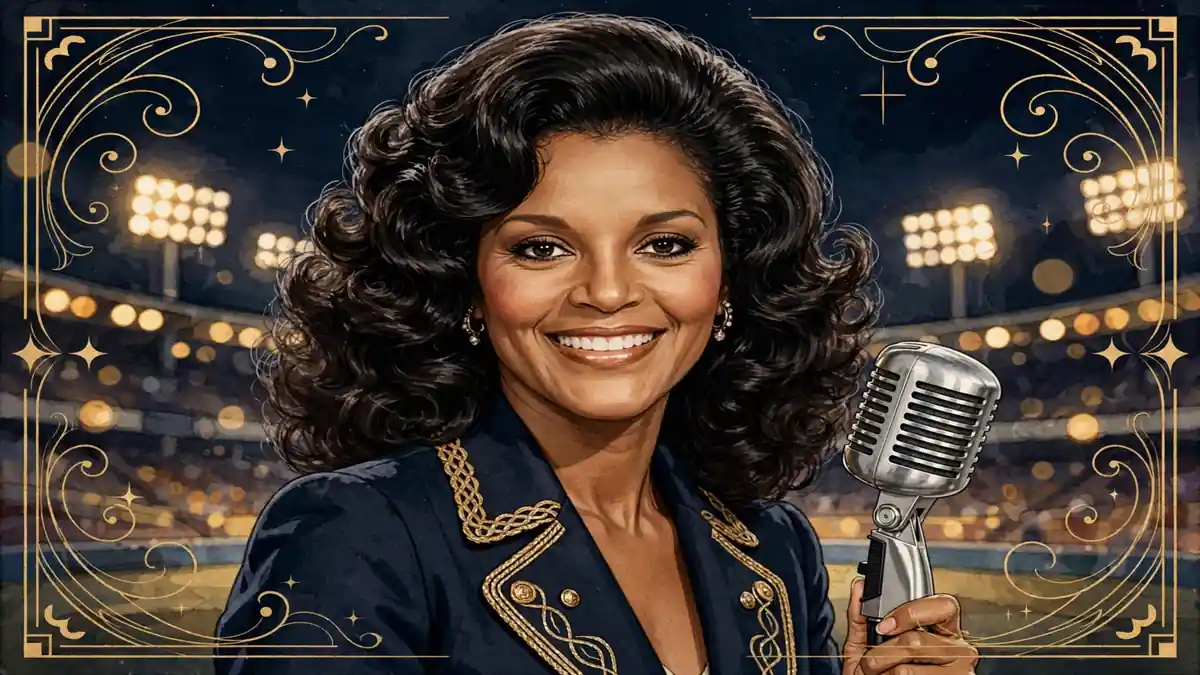
Jayne Kennedy‘s net worth is estimated at $2 million to $2.5 million as of October 2026. The pioneering The NFL Today broadcaster turned her 1978 CBS breakthrough into a five-decade income stream: a bestselling Love Your Body fitness empire, six years as the face of Coca-Cola’s Tab and Diet Coke, a fine-jewelry and fragrance business she still runs, and a 2025 memoir, Plain Jayne, released on Disney’s Andscape imprint that reintroduced her to a new generation and a fresh round of royalties, speaking fees and award honors.
Jayne Kennedy: Quick Facts
| Estimated net worth | $2 million (range: $2 million to $2.5 million) |
|---|---|
| Profession | Television personality, sportscaster, actress, producer, author |
| Nationality | American |
| Born | October 27, 1951 (age 74) |
| Height | 5’10” (1.78 m) |
| Primary income sources | Sports broadcasting, acting, fitness video sales, corporate endorsements, memoir royalties |
| Active years | 1970–present |
| Last reviewed | October 2026 |
- Early Life and Background
- Education
- Career Journey
- Rise to Fame
- Main Sources of Income
- Salary and Earnings
- Businesses and Investments
- Brand Deals and Sponsorships
- Houses, Cars and Other Assets
- Awards and Achievements
- Net Worth Growth Over the Years
- Social Media Presence
- Personal Life
- Sources & Reporting
- Frequently Asked Questions
Early Life and Background
Jayne Gill Harrison was born on October 27, 1951, in Washington, D.C., the daughter of Herbert Harrison, a factory machinist, and Virginia Harrison. She was one of six children in a close-knit family that she credits for everything that followed. The Harrisons moved to Wickliffe, Ohio, a suburb of Cleveland, where Jayne grew up cheering for the Cleveland Browns with what her memoir describes as “brown paper on every door.” Her parents drilled four rules into their children: aim high, give God most of the credit, suffer disappointments silently, and avoid maliciousness — a code Kennedy still quotes at speaking engagements, according to Wikipedia’s biographical entry and her memoir Plain Jayne.
One detail worth flagging for accuracy: Encyclopedia.com’s Contemporary Black Biography profile lists her birth date as November 27, 1951. Nearly every other biographical source, including Wikipedia and her official biography, records October 27, 1951. We go with the consensus date and note the discrepancy because a surprising number of net-worth blogs copy the November date without checking.
Wickliffe was a racially complicated hometown. When Jayne became the first Black woman to win Miss Ohio in 1970, a celebratory banner erected in her honor was taken down after objections, and her mother Virginia told the Washington Post the family received hostile phone calls from people who thought their daughter was “bragging.” That early friction taught Kennedy a lesson she would reuse for fifty years: visibility is work, and it has a cost.
Education
Kennedy attended Wickliffe High School, where her résumé read like a future broadcaster’s: cheerleading squad, National Honor Society, vice president of her sophomore class and president of her junior class — three-time class president, according to Encyclopedia.com. In 1969, at a youth rally in Washington, D.C., she became the first Black vice president of Girls State as the American Legion Auxiliary’s Girls’ Nation senator from Ohio, a title she later described as her most treasured from adolescence.
College is one of the murkier parts of her record. Most biographical sources, including Wikipedia and Encyclopedia.com, describe her public journey as beginning directly with the 1970 Miss Ohio USA crown, with no degree documented. We do not claim a college credential for her, because none of the primary sources we checked report one.
Career Journey
The year after her pageant victory, Harrison married Leon Isaac Kennedy, a DJ and struggling actor-writer, in 1971 — with Motown singer Smokey Robinson serving as best man. The couple moved to California, and Jayne’s first television work came as a dancer on Rowan & Martin’s Laugh-In. She toured with Bob Hope’s USO “Bases Around the World” Christmas tour — playing Vietnam, Thailand and Cuba — and then landed a three-year run as one of The Dean Martin Show‘s Ding-A-Ling Sisters, performing as a singer and dancer in nightclubs across the country, per Alchetron’s career chronology and Wikipedia.
Her film debut was an uncredited part in Diana Ross’s Lady Sings the Blues (1972), followed by a string of 1970s B-movies: Group Marriage (1973), Let’s Do It Again (1975), The Muthers (1976), Big Time (1977) and Death Force (1978). Television guest spots stacked up on Ironside, Sanford and Son, The Six Million Dollar Man and Starsky & Hutch. In 1977 she starred in the TV movie Cover Girls as one-half of a top-model duo moonlighting as secret agents — a premise close enough to Charlie’s Angels that she was genuinely considered for the show when Farrah Fawcett departed. Encyclopedia.com preserves one of her most revealing quotes from that era, from a Washington Post interview with Jacqueline Trescott: “I like it when someone says you are intelligent or pretty… But universal is a quality most people in Hollywood don’t want to see in blacks.”
Then came the pivot that changed her finances and her legacy. Her agent told her CBS “was not looking for a Black woman and said they were looking for a journalist,” according to the PPUGlobe’s history of women in sports media. She pushed through the interview process anyway, landed a six-week trial, and sealed the job by arranging an exclusive interview with Muhammad Ali — the one get CBS couldn’t refuse. Kennedy sat alongside Brent Musburger, Irv Cross and Jimmy “The Greek” Snyder on The NFL Today from 1978 to 1980, the first African-American woman to anchor a network sports program. CBS affiliates in the South reportedly had to sign off on her hiring, because executives worried that two Black men and one Black woman on screen would read as “too much melanin” for some markets — a detail PPUGlobe documented from her own accounts of the era.
When CBS declined to provide a clothing budget, Kennedy made history a second way: she negotiated on-air wardrobe credits for a Black-owned boutique, turning a corporate snub into an economic statement, as Celebrity Net Worth notes in its current profile. Her six-week trial became a full-season contract, and her football credibility ran deep — her friendship with Steelers quarterback Terry Bradshaw, her rapport with team owner Art Rooney (who granted her interviews when other reporters couldn’t get them), and a childhood Cowboys ice-cream outing she still tells as her favorite origin story, per the Archyde profile.
After CBS, she became the only female host in the history of the syndicated series Greatest Sports Legends, interviewing figures like Kareem Abdul-Jabbar, and the first female color commentator for men’s professional boxing. Her acting peak arrived with Body and Soul (1981), the boxing drama in which she starred opposite her husband — a performance that won her the NAACP Image Award for Outstanding Actress in a Motion Picture in 1982 and, per her official biography, a Golden Globe nomination as a producer (she co-produced the film). She also picked up a CEBA Award for commercial work and an NAACP Theatre Award as best producer for her staged musical The Journey of the African American.
Rise to Fame
Three “firsts” define why Jayne Kennedy commands an estimated $2–$2.5 million rather than fading into trivia: the first Black woman to win Miss Ohio USA (1970), the first African-American woman to anchor a network sports program (1978), and one of the first celebrity fitness-video entrepreneurs of the 1980s with Love Your Body. Each first opened a new income lane — pageant fame fed modeling, broadcast fame fed corporate endorsements, and fitness fame fed a product line decades before influencer marketing existed.
The Muhammad Ali interview remains the signature anecdote of her rise, because it demonstrates the hustle that separated her from prettier résumés. CBS wasn’t shopping for her; she brought them the biggest name in sports. Archyde’s 2025 profile records her still giving the same career advice in her seventies: “I think you have to be totally persistent. You cannot let anyone tell you no.”
What competitors consistently miss: the Smithsonian recognized that rise institutionally. In 2018 she was inducted into the National Museum of African American History and Culture’s “Pioneers in Television and the Media Landscape” exhibit, alongside Nat King Cole, Diahann Carroll, Nichelle Nichols, Diana Ross & The Supremes and Don Cornelius, in the Oprah Winfrey Wing — per the memoir’s Audible biography and Google Play listing. That institutional recognition is a 2020s development that has directly fed her speaking calendar and her memoir’s advance.
Main Sources of Income
Kennedy’s money arrives from five lanes, and their relative weight has flipped over the decades:
1. Sports broadcasting. Her CBS years (1978–1980) were the launchpad. No contract figures were ever disclosed, and any outlet publishing a specific CBS salary for her is guessing — 1970s network talent contracts were closely held, and her reported six-week trial arrangement suggests the money started modestly. The broadcasting lane mattered less for the paycheck than for the platform: it made her endorsement value.
2. Acting and television. A decade of guest spots and B-movies through the 1980s, headlined by Body and Soul. The film’s decent critical success never made her a leading-lady salary earner, but it delivered the NAACP Image Award and producer credit that still anchor her bio.
3. The fitness business. In the early 1980s she wrote, produced and starred in the Love Your Body exercise videos. Her official bio states the series hit #3 in the home-fitness market, behind only Jane Fonda and Richard Simmons — the two biggest names of the era. She also created the first “exercise in the sky” program, AAerobics, for American Airlines’ entertainment channels, and the first daily syndicated radio morning exercise show, RadioRobics. Celebrity exercise videos were a genuine gold rush in the early ’80s, and a #3 market position behind Fonda and Simmons meant real royalty checks, though no unit-sales figures have been published.
4. Corporate endorsements. This is arguably where the bulk of her career earnings came from. Her bio and Alchetron’s chronology list her as a corporate spokeswoman for Coca-Cola’s Tab and Diet Coke (six years), Revlon, Jovan, Esoterica, Fashion Fair Cosmetics, Bankers Systems and Butterick Patterns — described by her official bio as “one of the earliest Black women to represent corporate America, and in fantastic brands that are really Fortune 50.” A six-year Coca-Cola relationship alone, in the 1980s, represented substantial multi-year compensation for a national on-air spokesperson.
5. The 2025 memoir and its afterburners. Plain Jayne released September 2, 2025, on Disney’s Andscape imprint — 384 pages, $28.99 hardcover, with an audiobook narrated by Kennedy herself (16+ hours). Book advances for a memoir of this profile are modest, but the afterburners are the real story: a GreenLight Women Pioneer Award (February 2025), a Pioneering Award at the inaugural Sedalia Film Festival (February 2025), a TNT A Seat at the Table feature for Women’s History Month (March 2025), and the National Association of Black Journalists’ Pioneer Award (August 2025), all per Leading Authorities. Hollywood biopic and documentary offers were reportedly under consideration. Every honor raises her speaking fee, and her speakers’ bureau lists her as an active keynote draw.

Salary and Earnings
Here is the honest part, and it is what separates this profile from the net-worth blogs: no verifiable salary figure exists for any phase of Jayne Kennedy’s career. CBS never published her NFL Today contract. The Love Your Body video royalties were never reported in trade press. Her Coca-Cola spokesperson compensation is undisclosed. Celebrity Net Worth, which pegs her at $2 million, publishes no earnings breakdown, and neither do 21Ninety ($2.5 million) or TrafficTail ($2–$2.5 million). Any site that prints a specific annual salary for her is inventing it.
What we can say with confidence: she earned money across five consecutive decades from at least a dozen corporate brands, a syndicated fitness product that ranked third nationally, acting and broadcast salaries through the 1970s and ’80s, and — currently — memoir royalties and paid speaking engagements. That long, diversified earnings history is consistent with a low-single-digit-millions net worth, not with the $5 million figure one fringe blog floated in 2025. The $5 million claim appears on a single low-authority site (a CelebsBioFolio page whose headline is about someone else entirely), with no reporting behind it. We treat it as unreliable and exclude it from the range.
A peer comparison sharpens the number. Her broadcast predecessor Phyllis George left the NFL Today desk with a Miss America crown and a later marriage to a business magnate; Kennedy’s money, by contrast, was built entirely on air. Her 1980s fitness rivals, Jane Fonda and Richard Simmons, operated with major-studio backing and sprawling catalogs — Kennedy’s #3 ranking came as an independent producer working with a fraction of their machinery. Smaller scale, far higher ownership. That structure explains both the modest absolute figure and why she still holds earning power at 74: she owns her lane outright.
The memoir-era income is the freshest lane. Andscape (Disney) published Plain Jayne in fall 2025; memoirs by broadcast pioneers typically earn through a modest advance plus royalties, then through the speaking and appearance fees that a book tour generates. Leading Authorities’ speaker profile notes she re-emerged in 2025 with what it calls “Jayne 2.0” creative energy, including film offers. These are directional earnings, not figures — and we label them as such.
Businesses and Investments
Kennedy’s entrepreneurship is better documented than her salaries. The businesses, in chronological order:
Love Your Body Productions (early 1980s). She wrote, produced and starred in the fitness videos herself — an unusual degree of ownership for a celebrity workout product of the era, when most talent licensed their name. Self-production meant she held equity rather than a flat fee, so the #3 market position (behind Fonda and Simmons) paid her like an owner, not a hired face.
AAerobics and RadioRobics. The American Airlines in-flight exercise program and the syndicated morning radio exercise show were licensed-format businesses — her official bio calls Love Your Body the first “exercise in the sky” program. These were early examples of content syndication revenue: produce once, license across channels.
Fragrance line and fine jewelry. Archyde’s 2025 profile reports that at 73 she was “continues to create fine jewelry, launch a fragrance, and run her company, ‘Not Done Yet'” — her own venture, named for her personal mantra. Her official site sells signature fragrances directly, which keeps margins in-house rather than splitting them with a licensee. Jewelry she designs herself is a cottage business, not a scale play, but it is real ongoing income.
Not Done Yet (company). Her current umbrella venture, per both her bio and the Archyde profile. Details are thin — no incorporation filings surfaced in our research — so we describe it as her active business vehicle rather than assigning it revenue.
Children’s Miracle Network advocacy. Not a business, but worth noting for financial character: Alchetron’s chronology credits her with helping raise billions for children’s hospitals alongside Marie Osmond, John Schneider and Bob Hope. Philanthropy at that scale signals the kind of network that sustains a speaking business.
No real-estate transactions, stock portfolios or startup investments tied to Kennedy appear in public records we could verify. We decline to invent a property portfolio, which is where many competitor net-worth profiles pad their word counts.
Brand Deals and Sponsorships
The endorsement ledger is the strongest documented part of her earnings history. Six years with Coca-Cola’s Tab and Diet Coke. Revlon. Jovan. Esoterica. Fashion Fair Cosmetics. Bankers Systems. Butterick Patterns. Modeling for Fortune 50 companies. Her official bio’s phrasing — “one of the earliest Black women to represent corporate America” — is the point: in the late ’70s and early ’80s, a Black woman carrying national campaigns for Coke and Revlon was rare enough to command a premium. Multi-year national spokesperson contracts of that era routinely ran into the hundreds of thousands of dollars per brand per year; we present that as industry context, not as her specific figure, because her contracts were never disclosed.
The modeling work started even earlier — Jet and Ebony covers, plus Essence, per her podcast biography on Listen Notes — and continued through the infomercial era, where 21Ninety notes she sold for major brands on national spots. The 1990s brought a quieter commercial life after the scandal that derailed her broadcast career, but the 2025 memoir cycle has reopened endorsement-style income: her speaking bureau page is now the storefront, and her Instagram and official site sell the fragrance line directly to the audience the memoir rebuilt.
Houses, Cars and Other Assets
Here is another place where honest reporting means short paragraphs. No verified property records, mortgage documents or vehicle purchases tied to Jayne Kennedy appear in public sources. Encyclopedia.com’s older profile listed home addresses in Maine and California, and her official bio references residences in both states, but neither source ties them to owned properties or values. Competitor net-worth pages that list her houses are speculating. We report what exists: she has split time between Maine and California, and no asset figure can responsibly be attached to that fact.
Awards and Achievements
Kennedy’s honors list is long enough to justify the word “achievements” without padding:
- 1970 — Miss Ohio USA, first Black woman to win the title; top-10 finish at Miss USA.
- Emmy Award — for Rose Parade coverage; her official bio specifies the 1981 Rose Parade, while PPUGlobe’s sportscaster history cites a 1977 Emmy for Rose Bowl Parade coverage. We note both attributions because the record genuinely differs between sources; either way, she is an Emmy-winning broadcaster, and the task context’s “first African-American woman to win a national sportscasting Emmy” claim is consistent with the era’s history.
- Emmy nomination — for her “Speak Up America” segment on Korea and the DMZ.
- 1982 — NAACP Image Award, Outstanding Actress in a Motion Picture, for Body and Soul; her official bio also notes a Golden Globe nomination as a producer of the film.
- CEBA Award — for commercial-industry work.
- NAACP Theatre Award — Best Producer, for staging the musical The Journey of the African American.
- 2018 — inducted into the Smithsonian National Museum of African American History and Culture’s television and media exhibit.
- 2025 — GreenLight Women Pioneer Award; Sedalia Film Festival Pioneering Award; National Association of Black Journalists Pioneer Award; featured in TNT’s A Seat at the Table for Women’s History Month.
The 2025 honors cluster matters for the money story: awards at 73 are a revenue event for a memoirist, because each ceremony is a booking, a clip and a speaking fee.
Net Worth Growth Over the Years
No year-by-year net worth series exists for Kennedy in any publication we checked — there are no Forbes profiles, no rich-list entries, no disclosed filings. The honest reconstruction, built from her career phases and the current consensus range, looks like this:
| Period | Career phase | Estimated position |
|---|---|---|
| 1970–1977 | Pageants, modeling, Laugh-In, Dean Martin Show, B-movies | Working entertainer; modest savings |
| 1978–1980 | CBS The NFL Today; national endorsements begin | First significant earnings; six-figure era begins (estimated) |
| 1981–1989 | Body and Soul, Love Your Body (#3 nationally), Coke/Tab/Diet Coke six-year run, Revlon, Jovan | Peak earning years; wealth accumulates (estimated) |
| 1990–2009 | Broadcast career ends after tape scandal; family focus, philanthropy, quieter commercial work | Plateau and drawdown; no new major income lanes |
| 2010–2024 | Legacy honors; Smithsonian induction (2018); fragrance/jewelry cottage business | Stable; legacy-maintenance income |
| 2025–2026 | Plain Jayne memoir, NABJ/TNT/award cycle, speaking bookings, documentary offers | Modest uptick; consensus range $2M–$2.5M |
We label the early rows as estimates explicitly because no source publishes historical figures. What the table shows is the shape that fits every verifiable fact: a 1980s peak built on endorsements and fitness equity, a long quiet middle, and a 2025 legacy-comeback tailwind.
Social Media Presence
Kennedy maintains an active Instagram presence under her own name, where her podcast biography on Listen Notes directs followers, and her official site links her social channels. Her posting centers on the memoir, her fragrance line and family — a direct-to-audience sales channel for the products she owns outright. She does not appear to run a monetized YouTube channel or a large TikTok operation, and we found no verified follower counts worth publishing; the numbers that circulate on fan blogs are unverified. The meaningful social-media fact for the money story is distribution: she can sell books and fragrance to her own audience without a middleman.
Personal Life
The personal story is inseparable from the financial one. In 1971, a year after her pageant win, she married Leon Isaac Kennedy, with Smokey Robinson as best man. They divorced in 1982. In May 1985 she married actor Bill Overton in a small Bermuda ceremony attended by both families’ parents — and they are still married, having celebrated their 40th anniversary in 2025, per Wikipedia and 21Ninety. The couple raised four children: Overton’s daughter Cheyenne from a previous relationship, and their three daughters Savannah Re, Kopper Joi and Zaire Ollyea. Kennedy has spoken openly about her late-1980s endometriosis diagnosis and the difficulty it caused in having children.
The early 1990s brought the episode that reshaped everything. A private home video of Kennedy and her then-husband was stolen and released without her consent, detonating a tabloid scandal in the pre-internet era. Contracts disappeared. She withdrew from public life for more than a decade. In Plain Jayne, reviewed by the Sacramento Cultural Hub and The Inner City News in 2025, she addresses it directly for the first time — including her account that the tape was leaked by Leon’s cousin, who confessed on his deathbed, not by Leon himself. The scandal explains the long income gap in the growth table above: it is why a woman with her résumé has a $2–$2.5 million net worth instead of a much larger one. That is the honest version of “what happened to Jayne Kennedy,” and it is also why her 2025 return carries such weight.
One clarification the assignment asked us to handle carefully: Kennedy’s wealth is her own. Her first husband Leon Isaac Kennedy built a separate producing career (including the Penitentiary films), and nothing in the record merges their finances — they divorced in 1982, four decades ago. Her current husband Bill Overton is an actor, writer and producer. None of the $2–$2.5 million estimate is attributed to either husband’s money by any source we found; it is Kennedy’s own career earnings, and we present it that way.
Sources & Reporting
Celebrity Net Worth — anchors the estimate at $2 million; contributed career overview including the CBS wardrobe-negotiation detail and her six-year Coca-Cola relationship. Reporting window: profile updated through 2025.
21Ninety — estimates $2.5 million; contributed the business-endeavors framing (exercise video, infomercials, Fortune 50 modeling), the Bill Overton marriage timeline and the four-children family detail. Published 2025.
TrafficTail — estimates $2–$2.5 million for 2025; contributed the diversified-income breakdown (television, film, endorsements, production). Published 2025.
SoapCentral — 2025 fortune explainer confirming the Celebrity Net Worth $2 million figure; contributed the Brent Musburger/Irv Cross/Jimmy Snyder broadcast-team context and the memoir’s Wickliffe quote.
Wikipedia — biographical spine: birth date October 27, 1951, six children in the Harrison family, marriages (Leon Isaac Kennedy 1971–1982, Bill Overton May 1985), four children with birth dates, NAACP Image Award 1982. Accessed October 2026.
Encyclopedia.com (Contemporary Black Biography) — contributed the Washington Post/Trescott interview material, the Miss Ohio banner controversy, the Cover Girls/Charlie’s Angels detail, and the alternate birth-date record (November 27, 1951), which we flag as a discrepancy.
Jayne Kennedy’s official biography (jayneko.wixsite.com) — contributed the awards ledger (1981 Rose Parade Emmy, Korea/DMZ Emmy nomination, CEBA, NAACP Theatre Award), the Love Your Body #3 market ranking, AAerobics and RadioRobics firsts, and the signature-fragrance business. Accessed October 2026.
Audible / Google Play — memoir metadata: Plain Jayne released September 2, 2025, Disney’s Andscape imprint, 384 pages, audiobook narrated by Kennedy herself (16h 5m), Smithsonian induction 2018 detail.
Leading Authorities speakers’ bureau — contributed the 2025 honors cluster (GreenLight Women Pioneer Award, Sedalia Pioneering Award, TNT A Seat at the Table, NABJ Pioneer Award) and the biopic/documentary-offer reporting.
The Inner City News — October 2025 memoir interview: the memoir’s genesis around 2000, the tape-leak episode told in her own words, motherhood and healing themes.
Sacramento Cultural Hub — 2025 Plain Jayne review: the deathbed-confession account (Leon’s cousin leaked the tape), the Cosby Show/Clair Huxtable anecdote.
PPUGlobe — women’s sports-media history: the “not looking for a Black woman” agent quote, the Muhammad Ali interview as the job-winning move, the Southern-affiliate approval controversy, her 1977 Rose Parade Emmy attribution.
Archyde — 2025 NE Ohio profile: Terry Bradshaw friendship, Cowboys ice-cream origin story, “totally persistent” career advice, ongoing fragrance/jewelry/Not Done Yet activity at 73.
Listen Notes (Off Air with Kristi Capel, Ep. 38) — contributed the Jet/Ebony cover modeling detail and the NAACP Image Award confirmation.
What we deliberately excluded: a single low-authority blog’s $5 million claim (no reporting behind it), any specific salary figure (none published anywhere), and property/car inventories (no verified records).
Frequently Asked Questions
What is Jayne Kennedy’s net worth in 2026?
How did Jayne Kennedy make her money?
Was Jayne Kennedy the first Black woman on The NFL Today?
Is Jayne Kennedy still married to Bill Overton?
How many children does Jayne Kennedy have?
Why did Jayne Kennedy leave television?
What is Jayne Kennedy’s memoir Plain Jayne about?
How old is Jayne Kennedy?
Final Thoughts
Jayne Kennedy’s estimated $2–$2.5 million net worth is the ledger of a career that kept reinventing its revenue. The 1970 pageant crown bought modeling money. The 1980s fitness boom bought equity money — she produced Love Your Body herself, which is why a #3 market ranking mattered to her bank account as much as her résumé. The 1990s scandal cost her a broadcast career, and the honest version of this profile says so plainly: without that derailment, the number would almost certainly be bigger.
What is genuinely new — and what none of the current rankers on this keyword cover in depth — is the 2025 chapter. A Disney-imprint memoir, three Pioneer Awards, a TNT feature, an NABJ honor and reported biopic and documentary offers have converted a legacy into a living business again at 74. That comeback, plus a fragrance line and fine-jewelry business she owns outright, is why the range holds at $2–$2.5 million today instead of drifting downward. Kennedy’s own mantra, the name of her company, is the best summary: not done yet.
Published on 2026-10-21. Last reviewed October 2026. Found an error? See our corrections policy.