
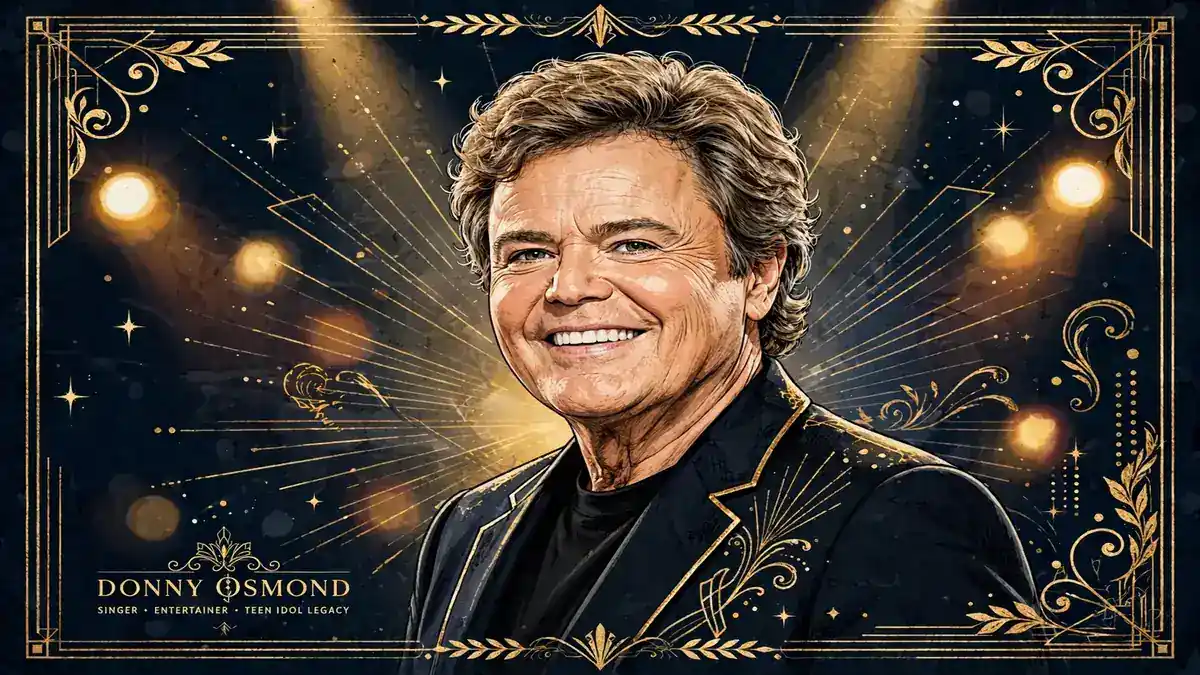
Donny Osmond‘s net worth is estimated at $8 million to $20 million as of October 2026. The range is wide on purpose: Celebrity Net Worth, the outlet other publications cite most, puts him at $8 million, while a run of thinner celebrity-finance sites land at $18–20 million, and neither camp can show you his bank statements. What the public record does show is one of the longest earning careers in pop history — more than six decades from the Andy Williams stage to an 11-year Flamingo residency, and a solo Harrah’s Las Vegas production that Caesars extended through June 2027. This article separates the documented money from the guesswork.
Donny Osmond: Quick Facts
| Estimated net worth | $8 million (range: $8–$20 million) |
|---|---|
| Profession | Singer, dancer, actor, television host |
| Nationality | American |
| Born | December 9, 1957, Ogden, Utah (age 68) |
| Height | 5 ft 9 in (1.75 m) |
| Primary income sources | Live performance and Las Vegas residencies, music royalties, television hosting, touring, brand partnerships |
| Active years | 1963–present |
| Last reviewed | October 2026 |
- Early Life and Background
- Education
- Career Journey
- Rise to Fame
- Main Sources of Income
- Salary and Earnings
- Businesses and Investments
- Brand Deals and Sponsorships
- Houses, Cars and Other Assets
- Awards and Achievements
- Net Worth Growth Over the Years
- Social Media Presence
- Personal Life
- Sources & Reporting
- Frequently Asked Questions
Early Life and Background
Donald Clark Osmond was born on December 9, 1957, in Ogden, Utah, the seventh of nine children born to George Virl Osmond and Olive May Osmond (née Davis). He arrived into a family where music was closer to a trade than a hobby: his older brothers Alan, Wayne, Merrill and Jay sang together as a barbershop quartet, and the two eldest brothers, Virl and Tom, had both been born almost completely deaf. The Osmonds were raised in The Church of Jesus Christ of Latter-day Saints, and the household ran on the kind of discipline that later let the family function as a self-contained business — rehearsal schedules, touring logistics, and finances all handled in-house under their father’s command.
The family’s break came through a television accident that became an origin story. The four singing brothers were spotted performing on a Disneyland television special by the father of singer Andy Williams, who invited them to audition for The Andy Williams Show. Williams had reservations about putting children on a national program, but the brothers proved such reliable performers that they became regulars. In 1963, five-year-old Donny joined them and sang “You Are My Sunshine” — his professional debut, and the start of an unbroken run of employment that was still going 63 years later in Las Vegas.
The sibling lineup shaped everything that followed. Alan, the eldest performing brother, was the group’s leader and the one Donny would later call his “protector”; Marie, born in 1959, was the only sister and would become Donny’s signature duet partner. Jimmy, the youngest, joined the family act as well. By the time Donny was a teenager, the Osmonds were no longer a novelty act — they were a touring and recording machine, and Donny was becoming its most recognizable face. That visibility would make him a fortune twice over: once as a teen idol, and once more as the act’s most durable survivor.
Education
Osmond’s schooling was fitted around a career that started at five. Like most child performers of the era, he studied with tutors and through homeschooling arrangements during touring and recording schedules rather than attending a conventional school through his teens. No public record details a high-school diploma or college attendance, and no credible source has ever suggested he pursued formal higher education — the industry was his classroom from 1963 onward. What is documented is that education mattered inside the family: the Osmonds treated their children as a professional enterprise, and Donny grew up fluent in the business mechanics of recording contracts, touring revenue, and production — knowledge that would matter enormously when the family fortune collapsed in the early 1980s and had to be rebuilt from the stage up.
Career Journey
The Osmonds’ recording career ignited in 1970 with “One Bad Apple,” which spent five weeks at number one on the Billboard Hot 100, followed by the 1972 hit “Crazy Horses.” Donny’s solo career launched in parallel in the early 1970s, and the numbers from those years still anchor his legacy: “Go Away Little Girl” made him the youngest male solo artist to reach number one on the Billboard Hot 100 at fourteen, a record widely cited in his biographies. His solo singles “Sweet and Innocent,” “Puppy Love,” and “Too Young” stacked up gold records through the decade — the RIAA certified his album Too Young gold on January 24, 1973, and he ultimately collected four RIAA gold albums alongside the 33 gold records his official biography credits him with across a catalog of more than 65 albums and over 100 million albums sold.
Success on that scale made the 1980s fall brutally public. The family fortune evaporated (more on that below), and Donny’s solo recording career stalled. The low point came in 1982, when he starred in a Broadway revival of the turn-of-the-century musical Little Johnny Jones — the show closed after a single performance, and New York Times theater critic Frank Rich dismissed the production even while crediting Osmond as “a give-his-all professional.” At twenty-four, with the clean-cut bubblegum image that had made him the pitchman for Hawaiian Punch now a punchline, Osmond was, in his own later telling, wondering whether he was any good at all. A publicist even suggested he get arrested crossing the U.S. border with drugs to manufacture a bad-boy edge — Osmond considered it briefly, fired the publicist, and stayed the course.
The comeback was built in layers. In 1989 he returned to the American charts with “Soldier of Love,” which climbed to number two on the Billboard Hot 100, followed by the top-twenty single “Sacred Emotion” — a reinvention produced with music-industry figure Steven Machat and English singer-songwriter Peter Gabriel’s orbit behind the scenes. Then came the stage role that became his signature: Joseph in Andrew Lloyd Webber’s Joseph and the Amazing Technicolor Dreamcoat, which he performed nearly 2,000 times across the United States and Canada during a six-year run, smashing touring records for a stage musical. The 1990s also put his voice in front of a new generation through film: he sang “I’ll Make a Man Out of You” for Disney’s Mulan (1998) — a performance that now outranks most of his singles in streaming and recognition — contributed vocals to Dweezil Zappa’s 1991 recording of the Bee Gees’ “Stayin’ Alive,” and recorded “No One Has to Be Alone” for The Land Before Time IX.
The 2000s and 2010s kept the catalog alive while the stage took over as the real business. He returned to the UK top ten in 2004 for the first time as a solo artist since 1973 with “Breeze On By,” a track co-written with Take That’s Gary Barlow that reached number eight. His 2014 album The Soundtrack of My Life featured cover songs of personal significance, including a track on which Stevie Wonder played harmonica, and his 2021 album Start Again marked another studio chapter. But the decisive financial story of this period was Las Vegas — the residency years that rebuilt and then cemented the fortune.
Rise to Fame
Donny Osmond has now risen to fame at least three times, and each ascent paid differently. The first was the 1970s teen-idol explosion: the Osmonds’ group hits plus his solo smashes made him one of the decade’s defining heartthrobs, and the family’s success funded a self-built empire — a 100,000-square-foot production studio in Orem, Utah, built because George Osmond negotiated with ABC that the 1976–1979 Donny & Marie variety show would be produced there, magnificent houses on what became Osmond Lane, a ranch outside Ogden in Huntsville, a condominium on Santa Monica Boulevard in Los Angeles, an apartment complex across from BYU in Provo, and the family’s own real-estate company. The Deseret News later reported estimates that the Osmonds were worth $70 million to $100 million in the late 1970s — a family-level fortune, not Donny’s alone, and one that would not survive the decade’s turn.
The second rise ran through television. After the ABC variety show ended in 1979, Donny and Marie returned with a syndicated daytime talk show in 1998–2000 that earned Daytime Emmy nominations, and Donny co-hosted the Miss America pageant with Marie in 1999–2000. He hosted the cable revival of the game show Pyramid from 2002 to 2004, and then reality television did what the 1980s could not: in 2009 he won season nine of Dancing with the Stars with partner Kym Johnson, becoming the show’s oldest winner ever at fifty-one, and in 2019 he finished runner-up on the first season of The Masked Singer performing as the Peacock. Each appearance reintroduced him to a younger audience without requiring a new hit record.
The third rise — the one that did the most for the balance sheet — was Las Vegas. After Marie’s Dancing with the Stars appearance in 2007, the siblings reunited for shows at the MGM Grand’s Hollywood Theatre in July 2008, their first Las Vegas engagement since 1979. The response was strong enough to launch the Donny & Marie residency at the Flamingo in September 2008, initially booked for six weeks. It ran for eleven years. Finale reporting counted 1,730 performances and more than 900,000 attendees; the Flamingo renamed its venue the Donny and Marie Showroom in 2014; and the pair collected multiple Las Vegas Review-Journal Best of Las Vegas awards along the way, including Best Show, Best All-Around Performer, and Best Singer in 2012 and Best Singer again in 2013. When the Flamingo run ended in November 2019, Osmond opened his solo residency at Harrah’s Showroom in August 2021 — and he has been a Strip headliner ever since.
Main Sources of Income
No verified breakdown of Donny Osmond’s income has ever been published, so any ranking of his revenue streams is informed judgment, not fact. That said, the public record points clearly at one dominant engine: live performance, especially Las Vegas. Between the eleven-year Flamingo run and the ongoing Harrah’s solo residency, he has spent sixteen of the last eighteen years as a working Strip headliner, and Caesars’ August 2026 announcement extending the Harrah’s engagement through June 2027 — with roughly 220 dated performances listed on sale — confirms the machine is still running.
Behind the stage money sit several long-tail streams. Music royalties flow from a catalog of more than 65 albums, 33 gold records, and singles that still stream heavily — “I’ll Make a Man Out of You” in particular earns from its permanent place in Disney’s catalog and in streaming playlists, while the 1970s hits generate mechanical and performance royalties from oldies radio and licensing. Touring beyond Vegas has been a constant: the family sold out shows in the United Kingdom, Australia, and Asia in the late 2000s, his first joint family tour in 27 years, and his own 2021 Start Again dates. Television hosting fees — Pyramid, Miss America, guest slots — and brand partnerships round out the picture. What does not appear in any credible accounting is a major standalone business empire or a real-estate portfolio on the scale of the fortune the family lost in the 1980s.
Salary and Earnings
This is where most celebrity-finance pages get sloppy, so let’s be precise about what is actually known. No current contract, salary, or per-show guarantee for Donny Osmond has been publicly verified. The single most specific pay figure on the public record comes from a 2010 Clark County contract dispute, in which a former producer’s complaint alleged that Donny and Marie each received a $1.625 million base salary plus 40 percent of gross box-office receipts above $250,000 — terms reproduced from the pleading by contemporary Vegas Inc reporting. That is unusually concrete evidence, but it was one side’s description in a lawsuit, and the reporting does not establish the payment period, later amendments, deductions, taxes, or how the case settled. It describes the possible structure of an early Flamingo deal; it cannot be multiplied across the residency’s eleven years, and it says nothing about the current Harrah’s contract.
The next-most useful data point is Pollstar’s 2016 North American chart, which lists $7.5 million of Donny & Marie box office for the covered reporting period. That is the show’s ticket gross — before the venue, producer, band, dancers, crew, marketing, agents, management, and taxes all take their cuts, and before whatever remained was split between two headliners. The residency’s scale is documented — 1,730 shows, more than 900,000 attendees — but the personal profit from it is not, and any article that presents a total residency gross as Osmond’s personal earnings is doing arithmetic with numbers it doesn’t have.
What can be priced from the outside is the current product. As of October 2026, face-value tickets for the Harrah’s show start around $95 to $105 all-in for rear seats, with front sections from about $111 and the pre-show VIP meet-and-greet experience at $262 including fees. The show itself has evolved into a career-retrospective production — a 90-minute set with a five-piece band and eight dancers, the fan-favorite “Auto-rap-ography” segment that raps through six decades of milestone photos, an audience request segment covering anything he has ever recorded, a full Broadway-style staging of “I’ll Make a Man Out of You,” and, since the 2026 extension, an AI-assisted duet of “Puppy Love” that pairs today’s Osmond with a 3-D recreation of his fourteen-year-old self built from 1970s multi-track audio and film footage. Selling that show five nights a week is the job that has underwritten the last decade of his wealth — and, notably, it keeps him performing at sixty-eight, which is itself a data point about how working entertainers’ fortunes actually get built.
Businesses and Investments
The Osmond family was once a diversified business: the Orem studio, the real-estate company, the Provo apartments, endorsement income, record royalties. The wipeout taught a lesson the family has quoted ever since — diversification beyond your expertise is how fortunes die. Bad investment advice and business partners who, as the Deseret News reported, included men who later went to prison for fraud and embezzlement, hollowed out the empire; one associate reportedly posed as a member of the family’s faith to win their trust before bilking them out of millions. By 1983 the family was broke. Every financial adviser said to declare bankruptcy; George Osmond refused, insisting the family would pay every bill it owed. They sold the houses, the studio, the Riviera Apartments, the cars — and when that wasn’t enough, George sent them all back on the road to sing.
Donny’s own investments since then are not a matter of public record, and this article will not invent a portfolio for him. What is documented on the business side is the professional infrastructure around the current career: his solo Harrah’s production is directed by Raj Kapoor with choreography by NAPPYTABS and produced by Mojave Ghost, the company led by Greg Young, who has also produced Osmond’s tours for the past decade. On the commercial side, he is represented by United Talent Agency, which handles his corporate advisory, entertainment marketing, and brand partnerships. His 61st album, the live One Night Only CD/DVD package from his sold-out 2017 UK tour, commemorated nearly six decades in show business — and served as a reminder that in Osmond’s economy, the catalog and the stage are the business.
Brand Deals and Sponsorships
Endorsement income has threaded through Osmond’s career since the teen-idol years, when he became the pitchman for Hawaiian Punch — the saccharine-sweet beverage deal that later became shorthand for his wholesome 1980s image problem. The modern deals are smaller in profile but better targeted at nostalgia economics. His booking agency, MN2S, lists a partnership with Chef Boyardee for the brand’s 90th-anniversary rejuvenation campaign, in which Osmond collaborated with rapper Lil Yachty on a “Start The Par-dee” remix built around the line “My name is Donny O, and you know I love my ravio’s.” The same agency credits a collaboration with American Greetings on customizable birthday e-cards featuring a personalized song, and a partnership with the app Skavengerz on “Donny’s 12 Days of…” content. None of these deals has a published dollar value — a recurring theme with Osmond’s finances — but together they describe a late-career brand strategy aimed squarely at the nostalgia market, where his recognition is highest and his image cleanest.

Houses, Cars and Other Assets
Donny and Debbie Osmond are publicly reported to be based in Utah, where they have lived for decades — the state has been the family’s home base since the Orem studio days. The magnificent houses the family built near the studio on Osmond Lane were sold in the 1980s to satisfy creditors, and nothing in the public record suggests the current real-estate footprint resembles the lost empire. Profiles that describe his lifestyle tend to emphasize restraint rather than excess: comfortable, upscale homes instead of mansions, frequent travel for performances, and interests that read more enthusiast than collector — he is reported to be passionate about aviation and flying, and to enjoy classic cars and fine craftsmanship. As with the investment portfolio, no public property records or vehicle collections have been attached to a named, verifiable source, so this section stays deliberately short. The one asset class that is beyond dispute is the catalog: more than 65 albums, 33 gold records, and publishing and royalty interests in a songbook that has been earning for over fifty years.
Awards and Achievements
Osmond’s trophy shelf is an unusual mix of pop-chart history and Vegas industry honors. The headline achievements: winner of season nine of ABC’s Dancing with the Stars in 2009 — at fifty-one, the oldest winner in the show’s history — and runner-up on the debut season of The Masked Singer in 2019. The Donny & Marie Flamingo production won three of the Las Vegas Review-Journal‘s Best of Las Vegas awards in 2012 (Best Show, Best All-Around Performer, Best Singer), Osmond took Best Singer again in 2013, and his solo Harrah’s show was named Best Family-Friendly Show in the 2023 edition. The 1998–2000 syndicated Donny & Marie talk show earned Daytime Emmy nominations.
The chart records tell the longer story. Official Charts data credits him with three UK number-one singles, nine UK Top 10 singles, and seven UK Top 10 albums. His official biography credits more than 65 albums, 33 gold records, and over 100 million albums sold — figures that place him among the best-selling artists of his generation even if the exact accounting behind them is the biography’s own. He performed at Ronald Reagan’s inauguration at twenty-three, celebrated fifty years in show business with the whole Osmond family on Oprah in 2008 (a daytime ratings record for the show), and in 2017 commemorated nearly six decades in the business with his 61st album, One Night Only, a live CD/DVD from a sold-out UK tour. Few performers of any era can claim a commercial arc that runs from 1971 chart-toppers to a 2026 AI-assisted stage duet with their own teenage self.
Net Worth Growth Over the Years
Third-party estimates of Donny Osmond’s wealth tell a story less of steady growth than of one catastrophic reset followed by a long, slow rebuild. The table below uses only figures traceable to named sources — and says so where the number belongs to the family, not to Donny personally.
| Year / Period | Estimated Net Worth | What the Figure Represents |
|---|---|---|
| Late 1970s | $70–$100 million (family) | Deseret News estimate of the entire Osmond family’s fortune — studio, homes, apartments, ranch, endorsements, royalties. Family-level, not Donny’s. |
| 1983 | Effectively zero (family) | The family was broke and sold its assets rather than declare bankruptcy, per the Deseret News. |
| 1999 | Rebuilding | Osmond told CBS MarketWatch he had once “lost everything and almost went under,” declining to name a precise amount lost. |
| 2021–2023 | $8 million | Celebrity Net Worth’s long-standing estimate, repeated across its reporting. |
| January 2025 | $8 million | Parade confirmed the $8 million figure, ranking Donny the second-richest Osmond behind Marie ($10 million). |
| October 2026 | $8–$20 million | Range across outlets: $8 million remains the most-cited figure; several thinner sites claim $18–$22 million without showing their work. |
The honesty gap between the two ends of that range is the whole story of celebrity net worth reporting. A few low-quality pages push figures as high as $35 million — and one outright fabrication we found during research claimed nearly $99 million for 2025 on the back of “digital asset optimization” — but no named source, filing, or rich list supports anything above the $20 million mark, and the outlet other publications actually cite holds at $8 million.
Social Media Presence
Osmond’s social footprint is substantial for a performer of his generation and actively monetized through the Vegas and nostalgia economy. His booking agency, MN2S, reports a combined audience of about 2.2 million across platforms: roughly 1.3 million Facebook followers, about 489,600 on Instagram (EntertainmentNow counted 481,000 in April 2026), around 334,400 on TikTok, and some 94,900 YouTube subscribers. Spotify data puts him at more than 3 million listeners and over 100,000 followers, with his most-played tracks — “I’ll Make a Man Out of You,” “Puppy Love,” and “Any Dream Will Do” — doing the heavy lifting, and Bandsintown lists about 128,000 followers tracking his 90-plus upcoming 2026–2027 show dates. The numbers are modest next to a modern pop star’s, but they describe an audience that buys tickets — which, for a working headliner, is the metric that matters.
Personal Life
Donny Osmond married Debra Glenn — Debbie — on May 8, 1978, and the marriage has lasted more than forty-eight years, a statistical outlier in entertainment. They have five sons — Don, Jeremy, Brandon, Christopher, and Joshua — and more than a dozen grandchildren; a 2026 AARP interview put the grandchild count at sixteen, and Osmond has spoken publicly about bonding with them in the outdoors. The family remains rooted in Utah and in the Latter-day Saint faith in which he was raised.
Two personal disclosures have shaped his public image beyond the music. Osmond has spoken in interviews about living with social anxiety since childhood — performing for millions while managing a disorder that made the spotlight itself a strain. And he has been candid about the 1980s nadir: the publicist who suggested a staged drug arrest to manufacture edge, the Broadway bomb, the years as a punchline. He rejected the reinvention-by-scandal playbook, and the decision became part of the brand: the clean-cut kid who outlasted the cynics.
Family losses have marked the recent years. His brother Wayne Osmond died in January 2025, and in April 2026 his eldest brother Alan — the group’s leader, who had battled multiple sclerosis for decades — died at seventy-six. Donny’s Instagram tribute called Alan “my protector” and “my guide,” crediting his tireless work with building everything the family became. He has also put time into philanthropy, including volunteering with the Starkey Hearing Foundation’s Las Vegas Hearing Mission, fitting hearing aids for recipients. In 2025, Fox News Digital reported that a Nevada woman had filed a negligence lawsuit against Osmond and Harrah’s over an inflatable-ball incident at a February 2024 show; no public resolution of the matter has been reported.
Sources & Reporting
- Celebrity Net Worth — the $8 million estimate, the figure most other publications cite; no published breakdown of holdings behind it.
- Parade — January 2025 reporting confirming the $8 million figure and ranking Donny the second-richest Osmond behind Marie ($10 million).
- Net Worth VIP — September 2026 methodology audit: the 2010 producer-lawsuit pay formula ($1.625M base + 40% above $250K), Pollstar’s $7.5 million 2016 box-office figure, UK Official Charts stats, the 1999 CBS MarketWatch “lost everything” interview, and the 2026 AARP grandchild count. Reporting window: 2024–2026.
- Deseret News — December 2018 deep dive on the family fortune: the $70–100 million late-1970s estimate, the Orem studio and property holdings, the fraud and embezzlement losses, the 1983 wipeout, and the refusal to declare bankruptcy. Reporting window: 2018.
- Business Wire — Caesars’ August 27, 2026 announcement extending the Harrah’s residency through June 2027, with the AI “Puppy Love” duet detail and Osmond’s sixteen-years-on-the-Strip quote.
- Gambling News — September 2026 extension details: September 5, 2026 start, Tuesday–Saturday 7:30 p.m. schedule, six years since the 2021 Harrah’s launch.
- MN2S — booking-agency profile: social reach stats (Facebook 1.3M, Instagram 489.6K, TikTok 334.4K, YouTube 94.9K), the Chef Boyardee × Lil Yachty “Start The Par-dee” campaign, American Greetings and Skavengerz partnerships, and United Talent Agency representation.
- EntertainmentNow — April 2026: Alan Osmond’s death at 76 after a long multiple-sclerosis battle, Donny’s Instagram tribute, and the 481,000-follower count.
- Reality TV World — 2009 reporting on the season-nine Dancing with the Stars win with Kym Johnson, including the oldest-winner record at fifty-one.
- SoapCentral — 2025 reporting, citing Fox News Digital, on the negligence lawsuit filed over an inflatable-ball incident at a February 2024 Harrah’s show.
- Insights Journal — September 2026 update: the widely repeated ~$20 million figure with an explicit caveat that it is not publicly verified.
Frequently Asked Questions
What is Donny Osmond’s net worth in 2026?
Donny Osmond’s net worth is estimated at $8 million to $20 million as of October 2026. Celebrity Net Worth — the outlet most other publications cite — holds at $8 million, a figure Parade confirmed in January 2025. Several thinner celebrity-finance sites claim $18–22 million, but none publishes the workings behind those numbers. The honest answer is that the figure is an estimate, not a verified balance sheet.
Is Donny Osmond still performing in 2026?
Yes. Caesars extended his solo Harrah’s Las Vegas residency through June 2027 in an announcement made August 27, 2026, marking five years at Harrah’s Showroom and sixteen total years as a Strip headliner. The 90-minute show runs Tuesday through Saturday at 7:30 p.m. and now includes an AI-assisted duet of “Puppy Love” with a 3-D recreation of his fourteen-year-old self.
How old is Donny Osmond?
Donny Osmond is 68 years old. He was born Donald Clark Osmond on December 9, 1957, in Ogden, Utah, and turns 69 in December 2026.
Who is Donny Osmond married to, and how long have they been together?
Donny Osmond has been married to Debra Glenn — Debbie — since May 8, 1978, more than forty-eight years. They have five sons (Don, Jeremy, Brandon, Christopher, and Joshua) and more than a dozen grandchildren.
Is Donny Osmond richer than Marie Osmond?
No — according to the most-cited estimates, Marie is the wealthier sibling. Parade’s January 2025 reporting put Marie Osmond’s net worth at $10 million and Donny’s at $8 million, ranking Donny the second-richest Osmond. As with all such figures, neither sibling has published verified accounts, so the comparison rests on third-party estimates.
What is Donny Osmond’s main source of income?
No verified breakdown exists, but the public record points to live performance — especially Las Vegas — as the dominant engine. He spent eleven years (2008–2019) headlining the Donny & Marie Flamingo residency (1,730 shows, 900,000+ attendees) and has headlined his solo Harrah’s residency since 2021. Music royalties from a 65-plus-album catalog, touring, television hosting, and brand partnerships make up the rest.
How did Donny Osmond lose millions?
In the late 1970s the Osmond family’s fortune was estimated at $70–100 million, built on record royalties, a self-built Orem studio, real estate, and endorsements. Bad investment advice and business partners — some later imprisoned for fraud and embezzlement — wiped it out; by 1983 the family was broke and sold its assets rather than declare bankruptcy. Donny told CBS MarketWatch in 1999 that he had once “lost everything and almost went under,” declining to name a precise amount. He rebuilt the fortune on stage.
How much does Donny Osmond make per Las Vegas show?
His per-show pay has never been publicly verified. The most specific figure on record is an allegation, not a fact: a 2010 producer’s lawsuit claimed Donny and Marie each received a $1.625 million base salary plus 40 percent of gross receipts above $250,000 under an early Flamingo deal — one side’s pleading, with no confirmed settlement or applicability to later years. For the current Harrah’s show, face-value tickets run roughly $95–$105 for rear seats to about $262 for the VIP pre-show experience as of October 2026.
Final Thoughts
Donny Osmond’s financial story is really two stories. The first is a cautionary one: a family fortune of $70–100 million, built on genuine talent and relentless work, dismantled in a few years by bad advice and worse partners — the kind of collapse that ends most careers. The second is the remarkable part: instead of declaring bankruptcy and fading out, he spent the next four decades working. The 1989 comeback single, the 2,000 performances of Joseph, the reality-TV trophies, the eleven-year Flamingo run, and now a Harrah’s residency extended through June 2027 form an earning arc that almost nobody in pop music can match.
That is why the $8–20 million range, wide as it is, is probably the most honest number in this article. It reflects a fortune rebuilt in public, night after night, rather than one preserved on paper. Whatever the true figure, the method of its making is fully documented — and it is still being made, five nights a week on the Las Vegas Strip.
Published on October 23, 2026. Last reviewed October 2026. Found an error? See our corrections policy.