
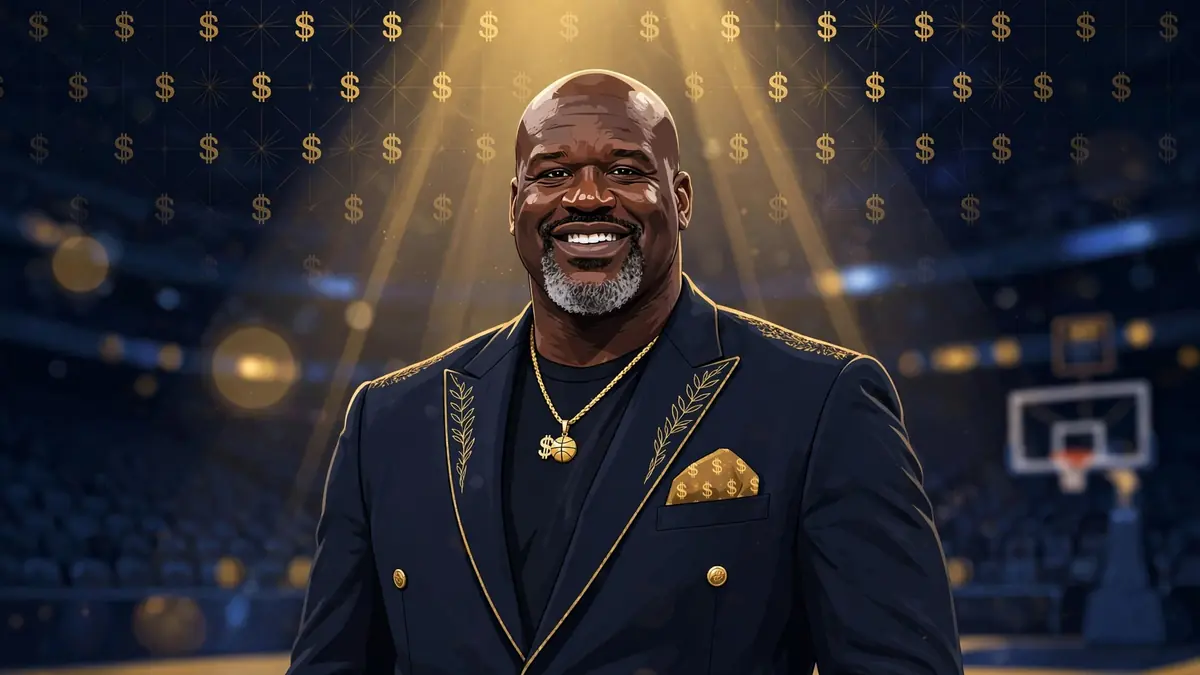
Shaquille O’Neal‘s net worth is estimated at $400 million to $500 million as of October 2026. The 7-foot-1 center who won four NBA championships and banked $286.3 million in salary — per Spotrac’s year-by-year contract record — has spent the fifteen years since his 2011 retirement doing what most athletes never manage: he made himself richer after he stopped playing. His franchise empire once counted roughly 350 restaurant and retail units, his Big Chicken chain has more than 350 locations in development across the United States and Canada, Papa John’s corporate filings document nearly $20 million in disclosed cash and stock compensation from his ambassador years, and in May 2026 Fortune described his fortune as roughly $500 million. He has also called himself a billionaire — a claim his own broadcast partner Charles Barkley laughed at on live television. The truth, as the numbers show, sits somewhere serious between those two positions.
Shaquille O’Neal: Quick Facts
| Estimated net worth | $500 million (range: $400–$500 million) |
|---|---|
| Profession | Former NBA player, franchise operator, brand executive, media analyst |
| Nationality | American |
| Born | March 6, 1972 (age 54) |
| Height | 7 ft 1 in (2.16 m) |
| Primary income sources | Franchise ownership, brand licensing, endorsements, media contracts, equity investments, real estate |
| Active years | 1992–present (NBA 1992–2011) |
| Last reviewed | October 2026 |
- Early Life and Background
- Education
- Career Journey
- Rise to Fame
- Main Sources of Income
- Salary and Earnings
- Businesses and Investments
- Brand Deals and Sponsorships
- Houses, Cars and Other Assets
- Awards and Achievements
- Net Worth Growth Over the Years
- Social Media Presence
- Personal Life
- Sources & Reporting
- Frequently Asked Questions
- Final Thoughts
Early Life and Background
Shaquille Rashaun O’Neal was born on March 6, 1972, in Newark, New Jersey, to Lucille O’Neal and Joe Toney. His father, a basketball player with serious street game, was incarcerated when Shaq was young, and the boy who would become the most physically dominant player of his generation was raised largely by his mother and, from age two, his stepfather Philip Harrison, an Army drill sergeant whose discipline shaped everything that followed. Shaq has spent his adult life describing his father as the man who “programmed” him — a line he repeated in a September 2026 interview with True Tamplin carried by EssentiallySports, in which he credited Harrison’s military-hard work ethic for both his playing career and the business appetite that came after it.
The family moved constantly on Army assignments, including a stretch in Wildflecken, West Germany, before settling in San Antonio, Texas. At Robert G. Cole High School in San Antonio, the teenager grew to 6-foot-10 and led his team to a 68–1 record and a state championship over two years. College scouts saw the rare combination: a center with a guard’s footwork and a lineman’s frame.
At Louisiana State University, O’Neal played three seasons (1989–1992) under Dale Brown, was a two-time All-American, and became the 1991 national player of the year. He left school early for the NBA — a decision that produced one of the great full-circle stories in sports education: he returned to finish his LSU bachelor’s degree in 2000, added an MBA from the University of Phoenix in 2005, earned a doctorate in education from Barry University in 2012, and in May 2026 — at 54, with an estimated half-billion dollars — walked across a stage at LSU again to collect a master’s degree in liberal arts and give the commencement address. “Your character will take you further than your resume,” he told the class of 2026, according to Fortune’s report on the ceremony, before plugging his Shaq-A-Licious gummies from the podium.
Education
O’Neal’s degree collection is unusual for any athlete and nearly unique among the sport’s billionaires-to-be. The timeline, all confirmed by the universities involved and by O’Neal’s own accounts:
Louisiana State University — bachelor’s degree, 2000. Eight years after leaving Baton Rouge for the Orlando Magic, O’Neal returned to finish what he had started, fulfilling a promise to his mother. He studied general studies and kept the commitment alive through a playing career that was pulling him in every other direction.
University of Phoenix — MBA, 2005. While playing for the Miami Heat and in the middle of a five-year, $100 million contract, O’Neal completed a master’s in business administration online. He has said he wanted to understand the deals he was signing, and the MBA arrived right as his franchise and equity investments were getting serious.
Barry University — doctorate in education (Ed.D.), 2012. The year after retiring from the NBA, O’Neal completed a doctorate focused on organizational learning and leadership. The dissertation defense took place in front of classmates who had watched him on television the night before.
Louisiana State University — master’s in liberal arts, May 2026. His fourth degree, completed at 54, made him an LSU commencement speaker the same spring. The school has not hidden its pride: the most famous alumnus in its athletic history keeps coming back to its classrooms.
None of this built his net worth directly. It built something adjacent and arguably more valuable: credibility with boards, brands, and business partners who might otherwise dismiss a retired ballplayer. When Authentic Brands Group’s CEO Jamie Salter describes O’Neal as a partner rather than a pitchman, the four degrees are part of why that language is believable.
Career Journey
O’Neal entered the 1992 NBA Draft as the consensus first overall pick, and the Orlando Magic took him over Alonzo Mourning without hesitation. The rookie contract — four years and $17.4 million, per Spotrac’s ledger — made him rich at 20. He responded by winning Rookie of the Year in 1993, averaging 23.4 points and 13.9 rebounds, and turning a fledgling expansion franchise into must-watch television.
Four seasons in Orlando (1992–1996) ended with a free-agency earthquake: in the summer of 1996 the Los Angeles Lakers signed him to a seven-year, $120 million contract, at the time the richest in NBA history. Eight seasons in Los Angeles (1996–2004) produced the three-peat — championships in 2000, 2001, and 2002 — with O’Neal winning Finals MVP all three years and the regular-season MVP in 2000. Along the way he earned $166.6 million in salary from the Lakers alone, more than from any other stop.
The 2004 trade to Miami brought a fourth title in 2006 and a five-year, $100 million extension that ran through 2008. The later years — Phoenix (2008–2009), Cleveland (2009–2010), Boston (2010–2011) — were the veteran’s tour: still marketable, still a draw, no longer the engine of a contender. He retired on June 1, 2011, after 19 seasons, and joined TNT’s Inside the NBA that same year.
The career numbers are monument-sized: 28,596 points, 13,099 rebounds, 2,732 blocks; 15 All-Star selections; two scoring titles (1995, 2000); Hall of Fame enshrinement in 2016 and FIBA Hall of Fame in 2017; jerseys retired by the Lakers (#34), the Heat (#32), and — in February 2024 — the Orlando Magic (#32), the first retired number in franchise history.
Retirement did not slow the earning. Within months of his last game, O’Neal was telling interviewers that he planned to make more money after basketball than during it. The 2015 ESPN story by Darren Rovell that broke his Authentic Brands Group deal noted that Forbes had projected $21 million in 2015 earnings for him — more than most active players were making. Fifteen years later, media estimates of his annual business and endorsement income range from roughly $60 million a year to, in one widely circulated Fadeaway World piece, $95 million a year. Treat those annual figures as media estimates, not confirmed income — but the direction of travel is unmistakable.
Rise to Fame
Fame arrived early and stayed, which is the boring-sounding fact that explains everything about the money. O’Neal was the first overall pick, Rookie of the Year, an All-Star starter as a rookie — and, unusually for a 7-foot-1 center, funny on camera. The Reebok deal made him the brand’s first signature athlete in 1992, the “Shaq Attaq” sneaker became an icon, and by 1994 he was co-starring in Blue Chips, rapping on a platinum album, and headlining national Pepsi campaigns.
The Lakers three-peat converted stardom into permanence. Between 2000 and 2002, O’Neal was the best player on the league’s best team, Finals MVP three years running, and a cultural fixture — movies (Kazaam in 1996, Steel in 1997), music, commercials, and later a long-running DJ career as “DJ Diesel.” The 2006 title in Miami added the fourth ring and cemented his standing across three fan bases.
What matters for the net worth story is that none of it faded. Inside the NBA gave him a weekly national stage from 2011 onward; when TNT’s NBA rights ended after the 2024–25 season, the show — O’Neal, Ernie Johnson, Kenny Smith, and Charles Barkley intact — moved to ESPN and ABC for the 2025–26 season under an 11-year licensing deal, with Turner still producing. Multiple outlets, including Sports Illustrated in early 2026, report O’Neal is enjoying the lighter marquee-date schedule. Fame, for Shaq, is infrastructure: it is what makes a fried chicken brand, a sneaker presidency, and a candy line possible.
Main Sources of Income
Five engines have carried O’Neal’s post-basketball finances, roughly in this order of importance:
1. Franchise ownership. The most-written-about piece of the empire. At various points O’Neal has been linked to roughly 350 restaurant and retail units: a reported 155 Five Guys locations at peak, about 40 24 Hour Fitness centers, some 150 car washes, plus Auntie Anne’s and Krispy Kreme locations. Some of these were sold off over the years — the 24 Hour Fitness holdings, for instance, appear to have been divested — and current counts are unverifiable, which is why his empire’s exact value is unknowable from outside. The structural point stands: he bought cash-flowing locations in businesses he personally used, paid royalties to the parent brands, and banked operating profits.
2. Brand licensing and endorsements. The 2015 Authentic Brands Group deal is the hinge of his modern finances: O’Neal sold the rights to manage his name in the merchandise and endorsement world to ABG while keeping a significant stake, then rolled the deal proceeds into ABG equity itself, becoming — in CEO Jamie Salter’s telling to Footwear News — the company’s second-largest shareholder. Separately, his Walmart Shaq shoe line has sold more than two million pairs a year at under $20 a pair, per ESPN’s 2015 reporting, and his suits at Macy’s and jewelry at Zales run on the same affordable-volume logic.
3. Media and appearances. Fifteen seasons on Inside the NBA, first at TNT and now on ESPN/ABC, reportedly on an eight-figure annual deal — the $10-million-plus-a-year figure traces to Andrew Marchand’s reporting in the New York Post. Add DJ Diesel tour dates, speaking fees, and product tie-ins like the 2026 Shaq-A-Licious SLAMS launch with Hershey.
4. Equity investments. The famous early positions: Google stock before the IPO — O’Neal has said in interviews he bought roughly $1 million worth — and an early investment in Ring, confirmed by founder Jamie Siminoff, which Amazon later acquired for about $1 billion in 2018. A small minority stake in the Sacramento Kings was held from 2013 and later sold. None of the share counts or hold periods are public, so these are directionally enormous, precisely unknowable.
5. Real estate. The Orlando mansion bought with his first NBA money, a Los Angeles home flipped in 2022, an Atlanta-area compound, and a reported $11 million Texas estate — property by property in the assets section below.
Media outlets that try to assign him a single annual income land anywhere from about $60 million a year (the long-running figure) to $95 million (Fadeaway World, January 2026). Neither is verifiable; both sit far above what he made in his best playing season, which is the real story.
Salary and Earnings Across Nineteen Seasons
Spotrac’s contract ledger — the closest thing basketball has to an audited pay record — credits O’Neal with $286,344,668 in NBA salary across 19 seasons. Some outlets round the figure to roughly $292 million; Spotrac’s contract-by-contract accounting is the more exact source, and it is the one we use. Every dollar below is gross, pre-tax, pre-agent-fee compensation, and it excludes endorsements entirely.
| Season(s) | Team | Cash earnings | Cumulative |
|---|---|---|---|
| 1992–1996 | Orlando Magic | $17,400,000 | $17,400,000 |
| 1996–2004 | Los Angeles Lakers | $166,592,487 | $183,992,487 |
| 2004–2008 | Miami Heat | $40,000,000 | $223,992,487 |
| 2008–2009 | Phoenix Suns | $41,000,000 | $264,992,487 |
| 2009–2010 | Cleveland Cavaliers | $20,000,000 | $284,992,487 |
| 2010–2011 | Boston Celtics | $1,352,181 | $286,344,668 |
Source: Spotrac contract database, figures in gross nominal dollars.
The landmarks: the 1992 rookie deal (four years, $17.4 million) that made him a millionaire at 20; the 1996 seven-year, $120 million Lakers contract — the richest in NBA history at the time — that followed his move to Los Angeles; and the 2004 five-year, $100 million extension in Miami that began with a $20 million annual salary and a fourth championship. His peak single-season pay was $27.7 million with the Lakers in 2004–05.
What the salary record hides is as important as what it shows. Federal and state taxes on a career split across Florida, California, Arizona, Ohio, and Massachusetts took an enormous cut. Agent fees, union dues, and business expenses took more. And the young man who earned it spent with famous abandon: he has told interviewers repeatedly that on the first day he was a millionaire he spent $1 million in 30 minutes — cars, jewelry, gifts for everyone he knew — and that a bank once refused him a mortgage because the 20-year-old had never heard of a credit score. The $286.3 million is a foundation, not a fortune: the fortune came from what he did with the after-tax remainder.
Endorsements layered a second career on top of the first. During his playing years, reported endorsement income exceeded $200 million — Reebok, Pepsi, Icy Hot, Buick, the General, Gold Bond — and the post-retirement years appear to have been richer still. In 2015, the year of the ABG deal, Forbes projected $21 million in earnings for a man four years retired. The $60-million-a-year figure that circulates in media coverage of his current income cannot be confirmed, but it points in the same direction every independent data point does: the commercial Shaq out-earned the playing Shaq.
Businesses and Investments: The Diesel Empire in Detail
O’Neal’s investing philosophy is the most quoted line in this entire story: he only buys into products he personally uses. The rule kept him out of the crypto implosions and the celebrity-tequila stampedes, and it produced one of the most diversified single-person business portfolios in sports.
Five Guys — the reported peak. Various outlets have reported that O’Neal once owned as many as 155 Five Guys locations, which would have made him one of the largest franchisees in the system. The current count is not public and may have been reduced, but the number matters less than the method: he bought operating restaurants with proven unit economics, not speculative brands.
24 Hour Fitness — owned, then sold. O’Neal held roughly 40 24 Hour Fitness locations at one point, another cash-flow play built around his own gym habit. The holdings appear to have been sold, which fits his pattern of harvesting mature positions rather than holding them forever.
Car washes, pretzels, doughnuts. Approximately 150 car washes, Auntie Anne’s pretzel locations, and Krispy Kreme stores have all been reported as part of the portfolio at various times. The car washes are the telling detail: deeply unglamorous, recurring-revenue businesses that print money in suburban markets. Nobody buys 150 car washes by accident.
Papa John’s — board, investor, pitchman. The most documented franchise relationship in his portfolio. O’Neal joined the Papa John’s board in 2019 as part of a broader brand-rehabilitation effort, invested in nine Atlanta-area restaurants through a joint venture (a 30% stake, per Papa John’s filings), and signed endorsement agreements that the company’s own filings value at $9.75 million in aggregate cash consideration across two deals, plus restricted-stock-unit grants valued at $9.925 million at the time of grant — figures surfaced by Net Worth VIP’s September 2026 teardown of the corporate disclosures. The limited-edition Shaq-a-Roni pizza became one of the chain’s most talked-about launches, with a dollar from every pizza going to charity. He left the board in 2023, but the commercial relationship outlasted the directorship.
Big Chicken — the founder play. His own concept, launched in 2018 with the first location in Las Vegas, built around his oversized persona and an outsized chicken sandwich. By 2026 the brand had more than 350 locations in development across the United States and Canada, with expansion into sports arenas, cruise ships, and international markets — and was reportedly raising $10 million in new capital, per Fadeaway World. Revenue flows to O’Neal through company-owned stores, franchise fees, and royalties on every location carrying his name. It is the one asset he built from zero, and it may end up being the most valuable.
Authentic Brands Group — the masterstroke. In December 2015, ESPN’s Darren Rovell reported that ABG would manage O’Neal’s name in the merchandise and endorsement world, with terms undisclosed but O’Neal retaining “a significant stake of his business future.” Then came the part that separates Shaq from every other celebrity licensor: he took the money ABG paid him and invested it back into ABG itself, becoming the company’s second-largest shareholder. “I’m doing a deal with you to sell you 50% of everything I have going on for the rest of my life,” he told CEO Jamie Salter, per Salter’s account to Footwear News. “Do you think I trust you?” ABG’s portfolio — Elvis Presley, Marilyn Monroe, Muhammad Ali, Sports Illustrated, and Reebok itself — means O’Neal now earns from a licensing machine far larger than his own name.
Google and Ring — the early bets. O’Neal has said in multiple interviews that he bought roughly $1 million of Google stock before the IPO, a position he held while the company became one of the most valuable in history. He was also an early investor in Ring, the video doorbell company — a story he loves telling, because he bought in after actually installing one in his home. Amazon acquired Ring for about $1 billion in 2018. Share counts and exit timing are private, but the direction is clear.
The Sacramento Kings. O’Neal bought a small minority stake in the Kings in 2013 under owner Vivek Ranadivé, later selling it. Like the ABG deal, it showed an instinct unusual among athletes: buying equity in the league’s business rather than just cashing its paychecks.
One claim deserves a correction because it floats around constantly: that O’Neal “invested over $135 million” in Authentic Brands Group. The sourced record (ESPN, Footwear News) describes a rights sale plus a reinvestment that made him the second-largest shareholder — not a standalone nine-figure cash outlay. The distinction matters for the net worth math: equity received as deal consideration is real wealth, but it is not the same as $135 million of salary being spent.
Brand Deals and Sponsorships
Few humans alive have sold more products than Shaquille O’Neal. ESPN’s 2015 ABG story counted more than 70 endorsement relationships across his career — and the pace barely slowed after retirement.
Reebok — from signature athlete to president. The relationship began in 1992 when O’Neal became Reebok’s first signature athlete, launching the Shaq Attaq. Thirty-one years later, in October 2023, Reebok named him president of basketball, with Allen Iverson as vice president — a genuine executive appointment, not a ceremonial title. “We are thrilled to be expanding upon our partnership with Shaquille with this historic appointment,” CEO Todd Krinsky said at the time, per NBC Sports and Boardroom reporting. Reebok had been sold to Adidas and then, in 2022, to Authentic Brands Group — meaning O’Neal is now, in effect, a shareholder-executive at the company that sells his own shoes. The basketball line relaunched in 2025 under his leadership.
Pepsi, Icy Hot, Buick. The Pepsi campaigns of the 1990s made his face one of the most recognized in advertising. Icy Hot, which he teamed up with in 2003, became one of his longest partnerships — he is not only a spokesman but a reported investor in the brand. The Buick commercials introduced him to a different demographic entirely.
The insurance years. The General’s car-insurance commercials — “Shaq-a-licious” era spots that leaned into self-deprecation — made him unavoidable on daytime television. Gold Bond, JCPenney, Zales jewelry, and Macy’s suits rounded out the portfolio, all operating on the philosophy he spelled out to ESPN: affordable products for the many, not luxury goods for the few. His Walmart Shaq shoes, often under $20 a pair, have sold more than two million pairs a year.
Shaq-A-Licious. The 2024 candy line — sour gummies in oversized shapes — moved from 7-Eleven shelves to a nationwide 2026 launch of Shaq-A-Licious SLAMS in partnership with Hershey, promoted with a Sports Illustrated interview in which O’Neal joked about celebrating slam dunks and “big-kid energy.” It is his most visible consumer-product venture since the Big Chicken launch.
The TV salary. His Inside the NBA contract — first with TNT, now carried to ESPN/ABC under the show’s 11-year licensing deal — is reported at more than $10 million a year, the figure traced to Andrew Marchand’s New York Post reporting on his 2022 renewal. It is the steadiest single paycheck he has had since his final NBA season, and it doubles as the marketing engine for everything else.
Houses, Cars and Other Assets
O’Neal’s real estate history is one of the best-documented parts of his finances — and one of the best examples of why headline prices don’t equal net worth.
The Isleworth mansion, Windermere, Florida. Bought in 1993 for $3.95 million — essentially his first real-estate move with NBA money — the 31,000-plus-square-foot estate sat on roughly four acres inside the gated Isleworth Golf & Country Club. The inventory reads like a theme park: 12 bedrooms, 15 bathrooms, a 6,000-square-foot indoor basketball court called the “Shaq Center,” a 17-car showroom garage, a 95-foot pool nicknamed “Shaq-apulco,” a private dock on Lake Butler, a cigar room, a wine cellar, and a life-size Superman statue. He listed it in 2018 at $28 million, cut to $22 million, then $19.5 million, then $16.5 million in 2020. When it finally sold in early 2021, the reports diverged — exactly the kind of conflict this publication doesn’t smooth over: several outlets, including Realty Today citing Mansion Global, pegged the sale at the $16.5 million final asking price, while the Stockworth Realty agent who represented the buyer announced a $11 million closing, calling it a Windermere record. Either way, it sold for less than half the original ask after three years on the market. He had held it for 28 years.
Ladera Heights, Los Angeles. A 5,217-square-foot home with five bedrooms on a third of an acre — modest by his standards — sold in 2022 for $8.25 million, a tidy profit on a house he had bought years earlier.
Atlanta area. O’Neal’s primary base during his TNT years was a compound in McDonough, Henry County, Georgia, where the production studios kept him weekly. The Atlanta address also explains the nine Papa John’s stores: he invested in the market he lived in.
North Texas. In 2026 the New York Post reported he had bought an $11 million estate on 14.3 acres roughly 30 miles from Dallas — a gated compound with room for the next chapter of the car collection, joining a celebrity corridor the Post noted includes Gloria Estefan.
The cars. The 17-car showroom in Florida was no exaggeration. O’Neal’s collection has run to custom-built everything — a stretched Lamborghini, oversized SUVs modified for a 7-foot-1 frame, luxury sedans — and the spending stories are legendary and, unusually, self-reported. He has said he spent $1 million in 30 minutes on his first day as a millionaire, buying cars and jewelry for friends and family without asking prices. In a 2021 interview he described walking into a Mercedes dealership, being ignored by a salesman, and buying three cars on the spot — a story economists would file under “status spending” and Shaq files under “don’t disrespect me.” Nobody has ever accused him of depreciation anxiety.
Real estate is the murkiest corner of his balance sheet: purchase prices and listing prices are public, but mortgage balances, renovation costs, and holding expenses are not. Treat the property portfolio as a meaningful eight-figure asset class, not a precisely countable one.
Awards and Achievements
The on-court resume is the credibility on which the empire is built:
- 4× NBA champion (2000, 2001, 2002 — Los Angeles Lakers; 2006 — Miami Heat)
- 3× NBA Finals MVP (2000–2002)
- NBA Most Valuable Player (2000)
- NBA Rookie of the Year (1993)
- 15× NBA All-Star (1993–1998, 2000–2007, 2009)
- 8× All-NBA First Team; 14 total All-NBA selections
- 2× NBA scoring champion (1995, 2000)
- NBA 75th Anniversary Team
- Naismith Memorial Basketball Hall of Fame (2016); FIBA Hall of Fame (2017)
- Number retired by the Los Angeles Lakers (#34), Miami Heat (#32), and Orlando Magic (#32, first in franchise history, 2024)
- FIBA World Championship MVP and USA Basketball Male Athlete of the Year (1994)
Off the court: a platinum rap album (Shaq Diesel, 1993) and a gold follow-up (Shaq Fu: Da Return, 1994) — the only NBA player whose music career has a certified plaque — plus four studio albums, a long-running touring career as DJ Diesel, and the kind of commercial ubiquity that made him Reebok’s first signature athlete and, 31 years later, its president of basketball.
Net Worth Growth Over the Years
No public audit of O’Neal’s finances exists, so any historical curve is a reconstruction. The table below combines reported salary milestones, business events, and published estimates from outlets including Forbes, ESPN, CelebrityNetWorth, and Fortune. Treat it as a directional picture, not a ledger.
| Year | Reconstructed estimate | Why it moved |
|---|---|---|
| 1996 | ~$25 million | First Lakers payday begins: the $120M deal starts; rookie fortune plus endorsements |
| 2000 | ~$75 million | Three-peat peak; Finals MVP run; Reebok and Pepsi money at full volume; LSU degree |
| 2005 | ~$150 million | Miami extension paying $20M/year; MBA completed; franchise buying begins |
| 2011 | ~$200 million | Retirement with $286.3M gross career salary banked; Inside the NBA seat secured |
| 2015 | ~$300 million | Authentic Brands Group deal (rights sale + equity stake); Forbes projects $21M in 2015 earnings |
| 2019 | ~$400 million | Papa John’s board seat, nine stores, ambassador deal; $400M becomes the standard published estimate |
| 2022 | ~$450 million | Inside the NBA renewal on eight-figure terms; Big Chicken expansion accelerates |
| 2024 | ~$500 million | Reebok presidency; Magic retires his jersey; Barkley disputes his billionaire claim at ~$700M |
| 2026 | $400–$500 million | Fortune (May 2026) describes ~$500M; CNW holds $500M; range reflects uncounted liabilities |
The pattern is the opposite of the usual athlete arc. Most players peak in net worth the year they retire and spend the next decade declining. O’Neal’s reconstructed curve keeps rising after 2011 because his biggest paydays — the ABG equity, the franchise cash flow, the media salary — all arrived after his last game. The 2024 entry needs context: on-air, Barkley pegged his broadcast partner at closer to $700 million, disputing O’Neal’s own billionaire talk. Our published range stays at $400–$500 million because the harder, sourced anchors — Spotrac, the Papa John’s filings, Fortune’s May 2026 reporting — support the half-billion figure, not the higher one.
How does he rank among athlete-businessmen? A quick comparison, all labeled:
| Peer | Published estimate | Source |
|---|---|---|
| Michael Jordan | Several billion (Forbes billionaire) | Forbes billionaires list |
| LeBron James | $1.2–$1.4 billion | Forbes |
| Magic Johnson | Billionaire | Forbes, 2023 |
| Shaquille O’Neal | $400–$500 million | CNW; Fortune, May 2026 (this article) |
| Charles Barkley | ~$90 million | CelebrityNetWorth |
O’Neal is not in the billionaire tier with Jordan, James, and Johnson — and the honest thing to say is that his own camp has noticed. The gap between his estimate and theirs is the gap between a great operator and a generational owner: Jordan owns a franchise sale’s worth of equity, James has SpringHill and Fenway stakes, and O’Neal’s empire, vast as it is, is built on franchise units and licensing rather than a single nine-figure equity event.
Social Media Presence
O’Neal’s online presence mirrors his broadcasting style — high-volume, comedy-forward, and monetized. He is one of the most followed retired athletes on the planet: tens of millions of followers across Instagram (@shaq), X, and TikTok, with a feed that mixes throwback highlights, DJ Diesel tour dates, product partnerships, and the occasional viral prank. His YouTube presence includes years of Inside the NBA clips that continue to circulate long after airing.
Two media properties deserve specific mention. “The Big Podcast with Shaq” ran for years as one of sports media’s most downloaded shows, built on his willingness to argue about his own legacy in public. And DJ Diesel is not a novelty act: he tours major electronic festivals, headlines Vegas residencies, and treats the turntables with the seriousness his critics never expected. Both feed the same machine — visibility that keeps the brand licensing engine, the ABG deal’s underlying asset, appreciating.
His social accounts are also where the spending transparency happens. The credit-score story, the $1-million day, the dealership tale — O’Neal tells these on himself, on camera, for free. It is marketing disguised as confession, and it has worked for three decades.
Personal Life
O’Neal married Shaunie Nelson in 2002. They had four children together — Shareef, Amirah, Shaqir, and Me’arah — and Shaunie’s son Myles from a previous relationship made five in the household. The marriage ended in divorce in 2011. Shareef played college basketball at UCLA and LSU; Shaqir has also played at the college level. O’Neal is publicly close to his children and his mother, Lucille, whose promise drove the 2000 LSU degree, and he has been linked in tabloid coverage to several relationships since the divorce — none of which have produced the kind of public financial entanglement that affects net worth estimates.
The stepfather who raised him, Army sergeant Philip Harrison, died in 2013. O’Neal still invokes him in nearly every serious interview — the September 2026 EssentiallySports piece is titled around his father’s “programming” — and the military-household discipline is the through-line he credits for both the championships and the business record.
His philanthropy runs on the same logic as his business: affordable and wide. The Shaq-a-Roni pizza directed a dollar per pie to charity; his Walmart shoe line is explicitly positioned as the anti-$150 sneaker, per his quote to ESPN in 2015 — “A lot of people can’t afford $150 shoes, and that stuck with me.” He has funded random acts of generosity that go viral with regularity — paying for strangers’ purchases, covering college tuition — without the foundation machinery most athletes build. Whether that is strategy or personality is, at this point, indistinguishable.
Sources & Reporting
Spotrac (contract database, accessed October 2026) — the year-by-year, team-by-team salary ledger totaling $286,344,668 over 19 seasons; the hardest single anchor in this article.
Fortune (May 2026) — described O’Neal’s fortune as roughly $500 million and reported his fourth-degree LSU commencement address; the freshest top-tier number available.
CelebrityNetWorth (ongoing, 2026 figure) — the widely repeated $500 million industry-standard estimate; origin figure most outlets cascade from.
ESPN / Darren Rovell (December 2015) — broke the Authentic Brands Group rights-management deal; reported O’Neal retaining a significant stake and Forbes’ $21 million 2015 earnings projection.
Sports Business Journal (December 2015) — deal terms and exclusions: the ABG agreement covered merchandise and endorsement rights but not his Turner Sports contract or his small Kings stake; brokered by Perry Rogers and Colin Smeeton.
Footwear News via ABG CEO Jamie Salter — O’Neal’s reinvestment of the deal proceeds into ABG, becoming the company’s second-largest shareholder.
Papa John’s SEC filings (as analyzed by Net Worth VIP, September 2026) — $9.75 million aggregate cash consideration across two endorsement agreements, RSU grants valued at $9.925 million at grant, and a 30% restaurant joint venture.
NBC Sports / Boardroom (October 2023) — Reebok named O’Neal president of basketball and Allen Iverson vice president; the 2025 basketball relaunch.
Sports Illustrated (January 2026) — Inside the NBA‘s move to ESPN/ABC for 2025–26 under the 11-year licensing deal; Shaq-A-Licious SLAMS nationwide launch with Hershey.
Athlon Sports / ESPN press release (October 2025) — official schedule for the show’s first ESPN/ABC season; Turner retaining production.
Mansion Global / Realty Today / Stockworth Realty (2020–2021) — the Isleworth listing history ($28M → $16.5M) and the conflicting sale reports ($16.5M final ask vs. $11M announced closing).
New York Post (2022, 2026) — the Inside the NBA renewal figure (via Andrew Marchand) and the $11 million North Texas estate purchase.
EssentiallySports (September 2026) — the True Tamplin interview: the credit-score lesson, “my father programmed me,” and the financial-literacy message.
InvestorMint (October 2026) — the most rigorous recent competitor analysis; publishes a $400–$500 million working range and the caution that franchise counts mix current and historical holdings.
Fadeaway World (January 2026) — the $95 million annual income claim (media estimate, unverified) and Big Chicken’s 350+ locations in development plus the $10 million raise.
Reporting window: September 2015 – October 2026. Figures are published estimates and disclosed filings, not audited statements; see our corrections policy if you spot an error.
Frequently Asked Questions
What is Shaq’s net worth in 2026?
Shaquille O’Neal’s net worth is estimated at $400 million to $500 million as of October 2026, anchored at the $500 million figure published by CelebrityNetWorth and described by Fortune in May 2026. The range reflects uncertainty around taxes, spending, private-company valuations, and deal terms — none of which are publicly disclosed.
Is Shaq a billionaire?
No — at least not by any published estimate. O’Neal has hinted at billionaire status in interviews, and his broadcast partner Charles Barkley suggested on-air in 2024–25 that he is worth closer to $700 million, but the hardest sourced figures — CelebrityNetWorth and Fortune — put him around $500 million. He would need to roughly double his documented fortune to join Michael Jordan, LeBron James, and Magic Johnson in the billionaire tier.
How much money did Shaq make in the NBA?
Spotrac’s contract ledger records $286,344,668 in NBA salary over 19 seasons (1992–2011), the bulk of it from the Los Angeles Lakers ($166.6 million). Some outlets round the figure to about $292 million. That is gross pre-tax pay and excludes endorsements, which reportedly added more than $200 million during his playing years.
What businesses does Shaq own?
His portfolio has included roughly 350 restaurant and retail units at peak — a reported 155 Five Guys, about 40 24 Hour Fitness centers (since sold), around 150 car washes, plus Auntie Anne’s and Krispy Kreme locations. He is the founder of Big Chicken (350+ locations in development), a former Papa John’s board member and nine-store investor, an Authentic Brands Group shareholder, and — since October 2023 — president of Reebok Basketball. Exact current holdings are private.
What is Shaq’s salary from Inside the NBA?
His analyst contract — which carried the show from TNT to ESPN/ABC for the 2025–26 season under an 11-year licensing deal — is reported at more than $10 million a year, the figure traced to Andrew Marchand’s reporting in the New York Post. It is his steadiest single paycheck since his final NBA season.
Did Shaq really invest in Google before the IPO?
He says so. O’Neal has stated in multiple interviews that he bought roughly $1 million of Google stock before the company’s IPO and held it as the stock appreciated enormously. The exact share count and holding period were never disclosed. He was also an early investor in Ring, the video-doorbell company Amazon bought for about $1 billion in 2018.
How many Five Guys restaurants does Shaq own?
At the reported peak, as many as 155 Five Guys locations — which would have made him one of the chain’s largest franchisees. The current number is not public and may have been reduced through sales, a pattern that also applies to his former 24 Hour Fitness holdings.
How much does Shaq make per year from endorsements now?
There is no verified figure. Media estimates range from about $60 million a year in business and endorsement income to a $95 million claim circulated by Fadeaway World in 2026. Both are estimates, not confirmed income — but every available signal agrees his post-retirement annual income exceeds what he made in his best playing season.
Final Thoughts
Shaquille O’Neal’s $400–$500 million fortune is the rare athlete wealth story that got better after the cheering stopped. The playing career — $286.3 million in salary, four rings, a platinum rap album — was the launchpad, not the peak. The peak came from a set of decisions that now look obvious and were anything but at the time: selling his name rights to Authentic Brands Group and then buying into ABG itself, building a franchise portfolio on cash-flow businesses he actually used, launching his own chicken chain instead of endorsing someone else’s, and keeping a weekly national television seat for fifteen years.
The honest caveats belong in the final paragraph, not the footnotes. He is not a billionaire, whatever the interviews suggest. The $500 million figure is an industry estimate, not an audit. The franchise counts mix current and historical holdings, the equity stakes are undisclosed, and the tax bill on a career that ran through five states was enormous. What is documented — the Spotrac ledger, the Papa John’s filings, the Reebok presidency, Fortune’s 2026 reporting — supports a serious, half-billion-dollar empire built by a man who once couldn’t get a mortgage because he didn’t know what a credit score was. That arc, from financial illiteracy at 20 to second-largest shareholder of a brand empire at 54, is the real money story here. For a fuller picture of how athlete fortunes stack up, compare his empire with LeBron James’s one-point-four-billion-dollar portfolio, Deion Sanders’s two-sport media business, or Patrick Mahomes’s half-billion-dollar quarterback deal — or browse the biggest money stories in entertainment to see where sports fortunes fit in the wider celebrity economy.
Published on October 6, 2026. Last reviewed October 2026. Found an error? See our corrections policy.