
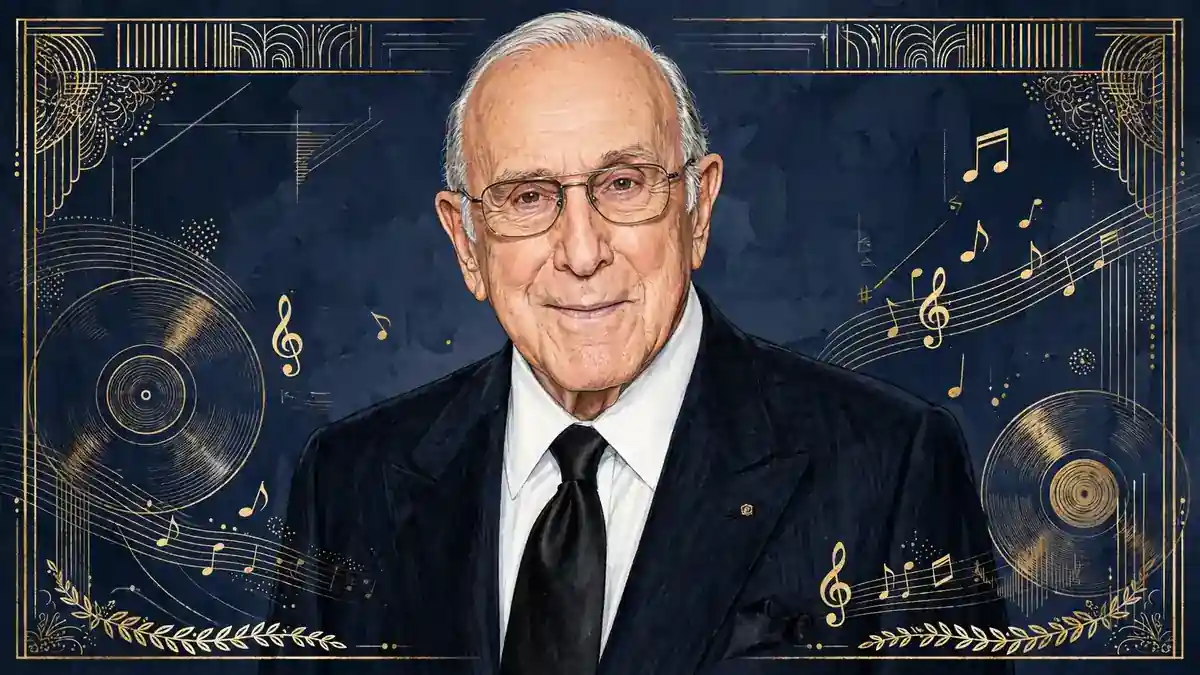
Clive Davis‘s net worth is estimated at $600 million to $850 million as of October 2026. The record executive who ran Columbia Records, founded Arista Records and launched J Records died at his Manhattan home on June 22, 2026, at the age of 94, leaving a fortune built across six decades of hit records, a reported 50 percent stake in J Records, a Manhattan property portfolio and an art collection reported to be worth as much as $100 million on its own.
Clive Davis: Quick Facts
| Estimated net worth | $600 million to $850 million at his death in June 2026 (range: $600 million to $850 million) |
|---|---|
| Profession | Record executive, A&R executive, record producer, lawyer |
| Nationality | American |
| Born | April 4, 1932 (died June 22, 2026, aged 94) |
| Height | Not publicly documented in reliable sources |
| Primary income sources | Record-label ownership and executive pay, label joint ventures, producer credits, books, art and property |
| Active years | 1960–2026 |
| Last reviewed | October 2026 |
- Early Life and Background
- Education
- Career Journey
- Rise to Fame
- Main Sources of Income
- Salary and Earnings
- Businesses and Investments
- Brand Deals and Sponsorships
- Houses, Cars and Other Assets
- Awards and Achievements
- Net Worth Growth Over the Years
- Social Media Presence
- Personal Life
- Sources & Reporting
- Frequently Asked Questions
- Final Thoughts
Early Life and Background
Clive Jay Davis was born on April 4, 1932, in Brooklyn, New York, and grew up in the Crown Heights neighbourhood. His parents died while he was still young — his father when Davis was a teenager and his mother not long after — and the loss left a practical mark on his character that friends and biographers kept returning to: school was the way out, and work was not optional. He studied hard, won scholarships, and built the academic record that carried him from a Brooklyn childhood to New York University and then to Harvard Law School.
That background matters to the money story because Davis entered the record business as a lawyer, not as a musician or a fan with a demo tape. He understood contracts, bargaining power in a negotiation, and the value of owning a position in a company rather than simply drawing a salary from one. The habit shows up at every turning point of his career: at Columbia, where he rose through the legal and administrative ranks; at Arista, which he built and ran as founder; and at J Records, where he negotiated an equity stake that became one of the single largest paydays of his life.
Brooklyn in the 1930s and 1940s also gave him an ear for the city’s mix of sounds. He was not a performer, and he never pretended to be one. His gift, as the tributes after his death kept phrasing it, was hearing a hit in a rough demo or a club set before anyone else in the room did — and then knowing how to put a record, a producer, a song and a marketing campaign around it. That combination of legal training and musical instinct is the thread that runs through a 66-year working life.
Education
Davis attended New York University on a full scholarship and graduated magna cum laude. He then won a full scholarship to Harvard Law School, graduating in 1956. The two scholarships are worth noting in a wealth profile because they explain how a young man who had lost both parents could reach the top of a profession without family money behind him. He passed the New York bar and spent his early working years at a New York law firm, where one of the firm’s clients was CBS, the parent of Columbia Records.
The law degree did more than open doors. At Columbia, Davis’s first assignments included contract work, and one early task — renegotiating Bob Dylan’s contract after the singer turned 21 — brought him to the attention of Columbia’s head, Goddard Lieberson. Within five years of joining the label’s legal department in 1960, Davis was administrative vice president. He became vice president and general manager in 1966 and president of Columbia Records in 1967, at the age of 35.
Education stayed a spending priority for the rest of his life. In 2002 he announced a $5 million gift to NYU’s Tisch School of the Arts to create a Department of Recorded Music, the first four-year degree programme of its kind to treat the creative producer as an artist. In 2011 he gave a further $5 million to expand it into the Clive Davis Institute of Recorded Music, with scholarship support for young talent. NYU Tisch marked his death in June 2026 with a tribute noting that the institute, and a permanent retrospective at the Clive Davis Gallery at 370 Jay Street since 2022, carry his name into the next generation of the business.
Career Journey
Davis joined Columbia Records as assistant counsel in 1960. The label at the time was a strong but conservative company, built on established stars and wary of the rock wave breaking out of San Francisco and London. Davis went to the Monterey Pop Festival in 1967, heard Big Brother and the Holding Company with Janis Joplin, and came back convinced that Columbia had to move. He signed Joplin’s band, then Santana, and kept going: Blood, Sweat & Tears, Chicago, Neil Diamond, Billy Joel, Bruce Springsteen, Aerosmith, Earth, Wind & Fire, Pink Floyd, Laura Nyro, Loggins & Messina, Sly and the Family Stone, Donovan and the Bay City Rollers all joined or were developed on his watch.
The commercial result was plain in the label’s own numbers. Columbia’s profits grew from about $5 million in 1967 to about $50 million by 1972, according to the account Davis’s own archive later published. He had turned a label that had been ignoring the youth market into the dominant record company of the rock era. He also learned, in those years, how a label president’s judgment shows up in the accounts: a signing that looks risky in the meeting room becomes a catalogue asset that pays for decades.
The Columbia chapter ended in May 1973, when Davis was fired after a federal investigation and an internal CBS probe over about $94,000 in expense-account items, including payments tied to his son’s bar mitzvah and apartment renovations. Davis maintained he had never authorised or intended CBS to pay for those expenses. Five of six charges were later dropped, and in 1975 he pleaded guilty to failing to report $2,700 in taxes on $8,800 of contested travel expenses, paying a $10,000 fine and receiving one day of unsupervised probation. The episode cost him his job, not his reputation with artists: when he started again, they followed him.
His second act began in 1974, when he took over the struggling record division of Columbia Pictures and renamed it Arista Records — a nod to the National Honor Society he had belonged to at school. CBS later backed the new label with a $1 million investment. Arista’s early hit, Barry Manilow’s “Mandy,” set the template: a strong voice, a strong song, and a campaign built around both. Dionne Warwick, Aretha Franklin, Patti Smith, the Grateful Dead, the Kinks, Lou Reed, Air Supply, Carly Simon and the Alan Parsons Project all recorded for Arista under Davis.
Arista’s Nashville division, launched in 1988, added Alan Jackson, Brooks & Dunn and Diamond Rio and collected more than 150 major industry awards over the years, according to AllMusic’s biography of Davis. In October 1989 he formed the LaFace Records joint venture with producers Antonio “L.A.” Reid and Kenneth “Babyface” Edmonds, which launched TLC, Toni Braxton, Usher, Outkast and Pink. In 1993 he backed Sean “Diddy” Combs’s Bad Boy Records as an Arista joint venture, the home of The Notorious B.I.G., Mase, Faith Evans and 112. By 2000, Arista accounted for about a third of parent company BMG’s sales — and BMG’s leadership tried to push Davis, then 68, into retirement under an age policy.
The push failed in the most profitable way possible. Davis refused to retire, artists including Aretha Franklin and Bruce Springsteen spoke publicly in his support, and BMG instead financed his next label, J Records, with $150 million in capitalisation. Davis reportedly owned 50 percent of the new company. Its first major signing, Alicia Keys, released Songs in A Minor in 2001, which sold more than 10 million copies worldwide and won five Grammy Awards. BMG later bought Davis’s stake in J Records; industry estimates cited by Celebrity Net Worth put the label’s enterprise value above $300 million at the time, which would value a 50 percent stake at roughly $150 million. The exact terms were never disclosed, so that figure stays an estimate, but it is the clearest single explanation for how an executive’s fortune reached nine figures.
From 2002 to April 2008 Davis was chair and chief executive of the RCA Music Group, which included RCA Records, J Records and Arista Records, and chair and chief executive of BMG North America. After the Sony-BMG merger, he became chief creative officer of Sony Music Entertainment in 2008, a title he held until his death in 2026. He attended the 68th Grammy Awards pre-Grammy gala in January 2026, his last, and the Recording Academy announced in October 2026 that the gala would continue on February 6, 2027, at the Beverly Hilton, honouring his life and career.
Rise to Fame
Davis was never famous in the way his artists were famous, and that was part of his power. His name became known inside the business first, then to the public through two routes: the annual pre-Grammy gala he created in 1976, which grew into the music industry’s most photographed party, and his books. Clive: Inside the Record Business, published in 1975, was a bestseller that told the Columbia story from the inside. The Soundtrack of My Life, his 2013 memoir, went further, including the public revelation that he was bisexual — he had been married twice, had four children, and described a 13-year relationship with a male doctor and a later long-term relationship.
The gala deserves a place in a wealth profile because it was a business asset as much as a party. For five decades it put Davis in the same room, on the same night, with the artists, managers, lawyers and corporate chiefs who decided where deals went. From 2009 he presented it in partnership with the Recording Academy. The 2027 edition, announced by the Academy in October 2026, keeps his name on the event after his death — a rare case of a personal brand outliving its founder in the same form.
The documentary Clive Davis: The Soundtrack of Our Lives, produced by IM Global and Scott Free Productions, took the story to a wider audience in 2017, with Davis himself narrating a career that had already run for more than half a century. By then the “man with the golden ear” tag, repeated in the Reuters obituary of June 2026, was fixed. It was earned, in the record business sense, by a run of signings no other executive matched across rock, pop, R&B and hip-hop: Joplin and Springsteen at Columbia, Houston and Manilow at Arista, Keys at J Records, plus the LaFace and Bad Boy rosters he backed rather than signed directly.
His most consequential single signing was Whitney Houston. Davis saw the 19-year-old perform at a New York nightclub in 1983 and signed her to Arista. Her 1985 debut album produced three number-one singles and became one of the best-selling debut albums in history; The Bodyguard soundtrack, released in 1992, later won the Grammy for Album of the Year with Davis as producer. The Houston story also shows why an executive’s wealth is hard to pin down: Davis did not own Houston’s recordings in the way a performer owns a catalogue, but the label he founded and ran profited from every one of them, and his standing in the business — and his pay — rose with each success.
Main Sources of Income
Davis’s fortune came from five streams, and the mix changed across his career. First, executive pay: president of Columbia Records, founder and president of Arista, chair and chief executive of RCA Music Group and BMG North America, and finally chief creative officer of Sony Music Entertainment. None of those salaries were published, and this article does not invent them. What is documented is the scale of the companies he ran — Columbia’s profits rising tenfold under him, Arista delivering about a third of BMG’s sales by 2000 — which puts his compensation in the top tier of entertainment executives for decades, without needing a made-up annual figure.
Second, equity. The J Records stake is the documented centrepiece: $150 million of BMG capitalisation at launch, a reported 50 percent personal holding, and a later buyout by BMG at an enterprise value estimated above $300 million. Third, joint ventures: LaFace Records and Bad Boy Records were Arista ventures in which Davis’s label, and Davis himself as its head, shared in the profits of rosters that dominated the charts through the 1990s. Fourth, producer credits and royalties: Davis won Grammy Awards as an album producer, including for The Bodyguard and Santana’s Supernatural, and producer royalties attach to records that keep selling and streaming.
Fifth, books, film and speaking: two bestselling books, a documentary, and five decades of gala and industry appearances. These were small next to the label money, but they kept his name — and his negotiating position — current into his nineties. Outside music, two asset classes carried a large share of the reported total: Manhattan property and the art collection, both covered in detail below.

Salary and Earnings
No reliable source has published a year-by-year salary for Davis, and readers should be wary of any profile that prints one. Executive pay at CBS, BMG and Sony was private, and Davis’s own books discuss deals and artists more than his own pay cheques. What can be stated with sources is the sequence of roles and the money attached to the companies around him.
At Columbia, the measurable figure is the label’s profit growth, from about $5 million in 1967 to about $50 million in 1972. At Arista, the measurable figure is market share: roughly a third of BMG’s sales by 2000, on a roster that included Houston, Manilow, Warwick, Franklin, Smith, Kenny G, Sarah McLachlan and Ace of Base. At J Records, the measurable figures are the $150 million launch capitalisation and the estimated $300 million-plus enterprise value at buyout. At Sony, his final role was chief creative officer, a senior advisory and A&R position he held from 2008 until his death; NPR’s obituary coverage noted it as his final lucrative role without publishing a salary.
One useful way to read the fortune is to separate salary from ownership. A salary, however large, does not compound into $600 million. Ownership does. Davis owned a founder’s position at Arista, negotiated a 50 percent stake at J Records, and held property and art for decades while both markets rose. The salary kept him at the top of the business; the equity and the assets made him wealthy.
The other earnings detail worth recording is the 1973 firing itself, because it shows the cost side of the ledger. Davis was accused of misusing about $94,000 in company funds. He later pleaded guilty to a tax charge covering $8,800 in travel expenses and paid a $10,000 fine. Set against a fortune later estimated in the hundreds of millions, the sums look small; at the time, they cost him the presidency of the biggest record company in America. His rebound — Arista within a year — is the reason the episode reads as a footnote rather than an ending.
Businesses and Investments
Arista Records was Davis’s first business as a founder. He took over Columbia Pictures’ struggling record division in 1974, renamed it, and built it into one of the most commercially successful labels of the 1970s, 1980s and 1990s. The label’s model under Davis was artist development over years, not singles: Manilow, Warwick, Franklin and Houston were all given multiple albums to find their audience, and the catalogue those albums created kept paying long after the chart runs ended.
LaFace Records, founded in 1989 with L.A. Reid and Babyface, showed a different model: back a proven production team, give them a label inside your distribution system, and share the upside. TLC, Toni Braxton, Usher, Outkast and Pink all came through LaFace, and Arista acquired the label in 1999. Bad Boy Records, founded in 1993 with Sean Combs, worked the same way for hip-hop: The Notorious B.I.G., Mase, Faith Evans and 112 gave Arista a chart presence in a genre Davis admitted he did not personally follow, without him having to build a hip-hop A&R department from scratch.
J Records, founded in 2000, was the purest version of the Davis model: his name, his ear, BMG’s money, and a 50 percent stake. Alongside Keys, the label signed Luther Vandross, Jamie Foxx, Monica, D’Angelo and Gavin DeGraw. When BMG bought his stake, Davis moved to run the combined RCA Music Group, folding J, RCA and Arista under one roof. The through-line across all four ventures is the same: Davis’s value to a parent company was his judgment, and he priced that judgment as equity rather than salary alone.
Outside the record business, his investments were concentrated and conservative: New York property and modern art. He did not build a portfolio of start-ups or a fashion line or a spirits brand, and no credible source credits him with venture-capital or private-equity holdings of any size. That concentration is itself a finding. Where other entertainment fortunes spread across dozens of bets, Davis’s non-music wealth sat in two asset classes he knew personally — apartments he lived in or bought for family, and pictures he lived with on his walls.
Brand Deals and Sponsorships
Davis did not earn his money from brand deals or sponsorships in the way a performer does, and any profile that lists endorsement income for him is guessing. He was the executive on the other side of those deals: the label president who approved, negotiated or blocked the partnerships his artists signed. His own commercial partnerships were institutional rather than personal — the Recording Academy partnership for the pre-Grammy gala, the NYU Tisch institute that carries his name, and the Grammy Museum theater named the Clive Davis Theater in 2010.
The closest thing to a personal brand venture was his authorship. Clive: Inside the Record Business (1975) and The Soundtrack of My Life (2013) were both bestsellers, and the 2017 documentary extended the same brand to film. These projects paid advances and royalties, but their real value was reputational: they kept Davis’s name in front of artists and executives who might otherwise have written off a man in his eighties. In a business where the next signing depends on whether an artist trusts your judgment, that visibility was worth more than the book money.
One sponsorship-adjacent detail belongs here because it is documented: the pre-Grammy gala’s commercial structure. The event, created in 1976 and presented with the Recording Academy from 2009, drew sponsors and partners as part of Grammy week, and Davis hosted it for five decades. The gala was never a personal endorsement deal, but it was the room where endorsement-scale relationships were made — and Davis owned the room.

Houses, Cars and Other Assets
Davis’s property story is a Manhattan story with a Westchester weekend chapter. Celebrity Net Worth’s post-death profile reports that he owned at least five units in a single Manhattan building at 465 Park Avenue. In 2015 he bought two units there for $3.4 million and combined them into a duplex, designed by Greg Schriefer with white-washed oak herringbone floors, Italian marble windowsills and a custom coiled staircase in white oak, glass and brass. He listed that duplex in 2017 for $7.8 million, cut the price to $6.995 million later that year, and took it off the market in 2019, according to 6sqft’s reporting on the listing. The unit carried a monthly homeowners’ fee of about $11,700.
Other documented transactions fill out the picture. CityRealty’s market reporting records a Rushmore condominium on the Far West Side, bought from the sponsor for $5.96 million in October 2011 and later sold for $4.99 million — a loss on that unit, and a reminder that even careful buyers sell at a loss sometimes. A Tribeca apartment at 108 Leonard Street was sold in 2023 for $4.6 million, with Crain’s New York Business noting that he broke even on it and was spending much of his time at his Westchester estate. That estate, bought in 1991 after his second divorce, was reported to include a 30-seat home theatre, an 8,000-square-foot main house and a 6,000-square-foot guest house.
The art collection was the second pillar. Celebrity Net Worth and Hello! Magazine both report it as worth as much as $100 million, with works by Pablo Picasso, Andy Warhol, Damien Hirst, Dale Chihuly, Adolph Gottlieb, Alex Katz, Fernando Botero and others. The figure is an estimate, not an auction total, but September 2026 gave it a market test: Christie’s announced that eight paintings from the collection would go to auction in New York in November 2026, valued together at more than $35 million, led by a circa-1986 Warhol portrait of Aretha Franklin, a 2009 David Hockney landscape and a 1992 Joan Mitchell abstraction, with works by Frank Stella, George Condo and Robert Motherwell. Eight paintings at more than $35 million makes the $100 million estimate for the full collection look plausible rather than inflated — and it means the estate’s final value will become clearer as auction results land.
A Hockney portrait of Davis himself later entered the Smithsonian National Portrait Gallery’s collection, a detail that belongs in a wealth profile because it shows how the collection worked socially: museum-grade works bought over decades, shown in his homes, and eventually placed with institutions. Cars, by contrast, barely feature in any reliable account of Davis’s life. He was a Manhattan and Westchester man who was driven, photographed at galas, and written about for his homes and his walls — not for a garage. This article records no car collection because no credible source documents one.
Awards and Achievements
Davis won five Grammy Awards, including Album of the Year as producer for The Bodyguard soundtrack (1994) and for Santana’s Supernatural (2000), and he received the Grammy Trustees Lifetime Achievement Award in 2000. The Recording Academy named the theatre inside the Grammy Museum the Clive Davis Theater in 2010. He was inducted into the Rock and Roll Hall of Fame as a non-performer in 2000, inducted by Patti Smith, who told the Associated Press that Davis loved artists in a way his mainstream reputation did not always show.
The list of artists he signed, developed or backed reads like a syllabus of post-1960s popular music. At Columbia: Janis Joplin, Santana, Bruce Springsteen, Billy Joel, Aerosmith, Chicago, Earth, Wind & Fire, Pink Floyd, Blood, Sweat & Tears, Neil Diamond, Laura Nyro, Donovan. At Arista: Whitney Houston, Barry Manilow, Aretha Franklin, Dionne Warwick, Patti Smith, Kenny G, Sarah McLachlan, Ace of Base, the Grateful Dead. Through joint ventures: TLC, Toni Braxton, Usher, Outkast, Pink, The Notorious B.I.G. At J Records: Alicia Keys, Luther Vandross, Jamie Foxx, Monica. LouderSound’s obituary estimated that artists Davis worked with sold more than a billion albums over his career; that is a cumulative industry figure, not a personal sales claim, but it explains why his name carried weight in every negotiation he entered.
His humanitarian honours included awards from the T.J. Martell Foundation, the Anti-Defamation League and the American Cancer Society, and the Humanitarian Award from amfAR for his work in the fight against AIDS. The NYU gifts — $5 million in 2002 and a further $5 million in 2011 — plus the Clive Davis Institute and the Clive Davis Gallery at 370 Jay Street, are the most durable part of the record: a school, a gallery and a scholarship fund that will outlast every chart position.
Net Worth Growth Over the Years
The table below separates documented figures from estimates. Only the property transactions, the J Records capitalisation and the Christie’s valuation are hard numbers; the net-worth column is a range drawn from the outlets named.
| Year | Estimated net worth | What changed |
|---|---|---|
| 1967 | Not publicly estimated | Becomes Columbia Records president; label profits about $5 million |
| 1972 | Not publicly estimated | Columbia profits reach about $50 million; fired in 1973 |
| 1974 | Not publicly estimated | Founds Arista Records; CBS later invests $1 million |
| 2000 | Not publicly estimated | Leaves Arista; BMG capitalises J Records with $150 million; Davis reportedly holds 50 percent |
| 2017 | About $800 million (6sqft, citing the estimate then current) | Lists the 465 Park Avenue duplex for $7.8 million |
| 2022–2024 | $800 million to $900 million in tracker estimates | Wealth trackers repeat and revise the figure upward; no new filing supports a single number |
| June 2026 | $600 million to $850 million | Dies June 22, 2026, aged 94; Celebrity Net Worth puts the figure at $600 million, other outlets at about $850 million |
| September 2026 | Range unchanged | Christie’s values eight collection paintings at more than $35 million for November 2026 auction |
Readers comparing this table with other profiles will notice the gap between the $850 million figure repeated before his death and the $600 million figure Celebrity Net Worth published after it. Hello! Magazine’s post-death report flagged exactly this split: multiple reports, primarily Celebrity Net Worth, place the wealth in the $600 million range, while some reports go as high as $850 million, with no concrete figures to corroborate the higher number. That is why this article’s headline estimate is a range. A profile that prints $850 million without mentioning the $600 million reassessment, or prints $600 million without mentioning the years of $850 million estimates, is hiding half the evidence.
The honest growth story is simpler than the table suggests. Davis was not rich in 1967 in any modern sense; he was a salaried executive. He became wealthy by founding and owning a label, by negotiating equity at J Records, and by holding Manhattan property and modern art for decades. The fortune grew slowly, then in steps — Arista’s rise, the J Records buyout, decades of property and art appreciation — and the final number depends on how much of the art collection and how many of the Manhattan units an estimator counts, and at what valuation date.
Social Media Presence
Davis was active on social media late in life, chiefly through his verified X account, @CliveDavis, where his team posted gala photographs, artist tributes and birthday messages. The account also carried the family statement after his death: his children wrote that to the world he was the iconic music legend whose vision shaped the soundtrack of countless lives. That post, shared by Music Week in its tribute coverage, became the family’s public farewell.
He did not run a personal influencer business. There were no sponsored posts, no merchandise drops and no paid partnerships on his accounts, and his social presence functioned as an extension of the gala and the label world: photographs with artists, announcements of honourees, and tributes when collaborators died. For a man who spent his career in rooms rather than on feeds, that is consistent — the account documented the room, it did not replace it.
Fans looking for current updates after June 2026 should follow the Recording Academy’s channels and the Clive Davis Institute at NYU Tisch, which now carry the gala announcements and the institute’s news. The 2027 pre-Grammy gala announcement in October 2026 came through the Recording Academy and Business Wire, not through Davis’s personal account.
Personal Life
Davis was married and divorced twice and had four children: Fred, Lauren, Mitchell and Doug, the last a music executive and Grammy-winning producer. He had eight grandchildren. In his 2013 memoir he wrote openly about being bisexual, describing a 13-year relationship with a male doctor and a later long-term relationship, becoming one of the highest-profile figures in the music industry to speak openly about his sexuality at the age of 80.
He lived in Manhattan for most of his adult life, with the Westchester estate as his weekend base. Friends described a routine built around listening: demos at home, dinners with artists, and the annual gala as the fixed point of the year. He was hospitalised with respiratory problems shortly before his death, and died at his Manhattan home on June 22, 2026. His family confirmed the death the same day, and tributes came from across the business, including Sony Music Group chairman Rob Stringer and the Recording Academy.
His funeral arrangements, reported in late June 2026, were a private service livestreamed for the public, with special performances — a format that suited a man whose working life had been spent presenting other people’s performances. The public memorial that most people will actually attend is the 2027 pre-Grammy gala, which the Academy has confirmed will honour his life and career at the Beverly Hilton on February 6, 2027.
Sources & Reporting
Celebrity Net Worth — post-death profile putting the fortune at $600 million; the J Records $150 million capitalisation, reported 50 percent stake and estimated $300 million-plus enterprise value; Manhattan units at 465 Park Avenue, the 2017 listing and price cuts, the Westchester estate, and the art collection at up to $100 million. Reporting window: profile updated after June 2026.
The New York Times — Ben Sisario’s June 22, 2026 obituary, cited by Wikipedia and other outlets, confirming the death at home in Manhattan at 94 after hospitalisation for respiratory problems. Reporting window: June 2026.
Variety — June 22, 2026 confirmation of the death, via the Lost 45s republication of Chris Morris’s report, and the three-act career framing: Columbia, Arista, J Records. Reporting window: June 2026.
BBC News — Mark Savage’s June 22, 2026 obituary, cited in the Wikipedia reference list, confirming the death at 94. Reporting window: June 2026.
Reuters — June 22, 2026 obituary carried by KELO and others: the “man with the golden ear” tag, four Grammys for producing plus a fifth for contributions to music, the Santana and Rod Stewart comebacks, and the 2013 memoir’s account of his personal life. Reporting window: June 2026.
Parade — post-death net-worth explainer repeating the $850 million estimate and tracing the Columbia, Arista, LaFace, Bad Boy and J Records history, plus the Sony chief creative officer role. Reporting window: June–July 2026.
Hello! Magazine — post-death report flagging the split between the $600 million and $850 million estimates and the art collection’s named artists. Reporting window: June 2026.
6sqft — the 465 Park Avenue duplex: 2015 purchase of two units for $3.4 million, 2017 listing at $7.8 million, price cut to $6.995 million, and the $800 million estimate then current. Reporting window: March and August 2017.
CityRealty — the Rushmore condominium bought for $5.96 million in October 2011 and sold for $4.99 million, and the 108 Leonard Street sale for $4.6 million in 2023. Reporting window: 2023 and 2026 market reports.
Surface Magazine — Christie’s September 2026 announcement that eight paintings from the collection, led by the Warhol portrait of Aretha Franklin, would be auctioned in November 2026 at a combined value above $35 million. Reporting window: September 2026.
NYU Tisch School of the Arts — the $5 million gifts in 2002 and 2011, the Clive Davis Institute of Recorded Music, the Clive Davis Gallery at 370 Jay Street since 2022, and the five Grammy Awards including the Trustees Lifetime Achievement Award. Reporting window: 2002–2026, tribute after June 2026.
Business Wire — Recording Academy announcement of October 8, 2026, confirming the February 6, 2027 pre-Grammy gala at the Beverly Hilton honouring Davis’s life and career. Reporting window: October 2026.
AllMusic — career biography: the Monterey Pop Festival turning point, the Arista Nashville division’s 150-plus industry awards, and the LaFace and Bad Boy joint ventures. Reporting window: biography updated after June 2026.
Wikipedia — consolidated career dates (Columbia president 1967–1973, Arista founder 1974–2000, RCA Music Group chair and chief executive 2002–2008, Sony chief creative officer 2008–2026) and the obituary reference list. Used for dates only; money figures are sourced to the outlets above. Reporting window: updated June 2026.
Frequently Asked Questions
What was Clive Davis’s net worth at the time of his death?
Estimates range from $600 million to $850 million. Celebrity Net Worth put the figure at $600 million in its post-death profile, while other outlets, including Parade, repeated the $850 million estimate that had circulated for years. No estate filing has published a verified total, so the range is the honest answer.
Is Clive Davis still alive?
No. Clive Davis died at his Manhattan home on June 22, 2026, at the age of 94, after a recent hospitalisation for respiratory problems. His family confirmed the death the same day, and the Recording Academy announced in October 2026 that the pre-Grammy gala would continue in his honour on February 6, 2027.
How did Clive Davis make his money?
Mostly through founding and owning record labels. He founded Arista Records in 1974, backed the LaFace and Bad Boy joint ventures in the 1990s, and negotiated a reported 50 percent stake in J Records, launched with $150 million of BMG capital in 2000. Executive pay at Columbia, Arista, RCA Music Group and Sony, producer royalties, books and a documentary added to the total, while Manhattan property and a modern art collection reported at up to $100 million carried a large share outside music.
How much was Clive Davis’s J Records stake worth?
The exact buyout terms were never disclosed. BMG capitalised J Records with $150 million at launch and Davis reportedly owned 50 percent; industry estimates cited by Celebrity Net Worth put the label’s enterprise value above $300 million when BMG bought his stake, which would value his holding at roughly $150 million. Treat that as an estimate, not a confirmed sale price.
What was Clive Davis’s art collection worth?
Reports put the full collection at as much as $100 million, with works by Picasso, Warhol, Hirst, Chihuly, Gottlieb and others. In September 2026 Christie’s announced that eight paintings from the collection would be auctioned in New York in November 2026 at a combined value above $35 million, led by a circa-1986 Warhol portrait of Aretha Franklin.
Who did Clive Davis discover?
His most famous signings were Janis Joplin and Santana at Columbia, Whitney Houston and Barry Manilow at Arista, and Alicia Keys at J Records. He also signed or developed Bruce Springsteen, Billy Joel, Aerosmith, Chicago, Earth, Wind & Fire, Aretha Franklin, Dionne Warwick and Patti Smith, and backed the LaFace roster (TLC, Usher, Outkast, Pink) and the Bad Boy roster (The Notorious B.I.G., Faith Evans, 112) through joint ventures.
Why was Clive Davis fired from Columbia Records?
He was dismissed in May 1973 after a federal investigation and an internal CBS probe over about $94,000 in expense-account items, including payments tied to his son’s bar mitzvah and apartment renovations. Davis maintained he never authorised CBS to pay those expenses. Five of six charges were later dropped, and in 1975 he pleaded guilty to failing to report $2,700 in taxes on $8,800 of travel expenses, paying a $10,000 fine. He founded Arista Records the following year.
What happened to the Clive Davis pre-Grammy gala after his death?
It continues. The Recording Academy announced on October 8, 2026, that the Clive Davis and Recording Academy Pre-Grammy Gala will take place on February 6, 2027, at the Beverly Hilton, the night before the 2027 Grammy Awards, honouring Davis’s life and career. Davis created the gala in 1976 and presented it with the Academy from 2009.
Final Thoughts
Clive Davis died with a fortune estimated between $600 million and $850 million, and the size of that range is the most honest thing about it. No one outside his family, his lawyers and his bankers knows the exact number, and the outlets that print a single figure are choosing one estimate and discarding the other. What is not in doubt is how the money was made: a lawyer’s eye for a contract, a founder’s stake in Arista, a 50 percent holding in J Records, decades of Manhattan property and a museum-grade art collection that Christie’s began to price in public in the autumn of 2026.
The career behind the fortune is harder to argue with than the fortune itself. Three labels, four musical eras, and a roster that runs from Janis Joplin to Alicia Keys, with Whitney Houston at the centre. The 1973 firing should have ended him; instead it produced Arista, and the attempted retirement in 2000 produced J Records. Few executives get one second act. Davis got two, and both made him richer than the first act ever did.
His lasting asset is not a number at all. It is the institute at NYU Tisch, the gallery at 370 Jay Street, and a gala that will still fill the Beverly Hilton in February 2027, eight months after his death. The fortune will be settled by auction results and probate papers. The influence is already settled: the sound of American popular music for sixty years passed, in one way or another, through his office.
Published on October 31, 2026. Last reviewed October 2026. Found an error? See our corrections policy.