
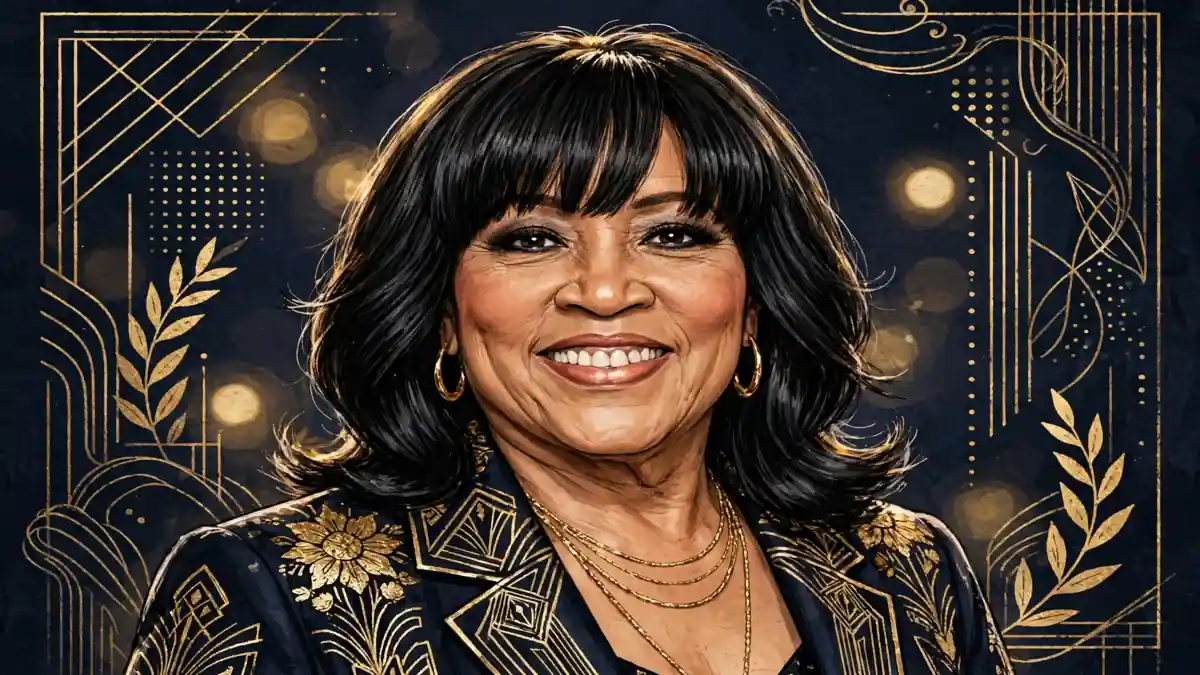
Jackée Harry‘s net worth is estimated at $3 million to $6.5 million as of October 2026. The spread is honest, not vague: the most conservative tracker, Celebrity Net Worth, puts her at $3 million, while Just Richest and several biography outlets put her at $6.5 million, and a handful of weaker roundups push the number to $8 million or more without showing their working. The truth sits inside that range, built slowly over nearly five decades in television — an Emmy-winning breakout on 227, six seasons as Lisa Landry on Sister, Sister, a long second act in syndication and daytime, and, since March 2021, a steady contract role as Paulina Price on Days of Our Lives.
Jackée Harry: Quick Facts
| Estimated net worth | $3 million to $6.5 million (range: $3 million to $6.5 million) |
|---|---|
| Profession | Actress, comedian, television personality |
| Nationality | American |
| Born | August 14, 1956 (age 70) |
| Height | 5 feet 7 inches (170 cm), as commonly listed |
| Primary income sources | Television acting, daytime soap contract, residuals and syndication, guest and voice roles, appearances |
| Active years | 1978–present |
| Last reviewed | October 2026 |
- Early Life and Background
- Education
- Career Journey
- Rise to Fame
- Main Sources of Income
- Salary and Earnings
- Businesses and Investments
- Brand Deals and Sponsorships
- Houses, Cars and Other Assets
- Awards and Achievements
- Net Worth Growth Over the Years
- Social Media Presence
- Personal Life
- Sources & Reporting
- Frequently Asked Questions
Early Life and Background
Jacqueline Yvonne Harry was born on August 14, 1956, in Winston-Salem, North Carolina, to Flossie Harry, who was Afro-Trinidadian, and Warren Harry. She was nine when the family moved to Harlem in New York City, and Harlem — not Winston-Salem — is the place she describes as home in interviews. Her mother worked as a hospital secretary, and Harry has spoken about growing up in a household where performance was encouraged early: at fourteen she played the King in a school production of The King and I, a lead role that, by her own later telling, settled something in her about where she belonged.
Two facts about that childhood matter for the money story that follows. First, Harry did not grow up inside the industry; there was no family connection to hand her a career, and the first decade of her working life was spent in classrooms and small theatres, not on television sets. Second, her mother died before 227 reached the air, so the role that made Harry famous arrived just after the person who had cheered it on most was gone — a detail Harry has returned to in interviews for forty years, and one reason she talks about the Sandra Clark years with a mixture of pride and grief rather than simple nostalgia.
Harry has a sister, Brenda, and brothers, and she has credited her sister Brenda Harry Free-Man with talking her into the Sister, Sister role years later, when Harry herself thought Lisa Landry was too young and too glamorous a character for a television mother. Family, in Harry’s telling, has repeatedly been the push behind the career decisions that paid best.
Education
Harry attended New York’s High School of Music and Art, the performing-arts school that fed directly into the city’s theatre scene, and then earned a Bachelor of Arts degree in education from Long Island University. She studied acting at the Henry Street Settlement on the Lower East Side, under Dick Anthony Williams, a teacher she has credited with convincing her that her talent could not be denied after a run of early rejections.
The education degree was not a fallback she never used. After graduating, Harry taught American history at Brooklyn Technical High School for two years before leaving teaching for acting full time. That two-year teaching stint is the least glamorous line on her résumé and, financially, one of the most telling: she entered show business as an adult with a profession to fall back on, and she has never, in any interview, described her career as an overnight success. The stage work that followed — her professional debut in Richard Wesley’s Goin’ Through Changes at the Billie Holiday Theatre in Brooklyn, and her Broadway debut in A Broadway Musical in 1978 — paid theatre wages, not television money. The fortune, such as it is, was built one contract at a time after that.
Career Journey
Harry’s television debut came in 1983, opposite Morgan Freeman, as Lily Mason on the NBC daytime soap Another World, a role she held into 1985. Daytime soaps were, then as now, steady-paying work rather than star-making work: five episodes a week, a regular cheque, and a large daytime audience that learned her face. That audience, and that discipline, carried straight into the role that changed her life.
In 1985 she joined the NBC sitcom 227 as Sandra Clark, the glamorous, man-chasing neighbour who sparred with Marla Gibbs’s Mary Jenkins in a Washington, D.C. apartment building. Harry was a series regular for four seasons and a recurring player in the fifth and final season, appearing in roughly 99 episodes across the show’s 1985–1990 run. The part was written as a foil; Harry played it as the show’s engine, and by the second season Sandra Clark was the character audiences quoted. NBC noticed: the network built a spin-off pilot around her, titled simply Jackée, which aired as a 227 episode in 1989 but did not go to series.
After 227, Harry worked the path that successful sitcom supporting players have always worked: a prestige television movie, The Women of Brewster Place (1989), opposite Oprah Winfrey; a seat in the ensemble of CBS’s The Royal Family (1991–1992) alongside Della Reese, stepping in after the sudden death of star Redd Foxx; and her first substantial film role, as assistant coach Julie Benson in the 1992 Rodney Dangerfield comedy Ladybugs. None of these paid like a series lead, but together they kept her visible through the early 1990s, when many sitcom actors fade from casting lists entirely.
The second act began in 1994. Sister, Sister, starring twins Tia and Tamera Mowry as long-separated sisters reunited as teenagers, cast Harry as Lisa Landry, Tia’s adoptive mother — a fashion designer, a single mother, and the show’s comic centre of gravity. Harry stayed for the full run: ABC in 1994–1995, then The WB from 1995 to 1999, six seasons and about 119 episodes. The show’s afterlife has been generous to her: it ran in syndication, found a second audience on streaming, and returned Harry to the screen as Lisa Landry for a 2014 guest spot on Instant Mom, playing the same character twenty years on.
The 2000s and 2010s filled out with recurring work rather than a third signature series: Vanessa, the gossipy salon owner, on Everybody Hates Chris (2006–2009, about 25 episodes); Delores Whitmore on BET’s Let’s Stay Together; Evelyn Rand on Girl Meets World; JoAnn Payne on OWN’s The Paynes (2018), the Tyler Perry spin-off of House of Payne; and, from 2012 to 2015, Pauletta Birdsong — the president’s sister-in-law — as a series regular on Byron Allen’s syndicated sitcom The First Family. Film work in the same period included You Got Served (2004) as Mama Smith, The Man in 3B (2015), and a run of television movies, including Christmas films in 2022, 2023, 2024 and 2025. Reality and game-show work — Celebrity Fit Club in 2005, Hollywood Squares, To Tell the Truth as a guest panellist, and Celebrity Weakest Link in 2025 — added appearance fees and kept her name in circulation between acting jobs.
Since March 2021, Harry has played Paulina Price on Days of Our Lives, the NBC soap that moved to Peacock. Paulina arrived as a wealthy businesswoman, became Salem’s mayor on screen, and has remained a regular presence through 2024, 2025 and into 2026, including the show’s Christmas spin-off Days of Our Lives: A Very Salem Christmas (2021). For an actress in her late sixties, a daytime contract is the steadiest income in American television: year-round production, a contracted per-episode rate, and a character with storylines rather than one-off guest slots.
Rise to Fame
Harry’s rise was not a single moment but a two-step climb separated by nearly a decade. Step one was Sandra Clark. 227 premiered in September 1985, and within two seasons Harry had won the 1987 Primetime Emmy Award for Outstanding Supporting Actress in a Comedy Series — the first African American woman to win in that category — beating Justine Bateman (Family Ties), Julia Duffy (Newhart), Estelle Getty (The Golden Girls) and Rhea Perlman (Cheers). Bruce Willis presented the award at the Pasadena Civic Auditorium on September 20, 1987. The win also brought a Golden Globe nomination, and it made Harry, briefly, the most talked-about supporting actress on network television.
Step two was Lisa Landry. Sister, Sister gave Harry a different audience — teenagers and their parents, rather than the adult sitcom crowd — and a different kind of fame: the show’s long syndication and streaming life means Lisa Landry has been discovered by new viewers in every decade since the 1990s, while Sandra Clark belongs to a specific broadcast era. Harry has said she initially resisted the part, thinking the character too young and too sexy to play a mother, and that her sister talked her into it. The two NAACP Image Awards she won for the role, in 1999 and 2000, are the formal record of a decision that paid off for six seasons.
What connects the two steps is a specific skill: Harry plays women who walk into a scene and take it over without raising their voices. Sandra Clark did it with innuendo; Lisa Landry did it with warmth; Paulina Price does it with authority. Casting directors have hired that skill, in one form or another, for forty years, which is why the résumé has no long empty stretch — and why the income, while never blockbuster-sized, never stopped either.
Main Sources of Income
Television acting is the trunk of Harry’s income, and it splits into four branches. The first is series-regular and recurring contracts: 227, Sister, Sister, The First Family and now Days of Our Lives each paid a contracted salary for months or years at a time, and daytime and syndicated work in particular is structured as reliable, year-round employment rather than a single lump sum.
The second branch is residuals. 227 and Sister, Sister both lived long second lives in syndication and on streaming services, and under Screen Actors Guild agreements, reruns and streaming reuse generate residual payments to performers. Harry herself has pointed to 227‘s weekend marathon runs on OWN as evidence of the show’s staying power; every one of those airings is also a small payment. No public figure exists for her residual income, and any outlet that prints one is guessing — but for a performer with two long-running, heavily rerun sitcoms, residuals are a real and continuing line, not a footnote.
The third branch is guest, voice and film work: one-off episodes, television movies (a steady market for her in the 2020s, with Christmas films in consecutive years), voice work such as Mothership in Disney’s Zombies: The Re-Animated Series (2024), and film supporting roles from Ladybugs to You Got Served. The fourth branch is appearances: reality television, game shows, talk shows, and the public-speaking and convention circuit that a performer with her recognition commands. One tracker, CineNetWorth, estimated her annual income at around $500,000 from residuals, guest roles and appearances combined — a plausible order of magnitude for a working veteran with a current daytime contract, but an estimate, not a reported salary, and we treat it as such.
What is absent matters too. Harry has no reported production company, no fashion or beauty line, no restaurant, and no headline endorsement deal. Her money is acting money, earned over a long time, which is exactly why the estimate is a range rather than a single confident number: there is no business valuation to anchor it, only a career’s worth of contracts and reruns.

Salary and Earnings
No verified per-episode salary for Harry has ever been published, and this article does not invent one. What can be said with confidence is structural: a network sitcom supporting player in the late 1980s, a WB sitcom regular in the late 1990s, a syndicated sitcom regular in the 2010s, and a daytime soap regular in the 2020s each sit in different pay bands, and Harry climbed through them in order. The 1980s money was the smallest in nominal terms but the most valuable in career terms, because 227 made her a name; the 1990s money, across six seasons of Sister, Sister, is the likeliest peak of her per-year acting income; the current Days of Our Lives money is the steadiest, because daytime soaps shoot year-round.
The published net-worth figures tell their own story about uncertainty. Celebrity Net Worth, the most widely cited tracker, lists $3 million. Just Richest lists $6.5 million as of 2026, and TheCityCeleb lists the same $6.5 million figure. CineNetWorth lists $8 million for 2025, while TheMost10 has published both $10 million and $12 million figures for 2026 on different pages — a spread so wide it discredits itself, since no single career event in 2025 or 2026 explains a doubling. Our range, $3 million to $6.5 million, keeps the two ends that have at least some corroboration and discards the outliers that do not. Readers who see a single number for Harry elsewhere should ask what that number is based on; in almost every case, the answer is another tracker, not a document.
One more honest limit: taxes, agents’ commissions (typically around 10 percent), managers’ fees, and the cost of maintaining a career in Los Angeles all come out of gross earnings before anything becomes net worth. A performer who earned steadily for forty years but never had a franchise-film payday or a producing windfall will, after those deductions, land exactly where Harry’s range lands: comfortable, not extravagant.
Businesses and Investments
Harry has no publicly documented business venture, startup investment, or product line. Searches of business reporting turn up no company founded by her, no equity stake announced, and no real-estate portfolio with a paper trail in her name. Some net-worth roundups credit her with “real estate investments” in passing, but none names a property, a purchase price, or a sale — and under our verification protocol, an unnamed asset is not an asset we count.
That absence is itself informative. Many celebrity fortunes in this price range are built on one business bet; Harry’s is built on employment. The closest thing to a business asset she holds is her professional reputation and her catalogue: two iconic characters that networks and streamers keep paying to rerun, and a daytime role that keeps her contracted in the present tense. If she holds stocks, retirement accounts or property, they are private holdings, and we do not assign them a value.
The one investment that is documented is the one she made in herself at the start: years of stage training and a teaching qualification before television paid anything at all. It is not a line on a balance sheet, but it explains why, when the sitcom work arrived, she was ready for it.
Brand Deals and Sponsorships
Harry has no headline endorsement deal on the public record — no beauty contract, no fashion line, no long-running commercial campaign with her name on it. That is unusual for a performer of her visibility and worth noting plainly rather than filling the gap with speculation. Her commercial value has always been her presence on screen, not her face on a product.
What she does have is the modern equivalent for a veteran performer: a lively social-media presence, frequent talk-show and convention appearances, and the kind of audience recognition that makes her a natural booking for nostalgia-driven programming — the 2019 live re-creation of The Jeffersons, which drew more than 22 million viewers, is the most-watched example. Appearance fees for that kind of work are real income, but they are episodic, not contractual, and no reliable figure exists for them.
Houses, Cars and Other Assets
No property purchase, sale, or mortgage record for Harry is publicly documented, and no car collection or luxury asset has been reliably reported. Biography outlets routinely describe her as Los Angeles-based — her career has been centred there since the 227 years — but a city is not an address, and we do not publish addresses or property claims without a record.
Readers should treat any article that lists a specific house value or car model for Harry with suspicion unless it cites a deed, a listing, or an interview in which she names it herself. We found none. The honest statement is that her material assets are private, and her public wealth is her career: the roles, the residuals, and the contract she holds now.
Awards and Achievements
Harry’s awards record is short, historic, and more valuable to her career than any single cheque. The headline is the 1987 Primetime Emmy Award for Outstanding Supporting Actress in a Comedy Series for 227, making her the first African American woman to win in that category — a first that stood alone for years, something Harry herself has noted with a mixture of pride and frustration, since no other Black woman has since won that particular prize. She was also nominated for a Golden Globe for the role.
She won the NAACP Image Award for Outstanding Supporting Actress in a Comedy Series for Sister, Sister in both 1999 and 2000, back-to-back wins that confirmed the second act was not a lesser version of the first. She was nominated for a Nollywood and African Film Critics Award for her film role in The Man in 3B (2015). Beyond trophies, the achievements that matter for the money story are structural: a spin-off pilot built around her by NBC in 1989; a six-season run on a show that outlived its original network; and a daytime contract at an age when most actresses are offered nothing at all.
Net Worth Growth Over the Years
Because no audited figures exist, the table below reconstructs the shape of Harry’s wealth from her career, not from tracker copy-paste. Early figures are necessarily approximate; the point is the curve — slow, steady, and still rising in her late sixties thanks to daytime work — rather than false precision.
| Period | Estimated position | What drove it |
|---|---|---|
| Late 1970s–early 1980s | Modest; theatre and teaching wages | Stage work, two years teaching history at Brooklyn Tech |
| 1983–1985 | Steady working-actress income | Another World as Lily Mason |
| 1985–1990 | Rising; first significant television money | 227 as Sandra Clark, Emmy win, spin-off pilot |
| 1991–1994 | Holding; ensemble and film work | The Royal Family, Ladybugs, The Women of Brewster Place |
| 1994–1999 | Peak earning years | Sister, Sister, six seasons as Lisa Landry |
| 2000s–2010s | Steady; residuals plus recurring roles | Everybody Hates Chris, The First Family, guest and film work, syndication residuals |
| 2021–present | $3 million to $6.5 million | Days of Our Lives contract as Paulina Price, television movies, voice and appearance work |
Two features of that curve stand out against her peers. First, there is no crash: no reported bankruptcy, lawsuit, or public financial reversal, which is rarer than it should be among performers with forty-year careers. Second, there is no spike: no franchise film, no producing deal, no business exit. Harry’s fortune is the compound interest of showing up, in good roles, for a very long time.
Social Media Presence
Harry is unusually active online for a performer of her generation, and her social presence is part of her current earning power rather than a hobby attached to it. She is known for direct, funny engagement with fans on X (formerly Twitter) — the Andscape profile of her in 2018 singled out how interactive she is there — and she maintains a public presence on Instagram and TikTok, where clips of Sandra Clark and Lisa Landry circulate constantly. That circulation is more than nostalgia; it is marketing for the reruns and streams that pay residuals, and it keeps her bookable for the talk shows, conventions and reunion programming that fill gaps between acting contracts.
The streaming afterlife deserves emphasis, because it changed the economics of Harry’s back catalogue. When Sister, Sister moved to streaming services, a show that had already paid its cast once began paying them again, in residuals, for a new audience that had not been born when it first aired. The same is true of 227 in syndication: weekend marathon blocks on OWN, which Harry herself cited in 2018 when asked whether audiences recognised her more as Sandra Clark or Lisa Landry, keep both the character and the residual cheques alive. For a performer without a producing stake, this is the closest thing to passive income television offers — small payments, arriving often, for work done decades ago.
Stage work has remained a thread through the television career, and it explains part of Harry’s durability. She returned to the stage as Billie Holiday in Lady Day at Emerson’s Bar and Grill in 1994, the same year Sister, Sister premiered, and played the Madam in The Boys From Syracuse on Broadway in 2003. Theatre does not pay television money, but it keeps an actor’s craft sharp between screen jobs, and it keeps casting directors aware that the performer is still working. Harry’s career has very few fallow years, and the stage credits help explain why: she never waited for the phone to ring.
Unlike younger stars, Harry does not appear to monetise her accounts through sponsored posts at any visible scale, and we found no reported social-media income figure worth repeating. Her accounts function as a shop window for a working actress, not as a business in themselves.
Personal Life
Harry was married to arranger and conductor Jerry Jemmott from 1980 to 1984. In 1996 she married Elgin Charles Williams, a celebrity hairstylist later known from the VH1 reality series Beverly Hills Fabulous; they divorced in 2003. During that marriage, in 1997, the couple adopted a son, Frank. Harry has spoken openly about wanting a child for years before the adoption, including in an early appearance on The Oprah Winfrey Show, and about the closeness of her relationship with Frank since. She is also a grandmother to two grandchildren, a role she has described with evident delight in interviews.
Some biography pages claim additional marriages; the two documented marriages above are the ones supported by reliable sources, and we do not repeat the rest as fact. Harry is not currently reported to be married. She has kept her private life notably free of scandal across four decades in public — no public legal or financial controversy attaches to her name — which, for a net-worth profile, is a material fact: there are no known judgments, settlements or debts dragging the estimate down.
Sources & Reporting
Celebrity Net Worth — the $3 million estimate, the low end of our range, and the most widely cited tracker figure for Harry.
Just Richest — the $6.5 million estimate for 2026, the high end of our range, attributing her wealth to acting, television personality work and public speaking.
Wikipedia — birth date and place, education, career chronology, awards, marriages and adoption, drawn from its Jackée Harry entry and checked against the sources below.
BlackPast — early life, Harlem upbringing, stage debut, Another World and 227 history, and the Emmy milestone.
Andscape — the 1987 Emmy ceremony detail, the nominees she beat, and her 2018 reflections on 227, Sister, Sister and The Paynes.
The A.V. Club — first-person interview covering 227, Ladybugs, Everybody Hates Chris and her early ambition for dramatic roles.
TV Insider — career chronology, teaching years, and 2024–2026 credits including Days of Our Lives and recent television movies.
CineNetWorth — the $8 million 2025 figure (treated here as an outlier) and the estimated $500,000 annual income from residuals, guest roles and appearances.
Reporting window: career records and tracker figures as published through October 2026. Where sources conflict — notably on height (5 feet 7 inches in most listings, 5 feet 8 inches in one) and on net worth — this article publishes the range and names the disagreement rather than picking a winner.
Frequently Asked Questions
What is Jackée Harry’s net worth in 2026?
Jackée Harry’s net worth is estimated at $3 million to $6.5 million as of October 2026. Celebrity Net Worth lists $3 million, while Just Richest lists $6.5 million. Higher figures of $8 million to $12 million appear in weaker roundups without supporting evidence, so we do not use them.
How did Jackée Harry make her money?
Almost entirely from television acting: series-regular roles on 227 and Sister, Sister, a syndicated run on The First Family, and her current Days of Our Lives contract, plus residuals from reruns and streaming, guest and voice roles, television movies, and appearance fees. She has no reported business or endorsement empire.
What was Jackée Harry’s first big role?
Her television debut was Lily Mason on the soap Another World in 1983, but her breakout was Sandra Clark on the NBC sitcom 227 (1985–1990), which won her the 1987 Emmy for Outstanding Supporting Actress in a Comedy Series.
Why is Jackée Harry’s Emmy win historic?
She was the first African American woman to win the Primetime Emmy Award for Outstanding Supporting Actress in a Comedy Series, beating Justine Bateman, Julia Duffy, Estelle Getty and Rhea Perlman in 1987.
Who did Jackée Harry play on Sister, Sister?
Lisa Landry, the adoptive mother of Tia Landry (played by Tia Mowry) — a fashion designer and single mother who was the show’s comic centre across six seasons from 1994 to 1999. She won two NAACP Image Awards for the role.
Is Jackée Harry still on Days of Our Lives?
Yes. She joined Days of Our Lives as Paulina Price in March 2021 and has remained a regular on the show, which moved from NBC to Peacock, through 2024, 2025 and into 2026.
How old is Jackée Harry?
Jackée Harry was born on August 14, 1956, in Winston-Salem, North Carolina, making her 70 years old as of October 2026.
Is Jackée Harry married, and does she have children?
She is not currently reported to be married. She was married to Jerry Jemmott (1980–1984) and to Elgin Charles Williams (1996–2003), with whom she adopted a son, Frank, in 1997. She is also a grandmother to two grandchildren.
Final Thoughts
Jackée Harry’s fortune is best understood as a working actress’s fortune, not a mogul’s. The $3 million to $6.5 million range reflects forty-plus years of contracts rather than one windfall: an Emmy-winning sitcom that still reruns, a second sitcom that found new audiences on streaming, and a daytime soap contract that keeps paying in her seventies. No business exit inflates the number, and no scandal deflates it.
That steadiness is the story. Plenty of performers earn more in a single year than Harry has in a decade; very few are still holding a regular television job at seventy, with two characters the culture still quotes. If the Days of Our Lives run continues and the Sister, Sister catalogue keeps streaming, the top of the range — not the bottom — is where the next revision will likely land.
Published on October 31, 2026. Last reviewed October 2026. Found an error? See our corrections policy.