
Al Snow‘s net worth is estimated at $500,000 to $3 million as of November 2026. The spread is wide because no reliable outlet has published an audited figure for the former WWE star, and the two most repeated public estimates sit at opposite ends of that range. Snow built his money the slow way: a decade on the independent circuit, a ten-year run with WWE during its hottest commercial period, seven years as a backstage agent for TNA, and then the riskiest move of his career — buying Ohio Valley Wrestling, the Louisville promotion that trained John Cena, Brock Lesnar, Randy Orton and Batista, and trying to keep it alive through a pandemic, a majority-stake sale, and a second sale in 2025.
Al Snow: Quick Facts
| Estimated net worth | $500,000 to $3 million (range: $500,000 to $3 million) |
|---|---|
| Profession | Professional wrestler, trainer and promoter |
| Nationality | American |
| Born | July 18, 1963, Lima, Ohio (age 63) |
| Height | 6 ft 1 in (185 cm) |
| Primary income sources | WWE earnings (1995–2008), TNA road-agent work (2010–2017), OVW ownership and training school, acting, appearances and book sales |
| Active years | 1982–present |
| Last reviewed | November 2026 |
- Early Life and Background
- Education
- Career Journey
- Rise to Fame
- Main Sources of Income
- Salary and Earnings
- Businesses and Investments
- Brand Deals and Sponsorships
- Houses, Cars and Other Assets
- Awards and Achievements
- Net Worth Growth Over the Years
- Social Media Presence
- Personal Life
- Sources & Reporting
- Frequently Asked Questions
- Final Thoughts
Early Life and Background
Allen Ray Sarven was born on July 18, 1963, in Lima, Ohio, a factory city in the northwest of the state. He grew up in the orbit of the regional wrestling circuit that ran through Ohio in the 1970s, when local promoters still drew crowds to armories and fairgrounds and a teenager could watch a whole business model play out from a folding chair. Sarven has described his break into the business in plain terms: he attended a professional wrestling try-out camp run by Ole Anderson and Gene Anderson, and there he met Jim Lancaster, promoter of Ohio’s Midwest Championship Wrestling, who agreed to train him. That camp, not a big-league tryout, was the door.
His debut came on May 22, 1982, when he was 18. The early years were the classic territory grind. Sarven wrestled across the Midwest through the 1980s and into the early 1990s, picked up singles and tag titles in small promotions, and shared rings with established names including Harley Race, Bruiser Brody, Kerry Von Erich, Ken Patera, Curt Hennig and Jimmy Garvin. On May 5, 1985, he beat Lancaster himself for the Midwest Championship Wrestling title. The money in that world was modest — payoffs per show, long drives, no contract security — and it explains a pattern that runs through Snow’s whole financial story: he never had one big payday. He accumulated income across decades of steady work rather than a single peak contract.
By the early 1990s he had earned a reputation in the business as one of its best-kept secrets: a technically sound worker who could make anyone look good, which is why promoters kept booking him even when television never made him a star. He worked as a jobber on WWF television in 1993 under the name Steve Moore, losing to Marty Jannetty and The Undertaker. He wrestled masked as Shinobi, a ninja-style gimmick, and entered the November 19, 1994, tournament for the vacant NWA World Heavyweight Championship, losing to Chris Candido, who went on to win it. He also helped train Dan Severn, the future UFC Hall of Fame member and NWA World Heavyweight Champion, during this period — early evidence of the coaching skill that would become his most durable income stream.
Education
No reliable public record names a college or university Al Snow attended, and this article does not invent one. His documented education was vocational and happened in wrestling rings: training under Jim Lancaster after the Anderson brothers’ try-out camp, then a decade of learning the trade on the road in Midwest promotions. That distinction matters for his money story. Snow’s later training business — first his own school, then the OVW academy — was built on that ring education, not on a degree. From 1995 to 1997 he ran a school called Body Slammers in Lima, Ohio, hiring D’Lo Brown as an assistant trainer. The school gave him his first taste of income that did not depend on his own body holding up, a lesson he returned to for the rest of his career.
Career Journey
Snow’s first national exposure came in Jim Cornette’s Smoky Mountain Wrestling, where he teamed with Unabomb — the man who later became Kane, real name Glenn Jacobs — as the Dynamic Duo and won the SMW Tag Team Championship from the Rock ‘n’ Roll Express. The pairing is a useful measure of Snow’s standing at the time: he was trusted to work with a future main-event talent before that talent was famous, and the title run put him on the radar of the two companies that mattered.
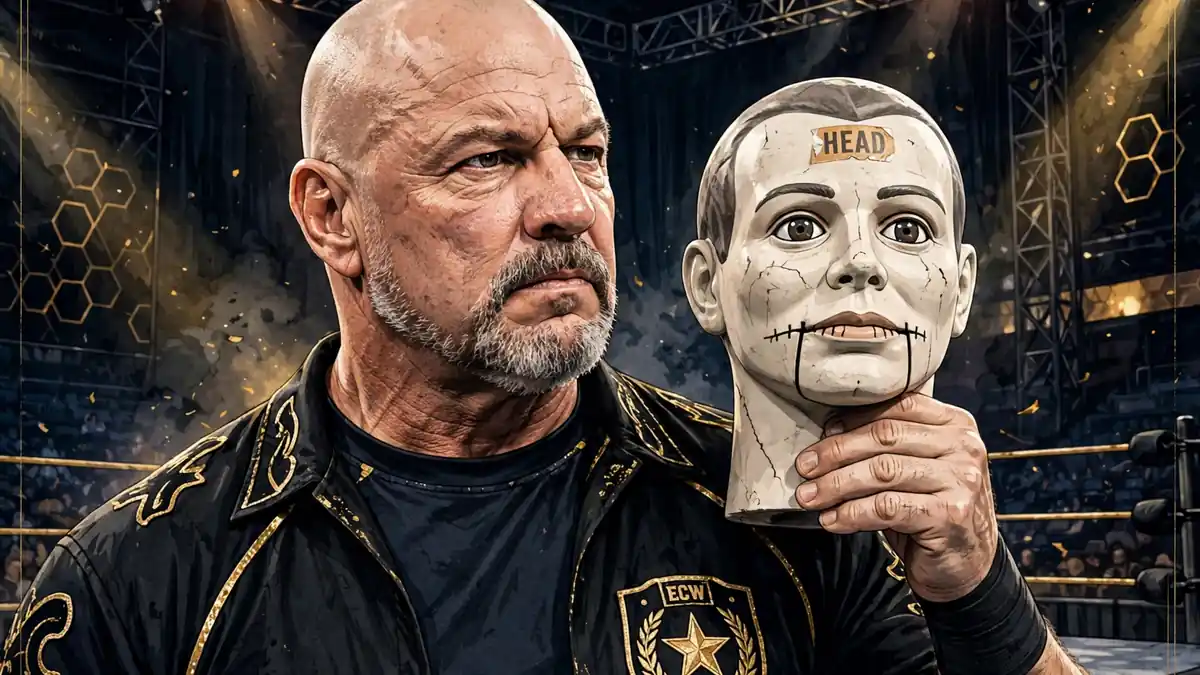
He joined Extreme Championship Wrestling in 1995 and, after a short first WWF run under gimmicks that went nowhere, came back to ECW in 1997 and found the character that changed his life. The story, as Snow has told it, starts with reading about abnormal psychology and finding a mannequin head on the street near the ECW Arena during a Mummers Day parade. He built a character around it: a wrestler coming apart, talking to the head, projecting his thoughts onto it. In ECW’s hardcore, adult-skewing rooms, the act caught fire. Fans chanted “Head” back at him. The J.O.B. Squad storyline — Snow as a man driven to the edge by years of losing as a jobber — gave the gimmick an emotional spine that most comedy acts never get.
WWF recalled him in May 1998, and the Head act arrived on national television at exactly the right moment. The company was in the Attitude Era, its ratings were climbing, and a character who talked to a mannequin head fit a show that rewarded noise. Snow fought himself in a hardcore match and won by putting himself through a table. He feuded on the microphone with Jerry Lawler. He teamed with Head and lost to Too Much at King of the Ring, beat Sgt. Slaughter in a boot camp match on Monday Night Raw on September 15, 1998, and beat Marc Mero at Judgment Day: In Your House. He entered the tournament for the vacant WWF Championship at Survivor Series 1998, beating Jeff Jarrett before losing to Mankind in the second round. The J.O.B. Squad followed him to WWF, with Bob Holly and 2 Cold Scorpio alongside him.
The title runs came in 1999. Snow formed a genuine friendship and a championship team with Mick Foley, wrestling as Mankind: the pair beat the Holly cousins for the WWF Tag Team Championship, then dropped the belts to the New Age Outlaws six days later. Snow’s first Hardcore Championship reign came at Backlash 1999, when he beat Bob Holly; he would win that belt six times in total. The feud with Big Boss Man produced one of the era’s most notorious matches, the Kennel From Hell, a cage match with untrained live dogs at ringside, built on a storyline in which Boss Man cooked Snow’s dog Pepper and fed it to him. In the summer of 1999, after Head was impaled with a spike by Prince Albert in storyline, Snow replaced the mannequin with a chihuahua actually named Pepper, who he claimed talked to him.
Off the ring, the Head act made mainstream news in 1999 when Wal-Mart pulled Snow’s action figure from shelves after Sabrena Parton, a professor at Kennesaw State University, complained that the figure’s “Head” accessory was a decapitated woman’s head that sent an inappropriate message about violence toward women. The controversy cost him a retail placement and gave him free publicity in the same week — a fair summary of how the gimmick worked commercially.
By 2000 Snow was working a comedy tag team with Steve Blackman called Head Cheese, losing to Test and Albert at WrestleMania 2000, and later that year he won the WWF European Championship from Perry Saturn. He played the title for laughs, entering to each host country’s native music, with his theme sung in that country’s language, wearing attire matched to the stereotype, until he lost the belt to William Regal. His last championship reign came on March 11, 2002, when he beat Goldust for his sixth and final Hardcore Championship; he lost it days later to Maven, his own former Tough Enough student. He was drafted to SmackDown in the 2002 brand extension, and his in-ring role gradually shifted toward coaching, commentary and backstage work.
Snow had already become a television coach. He appeared as a coach on WWF Tough Enough during its first three seasons, the show that turned training into reality television and gave him a second public identity as a teacher. In 2007 WWE named him head trainer of Ohio Valley Wrestling, its developmental territory, where he worked with Cody Rhodes, Shawn Spears and Aron Stevens, then known as Damien Sandow. When WWE ended its OVW affiliation in February 2008, Snow was released from his trainer role and left the company after a decade.
He moved to Total Nonstop Action Wrestling, where he worked as a road agent from 2010 to 2017 — the backstage job of laying out matches, timing segments and keeping a live show on track — while also appearing on screen and wrestling occasionally. A road-agent salary is a working wage, not star money, but it was steady for seven years and it kept him inside the business while his in-ring career wound down. He also opened his own training school in 2015, rebuilding the Lima model on a larger stage.
Rise to Fame
Snow’s rise is unusual because it happened twice, and the second time was worth more than the first. The first rise was the ECW-to-WWF jump of 1997–1998, when a character built from a found mannequin head carried a 15-year independent veteran onto Monday Night Raw during the highest-rated period in wrestling history. The second rise came 25 years later, when Netflix released Wrestlers on September 13, 2023, a seven-episode docuseries from BBC Studios Los Angeles, directed and executive produced by Greg Whiteley, the creator of Cheer and Last Chance U. The show followed OVW as Snow tried to save it, and it introduced him to an audience that had never watched a wrestling match. WrestlingInc reported in October 2026 that Snow, at 63, still wrestles occasionally in OVW and was still talking publicly about when he would retire — on his own condition, he said, that he would stop when the day came that he became an embarrassment in the ring.
His most recent match before that report came in April 2025, according to WrestlingInc, and on August 27, 2022, he teamed with Doug Basham to beat Adam Revolver and Joe Mack at OVW’s The Big One event. The long tail matters financially: a wrestler who stays visible at 63 can still sell appearances, signings and training, while a wrestler who disappears at 40 cannot. Snow’s fame was never top-of-the-card fame, but it proved durable, which is the rarer asset.
Main Sources of Income
Snow’s income has come from five distinct streams, and their order of importance changed with each decade of his life. In the 1980s and early 1990s, it was independent bookings and small-promotion title runs — low nightly pay, high volume. From 1995 to 2008, it was a WWE contract: a guaranteed downside, pay-per-view bonuses, merchandise royalties and video-game appearances. He appeared in 12 wrestling video games catalogued by The SmackDown Hotel, a royalty stream that continues to pay in small amounts as older titles are re-sold and re-licensed.
From 2010 to 2017, the anchor was TNA road-agent pay, supplemented by independent dates and appearances. From 2018 onward, the anchor became OVW itself: ticket sales, television and streaming distribution, training-school tuition and sponsorships. Around that sits a fifth stream that has grown with age — acting roles, convention appearances, his book Self Help: Life Lessons from the Bizarre Wrestling Career of Al Snow, and paid bookings through agencies such as MN2S, which lists him as a bookable talent for appearances. None of these streams on its own explains a fortune. Together, over 44 years, they explain a working wrestler’s comfortable living — and also explain why no outlet can pin a single number on him.
Salary and Earnings
No contract figure for Al Snow has ever been published, and this article will not invent one. What can be said with confidence is where he sat in WWE’s pay structure. Snow was a midcard act, not a main-event draw, during 1998–2008. WWE midcard contracts of that era paid a guaranteed downside plus bonuses tied to pay-per-view buyrates, merchandise and live-event gates; the top stars earned many times what the middle of the roster earned, and Snow’s earnings reflected his slot. His six Hardcore Championship reigns and his European and Tag Team title runs kept him on television, which kept his bonuses flowing, but he never held the company’s top championship and never headlined a pay-per-view as a singles star.
The same honest limit applies to his later roles. TNA road agents were salaried backstage staff, paid a steady wage for a touring job — solid, unglamorous income. OVW’s finances point the other way. The official Netflix synopsis for Wrestlers, reported by Variety and repeated by Post Wrestling, ComicBook.com and others in August 2023, states plainly that OVW “struggles week to week to stay relevant enough to keep its doors open,” that Snow had to sell a majority stake, and that even after new owners infused cash, the promotion “still operates at a staggering loss.” A business losing money is not an asset that adds to its owner’s net worth in the year it loses money — it is a liability he was funding. Any estimate of Snow’s wealth that ignores the OVW losses is incomplete.
For scale, consider his peers from the same OVW lineage. Dwayne Johnson’s net worth runs into hundreds of millions because he left wrestling for film; John Cena’s net worth follows the same path. Snow stayed in wrestling. That single career choice — trainer and promoter rather than Hollywood — is the main reason his fortune sits in the low single millions at most, while the men he trained became global stars. The comparison is not a criticism; it is the arithmetic of the business.
Businesses and Investments
Snow’s business life has three chapters, and each one changed his net worth in a different direction. Chapter one was Body Slammers, his Lima wrestling school from 1995 to 1997, with D’Lo Brown as assistant trainer. It was small, local and profitable enough to run for two years, and it taught him that tuition income did not require him to take bumps.
Chapter two began in April 2018, when WDRB in Louisville reported that Snow had purchased Ohio Valley Wrestling from founder Danny Davis. He bought it with two business partners, according to Kentucky to the World’s profile, with a stated goal of building a 12-month, full-time training program that taught writing, fitness, nutrition, on-camera presentation, character development and financial management alongside ring work — a curriculum no other school offered at that breadth. The Al Snow Wrestling Academy grew out of that purchase. OVW already carried history: founded by Danny Davis in 1993, it served as WWE’s primary developmental territory from 2000 to February 2008, then as TNA’s developmental territory from November 2011 to November 2013 and again from March 2019. Its alumni list — Cena, Lesnar, Orton, Batista, The Miz — is the promotion’s most valuable asset, and Snow bought the name, the building and that lineage.
The pandemic broke the model. Live-event income collapsed, and in January 2021 Snow sold a majority interest in OVW to a group led by radio host Matt Jones and Craig Greenberg, the former 21c Museum Hotels chief executive who later became mayor of Louisville. Snow stayed on to run day-to-day operations, but he no longer owned the majority of the company he had bought three years earlier. Selling a majority stake in a distressed business rarely produces a windfall; it usually produces enough cash to keep the business alive, with the seller’s equity reduced. That is the most reasonable reading of the 2021 deal, and it is a key reason this article’s range stays wide rather than climbing toward the top end.
Chapter three closed in 2025. On April 7, 2025, Matt Jones announced that Morley Sports Management, a UK-based sports consulting firm and owner of Haverfordwest County, had acquired a majority shareholding stake in OVW, effective May 1, 2025, with Morley founder Rob Edwards becoming chief executive. Jones, Greenberg, Andrew Jefferson, Jeffrey Tuvlin and Snow remained as advisors and minority owners. Snow’s stake shrank a second time. He kept a minority holding and an advisory role, but the days of him owning the promotion outright were over. No purchase price has been published for either the 2018 purchase, the 2021 sale or the 2025 sale, and no figure in this article is derived from guessing at those prices.
Beyond OVW, Snow’s documented business interests are his training schools and his book. No property portfolio, stock holding or company filing in his name has been published, and the vague claims on some net-worth aggregator sites about “investments in stocks and real estate” carry no named source and are not repeated here as fact.
Brand Deals and Sponsorships
Snow never carried a major national endorsement deal, and that absence is itself informative. His commercial value sat in wrestling merchandise — action figures, T-shirts and video games — rather than outside sponsorship. The most famous merchandise story attached to him is a negative one: Wal-Mart pulling his action figure in 1999 after the complaint about the Head accessory. A pulled figure is lost royalty income, not gained income, and it shows how a controversial gimmick can cost as well as pay.
In the OVW era, sponsorship moved to the promotion level rather than the individual. OVW’s distribution deals — including the addition of Game+ as a broadcast platform, reported by Forbes contributor Alfred Konuwa with a comment from Snow as owner — brought money into the company, not directly into Snow’s pocket, and after 2021 most of that money belonged mostly to other shareholders. His modern commercial income is appearance-based: convention signings, comedy-club and speaking bookings such as his 2023 Zanies Chicago listing, and agency bookings through MN2S. These pay per event, in the low thousands of dollars per appearance at his level of fame, and they depend on him staying visible — which the Netflix series helped him do.
Houses, Cars and Other Assets
Public records do not document a house, car collection or property portfolio for Al Snow, and this article does not guess at addresses or vehicles. What is documented is where he has lived and worked: born in Lima, Ohio, based for years in Louisville, Kentucky, where OVW operates, with an earlier residence listed as Louisville in biographical records. Louisville is a mid-cost city, and a promoter based there is not carrying the housing costs of a Los Angeles or New York celebrity. That geography is part of the financial picture: Snow’s overhead has always been regional, not coastal, which stretches a midcard wrestler’s earnings further than the same money would stretch in a major media city.
His tangible assets, as far as the public record shows, are the wrestling business itself: his minority stake in OVW, his training-school operation, his ring gear and memorabilia, and the intellectual value of the Al Snow character and the Head gimmick, which still sells merchandise and appearance bookings. The OVW stake is the only asset with plausible six-figure value, and after two dilutions — 2021 and 2025 — it is worth less to him than it was in 2018. No car collection, watch collection or real-estate portfolio has been reported for him, and aggregator claims to the contrary carry no source.
Awards and Achievements
Wrestling has no single awards body, so Snow’s record is measured in championships, and his is long. In WWF/WWE he won the Hardcore Championship six times, the European Championship once, and the Tag Team Championship once, with Mankind. The SmackDown Hotel’s profile credits him with 10 championships in major promotions, and his full record across independent promotions runs far longer: the SMW Tag Team Championship with Unabomb, the GWA Heavyweight and Junior Heavyweight Championships, five GWA Tag Team Championships with Mike Kelly, two GLCW Heavyweight Championships, the JAPW Heavyweight Championship, the NWA Bluegrass Heavyweight Championship, the QPW Tag Team Championship and more than 50 title wins claimed in his Kentucky to the World profile.
His coaching record may outlast his title record. As OVW head trainer in 2007 he worked with Cody Rhodes, Shawn Spears and Aron Stevens. As owner and head trainer from 2018 onward he built the academy that Netflix filmed. His television record includes coaching the first three seasons of Tough Enough, a show that turned wrestling training into a mainstream format. And his acting record, while secondary, is real: film roles including Overtime (2011), The Legacy and Hell House, in which he played the serial killer Grim, plus television and commentary work. None of these achievements came with a prize purse. Their financial value was indirect: they kept him employed, visible and bookable for four decades.
Net Worth Growth Over the Years
Year-by-year net worth figures for Snow have never been published, so the table below is an honest reconstruction by career phase, not a set of sourced annual balances. It shows direction, not precision, and it is the only growth table this article can defend.
| Period | Financial position | What drove it |
|---|---|---|
| 1982–1994 | Modest; living from bookings | Independent circuit pay, small-promotion titles, no national contract |
| 1995–1998 | Rising | ECW exposure, Body Slammers tuition, first WWF run |
| 1998–2008 | Peak earning years | Full-time WWE contract, six Hardcore reigns, merchandise and video-game royalties, Tough Enough coaching |
| 2008–2017 | Steady, lower | TNA road-agent salary, independent dates, own school from 2015 |
| 2018–2020 | Capital at risk | OVW purchase; owner income replaced by owner costs |
| 2021–2023 | Diluted | Majority stake sold to Jones–Greenberg group; Netflix exposure raised his booking value |
| 2024–2026 | Minority owner, working | Second dilution to Morley Sports Management in 2025; still wrestling occasionally and training |
The shape of that table is the argument against a large fortune: Snow’s peak earning decade ended in 2008, and the 18 years since have been spent largely funding, then selling down, a loss-making promotion. A wrestler who retired into commentary or acting after 2008 would have banked more. Snow reinvested in wrestling, and wrestling — at OVW’s scale — did not return the investment in cash. What it returned was a legacy, a school and a Netflix series.
Social Media Presence
Snow’s social footprint is modest by modern wrestling standards and consistent with a performer whose peak came before social media existed. His booking listing for Zanies Chicago in 2023 gave his Instagram handle as @TheRealAlSnow with more than 60,000 followers at that time. That figure is a booking listing, not a live count, and this article does not present it as current. He posts as a working promoter and trainer — OVW shows, training clips, appearances and throwbacks to the Head era — rather than as a lifestyle influencer, and he has no documented income from sponsored social posts. His audience is concentrated and loyal: Attitude Era fans, OVW regulars and wrestling-history followers, the same people who buy tickets to independent shows and pay for signings.
Personal Life
Snow has been married three times. He married Pam Sarven in 1986, and the couple had two children before divorcing in 2004. His second wife was fellow wrestler Cynthia Lynch, who wrestled as Bobcat; they married in 2009 and divorced in 2015, with some records giving 2016 as the year the divorce was finalized. In 2017 he married Jessica Gousha. The children’s names have not been published in reliable sources and are not named here.
One personal story from outside wrestling earned him wider press. In 2021, Snow saved a child from an ocean riptide at Santa Rosa Beach in Florida, an act reported in wrestling media and repeated in his biographical profiles. It fits the public image he built at OVW: a veteran who takes responsibility for younger people, in the water as in the ring. He remains based in the Louisville area for his OVW work, and at 63 he still steps into the ring on occasion — most recently in April 2025 — while working as a trainer and advisor.
Sources & Reporting
CelebsMoney — published the low-end estimate of $100,000 to $1 million for Snow, last updated January 2024, and supplied his birth date, Lima origin and six Hardcore Championship reigns. Its range is broad and dated, which is why this article treats it as a floor, not a verdict.
NetWorthList and FamousNetwork — both repeat a $3 million figure for Snow, with no named methodology and no primary source. That figure supplies the top of this article’s range and is flagged as unsourced wherever it appears.
Wikipedia (Al Snow; Ohio Valley Wrestling) — supplied the verified career spine: birth name Allen Ray Sarven, July 18, 1963, Lima; debut May 22, 1982; trainer Jim Lancaster; billed height 6 ft 1 in; the 2018 OVW purchase, the January 2021 majority sale to the Jones–Greenberg group, and the April–May 2025 Morley Sports Management acquisition leaving Snow as advisor and minority owner; three marriages and two children.
WrestlingInc — reported in October 2026 that Snow, at 63, still wrestles occasionally in OVW and discussed his retirement condition in an interview with Maven Huffman; and in May 2025 covered his move into training, his 2015 school and his 2018 OVW purchase, with his most recent match then dated April 2025.
WDRB (Louisville) — first reported on April 6, 2018, that Snow had purchased Ohio Valley Wrestling, the local report cited by Wikipedia and later wrestling coverage.
Variety via Post Wrestling, ComicBook.com and 411mania — reported the September 13, 2023, Netflix premiere of Wrestlers, its seven episodes, its Greg Whiteley direction, and the official synopsis stating OVW operated at a loss and Snow had sold a majority stake to keep it open.
Kentucky to the World — profiled Snow’s career and OVW academy, including the 12-month training curriculum, the two business partners in the 2018 purchase, and the claim of at least 50 championship titles.
The Sportster — supplied the detail of the six Hardcore reigns, the Tag Team Championship with Mankind, the New Rockers run as Leif Cassidy, and the SMW title with Unabomb.
The SmackDown Hotel — catalogued 10 championships in major promotions, 12 video-game appearances, and his billed height and weight.
Zanies Chicago — listed Snow’s Instagram handle @TheRealAlSnow at more than 60,000 followers in 2023 and his book Self Help: Life Lessons from the Bizarre Wrestling Career of Al Snow.
Reporting window: career records span 1982–2026; net-worth estimates cited were published between 2018 and 2024, with OVW ownership changes confirmed through May 2025 and Snow’s active status confirmed in October 2026. No outlet cited here publishes an audited net worth for Snow, and no figure in this article should be read as one.
Frequently Asked Questions
What is Al Snow’s net worth in 2026?
Al Snow’s net worth is estimated at $500,000 to $3 million as of November 2026. Published estimates disagree sharply — CelebsMoney gives $100,000 to $1 million, while NetWorthList and FamousNetwork repeat $3 million — and no audited figure exists, so a range is the only honest answer.
How did Al Snow make his money?
Through a 44-year wrestling career: independent bookings in the 1980s and early 1990s, a WWE contract from 1995 to 2008, seven years as a TNA road agent from 2010 to 2017, ownership of Ohio Valley Wrestling from 2018, training-school tuition, acting roles, appearances and book sales.
Does Al Snow still own OVW?
Only a minority stake. He bought OVW in 2018, sold a majority interest to a group led by Matt Jones and Craig Greenberg in January 2021, and in May 2025 Morley Sports Management acquired a majority shareholding, leaving Snow as an advisor and minority owner.
What is Al Snow’s real name and age?
His real name is Allen Ray Sarven. He was born on July 18, 1963, in Lima, Ohio, which makes him 63 years old in November 2026.
What was the Head gimmick?
In ECW in 1997, Snow built a character around a mannequin head he had found near the ECW Arena, playing a wrestler who talked to the head and projected his thoughts onto it. The act moved with him to WWF in May 1998 and became one of the Attitude Era’s most remembered comedy characters.
How many championships did Al Snow win?
In WWF/WWE he won the Hardcore Championship six times, the European Championship once and the Tag Team Championship once, with Mankind. Across all promotions his title count runs into the dozens, including the SMW Tag Team Championship with Unabomb, later known as Kane.
Is Al Snow still wrestling?
Yes, occasionally. WrestlingInc reported in October 2026 that he still wrestles from time to time in OVW, with his most recent match before that report coming in April 2025, and that he plans to retire when he feels he has become an embarrassment in the ring.
Who is Al Snow’s wife?
Al Snow has been married three times: to Pam Sarven from 1986 to 2004, with whom he has two children; to fellow wrestler Cynthia Lynch, known as Bobcat, from 2009 to 2015; and to Jessica Gousha, whom he married in 2017.
Final Thoughts
Al Snow’s money story runs against the usual celebrity arc. He never had a breakout payday, never left wrestling for a bigger industry, and spent his later years buying the very kind of small promotion that made him — then selling most of it twice to keep it alive. The $500,000 to $3 million range reflects that reality: a long, well-paid working career on one side, and a loss-making business plus two dilutions on the other. The top-end $3 million figure, repeated without a source, looks generous against the documented OVW losses; the low-end CelebsMoney range looks cautious against a decade of WWE earnings plus 44 years of work. The truth most likely sits between them, closer to the middle than either edge. What is not in doubt is the career itself: a man who turned a discarded mannequin head into a television character, a coaching job into a school, and a school into ownership of one of wrestling’s most storied training grounds — and who, at 63, is still in the building.
Published on November 1, 2026. Last reviewed November 2026. Found an error? See our corrections policy.