
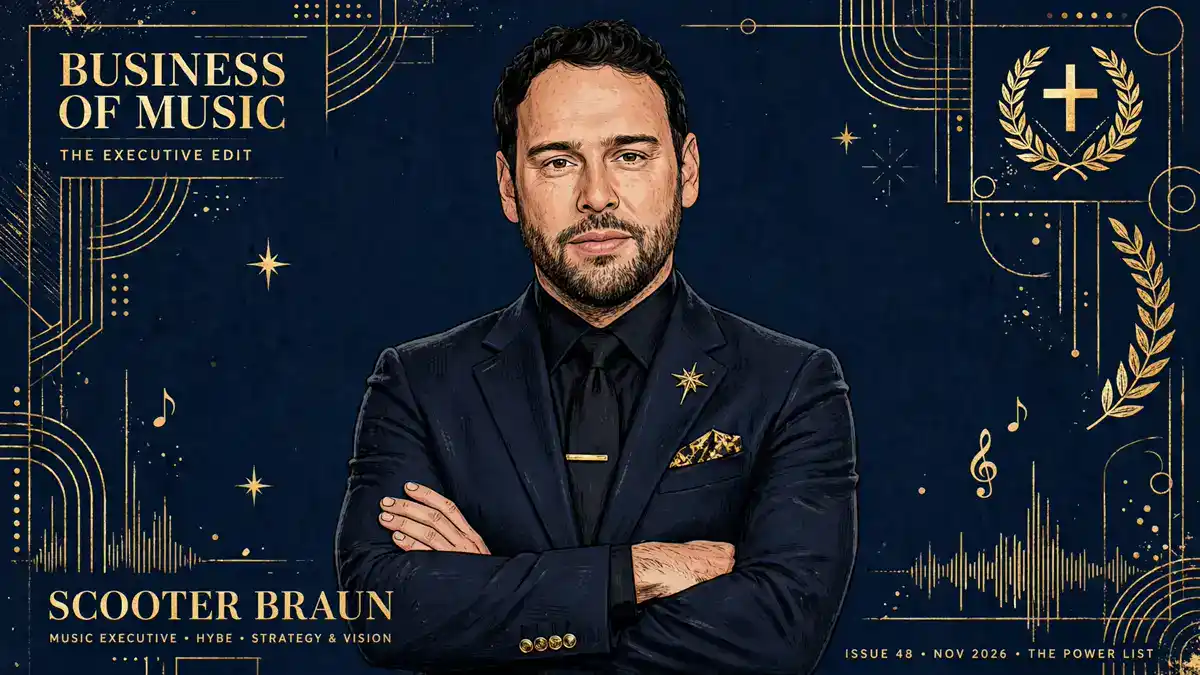
Scooter Braun‘s net worth is estimated at $400 million to $1 billion as of November 2026. The spread is wide because Braun’s fortune sits mostly in private deals, not public filings: the headline number comes from his 2021 sale of Ithaca Holdings to HYBE, while the lower end reflects taxes, a costly divorce, and the fact that he has since stepped back from the day-to-day roles that generated his biggest paydays.
Scooter Braun: Quick Facts
| Estimated net worth | $400 million to $1 billion (range: $400 million to $1 billion) |
|---|---|
| Profession | Music executive, entrepreneur, investor, former talent manager |
| Nationality | American |
| Born | June 18, 1981 (age 45) |
| Height | 5 feet 11 inches (180 cm) |
| Primary income sources | Music company sale (HYBE/Ithaca), catalog deals, management commissions, tech and venture investments, HYBE shares |
| Active years | 2003–present |
| Last reviewed | November 2026 |
- Early Life and Background
- Education
- Career Journey
- Rise to Fame
- Main Sources of Income
- Salary and Earnings
- Businesses and Investments
- Brand Deals and Sponsorships
- Houses, Cars and Other Assets
- Awards and Achievements
- Net Worth Growth Over the Years
- Social Media Presence
- Personal Life
- Sources & Reporting
- Frequently Asked Questions
Early Life and Background
Scott Samuel Braun was born on June 18, 1981, in New York City, to Ervin and Susan Braun. His father owned a dental practice, and his mother was an orthodontist’s office manager; the family later moved to Greenwich, Connecticut, where Braun grew up in comfortable but not wealthy surroundings. The nickname “Scooter” stuck in childhood and followed him into every boardroom he would later enter.
Braun’s upbringing shaped the two traits that define his business career: relentless networking and an instinct for spotting talent before anyone else. As a teenager he was a competitive basketball player who dreamed of the NBA, but he was also the kid organizing events and selling things to classmates. That hustle — part promoter, part salesman — became the template for everything that followed. His parents, both professionals, gave him a stable base; the ambition was his own.
One detail competitors routinely skip: Braun’s early exposure to the music business came through the Atlanta party scene, not through a record label internship. He learned promotion by filling rooms, not by filing papers. That distinction matters because it explains why his management style always leaned toward marketing and audience-building rather than the traditional A&R route. He understood crowds before he understood contracts.
Education
Braun attended Emory University in Atlanta, where he played basketball and began promoting parties around the city. He never finished his degree. In 2002, while still a student, he was hired to plan after-parties in five cities on the Anger Management Tour, which featured Eminem and Ludacris. The gig put him in rooms with the people who ran hip-hop, and one of them changed his life.
Producer Jermaine Dupri, founder of So So Def Recordings, offered the 20-year-old Braun a job as the label’s executive director of marketing. Braun dropped out of Emory to take it. The decision looks obvious in hindsight and reckless at the time: he traded a degree from a respected university for a marketing job at a regional label. It paid off because Dupri’s operation taught him how records were actually sold in the pre-streaming era — radio, clubs, street teams, and artist branding.
Braun left So So Def after a few years, convinced that social media would upend artist development. His boss, by several accounts, did not share that conviction. The split is one of the great sliding-door moments in modern music: Braun walked away from a secure label job to bet on MySpace and YouTube, platforms most executives still treated as toys.
Career Journey
Braun’s independent career began with a marketing business built on one deal: a $12 million campaign pairing Ludacris with Pontiac. He brokered the endorsement, produced the surrounding content, and proved he could move money between brands and artists without a major label in the middle. That deal became his calling card.
In 2007 he founded SB Projects, a full-service entertainment and marketing company that bundled management, a record label (Schoolboy Records), and a publishing arm. The structure mattered. Most managers took a commission and sent their clients elsewhere for everything else; Braun kept the label, the publishing, and the brand work under one roof, so a larger share of each artist’s revenue stayed inside his company. SB Projects would later sit inside Ithaca Holdings, the holding company he sold to HYBE.
His first major discovery after going independent was Asher Roth, whom he found on MySpace. Roth’s 2009 single “I Love College” became a hit, but the discovery that defined Braun’s career came a year earlier, on a different platform, and almost by accident.
Rise to Fame
In 2008, Braun clicked on a YouTube video of a 12-year-old Canadian kid singing Ne-Yo’s “So Sick” at a local talent show. The kid was Justin Bieber. Braun tracked down Bieber’s mother, Pattie Mallette, and persuaded her to bring her son to Atlanta for a no-strings trial period. He housed them, paid their bills, and recorded demos. Then he pitched Bieber to two superstars — Usher and Justin Timberlake — both of whom wanted in. Usher’s mentor, L.A. Reid, ultimately signed Bieber to Island Def Jam in partnership with Braun and Usher’s Raymond-Braun Media Group (RBMG).
What followed was the first fully social-media-built pop career. Braun grew Bieber’s YouTube audience from tens of thousands to tens of millions with raw, under-produced videos — the opposite of the polished label marketing of the era. Bieber’s 2010 debut album My World 2.0 topped charts worldwide, and the 2011 concert film Justin Bieber: Never Say Never, which Braun produced, grossed nearly $100 million at the box office. Braun was no longer a manager; he was the architect of the template every label would copy.
Ariana Grande signed to Braun’s management in 2012, and her run — six consecutive chart-topping albums and some of the biggest tours of the decade — made SB Projects the most powerful management stable in pop. Demi Lovato, J Balvin, The Kid LAROI, and, for a period, Kanye West all passed through the roster. At its peak, Braun’s company managed artists who dominated streaming charts on three continents at once.
The scale kept growing through acquisition. Braun’s Ithaca Holdings absorbed stakes in the management firms behind Lady Gaga, Bruno Mars, Kenny Chesney, and Kacey Musgraves, among others, building what was briefly the largest music-management company in the business. The 2019 purchase of Big Machine Label Group — home to Taylor Swift’s first six albums — was the boldest move of all, and the one that would define his public reputation.
The artist departures of 2023 tested that empire. Within months, reports surfaced that Grande, Bieber, Lovato, and others were moving on or renegotiating, and Braun answered with a joke on X that he was “no longer managing myself.” The departures matter financially because management companies are valued on their rosters: every artist who left reduced the recurring commission base that made Ithaca attractive. Yet the HYBE sale had already closed two years earlier, so the roster erosion hit HYBE’s asset, not Braun’s personal balance sheet — a timing detail that explains why his net worth survived a period that looked, from the outside, like a collapse. By the time he retired from management in June 2024, the commission engine that built his fortune was already someone else’s problem.
There is also a quieter part of the rise that rarely makes the profiles: Braun’s early bet on the business of attention itself. While other managers were still buying radio promotion, he was building email lists, YouTube channels, and direct-to-fan content pipelines for Bieber years before “creator economy” became industry jargon. The 2011 Never Say Never film grossed nearly $100 million worldwide on a reported production budget around $13 million — a margin that showed Braun understood, earlier than his peers, that an artist’s audience was itself a media property that could be monetized like a film or a television show.
Main Sources of Income
Braun’s wealth comes from five distinct streams, and understanding their order matters more than any single headline number:
1. The HYBE sale. In April 2021, South Korea’s HYBE Corporation acquired Ithaca Holdings in a deal valued at about $1.05 billion. Forbes reported at the time that Braun received HYBE shares worth more than $103 million plus an undisclosed amount of cash, and that he owned roughly 70% of Ithaca’s equity — implying a pre-tax windfall in the region of $840 million on paper before debt, taxes, and payouts to partners and artists. Celebrity Net Worth’s $1 billion estimate for Braun traces directly to this transaction.
2. Catalog deals. The Taylor Swift masters saga produced two paydays. Ithaca bought Big Machine Label Group in June 2019 for a reported $330 million, acquiring Swift’s first six albums in the process. In November 2020, Ithaca sold those masters to Shamrock Capital for a reported $300 million-plus — Music Business Worldwide later reported the total reached $405 million including a $45 million performance payout, for a profit of roughly $265 million over the catalog’s $140 million attributed value. Braun kept a continuing participation in the catalog’s earnings under the Shamrock deal’s structure.
3. Management commissions. For 23 years, Braun earned standard management commissions — typically 15–20% — on the earnings of Bieber, Grande, and his wider roster, covering touring, recordings, endorsements, and merchandising. Bieber’s tours alone grossed hundreds of millions of dollars across his career, and Grande’s tours regularly ranked among the highest-grossing of their years. Braun retired from management in June 2024, ending this stream.
4. Tech and venture investments. Through SB Projects’ incubator and later TQ Ventures, Braun was an early investor in Uber, Spotify, Waze, Dropbox, Pinterest, Lyft, and several other startups. Ithaca Ventures raised $120 million in 2010 for venture investing. The exact returns are private, but even modest early stakes in Uber and Spotify would be worth many times their entry price.
5. HYBE shares and executive pay. After the sale, Braun served as co-CEO and then sole CEO of HYBE America from 2021 to July 2025, drawing executive compensation and holding a large HYBE share position — at one point the second-largest individual holding in the company. Regulatory filings in South Korea in 2026 showed his reported bloc of 362,292 voting shares plus 137,560 other securities was no longer listed as part of chairman Bang Si-hyuk’s shareholder group, though HYBE declined to confirm whether the shares were sold or transferred.

Salary and Earnings
Braun has never had a public salary in the way a CEO of a listed company does, because his companies were private until the HYBE deal. His income arrived as deal proceeds, commissions, and investment returns rather than a paycheck, which is why year-by-year earnings figures for him are estimates built from deal reporting rather than filings.
The two anchor years are 2020 and 2021. In late 2020, the Shamrock sale returned hundreds of millions to Ithaca’s shareholders, with roughly half the profit reportedly used to repay Big Machine acquisition debt and the rest distributed as dividends. In 2021, the HYBE transaction converted his Ithaca equity into cash and HYBE stock. Forbes’ contemporary reporting put Braun’s HYBE share allotment alone above $103 million, with additional cash on top.
Between 2021 and 2025, his HYBE America CEO compensation was never disclosed, but the role put him in charge of a US operation that included Big Machine Label Group and, from 2023, Quality Control Music — acquired by HYBE for $300 million — plus a 2024 distribution deal with Universal Music Group. Executive pay at that level in the music industry typically runs into seven figures annually, with equity upside on top.
One earnings episode deserves a note because it shows how Braun’s money and his artists’ money intertwined: when Bieber’s Justice tour was cancelled in 2022, Braun’s company reportedly covered Bieber’s resulting debt through a low-interest loan, and the two later reached a financial settlement. Digital Music News reported in 2025 that Braun’s final act at HYBE was to “close the book” on the Bieber situation. The amounts were never confirmed publicly, and we do not treat them as part of Braun’s net worth.
Businesses and Investments
SB Projects remains the core of Braun’s business identity: management, label services, publishing, film and television production, and brand partnerships under one roof. Its film work includes the Bieber concert films and the Scary Movie franchise’s later entries, while its television division developed projects around its artists. The company was folded into Ithaca Holdings and sold with it to HYBE in 2021.
TQ Ventures, the investment firm Braun co-founded, is where his tech money lives. Its portfolio has included early positions in Uber, Spotify, Waze, Dropbox, Pinterest, Lyft, Ro, Noom, and Liquid I.V. The firm’s pitch was simple: a music executive with a direct line to young consumers could spot consumer apps before traditional venture firms did. The Uber and Spotify positions alone, bought when both companies were private and valued in the low billions, would have multiplied many times over by their public listings.
Braun also co-founded Mythos Studios, a comic-book and entertainment studio, and held a stake in esports organization 100 Thieves. Neither is large relative to the HYBE proceeds, but both show the same pattern: minority stakes in culture-adjacent businesses where his network added value beyond capital.
The deal that did not happen is instructive too. In late 2025, Puck News reported that Braun led a group exploring a purchase of OnlyFans at an $8 billion valuation, with Braun positioned as the public face of the business. TMZ later reported a different version — that OnlyFans’ owners approached Braun, that talks never went deep, and that he walked away. Either way, no deal closed, and no OnlyFans value sits in his net worth. The episode matters because it shows Braun, post-HYBE, shopping for a second act at a scale only a billionaire can attempt.
Under Braun, HYBE America itself became a deal machine. The US arm combined Big Machine Label Group in Nashville, Quality Control Music in Atlanta — the hip-hop label behind Migos, Lil Baby, and City Girls, acquired for $300 million in 2023 — and, from 2024, a distribution partnership with Universal Music Group that put Braun at the center of marketing collaboration between the two companies. HYBE America also launched Katseye, the multinational girl group built through a joint project with Geffen Records, which became one of Braun’s final projects before his 2025 exit. Each of these moves increased the value of the company he had already sold — good for HYBE’s shareholders, but no longer a direct line to Braun’s own net worth, except through whatever HYBE stock he still held.
One more venture deserves a line because competitors often mislabel it: Braun’s 2025 partnership between HYBE America and Jermaine Dupri’s So So Def, the label where his career began, to release new music and cooperate on distribution and marketing. It closed a circle that started in 2002, when Dupri hired the 20-year-old college dropout. Sentiment aside, it was a small deal next to Quality Control — but it shows Braun’s deal flow never depended on a single company, which is exactly why his wealth survived leaving HYBE’s executive suite.
Brand Deals and Sponsorships
Braun’s brand work divides into two eras. Early on, he brokered deals for others — the $12 million Ludacris-Pontiac campaign that launched his independent career is the signature example. Later, as a manager, he built brand partnerships for his artists: Bieber’s deals with Calvin Klein, Proactiv, and Adidas; Grande’s fragrance empire, which has generated more than $1 billion in retail sales across its lines; and Lovato’s partnerships in beauty and wellness. Braun’s cut came through management commissions and, in some cases, equity or profit participation.
He has also been a brand himself. Braun’s public profile — the manager as celebrity — earned him producing credits, television appearances, and a personal brand built on philanthropy. His Braun Family Foundation and his work with the Make-A-Wish Foundation, Pencils of Promise, and various cancer charities (his wife Yael founded the Fuck Cancer charity) kept him visible in rooms where deals happen. Philanthropy rarely shows up in a net worth calculation, but for Braun it was part of the business model: access and reputation converted into deal flow.
One caution: some outlets credit Braun with “endorsement income” as if he were a performing artist. He is not. His brand revenue is deal-making revenue — fees, commissions, and equity — not appearance fees. Any profile that lists personal endorsement deals for Braun is confusing him with his clients.

Houses, Cars and Other Assets
Real estate is the most documented part of Braun’s wealth, thanks to divorce filings reported by TMZ. In November 2014, Braun and Yael Cohen bought a Brentwood mansion for $13.1 million; in 2020 they expanded the compound by buying the neighboring property from John Travolta and Kelly Preston in an off-market deal reported at $18 million. The couple also bought a Montecito estate for $10.9 million in 2014 and sold it in September 2021 for $28 million — a profit of roughly $17 million before costs.
The divorce split the property empire. Under the September 2022 settlement, Yael kept the Brentwood family compound, valued above $30 million, while Braun kept a separate Brentwood mansion he bought after the separation for a reported $65 million. That single house is now the largest identifiable asset in his portfolio, and its value alone explains why lower-end net worth estimates near $400 million look too low: the house, the jet, and the art collection together clear $200 million before counting a dollar of HYBE stock or venture returns.
The art collection is the sleeper asset. Divorce reporting credited Braun with more than 100 pieces, including works by Andy Warhol and Keith Haring, valued above $100 million in total. Art at that level is illiquid and hard to value precisely, but it is real wealth, and it rarely appears in the headline estimates that focus only on the HYBE deal.
Transport: Braun kept a Gulfstream private jet in the divorce — reported as a G450 valued around $40 million — plus a Porsche and a Tesla. His child support obligation runs at $60,000 per month for his three children, and the equalization payment to Yael was $20 million, both reported by TMZ from settlement paperwork.
Awards and Achievements
Braun’s trophy case is thin by design — managers win differently than artists. His recognitions include Billboard’s Power 100 listings (he and HYBE chairman Bang Si-hyuk ranked No. 17 jointly on the 2025 edition), Time’s 100 most influential people consideration in industry coverage, and multiple “manager of the year” style honors from music trade press. He was named to Fortune’s 40 Under 40 list in 2012.
The achievements that matter more are structural: discovering Bieber on YouTube and building the first social-media-native pop career; assembling the largest management company in music; executing the first billion-dollar sale of a management-led holding company to a K-pop conglomerate; and steering HYBE America’s US expansion, including the $300 million Quality Control acquisition and the Universal Music Group distribution deal. Those are business milestones, not plaques, and they are what the net worth actually rests on.
Net Worth Growth Over the Years
The trajectory is a step function, not a slope — long plateaus punctuated by two enormous liquidity events:
| Year | Estimated net worth | What moved it |
|---|---|---|
| 2010 | $10–$20 million | Bieber’s breakthrough; Ithaca Ventures raises $120 million |
| 2015 | $50–$100 million | Grande’s peak years; SB Projects expansion |
| 2019 | $100–$200 million | Big Machine acquisition ($330 million deal) |
| 2020 | $200–$400 million | Shamrock masters sale; dividends to shareholders |
| 2021 | $500 million–$1 billion | HYBE acquires Ithaca for ~$1.05 billion |
| 2022 | $400–$900 million | Divorce settlement ($20 million + asset split); taxes |
| 2024 | $400 million–$1 billion | Retires from management; HYBE America CEO |
| 2025 | $400 million–$1 billion | Steps down as HYBE America CEO; OnlyFans talks end |
| 2026 | $400 million–$1 billion | Board exit disclosed; advisory role continues |
Why the range stays wide: nobody outside Braun’s accountants knows the tax bill on the HYBE proceeds, the size of his remaining HYBE position after the 2026 filings, or the current value of his venture portfolio. Outlets that print a single number are picking a point inside this range and dropping the uncertainty. We keep the range because the honest answer is a range.
Social Media Presence
Braun’s Instagram account (@scooterbraun) has roughly 3.8 million followers, and his X/Twitter presence has been a news source in its own right — his 2023 joke that he was “no longer managing myself” became the story when artists began leaving SB Projects. But social media is not an income line for Braun; it is a reputation tool. Unlike his clients, he does not monetize posts, and his follower count has no bearing on his net worth. The one exception is deal sourcing: his public profile keeps him in the conversation for transactions like the OnlyFans approach, where a recognizable face was part of the pitch.
Personal Life
Braun married Yael Cohen, founder of the Fuck Cancer charity, in Whistler, British Columbia, in July 2014. They have three children: Jagger Joseph, Levi Magnus, and Hart Violet. Braun filed for divorce in July 2021 after seven years of marriage, citing irreconcilable differences; the divorce was finalized in September 2022 under a prenuptial agreement negotiated by celebrity divorce lawyer Laura Wasser. The settlement — $20 million equalization payment, $60,000 monthly child support, joint custody — was reported by TMZ from court paperwork.
Since the divorce, Braun’s personal life has drawn tabloid attention, most recently in 2025–2026 reports linking him with actress Sydney Sweeney after the two were photographed together at events including the Stagecoach Festival. Neither has confirmed a relationship, and we treat the reports as unconfirmed. What is confirmed is Braun’s own framing of his post-2024 life: when he retired from management in June 2024, he said he wanted to focus on being a father and on his role at HYBE. A year later he stepped back from that role too, and in 2026 he left HYBE’s board while remaining as an advisor — a man with a billion-dollar deal behind him and, for the first time in two decades, no day-to-day job.
The coverage matters for this profile only in one respect: it keeps Braun in the news cycle during a period when he holds no operating job, which in turn keeps his name attached to every new music-business transaction. For a man whose career was built on being the person in the room, visibility is a business asset even when it generates no direct income. Braun has also spoken publicly about the toll of the Swift dispute and the artist departures, telling podcast interviewers in 2026 that he did not know Swift personally and that he bought Big Machine because he wanted to work with her — a version of events Swift’s camp has always disputed.
Sources & Reporting
Forbes — contemporary HYBE deal reporting: the $1.05 billion Ithaca valuation and Braun’s HYBE share allotment above $103 million plus cash (April 2021).
Music Business Worldwide — the Shamrock masters sale total including the $45 million performance payout; Braun’s July 2025 HYBE America exit and his March 2026 board resignation disclosed via South Korean DART filings.
Celebrity Net Worth — the $1 billion headline estimate, the ~70% Ithaca equity stake, and the divorce asset inventory (Brentwood homes, jet, art collection).
Billboard — the Shamrock purchase price of about $360 million for Swift’s masters and the 2025 Power 100 ranking (Braun and Bang Si-hyuk at No. 17).
Digital Music News — Braun’s July 2025 transition to HYBE board director and senior advisor, and the Bieber financial settlement reporting.
NME — the late-2025 OnlyFans acquisition reports (Puck News claim of an $8 billion valuation; TMZ’s counter-report that talks never went deep).
BBC — Braun’s June 2024 retirement from talent management after 23 years.
Reporting window: April 2021 (HYBE deal) through May 2026 (DART filings and board exit), reviewed November 2026. Where outlets conflict — notably the Shamrock price ($300 million vs $360 million vs $405 million including payouts) and the headline net worth ($400 million vs $500 million vs $1 billion) — this article publishes the range and names who says what.
Frequently Asked Questions
What is Scooter Braun’s net worth in 2026?
Scooter Braun’s net worth is estimated at $400 million to $1 billion as of November 2026. Celebrity Net Worth puts him at $1 billion, while other outlets estimate $400–$500 million. The gap reflects taxes on the HYBE deal, his 2022 divorce settlement, and the private nature of his venture portfolio, so we publish the range rather than a single figure.
How did Scooter Braun make his money?
Braun made most of his money selling Ithaca Holdings — his music company built around SB Projects and Big Machine Label Group — to South Korea’s HYBE Corporation in 2021 for about $1.05 billion. He also profited from selling Taylor Swift’s masters to Shamrock Capital in 2020, earned 23 years of management commissions from Justin Bieber, Ariana Grande, and others, and invested early in Uber, Spotify, Waze, and Dropbox.
How much did Scooter Braun make from the HYBE deal?
HYBE acquired Ithaca Holdings for about $1.05 billion in April 2021. Forbes reported Braun received HYBE shares worth more than $103 million plus an undisclosed amount of cash, and Celebrity Net Worth reports he owned roughly 70% of Ithaca’s equity — implying a pre-tax windfall near $840 million before debt, taxes, and partner payouts. The exact after-tax figure was never disclosed.
Did Scooter Braun profit from Taylor Swift’s masters?
Yes. Ithaca bought Big Machine Label Group for a reported $330 million in 2019, acquiring Swift’s first six albums. In November 2020, Ithaca sold those masters to Shamrock Capital for a reported $300 million-plus; Music Business Worldwide later reported the total reached $405 million including a $45 million performance payout, a profit of roughly $265 million over the catalog’s attributed $140 million value. Swift bought her masters back from Shamrock in May 2025 for a reported $360 million.
Is Scooter Braun still the CEO of HYBE America?
No. Braun stepped down as CEO of HYBE America on July 1, 2025, handing the role to Isaac Lee, and moved to a board director and senior advisor role. In March 2026 he resigned from HYBE’s board, though HYBE said he would remain as an advisor. He had retired from artist management a year earlier, in June 2024.
How much did Scooter Braun pay in his divorce?
Under the September 2022 settlement reported by TMZ, Braun paid his ex-wife Yael Cohen a $20 million equalization payment and $60,000 per month in child support for their three children. Yael kept the Brentwood family compound valued above $30 million, while Braun kept a $65 million Brentwood mansion, a Gulfstream jet, and an art collection valued above $100 million.
Who did Scooter Braun discover?
Braun discovered Justin Bieber in 2008 after clicking on a YouTube video of the 12-year-old singing at a talent show. He also signed Ariana Grande to his management in 2012 and managed Demi Lovato, J Balvin, The Kid LAROI, and, for a period, Kanye West. His first independent discovery was Asher Roth, found on MySpace.
Did Scooter Braun try to buy OnlyFans?
Reports differ. Puck News reported in November 2025 that Braun led a group exploring an OnlyFans purchase at an $8 billion valuation. TMZ counter-reported that OnlyFans’ owners approached Braun, that talks never went deep, and that he walked away. No deal closed, and no OnlyFans value is counted in his net worth.
Final Thoughts
Scooter Braun’s fortune is best understood as two deals and a long career of commissions. The HYBE sale turned a management company into a billion-dollar exit; the Taylor Swift masters trade turned a controversial label purchase into a nine-figure profit. Everything else — the Brentwood houses, the jet, the Warhol and Haring works on the walls, the early Uber and Spotify stakes — is the visible residue of those two transactions.
The honest estimate is a range, not a number. At the top end, $1 billion credits him with the full pre-tax value of the HYBE windfall. At the bottom end, $400 million reflects taxes, a $20 million divorce payment, a $65 million house, and a venture portfolio nobody outside his office has priced. The truth sits somewhere inside that spread, and it will narrow only if Braun sells a major asset or files a disclosure that prices one. Until then, the range is the story: a man who built a fortune by spotting talent early, sold the company at the peak, and walked away from the industry he reshaped — twice.
Published on November 5, 2026. Last reviewed November 2026. Found an error? See our corrections policy.