
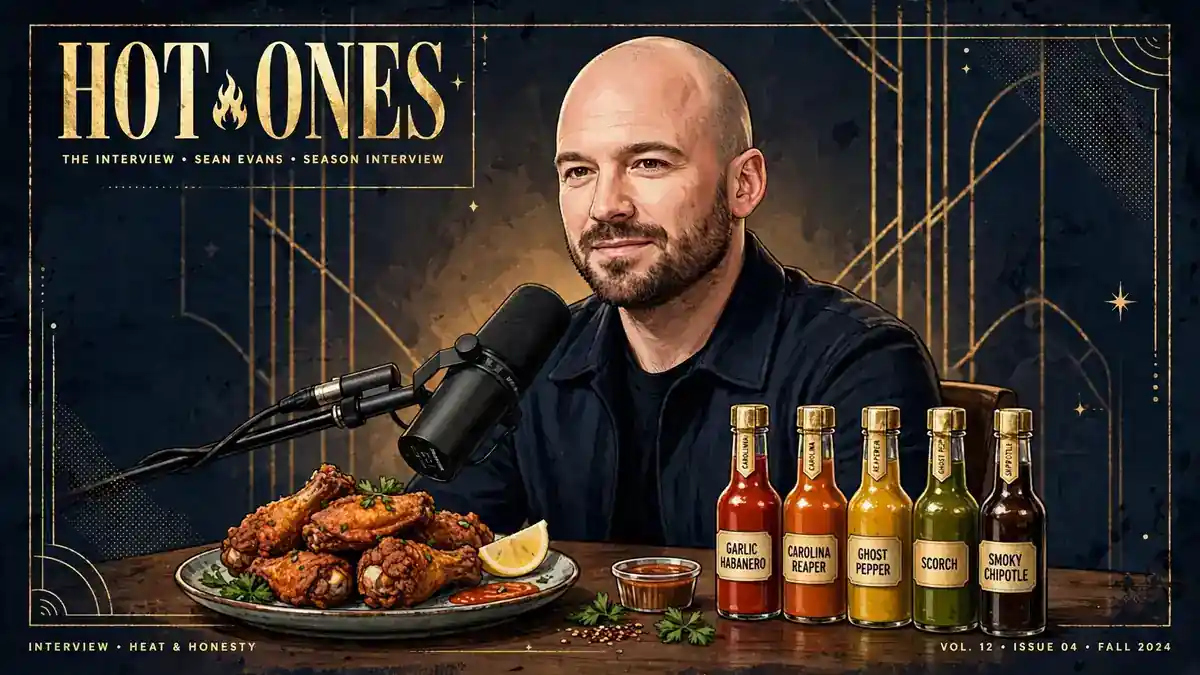
Sean Evans‘s net worth is estimated at $8 million to $10 million as of November 2026. The host of Hot Ones built that fortune from a YouTube interview show that started as a cheap experiment in 2015, turned into a franchise with more than 400 episodes, and ended with Evans becoming a part-owner of First We Feast when the company sold for $82.5 million in December 2024 — then, in July 2026, taking the format to Netflix with Hot Ones: Extra Heat.
Sean Evans: Quick Facts
| Estimated net worth | $8 million to $10 million (range: $8 million–$10 million) |
|---|---|
| Profession | YouTube host, interviewer, producer, media executive |
| Nationality | American |
| Born | April 26, 1986 (age 40) |
| Height | 5 feet 8 inches (1.73 m), as reported by biography outlets |
| Primary income sources | Hot Ones hosting and producing, First We Feast ownership stake, licensing, brand deals, live events |
| Active years | 2008–present |
| Last reviewed | November 2026 |
- Early Life and Background
- Education
- Career Journey
- Rise to Fame
- Main Sources of Income
- Salary and Earnings
- Businesses and Investments
- Brand Deals and Sponsorships
- Houses, Cars and Other Assets
- Awards and Achievements
- Net Worth Growth Over the Years
- Social Media Presence
- Personal Life
- Sources & Reporting
- Frequently Asked Questions
Early Life and Background
Sean Evans was born on April 26, 1986, in Evanston, Illinois, and grew up in Crystal Lake, a suburb northwest of Chicago. He turned 40 in April 2026. His father is Michael Evans and his mother is Donna Arthofer, and he has a younger brother, Gavin, who later became part of the small core team behind Hot Ones.
Evans grew up watching late-night television with his father. David Letterman was the household favorite, and Evans later named Letterman, Howard Stern, Jimmy Kimmel and Adam Carolla as the interviewers who shaped his sense of the job. The through-line in all four was the same: put a famous person in a situation where the rehearsed answers stop working, and the audience sees something real.
Crystal Lake Central High School came first, then the University of Illinois. Nothing in his childhood pointed toward hot sauce. The Chicago suburbs gave him two things that mattered later: a flat Midwestern delivery that reads as calm on camera, and a sports-and-hip-hop diet that made him fluent in the two cultures Complex magazine served. Both showed up in his interview style — he asks athletes about rap and rappers about sports, and guests notice.
That calm is now part of the brand. Evans eats the same wings as his guests, sauce for sauce, and keeps asking precise questions while they sweat. The contrast — one man falling apart, the other barely blinking — is the visual engine of the show. It was not a trick he learned in television school. It was patience, built over years of asking strangers questions for a living.
Education
Evans studied broadcast journalism at the University of Illinois Urbana-Champaign and graduated in 2008. The timing could hardly have been worse. He left college with a journalism degree in the middle of the financial crisis, when newsrooms were cutting staff and entry-level television jobs had all but vanished.
He went back to the Chicago area and took work connected to the city’s tourism industry. Parade reports he took a copywriting job with the Chicago Tourism Board; Celebrity Net Worth records that he also worked as an architecture tour guide. Either way, the work paid rent while he chased freelance writing assignments wherever he could find them.
The degree did pay off, just slowly. Broadcast journalism taught him how to research a subject, structure an interview and write to a deadline — the exact three skills Hot Ones runs on. Each episode now takes about 10 days from research to filming and editing, according to Evans himself in an interview with The Wrap, and the prep is the product as much as the wings are.
In 2026, nearly two decades after graduating, Evans returned to the University of Illinois as the universitywide commencement speaker, delivering the address at Memorial Stadium. It was a neat bookend: the class of 2008 graduate who could not find a television job came back to tell the class of 2026 how he built one himself.
Career Journey
Evans started freelancing for Complex while still based in Chicago, writing celebrity interviews out of New Orleans assignments and anywhere else the work took him. He was interviewing hip-hop stars like 2 Chainz and NBA players like Steph Curry for print, at the same time Complex was expanding into video. The company asked whether he would do some of those interviews on camera.
The camera tests went well enough that Complex offered him a full-time job. Evans left Chicago, sold much of what he owned, and moved to New York City within about a month. The speed of that move tells you how thin his margin was — he bet a freelance living on a staff job in a city he could barely afford, because the job put him in the room where video was being invented.
At Complex, he worked across writing and on-camera interviewing, and his background in sports, hip-hop, pop culture and internet media fit a company whose audience sat at the intersection of all four. The job also put him next to Chris Schonberger, who had created First We Feast in 2012 as Complex‘s food-focused property. Schonberger had a concept: interview celebrities while making them eat chicken wings coated in progressively hotter sauces.
Evans was picked as the host, and he helped turn a stunt into an actual interview show. The first episode premiered on March 12, 2015, with rapper Tony Yayo as the guest. It was basic — a plain set, a few minutes long — and Evans and Schonberger first imagined they might make it only occasionally. The audience had other ideas.
By 2024 the corporate ground had shifted under the show three times. BuzzFeed acquired Complex Networks in 2021. In February 2024, BuzzFeed sold most of Complex to NTWRK for $108.6 million but deliberately kept First We Feast. Ten months later, First We Feast itself was sold — and this time Evans was on the buying side of the table.
Rise to Fame
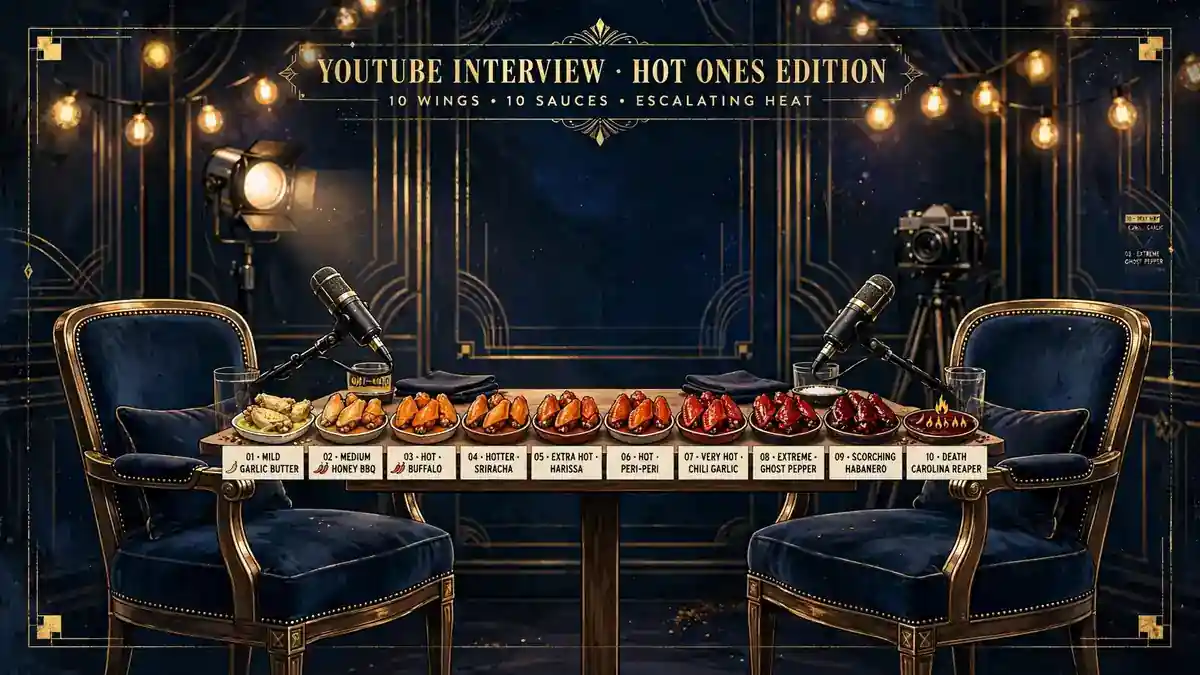
Hot Ones works because the format is a trap for media training. Each guest eats ten wings, with the sauce getting substantially hotter at every stage, while Evans eats the same wings and asks increasingly detailed questions. The physical discomfort breaks the rhythm of a normal celebrity press interview. Guests who have answered the same promotional questions dozens of times suddenly find themselves sweating, pacing, drinking milk or struggling to finish a sentence — and in that state, they say things they would never say on a talk show couch.
Evans’ research is the other half of the trick. The Hot Ones team digs through old interviews, obscure videos, social-media posts, forgotten articles and details from earlier stages of a guest’s career. Evans then spends hours refining the wording and order of his questions, working with his brother Gavin and Schonberger. Guests react with visible surprise when he pulls up something from a decade ago, and that surprise is what separates the show from the hundreds of celebrity-interview formats competing online.
The breakthrough episodes came in sequence. A 2016 appearance by Kevin Hart became one of the show’s early viral hits. Gordon Ramsay’s first appearance in 2019 went further: Ramsay arrived with lemon juice, antacid and a plan, swore his way through the final sauces, and the episode passed 100 million views, making it one of the biggest Hot Ones installments ever. Later that year, Paul Rudd’s episode produced the unscripted “Hey, look at us” exchange, which became a lasting internet meme.
By the 2020s, Hot Ones had become a routine stop for actors promoting major films. Sydney Sweeney appeared in January 2024 while promoting Madame Web. Jennifer Lawrence’s 2023 appearance became memorable for how badly she struggled with the later sauces. Conan O’Brien’s 2024 episode — in which the veteran late-night host drank hot sauce from the bottle, smeared it on his face and consulted an on-set doctor — is talked about by fans as one of the best episodes the show has ever made. The symbolism was hard to miss: one of the most accomplished traditional late-night interviewers of his generation had come to the digital format that helped redefine celebrity publicity.
The numbers kept climbing with the guest list. The show passed 300 episodes in 2023 and celebrated its tenth anniversary in 2025. As of August 2025 it had produced 27 seasons, with three seasons a year since 2018; Parade counted it at its 28th season in September 2025, and Season 30 premiered on May 21, 2026. The episode count now stands past 400, and reports put the show’s cumulative views past 1.5 billion.
Evans has always framed the show as late-night interviewing by other means. The hosts he admired — Letterman, Stern, Kimmel — built careers by placing famous people in situations where audiences could see something beyond rehearsed promotion. Hot Ones arrives at the same goal through a different mechanism: the hot sauce is, in Evans’ own words to The Wall Street Journal, “the disruptive element. It’s designed to knock our celebrity guests off their PR-driven flight pattern. I’m going up the mountain with you, so it’s a bonding experience. By Wing 6, we’re best friends.”
Main Sources of Income
Evans’ money comes from five streams, and the balance between them has shifted sharply since 2024. Hosting and producing Hot Ones is the foundation — the salary, the YouTube advertising revenue and the sponsorships that run through the show. The First We Feast ownership stake is the newest and potentially largest piece, though its value cannot be pinned down. Licensing and consumer products, brand deals, and live events fill out the rest.
YouTube advertising is the most visible stream and the hardest to value from outside. The First We Feast channel carries the show, and the channel has passed 12 million subscribers, with the Hot Ones catalogue alone accounting for more than 1.5 billion views. Advertising rates for a channel of that size run into seven figures a year, but the split between Evans, First We Feast and YouTube is private, so no honest article can attach a number to his personal take.
Sponsorships are the second stream, and The Wall Street Journal has reported that the show’s budget is low while its revenue streams are several — sponsorships on top of ads, with marketing spending close to zero because social media does the distribution for free. That cost structure is the quiet reason the business is valuable: most of the money the show makes, aside from overhead and the platform’s cut, stays inside First We Feast.
Licensing is the third stream, and it is the one that turned a YouTube show into a consumer brand. First We Feast partnered with specialty hot-sauce retailer Heatonist and began selling the sauces from the program. “The Last Dab” arrived in 2017, named for the tradition in which Evans and his guest add an optional final dab to the last wing. “Los Calientes” followed in 2018. The line then grew into ramen, snack foods, frozen foods, merchandise, games and restaurant collaborations, with sauces moving from online sales into major retail chains.
Live events and spin-offs are the fourth stream. First We Feast has taken Hot Ones into live shows where audiences watch the challenge in person, and the franchise has produced Hot Ones Versus, in which celebrities face each other rather than Evans, and Truth or Dab, a party game that extends the brand beyond video. In 2025 Evans launched One More Round, an interview series that swaps the wings for whiskey and lets him conduct longer-form conversations.
The fifth stream is the ownership stake itself. Since December 2024, Evans is not just the face of the franchise — he is a co-owner of the company behind it, and its chief creative officer. That changes the math of his wealth from a salary story into an equity story, which is why the range in this article is wide and why the $82.5 million sale price must not be mistaken for his personal payout.
Salary and Earnings
Here is the honest answer first: Sean Evans’ pay per episode is not publicly known. Parade states this directly, and no filing, interview or company disclosure has ever put a number on it. Anyone who tells you a precise per-episode figure is guessing.
That has not stopped the guessing. Low-quality net-worth sites circulate figures of $50,000 per episode, and at least one puts it at $200,000 per episode. Neither number traces to a named source, and they cannot both be right — which is exactly why this article does not repeat them as fact. The $50,000 figure, if it were true, would imply roughly $2 million a year from a 40-episode season, a number that sits oddly against a company doing $30 million in annual revenue. The $200,000 figure would imply $8 million a year from hosting alone, which would make his $8 million net worth impossible after a decade of earning at that rate. The rumors fail their own arithmetic, and that is worth saying plainly.
What can be said with confidence is structural. Evans is paid as the host and co-creator of the franchise’s flagship show, he holds an executive role — chief creative officer of First We Feast — and he now holds equity in the company. His annual earnings are best understood as salary plus executive pay plus a share of company profit, not as a per-episode rate. That is also why his net worth jumped after December 2024: equity in a profitable company is worth more than a salary, even a large one.
The company numbers give the scale. By the time of the December 2024 acquisition, First We Feast was generating roughly $30 million in annual revenue and about $10 million in profit, according to Celebrity Net Worth. A business doing $10 million in profit, sold for $82.5 million, changed hands at roughly 8 times profit — a normal multiple for a growing media brand with a licensing arm. Evans’ share of that $82.5 million depends entirely on his ownership percentage and how his portion of the buyout was financed, and neither figure has been disclosed. A small stake in an $82.5 million company is still a serious asset. A large stake would be life-changing. The public record does not say which it is, and this article will not pretend otherwise.
For context, the franchise’s economics look nothing like a normal YouTube channel. The Wall Street Journal reported that the show’s budget is low and its marketing spending is close to zero, because social media carries the promotion. Low costs plus several revenue streams — ads, sponsorships, licensing — is why a show filmed in one room with chicken wings could support a $30 million revenue business.
Businesses and Investments
The December 11, 2024 sale of First We Feast is the single biggest business event of Evans’ career, and it is also the most misreported. The headline number — $82.5 million in cash — is the price of the whole company, not Evans’ payday. Several outlets have framed the deal as if it “boosted his fortune” by something close to that figure. It did not, or at least the public record gives no basis for saying so.
Here is what happened, step by step. BuzzFeed acquired Complex Networks in 2021. In February 2024, BuzzFeed sold most of Complex to NTWRK for $108.6 million but deliberately retained First We Feast, the food brand that owned Hot Ones. BuzzFeed then put First We Feast on the market, and on December 11, 2024, it sold for $82.5 million in cash to a consortium that included Evans, Chris Schonberger, Soros Fund Management, Crooked Media and Mythical Entertainment — the company founded by YouTube stars Rhett McLaughlin and Link Neal.
Schonberger became CEO of the newly independent First We Feast, and Evans took the newly created position of chief creative officer while continuing as host. For nearly a decade he had been the face of Hot Ones while the intellectual property belonged to larger media companies. The acquisition turned him into an equity owner of the company behind the franchise he helped build.
The deal’s structure matters for the net worth estimate. Evans was a buyer, not a seller. He put money in — or took on financing — to acquire his stake, rather than receiving a payout. His individual investment amount and percentage ownership were not publicly disclosed. That is the single biggest unknown in this entire estimate, and it cuts both ways: if his stake is small, his net worth sits near the $8 million that Celebrity Net Worth and Parade carry; if it is large, the top of the range — and beyond — is plausible. The $8 million to $10 million range reflects the first case with room for the second.
Beyond First We Feast, there is no public record of Evans holding other businesses or a disclosed investment portfolio. He has not announced startup investments, real estate funds or venture stakes, and no filing ties him to any. That absence is itself information: unlike many creators who branch into restaurants or venture capital, Evans has kept his business identity inside one company, and his wealth is concentrated in it.
The franchise keeps expanding under the new ownership. Hot Ones Versus pits celebrities against each other instead of against Evans. Truth or Dab turned the format into a party game. Live events bring the challenge to paying audiences. And in June 2026, Netflix ordered Hot Ones: Extra Heat, a run of 30-minute specials filmed on location at Netflix’s live events, with Evans as host and executive producer. Each of these is a new revenue line for the company he part-owns, and each one raises the value of the stake whose size nobody outside the deal knows.
Brand Deals and Sponsorships
Hot Ones has always been a sponsor-friendly show, and the sponsorships are woven into the format rather than bolted on. The Wall Street Journal reported that the show carries a number of sponsorships in addition to advertising, and that the combination is a major reason the business stays profitable on a low budget.
The most durable commercial partnership is with Heatonist, the specialty hot-sauce retailer that helped turn the show’s sauces into consumer products. The Last Dab, released in 2017, and Los Calientes, released in 2018, started as show props and became retail products. From there the brand moved into grocery and retail chains, which is a different kind of money from YouTube ads: shelf space pays again and again, long after an episode stops getting views.
The licensing program now covers ramen, snack foods, frozen foods, merchandise, games and restaurant collaborations. Each category is a separate deal, and together they are the reason First We Feast was doing $30 million a year in revenue by 2024. For Evans personally, these deals pay through the company he part-owns and through his executive role, rather than as a string of personal endorsement cheques.
Evans has not built a personal endorsement portfolio in the usual celebrity sense. There is no public record of him fronting a watch brand, a car campaign or a fashion label, and his public image has stayed tied to the show rather than to outside products. That restraint is consistent with the brand: the host who sells you hot sauce is believable; the host who sells you everything is not.
The Netflix deal is the newest sponsorship-adjacent line. Hot Ones: Extra Heat premiered on July 13, 2026, immediately after Major League Baseball’s Home Run Derby, with Will Ferrell, Fortune Feimster and Jimmy Tatro as the first guests, promoting their Netflix golf comedy The Hawk. The format ties the show directly to Netflix’s live-event calendar, which means the franchise is now paid to promote the streamer’s own slate — a neat inversion of the old model, in which the show depended on guests promoting their films.

Houses, Cars and Other Assets
There are no verified public records of Sean Evans owning a house, and no credible reporting of a property portfolio or a car collection. This section says so plainly because other net-worth sites fill it with invented detail, and inventing a mansion is worse than admitting a gap.
What is known is the shape of his life. Evans lived in Chicago, then moved to New York City in the early 2010s for the Complex job, and the show has been filmed in New York throughout its run. He has kept his home life private — no house tours, no real-estate features, no property records attached to his name in the press. That privacy is consistent with everything else about him: he talks about his guests, not himself.
The same applies to cars. No outlet has reported a vehicle collection, and Evans has never made cars part of his public persona. The man who eats the world’s hottest wings on camera has never tried to sell a lifestyle, and the absence of a garage full of supercars is part of the point.
His real assets, as far as the public record shows, are threefold: his equity stake in First We Feast, his earning power as the host of a franchise with more than 400 episodes, and the Hot Ones brand association itself, which is what makes the Netflix specials and live events possible. None of those has a Zillow listing. All three are worth more than a house.
One thing the record does show is spending discipline. Evans spent the early years of his career broke — a 2008 graduate in a financial crisis, working tourism jobs while freelancing — and the show’s own economics reflect the same habit: a low budget, near-zero marketing spend, and revenue that stays inside the company. The $82.5 million buyout was financed by a consortium, not by Evans alone, and there is no evidence he has cashed out any part of his stake since.
Awards and Achievements
Hot Ones and Evans have collected recognition that matters because it comes from outside the YouTube world. In 2019, Evans won Webby Awards for both Food & Drink and Best Creator, Personality or Host — the Webby is the internet industry’s main prize, and the host award put him in the same conversation as the biggest creators on the platform. The franchise has picked up further Webby, Shorty and Streamy recognition since.
The television establishment has noticed too. Evans earned a Daytime Emmy nomination for Outstanding Entertainment Talk Show Host, while Hot Ones itself received a Daytime Emmy nomination for Outstanding Talk Show Entertainment. Those nominations are striking because the show comes from YouTube, not the broadcast and syndicated television system that has historically dominated the talk-show categories.
In 2025, Evans was named to TIME’s inaugural TIME100 Creators list, which ranks the most influential digital creators in the world. The same year, Hot Ones appeared in the film Happy Gilmore 2, with Evans interviewing a character played by Benny Safdie, and in 2026 the show appeared in the film Verity, with Evans interviewing the title character played by Anne Hathaway. A YouTube interview format showing up inside feature films is a measure of how far the brand has travelled from a first episode with Tony Yayo in 2015.
Then came the academic honour. In 2026, the University of Illinois invited Evans to deliver the universitywide commencement address at Memorial Stadium. For a graduate who left in 2008 with a broadcast journalism degree and could not find a television job, standing on that stage was the most literal proof that the career he built outside television had become the career.
The truest achievement, though, is structural. Hot Ones is now a format other people copy, a brand that sells sauce in grocery stores, a game show, a party game, a live event and a Netflix special. Evans co-created it, hosted every step of it, and now owns part of it. Few interviewers in any medium can say the same about their show.
Net Worth Growth Over the Years
Evans’ wealth grew slowly for most of his career, then jumped when ownership entered the picture. The figures below are NetWorthCraft estimates built from the Celebrity Net Worth trajectory and the dated milestones in this article — the 2015 launch, the 2019 breakout, the 2024 buyout — and they should be read as a shape, not a bank statement.
| Year | Estimated net worth | What changed |
|---|---|---|
| 2015 | $100,000 | Hot Ones premieres; Evans is a staff host at Complex |
| 2017 | $500,000 | The Last Dab launches; sauces become a product line |
| 2019 | $1 million–$2 million | Gordon Ramsay episode passes 100 million views; Webby wins |
| 2020 | $2 million–$3 million | Hot Ones: The Game Show airs on truTV |
| 2022 | $3 million–$5 million | Show passes 300 episodes; licensing grows |
| 2024 | $6 million–$8 million | First We Feast sold for $82.5 million; Evans becomes co-owner and CCO |
| 2025 | $8 million | Tenth anniversary; TIME100 Creators; One More Round launches |
| 2026 | $8 million–$10 million | Netflix orders Extra Heat; Evans delivers UIUC commencement |
The shape tells the story better than any single number. For nine years, Evans was a well-paid host whose wealth grew with his audience. In December 2024, he became an owner, and the curve bent upward — not because he was handed $82.5 million, but because a slice of a $30 million-revenue company is worth far more than a salary. The 2026 range of $8 million to $10 million reflects that bend while staying honest about the one fact nobody outside the deal knows: the size of his slice.
Two common figures deserve a direct correction. A handful of low-quality sites put Evans at $20 million, and one puts him at $42 million. Neither number cites a source, and both contradict Celebrity Net Worth and Parade, which agree on $8 million. The $42 million figure appears to be an invented table with no reporting behind it. Readers should treat any number above $10 million as unsourced until a named outlet stands behind it.
The peer comparison is instructive in a different way. Traditional late-night hosts — the Letterman and Kimmel lineage Evans grew up watching — built fortunes in the tens and hundreds of millions over decades of network television. Evans built $8 million to $10 million in eleven years from a YouTube room, and he did it as an owner rather than an employee. The absolute number is smaller. The ownership is the difference.
Social Media Presence
Evans is not a creator who lives on his personal accounts. His public presence runs through the First We Feast channels, and his own profiles are quiet by comparison — a choice that fits a host whose job is to make the guest the story.
| Platform | Handle / channel | Followers |
|---|---|---|
| @seanseaevans | Roughly 500,000 | |
| YouTube (First We Feast) | First We Feast | More than 12 million subscribers |
| X (Twitter) | @seanseaevans | Active, smaller than Instagram |
The First We Feast channel is the real number: more than 12 million subscribers, with the Hot Ones catalogue past 1.5 billion views. Individual episodes routinely draw millions of views, and the biggest — Gordon Ramsay’s first appearance — passed 100 million on its own. That is the distribution that makes the sponsorships valuable and the licensing deals possible.
Evans’ personal Instagram, at roughly half a million followers, is modest next to the channel, and that gap is itself a data point. He has never tried to convert the show’s audience into a personal influencer brand. There are no sponsored posts selling skincare or watches, no daily vlog, no attempt to be the product. The product is the interview, and the interview lives on the First We Feast channel.
That restraint has a commercial logic. A host who is visibly for sale weakens the premise of the show, which depends on the audience believing the conversation is real. Evans’ low personal profile is part of why the format still works in its thirtieth season: the audience trusts that he is there for the questions, not for the endorsement cheque.
Personal Life
Evans keeps his private life private, and this section respects that — it reports only what has been publicly confirmed, and it does not repeat gossip as fact.
He is not married and has no children. His most substantial public relationship was with Natasha Alexis Martinez, a television host and former Miss California USA, which ran from around 2018 to 2022. The relationship was low-key and largely out of the press while it lasted.
In February 2024, reports linked Evans to Melissa Stratton, an adult film performer. The two had connected in October 2023 and were seen together during Super Bowl LVIII weekend in Las Vegas. The relationship was brief: TMZ reported that Evans ended it on Valentine’s Day, days after the couple went public, with a source saying he wanted to call it quits because of the media attention. Stratton later confirmed that her line of work contributed to the split, telling TMZ, “Yeah definitely. We had conversations about it.”
Since then, Evans has not publicly announced a partner. His name was tied to Keke Palmer in 2025 after a playful on-screen kiss during her Hot Ones appearance and a later appearance on her podcast, Baby, This is Keke Palmer, where she brought up his admitted crush on her. Both have treated it as flirtation, not a relationship, and no outlet has confirmed them as a couple.
His family is small and close. His younger brother Gavin is part of the three-person research core behind the show, alongside Evans and Schonberger, and the three of them still do the prep together — reading, watching and digging through a guest’s history before every episode. It is a family business in the literal sense, and it is one reason the show’s voice has not changed in eleven years.
Off camera, Evans has described himself as a student of the interview craft rather than a celebrity. He watches old Letterman, studies how Stern gets people talking, and treats each episode as a research project. The 10-day prep cycle is not a production detail; it is the whole job, and it is why guests keep saying yes to a show that makes them eat the hottest sauce on earth.
Sources & Reporting
Celebrity Net Worth — the $8 million estimate; birth date and Crystal Lake upbringing; University of Illinois graduation in 2008; Complex career and the move to New York; the March 12, 2015 premiere with Tony Yayo; the $82.5 million First We Feast sale and the consortium members; First We Feast revenue of about $30 million and profit of about $10 million at acquisition; the 2019 Webby Awards and Daytime Emmy nominations; the 2026 University of Illinois commencement address.
Parade — the $8 million estimate for 2026; the 28th season as of September 2025; the copywriting job with the Chicago Tourism Board; the 10-day episode preparation cycle and the Gavin Evans and Chris Schonberger research team, via The Wrap; confirmation that per-episode pay is not publicly known.
The Wall Street Journal — the show’s low budget, multiple revenue streams and near-zero marketing spend, as reported through Parade and Celebrity Net Worth; Evans’ own description of the hot sauce as “the disruptive element.”
The New York Times — Chris Schonberger on the thinking behind the format, as quoted by Parade.
Wikipedia — Hot Ones episode and season counts; the truTV game show dates and $25,000 prize; the June 2026 Netflix order for Hot Ones: Extra Heat and its July 13, 2026 premiere; the Happy Gilmore 2 and Verity appearances.
Tubefilter — the Netflix Extra Heat announcement, the Home Run Derby premiere slot and the Will Ferrell, Fortune Feimster and Jimmy Tatro first guests.
TMZ — the Melissa Stratton relationship and its end on Valentine’s Day 2024, as reported through Distractify and Hello Magazine.
Famous People Today — the $10 million estimate that sets the top of our range; the 1.5 billion-view figure for Hot Ones; the height of 5 feet 8 inches.
Distractify — the February 2024 Stratton timeline, the Season 30 premiere date of May 21, 2026, and the Keke Palmer episode context.
Reporting window: October 2025 to November 2026, with the newest material being the June–July 2026 Netflix Extra Heat order and premiere. Figures that no named outlet supports — including the $50,000 and $200,000 per-episode salary rumors and the $20 million and $42 million net worth figures on low-quality sites — are flagged in the text as unverified and are not used in the estimate.
Frequently Asked Questions
What is Sean Evans’ net worth in 2026?
Sean Evans’ net worth is estimated at $8 million to $10 million as of November 2026. Celebrity Net Worth and Parade both put him at $8 million, while Famous People Today carries $10 million, so we publish the range. The figure reflects his hosting and producing income plus an ownership stake in First We Feast, whose size has never been disclosed.
How much does Sean Evans make per episode of Hot Ones?
His per-episode pay is not publicly known — Parade states this directly, and no filing or interview has ever disclosed it. Figures of $50,000 or $200,000 per episode circulate on low-quality sites, but neither traces to a named source and they contradict each other, so neither should be treated as fact. Evans is paid as host and co-creator, holds the chief creative officer role at First We Feast, and owns equity in the company.
Does Sean Evans own Hot Ones?
Partly. Evans co-created Hot Ones with Chris Schonberger, and in December 2024 he became a co-owner of First We Feast — the company that owns the show — when a consortium including Evans, Schonberger, Soros Fund Management, Crooked Media and Mythical Entertainment bought it from BuzzFeed for $82.5 million. His exact ownership percentage has not been disclosed, and he is also the company’s chief creative officer.
How did Sean Evans become famous?
Evans studied broadcast journalism at the University of Illinois, graduated in 2008, worked tourism and freelance writing jobs in Chicago, then joined Complex full-time and moved to New York. With First We Feast founder Chris Schonberger, he co-created Hot Ones, which premiered on March 12, 2015. The show’s mix of deep research and escalating hot wings made it a cultural fixture, with breakout episodes from Kevin Hart, Gordon Ramsay and Paul Rudd.
How old is Sean Evans?
Sean Evans was born on April 26, 1986, in Evanston, Illinois, which makes him 40 years old as of November 2026. He grew up in Crystal Lake, Illinois, and graduated from the University of Illinois Urbana-Champaign in 2008.
How tall is Sean Evans?
Sean Evans is reported to be 5 feet 8 inches (1.73 m) tall. The figure comes from biography outlets rather than an official measurement, so it should be read as reported rather than verified.
Who is Sean Evans’ girlfriend?
Sean Evans does not have a publicly confirmed partner as of November 2026. He previously dated television host Natasha Alexis Martinez from around 2018 to 2022, and was briefly linked to Melissa Stratton in late 2023, a relationship that ended on Valentine’s Day 2024. He is not married and has no children.
What is Hot Ones: Extra Heat on Netflix?
Hot Ones: Extra Heat is a Netflix spin-off ordered in June 2026 and premiered on July 13, 2026, right after the MLB Home Run Derby. It keeps the same ten-wing format but films in 30-minute specials on location at Netflix’s live events instead of the studio. Sean Evans hosts and executive-produces it, with Will Ferrell, Fortune Feimster and Jimmy Tatro as the first guests. The original series continues weekly on YouTube.
Final Thoughts
Sean Evans’ $8 million to $10 million fortune is a study in what ownership does to a career. For nine years he was a talented employee with a hit show. Then, in December 2024, he bought into the company behind it, and the story changed from salary to equity. The $82.5 million sale price is not his money — it is the price of the whole company, and his slice of it is undisclosed — but even a modest slice of a business doing $30 million a year in revenue is the kind of asset a hosting fee never becomes.
The Netflix deal in 2026 confirms the direction. Hot Ones started as a cheap experiment in a bare room, became the interview every celebrity has to survive, and is now a format a streamer pays to stage at its biggest live events. Evans is still the same interviewer he was in 2015: the calm man across the table, asking the question nobody else thought to ask, eating the same wing as his guest. The difference is that he now owns a piece of the table too.
Published on 2026-11-06. Last reviewed November 2026. Found an error? See our corrections policy.