
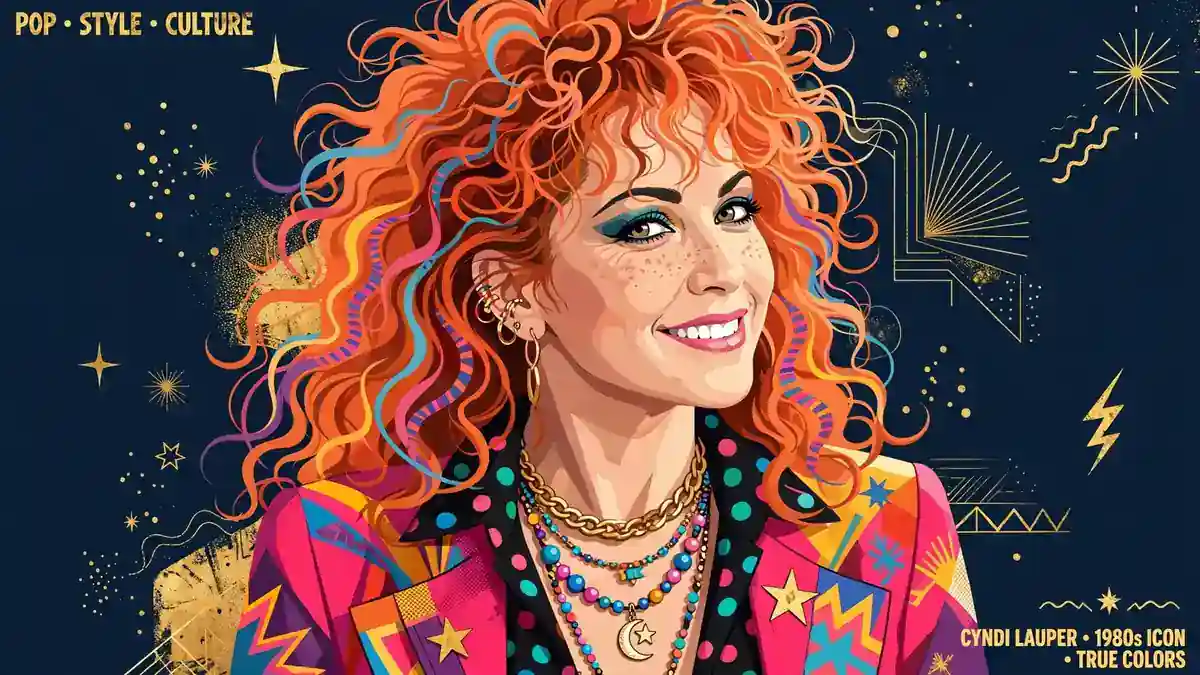
Cyndi Lauper‘s net worth is estimated at $50 million as of November 2026. The figure rests on four decades of hit records, a Broadway fortune built on Kinky Boots, a music-catalog sale to ABBA’s Björn Ulvaeus in 2024, and a farewell tour that closed with a Rock & Roll Hall of Fame induction in November 2025 — followed by a first-ever Las Vegas residency in the spring of 2026.
Cyndi Lauper: Quick Facts
| Estimated net worth | $50 million (range: $35 million – $65 million) |
|---|---|
| Profession | Singer, songwriter, actress, Broadway composer |
| Nationality | American |
| Born | June 22, 1953 (age 73) |
| Height | 5 feet 3 inches |
| Primary income sources | Music royalties, touring, Broadway, catalog sale, acting |
| Active years | 1977 – present |
| Last reviewed | November 2026 |
- Early Life and Background
- Education
- Career Journey
- Rise to Fame
- Main Sources of Income
- Salary and Earnings
- Businesses and Investments
- Brand Deals and Sponsorships
- Houses, Cars and Other Assets
- Awards and Achievements
- Net Worth Growth Over the Years
- Social Media Presence
- Personal Life
- Sources & Reporting
- Frequently Asked Questions
Early Life and Background
Cynthia Ann Stephanie Lauper was born on June 22, 1953, in Brooklyn, New York, and grew up in Queens, where her mother Catrine raised three children on a waitress’s wages after splitting from Lauper’s father, Fred. The family moved around the borough — Ozone Park and Richmond Hill among the stops — and money was tight enough that the shape of Lauper’s childhood shows up in her later work: the scrappy independence, the thrift-store style assembled into a look, the refusal to sand down her accent or her opinions for anyone in a boardroom.
Music reached her early. She started singing as a child, taught herself guitar and piano, and by her teens was performing cover songs in New York clubs. Her sister Ellen, who is a lesbian, became one of the defining influences on Lauper’s life and politics — the bond between the sisters later drove much of Lauper’s LGBTQ+ advocacy, and her 2008 nonprofit work traces directly back to watching Ellen navigate a world that was far less accepting than the one Lauper sings about now.
Queens in the 1960s and 1970s gave her the raw material for everything that followed. She has described herself as a kid who never fit the mold her schools wanted, and the borough’s mix of working-class families, immigrant storefronts, and street-corner radio fed a taste that ran from the Beatles and the Shangri-Las to blues and country. That range — pop hooks with a rockabilly spine and a blues singer’s phrasing — is the sound she has carried through eleven studio albums.
Education
Lauper attended Richmond Hill High School in Queens and left before graduating. The dropout line shows up in nearly every profile of her, and it matters to the money story: she had no safety net, no degree, and no family wealth to fall back on when her first band collapsed. What she had instead was a voice with a four-octave range and a willingness to work club dates for whatever the room paid.
Her real education came on stage. After leaving school she sang in a series of local bands, learning harmony, stagecraft, and the business of getting paid — or not getting paid — as a working musician in New York. She also studied voice formally enough to repair the damage that nearly ended her career: after Blue Angel fell apart, vocal cord problems left her temporarily unable to sing, and vocal therapy plus disciplined retraining rebuilt the instrument that made her famous. The episode taught her the lesson that runs through her finances ever since — a singer’s voice is the asset, and protecting it is a business decision, not vanity.
She later earned her GED, a detail she has mentioned in interviews as a point of pride rather than a footnote. The credential came after fame, not before it, which says something about how she treats unfinished business.
Career Journey
Lauper’s professional career began in 1977, when she joined the rockabilly band Blue Angel with saxophonist John Turi. The group built a following in New York clubs and signed with Polydor Records, releasing a self-titled debut album in 1980. Critics liked the record and Lauper’s voice; buyers did not. The album flopped, the band broke up in 1982, and the failure nearly finished her before she started.
The collapse carried a bill. Blue Angel’s manager sued, and Lauper was hit with an $80,000 lawsuit that she could not pay. In 1981 she filed for bankruptcy and went back to waiting tables and working retail in Manhattan while she rebuilt her voice and her career. It is the single most important fact in any honest account of her wealth: the woman now worth an estimated $50 million once stood in a bankruptcy court with nothing, and every dollar after that was earned twice — once on stage, once in the long climb back.
The turn came through manager David Wolff, who saw her sing in a Manhattan club and took her on. Wolff got her a solo deal with Portrait Records, the CBS imprint, and paired her with producer Rick Chertoff. The sessions that followed produced She’s So Unusual, released in October 1983, and the next two years remade her life. She was 30 years old when the album came out — a late start by pop standards, and one reason her career has lasted: she arrived as an adult with a point of view, not a teenager molded by a label.
What followed was a career that refused to stay in one lane. The 1980s made her a pop star; the 1990s pushed her toward folk, blues, and socially charged songwriting; the 2000s brought dance records, an acoustic reinvention, and a blues album; the 2010s made her a Broadway composer. Each shift cost her some chart momentum and bought her something more durable — a catalog that earns in five genres at once, and a reputation that lets her sell out a farewell tour forty years after her debut.
Rise to Fame
She’s So Unusual did what debut albums almost never do. It has sold more than 16 million copies worldwide, and it made Lauper the first woman in history to place four top-five singles from a debut album on the Billboard Hot 100: “Girls Just Want to Have Fun” reached No. 2, “Time After Time” hit No. 1, “She Bop” reached No. 3, and “All Through the Night” reached No. 5. The Grammy for Best New Artist followed in 1985, and the album’s day-glo visual language — thrifted clothes, layered jewelry, hair in every color at once — became the look of the MTV era.
The “Girls Just Want to Have Fun” video did as much work as the song. Directed by Edd Griles and starring Lauper’s own mother as her on-screen mom, it played constantly on MTV and won the 1984 MTV Video Music Award for Best Female Video. The song itself was a cover — Robert Hazard wrote it as a wry male complaint, and Lauper flipped it into a declaration of independence that still plays at weddings, protests, and Pride parades. The royalties from that one song, written into film, television, advertising, and cover versions for four decades, form one of the steadiest income streams in her catalog.
“Time After Time,” co-written with Rob Hyman of the Hooters, showed the other side of her: a ballad with a melody that has been covered by more than a hundred artists, from Miles Davis to Eva Cassidy to Cyndi’s own duet partners. A song that gets covered that often pays its writer every time someone records it, performs it, or streams it — and “Time After Time” has been paying since 1984.
Her second album, True Colors (1986), sold more than 7 million copies and gave her a second No. 1 with its title track, written by Billy Steinberg and Tom Kelly. The song grew into an LGBTQ+ anthem, which later became the namesake of her charity and the throughline of her public identity. She also sang “The Goonies ‘R’ Good Enough” for the 1985 film The Goonies, a paycheck and a placement that tied her to one of the decade’s most beloved movies.
By the end of the 1980s she had three more albums — A Night to Remember (1989), built around the hit “I Drove All Night” — and a film career underway with Vibes (1988) and Life with Mikey (1993). Her total record sales now stand above 50 million worldwide, a figure reported by Celebrity Net Worth and repeated across the music press, which places her among the best-selling female recording artists of all time.
Main Sources of Income
Lauper’s money comes from five streams, and the balance between them has shifted with each decade of her career. The first is recorded-music royalties: eleven studio albums, a catalog that has sold more than 50 million records, and two songs — “Girls Just Want to Have Fun” and “Time After Time” — that generate licensing, streaming, and cover-version income every year. Streaming pays far less per play than the vinyl and CD sales of the 1980s did, but the catalog’s size and its constant use in film, television, and advertising keep the checks coming.
The second stream is touring. Lauper toured steadily for four decades, and her final full tour — the Girls Just Want to Have Fun Farewell Tour of 2024–2025 — was her first major headlining run in a decade. Ticket marketplace SeatGeek reports the 69-date run grossed $42.5 million, including her first-ever sold-out headlining show at Madison Square Garden. A gross is not a paycheck — promoters, venues, and costs take their share — but a tour of that size, at arena prices, is the biggest single payday of her recent career.
The third stream is Broadway. Kinky Boots, for which she wrote the music and lyrics, ran on Broadway from 2013 and grossed more than $320 million during its Broadway run, according to Celebrity Net Worth. Lauper earns as the show’s composer through royalties on Broadway productions, touring companies, and licensed productions around the world — income that continues years after the original cast took its final bow. She also wrote songs for the SpongeBob SquarePants musical, which reached Broadway in 2017, and her Working Girl musical premiered at the La Jolla Playhouse in California in the fall of 2025.
The fourth stream is the catalog sale. In February 2024 she sold a majority stake in her recorded-music catalog to Pophouse Entertainment Group, the Swedish company founded by ABBA’s Björn Ulvaeus. The price was never disclosed, and comparable catalog deals point to tens of millions of dollars. That single transaction converted decades of future royalty checks into a lump sum — the largest one-time payment of her career, and the main reason her net worth held at $50 million rather than drifting down as touring wound down.
The fifth stream is acting and television: film roles, a long run of guest spots led by Mad About You, reality television, voice work, and her 2010 run on The Celebrity Apprentice, where she finished sixth. Acting was never her main earner, but it kept her visible between albums and added a separate royalty stream through residuals and syndication.

Salary and Earnings
No contract or pay stub from Lauper’s career has ever been published, so her earnings have to be reconstructed from the deals and grosses that are on the record. The picture that emerges is a career of modest paychecks in the early years, one enormous album run, and a long tail of royalties that peaked again in the 2020s.
The debut era paid in album sales. She’s So Unusual sold more than 16 million copies, and True Colors added more than 7 million. At 1980s royalty rates, a hit album of that scale paid its artist millions across the first few years — but Lauper has been open about the fact that early deals were not generous. She told Parade that she does not consider herself a sharp business operator, saying, “I don’t have good business sense. You never get much money for the arts. But I like independence.” The quote matters because it explains the shape of her fortune: built slowly, from work, rather than from one windfall deal early on.
By the 1990s her album sales had cooled — Hat Full of Stars (1993) and Sisters of Avalon (1997) earned critical praise and modest sales — and touring and acting filled the gap. Her 1994 greatest-hits collection, Twelve Deadly Cyns…and Then Some, sold more than 6 million copies, a reminder that the debut-era songs kept selling long after the new albums stopped charting. Compilation sales are a quiet earner in a catalog artist’s life: no new recording costs, and the same hits repackaged for a new format.
The 2000s brought smaller, steadier checks. Memphis Blues (2010) became the best-selling blues album of its year, and Bring Ya to the Brink (2008) returned her to dance floors. None of these records matched the 1980s numbers, but each one added songs to a catalog that earns every time a track is streamed, licensed, or covered.
The recent peak is easy to date. The Pophouse catalog sale in February 2024 is the biggest single transaction of her career, estimated in the tens of millions of dollars. The farewell tour that followed grossed a reported $42.5 million across 69 dates. Trade estimates in the net-worth press put her annual income from royalties, touring, and residuals in the range of $3 million to $5 million in recent years, though that figure is an outside estimate rather than a disclosed number, and the tour and catalog years would have run well above it.
What the earnings record shows, taken together, is a fortune assembled in layers: a huge first decade, a long middle stretch of working income, and a late-career harvest — the catalog sale, the farewell tour, the residency — that turned a lifetime of work into cash while she could still enjoy it.
Businesses and Investments
Lauper never built a product empire. There is no cosmetics line, no fashion label, no restaurant chain with her name on it, and that absence is part of the story: her wealth comes from songs and shows, not from leveraging fame into retail. The one large business transaction of her life is the catalog deal, and it deserves a close look because it is the deal that defines her current net worth.
In February 2024, Pophouse Entertainment Group acquired a majority stake in Lauper’s music catalog, including “Girls Just Want to Have Fun” and “True Colors.” The Swedish company, founded in 2014 by ABBA’s Björn Ulvaeus and EQT chairman Conni Jonsson, had already bought the catalogs of Avicii and Swedish House Mafia before turning to Lauper. The price was never disclosed, and Lauper declined to discuss terms beyond confirming that Pophouse bought “a majority” of the catalog. Industry reporting around comparable sales — catalogs of legacy artists with durable hit songs — points to a price in the tens of millions of dollars.
Two details of the deal matter more than the price. First, her Broadway music was excluded: Kinky Boots and her theater work stayed with her, so the royalty stream from stage productions was untouched. Second, the deal created a joint venture between Lauper and Pophouse to manage the catalog, with announced plans for a television series, a festival, and an immersive theater experience built around her songs. She sold the rights and kept a seat at the table — a structure that suggests she negotiated for creative control as well as cash.
Catalog sales became the music industry’s biggest wealth event of the 2020s, and Lauper’s timing was careful. She sold after the streaming era had stabilized the value of old hits, after True Colors had spent decades growing as an anthem, and before her farewell tour put a final spotlight on the songs. Selling a majority stake rather than the whole catalog also left her with a continuing interest in the music’s future earnings.
Beyond the catalog, her investments are low-key and private. She has never spoken publicly about a stock portfolio or a business stake, and no filing or report ties her to a startup or a fund. The money she made went into the two things she has talked about: her home, and her charity work. The True Colors Fund — now True Colors United — has been her main institutional investment since 2008, and she founded the Girls Just Want to Have FUNdamental Rights fund in 2022, after the U.S. Supreme Court overturned Roe v. Wade, to support women’s rights organizations.
Brand Deals and Sponsorships
Lauper’s endorsement history is thin compared with pop stars of her generation, and the deals she did take were personal rather than commercial. The best-known is her work with Cosentyx, the psoriasis medication. Lauper has lived with psoriasis, a chronic skin condition, for years, and she appeared in commercials and awareness campaigns for the drug, talking openly about flare-ups and joint pain. The partnership paid her, but it also fit a pattern: she lends her name to causes and products tied to her own life, not to whatever brand offers the biggest check.
Her songs have done more endorsement work than she has. “Girls Just Want to Have Fun” has been licensed to countless commercials, films, and television shows, and “True Colors” has been used in charity campaigns and corporate diversity spots for decades. Each placement is a synchronization fee plus performance royalties, and the two songs’ ubiquity means the licensing income never really stops.
She has also been a fixture of Pride events and LGBTQ+ campaigns around the world, performing at fundraisers and rallies rather than signing paid spokesperson contracts. The distinction matters to her public image and to her income: advocacy appearances are usually unpaid or expenses-only, which means her activism has cost her money in the short term while building the reputation that keeps her booking fees high.
Television gave her a different kind of brand exposure. Her 2010 run on The Celebrity Apprentice put her in front of a prime-time audience that had not bought a record in twenty years, and her long list of guest roles — Mad About You, Bones, and a voice role on The Simpsons among them — kept her name in casting conversations. None of these were endorsement deals in the usual sense, but each one was a paid appearance that also marketed the catalog.

Houses, Cars and Other Assets
Lauper’s real estate story is a short one with a clear ending, and it runs against the usual celebrity pattern of trading up. She bought her first home — a French Country-style house at 250 Saddle Hill Road in North Stamford, Connecticut — in 1986, three years after her debut album made her famous. The house measured about 3,900 square feet on 1.58 acres, and she lived there for more than 30 years with her husband, actor David Thornton, and their son Declyn. Five of her albums and much of Kinky Boots were written in the property’s guest house, which makes it one of the more productive songwriting rooms in pop history.
She listed the house for $1.25 million in May 2017, telling the Wall Street Journal that she and Thornton wanted to spend more time at their Manhattan rental on the Upper West Side. The market disagreed with the price. After months on the market, the house sold in January 2018 for $804,625 — about $445,000 below the asking price, as reported by the Stamford Advocate. It was, by the numbers, a loss against the ask, though she had owned the home for 31 years and bought it in a different market entirely.
Since the sale she has lived in New York City, in a Manhattan apartment on the Upper West Side. Public reporting describes it as a rental she and Thornton kept while selling the Connecticut house, and later accounts describe an apartment purchase in the city — the details are private, and no verified listing or price has been published for her current home. What is clear is the direction of travel: out of the suburbs, back to the city where her career started, and into a smaller footprint.
Cars have never been part of her public image. Unlike stars who collect vehicles as assets, Lauper has no reported car collection and no known luxury garage; her spending on transport has never made a headline. Her tangible assets are the ones that earn: the remaining minority stake in her catalog, the Broadway royalties, and the publishing rights to songs she wrote. Those are worth more than any house she has owned.
Awards and Achievements
Lauper is one of a small group of artists to hold a Grammy, an Emmy, and a Tony — a combination that took her thirty years to complete and that no rival from the 1980s pop class can match in the same form.
The Grammy came first. She won Best New Artist at the 1985 Grammy Awards for She’s So Unusual, and she has been nominated fourteen times across her career. A second Grammy arrived in 2014, when the Kinky Boots original Broadway cast recording won Best Musical Theater Album. The Emmy followed in 1995, for Outstanding Guest Actress in a Comedy Series, for her recurring role as Marianne Lugasso on Mad About You.
The Tony is the one that made history. In 2013 she won Best Original Score for Kinky Boots, becoming the first woman ever to win the award on her own. The show itself won six Tony Awards, including Best Musical, and its Broadway run grossed more than $320 million. The Tony completed a run of firsts: first woman with four top-five singles from a debut album, first woman to win the Tony for Best Original Score solo.
The capstone arrived on November 8, 2025, when she was inducted into the Rock & Roll Hall of Fame in the performer category at the Peacock Theater in Los Angeles. Chappell Roan, who wore a replica of the skirt from the “True Colors” video, gave the induction speech. Lauper sang “True Colors” and “Time After Time” — joined by Raye for the second song — then closed with “Girls Just Want to Have Fun” alongside Avril Lavigne and Salt-N-Pepa. The ceremony streamed live on Disney+, and a primetime special aired on ABC on January 1, 2026.
Other honors fill out the shelf: an MTV Video Music Award for Best Female Video in 1984, a place on the Hollywood Walk of Fame, and the 2025 CBS special A Grammy Salute to Cyndi Lauper: Live from the Hollywood Bowl, filmed on the final two nights of her farewell tour with guests including Cher, SZA, John Legend, and Joni Mitchell. Her 2023 documentary, Let the Canary Sing, premiered on Paramount+ and added a filmed record of the career to the awards list.
The peer comparison is worth making plainly. Madonna, her supposed 1980s rival, built a larger fortune on touring scale and business ventures; Lauper built a smaller one on songs, theater, and longevity. Critics have long credited Lauper with paving the way for Lady Gaga, Katy Perry, and Pink — artists who mix bold fashion, genre-hopping records, and open advocacy in the way she did first. The influence does not pay royalties, but it explains why a farewell tour could sell out Madison Square Garden forty-two years after her debut.
Net Worth Growth Over the Years
Lauper’s wealth curve is a U-shape with a long flat middle and a sharp rise at the end — the opposite of the pop-star pattern, where the money peaks early and fades. She started at zero, twice: first as a broke club singer, then as a bankrupt 27-year-old. The debut album made her rich by 1984; the 1990s and 2000s kept her comfortable but not growing fast; the 2010s Broadway years added a new income layer; and the 2024 catalog sale plus the farewell tour pushed her to the highest net worth of her life at 71.
| Year | Milestone | Reported estimate |
|---|---|---|
| 1981 | Bankruptcy filing after Blue Angel lawsuit | Effectively zero |
| 1983–1986 | She’s So Unusual (16M+ copies) and True Colors (7M+) | First millions; no public estimate |
| 1990s | Acting roles, touring, compilation sales | No public estimate |
| 2013 | Kinky Boots wins Tony for Best Original Score | No public estimate |
| 2019 | Steady catalog and touring income | $35 million (Scintillating Stars) |
| 2024 | Pophouse catalog sale (majority stake, price undisclosed) | $50 million (Celebrity Net Worth) |
| 2025 | Farewell tour grosses a reported $42.5M; Rock Hall induction | $50 million (Celebrity Net Worth, Parade) |
| 2026 | Las Vegas residency at the Colosseum; True Colors 40th anniversary edition | $50 million (consensus) |
The spread in published estimates deserves an honest note. Most outlets — Celebrity Net Worth, Parade, and the 2026 net-worth roundups — put her at $50 million. A few put her lower, at $35 million, a figure that appears in older profiles and seems to predate the catalog sale. One outlier, The Most 10, publishes $65 million. The $35 million figure is best read as a pre-2024 estimate: it fits the years before the Pophouse deal, and it does not account for a catalog sale worth tens of millions or a $42.5 million-grossing farewell tour. The $65 million figure, meanwhile, has no named source behind it and no corroboration from the major outlets. The $50 million consensus sits between the two and matches the outlets that update their figures yearly.
Looking ahead, the residency is the next lever. Her first Las Vegas residency, Cyndi Lauper: Live in Las Vegas, opened at the Colosseum at Caesars Palace on April 24, 2026, ran through May 2, and was extended with new dates announced for 2027, according to ticket marketplace SeatGeek. A residency pays differently from a tour — no travel, no trucking, a fixed room — and for a 73-year-old performer it is the most efficient way to keep earning from live performance. If the 2027 dates sell the way the farewell tour did, her net worth has room to move up from $50 million rather than down.
Social Media Presence
Lauper’s social media presence is smaller than her fame, and that gap says something about when she became famous. She built her audience before social media existed, so her accounts function as a direct line to loyal fans rather than a growth machine. Publicly visible counts put her Instagram audience at more than 1.4 million followers under the handle @cyndilauper, her Facebook page above 2.7 million followers, and her YouTube channel above 1.8 million subscribers, with her X account near 382,000 followers. The numbers move daily and differ between trackers, but the order of size is consistent: Facebook first, then YouTube and Instagram, then X.
What she posts is a mix of tour and residency announcements, archival photos from the 1980s, advocacy for LGBTQ+ youth through True Colors United, and psoriasis awareness. The account reads like her: unfiltered, funny, and political when the moment calls for it. During the farewell tour she used Instagram to post nightly photos and thank-you notes from the road, and the Rock Hall induction in November 2025 produced her most-shared posts of the year.
Streaming tells a parallel story. Her Spotify following runs past 3 million, and “Girls Just Want to Have Fun” and “Time After Time” sit on playlists that reach hundreds of millions of listeners, according to ticketing and streaming trackers. TikTok has given the catalog a second life: more than 7,000 posts feature her tracks, and the “Girls Just Want to Have Fun” sound has been viewed billions of times. She did not need to chase the platform — the songs got there on their own, carried by users half her age.
Personal Life
Lauper married actor David Thornton in November 1991, after meeting him on the set of the 1991 film Off and Running. Thornton, a stage and screen actor, has kept a lower profile than his wife, and the couple have guarded their private life carefully for more than three decades. Their son, Declyn Wallace Thornton Lauper, was born in 1997 and has followed his mother into music as a rapper.
Before Thornton, Lauper was in a long relationship with her manager David Wolff, who guided her solo career from its start. The relationship ended as the professional partnership did, and both have spoken about it without bitterness. The marriage to Thornton has lasted since 1991 — a rarity in her industry, and one she credits to keeping the relationship out of the spotlight.
Health has been a public part of her story. She has spoken openly about living with psoriasis, the chronic skin condition that causes red, scaly patches and joint pain, and about the panic attacks she describes in her 2012 memoir, Cyndi Lauper: A Memoir. The memoir, written with Jancee Dunn, covers the bankruptcy, the vocal cord damage, the fame, and the activism in her own voice — blunt, funny, and unsentimental.
Her advocacy is the thread that ties the personal life to the public one. She co-founded the True Colors Fund in 2008 — now True Colors United — to fight homelessness among LGBTQ+ youth, a cause rooted in her sister Ellen’s experience and in the murder of Matthew Shepard, to whom she dedicated the song “Above the Clouds.” After the Supreme Court overturned Roe v. Wade in 2022, she started the Girls Just Want to Have FUNdamental Rights fund for women’s rights. The charity work earns her no money and costs her time; it is also the reason her name still opens doors in rooms that have nothing to do with music.
Sources & Reporting
Celebrity Net Worth — the $50 million estimate, record sales (She’s So Unusual 16 million+, True Colors 7 million+, 50 million total), the Kinky Boots Broadway gross above $320 million, and the Pophouse catalog sale terms; profile updated February 2026.
Parade — the $50 million estimate, the 1981 bankruptcy and $80,000 lawsuit, the farewell tour and Las Vegas residency dates, the True Colors Fund history, and Lauper’s own words on business sense; published November 2025.
NME — Rock & Roll Hall of Fame induction on November 8, 2025, Chappell Roan’s induction speech, and the on-stage performances with Raye, Avril Lavigne, and Salt-N-Pepa; November 2025.
Ultimate Classic Rock — Hall of Fame induction details and the Las Vegas residency at the Colosseum at Caesars Palace; November 2025.
Cyndi Lauper’s official site — farewell tour dates, the 25-show summer 2025 leg, Hollywood Bowl dates, and the Hall of Fame announcement; April–July 2025.
6sqft — the Stamford, Connecticut home listing at $1.25 million, the 3,900-square-foot, 1.58-acre property, and the move to a Manhattan Upper West Side rental; May 2017, citing the Wall Street Journal.
Female First — the Stamford home sale at $804,625 in January 2018, $445,375 below the asking price, citing the Stamford Advocate; January 2018.
Scintillating Stars — the 2019 net worth estimate of $35 million used in the growth table; 2026 edition.
SeatGeek — the farewell tour’s 69 dates and reported $42.5 million gross, and the Las Vegas residency extension with 2027 dates; 2026.
Shore Fire Media — the CBS special A Grammy Salute to Cyndi Lauper: Live from the Hollywood Bowl, filmed on the final two nights of the farewell tour and aired October 5, 2025.
Far Out Magazine — biographical details including height (5 feet 3 inches), birthplace, and the $50 million estimate; October 2026.
Wikipedia — career chronology, discography dates, and the Pophouse deal structure (majority stake, Broadway music excluded, joint venture); accessed November 2026.
Reporting window: October 2025 – November 2026. Figures are estimates drawn from public reporting; private assets, debts, taxes, and the undisclosed Pophouse price are not publicly known.
Frequently Asked Questions
What is Cyndi Lauper’s net worth in 2026?
Cyndi Lauper’s net worth is estimated at $50 million as of November 2026. Most outlets, led by Celebrity Net Worth and Parade, converge on that figure. Published estimates range from $35 million to $65 million, with the lower figure appearing to predate her 2024 catalog sale and the higher one lacking corroboration.
How did Cyndi Lauper make her money?
Five streams: recorded-music royalties from a catalog that has sold more than 50 million records; touring, including a farewell tour that reportedly grossed $42.5 million; Broadway, where Kinky Boots grossed more than $320 million on Broadway and still pays her composer royalties; the February 2024 sale of a majority stake in her music catalog to Pophouse Entertainment Group; and acting and television residuals.
Did Cyndi Lauper sell her music catalog?
Yes. In February 2024 she sold a majority stake in her music catalog to Pophouse Entertainment Group, the Swedish company founded by ABBA’s Björn Ulvaeus. The price was never disclosed, but comparable catalog deals suggest tens of millions of dollars. Her Broadway music, including Kinky Boots, was not part of the deal.
Was Cyndi Lauper ever bankrupt?
Yes. After her first band, Blue Angel, broke up, her manager sued her for $80,000 and she filed for bankruptcy in 1981. She worked as a waitress and in retail while rebuilding her voice after vocal cord damage, then signed her solo deal with Portrait Records and released She’s So Unusual in 1983.
How old is Cyndi Lauper, and is she still alive?
Yes, she is alive and performing. Born on June 22, 1953, in Brooklyn, New York, she turned 73 in June 2026. She closed her farewell tour in August 2025, was inducted into the Rock & Roll Hall of Fame that November, and opened her first Las Vegas residency in April 2026.
Who is Cyndi Lauper’s husband?
She has been married to actor David Thornton since November 1991. They met on the set of the 1991 film Off and Running. They have one son, Declyn Wallace Thornton Lauper, born in 1997, who works as a rapper.
How many records has Cyndi Lauper sold?
More than 50 million records worldwide. Her debut album, She’s So Unusual, accounts for more than 16 million copies, True Colors for more than 7 million, and her 1994 greatest-hits collection for more than 6 million.
What is Cyndi Lauper doing now?
After finishing her Girls Just Want to Have Fun Farewell Tour in August 2025 and her Rock Hall induction in November 2025, she opened her first Las Vegas residency at the Colosseum at Caesars Palace in April–May 2026, with more dates announced for 2027. She also released a 40th anniversary expanded edition of True Colors in September 2026 and continues her advocacy through True Colors United.
Final Thoughts
Cyndi Lauper’s $50 million is the most unusual fortune in 1980s pop, because it was assembled the hard way: bankruptcy at 27, a debut album that rewrote the record books at 30, a long middle stretch of working income, and a late harvest — a Broadway hit, a catalog sale, a farewell tour, and a Hall of Fame induction — that paid off at 71 and 72. She never built a product empire, never sold a company, never cashed in on a brand. She wrote songs that people still need, kept the rights long enough for them to be worth tens of millions, and sold a majority stake at the right moment while keeping the theater royalties for herself.
The number will move again. The Las Vegas residency, extended into 2027, is the kind of low-cost, high-margin engagement that adds to a fortune rather than draining it, and the True Colors 40th anniversary edition shows the catalog still has new product in it. What will not change is the shape of the story: a singer who lost everything at the start of her career, rebuilt it song by song, and ended up with a fortune that reflects the work rather than the hype.
Published on November 6, 2026. Last reviewed November 2026. Found an error? See our corrections policy.