
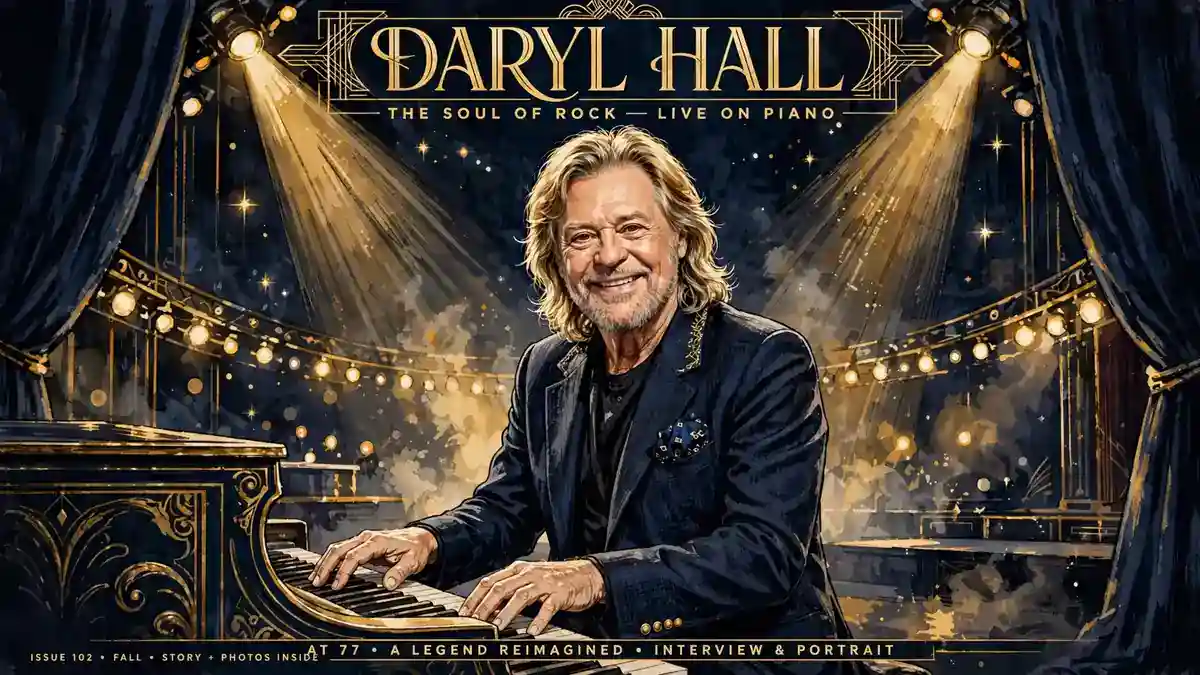
Daryl Hall‘s net worth is estimated at $70–80 million as of November 2026. The split between the two numbers tells its own story: Celebrity Net Worth, the most-cited tracker of his fortune, holds the figure at $70 million, while Finance Monthly’s 2025 estimate puts it at $80 million. What both agree on is where the money sits — a Hall & Oates song catalog that has sold more than 40 million records, a touring career that is still going at age 80, and a restaurant and music club in Pawling, New York, that Hall built himself. The newest chapter arrived in June 2026, when Hall told fans he had received a kidney transplant from a living donor, then celebrated his 80th birthday on October 11 and went straight back on the road.
Daryl Hall: Quick Facts
| Estimated net worth | $70–80 million (range: $70–80 million) |
|---|---|
| Profession | Singer, songwriter, keyboardist, guitarist, producer |
| Nationality | American |
| Born | October 11, 1946 (age 80) |
| Height | 6 feet 1 inch (1.85 m) |
| Primary income sources | Music royalties and publishing, touring, Daryl’s House Club, Live from Daryl’s House |
| Active years | 1967–present |
| Last reviewed | November 2026 |
- Early Life and Background
- Education
- Career Journey
- Rise to Fame
- Main Sources of Income
- Salary and Earnings
- Businesses and Investments
- Brand Deals and Sponsorships
- Houses, Cars and Other Assets
- Awards and Achievements
- Net Worth Growth Over the Years
- Social Media Presence
- Personal Life
- Sources & Reporting
- Frequently Asked Questions
- Final Thoughts
Early Life and Background
Daryl Franklin Hohl was born on October 11, 1946, in Pottstown, Pennsylvania, about 40 miles northwest of Philadelphia. His parents, Walter Franklin Hohl and Betty Hohl, both sang — music was the family trade before it became his career. He grew up in a household where harmony singing was ordinary, and by his teens he was singing doo-wop on Philadelphia street corners and in local groups.
The first serious vehicle was the Temptones, a vocal group Hall formed while still in school. The group cut records and toured the Philadelphia circuit, and Hall’s tenor — a white singer steeped in Black soul and R&B — became his calling card. Session work followed: Hall sang backing vocals around Philadelphia’s studios while the city’s soul sound, built by Kenny Gamble and Leon Huff, was taking over American radio. That apprenticeship matters to the money story, because it taught Hall how records were made, who owned what, and why publishing mattered — lessons that shaped the catalog he later fought in court to protect.
The meeting that changed his life happened at Temple University in 1967, when Hall and John Oates found themselves at the same band competition at the Adelphi Ballroom in Philadelphia. The story, retold by both men for decades, is that a fight broke out between rival groups’ supporters and the two fled the venue together. They stayed in touch, sang together, and within a few years were writing songs as a duo.
Before the duo took off, Hall fronted Gulliver, a band he formed with singer-songwriter Tim Moore. Gulliver released one album in 1970 and folded, but the experience gave Hall his first taste of the record business from the inside — a label deal, a release, and a quick lesson in how little of the money reaches the artist.
Education
Hall attended Owen J. Roberts High School in Pottstown, then enrolled at Temple University in Philadelphia, where he studied music. Temple was more than a classroom: it was where he met Oates, and where the Philadelphia soul scene gave him session work that paid while he learned the trade. He did not finish a degree — the music work pulled him out — and he has never presented himself as a formally trained conservatory musician. His training was the studio floor and the stage.
That gap in formal credentials never held him back. Hall plays keyboards and guitar, writes melodies with a soul singer’s ear for phrasing, and arranges vocals with a precision that session players noticed early. The education that counted for his fortune was commercial: publishing, royalties, and ownership of the songs he wrote.
Career Journey
Hall & Oates signed to Atlantic Records and released their debut album, Whole Oats, in 1972. The record sold modestly, but it established the duo’s template: Hall’s soaring tenor up front, Oates’ guitar and harmonies behind it, and songs that mixed Philadelphia soul with rock. Their second album, Abandoned Luncheonette (1973), produced “She’s Gone,” a song that became a hit on its first release in some markets and a bigger one when it was reissued — a pattern that would repeat across their career, with songs earning money in waves rather than all at once.
The mid-1970s were lean. War Babies (1974), produced by Todd Rundgren, and the duo’s move to RCA Records in 1975 brought slow progress rather than a breakthrough. “Sara Smile,” written for Hall’s longtime partner Sara Allen, reached the Top 10 in 1976, and “Rich Girl” gave them their first Billboard Hot 100 No. 1 in 1977. The money was real but uneven — enough to keep going, not enough to make anyone rich.
The dam broke in 1980. Voices produced “Kiss on My List,” a second No. 1, and the duo released a run of albums — Private Eyes (1981), H2O (1982), Big Bam Boom (1984) — that turned them into the biggest-selling duo in American music history. Six of their singles reached No. 1 on the Billboard Hot 100: “Rich Girl,” “Kiss on My List,” “Private Eyes,” “I Can’t Go for That (No Can Do),” “Maneater,” and “Out of Touch.” The Recording Industry Association of America credits them with more than 40 million records sold, a figure Celebrity Net Worth and other outlets repeat.
Hall’s solo career ran in parallel. His first solo album, Sacred Songs (1980), was produced by Robert Fripp. Three Hearts in the Happy Ending Machine (1986), co-produced with Dave Stewart of Eurythmics, produced the Top 10 single “Dreamtime.” Later solo records — Soul Alone (1993), Can’t Stop Dreaming (1996, reissued 2003), and Laughing Down Crying (2011) — sold to a smaller but loyal audience. Then came D in 2024, his sixth solo studio album and his first in 13 years, again made with Dave Stewart, who co-wrote seven of its nine songs. The album produced two Top 20 hits on the Adult Contemporary chart, according to the tour announcement that followed its release.
In 2007, Hall started the project that would become his second act. Live from Daryl’s House began as a monthly web series filmed at his home in Millerton, New York, with guest musicians dropping by to eat, talk, and play. Guests over the years have included Smokey Robinson, Todd Rundgren, Joe Walsh, Kenny Loggins, Robby Krieger, and younger acts such as Fitz and the Tantrums. The series won a Webby Award in 2010, ran for more than 90 episodes, and returned on November 1, 2023, after a five-year break, with new episodes filmed at his club in Pawling.
The duo’s story ended in court. In November 2023, Hall filed a lawsuit against Oates to stop him selling his share of their joint company, Whole Oats Enterprises, to the music publisher Primary Wave. Hall said the sale would breach their business agreement; a Nashville court paused the sale while the pair went into private arbitration. In April 2024, Oates told Rolling Stone he had moved on and the duo would never perform together again; Hall confirmed the same a month later. On August 11, 2025, Hall’s lawyers filed to dismiss the case after a final arbitration judgment, and the court granted the dismissal on August 12, 2025. The terms are sealed — neither side has said whether the Primary Wave sale can proceed or what money, if any, changed hands.
Rise to Fame
Hall & Oates became famous the slow way, then all at once. The 1970s gave them credibility and a handful of hits; the early 1980s gave them ubiquity. Between 1980 and 1984 they placed a string of singles at the top of the charts, filled arenas, and became fixtures on MTV at the exact moment music video turned pop stars into household faces. “You Make My Dreams,” “Maneater,” and “Private Eyes” were hits that kept working — songs that played everywhere, for years, in films, on radio, and later in commercials and streaming playlists. That kind of saturation is what makes a catalog pay for decades.
The Rock and Roll Hall of Fame inducted Hall & Oates in 2014, and the duo were also inducted into the Songwriters Hall of Fame. The inductions put a formal stamp on what the sales figures already showed: no duo in American music history has sold more records. Hall’s voice — that high, clear tenor — is the sound most listeners attach to the pair, and it is the asset that kept earning after the hits stopped coming.
Fame also brought the kind of long-tail income that defines Hall’s fortune. A No. 1 single from 1982 earns every time it streams, every time it is licensed to a film or an advertisement, and every time a compilation is sold. Hall co-wrote most of the duo’s biggest songs, which means he holds a songwriter’s share of the publishing on top of his performer’s share. That double position — writer and performer — is the difference between a famous singer and a wealthy one.
The second rise came later and looked different. Live from Daryl’s House made Hall a curator rather than a hitmaker: a respected elder statesman of soul and rock who could sit at a piano with artists half his age and hold his own. The series rebuilt his public profile in the streaming era and gave him a business — a show, a club, a brand — that did not depend on the duo.
Main Sources of Income
Four streams carry Hall’s fortune, and the first dwarfs the rest. Music royalties and publishing from the Hall & Oates catalog are the foundation: more than 40 million records sold, six No. 1 singles, and a songbook that streams, syncs, and sells compilations every year. Hall co-wrote the biggest songs, so he earns as both songwriter and performer. The catalog’s value is also the reason the 2023 lawsuit mattered so much — Whole Oats Enterprises holds the duo’s publishing rights, and control of that company is control of the money.
Touring is the second stream. Hall toured through 2024 and 2025, including a run with Elvis Costello in 2024 and a long 2025 tour with Glenn Tilbrook of Squeeze, and he opened a West Coast run with Tilbrook on October 19, 2026, in Reno, eight days after turning 80. Touring at his level means theater and casino dates rather than stadiums, but the margins on a solo show with a tight band are strong, and the dates double as promotion for the catalog and the club.
The third stream is Daryl’s House Club, the restaurant and live music venue Hall opened in Pawling, New York, on Halloween 2014. The club sells food, drink, and tickets, hosts touring acts most weeks, and serves as the filming home of Live from Daryl’s House. It is a real operating business with staff, a kitchen, and a calendar — not a vanity project.
The fourth stream is Live from Daryl’s House itself: a Webby-winning series with more than 90 episodes, syndication and streaming revenue, and a format that has been running, on and off, since 2007. The show’s return in November 2023 after a five-year hiatus showed it still had an audience, and its guests keep it in the music press without Hall having to chase a hit record.
What is missing from the list is just as telling. Hall has no documented endorsement portfolio of the kind pop stars sign today, no fashion line, no fragrance, no tequila brand. His wealth is almost entirely music money — catalog, stage, and a room of his own where the two meet.

Salary and Earnings
Hall has no published salary, and no record label or promoter has ever disclosed his per-show fee. The best public guide to his annual income is Finance Monthly’s 2025 estimate, which put his yearly earnings at $2–4 million from royalties, live shows, and his business ventures. That figure is a trade publication’s estimate, not a filing, so treat it as a range — but it lines up with the shape of his career: a catalog that pays every year, a touring schedule that runs most years, and a venue business on top.
The catalog is the steady part. Songs such as “Maneater,” “You Make My Dreams,” and “Rich Girl” earn streaming royalties, radio play, and sync fees year after year, and Hall’s songwriter share means he is paid on both sides of each use. Catalog income does not spike the way a tour does, but it does not stop either — and for a writer with six No. 1 singles, the floor is high.
Touring income is lumpy. A year with a full run — the 2025 dates with Glenn Tilbrook covered the United States and the United Kingdom, including a May 19 date at London’s Royal Albert Hall — earns far more than a year with a handful of club shows. The 2024 run included a November tour of eight U.S. dates from Orlando to Atlantic City, with a stop at Nashville’s Ryman Auditorium, and the club’s 10th anniversary show on Halloween 2024 was free to fans — a goodwill gesture, not a payday.
One honest gap in the record: nobody has published what Hall earned in any single year, and the sealed 2025 arbitration means any money tied to the Whole Oats dispute stays private. The $2–4 million annual figure is the only published estimate of his yearly take, and we present it as such.
Businesses and Investments
Daryl’s House Club is Hall’s main business, and it is also his most personal one. The idea grew out of Live from Daryl’s House: Hall wanted a room that felt like his home, where musicians could play the way they did on the show. In 2013 he sold his house in Millerton, New York, where the show had been filmed, and leased the old Towne Crier nightclub building at 130 Route 22 in Pawling. He remodeled it to look like his old home, and on Halloween 2014, Hall & Oates opened the room with a 90-minute set for about 300 people. General admission that night cost $30, according to the Poughkeepsie Journal’s reporting at the time.
The club has run ever since — restaurant Wednesday through Sunday, live music most weeks, and the show filmed on its stage. Hall lives about nine miles away in Sherman, Connecticut, which keeps the commute short and the operation hands-on. In September 2024 he marked the club’s 10th anniversary with a free Halloween concert for fans, then launched an eight-date U.S. tour the following week. A decade in, the club is both a business and the physical home of his brand.
The second business is the show itself. Live from Daryl’s House is executive-produced by Hall’s manager and has run as a web series, a television property, and a streaming title across its life. Its value goes beyond the money it earns directly: it is the platform that keeps Hall visible, sells tickets to his tours, and fills his club. Guests bring their own audiences, and every episode is another advertisement for the catalog.
On investments beyond music and the club, the public record is quiet. Hall is not known as a startup investor, a real estate flipper, or a collector of the kind that makes headlines. The one catalog investment that matters is the one he fought over: Primary Wave, the music publisher, has owned a significant interest in the Hall & Oates song catalog for more than 15 years, according to court reporting, and Oates’ attempt to sell his remaining share of Whole Oats Enterprises to Primary Wave was the trigger for the 2023 lawsuit. Whatever the sealed arbitration decided, the catalog’s ownership now sits at the center of Hall’s finances.
Brand Deals and Sponsorships
Hall’s name does not appear on the endorsement deals that define younger pop stars’ fortunes, and that absence is itself a finding. No sneaker deal, no beverage partnership, no fashion collaboration is documented in the press covering him. His commercial partnerships are musical: a 2024 solo album released on Virgin Records, produced with Dave Stewart, and touring partnerships such as the 2025 run with Glenn Tilbrook.
The most valuable commercial relationship in his orbit is not a sponsorship at all — it is Primary Wave’s long-standing interest in the Hall & Oates catalog. Music publishers buy catalog stakes because the songs pay; Primary Wave’s involvement, stretching back more than 15 years, is a market verdict on the catalog’s worth, and the 2023 fight over Oates’ share shows how seriously both men take that value.
Sync licensing is the quiet earner in this section. Hall & Oates songs turn up in films, television, and advertising with a regularity that keeps the catalog in front of new listeners — “You Make My Dreams” has become a fixture of film soundtracks and trailers, and each placement pays a fee and drives a spike in streaming. No single deal is public, but the pattern is: a catalog this familiar gets licensed often.

Houses, Cars and Other Assets
Hall’s property story is a Hudson Valley story. For years he lived in Millerton, New York, where Live from Daryl’s House was filmed in his home. In August 2013 he sold that house and moved to Sherman, Connecticut, about nine miles from the Pawling club — a move the Chronogram reported at the time, alongside his plan to lease the Towne Crier building and rebuild the show’s set inside it. Recent reporting describes a Georgian-style estate in New York valued at about $4.3 million; that figure comes from secondary reporting rather than a property record we could verify, so we present it as reported, not confirmed.
The club building itself is leased, not owned — Hall took over the former Towne Crier space on Route 22 in Pawling and remodeled it. The distinction matters for the net worth math: the value sits in the operating business, the brand, and the show filmed there, rather than in the bricks.
On cars, the public record is silent. No verified reporting describes a car collection, a garage of classics, or a single headline vehicle attached to Hall, and we will not invent one. The same applies to watches, art, and other luxury assets: Hall’s public image is a working musician’s, not a collector’s, and his money is visible in the catalog and the club rather than in things he drives.
The asset that counts most is the one you cannot photograph: his share of the Hall & Oates publishing catalog, held through Whole Oats Enterprises. Song catalogs by heritage acts have traded at large multiples of annual earnings in recent years, and while no sale price for Hall’s share has ever been published, the 2023 dispute over Oates’ stake shows the market — in the form of Primary Wave — was ready to pay for it.
Awards and Achievements
The headline honor is the Rock and Roll Hall of Fame, which inducted Hall & Oates in 2014. The duo were also inducted into the Songwriters Hall of Fame, recognition of a catalog that other writers study. Hall & Oates are Grammy-nominated artists, and their six Billboard Hot 100 No. 1 singles put them in rare company: no other duo in American music history has sold more records.
Live from Daryl’s House won a Webby Award in 2010 in the variety category, an early sign that a web series shot in a musician’s living room could compete with television. The show has since run for more than 90 episodes and returned in 2023 after a five-year break — longevity that few music series of its era can claim.
The commercial achievements are the ones that pay: six No. 1 singles, more than 40 million records sold worldwide, and a run of multi-platinum albums in the early 1980s that made Hall & Oates the best-selling duo of all time. Add the 2024 solo album D — two Top 20 Adult Contemporary hits, a first solo record in 13 years — and a touring schedule still running at 80, and the achievement list keeps growing past the point most artists stop.
Net Worth Growth Over the Years
Hall’s fortune was built in two waves. The first came in the early 1980s, when the run of No. 1 singles turned a working duo into arena headliners and the royalties started compounding. The second came later, as the catalog’s value rose with streaming and as Hall added the club and the show to the music income. There are no published year-by-year figures for the 1980s or 1990s — nobody was tracking celebrity net worth then — so the table below uses the published estimates that exist, and says plainly where they come from.
| Year | Estimated net worth | What drove it |
|---|---|---|
| 2021 | $70 million | Celebrity Net Worth figure cited in March 2021 reporting; catalog royalties and touring |
| 2024 | $70 million | Celebrity Net Worth, updated July 2024; solo album D released; club’s 10th anniversary |
| 2025 | $80 million | Finance Monthly estimate; lawsuit settled in arbitration; U.S. and U.K. touring with Glenn Tilbrook |
| 2026 | $70–80 million | Range held: kidney transplant in June, 80th birthday in October, West Coast tour from October 19 |
The honest reading of that table is that Hall’s wealth has been flat in published terms for five years — $70 million on the most-cited tracker since at least 2021, $80 million on the newer estimate. Flat does not mean stagnant. A catalog that pays $2–4 million a year, in Finance Monthly’s estimate, against living costs and a club business, holds its value rather than compounding like a tech fortune. The 2026 range reflects real disagreement between the two published estimates, not a decline: Celebrity Net Worth has not moved its number since July 2024, while Finance Monthly’s higher figure dates to 2025.
How does Hall compare with his peers? The table below uses Celebrity Net Worth estimates for the same kind of heritage act, so the numbers are comparable — all from the same tracker, all dated the same way.
| Artist | Estimated net worth | Note |
|---|---|---|
| Daryl Hall | $70–80 million | Hall & Oates catalog, club, touring |
| John Oates | $60 million | Celebrity Net Worth estimate; the other half of the duo |
| Billy Joel | $250 million | Celebrity Net Worth estimate; piano-rock contemporary with a far larger touring machine |
| Phil Collins | $350 million | Celebrity Net Worth estimate; solo career plus Genesis catalog |
The comparison flatters Hall in one way and humbles him in another. He sits close to his partner Oates, as you would expect from two men who split the same catalog — and well below Joel and Collins, whose solo careers and touring operations ran at a bigger scale. The gap is a useful check on the numbers: Hall’s fortune looks like a catalog fortune, not a stadium-touring fortune, and the $70–80 million range fits that shape.
Social Media Presence
Hall is not a heavy social media user, and his accounts read like a working musician’s noticeboard rather than an influencer’s feed. The most consequential post of his recent career came in June 2026, when he used Instagram to tell fans he had received a kidney transplant from a living donor, that the operation had been a complete success according to his doctors, and that he expected to be back to normal within a few months. Parade reported the post the same month, and Hall used it to promise more music and more episodes of Live from Daryl’s House.
The show and the club carry much of the online load. Live from Daryl’s House has its own YouTube presence, where episodes and clips reach viewers who never saw the original web series, and Daryl’s House Club posts its calendar and shows on its own channels. Hall’s own accounts announce tours and albums — the October 2026 West Coast run with Glenn Tilbrook was promoted through the usual channels — but he does not monetize a personal brand the way younger artists do. There is no published follower count we can verify for his personal accounts, and we do not report one.
Personal Life
Hall has been married twice and is currently single. His first marriage, to Bryna Lublin in 1969, ended in divorce in 1972; he converted to Judaism before the wedding. His longest relationship was with singer-songwriter Sara Allen, his partner for nearly 30 years and the inspiration for “Sara Smile”; they never married and separated in 2001, remaining friends. In December 2009 he married Amanda Aspinall, daughter of British gambling and zoo magnate John Aspinall; the couple divorced in 2015, and Amanda died in January 2019. Hall became stepfather to her two children, March and Orson, and March sang backing vocals on his 2011 album Laughing Down Crying.
Hall has one biological child, a son named Darren Hall, born in January 1984 to Andrea Zabloski of Duluth, Minnesota. Darren has spoken publicly about growing up apart from his father and about his own music career. Hall’s parents lived long lives: his father, Walter Franklin Hohl, died in July 2014 at 95, and his mother, Betty, died in December 2022 at 98.
Health became the story of 2026. In June, Hall revealed on Instagram that he had undergone a kidney transplant from a living donor a couple of weeks earlier, calling the operation a complete success and saying he was already starting to feel better. He promised fans more music and more Daryl’s House shows — and he kept the promise fast. He turned 80 on October 11, 2026, and eight days later opened a West Coast tour with Glenn Tilbrook in Reno, Nevada, running through November 4 in Denver. The transplant, the birthday, and the tour together are the freshest facts in this article, and they are the reason the 2026 estimate carries a November review date.
Sources & Reporting
Celebrity Net Worth — the $70 million net worth figure and the 40-million-records career total; its Daryl Hall profile was last updated July 1, 2024.
Finance Monthly — the $80 million 2025 estimate and the $2–4 million annual earnings figure, as cited in 2025–2026 reporting.
Parade — Hall’s June 2026 kidney transplant announcement, his 80th birthday on October 11, 2026, and the 2024 solo album D; reporting from October 2026.
Rolling Stone — Oates’ April 2024 statement that the duo would never perform together again, and the August 2025 reporting that the pair had settled in arbitration and filed to dismiss the case.
Noise11 — the August 11, 2025 dismissal filing in Nashville’s Davidson County Chancery Court and the end of the two-year legal fight.
Poughkeepsie Journal — the October 31, 2014 opening of Daryl’s House Club in Pawling, the 300-person opening night, and the $30 general admission price; reporting from 2014–2015.
American Songwriter — the club’s 10th anniversary free Halloween show on October 31, 2024, and the eight-date U.S. tour that followed.
Hello Magazine — Hall turning 80 in October 2026, the 2024 album D, and his touring through 2025.
Information Cradle — Hall’s height of 6 feet 1 inch, his marriages to Bryna Lublin and Amanda Aspinall, and his son Darren; profile updated May 2026.
Chronogram — the August 2013 sale of Hall’s Millerton home, the lease of the former Towne Crier building in Pawling, and the move to Sherman, Connecticut; reporting from October 2013.
Reporting window: October 2013 – November 2026. Net worth estimates are dated November 2026. Where sources disagreed on the headline figure, we published the $70–80 million range and named both sources rather than picking one.
Frequently Asked Questions
What is Daryl Hall’s net worth in 2026?
Daryl Hall’s net worth is estimated at $70–80 million as of November 2026. Celebrity Net Worth puts the figure at $70 million (last updated July 2024), while Finance Monthly’s 2025 estimate is $80 million. The range reflects a genuine disagreement between the two published estimates, and his fortune rests on the Hall & Oates song catalog, touring, and his Daryl’s House Club in Pawling, New York.
What is Hall & Oates’ net worth?
There is no single combined figure, because the two men hold their money separately. Celebrity Net Worth estimates Daryl Hall at $70 million and John Oates at $60 million, which puts their combined estimated wealth at about $130 million. The pair’s joint company, Whole Oats Enterprises, holds their publishing rights, and control of that company was the subject of their 2023–2025 legal dispute.
Is Daryl Hall still touring in 2026?
Yes. Hall turned 80 on October 11, 2026, and opened a West Coast tour with Glenn Tilbrook of Squeeze on October 19 in Reno, Nevada, running through November 4 in Denver. He toured through 2024 and 2025 as well, including a run with Elvis Costello and a long U.S. and U.K. tour with Tilbrook that included London’s Royal Albert Hall.
Are Hall & Oates still together?
No. The duo’s partnership ended after Hall sued Oates in November 2023 to stop him selling his share of their company, Whole Oats Enterprises, to the music publisher Primary Wave. In April 2024, Oates told Rolling Stone the duo would never perform together again, Hall confirmed it, and the lawsuit was dismissed in August 2025 after a private arbitration whose terms are sealed. Both men now perform solo.
What happened in the Hall & Oates lawsuit?
Hall filed suit in November 2023 to block Oates from selling his half of Whole Oats Enterprises to Primary Wave, saying the sale would breach their business agreement. A Nashville court paused the sale while the pair went into private arbitration. The arbitration produced a final judgment, and on August 11, 2025, Hall’s lawyers filed to dismiss the case; the court granted the dismissal on August 12, 2025. The settlement terms are sealed, so nobody outside the two camps knows whether the sale can proceed or what money changed hands.
What is Daryl’s House Club?
Daryl’s House Club is Hall’s restaurant and live music venue at 130 Route 22 in Pawling, New York. He opened it on Halloween 2014 in the former Towne Crier nightclub building, with Hall & Oates playing a 90-minute opening set for about 300 people. It hosts touring acts, serves food, and is the filming home of his series Live from Daryl’s House. Hall marked its 10th anniversary with a free Halloween concert on October 31, 2024.
How old is Daryl Hall?
Daryl Hall was born Daryl Franklin Hohl on October 11, 1946, in Pottstown, Pennsylvania, which makes him 80 years old as of November 2026. He celebrated the milestone with a West Coast tour that began eight days after his birthday, and he had a kidney transplant from a living donor in June 2026, which he described as a complete success.
Who was Daryl Hall married to, and does he have children?
Hall has been married twice: to Bryna Lublin from 1969 to 1972, and to Amanda Aspinall, daughter of British magnate John Aspinall, from 2009 to 2015. He was also in a nearly 30-year relationship with singer-songwriter Sara Allen, the inspiration for ‘Sara Smile’; they never married and separated in 2001. He has one biological child, a son named Darren Hall, born in January 1984 to Andrea Zabloski. He is currently single.
Final Thoughts
Daryl Hall’s $70–80 million fortune is a catalog fortune, and that is a compliment. The six No. 1 singles, the 40 million records, and the songwriter’s share of the publishing have paid him for forty years, and they will keep paying after the touring stops. What makes his story different from most heritage acts is what he built around the catalog: a show that turned his living room into a television format, and a club that turned that format into a business with a kitchen, a stage, and a calendar.
The 2023 lawsuit was the bill coming due on a partnership that had lasted half a century, and its sealed ending in August 2025 leaves the biggest question — who controls the catalog now — unanswered in public. But Hall’s answer since then has been to work: a new solo album in 2024, a club still running at ten years old, a kidney transplant in June 2026, an 80th birthday in October, and a tour eight days later. The range in the headline figure is honest about what we do not know. What we do know is that the voice behind “Sara Smile” is still earning, still performing, and still betting on a room of his own.
Published on November 6, 2026. Last reviewed November 2026. Found an error? See our corrections policy.