
Susanna Hoffs‘s net worth is estimated at $10 million to $12 million as of November 2026. The Bangles co-founder built that fortune on one of the most durable catalogs of the 1980s — a triple-platinum album, two American number-one singles, and a ballad she co-wrote that still earns publishing money nearly forty years later — then added a solo career, film cameos, and a 2023 debut novel whose film rights Universal Pictures bought before the book even reached stores.
Susanna Hoffs: Quick Facts
| Estimated net worth | $10 million to $12 million (range: $10 million to $12 million) |
|---|---|
| Profession | Singer, songwriter, guitarist, actress, author |
| Nationality | American |
| Born | January 17, 1959 (age 67) |
| Height | 5 feet 2 inches (157 cm) |
| Primary income sources | Music royalties, songwriting publishing, touring, solo albums, acting, book and film-rights income |
| Active years | 1981–present |
| Last reviewed | November 2026 |
- Early Life and Background
- Education
- Career Journey
- Rise to Fame
- Main Sources of Income
- Salary and Earnings
- Businesses and Investments
- Brand Deals and Sponsorships
- Houses, Cars and Other Assets
- Awards and Achievements
- Net Worth Growth Over the Years
- Social Media Presence
- Personal Life
- Sources & Reporting
- Frequently Asked Questions
Early Life and Background
Susanna Lee Hoffs was born on January 17, 1959, in Los Angeles, California, into a household where film and psychology sat side by side. Her mother, Tamar Simon Hoffs, worked as a film director, writer and producer; her father, Joshua Allen Hoffs, was a psychoanalyst. She grew up in a Jewish family in Los Angeles with a younger brother, Jesse, and the creative streak showed early: she took ballet as a child and started playing guitar in elementary school, learning chords from her uncle.
Los Angeles in the 1960s and 1970s gave her a front-row seat to rock music, and she absorbed it the way only a kid with a guitar and a record collection can. She attended Palisades High School, and the music she heard there — British Invasion harmonies, folk-rock jangle, the pop singles on AM radio — would later surface directly in The Bangles’ sound. The band’s chiming guitars and stacked harmonies were not a record-company invention; they were the sound of a teenager who had grown up loving the Beatles, the Byrds and the Mamas & the Papas.
What set Hoffs apart from plenty of other Los Angeles kids with guitars was follow-through. She kept playing through her teens, kept writing, and kept looking for people to play with. By the time she left high school, music had moved from a hobby to the plan. The money story of her life starts here, in a modest way: no family fortune, no child-star earnings, just a Los Angeles upbringing, a guitar, and a decade of groundwork before the first real paycheck arrived.
Education
Hoffs enrolled at the University of California, Berkeley, where she switched majors between dance, theater, film and art before settling on art, graduating with a bachelor’s degree in 1980. Berkeley changed her musical direction in a single night: she attended the final Sex Pistols show, and the blast of punk rock turned her ambitions from dancing toward forming a band of her own.
While still a student in the late 1970s, she and her then-boyfriend David Roback formed a band called the Psychiatrists, later renamed the Unconscious. Roback would go on to co-found Mazzy Star, and the Berkeley years gave Hoffs her first experience of writing songs, booking rehearsals and playing in front of strangers — the unglamorous rehearsal-room education that precedes every overnight success. She has described the period as the moment she stopped thinking of music as something other people did and started treating it as her job.
The art degree mattered more than it looks on a résumé. Hoffs has always been a visual thinker — the Bangles’ videos, sleeve art and stage presentation carried a deliberate 1960s style — and the Berkeley training in art, film and theater fed directly into the band’s image. It also gave her a fallback she never needed: by graduation year, the band was already forming.
Career Journey
After graduating in 1980, Hoffs placed a classified advertisement in The Recycler, a Los Angeles free paper, looking for bandmates. Guitarist and vocalist Vicki Peterson and her sister, drummer and vocalist Debbi Peterson, answered. The three formed a band first called The Bangs, then renamed The Bangles after learning another group already used the name. Bassist Annette Zilinskas joined for the early recordings, later replaced by Michael Steele.
The band’s first release was a self-titled five-track EP in 1982 on Faulty Products, the label run by Miles Copeland. It sold modestly but got the group noticed in Los Angeles clubs and on college radio, and Columbia Records signed them. Their debut album, All Over the Place, arrived in 1984. Critics loved its jangling power-pop — nine of its eleven songs were originals — but the public took longer to catch on. The album peaked at number 80 on the Billboard 200, with singles “Hero Takes a Fall” and a cover of “Going Down to Liverpool” earning airplay without breaking the band nationally. The record sold just over 49,000 copies in its early run, according to later reporting — a respectable start that paid very little.
The lean years are part of the money story. For three years, Hoffs earned a working musician’s living: club dates, small tours, session work, and the slow build of a reputation. She also began acting, taking the starring role of Molly in the 1987 teen comedy The Allnighter. The film did not make her a movie star, but it put a second income stream on the table and kept her visible while the band regrouped. Those early years explain why the fortune that followed was built on catalog rather than on a single windfall: the Bangles’ biggest paydays came from songs that kept selling for decades.
When the band split in 1989, Hoffs went solo. Her debut solo album, When You’re a Boy, came out on Columbia on January 29, 1991, led by the single “My Side of the Bed,” which reached number 30 on the Billboard Hot 100. The album peaked at number 83 on the Billboard 200 — a solid showing that still fell far short of Bangles numbers. She recorded a second solo album in 1993 and 1994, but Columbia dropped her before it came out, and the record stayed unreleased. Her self-titled second solo album arrived in 1996 on London Records, with a cover of the Lightning Seeds’ “All I Want” reaching number 77 on the Hot 100. Neither solo record matched the band’s sales, and Hoffs stepped back from chasing mainstream pop stardom.
The Bangles reunited in 1999, and the reunion turned out to be durable rather than a one-off nostalgia tour. They released Doll Revolution in 2003 and Sweetheart of the Sun in 2011, and kept touring in various lineups. In parallel, Hoffs rebuilt her solo career on her own terms: the Under the Covers series with Matthew Sweet (three volumes in 2006, 2009 and 2012), the original album Someday in 2012, the covers albums Bright Lights in 2021 and The Deep End in 2023, the archival release The Lost Record in 2024, and a new album of original songs, The List, in 2026. Few artists from the 1980s have kept up that pace into their late sixties, and the steady output is one reason the royalties never stopped.
Rise to Fame
Everything changed with the second album. Different Light, released in January 1986 and produced by David Kahne, reached number 2 on the Billboard 200 and spent 81 weeks on the chart. It was certified triple platinum by the RIAA in 1994, with more than 3 million copies sold in the United States alone and over 3.5 million worldwide. The album’s singles did the heavy lifting: “Manic Monday,” written by Prince under the pseudonym Christopher, reached number 2 on the Hot 100, and “Walk Like an Egyptian,” written by Liam Sternberg, hit number 1. “Walking Down Your Street” reached number 11 and “If She Knew What She Wants” reached number 29, giving the album four Hot 100 hits.
The videos made Hoffs a star in her own right. MTV played the “Walk Like an Egyptian” clip constantly, and Hoffs — singing lead, playing her Rickenbacker, and doing the song’s sideways-glance choreography — became the band’s most recognizable face. That visibility had a direct financial effect: lead singers of hit bands get the solo offers, the acting roles and the songwriting invitations, and Hoffs collected all three over the next decade.
The third album, Everything, arrived in October 1988, produced by Davitt Sigerson. It peaked at number 15 on the Billboard 200 and went platinum in the United States. Its singles kept the run going: “In Your Room” reached number 5, and “Eternal Flame” — co-written by Hoffs with Billy Steinberg and Tom Kelly after Hoffs told Steinberg about a visit to the Elvis Presley memorial in Memphis — topped the Hot 100 on April 1, 1989, and became the band’s biggest-selling single worldwide. A cover of Simon & Garfunkel’s “Hazy Shade of Winter,” recorded for the Less Than Zero soundtrack, reached number 2. Billboard later named “Walk Like an Egyptian” the number-one song of 1987 on its year-end chart.
At the peak, the Bangles were one of the biggest female-fronted acts on the planet, with reported career record sales of more than 40 million across their catalog, according to booking and industry profiles. Then, in 1989, at the height of their fame, they split. Internal tension, exhaustion from touring, and frustration over how the band’s image was marketed all played a part. The split froze the catalog at its most valuable moment — and, as it turned out, a frozen catalog of two number-one singles and a triple-platinum album keeps paying for a very long time.
Main Sources of Income
Hoffs’ money comes from six streams, and the balance between them is what makes her fortune stable rather than flashy. The largest is music royalties: record sales, digital streaming, radio airplay and licensing from the Bangles catalog and her solo work. “Walk Like an Egyptian” and “Eternal Flame” are permanent fixtures on oldies radio, 1980s playlists, film soundtracks and advertising — every play, stream and sync sends money to the songwriters and performers. Because Hoffs co-wrote “Eternal Flame” and sang lead on the band’s biggest hits, she collects from more than one royalty stream on the same songs: performance royalties as a singer, mechanical and publishing royalties as a songwriter, and artist royalties on the recordings.
Songwriting publishing is the second stream, and it is the one most net-worth profiles underrate. “Eternal Flame” has been covered repeatedly — most famously by Atomic Kitten, whose 2001 version topped the UK singles chart — and each cover generates fresh publishing income for its writers. Hoffs also wrote or co-wrote songs across the Bangles catalog and her solo albums, including “My Side of the Bed” material and the songs on The List, her 2026 album of originals. Publishing is the gift that keeps paying: a hit song written in 1988 can still produce a check in 2026.
Touring and live performance form the third stream. The Bangles have toured in their reunion years, and Hoffs performs solo dates and festival appearances, including a featured slot at the Love Rocks benefit concert in New York in 2026 alongside Paul Simon, Mary J. Blige and Elvis Costello. Reunion-era touring pays differently from 1980s arena touring — smaller rooms, higher ticket prices, and a catalog audience that buys merchandise — but it is steady work for an act with two number-one singles. Third-party blogs have guessed at touring earnings of $200,000 to $500,000 a year for Hoffs; no verified figure exists, so treat that range as a blog estimate, not a fact.
The fourth stream is solo recording. Her solo albums never matched Bangles sales, but they sell steadily to a loyal audience, and the Under the Covers albums with Matthew Sweet found a durable niche among classic-rock fans. The fifth stream is acting and screen work: the 1987 lead in The Allnighter, her appearances as a member of the fictional band Ming Tea in her husband Jay Roach’s Austin Powers films, and assorted television and film appearances over the years. The sixth, newest stream is books: her debut novel This Bird Has Flown (Little, Brown, April 2023) earned an advance and, before publication, a film-rights sale to Universal Pictures — with Hoffs herself writing the screenplay.
Streaming deserves a note of its own. The Bangles’ catalog performs strongly on Spotify and similar services, where 1980s hits sit on playlists with tens of millions of followers. Streaming pays fractions of a cent per play, so it takes enormous volume to matter — but “Walk Like an Egyptian” and “Eternal Flame” have that volume, and the money arrives every month without Hoffs having to tour, record or promote anything. That is the quiet engine of her net worth: songs recorded in 1986 and 1988 that still earn in 2026.

Salary and Earnings
There is no public salary record for Susanna Hoffs — she has never disclosed a paycheck, and no filing lists one. What exists instead is a trail of album economics that lets us size the fortune honestly. The Richest, one of the longer-running net-worth trackers, published estimated record earnings for the band’s peak albums: roughly $4.5 million from Different Light on 3 million US copies, and about $1.5 million from Everything on 1 million US copies. Those are The Richest’s estimates of gross record earnings at the band level, and they need a large warning label: the money was split four ways among the band, then shared with the label, producers, managers and agents, and much of it was recouped against recording and promotion costs. A triple-platinum album does not put $4.5 million in one singer’s bank account.
The same caution applies to the annual-income guesses that circulate on smaller blogs. One site puts Hoffs’ yearly take from album sales and royalties at $500,000 to $1 million, and her touring at $200,000 to $500,000 a year. Those numbers are unsourced blog estimates, and we repeat them only to show what the low-quality end of the internet claims — not as facts. The honest statement is narrower: her recurring income is dominated by catalog royalties and publishing, it arrives in lumpy annual amounts that rise when a song is licensed for a film or advertisement, and no audited figure is public.
What can be said with confidence is where the money concentrated. The Bangles’ five studio albums have sold more than 6.7 million copies worldwide, according to discography records, with Different Light accounting for over half of that total. “Eternal Flame” was certified gold in the United States and platinum in several other markets, and “Walk Like an Egyptian” was certified gold in the United States and platinum in the UK, Canada and the Netherlands. Each certification represents a threshold of sales that generated real, if shared, revenue — and the songwriting royalties on “Eternal Flame” belong in part to Hoffs herself, as a writer, rather than only to the band as a performing unit.
| Album | Year | Billboard 200 peak | US certification |
|---|---|---|---|
| All Over the Place | 1984 | 80 | — |
| Different Light | 1986 | 2 | 3× Platinum |
| Everything | 1988 | 15 | Platinum |
| Doll Revolution | 2003 | — | — |
| Sweetheart of the Sun | 2011 | — | — |
The solo ledger is smaller and easier to read. When You’re a Boy (1991) peaked at number 83 on the Billboard 200, with “My Side of the Bed” reaching number 30 on the Hot 100. The 1996 self-titled album did not chart on the Billboard 200, though “All I Want” reached number 77 on the Hot 100. Those are modest numbers by Bangles standards, and they explain why Hoffs’ fortune rests on the band catalog rather than on her solo record sales — and why she shifted, after 1996, toward collaborations, covers projects and writing, where the economics suited her better.
Businesses and Investments
Hoffs has never run a public business empire, and that honesty matters: there is no fashion line, no beauty brand, no restaurant chain and no tech startup attached to her name. Her business life is her music business — catalog ownership, publishing rights, and the steady exploitation of a small number of very valuable songs. That is a narrower portfolio than a pop star with a perfume line, but it is also a safer one: songs do not go out of business.
The most valuable asset she holds is her share of the Bangles’ publishing and recording royalties, plus her writer’s share of “Eternal Flame” and her other co-writes. Catalog valuations have risen sharply in recent years as investment funds have bought up song rights, and a catalog containing two American number-one singles and a triple-platinum album is worth far more per song than the average 1980s catalog. Hoffs has never announced a catalog sale, so the value stays in her hands as an income-producing asset rather than a one-time payout.
The novel added a second kind of intellectual property. This Bird Has Flown was published by Little, Brown in April 2023, drew praise from The New York Times, NPR and Entertainment Weekly, and had its film rights bought by Universal Pictures before publication, with producers Liza Chason and Bruna Papandrea attached and Hoffs writing the screenplay herself. Book advances and film-rights payments for a debut novelist are typically five or low-six figures — meaningful money, but a fraction of what a hit song earns over a lifetime. The real value is the option: if the film gets made, the book, the soundtrack and Hoffs’ profile all rise together.
She has also invested in her own output. The 2020s run of albums — Bright Lights, The Deep End, The Lost Record and The List — was released through independent channels with respected collaborators (Peter Asher produced The Deep End; CJ Camerieri produced The List), a model that trades big-label advances for a bigger share of each sale. The Lost Record, released in 2024, was built from home-recorded sessions she cut in her garage in 1999 with producer Dan Schwartz — recordings that sat unheard for 25 years before becoming a new release. Turning a shelved tape into a 2024 album is a tidy piece of catalog management: no new recording costs, and a fresh product for an audience that had waited decades.
Brand Deals and Sponsorships
Unlike many 1980s pop stars, Hoffs has no long list of endorsement deals on the public record. No major brand campaign, no signature product line, no paid social-media partnership has ever been attached to her name in reliable reporting. That absence is itself a fact worth stating: her fortune was built on records and songs, not on selling other companies’ products.
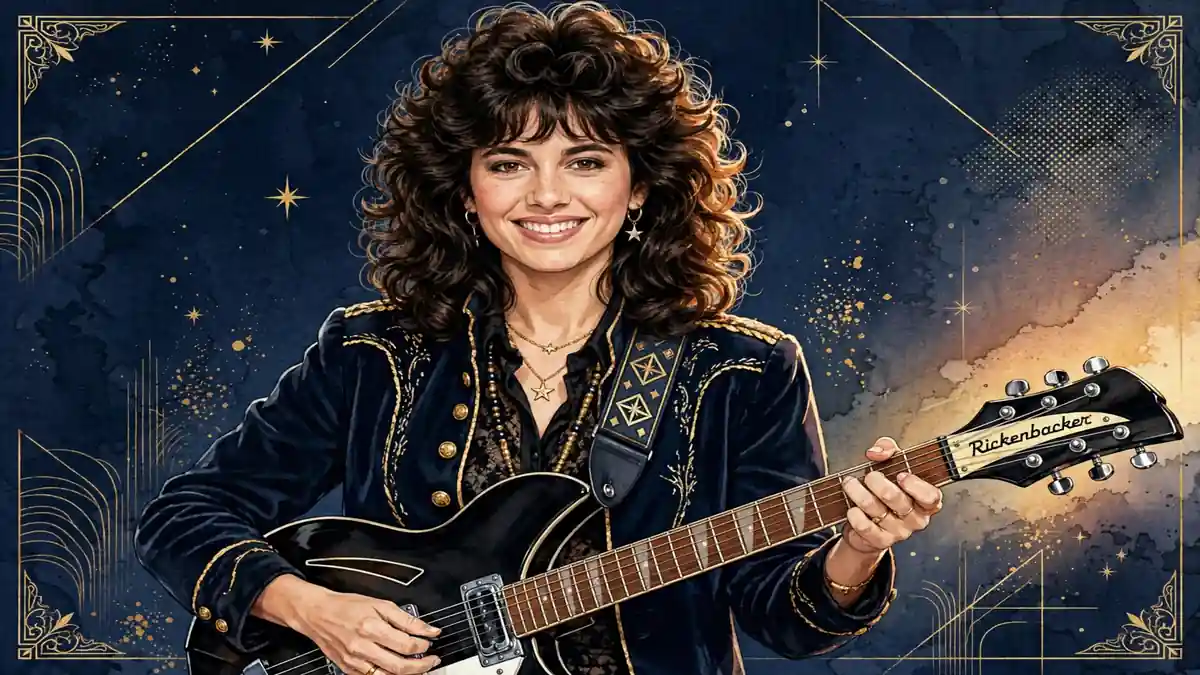
The closest thing to a brand association is her guitar. Hoffs is identified with the Rickenbacker electric guitar — the jangling twelve-string sound that defined The Bangles’ records — and her name comes up whenever guitar magazines write about the instrument. There is no confirmed paid endorsement deal with Rickenbacker on the public record, so the association should be read as artistic identity rather than a sponsorship. The same goes for the band’s 1980s image: the videos, the styling and the look were carefully managed, but they sold records, not merchandise licenses.
Licensing is where brands do pay her, just indirectly. When “Walk Like an Egyptian” or “Eternal Flame” appears in a film, a television show or an advertisement, the production pays a sync fee, and Hoffs collects as a performer and, on “Eternal Flame,” as a songwriter. Those placements — in comedies, period pieces set in the 1980s, and commercials trading on nostalgia — are a regular, if unpredictable, source of income, and they explain why a 40-year-old catalog can still produce a good year.

Houses, Cars and Other Assets
Hoffs and Roach have lived for years in the Brentwood neighborhood of Los Angeles, and one property-tracking site values their Brentwood home at roughly $7.3 million. That figure comes from NetWorthRanker, a third-party estimator, and should be treated as an estimate rather than a confirmed sale price — but it fits the pattern of a long-married Hollywood couple who bought in a prime Los Angeles neighborhood decades ago and held on while prices climbed. The home is a household asset shared with Roach, not a solo holding, and no public record breaks out Hoffs’ individual share.
Beyond the family home, there is little on the public record. No second home, no investment-property portfolio and no car collection has ever been documented for Hoffs, and we will not invent one. She is not a celebrity known for flaunting cars or houses, and the absence of property gossip is consistent with a private life lived mostly out of the tabloids. What can be documented is the asset that matters most: her share of a music catalog that includes two number-one singles, a triple-platinum album and a songwriting credit on one of the most-covered ballads of the era.
Her guitar collection is part of that working life rather than a trophy case. The Rickenbacker guitars she has played since the 1980s are professional tools with real value, and vintage Rickenbackers in good condition command serious prices — but no inventory of her instruments has ever been published, so no figure belongs here. The honest summary is that her visible wealth is a Los Angeles home and a catalog, not a fleet of cars or a property empire.
Awards and Achievements
The Bangles never collected a shelf of Grammys, and it is worth saying so plainly: their achievement was commercial and cultural rather than awards-driven. The record speaks in chart positions and certifications. “Walk Like an Egyptian” was Billboard’s number-one song of 1987 on the year-end chart — the single biggest song of that year in America. “Eternal Flame” topped the Hot 100 in 1989 and reached number one in multiple countries, becoming the band’s biggest-selling single. Different Light went triple platinum in the United States and platinum in the UK, Canada and Australia; Everything went platinum in the United States and the UK.
The band’s catalog has also proved unusually durable. “Eternal Flame” has been covered by artists in several countries, with Atomic Kitten’s 2001 version reaching number one in the UK — a second life that keeps the song earning publishing income for its writers. “Manic Monday” remains one of Prince’s most famous compositions for another artist, and the story of Prince handing the song to the band is now part of pop history. The Bangles’ five studio albums have sold more than 6.7 million copies worldwide, and booking profiles credit the band with more than 40 million records sold across albums, singles and compilations.
Hoffs’ solo achievements run on a different scale but show the same staying power. “My Side of the Bed” gave her a top-40 solo hit in 1991. The Under the Covers series with Matthew Sweet earned strong reviews across three volumes. And the novel brought a new kind of recognition: This Bird Has Flown was praised by The New York Times as a “smart, ferocious rock-star redemption romance,” called a “valentine to music” by NPR, and drew praise from Taylor Jenkins Reid, author of Daisy Jones & the Six. For a debut novelist, that is a serious critical reception — and it arrived in her mid-sixties, four decades after her first record.
Net Worth Growth Over the Years
No year-by-year fortune was ever published for Hoffs, so the table below is our estimate, built from career milestones and the published estimates that exist for each era. It is a reconstruction, not a filing — but it shows the shape of the story: a slow start, a sharp rise in 1986–1989, a long plateau of catalog income, and a gentle lift in the 2020s as streaming, licensing and the novel added new revenue.
| Year | Estimated net worth | What drove it |
|---|---|---|
| 1984 | Under $500,000 | Debut album peaked at number 80; club and touring income |
| 1986 | About $1 million | Different Light hits number 2; two hit singles |
| 1989 | About $3 million | “Eternal Flame” number one; Everything goes platinum |
| 1991 | About $4 million | Solo debut; catalog royalties keep arriving |
| 2000 | About $5 million | Bangles reunion; compilations and licensing |
| 2012 | About $7 million | Someday and Under the Covers; steady touring |
| 2021 | About $9 million | Streaming growth; Bright Lights release |
| 2023 | About $10 million | Novel published; Universal buys film rights |
| 2026 | $10 million to $12 million | New album The List; catalog and licensing income |
The published estimates cluster tightly around the current figure. Celebrity Net Worth lists $100 million but states plainly that it is a combined net worth with her husband, Jay Roach — a figure that belongs to the household, not to Hoffs alone. The Richest, Urban Splatter, NetWorthList and several other trackers put her individual figure at $10 million. NetWorthPrime’s 2026 update puts it at $12 million, and The Most 10 puts it at $16 million. One outlier site claims $50 million, but it offers no sourcing for that number and contradicts every other tracker; we discount it. The range we publish — $10 million to $12 million — sits where the best-sourced estimates agree.
Social Media Presence
Hoffs is active on social media, chiefly Instagram, where she posts performance clips, guitar videos, studio updates and tour news to an audience built over four decades of fandom. She marked her 65th birthday in January 2024 with a bare-faced video message to followers, telling them that getting older was “all good” — a small, unfiltered moment that drew warm coverage and fit her reputation for candor. She also appears at live events and festivals, including the VersoFest 2026 storytellers program, where she performed and discussed the novel in conversation.
She does not run the kind of monetized influencer operation that younger celebrities do — no sponsored posts, no product codes, no paid partnerships on the public record. Her social presence functions as a direct line to fans and a marketing channel for albums, books and shows, which is worth more to her career than any single brand deal: every post reminds a streaming audience that the catalog is still alive, and every tour announcement converts that audience into ticket sales. Follower counts change constantly and are easy to misstate, so we do not publish a number here; the point is that she uses the platforms herself, in her own voice, rather than through a management feed.
Personal Life
Hoffs married filmmaker Jay Roach on April 17, 1993, after three years together. Roach went on to direct the Austin Powers trilogy, Meet the Parents, Meet the Fockers, Trumbo and Bombshell, and to win Emmy Awards for the HBO political films Recount, Game Change and All the Way. The couple have two sons, Jackson, born in 1995, and Sam Rayfield, born in 1998. Roach converted to Judaism after marrying Hoffs, and the family has lived in Los Angeles throughout.
The marriage is the reason the $100 million figure causes so much confusion. Celebrity Net Worth values Roach himself at $100 million, and lists Hoffs at the same $100 million explicitly as a combined figure with her husband. Readers who see the number without the fine print assume Hoffs herself is worth $100 million; she is not, on any individual accounting. The household is wealthy — two long, successful entertainment careers under one roof, plus a Brentwood home — but the individual fortune is the $10 million to $12 million range this article carries.
Hoffs has spoken in interviews about the difficulty of balancing motherhood with a music career in the 1990s, when the industry offered little support to touring mothers. She stepped back from the spotlight while her sons were young, recording and performing selectively, and returned to a fuller schedule once they were grown. That pause cost her some momentum in the 1990s — the solo career stalled, and the second Columbia album never came out — but it also preserved the catalog’s value: she never oversaturated the market, and the Bangles’ reunion in 1999 landed with an audience that had missed them.
Sources & Reporting
Celebrity Net Worth — lists Hoffs at $100 million, explicitly as a combined net worth with husband Jay Roach; also values Roach individually at $100 million. Reporting window: profile updated February 2025.
The Richest — puts Hoffs’ individual net worth at $10 million and publishes estimated per-album record earnings ($4.5 million for Different Light, $1.5 million for Everything).
Urban Splatter — 2026 profile estimating $10 million, with career and solo-work detail. Published March 2026.
AllMusic — biography and discography, including the 2020s albums Bright Lights, The Deep End, The Lost Record and the 2026 album The List.
Wikipedia — biographical facts (birth date, family, education, marriage, children), Bangles discography with chart peaks and RIAA certifications, and solo chart positions.
American Songwriter — history of Different Light and its triple-platinum success. Published April 2025.
Stereogum — chart history of “Eternal Flame” and the solo career, including the “My Side of the Bed” peak at number 30.
NPR — praised the novel This Bird Has Flown as a “valentine to music.”
The New York Times — praised the novel as a “smart, ferocious rock-star redemption romance.”
Consequence — career overview, including the novel, the Universal Pictures film-rights deal and the 2020s albums.
Screen Dollars — box-office figures for Jay Roach’s films, including the Austin Powers trilogy’s combined $677 million gross.
Where sources disagree — most visibly on the headline number — this article publishes the range and names who says what, rather than picking the biggest figure. Annual-income guesses from smaller blogs are reported as blog estimates, not facts, and the net-worth growth table is our own estimate labeled as such.
Frequently Asked Questions
What is Susanna Hoffs’ net worth in 2026?
Susanna Hoffs’ net worth is estimated at $10 million to $12 million as of November 2026. Most published estimates put her individual fortune at $10 million, with a 2026 update at $12 million. The $100 million figure often attached to her name is a combined household figure shared with her husband, film director Jay Roach.
Is Susanna Hoffs still married to Jay Roach?
Yes. Hoffs married filmmaker Jay Roach on April 17, 1993, and they remain married. Roach directed the Austin Powers films and Meet the Parents. The couple have two sons, Jackson and Sam, and live in Los Angeles.
Why do some sites say Susanna Hoffs is worth $100 million?
Because Celebrity Net Worth lists her at $100 million as a combined net worth with her husband Jay Roach, who is himself valued at $100 million as a director. The $100 million figure describes the household, not Hoffs alone. Her individual fortune, per most trackers, is $10 million to $12 million.
How old is Susanna Hoffs?
Susanna Hoffs was born on January 17, 1959, in Los Angeles, California, which makes her 67 years old as of November 2026.
How tall is Susanna Hoffs?
Susanna Hoffs is listed at 5 feet 2 inches (157 cm). Some profiles list her at 5 feet 1 inch; the 5 feet 2 inches figure is the most widely cited.
What are The Bangles’ biggest songs?
The Bangles’ biggest hits are “Walk Like an Egyptian,” which topped the Billboard Hot 100 in 1986 and was the number-one song of 1987, “Eternal Flame,” which hit number one in 1989 and which Hoffs co-wrote, and “Manic Monday,” written by Prince, which reached number 2. “Hazy Shade of Winter” reached number 2 and “In Your Room” reached number 5.
Is Susanna Hoffs still performing in 2026?
Yes. In 2026 she performed at the Love Rocks benefit concert in New York, appeared at the VersoFest storytellers program, and released a new album of original songs, The List. She continues to record and perform both solo and with The Bangles.
What is Susanna Hoffs’ novel This Bird Has Flown about?
This Bird Has Flown, published by Little, Brown in April 2023, is a romantic comedy about a struggling musician in her thirties trying to revive her career and find new love. It drew praise from The New York Times and NPR, and Universal Pictures bought the film rights before publication, with Hoffs writing the screenplay herself.
Final Thoughts
Susanna Hoffs’ fortune is a study in how a short burst of fame becomes a long income. Three years of hits — 1986 to 1989 — produced a catalog that has paid her ever since: a triple-platinum album, two number-one singles, and a ballad she co-wrote that other artists keep covering. The solo career, the acting roles and the novel added layers without ever replacing the catalog as the foundation, and the 2020s run of albums and books shows an artist still adding to the pile at 67.
The number to remember is $10 million to $12 million — her own fortune, built song by song. The $100 million figure belongs to the household she shares with Jay Roach, and it says as much about a 33-year marriage between two successful entertainers as it does about either career alone. What Hoffs built herself is smaller, and in its way more impressive: a career that survived a band breakup, a stalled solo launch, a decade of motherhood and four decades of changing musical fashion, and still pays — every month, from songs recorded when she was 27 years old.
Published on November 7, 2026. Last reviewed November 2026. Found an error? See our corrections policy.