
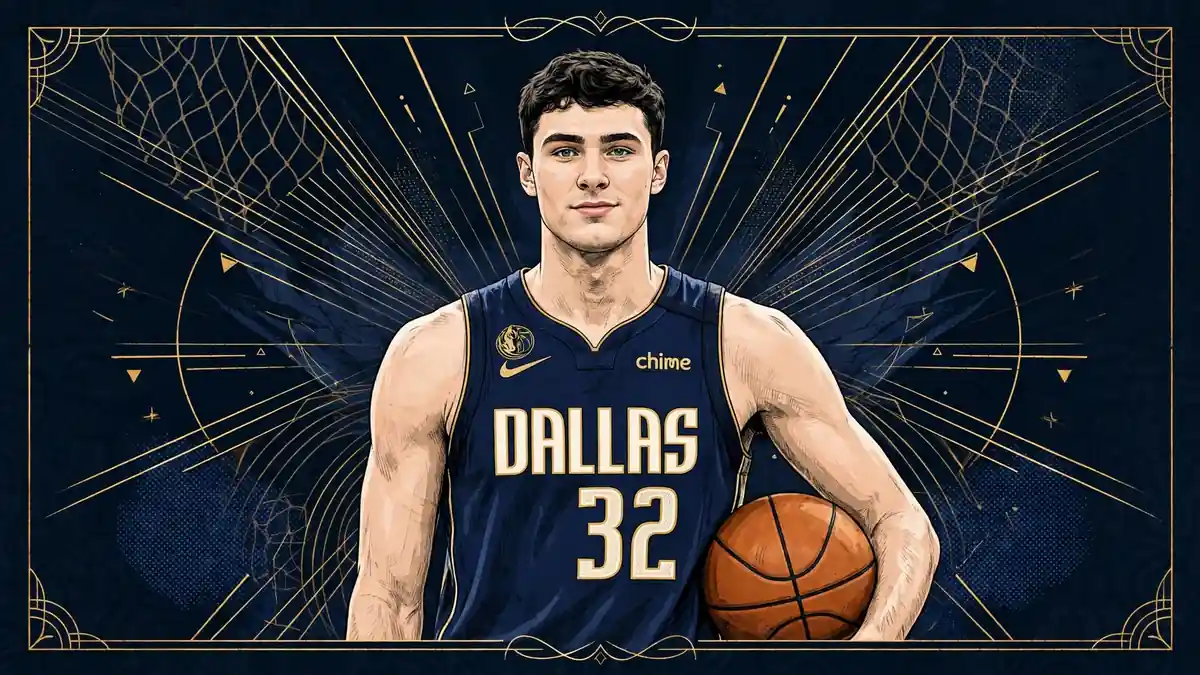
Cooper Flagg‘s net worth is estimated at $20 million to $28 million as of November 2026. The 19-year-old Dallas Mavericks forward banked the money before most players sign their first shoe deal: a reported $28 million in name, image and likeness contracts during one season at Duke, a four-year NBA rookie contract worth $62.7 million, and a Rookie of the Year season in which he averaged 21 points a game and became the first rookie since Michael Jordan to lead his team in points, rebounds, assists and steals.
Cooper Flagg: Quick Facts
| Estimated net worth | $20 million to $28 million (range: $20 million to $28 million) |
|---|---|
| Profession | Professional basketball player, forward, Dallas Mavericks |
| Nationality | American |
| Born | December 21, 2006 (age 19) |
| Height | 6 feet 9 inches (2.06 m) |
| Primary income sources | NBA salary, NIL and endorsement contracts (New Balance, Fanatics, Gatorade, Chime), memorabilia and trading cards |
| Active years | 2024–present (Duke 2024–25; NBA 2025–present) |
| Last reviewed | November 2026 |
- Early Life and Background
- Education
- Career Journey
- Rise to Fame
- Main Sources of Income
- Salary and Earnings
- Businesses and Investments
- Brand Deals and Sponsorships
- Houses, Cars and Other Assets
- Awards and Achievements
- Net Worth Growth Over the Years
- Social Media Presence
- Personal Life
- Sources & Reporting
- Frequently Asked Questions
- Final Thoughts
Early Life and Background
Cooper Flagg was born on December 21, 2006, in Newport, Maine, a town of roughly 3,000 people in Penobscot County. He arrived one minute after his fraternal twin brother, Ace Flagg, and the two grew up with an older brother, Hunter, in a household where basketball was the family trade. Their mother, Kelly Bowman Flagg, played at Nokomis Regional High School in Newport and went on to play at the University of Maine, where she won three conference titles and served as team captain in 1999. Their father, Ralph Flagg, also played the game. The driveway outside the family home in Newport became the twins’ first arena, and the one-on-one games there — Cooper against Ace, day after day — built the edge that later defined his game.
Maine is not a basketball hotbed. It produces almost no NBA players, and its high school gyms sit a long way from the recruiting circuits in Florida, Texas and California. That distance shaped Flagg’s story in two ways. First, it made his rise harder to miss: scouts who drove to Newport found a 6-foot-9 teenager who handled the ball like a guard, defended every position and played with a motor that stood out even against older players. Second, it gave him a home-state identity that brands later paid for. When New Balance signed him, the company could point to a factory in Skowhegan, Maine, roughly 25 miles from the house where he grew up — a detail no marketing department could have invented.
The family history carries a sadder note that Flagg rarely discusses in public. Kelly and Ralph had twins before Cooper and Ace: Hunter and Ryder, born in 2004. Ryder died two days after birth. Hunter, the surviving twin of that pair, played basketball at Nokomis alongside his younger brothers and later studied at the University of Maine. The three brothers won a Maine state championship together at Nokomis in their freshman season of 2021–22, the school’s first-ever state title, and that run put the Flagg name on the state map before Cooper had turned 16.
By the time he was 15, Flagg was the most talked-about high school player in the country. Recruiting services ranked him the No. 1 prospect in his class, and he drew comparisons to players a decade older. The attention arrived early enough that his family signed with CAA, the powerhouse sports agency, before he had played a minute of college basketball — a decision that later mattered enormously, because CAA’s relationships helped turn his single Duke season into the richest NIL year college basketball had seen.
Education
Flagg started at Nokomis Regional High School in Newport, where he played three seasons and won the state title as a freshman. After that 2021–22 season, he and Ace transferred to Montverde Academy in Montverde, Florida, the private basketball academy that has produced more NBA players than any other high school program of the last two decades. At Montverde, Flagg played against the best prep talent in America every day in practice, and the school’s 2023–24 team finished the season undefeated and won the Chipotle Nationals, the unofficial national high school championship.
He then made the decision that compressed his whole timeline: he reclassified from the high school class of 2025 to the class of 2024, skipping a year so he could enrol at Duke a season early. The move made him the youngest top draft pick since LeBron James in 2003, and it put him in college at 17. Ace stayed on the normal path, finishing his senior year at Greensboro Day School in North Carolina, where he won a third state championship in a third different state, before committing to the University of Maine for the 2025–26 season.
Flagg committed to Duke University and enrolled in June 2024, joining a program that has sent more players to the NBA than almost any other school. He spent one season in Durham, 2024–25, and left after it for the NBA Draft. He did not complete a degree — the standard path for a one-and-done prospect of his standing — but his single college season delivered more on-court honours than most four-year players collect, and it delivered the endorsement portfolio that forms the base of his fortune.
The education that mattered most to his bank balance was not academic. It was the year he spent learning how a modern star’s money works: multiyear shoe and memorabilia contracts signed before his 18th birthday, a national commercial presence while still a student, and an agency team that negotiated his deals while he played. Few 18-year-olds have ever been taught those lessons with $28 million on the table.
Career Journey
Flagg’s career breaks into three acts, and each one lasted about a year. Act one was Maine: Nokomis, the state title, and a reputation that outgrew the state. Act two was Montverde: an undefeated season, a national title, reclassification, and the No. 1 recruiting ranking. Act three was Duke: 37 games, a Final Four, every major national player-of-the-year award, and the richest NIL season in college basketball history. Then came the NBA, where the acts started running together — a No. 1 draft pick, a $62.7 million contract, and a Rookie of the Year award inside 12 months.
At Duke in 2024–25, Flagg averaged 19.2 points, 7.5 rebounds and 4.2 assists across 37 games, and he did it as the youngest player on the roster. He led the Blue Devils to the Final Four, where they lost to Houston in the national semi-final, and he finished the season as the fourth freshman ever to win the Wooden Award, joining Kevin Durant (2007), Anthony Davis (2012) and Zion Williamson (2019). He also won the Naismith Trophy, ACC Player of the Year, ACC Rookie of the Year, first-team All-American honours and a place on the ACC All-Defensive team. The numbers were strong; the completeness was the story. He scored, rebounded, passed, defended the other team’s best player and played 30-plus minutes a night without fading.
The Dallas Mavericks selected Flagg with the first pick of the 2025 NBA Draft on June 25, 2025. Dallas had landed the pick in the draft lottery despite long odds, and the selection gave the franchise a new centrepiece months after the Luka Doncic trade had remade its roster. Flagg signed his rookie contract on July 2, 2025, and made his NBA debut on October 22, 2025, against the San Antonio Spurs, recording 10 points and 10 rebounds in a 125–92 loss. The debut was quiet by his standards. The season that followed was not.
His rookie year ran on a steady upward slope. He scored 49 points against the Charlotte Hornets on January 29, 2026, a career high at the time, then topped it with 51 points against the Orlando Magic in April, becoming the youngest player ever to score 50 points in an NBA game. He put together three straight 30-point games from late January into early February — again the youngest player ever to do it — and at one stage scored 96 points across two games. He finished the season having played 70 games and averaged 21.0 points, 6.7 rebounds, 4.5 assists, 1.2 steals and 0.9 blocks, with 1,473 total points, while Dallas finished 26–56 in a rebuilding year.
His second season opened with a statement: 32 points against the Houston Rockets in the 2026–27 season opener. By his 75th career game, in November 2026, he had 1,607 career points — only Luka Doncic, with 1,614, had scored more for the Mavericks through his first 75 games — along with 496 rebounds, 349 assists, 97 steals and 70 blocks. Thirteen of those 75 games were 30-point games, tied for the 25th-most in the league since the start of the 2025–26 season. The arc from Newport driveway to franchise cornerstone had taken less than five years.
Rise to Fame
Flagg’s fame arrived in waves, and each wave was bigger than the last. The first wave was recruiting: by 2023 he was the consensus No. 1 high school player in America, and his games at Montverde drew NBA scouts, national television and a level of coverage usually reserved for college stars. The second wave was Duke, where his freshman season was broadcast as an event — every home game a showcase, every road game a test — and where his all-around game made him the rare college player discussed as a future face of the league before he had played 20 games.
The third wave was the money story. In May 2025, veteran sports journalist Howard Bryant told Bob Costas, during a sit-down at the 92nd Street Y in New York City, that Flagg had earned at least $28 million in NIL deals during his one season at Duke. The number landed like a shock because the public estimate had been far smaller: On3, the recruiting and NIL tracker, had assigned Flagg an NIL valuation of $4.8 million. Bryant’s figure — $13 million from New Balance and $15 million from Fanatics — was more than five times that valuation, and it reframed the whole conversation about college athletes’ pay. Within days, the $28 million figure was the most repeated number in American sports media, carried by Fox Sports, CBS Sports, The Spun and Yardbarker, and it turned Flagg from a basketball prospect into a business story.
The fourth wave was the draft and the rookie season. Dallas taking him first overall was the least surprising pick of the decade, but the way he played as a rookie — leading a rebuilding team in all four major categories — made the hype look cautious rather than inflated. When the Rookie of the Year vote came in on April 27, 2026, Flagg had 56 first-place votes to 44 for his former Duke teammate Kon Knueppel of the Charlotte Hornets, one of the closest finishes under the current voting system. He was the second-youngest winner ever, at 19 years and 112 days, behind only LeBron James at 19 years and 106 days in 2003–04.
The fifth wave is still building, and it is the trading-card market. A one-of-one 2025 Bowman Chrome Superfractor Flagg card, graded PSA 9, sold for $252,000 through Fanatics Collect’s August 2026 Premier Auction. Then his one-of-one Rookie Debut Patch Autograph card — a patch cut from the jersey he wore in his first NBA game, with his autograph — was reported sold for $8.04 million in October 2026, a figure that made it one of the most expensive basketball cards ever sold. Flagg does not own those cards and does not collect the sale price, but the prices show how much money now orbits his name, and they feed directly into the value of his Fanatics memorabilia deal.
Main Sources of Income
Flagg’s income comes from three streams, and the order in which they arrived is unusual. Most NBA stars earn their salary first and build endorsements later. Flagg did it the other way round: the endorsement money came first, while he was still a student, and the salary followed. That sequence matters for his net worth, because the NIL contracts were multiyear deals whose cash arrives over several seasons, not a single lump sum in 2025.
The first stream is his NBA salary. His four-year rookie-scale contract with Dallas is worth $62,730,226 in total, and he has already collected the first two seasons of it: $13,825,920 in 2025–26 and $14,517,480 in 2026–27. The remaining two seasons are team options worth $15,208,680 and $19,178,146, and Dallas has already exercised the first of them. Salary is the steadiest stream and the one that will grow fastest, because his next contract — a supermax extension he becomes eligible for in 2029 — could be worth up to $359 million over five years.
The second stream is endorsements and NIL contracts, and it is the stream that made him rich before he turned professional. The two anchor deals are New Balance, reported at $13 million, and Fanatics, reported at $15 million — a combined $28 million that veteran journalist Howard Bryant disclosed in May 2025. Around those sit Gatorade, AT&T, CORT Furniture, New Era and the NIL Store from his Duke season, and a long-term partnership with financial technology company Chime signed after he turned professional. The Chime deal is the first endorsement of his NBA career rather than his college career, and it signals the direction of the portfolio: financial services and national brands that want a young, clean-cut star with a decade of prime ahead of him.
The third stream is memorabilia and trading cards, which is smaller in direct income but growing fast. His exclusive Fanatics agreement covers autographs, memorabilia and trading cards, so the runaway prices of his rookie cards — a $252,000 Superfractor sale and a reported $8.04 million Debut Patch sale — feed the value of that deal even though the auction money goes to the card owners, not to Flagg. The card market also pays him indirectly: every record sale raises his profile with collectors, and collectors are the audience Fanatics sells to.
There is a fourth stream that does not exist yet and is worth naming because it explains why his net worth will move so fast. Flagg has no reported business ventures, no property portfolio and no investment record in public filings. He is 19, in his second NBA season, and his money is still mostly contracted future income rather than deployed capital. The moment his supermax extension is signed, the investment and business side of his finances will become a real story. Right now, it is a blank page — and that blank page is itself a fact about his wealth: it is young money, barely a year old, and almost all of it is still ahead of him.
Salary and Earnings
Flagg’s NBA contract is a rookie-scale deal, and rookie-scale deals are the most transparent contracts in American sport. The NBA’s collective bargaining agreement fixes the salary of every first-round pick by draft slot, so there was no negotiation over the headline number: the No. 1 pick gets the No. 1 pick’s money. Spotrac, the contract tracker, lists the deal as four years and $62,730,226, signed on July 2, 2025, with $28,343,400 guaranteed at signing. The first two seasons are fully guaranteed. The last two are team options, which Dallas can exercise or decline — and given his Rookie of the Year season, the options were formalities. Dallas exercised the third-year option, worth $15,208,680 for 2027–28, on October 17, 2026, two weeks ahead of the October 31 deadline. The fourth-year option, worth $19,178,146 for 2028–29, has a deadline of October 31, 2027.
The year-by-year breakdown, per Spotrac, is:
| Season | Base salary | Status |
|---|---|---|
| 2025–26 | $13,825,920 | Fully guaranteed — paid |
| 2026–27 | $14,517,480 | Fully guaranteed — current season |
| 2027–28 | $15,208,680 | Team option — exercised October 2026 |
| 2028–29 | $19,178,146 | Team option — decision due October 2027 |
| Total | $62,730,226 | $28,343,400 guaranteed at signing |
Two features of the deal deserve attention because they change what the headline number means. The first is tax. Texas has no state income tax, and Flagg plays his home games in Dallas, so he keeps more of each paycheque than a player on a New York or California team would. Federal tax still takes the top 37% bracket on most of it, and his agent’s fee runs at roughly 4%, but the Texas address is worth millions over the life of the contract — one analysis of the deal put its after-tax, after-fee value at roughly $37 million on the $62.7 million gross. The second is escrow. The NBA withholds around 10% of player salaries each season until league revenues are reconciled at year end, so the cash in hand during a season is lower than the salary figure on the page.
The headline that follows Flagg everywhere is the one Spotrac’s Michael Ginnitti laid out before the draft: if he becomes the superstar his rookie season suggests, his career playing earnings could approach $1 billion by the time he is 31. The path runs through two supermax extensions. In 2029, when his rookie deal ends and he reaches restricted free agency, he will be eligible for a supermax worth up to 30% of the salary cap — projected at up to $359 million over five years — provided he meets the performance thresholds, such as an All-NBA selection in two of the three seasons before the deal starts, or an MVP or Defensive Player of the Year award. Fox Sports has reported he could become the first North American athlete to earn $1 billion solely from playing contracts. A second supermax, starting in 2034 at 35% of the cap, is projected at roughly $509 million. Added to the rookie deal, the three contracts total about $930 million. Those are projections, not promises — they depend on health, performance and a rising salary cap — but they explain why every estimate of Flagg’s wealth today is really an estimate of a fortune still being built.
Set against that future, his earnings to date are modest in scale and remarkable in speed. Through November 2026 he has banked one full NBA season’s salary of $13.8 million gross, is part-way through a second at $14.5 million, and has the cash received so far from his NIL contracts. The $28 million NIL figure that dominates the headlines is the total value of multiyear deals, paid out over their terms, not a single year’s pay. That distinction is the single most misunderstood fact about his money, and it is why this article anchors his net worth at $20 million to $28 million rather than simply adding $28 million and $62.7 million together and calling it $90 million.
Businesses and Investments
There is no public record of Cooper Flagg owning a business, holding an equity stake in a company, or making a reported investment. That is not a gap in the reporting — it is the normal position of a 19-year-old in his second professional season whose income has only just started arriving. His money is still in the accumulation phase: contracts signed, salaries being paid, endorsement fees arriving on schedule. The investment phase comes next, and the first signs of it will probably surface when his supermax extension is signed in 2029, when the sums involved make wealth management a full-time job rather than a side task.
What is known is the shape of the team around him. He is represented by CAA, the agency that signed him before Duke, and CAA’s role goes beyond negotiating contracts: the agency shapes which brands he works with, how his image is used, and how his off-court income is structured. The choice of partners so far — New Balance, Fanatics, Gatorade, Chime — shows a preference for long-term, multiyear relationships with established companies over a scatter of one-off paid posts. That pattern is the closest thing to an investment strategy visible in his public record: he is investing in durable brand relationships while his playing career is young, rather than cashing in quickly on short deals.
The Chime partnership, signed after he turned professional, is the clearest hint of where his business interests may go. Chime is a financial technology company, and a long-term deal with a fintech brand puts a young athlete in front of the exact audience — young savers and first-time investors — that his own financial story speaks to. It also suggests his team is thinking about his post-playing profile early: a player who is the face of a financial brand at 19 has a natural lane into business and media once the playing days end.
Two cautions belong here. First, any site that lists specific Flagg businesses, property holdings or investment portfolios is inventing them — no filing, interview or credible report has disclosed any. Second, the absence of investments is not a weakness in his finances. His wealth is concentrated in the safest asset a young athlete can hold: a guaranteed NBA contract, multiyear endorsement deals with large companies, and a career path that points at the largest contracts in league history. Diversification will come. For now, concentration in his own career is the strategy, and his rookie season suggests it is working.
Brand Deals and Sponsorships
Flagg’s endorsement portfolio is the most valuable part of his story, because it is the part that arrived before the NBA money and the part no other rookie of his generation can match. The two anchor deals, both disclosed by Howard Bryant in May 2025, are worth a combined $28 million: New Balance at $13 million and Fanatics at $15 million. Both are multiyear agreements, and neither company has publicly disclosed the payment schedules, so the cash received to date is only a portion of those totals. Bryant’s disclosure came during a 92nd Street Y conversation with Bob Costas, and it corrected the public record sharply — On3’s NIL valuation of $4.8 million had been the accepted figure, and it turned out to measure something different: an annualised estimate of his market value, not the total value of the contracts he had actually signed.
The New Balance deal, signed in August 2024, is the more personal of the two. New Balance runs a manufacturing factory in Skowhegan, Maine, about 25 miles from Flagg’s childhood home in Newport, and his mother used to shop the brand’s tent sales for back-to-school sneakers when he was a boy. The company pitched him with a video showing “FLAGG” stitched into custom grey 990s made at the Maine factory, and the deal made him one of the brand’s signature athletes alongside Kawhi Leonard, Jamal Murray, Tyrese Maxey and WNBA star Cameron Brink. ESPN’s Adrian Wojnarowski had reported the agreement as “significant” when it was signed, without a figure. It is a footwear and apparel deal that runs through his NBA career, and it gives New Balance a young American star to build around as its basketball line grows.
The Fanatics deal, signed in January 2025, is an exclusive multiyear agreement covering autographs, memorabilia and trading cards. Its value has grown since signing, because the collectibles market around Flagg has run hotter than anyone predicted. His one-of-one 2025 Bowman Chrome Superfractor card, graded PSA 9, sold for $252,000 through Fanatics Collect’s August 2026 Premier Auction. His one-of-one Rookie Debut Patch Autograph card — the patch from his first NBA game jersey, with his autograph — was reported sold for $8.04 million in October 2026, and the Mavericks themselves announced in August 2026 that they wanted the card, offering a trade for it. Flagg does not receive the auction money; the card owners do. But the prices make his signature and his game-worn material among the most valuable in the sport, and that is exactly what Fanatics paid for.
The rest of the portfolio fills out the picture. In October 2024 he signed with Gatorade, becoming the company’s first men’s college basketball NIL athlete. He appeared in AT&T’s national “Bingo” commercials, and he added partnerships with CORT Furniture, New Era and the NIL Store during his Duke season. After the draft, he signed the long-term Chime partnership, his first major deal as a professional rather than a college athlete. Taken together, the portfolio shows a star who was marketable before he was draft-eligible, and whose brand value has risen with every step: high school No. 1, Duke star, No. 1 pick, Rookie of the Year.
One comparison puts the scale in context. Yardbarker noted that Flagg’s reported $28 million NIL year was more than his annual NBA salary in each of his first two seasons — $13.8 million and $14.5 million. He took, in effect, a pay cut to turn professional. That is a strange sentence to write about a teenager, and it is the clearest single measure of how unusual his college year was: no college basketball player before him had earned that much in one season, and the deals that produced it were signed while he was still a student in Durham.

Houses, Cars and Other Assets
No home purchase by Cooper Flagg has surfaced in public records or reporting. One 2026 profile noted directly that no reported home purchase had appeared, and property records in Dallas and Maine carry no listing under his name. That is unremarkable for a 19-year-old who spent his first professional year living through a rookie season, but it is worth stating plainly because net-worth aggregators sometimes attach houses and cars to young stars without evidence. Flagg’s known assets are his contracts, his endorsement deals and his future earnings — not real estate.
What he does own, in the practical sense, is a wardrobe of the brands he represents. His New Balance deal puts the company’s footwear and apparel on him in public appearances, and his Fanatics deal covers the memorabilia side of his image. Neither is an asset in the accounting sense, but both are part of how his wealth works: the deals pay him, and they also dress him, which is the point of a sponsorship.
His most valuable asset that is not a contract is his own name and image, and the market has now put a price on it in a way that is hard to ignore. The reported $8.04 million sale of his one-of-one Rookie Debut Patch Autograph card in October 2026 is not money he received — the card belonged to whoever pulled it from a pack — but it is a market verdict on what his signature and his game-worn material are worth. The $252,000 sale of his Bowman Chrome Superfractor two months earlier is the same verdict at a smaller scale. A player’s name becomes an asset when other people will pay millions for a piece of cardboard with his face on it, and Flagg’s name reached that point before his 20th birthday.
Cars are the other item readers ask about, and here the record is again quiet: no vehicle purchase, collection or endorsement deal involving cars has been reported for Flagg. He has not been photographed with a luxury fleet, and no dealer has announced a deal with him. That may change — a supermax contract tends to come with a garage — but as of November 2026, the car story is that there is no car story, and inventing one would be fabrication.
Awards and Achievements
Flagg’s trophy record is short because his career is short, and it is remarkable for the same reason. He has won the top individual honour at every level he has played, and he did it as the youngest player on the floor each time.
At Duke in 2024–25, he won the John R. Wooden Award as national player of the year, the Naismith Trophy, ACC Player of the Year, ACC Rookie of the Year, first-team All-American honours, the Lute Olson Award, the Julius Erving Award, the Wayman Tisdale Award, NABC Freshman of the Year and a place on the ACC All-Defensive team. He was only the fourth freshman ever to win the Wooden Award, after Kevin Durant in 2007, Anthony Davis in 2012 and Zion Williamson in 2019. His Duke team reached the Final Four, and he averaged 19.2 points, 7.5 rebounds and 4.2 assists across 37 games. Before Duke, he was National High School Player of the Year in 2024, won the Chipotle Nationals with an undefeated Montverde team, and was the consensus No. 1 recruit in the country.
In the NBA, the headline honour is the 2025–26 NBA Rookie of the Year award, announced on April 27, 2026. He won it with 56 first-place votes against 44 for Kon Knueppel, his former Duke teammate, in one of the closest votes under the current system. At 19 years and 112 days, he was the second-youngest winner in league history, behind LeBron James. The statistical case was overwhelming: he led Dallas in points, rebounds, assists and steals, the first rookie to do that since Michael Jordan in 1984–85, and he was only the third rookie in 45 years to average at least 20 points, six rebounds and four assists.
The record book entries matter as much as the awards. He is the youngest player ever to score 50 points in an NBA game, after his 51-point night against the Orlando Magic in April 2026. He is the youngest player ever to record three straight 30-point games. He scored 32 points in the 2026–27 season opener against Houston, and through 75 career games only Luka Doncic had scored more points for the Mavericks. These are not the records of a player who might become a star. They are the records of a player who already is one, and they are the reason his next contract is projected in the hundreds of millions.
Net Worth Growth Over the Years
Flagg’s net worth history is unlike any other athlete’s, because almost all of it was created in a single year. There was no slow climb through minor-league salaries or early endorsement deals. There was a high school career with no income, a single college season in which $28 million of contracts were signed, and then an NBA career that started paying $13.8 million a year. The table below tracks the public estimates, with the source of each figure named so readers can see what each number actually measures.
| Period | Estimated net worth | What the figure measures |
|---|---|---|
| 2024 (pre-Duke) | Under $5 million | On3 NIL valuation of $4.8 million — an annualised market estimate, not signed contracts |
| Mid-2025 (after Duke) | About $28 million in signed deals | Total value of NIL contracts reported by Howard Bryant — New Balance $13 million plus Fanatics $15 million, multiyear, paid over time |
| Late 2025 (rookie season) | About $20 million | Celebrity Net Worth estimate (September 2026 update) — reflects cash received, taxes and fees |
| November 2026 | $20 million to $28 million | NetWorthCraft range — CNW’s $20 million as the floor, Bryant’s $28 million in signed contract value as the ceiling |
Three things explain the gap between the figures. The first is the difference between contract value and cash received. The $28 million of NIL deals are multiyear contracts, so only a portion had been paid by the time the 2025–26 NBA season started. The second is tax and fees: federal tax at the 37% top bracket, an agent fee of roughly 4%, and the NBA’s escrow withholding of around 10% all reduce what lands in the bank, even though Texas charges no state income tax. The third is the difference between what is signed and what is earned: his $62.7 million rookie contract pays out over four seasons, so counting the full amount as net worth today would overstate his wealth by tens of millions. One 2026 analysis that added his net contract value to his NIL earnings and arrived at $60 million to $65 million makes exactly that error — it treats four years of future salary as money already in hand. We do not follow that method.
The growth ahead is easier to project than the growth so far, because the milestones are contractual. His salary rises to $15.2 million in 2027–28 and $19.2 million in 2028–29. In 2029 he becomes eligible for a supermax extension projected at up to $359 million over five years, and a second supermax from 2034 is projected at roughly $509 million. If he stays healthy and keeps playing at an All-NBA level, his net worth will pass $100 million early in the next decade and could approach $1 billion in career playing earnings alone by the time he is 31, per Spotrac’s projections and Fox Sports’ reporting. Those are projections tied to performance thresholds, not guarantees — but no other 19-year-old in basketball has a path to those numbers.
The honest way to read his wealth today is as a down payment. Twenty to $28 million at 19, with a $62.7 million contract already signed and a $359 million extension on the horizon, is a position almost no athlete has ever held at this age. The fortune is real, the range is honest, and the trajectory is the story.
Social Media Presence
Flagg keeps a lower public profile than his fame would suggest. He is active on Instagram, where his account carries the verified badge and posts a mix of game highlights, New Balance campaigns and family moments, but he is not a constant poster and he does not run the kind of daily content operation that many young stars do. His social presence is managed in the background while his basketball does the talking, and that restraint fits the rest of his public image: a small-town Maine teenager who became the most famous 19-year-old in basketball without becoming a celebrity first.
The numbers that matter on social media are not his follower counts but his reach through other people’s accounts. His 51-point game, his Rookie of the Year announcement and his card sales were all carried by the NBA, ESPN, Bleacher Report, the Mavericks and Fanatics to audiences far larger than his own following. The Chime partnership and the New Balance campaigns use his image in paid media that reaches people who have never watched a Mavericks game. In commercial terms, his social value is in the image — the clean-cut Maine kid with the 6-foot-9 frame and the all-around game — rather than in a personal feed.
He is also notably absent from the controversies that fill other young stars’ timelines. No public disputes, no deleted posts that became news, no off-court incidents. That clean record is itself a commercial asset: brands pay more for athletes they do not have to worry about, and the length of his deals — multiyear, with companies that have reputations to protect — shows that the market has priced his reliability into the contracts.
Personal Life
Flagg’s personal life is, by his own choice, mostly private. He has no publicly confirmed relationship, and no girlfriend has been identified in credible reporting — a fact worth stating because gossip sites regularly invent one for players of his profile. He is 19, in his second NBA season, and his public life is basketball, family and the brands he represents.
Family is the centre of it. His parents, Kelly and Ralph, moved with the family to Florida when the twins transferred to Montverde, and they have stayed close to his career since. His twin brother Ace plays college basketball for the Maine Black Bears, the same program their mother played for, and his older brother Hunter studied sports management at Maine. The three brothers grew up playing together in the Newport driveway, won a state title together at Nokomis, and still talk about the game as a family business rather than a solo career. Ace was born a minute before Cooper, a detail the family has mentioned in interviews, and the two remain close despite playing in different states.
He has spoken in interviews about Maine as home, not as a stepping stone. The New Balance deal’s Maine connection — the Skowhegan factory, the tent sales his mother shopped at — is a story he has told himself, and it suggests the identity is real rather than a marketing line. He returns to Newport in the off-season, and the town of 3,000 people now has the most famous export in its history playing 1,800 miles away in Dallas. He has not, as of November 2026, bought a home in Dallas or in Maine, and he has not spoken publicly about property plans. His life, for now, is a rookie-scale contract, a hotel-room-and-apartment existence on the road, and a family that treats the whole thing as a shared project.
Sources & Reporting
Spotrac — the contract figures: four years, $62,730,226, $28,343,400 guaranteed, year-by-year salaries, team-option dates, the $359 million supermax projection and the $930 million career-earnings path; also the Fox Sports reporting on the $1 billion milestone that Spotrac’s Michael Ginnitti laid out.
Celebrity Net Worth — the $20 million net worth estimate (last updated September 2026), the contract summary, and the endorsement timeline including New Balance (August 2024), Gatorade (October 2024), Fanatics (January 2025) and Chime.
CBS Sports — Howard Bryant’s disclosure of the $28 million NIL figure ($13 million New Balance, $15 million Fanatics) from the 92nd Street Y conversation with Bob Costas, May 2025, and the distinction between contract totals and annual payments.
Fox Sports — Bryant’s $28 million reporting as carried by Fox, and the reporting that Flagg could become the first North American athlete to earn $1 billion solely from playing contracts.
NBC Sports — the Rookie of the Year announcement (April 27, 2026), the 56–44 first-place vote split against Kon Knueppel, and the rookie-season averages of 21.0 points, 6.7 rebounds and 4.5 assists in 70 games.
ESPN — Howard Bryant’s reporting, Adrian Wojnarowski’s earlier report that the New Balance agreement was “significant,” and the background on Flagg’s Duke season and draft selection.
Heavy — the $252,000 sale of the one-of-one Bowman Chrome Superfractor card (Fanatics Collect, August 2026) and the Rookie Debut Patch Autograph card reporting, including the Mavericks’ August 2026 offer to trade for it.
Athlon Sports — the reported $8.04 million sale of the one-of-one Rookie Debut Patch Autograph card (October 2026) and the 51-point game against Orlando, the youngest 50-point game in NBA history.
On3 — the $4.8 million NIL valuation that preceded Bryant’s disclosure, and the context on how NIL valuations differ from signed contract values.
Yardbarker — the comparison of Flagg’s $28 million NIL year with his $13.8 million rookie salary, and the Spotrac contract and supermax figures as carried in its reporting.
Reporting window: November 2026. Contract and salary figures are drawn from Spotrac’s live contract pages and the Mavericks’ October 2026 team-option announcement. Card-sale figures are from Fanatics Collect auction reporting (August 2026) and Athlon Sports (October 2026). Where sources disagree — most notably the $20 million and $28 million net worth estimates — this article publishes the range and names who says what, rather than picking one number.
Frequently Asked Questions
What is Cooper Flagg’s net worth?
Cooper Flagg’s net worth is estimated at $20 million to $28 million as of November 2026. Celebrity Net Worth lists him at $20 million, while a second estimate of $28 million equals the total value of his two biggest NIL contracts. The range reflects the fact that the $28 million covers multiyear deals paid out over time, and that taxes, agent fees and payment schedules are not public.
How much does Cooper Flagg make per year?
Flagg earns a base NBA salary of $14,517,480 in the 2026–27 season, up from $13,825,920 in his rookie season of 2025–26. His four-year rookie contract with the Dallas Mavericks is worth $62,730,226 in total. Endorsement income from New Balance, Fanatics, Gatorade and Chime sits on top of the salary, and the NIL deals he signed at Duke were reported at a combined $28 million in total value.
How much did Cooper Flagg make in NIL deals at Duke?
Flagg reportedly signed at least $28 million in NIL deals during his one season at Duke in 2024–25, according to veteran journalist Howard Bryant, who disclosed the figure in a May 2025 conversation with Bob Costas. The two biggest deals were $13 million with New Balance and $15 million with Fanatics. Both were multiyear contracts, so the $28 million is the total contract value, not a single year’s cash. The public NIL valuation site On3 had estimated his value at $4.8 million, a far lower figure that measured annualised market value rather than signed deals.
What is Cooper Flagg’s contract with the Dallas Mavericks?
Flagg signed a four-year rookie-scale contract worth $62,730,226 on July 2, 2025, with $28,343,400 guaranteed at signing. His salaries are $13,825,920 in 2025–26, $14,517,480 in 2026–27, a team option of $15,208,680 in 2027–28 (exercised in October 2026) and a team option of $19,178,146 in 2028–29. He becomes a restricted free agent in 2029, when he will be eligible for a supermax extension projected at up to $359 million over five years.
How old is Cooper Flagg?
Cooper Flagg is 19 years old. He was born on December 21, 2006, in Newport, Maine, and he turns 20 on December 21, 2026. He was the second-youngest No. 1 draft pick ever, behind LeBron James, and the second-youngest Rookie of the Year winner, also behind James.
How tall is Cooper Flagg?
Cooper Flagg is 6 feet 9 inches tall (2.06 m). He plays forward for the Dallas Mavericks and wears jersey No. 32. His twin brother Ace, who plays for the Maine Black Bears, is 6 feet 7 inches — two inches shorter.
Did Cooper Flagg win Rookie of the Year?
Yes. Flagg was named the 2025–26 NBA Rookie of the Year on April 27, 2026, after averaging 21.0 points, 6.7 rebounds, 4.5 assists and 1.2 steals in 70 games for Dallas. He received 56 first-place votes, beating his former Duke teammate Kon Knueppel, who had 44. He was the first rookie since Michael Jordan in 1984–85 to lead his team in points, rebounds, assists and steals.
What shoe deal does Cooper Flagg have?
Flagg has a multiyear footwear and apparel deal with New Balance, signed in August 2024 and reported to be worth $13 million. New Balance operates a factory in Skowhegan, Maine, about 25 miles from his childhood home in Newport, and his mother used to shop the brand’s tent sales when he was a boy. He is one of the brand’s signature basketball athletes, alongside Kawhi Leonard, Jamal Murray, Tyrese Maxey and Cameron Brink.
Final Thoughts
Cooper Flagg’s net worth — $20 million to $28 million at 19 — is the most unusual fortune in basketball, because it was built backwards. The endorsements came first, the salary second, and the biggest paydays are still four years away. His $28 million NIL year at Duke rewrote what a college athlete can earn. His $62.7 million rookie contract pays him like a star while he is still a teenager. His Rookie of the Year season, with 21 points a night and the youngest 50-point game in league history, proved the money was not hype. And the supermax path ahead — up to $359 million from 2029, a projected $930 million in career playing earnings by 31 — is the largest runway any young player has ever had.
The range is honest and the trajectory is clear. He has no business empire yet, no property portfolio and no investment record — and at 19, that is exactly as it should be. His wealth is his career, and his career is barely a year old. If he stays healthy and keeps playing the way he played as a rookie, the $20 million to $28 million of today will look, within a decade, like the smallest number ever attached to his name.
Published on November 7, 2026. Last reviewed November 2026. Found an error? See our corrections policy.