
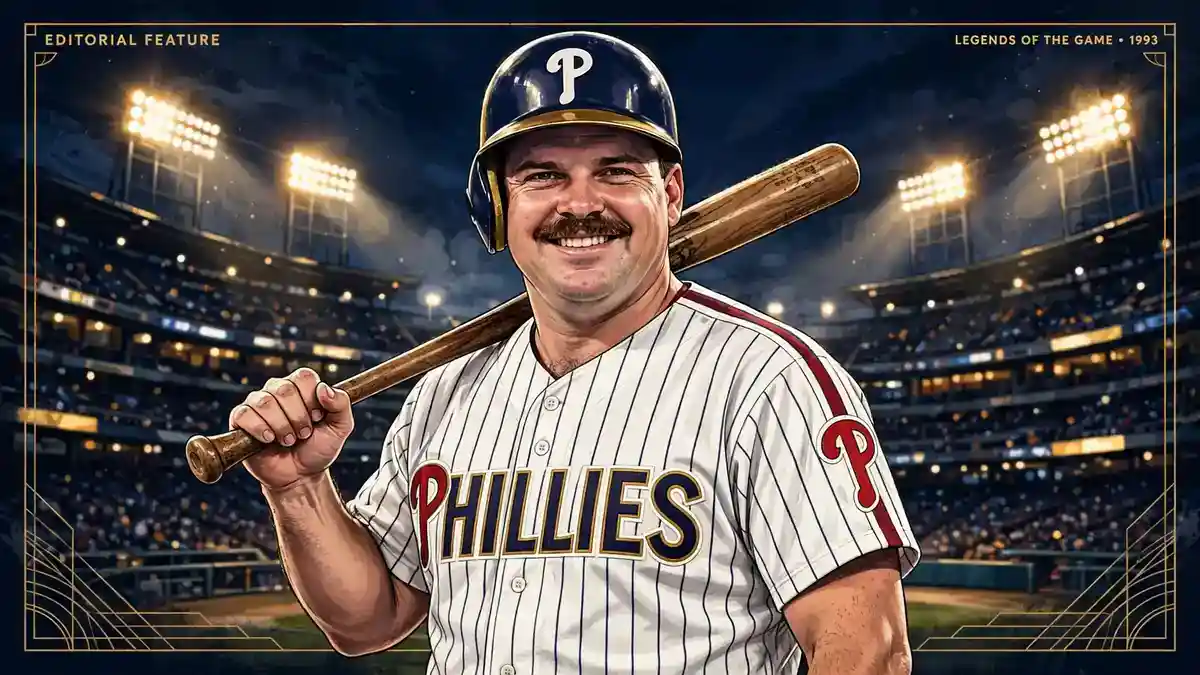
John Kruk‘s net worth is estimated at $12 million as of November 2026. The former Philadelphia Phillies first baseman banked $10.95 million in Major League Baseball salaries between 1986 and 1995, then built a second career that has now lasted three times longer than his playing days — twelve years at ESPN followed by a return to the Phillies broadcast booth in 2017 — and added a Florida cheesesteak restaurant to the mix along the way.
John Kruk: Quick Facts
| Estimated net worth | $12 million (range: $10 million – $15 million) |
|---|---|
| Profession | Former MLB first baseman and outfielder; television baseball analyst |
| Nationality | American |
| Born | February 9, 1961 (age 65) |
| Height | 5 feet 10 inches |
| Primary income sources | MLB salaries, ESPN and NBC Sports Philadelphia broadcasting, restaurant business, book |
| Active years | 1986–1995 (MLB); 2001–present (broadcasting) |
| Last reviewed | November 2026 |
- Early Life and Background
- Education
- Career Journey
- Rise to Fame
- Main Sources of Income
- Salary and Earnings
- Businesses and Investments
- Brand Deals and Sponsorships
- Houses, Cars and Other Assets
- Awards and Achievements
- Net Worth Growth Over the Years
- Social Media Presence
- Personal Life
- Sources & Reporting
- Frequently Asked Questions
Early Life and Background
John Martin Kruk was born on February 9, 1961, in Charleston, West Virginia, and grew up in Keyser, a small railroad and coal town in the state’s Eastern Panhandle. Keyser sits in Mineral County, hard against the Maryland line, and Kruk’s roots there stayed with him for life — he met his second wife through neighbours from the same town, and he still talks about Keyser as home whenever a microphone is near. He was not a blue-chip prospect. No scout’s list had him pegged as a future All-Star, and the $2,500 signing bonus the San Diego Padres handed him in 1981 tells that story in one number.
What Kruk had instead was a left-handed swing that made hard contact look easy. He hit for average at every stop in the minors, and he did it with a body type that scouts kept doubting: listed at 5 feet 10 inches and around 220 pounds in his playing prime, he looked more like a softball regular than a big-league first baseman. That mismatch became his calling card. Fans loved him for it, pitchers hated facing him for it, and it shaped the blunt, self-deprecating persona that later made him a natural on television.
His father worked in the area, and the family lived a working-class life far from the showcase circuits that feed modern scouting. Kruk played his school ball in Keyser and went on to Allegany Community College in Cumberland, Maryland, just across the state line. The Padres took him in the third round of the 1981 draft — a solid pick, not a celebrated one — and sent him to the low minors to prove the bat was real. It took five seasons. He reached the majors at 25, older than most debutants, and he arrived with something to prove.
Education
Kruk attended Keyser High School in Keyser, West Virginia, where he played baseball before moving on to Allegany Community College in Cumberland, Maryland. The junior-college stop mattered: it gave him two more years of at-bats against older competition, and it was from Allegany that the Padres drafted him in 1981. He did not attend a four-year university, and no record shows him completing a degree — baseball took over that summer, and he never went back to school full-time.
The education that shaped his earning power came on the field. Five minor-league seasons taught him to hit professional breaking balls, and the long apprenticeship explains why his major-league arrival felt so polished: by his debut in April 1986, he already knew how to work a count and use the whole field. That patience at the plate — a career .397 on-base percentage built on 649 walks against 1,200 games — was the skill that kept him employed for a decade and made him a three-time All-Star.
Career Journey
Kruk’s professional story splits cleanly into three acts: the San Diego apprenticeship, the Philadelphia peak, and a one-summer coda in Chicago. He signed with the Padres in 1981 for $2,500 and spent 1981 through 1985 climbing their farm system, hitting at every level without ever being treated as a priority prospect. His major-league debut came on April 7, 1986, at age 25. He played 122 games that year and hit .241 — a modest start that hid the hitter he was about to become.
San Diego kept him for three and a half seasons. He hit .286 in 1987 and showed the gap power and plate discipline that would define him, but the Padres had a logjam at first base and outfield corners, and on June 2, 1989, they traded him to the Philadelphia Phillies with Randy Ready for outfielder Chris James. The trade changed his life. In Philadelphia he found a ballpark that suited his pull swing, a fan base that adored an everyman hero, and a lineup — the rough-edged “Macho Row” crew — that fit his personality exactly.
The Phillies years, 1989 to 1994, were the heart of his career: three straight All-Star selections, a National League pennant in 1993, and a World Series trip that ended in a six-game loss to the Toronto Blue Jays. His 1994 season was cut short by testicular cancer — diagnosed that summer, treated with surgery — and he came back from it to play again. After the 1994 season he left Philadelphia as a free agent, and in May 1995 he signed a one-year, $1 million deal with the Chicago White Sox to serve as designated hitter. The Sox stint lasted barely two months. On July 30, 1995, in Baltimore, he singled in his first at-bat, then told manager Terry Bevington he was done. He had promised himself he would retire the moment he got a hit, and he kept the promise on the spot. He was 34, with a career .300 average, exactly 100 home runs and 592 RBIs in 1,200 games.
Broadcasting filled the space baseball left. He coached the Reading Phillies in 2001, worked for Fox Sports Net the same year, joined Comcast SportsNet Philadelphia as a Phillies analyst in 2003, and then spent twelve years at ESPN — on Baseball Tonight from 2004 and as the colour commentator on Sunday Night Baseball alongside Dan Shulman from 2012. When he and ESPN parted ways after the 2016 season, he came home: Comcast SportsNet announced in February 2017 that Kruk would join the Phillies broadcast team, and he made his debut on February 25, 2017. He has been in the NBC Sports Philadelphia booth ever since, working alongside play-by-play voice Tom McCarthy.
Rise to Fame
Kruk’s rise was not a sudden breakout — it was a slow burn that caught fire in 1991. He hit .294 that year, made his first All-Star team, and finished in the top 20 of National League MVP voting, a feat he repeated in each of the next two seasons. From 1991 to 1993 he was an All-Star every year, and over his six Philadelphia seasons he hit .309 with a .400 on-base percentage and 62 home runs, numbers that put him among the best hitters in franchise history for that span.
The 1993 season made him a Philadelphia folk hero. The Phillies — a team picked to finish near the bottom of the division — won the National League pennant behind a roster of characters: Lenny Dykstra, Darren Daulton, Mitch Williams, Curt Schilling and Kruk, the first baseman who looked like he had wandered in from the stands. They lost the World Series to Toronto in six games, but the run sealed Kruk’s place in the city. Philadelphia has always loved players who play hard and talk straight, and Kruk did both.
One quirk of his record tells you how precise his career was. His lifetime average sat at .29989 — a fraction below .300 — and only rounding carried it to the .300 mark that history records. He finished with exactly 100 home runs, a round number he reached deliberately and protected. He never chased milestones for their own sake; he got his hit in Baltimore in July 1995 and walked away the same night, which is a stranger and more honest ending than most players get.
His 1994 book, I Ain’t an Athlete, Lady, published the year of his cancer diagnosis, added to the persona: funny, blunt, allergic to self-importance. The title came from a real exchange — a woman had asked him what it felt like to be an athlete, and he had answered that he was no athlete, just a guy who could hit. That line, and the attitude behind it, is why Philadelphia still cheers him in the broadcast booth thirty years later.
Main Sources of Income
Kruk’s money comes from four streams, and their balance shifted sharply after 1995. His playing salaries were the foundation — $10.95 million across ten seasons, earned when baseball pay was a fraction of today’s levels. Broadcasting is the second stream, and by now it is the larger one in total: twelve years at ESPN plus nine seasons and counting at NBC Sports Philadelphia, a run of steady television pay that has outlasted his playing career three times over. The third stream is his restaurant business in Florida. The fourth is the smaller stuff that fills out a former athlete’s income — a book, a newspaper-era ESPN.com column called Chewing the Fat, endorsements, appearances and Phillies alumni work.
There is no sign of the big-ticket side ventures that pad other athletes’ fortunes — no clothing line, no venture fund, no real estate empire. Kruk’s wealth looks like what it is: a solid playing career, a long and stable broadcasting career, and one local business, compounded over thirty years. That is exactly why the published estimates swing so wildly: outlets that count only the playing career land near $4 million, while outlets that price in three decades of television work land near $15 million.
The broadcasting stream deserves emphasis because it is the part most net-worth pages gloss over. Kruk has been on television almost continuously since 2001 — Fox Sports Net, Comcast SportsNet, twelve years at ESPN, then NBC Sports Philadelphia from 2017. National baseball analysts at major networks typically earn between $100,000 and $500,000 a year, according to CollegeNetWorth’s industry survey, and a veteran with Kruk’s profile and tenure sits at the upper end of that band. Even at a conservative average, twenty-plus years of television work adds several million dollars of gross income on top of his playing pay, and it is still paying him in 2026.

Salary and Earnings
The most useful document in Kruk’s financial story is his year-by-year salary record. It is the one hard number set in an otherwise foggy picture, and it corrects a mistake that several net-worth sites repeat. Celebrity Net Worth states that his total career salary earnings were “around $7 million” — but the season-by-season record adds up to $10.95 million, nearly 60 percent more. The table below uses the year-by-year figures compiled from historical salary records:
| Season | Team | Salary |
|---|---|---|
| 1986 | San Diego Padres | $60,000 |
| 1987 | San Diego Padres | $110,000 |
| 1988 | San Diego Padres | $250,000 |
| 1989 | San Diego Padres / Philadelphia Phillies | $450,000 |
| 1990 | Philadelphia Phillies | $655,000 |
| 1991 | Philadelphia Phillies | $1,175,000 |
| 1992 | Philadelphia Phillies | $2,350,000 |
| 1993 | Philadelphia Phillies | $2,450,000 |
| 1994 | Philadelphia Phillies | $2,450,000 |
| 1995 | Chicago White Sox | $1,000,000 |
| Career total | $10,950,000 |
The shape of that table is the story of a late bloomer. He earned $60,000 as a rookie in 1986 and did not crack $1 million until 1991, his sixth season — the year he became an All-Star. His peak pay was $2.45 million in both 1993 and 1994, which sounds modest until you adjust it: $2.45 million in 1993 is roughly $5.4 million in 2026 dollars. One claim worth flagging as unverified: a biography site states Kruk signed a $6.5 million contract in 1991. That figure does not match the year-by-year record, which shows $1.175 million for 1991 and $2.35 million for 1992, so we do not use it. The $2,500 signing bonus from 1981 is the other end of the same arc — a 980-fold jump from bonus to peak annual salary across thirteen years.
After retirement, the paydays changed shape rather than stopping. ESPN hired him in 2004, and he stayed for twelve seasons, moving from Baseball Tonight studio work to the Sunday Night Baseball booth in 2012. Exact ESPN pay was never disclosed, and one site’s claim of a $75,000 average analyst salary looks far too low for a national broadcaster of his standing — industry bands published by CollegeNetWorth put major-network baseball analysts at $100,000 to $500,000-plus a year, and Kruk’s seniority points to the top of that band. His NBC Sports Philadelphia deal, signed in 2017, was later extended — one Phillies site reports a four-year extension — which means he has had continuous, contracted television income from 2004 through today. Add the restaurant and the book, and the post-playing gross comfortably exceeds the playing gross.
Taxes and time did their usual work on the playing money. The $10.95 million was gross pay across a decade, spread over federal and state taxes, agent fees and living costs, and it arrived in the late 1980s and early 1990s, when a dollar bought roughly twice what it does now. That is why a $12 million net worth in 2026 is a fair reading rather than a low one: the playing fortune was real but finite, and the broadcasting fortune was built slowly, year by year, over three decades.
Businesses and Investments
Kruk’s best-known business is Kruk’s Philly Steaks, a cheesesteak shop he opened in Naples, Florida, in 2016 with partner Michael Michaud. The shop sits at 6434 Naples Boulevard in North Naples, and its opening was covered by the local press as a homecoming of sorts — Kruk had lived in the Naples area for years, and the restaurant put his name on a South Philly staple in a town full of transplanted Northeasterners. The menu leans on the classics: imported rolls, “wiz” cheese, and a signature sandwich called The Krukker — listed as No. 29, a nod to his uniform number — a Philly steak with American cheese, fried onion, ketchup and mayo. A second sandwich, The Bush, named for co-owner Kevin Bush, is an Italian pork sandwich with provolone and au jus. Build-your-own sandwiches were priced at $8.99 at opening, and the shop’s Phillies-red interior is lined with baseball memorabilia.
The restaurant is a local business, not an empire — there is no public record of a franchise chain or multiple locations, and reports of him owning “a chain of restaurants in Florida” overstate a single well-loved shop. Still, it is a real operating business with a decade of trading behind it by 2026, and it is the most concrete post-baseball asset in his portfolio. No revenue figures have ever been published for it, so we do not guess at any.
His book, I Ain’t an Athlete, Lady (1994), was a modest commercial venture rather than a fortune-maker, but it kept his name in print during his playing peak and still sells in used and digital editions. His ESPN.com column, Chewing the Fat, ran during his ESPN years and was part of his network deal rather than a separate income line. In 2016 he also coached softball at Seacrest Country Day School in Naples, winning Florida Athletic Coaches Association Class 2A Coach of the Year in his first season — a volunteer-style school role, not a paid career, but a sign of how he spent his Florida years.
On investments, the honest answer is that almost nothing is public. Kruk has never discussed a portfolio, a property fund or a startup stake in any interview we could find, and no filing or rich list covers him. That silence is itself informative: unlike modern stars who announce every deal, Kruk belongs to a generation that kept its finances private. Our estimate therefore rests on the two income streams we can document — playing pay and broadcasting pay — plus the restaurant, and it assumes ordinary saving and home ownership rather than any hidden windfall.
Brand Deals and Sponsorships
Kruk’s endorsement record is thin, and that thinness is part of the story. During his playing days he was a star in Philadelphia but never a national marketing figure — first basemen who hit .300 without hitting 40 home runs did not get shoe deals in the early 1990s. One biography site reports endorsement work with Hershey’s and Microsoft, but neither deal is documented with dates or figures anywhere we could verify, so we list them as reported rather than confirmed. There is no record of a major national campaign built around him.
What he did get, and what has lasted, is the local kind of commercial value: Phillies alumni appearances, charity golf outings, card-show signings, and the steady visibility of a regional broadcast booth. The NBC Sports Philadelphia role is itself a kind of endorsement — the network has kept him front and centre for nine seasons, and a reported four-year contract extension signals that his local commercial value is still rising, not fading. The restaurant doubles as a brand vehicle: his name above a Naples door is a marketing asset that costs him nothing extra.
Compared with a modern star, the gap is stark. Today’s first basemen sign nine-figure deals before their first All-Star game; Kruk’s entire playing career paid less than a single season of a modern star’s contract. The sponsorship money he missed in the 1990s is one reason his net worth sits at $12 million rather than $50 million — and one reason the broadcasting second act mattered so much.
Houses, Cars and Other Assets
Kruk lives in Naples, Florida, where he has been based for years with his wife Melissa and their children. He previously lived in Mount Laurel Township, New Jersey, during his Phillies years and early broadcasting career, before the family moved south. Florida’s lack of state income tax is a quiet factor in his finances — a broadcaster earning in the six figures keeps meaningfully more of it in Naples than he did in New Jersey or Pennsylvania.
A property site reports a house in Keystone Heights, Florida, valued at around $3.5 million, and describes it as his primary residence in that listing — but that conflicts with the better-sourced reporting that places the family in Naples, so we treat the Keystone Heights figure as an unverified property report rather than a confirmed holding. Celebrity Net Worth notes that Kruk sold a home he later regretted parting with, claiming it would be worth north of $6 million today, without giving an address or a sale price, so that detail stays in the “reported, not verified” column too. No mortgage records or property portfolios are public.
On cars, there is nothing to report — and that is worth saying plainly. No interview, profile or social post documents a car collection, a luxury purchase or a garage worth cataloguing. Kruk’s public image has always run in the opposite direction: the regular guy who happened to hit .300. Any article that lists his vehicles is inventing them, so we don’t.
The assets we can stand behind are the ordinary ones: a Florida home, the restaurant premises and brand, and thirty years of accumulated earnings. That is a comfortable, upper-middle-class fortune for a retired athlete — not a mogul’s portfolio, and not a cautionary tale either.
Awards and Achievements
Kruk’s trophy case is modest by Hall of Fame standards and rich by any other measure. He was a Major League All-Star in 1991, 1992 and 1993 — three straight selections, all with Philadelphia — and he finished in the top 20 of National League MVP voting in each of those three seasons. He won a National League pennant with the 1993 Phillies and played in the World Series that October. On August 12, 2011, the Phillies inducted him into the Philadelphia Baseball Wall of Fame, an honour reserved for the franchise’s most beloved figures; he was only the second player from the 1993 team to receive it.
His career numbers still hold up: a .300 batting average over 1,200 games, 100 home runs, 592 RBIs, 649 walks and a .397 on-base percentage — good for 72nd on baseball’s all-time on-base list — with a 133 OPS+. He hit .309 as a Phillie, with a .400 on-base percentage across six seasons in the city. In the 1993 World Series he hit .348 with a .500 on-base percentage, and his 1993 All-Star Game at-bat against Randy Johnson — ducking a fastball that sailed over his head, then drawing a walk — is still replayed every July. In 2003, the final year of Veterans Stadium, Phillies fans voted him the first baseman on the Phillies All-Vet Team. One widely repeated claim needs a correction here: some net-worth pages credit him with a Silver Slugger Award in 1991. The award records do not support that — his listed career honours are the three All-Star selections and the Wall of Fame induction — so we do not include it.
His post-playing honours are smaller but telling. As a first-year softball coach at Seacrest Country Day School in Naples in 2016, he was named Florida Athletic Coaches Association Class 2A Coach of the Year. And his broadcasting longevity is its own achievement: twelve seasons at ESPN, including five years in the Sunday Night Baseball booth, followed by nine seasons as the Phillies’ colour commentator. Few players from his era stayed on television that long.
Net Worth Growth Over the Years
No rich list has ever tracked Kruk year by year, so the honest version of this table is a reconstruction: documented earnings on one side, published estimates on the other, with the gaps labelled as such. The pattern is a slow build, not a spike — the opposite of the modern star whose fortune arrives in a single contract.
| Year | Milestone | Estimated net worth |
|---|---|---|
| 1981 | Drafted by San Diego; $2,500 signing bonus | Under $10,000 |
| 1986 | MLB debut; $60,000 rookie salary | Under $100,000 |
| 1991 | First All-Star selection; salary passes $1 million | About $1–2 million |
| 1994 | Peak salary year ($2.45 million); cancer diagnosis and return | About $4–5 million |
| 1995 | Retires with $10.95 million in career MLB pay | About $5–6 million |
| 2004 | Joins ESPN; broadcasting income begins in earnest | About $6–7 million |
| 2016 | Opens Kruk’s Philly Steaks in Naples; leaves ESPN | About $9–10 million |
| 2017 | Returns to Phillies booth on NBC Sports Philadelphia | About $10 million |
| 2024 | NetWorths.io estimates $15 million; TheRichest still lists $25 million | $12–15 million (published range) |
| 2025 | Celebrity Net Worth updates its figure to $4 million | $4–15 million (published range) |
| 2026 | Still broadcasting; NBC Sunday Night Baseball assignment in April 2026 | $12 million (our estimate; range $10–15 million) |
Why do the published numbers disagree by a factor of six? The table of sources makes the split clear. Celebrity Net Worth’s $4 million (updated August 2025) sits at the bottom and rests on a career-earnings figure of “around $7 million” that the year-by-year record contradicts. TheRichest’s $25 million sits at the top and appears to be an old, unrevised figure — it still describes him as ESPN’s current analyst, a role he left in 2016. The middle of the pack — CollegeNetWorth at $15 million, NetWorths.io at $15 million, Living Gossip at $14 million, and a 2026 roundup at $12–18 million — clusters tightly, and our $12 million anchor sits at the cautious end of that cluster.
| Source | Published estimate | Notes |
|---|---|---|
| Celebrity Net Worth | $4 million (Aug 2025) | Lowest figure; understates career pay at ~$7M vs $10.95M record |
| TheRichest | $25 million | Highest figure; stale — still lists him as an ESPN analyst |
| CollegeNetWorth | $15 million (Jun 2025) | Mid-range; notes broadcasting pay bands |
| NetWorths.io | $15 million (2024) | Mid-range |
| Living Gossip | $14 million (2024) | Mid-range |
| NetWorthCraft estimate | $12 million (Nov 2026) | Range $10–15 million |
The growth story since retirement is the broadcasting story. A player who retired in 1995 with roughly $5–6 million in net assets, then earned a steady television salary for thirty years while living in a no-income-tax state and running a small business, reaches $12 million without any single windfall. It is slow money, and that is why it is believable.
Social Media Presence
Kruk keeps a light footprint online, which fits a broadcaster of his generation. He posts on X (formerly Twitter) as @JohnKruk, where Phillies fans follow him for game-day observations and the occasional throwback — the Good Phight pointed readers to that handle in its 2023 profile of him. He is not a daily poster, and his account reads like a working broadcaster’s notebook rather than a personal brand channel.
There is no verified public Instagram or Facebook presence tied to him that we could confirm, and his name turns up mostly through the Phillies’ and NBC Sports Philadelphia’s accounts, which clip his booth moments for their own feeds. That low profile is a deliberate choice, not an absence: his public life happens on television five nights a week during the season, and he has never needed a social following to stay employed. For net-worth purposes, social media contributes nothing measurable to his income — no sponsored-post business, no creator revenue, no merchandise funnel.
Personal Life
Kruk married Jamie Heeter in 1991; the marriage ended in divorce. He met Melissa McLoughlin in 1999 through a mutual friend — former Phillies reliever Mitch Williams — and they married on December 20, 2000. Melissa, a former Miss New Jersey (1999) from Cinnaminson, New Jersey, had competed in the Miss USA pageant before the marriage. The couple have three children — Gavin, Kyle and Kiera — and have been based in Naples, Florida, for years. Their son Kyle played baseball, and their daughter Kiera committed to play volleyball at Berry College. Some profiles list two children rather than three; the three-name version appears in the most detailed family reporting, and we use it here.
The hardest chapter of his personal life came in 1994, when he was diagnosed with testicular cancer during the season. He had surgery and returned to the field, and he has spoken about the experience in the years since — plainly, without turning it into a platform. It cost him playing time in his final full Phillies season, and it is part of why his 1994 line looks thinner than the three All-Star seasons before it.
He grew up in Keyser, West Virginia, and the town still claims him — he and Melissa lived on adjoining farms there before their marriage, a detail that says plenty about how small his world was before baseball widened it. In Naples he has stayed close to the game at ground level, coaching school softball and showing up at his children’s games rather than chasing the celebrity circuit. He is 65 in November 2026, still calling Phillies games, and still living in the same Florida town where he opened his restaurant a decade ago.
Sources & Reporting
Celebrity Net Worth — the $4 million estimate (updated August 2025) and the “around $7 million” career-earnings claim, which our salary-table check contradicts; also the note about a sold home now worth north of $6 million. Reporting window: August 2025.
TheRichest — the $25 million estimate, now stale (still describes Kruk as an ESPN analyst). Used only to mark the top of the published range.
CollegeNetWorth — the $15 million estimate, the $100,000–$500,000-plus analyst pay band, the 2017 NBC Sports Philadelphia return, and the Naples residence. Reporting window: June 2025.
NBC Sports Philadelphia — the February 6, 2017 announcement of Kruk joining the Phillies broadcast team, his 2001 Fox Sports Net start, his 2003 Comcast SportsNet stint, his twelve ESPN years and his 2001 Reading Phillies coaching role.
Wikipedia — career timeline, the June 2, 1989 trade details, the 2012 Sunday Night Baseball move with Dan Shulman, the October 2016 ESPN parting, and the August 12, 2011 Wall of Fame induction date.
Baseball-Reference — career statistics (.300 average, 100 home runs, 592 RBIs, 133 OPS+, .397 on-base percentage, 72nd all-time in on-base percentage) and the 1991 National League Silver Slugger list, which confirms Will Clark — not Kruk — won the award at first base.
Sports Illustrated — the 1981 third-round draft detail and the post-playing broadcast career summary.
PhillyVoice — the 2017 spring-training broadcast schedule, Kruk’s .309 Phillies average and 62 Phillies home runs, and his 2011 Wall of Fame induction.
Sox Machine — the May 12, 1995 $1 million White Sox signing, the July 30, 1995 retirement story, and the .29989 career-average rounding detail.
faqs.org — the year-by-year salary table (1986–1995) that sums to $10.95 million in career pay.
PlayersBio — the Melissa McLoughlin marriage (December 20, 2000), the Mitch Williams introduction, her Miss New Jersey 1999 title, and the three children.
DailyWikiBio — family details, the Naples move, the Seacrest softball coaching award, and the reported Hershey’s and Microsoft endorsements.
Naples Daily News — the 2016 opening of Kruk’s Philly Steaks at 6434 Naples Boulevard, the menu and prices, and co-owner Kevin Bush.
NetWorths.io — the $15 million estimate (2024) and the Silver Slugger claim we debunked against Baseball-Reference.
Living Gossip — the $14 million estimate (2024).
Housing Market News — the reported $3.5 million Keystone Heights, Florida, property, flagged here as unverified.
The Good Phight — Kruk’s X handle (@JohnKruk) and his standing with Phillies fans.
NBC Sports — the April 2026 press release placing Kruk on the Sunday Night Baseball announce team for Braves–Phillies, confirming national broadcast work in 2026.
Reporting window: October–November 2026. Where sources disagreed — the $4 million to $25 million estimate spread, the $7 million versus $10.95 million career-pay figures, the Silver Slugger claim — we published the range or the correction rather than picking the friendlier number.
Frequently Asked Questions
What is John Kruk’s net worth in 2026?
John Kruk’s net worth is estimated at $12 million as of November 2026, within a range of $10 million to $15 million. Published estimates disagree widely — Celebrity Net Worth lists $4 million while TheRichest lists $25 million — and the mid-range outlets cluster at $14–$15 million. Our anchor reflects his $10.95 million in career MLB salaries plus thirty years of broadcasting income.
How much did John Kruk earn in his MLB career?
Kruk earned $10.95 million in salary across his ten-season MLB career (1986–1995), according to the year-by-year salary record. He started at $60,000 as a San Diego rookie in 1986 and peaked at $2.45 million a season with Philadelphia in 1993 and 1994. Celebrity Net Worth’s claim of “around $7 million” in career earnings is contradicted by that season-by-season record.
What teams did John Kruk play for?
Kruk played for three teams: the San Diego Padres (1986–1989), the Philadelphia Phillies (1989–1994) and the Chicago White Sox (1995). He was traded from San Diego to Philadelphia on June 2, 1989, with Randy Ready for Chris James, and he spent six of his ten seasons with the Phillies.
Why did John Kruk retire?
Kruk retired on July 30, 1995, at age 34, in the middle of a game. He had told White Sox manager Terry Bevington he would quit the moment he got a hit — and after singling in his first at-bat in Baltimore, he did exactly that. He finished with a .300 career average and exactly 100 home runs.
Did John Kruk have cancer?
Yes. Kruk was diagnosed with testicular cancer during the 1994 season. He had surgery and returned to play. The illness cost him playing time in his final full season with the Phillies, and he has spoken about it plainly in interviews since.
Who is John Kruk’s wife?
John Kruk is married to Melissa McLoughlin, a former Miss New Jersey (1999). They met in 1999 through former Phillies pitcher Mitch Williams and married on December 20, 2000. They have three children — Gavin, Kyle and Kiera — and live in Naples, Florida. Kruk was previously married to Jamie Heeter in 1991; that marriage ended in divorce.
How old is John Kruk and how tall is he?
John Kruk was born on February 9, 1961, in Charleston, West Virginia, making him 65 years old in November 2026. He is listed at 5 feet 10 inches tall and played at around 220 pounds.
Where is John Kruk now and what is he doing?
Kruk is a colour commentator for Philadelphia Phillies games on NBC Sports Philadelphia, a role he has held since February 2017. He also took a national assignment on NBC Sports’ Sunday Night Baseball team in April 2026. He lives in Naples, Florida, where he owns Kruk’s Philly Steaks, a cheesesteak restaurant he opened in 2016.
Final Thoughts
John Kruk’s $12 million fortune is a story of two careers, not one. The first paid him $10.95 million over ten seasons and ended with a single in Baltimore and a handshake. The second — thirty years in broadcast booths from Fox Sports Net to ESPN to NBC Sports Philadelphia — is the one that turned a solid playing fortune into a lasting one. Add a Naples cheesesteak shop and a Florida address with no state income tax, and you get a net worth that grew slowly, honestly and without a single windfall. The published estimates that put him at $4 million undercount his playing pay, and the ones that put him at $25 million are stale. Twelve million, inside a $10–$15 million range, is the number the record supports — and it belongs to a player who retired on his own terms, at .300 on the dot, and never looked back.
Published on November 7, 2026. Last reviewed November 2026. Found an error? See our corrections policy.