
Burt Reynolds‘s net worth was estimated at $3 million when he died in September 2018 — a figure that hides one of the wildest financial rides in Hollywood history. At his peak in the late 1970s, Reynolds was the biggest box-office star on the planet, earning around $10 million a year, and he put his own peak fortune at $60 million after taxes. By 1996 he was in Chapter 11 bankruptcy, listing $6.65 million in assets against $11.2 million in debts. He clawed part of it back through television, a late-career Oscar nomination, and the sale of his cars and memorabilia, but he never came close to his peak wealth again. This article traces every dollar: the $1 million Smokey and the Bandit payday, the $5 million Cannonball Run cheque, the restaurant deals that bled him dry, the divorce that cost him years in court, and the estate he left behind.
Burt Reynolds: Quick Facts
| Estimated net worth | $3 million at death (2018) (range: $500,000 – $5 million) |
|---|---|
| Profession | Actor, director, producer |
| Nationality | American |
| Born | February 11, 1936, Lansing, Michigan (age 82 at death) |
| Height | 6 feet 2 inches (1.88 m) |
| Primary income sources | Film salaries, television, directing, residuals, memorabilia and property sales |
| Active years | 1958 – 2018 |
| Last reviewed | November 2026 |
- Early Life and Background
- Education
- Career Journey
- Rise to Fame
- Main Sources of Income
- Salary and Earnings
- Businesses and Investments
- Brand Deals and Sponsorships
- Houses, Cars and Other Assets
- Awards and Achievements
- Net Worth Growth Over the Years
- Social Media Presence
- Personal Life
- Sources & Reporting
- Frequently Asked Questions
- Final Thoughts
Early Life and Background
Burton Leon Reynolds Jr. was born on February 11, 1936, in Lansing, Michigan, and raised mostly in Riviera Beach, Florida, where his father served as the town’s police chief. The household was strict, Southern, and working-class — a long way from a film set — and the young Reynolds first imagined a future in football, not acting. He grew up fast and tough: a big, athletic teenager who played halfback and dreamed of the NFL, and who later said his father kept him on a short leash that he spent years testing.
The move that changed his life was an accident of timing. A knee injury on the football field, followed by a car accident that damaged the same knee further, closed the door on professional football before it properly opened. Reynolds has often been quoted saying that football was his first love and acting was the fallback — and the fallback turned into a sixty-year career. The injury is the hinge of his whole story: without it, there is no Gunsmoke, no Deliverance, no Bandit, and no $60 million peak fortune to lose.
Florida shaped the man audiences later paid to see. He kept the drawl, the swagger, and the good-old-boy grin, and he returned to Florida again and again — to live, to invest, to build a ranch and a dinner theatre, and finally to die there. His Jupiter, Florida, base became both his refuge and, in the bankruptcy years, the asset creditors circled. The state gave him his identity and, in the end, most of his remaining wealth sat in its property.
Education
Reynolds attended Palm Beach High School in West Palm Beach, Florida, where he starred on the football team, then won a football scholarship to Florida State University in Tallahassee. At FSU he played halfback for the Seminoles, and the plan — shared by his father and his coaches — was a professional career. The knee injury in 1955 ended that plan in his sophomore year, and a second blow came in a car accident soon after.
Acting entered his life through a college English class. His teacher cast him in a campus production of Outward Bound, and Reynolds won the Florida State Drama Award for the performance — the first sign that the fallback had real legs. He left FSU without a degree and headed for New York, where he studied at the Hyde Park Playhouse and worked odd jobs while chasing stage work. The education that mattered was not the diploma he never collected; it was the football discipline, the stage training, and the years of small parts that taught him how to hold a camera’s attention.
That apprenticeship ran through New York theatre and live television in the late 1950s, then to Hollywood in 1960. He arrived with no money and no connections, and spent the first years of the decade in guest spots on westerns and police shows — the unglamorous work that built the résumé behind the later paydays.
Career Journey
Reynolds’s first steady break came in 1962, when he joined the cast of Gunsmoke as Quint Asper, the half-Comanche blacksmith, and stayed for three seasons and 50 episodes. The show was the biggest thing on American television, and it gave him a national face — and a weekly wage — for the first time. He followed it with the lead in the ABC detective series Dan August (1970–71), produced by Quinn Martin, and a run of film roles that kept getting bigger: Navajo Joe (1966), 100 Rifles (1969), and the ensemble of Deliverance (1972).
Deliverance was the turning point. John Boorman’s film about four Atlanta businessmen on a canoe trip down a Georgia river earned three Academy Award nominations, including Best Picture, and made $46 million worldwide on a $2 million budget. Reynolds played Lewis Medlock, the macho outdoorsman, and the performance proved he could carry a serious film. The same year he became the first man to pose nude for Cosmopolitan magazine — the April 1972 centerfold that made him a sex symbol overnight and, by his own later admission, a joke in some casting offices and a draw in others.
The mid-1970s turned him into a hit machine. White Lightning (1973) and The Longest Yard (1974) — the prison football comedy that grossed $43 million — established the formula: Reynolds as the grinning, fast-talking rogue who beat the system and got the girl. He directed Gator (1976), the sequel to White Lightning, and started to take a hand behind the camera that later became a real second income. Then came 1977, the year that changed everything.
The 1980s were the long slide from the summit. Smokey and the Bandit II (1980), The Cannonball Run (1981), The Best Little Whorehouse in Texas (1982), and Cannonball Run II (1984) kept the cheques coming, but the reviews turned and the flops piled up — Stroker Ace (1983), City Heat (1984) with Clint Eastwood, and a string of forgettable action pictures. By the end of the decade the offers had thinned to the point where television, the medium he had left behind, became the rescue plan.
Evening Shade (1990–94) ran for 100 episodes on CBS, won him an Emmy and a Golden Globe, and — less glamorously — paid down a large share of his bankruptcy debts through syndication income. Then came the role that rewrote his reputation: Jack Horner, the porn-film director with a father’s warmth, in Paul Thomas Anderson’s Boogie Nights (1997). The performance won him a Golden Globe and his only Academy Award nomination, and it kept him working steadily for the next twenty years — character parts, voice work (Charlie B. Barkin in All Dogs Go to Heaven, 1989), and a final, poignant casting as George Spahn in Quentin Tarantino’s Once Upon a Time in Hollywood, filmed shortly before his death and released in 2019.
Rise to Fame
The rise had a precise shape: five years at the very top. Reynolds was voted the world’s number one box-office star in the annual Quigley Top Ten Money Making Stars Poll for five consecutive years, from 1978 to 1982 — a record he shares with Bing Crosby, Clint Eastwood, and Tom Hanks, and one Tom Cruise did not pass until 2001. For half a decade, no actor on earth sold more tickets.
Smokey and the Bandit was the engine. Made for $4.3 million — with Reynolds himself taking $1 million of that, a quarter of the entire budget — the film grossed $127 million in North America and roughly $300 million worldwide, finishing as the second-highest-grossing film of 1977 behind only Star Wars. Reynolds’s friend Hal Needham, a stuntman directing his first feature, had planned it as a $1 million B-movie; Reynolds’s agreement to star is what got Universal to fund it at all. The black Pontiac Trans Am, the CB-radio slang, and the Sally Field romance became pop-culture shorthand for the late 1970s.
Fame at that level paid in ways beyond salary. Reynolds could command $5 million a picture by 1981, and his name alone could green-light a film. He was on magazine covers, talk shows, and lunchboxes. He was also, by his own account, spending like the money would never stop — multiple houses, a 153-acre ranch, a private jet, a helicopter, a staff payroll, and a habit of lending money to friends. The fame and the spending were the same story: the grin that sold tickets was the same grin that signed the cheques.
The fall from that height was slower than the rise but just as public. The box-office failures of the mid-1980s, the tabloid divorce, and the restaurant investments all arrived within a few years of each other. Reynolds later told Vanity Fair in December 2015, in a line that became the epitaph for his finances: “I’ve lost more money than is possible because I just haven’t watched it.” The candour was part of the appeal — he never pretended the losses were someone else’s fault.
Main Sources of Income
Film salaries were the foundation of the fortune. Across more than 90 feature films and 300 television episodes, Reynolds earned his money in three distinct waves: the television wages of the 1960s, the blockbuster film paydays of 1977–84, and the steady television and character-actor income of the 1990s and 2000s. At his peak he was pulling in around $10 million a year, according to Wikipedia’s summary of his career earnings, a figure People and Insider have repeated — roughly $49 million a year in 2025 dollars.
Television paid twice: once in salary and once in syndication. Gunsmoke gave him three seasons of network wages in the 1960s. Evening Shade gave him four seasons as a star and producer-director in the early 1990s, and its syndication run helped him pay off much of the bankruptcy debt after 1998. He directed 35 of the show’s 98 episodes, and directing fees stacked on top of his acting salary.
Directing itself was a real second career. Reynolds directed Gator (1976), The End (1978), Sharky’s Machine (1981), and episodes of Evening Shade and B.L. Stryker, the detective series he starred in for ABC in 1989–90. Directors’ fees were smaller than his acting cheques, but they kept money coming in during years when leading-man offers dried up.
Residuals and royalties ran quietly in the background for decades. Smokey and the Bandit alone generated decades of television, home-video, and streaming income, and Deliverance, The Longest Yard, and Evening Shade all kept paying. These were never enough to rebuild a $60 million fortune, but they were the floor under his later years — the reason he could keep living in his Florida home even as the big paydays stopped.
The last income wave was liquidation. The 2014 Julien’s Auctions sale of his art, memorabilia, and cars brought in about $2.5 million, and a second auction of his remaining possessions followed his death in 2019. His own possessions became, in the end, his most reliable source of cash — a sad symmetry for a man who had spent a fortune collecting them.
Salary and Earnings
The salary ladder tells the story in numbers. In the early 1960s, Gunsmoke paid a working actor’s wage — comfortable, but not wealth. By 1972, Deliverance had made him a film star, and his price rose with every hit. The jump came in 1977: $1 million for Smokey and the Bandit, a fee so large relative to the film’s $4.3 million budget that director Hal Needham was left with only $3.3 million to shoot the movie. The gamble paid off for everyone — the film returned roughly seventy times its budget worldwide.
By 1981 the price had quintupled. Reynolds was paid a reported $5 million for The Cannonball Run, a film he later said he made as a favour to Needham and never much liked. People has reported his peak per-film pay at $10 million, and his annual income at the same level — $10 million a year at the top of his run. In today’s money, that $10 million a year is close to $49 million, and his $60 million peak fortune works out to roughly $150 million after inflation, a figure Celebrity Net Worth itself cites.
The television years paid differently. Evening Shade gave him a network star’s salary for four seasons plus directing fees for 35 episodes, and the show’s syndication — CBS sued him in 1996 over a $3.7 million loan tied to the show’s financing — shows how much money was moving through it. The loan is the detail that links his biggest television success to his bankruptcy: he had borrowed against the show’s future, and when the show ended in 1994, the bill came due.
After the bankruptcy, the numbers shrank. Boogie Nights (1997) paid a fraction of his old fees — the film’s whole budget was only $15 million — but it bought him something money had not bought in years: respect, and steady work. For the last twenty years of his life he worked constantly in supporting roles, voice parts, and independent films, earning a working actor’s income rather than a star’s. The paydays never returned to eight figures, and neither did the fortune.
One salary deserves a note of its own: the Cosmopolitan centerfold. The April 1972 nude shoot paid little directly, but it made him a sex symbol and a household name, and the fame it generated fed every salary negotiation that followed. It was, in pure business terms, the best-paid photograph of his career.
Businesses and Investments
Reynolds’s business record is the dark half of his financial story, and he was the first to admit it. His most damaging investment was in Po’ Folks, a Southern restaurant chain named after a Bill Anderson song, and its sister venture Daisy’s Diner. Reynolds invested as an individual, not through a corporation, which meant he was personally liable when the chains failed. The losses ran into the millions — the Daily Express put the restaurant losses at around £9 million (roughly $14 million at the time) — and the debts were still being counted in his 1996 bankruptcy filing.
He also owned the Burt Reynolds Dinner Theatre in Jupiter, Florida, a working ranch, an art collection, and the Burt Reynolds and Friends Museum in Jupiter. The theatre and the museum were labours of love that doubled as businesses, and both consumed cash. The museum, which displayed his memorabilia, closed years before his death; its contents ended up on the auction block instead.
Sports ownership was another venture. Reynolds was a part-owner of the Tampa Bay Bandits of the United States Football League in the mid-1980s, alongside the team’s founder John Bassett. The USFL folded in 1986, and the investment went with it — another line in a long list of businesses that cost him more than they returned.
Real estate was the one investment class that sometimes worked. His Florida properties appreciated enormously over the decades — the Tequesta waterfront estate he bought for about $700,000 in 1980 was listed for as much as $15 million at one point — but he borrowed against them, missed payments, and faced a Merrill Lynch foreclosure suit in 2011 over $1.2 million on his Hobe Sound home. Property made him paper-rich and cash-poor at the same time, and the paper wealth evaporated whenever a lender called the loan.
The pattern is consistent across every venture: Reynolds invested with his gut, trusted the wrong people, and signed personal guarantees. Vanity Fair‘s 2015 interview captured his own verdict — he had lost more money than seemed possible because he had not watched it. No competitor’s account of his business career finds a single venture that made him rich; the acting paid for everything, and the businesses gave most of it back.
Brand Deals and Sponsorships
Reynolds’s endorsement career was smaller than his fame suggested, and he said so himself. During his divorce from Loni Anderson, he claimed the tabloid frenzy around the split cost him $3 million in commercial endorsements, according to the Los Angeles Times — a figure that shows both how much endorsement money was on the table and how quickly scandal could take it away.
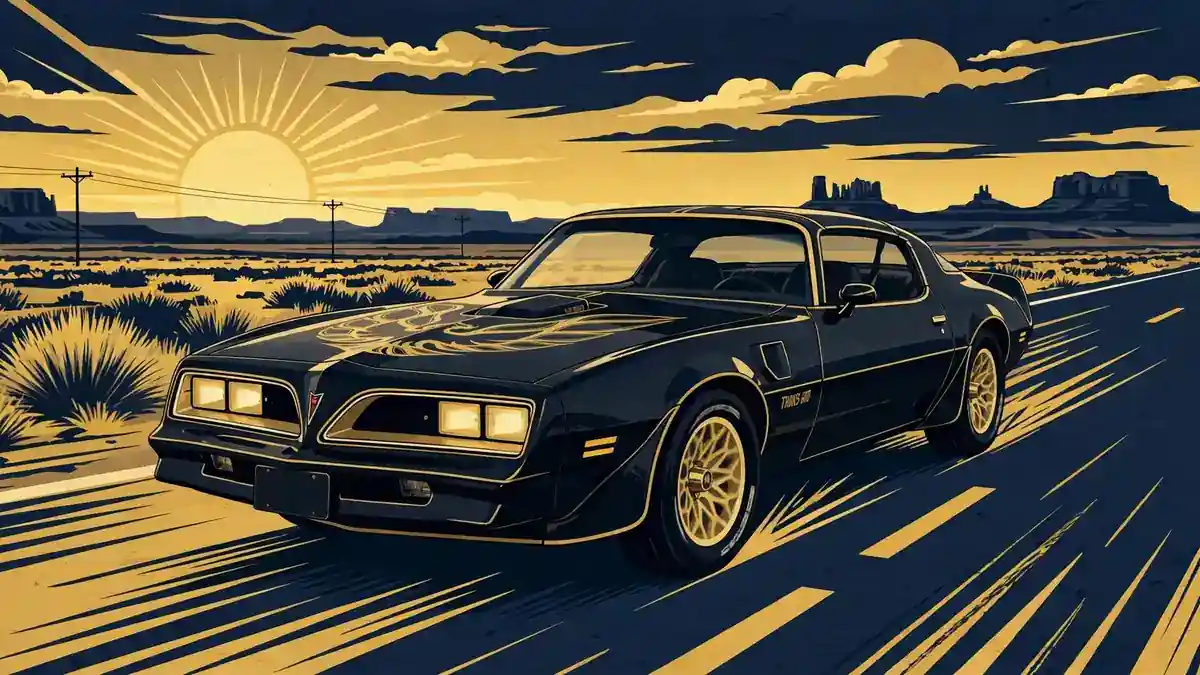
The most famous commercial association of his career was not a paid endorsement at all: Pontiac. After Smokey and the Bandit made the black Trans Am a cultural icon — sales of the model jumped from 68,745 in 1977 to 93,341 in 1978 — Pontiac’s president promised Reynolds a new Trans Am every year. The car became his signature, and the association outlived the film by decades: his personal Trans Ams kept selling at auction for hundreds of thousands of dollars long after Pontiac itself was discontinued by General Motors in 2009.
He did take paid endorsement work in his later years, including commercials and voice work, but nothing on the scale of the film salaries. The endorsement story is really a story about the one that got away: a star with his looks, his grin, and his five-year run at number one should have been one of the most endorsed men in America. The divorce, the bankruptcy, and his own reluctance to chase the work meant the endorsement column of his ledger stayed thin — and its thinness is one reason the fortune never rebuilt itself.

Houses, Cars and Other Assets
The centrepiece was Valhalla, his Mediterranean-style waterfront estate in Tequesta, Florida, across the Intracoastal Waterway from Jupiter Island. He bought the compound in the early 1980s for roughly $700,000, according to TMZ, and at various points listed it for up to $15 million. He put it on the market in 2005, cut the price to $9 million by 2008, and finally sold it in 2015 to his friend and neighbour Charles Modica — on one condition: Modica let Reynolds keep living there until he died. He did, for three more years.
The second great property was the Jupiter Farms ranch: 153 acres with a petting zoo, an airstrip, and a film location where scenes for Smokey and the Bandit were shot — and where he married Loni Anderson in 1988. After the bankruptcy he sold the ranch around 1999 to Palm Beach County for approximately $3.8 million, according to The Real Deal; the county later sold it to a developer for about $5 million, and the land became a 30-home equestrian development. The ranch was the asset that saved him: Florida’s homestead exemption laws and the settlement negotiations let him keep the property through bankruptcy while other assets were sold.
The cars were the most famous assets of all. The promotional 1977 Pontiac Trans Am gifted to him after Smokey and the Bandit sold at Julien’s Auctions in December 2014 for $450,000 — more than five times its $60,000–$80,000 estimate — as part of a sale that brought in about $2.5 million in total. His screen-worn Bandit jacket fetched $34,375, his cowboy boots $20,000, and a gold pocket watch given to him by Sally Field $13,750. A second auction of more than 800 of his possessions followed his death in June 2019, including another of his personal Trans Ams, which sold for $317,500.
Beyond the headline items, the estate included homes in Beverly Hills, Malibu, and Georgia, a mountaintop retreat in the Smoky Mountains, a private jet, a personal helicopter, and a collection of sports cars. At his peak he also kept around 150 horses on the ranch. The 2014 auction catalogue — more than 600 lots of art, costumes, awards, and personal effects — reads like an inventory of a life lived at full volume: a Harold Shelton painting for $12,500, a John Wayne portrait for $8,750, and his Golden Globe award, which he auctioned off to pay debts.
Awards and Achievements
The awards shelf tells two stories: the popular star and the late-blooming serious actor. Reynolds won nine People’s Choice Awards — a record of how much ordinary audiences loved him — and was nominated twice for the Golden Globe for Best Actor in a musical or comedy film, for Starting Over (1979) and The Best Little Whorehouse in Texas (1982). He won the Golden Globe for Best Actor in a television comedy for Evening Shade in 1992, and the Primetime Emmy for Outstanding Lead Actor in a Comedy Series in 1991.
The career peak, in prestige terms, came in 1998. For Boogie Nights he won the Golden Globe for Best Supporting Actor and received his first and only Academy Award nomination, for Best Supporting Actor — losing to Robin Williams for Good Will Hunting at a ceremony where he was widely tipped to win. He also received a BAFTA nomination and two Screen Actors Guild nominations for the role. In total his career count runs to two Golden Globe wins from seven nominations, one Emmy win from two nominations, and one Oscar nomination.
The commercial achievement outshone the trophies. Five consecutive years as the world’s number one box-office star (1978–82) is a record shared with only three other actors in history. His films grossed hundreds of millions of dollars, and Smokey and the Bandit alone — $127 million domestic on a $4.3 million budget — remains one of the most profitable films ever made relative to its cost. He has a star on the Hollywood Walk of Fame, and in 2015 he published his memoir, But Enough About Me, which became a bestseller and added a final income stream in his last years.
Net Worth Growth Over the Years
| Period | Estimated net worth | What moved it |
|---|---|---|
| Early 1960s | Under $100,000 | Gunsmoke wages; working actor |
| 1972–74 | $1 – $2 million | Deliverance, The Longest Yard; rising film fees |
| 1977–82 | $30 – $60 million | Five years as the world’s top box-office star; $5–$10M a year |
| Late 1980s | $15 million | Flops, restaurant losses, divorce costs; prenuptial agreement listed $15M in 1988 |
| 1996 | Negative (bankrupt) | Chapter 11: $6.65M assets vs $11.2M debts |
| 1998–2005 | $1 – $3 million | Out of bankruptcy; Evening Shade syndication, Boogie Nights revival |
| 2014–15 | $2 – $4 million | Julien’s auction (~$2.5M); Valhalla sale |
| September 2018 (death) | $3 million (range $500,000 – $5 million) | Final estate; sources disagree (see below) |
The range at death needs explaining, because it is the widest disagreement in this whole article. Celebrity Net Worth’s current page puts Reynolds at $500,000 at his death; its older figure, repeated by Market Realist, TheThings, and FanBuzz’s reporting, was $3 million; People cited estimates of $5 million. The honest reading: his liquid estate was small — a few million at most — and the exact number depends on whether you count the trust set up for his son, the value of his remaining property, and the auction proceeds. We anchor on $3 million because it is the most commonly cited figure across independent outlets, and we show the full $500,000–$5 million range so readers can see the disagreement instead of having it hidden from them.
The growth table also shows the shape that matters: this was not a slow decline but a cliff. He went from $60 million to bankruptcy in under a decade, then spent twenty years rebuilding to a few million. The peak-to-death drop — roughly 95 percent of the fortune gone — is one of the steepest of any major Hollywood star, and it is why his story is still told as a cautionary tale.
Social Media Presence
Reynolds died in September 2018, before the era when every star runs their own Instagram account, and he never had a personal social media presence. There is no verified Burt Reynolds Instagram, Twitter, or Facebook account to cite, and any account using his name today is a fan page or a memorial page run by others. His public presence in his final years was interviews, talk-show appearances, and the memoir — old media, for a star of old Hollywood.
His legacy lives on social media anyway. Clips of Smokey and the Bandit, the Cosmopolitan centerfold, and his Boogie Nights scenes circulate constantly, and the auction of his Trans Am still generates headlines each time one of his cars crosses the block. The 2019 auction of his possessions was covered live on social platforms by Julien’s Auctions, and the $450,000 Trans Am result remains one of the most shared celebrity-auction stories of the decade. His fame, in other words, outlasted both his fortune and his lifetime — and it is still earning attention, if no longer earning him money.
Personal Life
Reynolds was married twice. His first marriage, to the British actress Judy Carne, lasted from 1963 to 1965. His second, to WKRP in Cincinnati star Loni Anderson, ran from 1988 to 1994 and became one of the most public divorces of the decade. They married on his Jupiter Farms ranch in 1988 and adopted their son, Quinton Anderson Reynolds, the same year. The marriage ended after Reynolds became involved with cocktail waitress Pam Seals, with whom he later traded lawsuits that were settled out of court.
The divorce was expensive in every sense. Anderson sought a $10 million settlement; Reynolds ultimately lost a reported $2 million in the divorce itself, paid $15,000 a month in support, and fought over the settlement in court for more than twenty years. The dispute was not finally closed until September 2015, when Reynolds wrote a cheque for $154,520 to end it. The long tail of that divorce — legal fees, support payments, and the lost endorsement income he blamed on the publicity — was one of the three forces, alongside the restaurant failures and the CBS loan, that pushed him into bankruptcy.
His longest relationship was with Sally Field, his co-star in Smokey and the Bandit, Hooper, Smokey and the Bandit II, and The End. They were together on and off from 1977 into the early 1980s, and Field later wrote in her memoir that he was a complicated, controlling partner — a reminder that the grin on screen hid a harder private life. Reynolds himself called Field the love of his life, and the gold pocket watch she gave him was one of the lots in the 2014 auction.
He died on September 6, 2018, at Jupiter Medical Center in Florida, of a heart attack, at the age of 82. His niece, Nancy Lee Brown Hess, said the death was “totally unexpected.” A private memorial was held in North Palm Beach on September 20, organised by Anderson, Quinton, and Hess. His will named Hess as personal representative of the estate — and, in the detail that made headlines around the world, it stated that he was intentionally omitting his son Quinton from the will because he had “provided for him during my lifetime in my Declaration of Trust.” The trust, not the will, was how he took care of his son.
Sources & Reporting
Celebrity Net Worth — the $500,000-at-death figure on its current page, the $60 million peak fortune by Reynolds’s own estimate, and the 1996 bankruptcy figures ($6.65 million in assets against $11.2 million in debts). Reporting window: page updated within the last month; figures cross-checked against its older $3 million estimate.
People — the $10 million-per-movie peak pay, the $5 million estate estimate at death, and the “totally unexpected” family statement after his death.
Vanity Fair — Reynolds’s December 2015 interview, including “I’ve lost more money than is possible because I just haven’t watched it.”
Los Angeles Times — the $3 million in endorsement income Reynolds said the divorce publicity cost him.
Forbes — the 2014 auction coverage, including the Trans Am result reported through its auction reporting.
MotorTrend — the 1977 Trans Am selling for $450,000 at Julien’s Auctions in December 2014, against a $60,000–$80,000 estimate, with the auction totalling about $2.5 million.
Fox News — the will’s wording on Quinton’s omission and the trust arrangement, and Hess’s role as estate representative.
Wikipedia — career chronology, the five-year Quigley poll record (1978–82), the Smokey and the Bandit budget and gross figures, the bankruptcy timeline, and the awards record. Used for dates and filmography, with money figures cross-checked against the outlets above.
TMZ — the Valhalla estate purchase price of about $700,000 in 1980 and the 2015 sale to Charles Modica with life tenancy.
The Real Deal — the Jupiter Farms ranch sale to Palm Beach County for about $3.8 million and its later resale.
Reporting window: October–November 2026. Reynolds died in 2018, so all figures are historical; where outlets disagree on the estate value, the range is published with the disagreement named.
Frequently Asked Questions
What was Burt Reynolds’s net worth when he died?
Burt Reynolds’s net worth at his death on September 6, 2018, is most commonly estimated at $3 million, though sources disagree widely. Celebrity Net Worth’s current page lists $500,000, while People cited estimates of $5 million. The honest answer is a range of $500,000 to $5 million, with $3 million the figure most outlets cite. His liquid estate was small because most of his peak fortune had been spent, lost in business ventures, or paid out in his divorce and bankruptcy.
How much was Burt Reynolds worth at his peak?
At his peak in the late 1970s and early 1980s, Burt Reynolds’s net worth reached about $60 million after taxes, by his own estimate as reported by Celebrity Net Worth. Adjusted for inflation, that is roughly $150 million in today’s money. He was earning around $10 million a year at the time, as the world’s number one box-office star for five straight years from 1978 to 1982.
How did Burt Reynolds lose his money?
Three forces did most of the damage: failed business investments, above all the Po’ Folks restaurant chain, in which he invested personally and was liable for the losses; his divorce from Loni Anderson, which cost him a reported $2 million plus $15,000 a month in support and more than twenty years of legal fees; and an extravagant lifestyle — multiple estates, a 153-acre ranch, a private jet, a helicopter, and a large staff payroll. A $3.7 million loan from CBS tied to Evening Shade pushed him over the edge, and he filed for Chapter 11 bankruptcy in December 1996.
Did Burt Reynolds go bankrupt?
Yes. In December 1996 Reynolds filed for Chapter 11 bankruptcy in Florida, listing $6.65 million in assets against $11.2 million in debts. CBS had sued him over a $3.7 million loan, and the divorce settlement and restaurant debts had drained his cash. He emerged from bankruptcy in 1998, after selling off properties and paying down the debts, and kept his Jupiter Farms ranch through Florida’s homestead exemption laws.
Who inherited Burt Reynolds’s money?
Reynolds’s will named his niece, Nancy Lee Brown Hess, as personal representative of his estate. His son Quinton was intentionally left out of the will itself — but only because Reynolds had already provided for him through a separate Declaration of Trust, as the will states. So Quinton was provided for through the trust, while Hess controlled the estate. There was no large liquid fortune to divide: the estate was worth a few million dollars at most.
What was Burt Reynolds’s highest salary for a movie?
His highest reported per-film pay was around $10 million, according to People, at the peak of his run as Hollywood’s top box-office star. The best-documented single paydays are $1 million for Smokey and the Bandit in 1977 — a quarter of the film’s entire $4.3 million budget — and a reported $5 million for The Cannonball Run in 1981. At his peak he was earning about $10 million a year.
How much did Smokey and the Bandit make at the box office?
Smokey and the Bandit grossed $127 million in North America and roughly $300 million worldwide, on a budget of just $4.3 million. It was the second-highest-grossing film of 1977, behind only Star Wars, and remains one of the most profitable films ever made relative to its cost. The film also boosted sales of the Pontiac Trans Am, which jumped from 68,745 sold in 1977 to 93,341 in 1978.
What happened to Burt Reynolds’s ranch and his Trans Am?
His 153-acre Jupiter Farms ranch was sold around 1999 to Palm Beach County for about $3.8 million and later became a 30-home equestrian development. His Tequesta waterfront estate, Valhalla, was sold in 2015 to neighbour Charles Modica, who let Reynolds live there until his death. His promotional 1977 Pontiac Trans Am sold at Julien’s Auctions in December 2014 for $450,000 — more than five times its estimate — as part of a sale that raised about $2.5 million.
Final Thoughts
Burt Reynolds’s money story is the mirror image of his screen image. On screen he was the man who always got away with it — the Bandit outrunning the law with a grin. Off screen, the law of arithmetic caught up with him: $60 million in, $11.2 million of debt, a bankruptcy filing, and a final estate of about $3 million. The numbers are not a tragedy, exactly — he worked for sixty years, won an Emmy and two Golden Globes, earned an Oscar nomination, and died at home in Florida, still loved. But they are a warning, and Reynolds knew it. “I’ve lost more money than is possible because I just haven’t watched it,” he said in 2015, and that sentence is the most useful line in his whole financial record. Talent earns the fortune; attention keeps it. Reynolds had the first in abundance and, by his own account, not enough of the second.
For readers, the figure to remember is the range, not the headline: $500,000 to $5 million at death, against a $60 million peak. Any site that gives you one clean number for Burt Reynolds without mentioning the disagreement is selling certainty the record does not support. The fortune is gone; the films are not — and the films are the reason anyone is still counting.
Published on November 8, 2026. Last reviewed November 2026. Found an error? See our corrections policy.