
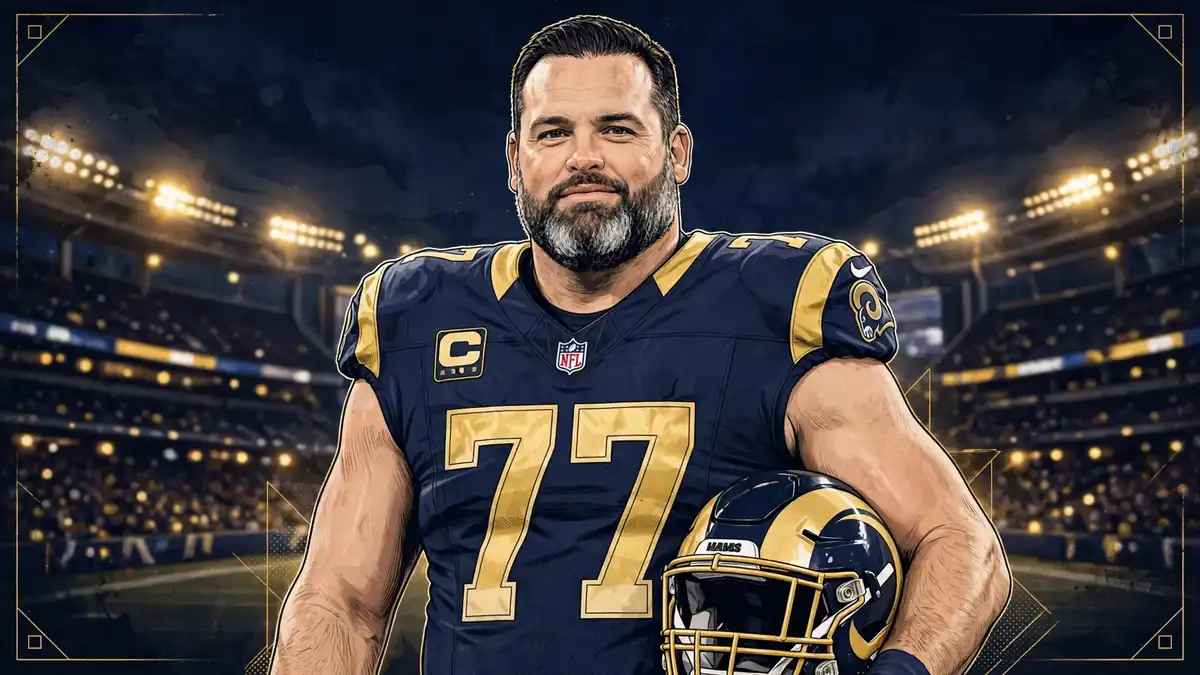
Andrew Whitworth‘s net worth is estimated at $40 million–$50 million as of November 2026. The range exists because the outlets that track athlete wealth do not agree: Celebrity Net Worth puts him at $40 million, while PlayersBio and several other sites land at $47 million or $50 million. The one number nobody disputes is the engine behind the fortune — more than $105 million in NFL salary across 16 seasons, a career that ended with a Super Bowl ring at age 40, and a second act as an Amazon Prime Video analyst that keeps the cheques coming after retirement.
Andrew Whitworth: Quick Facts
| Estimated net worth | $40 million (range: $40 million–$50 million) |
|---|---|
| Profession | Former NFL offensive tackle; Amazon Prime Video analyst |
| Nationality | American |
| Born | December 12, 1981 (age 44) |
| Height | 6 ft 7 in (2.01 m) |
| Primary income sources | NFL salaries (2006–2021), broadcasting (Amazon Thursday Night Football), podcasting, appearances |
| Active years | 2006–present (NFL 2006–2021; broadcasting 2022–present) |
| Last reviewed | November 2026 |
- Early Life and Background
- Education
- Career Journey
- Rise to Fame
- Main Sources of Income
- Salary and Earnings
- Businesses and Investments
- Brand Deals and Sponsorships
- Houses, Cars and Other Assets
- Awards and Achievements
- Net Worth Growth Over the Years
- Social Media Presence
- Personal Life
- Sources & Reporting
- Frequently Asked Questions
Early Life and Background
Andrew James Whitworth was born on December 12, 1981, in Monroe, Louisiana, to James and Charlotte Whitworth. Monroe sits in the northern part of the state, a long way from the Friday-night-lights mythology of Texas, but Louisiana high school football has its own ferocious culture — and West Monroe High School, where Whitworth played, was one of its cathedrals.
He played under legendary coach Don Shows, a man later inducted into the Louisiana Sports Hall of Fame in 2011 with the fifth-most wins in state high school history. Shows built West Monroe into a machine, and Whitworth was part of three state championship teams, winning titles in the Superdome in New Orleans in 1997, 1998 and 2000. That detail matters for the money story that follows: Whitworth won championships at every level he played — high school, college and the NFL — and the habit of winning in the Superdome started before he could drive.
Whitworth did not start out as a tackle. He played tight end early in his high school career and moved to tackle for his senior year, a switch that looks obvious in hindsight — he was already 6-foot-7 — but required relearning footwork, hand placement and the patience of pass protection. He took to it fast enough to be rated the No. 5 offensive lineman in the country by Rivals.com coming out of high school, a striking ranking for a player from a state that, as Tiger Rag noted in 2025, has historically produced few elite offensive linemen.
He was a multi-sport athlete in a way that sounds almost old-fashioned now: tennis, basketball, baseball, golf, powerlifting and the shot put in track and field. Each sport fed something different into the tackle he became — the footwork from tennis and basketball, the raw strength from powerlifting, the throwing mechanics from the shot put. The Louisiana Sports Hall of Fame, which inducted him in June 2025, made a point of that breadth in its citation, crediting the range of sports with shaping a player who retired as the oldest offensive lineman ever to win a Super Bowl.
Money was not part of the picture yet. Whitworth grew up in a working Louisiana family, and nothing in his background suggested a nine-figure career. What he had was size, durability and a coach who demanded precision — three traits that would eventually be worth more than $100 million.
Education
Whitworth signed with LSU as part of Nick Saban’s first recruiting class in which Saban had a full year to gather talent, the 2001 class. Saban had arrived in Baton Rouge in late 1999 and was rebuilding a programme that had not won a national championship since 1958. Whitworth redshirted in 2001, his first year on campus, then became a fixture: he started 52 consecutive games for the Tigers from 2002 through 2005 and never missed a college game, a school record at the time.
The defining season came in 2003. As a sophomore, Whitworth started all 14 games at left tackle while LSU went 13–1 and beat Oklahoma in the Sugar Bowl to claim the BCS national championship — the programme’s first title in 45 years. He led the team’s linemen in snaps that season and piled up team highs in knockdown blocks, the unglamorous grunt work that springs running backs and buys quarterbacks time.
He earned first-team All-SEC honours in 2004 and again in 2005, and second-team All-American honours as a senior in 2005 from the Walter Camp Football Foundation. By the time he left Baton Rouge, he had played in a national title game, started more consecutive games than any lineman in school history, and built the reputation that would carry him into the NFL: a technician who never missed a snap and never needed help.
The education that mattered most for his bank balance was not in a classroom. It was the four years of starting against SEC defensive lines — the closest thing college football offers to an NFL apprenticeship — under a coach in Saban who treated offensive line play as a science. Scouts noticed. When the 2006 NFL Draft arrived, the question was not whether Whitworth would be picked, but how far a 6-foot-7 tackle with 52 straight starts and a national title would fall.
Career Journey
The Cincinnati Bengals selected Whitworth in the second round of the 2006 NFL Draft, 55th overall. He signed a four-year rookie contract worth $2.965 million, including a $1.1 million signing bonus and an average salary of $741,250, according to Spotrac figures cited by PlayersBio and Money Inc. For a second-round pick, that was standard money. Nothing about the deal hinted at what would follow.
Whitworth spent his first seasons moving between guard and tackle, the kind of versatility coaches love and agents hate, because it delays the big left-tackle payday. He settled at left tackle and stayed there. On July 25, 2008, he agreed to a contract extension with the Bengals worth $24.635 million, keeping him in Cincinnati through 2013, per Celebrity Net Worth’s account of the deal. A two-year, $19.525 million deal followed in August 2011, carrying a $6 million signing bonus, $10.3 million in total guarantees and a $9.76 million average salary. In 2015 he signed a one-year, $9 million contract. The pattern was set: the Bengals kept paying him, and he kept not missing games.
Across 11 seasons in Cincinnati, Whitworth started 168 games, made three Pro Bowls (2012, 2015 and 2016) and earned first-team All-Pro honours in 2015 and second-team All-Pro in 2014. The Bengals reached the playoffs five times in his tenure but never won a postseason game with him — a fact that hung over the back half of his Cincinnati years and shaped the decision that changed his earnings trajectory.
At 35, an age when most offensive linemen are retired or hanging on as backups, Whitworth hit free agency. On March 9, 2017, he signed a three-year, $33.75 million contract with the Los Angeles Rams, including a $5 million signing bonus, $15 million in total guarantees and an $11.25 million average salary. He was one of Sean McVay’s first free-agent additions, brought in to protect the blind side of a young Jared Goff and to set the professional standard for the youngest roster in the league.
The move paid off for both sides. The Rams went 55–26 with Whitworth at left tackle, posted five straight winning seasons, made four playoff runs and reached two Super Bowls, per Crescent City Sports’ 2025 retrospective. Whitworth made his fourth Pro Bowl in his first Rams season and earned his second first-team All-Pro selection in 2017. On April 1, 2020, he signed another three-year deal with the Rams, this one worth $30 million with a $5 million signing bonus, $12.5 million guaranteed and a $10 million average salary.
His final game was the biggest of his life. On February 13, 2022, the Rams beat his former team, the Bengals, 23–20 in Super Bowl LVI at SoFi Stadium. Whitworth, 40 years old, became the oldest offensive tackle ever to play in a Super Bowl and the oldest offensive lineman ever to win one. A month later, on March 15, 2022, he announced his retirement after 16 seasons — 239 regular-season games, 235 starts, and 15 postseason appearances. The Rams’ retirement announcement noted the move would save the team $15.5 million in salary-cap space, a final reminder of how expensive, and how valuable, he had been.
Within weeks of retiring, Whitworth joined Amazon’s Thursday Night Football crew as a studio analyst, starting a second career that is still running in 2026. The arc is rare in the NFL: 16 seasons, one team change, no holdouts, no scandals, and a retirement timed to the exact week his market value peaked — a Super Bowl ring in hand, a broadcasting contract waiting.
Rise to Fame
Offensive linemen do not become famous the way quarterbacks do. There are no fantasy points for a clean pocket, no jersey sales for a perfect pass set. Whitworth’s rise was slower and stranger: he became famous for lasting. Every season he survived past 35, the story got bigger, because the sport kept telling him to leave and he kept grading out as one of the best at his position.
The first real marker came in 2012, his seventh season, when he made his first Pro Bowl. He was 31, an age when tackles are supposed to be declining. Instead he was entering his prime. First-team All-Pro followed in 2015, the year he turned 34, and he repeated the honour in 2017 with the Rams at 36. Pro Football Focus-style grading services and the Rams’ own internal numbers told the same story: in his five Rams seasons he ranked second among offensive tackles in ESPN’s pass block win rate, a measure of how often a lineman holds his block for at least 2.5 seconds.
The 2018 season brought the Super Bowl stage, and a loss. The Rams fell to the New England Patriots 13–3 in Super Bowl LIII, the lowest-scoring Super Bowl ever played. Whitworth was 37. Most players that age, after that kind of defeat, walk away. He signed the $30 million extension instead, betting he had another run in him.
Then came the season that made him a national figure beyond football fans. In February 2022, three days before Super Bowl LVI, Whitworth was named the 2021 Walter Payton NFL Man of the Year, the league’s most prestigious individual honour, recognising on-field excellence and community work together. Days later he won the Super Bowl against the team that drafted him, in a stadium 15 miles from where he had just spent five years. The symmetry — Man of the Year on Thursday, a ring on Sunday, against Cincinnati — turned a respected veteran into a retirement story the whole country watched. He announced his retirement a month later, on top, at 40, the oldest tackle in NFL history.
Fame after football came faster than fame during it. Amazon hired him before the retirement press conference dust had settled, and his studio work on Thursday Night Football — blunt, funny, allergic to cliché — made him one of the most-liked analysts in the sport within two seasons. In June 2025, the Louisiana Sports Hall of Fame inducted him alongside Nick Saban, the coach who recruited him to LSU, closing a loop that started in 2001. And in May 2025, Rams president Kevin Demoff publicly credited Whitworth with pushing the NFL to create its first award specifically for offensive linemen, writing that the recognition was “long overdue and deserving” and crediting Whitworth by name. A lineman who spent 16 years doing invisible work had, in retirement, made the invisible visible.
Main Sources of Income
Whitworth’s fortune has one dominant source and several smaller ones. The split matters, because it explains why his net worth sits at $40–50 million rather than the $100 million-plus his career earnings might suggest: NFL salaries are taxed heavily, agents take their cut, and 16 years of living costs add up, even for a careful spender.
NFL salaries (2006–2021) — the foundation. More than $105 million in salary across six contracts with two teams, per Celebrity Net Worth, with Spotrac-derived totals reaching $107.8 million, per PlayersWiki. This is roughly 95 percent of everything he has ever earned. The Rams years were the richest: $33.75 million for 2017–2019 and $30 million for 2020–2022, against $24.6 million, $19.5 million and $9 million deals in Cincinnati plus the $2.97 million rookie contract.
Broadcasting (2022–present). Whitworth joined Amazon Prime Video’s Thursday Night Football as a studio analyst immediately after retiring, and he remains on the crew in the 2026 season. Amazon has not disclosed his salary, and neither has Whitworth, so no figure can be stated with confidence — but the role is his main post-retirement income, and top NFL studio analysts at major networks are paid in the high six figures to low seven figures a year. He has also done Super Bowl work for Sky Sports in the UK and called a Monday night game on radio for Westwood One, both paid side assignments inside the same broadcasting lane.
Podcasting. Fitz & Whit, his podcast with former quarterback Ryan Fitzpatrick, started as a casual conversation between two retired players and grew into a property Amazon now folds into its Thursday Night Football pregame coverage at times during the season. The podcast earns through Amazon’s platform and sponsorships, and — more importantly for his wealth — it keeps his name in front of the audience that hires analysts, sells books and fills speaking rosters.
Appearances and speaking. Whitworth is a regular at Rams events, LSU functions and corporate speaking engagements, including the Louisiana Sports Hall of Fame circuit in 2025. Fees for events like these are not public, but for a Super Bowl champion and Man of the Year winner they are a real, if modest, income line.
What he does not have: no public record of a major national endorsement portfolio. Linemen rarely land the shoe and soft-drink deals that skill players get, and Whitworth was no exception — his brand was reliability, which sells far better to general managers than to advertisers. His wealth is a salary story, not a sponsorship story, and the article is honest about that.

Salary and Earnings
The contract table below is the spine of this article. The figures come from Spotrac contract data as reported by PlayersBio, Money Inc and Pro Football Network, with Celebrity Net Worth’s narrative account of the 2008 extension. Two numbers deserve a note before the table: the total value of every contract Whitworth ever signed was roughly $120 million, per Pro Football Network, but the cash he actually collected was lower — between $105 million (Celebrity Net Worth) and $107.8 million (Spotrac, via PlayersWiki) — because the final Rams deal was cut short by retirement and because contract values include money that is never fully earned. Both numbers are correct; they measure different things.
| Contract | Team | Value | Signing bonus | Guaranteed | Avg. salary |
|---|---|---|---|---|---|
| Rookie deal, 2006–2009 | Cincinnati Bengals | $2.97 million | $1.1 million | $1.1 million | $741,250 |
| Extension, 2008 | Cincinnati Bengals | $24.64 million | $6.0 million | $6.0 million | $4.11 million |
| Extension, 2011–2012 | Cincinnati Bengals | $19.53 million | $6.0 million | $10.3 million | $9.76 million |
| One-year deal, 2015–2016 | Cincinnati Bengals | $9.0 million | — | — | $9.0 million |
| Free agency, 2017–2019 | Los Angeles Rams | $33.75 million | $5.0 million | $15.0 million | $11.25 million |
| Extension, 2020–2022 | Los Angeles Rams | $30.0 million | $5.0 million | $12.5 million | $10.0 million |
The shape of the table tells the story. His average salary rose from $741,250 as a rookie to $11.25 million at his peak — a 15-fold increase over 11 years — and it rose late. Most NFL players peak financially at 27 or 28. Whitworth’s two biggest contracts came at 35 and 38, ages when the league usually stops calling. That late peak is the single most unusual fact about his earnings, and it is why his career total clears $105 million despite a modest start: he was paid like a star for a decade, not for two or three seasons.
Year by year, the money stacked up like this. The rookie deal paid under $3 million across four seasons. The 2008 extension pushed his career earnings past $25 million. By the end of the 2011 deal he had banked roughly $45 million in contract value. The one-year $9 million deal in 2015 took him past $55 million. Then the Rams years added $63.75 million in signed value in five seasons — more than his entire 11-year Bengals career combined. The 2019 season alone paid him a $10.25 million base salary, per Media Referee, the single richest year of his career.
Context sharpens the picture. Whitworth earned more in salary than almost every offensive lineman of his generation, and the reason was durability, not negotiating power. He played 239 regular-season games and started 235 of them. Teams pay for availability, and a left tackle who never misses a game is the most bankable asset on an offence after the quarterback. His guarantees climbed with his reputation: $1.1 million guaranteed as a rookie, $15 million guaranteed on the 2017 Rams deal.
Taxes took a large share. Whitworth earned his money in Ohio and California, two high-tax states, and paid the federal top rate on most of it. Agent fees (typically 3 percent) and NFLPA dues shaved off more. A rough rule of thumb — that an athlete keeps about half of gross salary after taxes and fees — puts his take-home from football at roughly $50–55 million, which lines up neatly with the $40–50 million net worth range once living costs, property and charitable giving are counted. The range, in other words, is not a guess layered on a guess: it is what the arithmetic points to.
One stale figure deserves a correction. Several low-quality sites still list his net worth at $47 million as a 2022 figure and present it as current. That number traces to 2022-era estimates from Media Referee and Wealthy Gorilla, and PlayersBio’s own page carries both $40 million in its facts table and $47 million in its text — an internal contradiction that shows how these figures drift when pages are updated in pieces. The honest 2026 position is the range: $40 million on the most recently updated tracker, $47–50 million on older or less maintained ones.
Businesses and Investments
Whitworth has never presented himself as a businessman in the way some athletes do — no restaurant chain, no clothing line, no venture fund with his name on it. His off-field business life is quieter and, in the long run, probably smarter: a charitable foundation that doubles as a community platform, a media career that monetises the expertise he built on the field, and property.
The centrepiece is the Big Whit 77 Foundation, which he founded with his wife Melissa in 2009. The foundation’s mission is to support youth and families in Louisiana communities, and it runs two named programmes. Whit’s Warriors offers financial assistance to high school seniors in Ouachita and Lincoln Parishes — the parishes around Monroe and Ruston where the Whitworths grew up. Open Arms, the second programme, supports families going through the adoption process, with applicants required to come from Ouachita or Lincoln parishes or nearby areas and to have completed a home study. The foundation also funds golf tournaments in Louisiana and hands-on projects: Lola Magazine documented Whitworth giving away 600 bikes to children in Compton during his Rams years, and the foundation’s work in Cincinnati and Los Angeles followed the same pattern — small, visible, local.
The foundation is a charity, not a profit centre, and this article does not count it as income. It matters for the wealth story in a different way: it is the reason Whitworth won the Walter Payton NFL Man of the Year award in 2021 and the NFLPA’s Alan Page Community Award in 2019, and those honours are what made him hirable as a broadcaster the moment he retired. In the NFL, reputation is a financial asset, and Whitworth invested in his for 16 years.
His media work is the real post-retirement business. The Fitz & Whit podcast with Ryan Fitzpatrick began as two retired players talking football and became a fixture Amazon now places inside its Thursday Night Football pregame coverage. Podcasts do not make retired linemen rich on their own, but this one does something more valuable: it keeps Whitworth in the weekly conversation, which protects the Amazon analyst job and creates the audience for anything he does next. He has also worked for Sky Sports in the UK around the Super Bowl and called a Monday night game for Westwood One radio — small, paid assignments that show how wide his broadcasting lane has become.
On investments beyond property, the public record is thin. Whitworth has not spoken publicly about a stock portfolio, private equity stakes or startup investments, and this article will not invent any. What is known is that he played 16 seasons without a single reported financial scandal, lawsuit or bankruptcy filing — a clean record that, in a league where a third of players report serious money trouble within years of retiring, is itself a form of wealth management. His approach looks like the classic lineman’s approach: earn a lot, spend carefully, let the salary do the work.
Brand Deals and Sponsorships
There is no verified record of major national endorsement deals for Andrew Whitworth, and this section says so plainly rather than padding itself with speculation. Offensive linemen occupy a strange place in sports marketing: they are among the highest-paid players on the field and among the least marketable off it. Quarterbacks sell shoes and soft drinks. Left tackles sell reliability to 32 general managers, and that market pays in contracts, not commercials.
Whitworth’s commercial footprint reflects that reality. His public partnerships have been local and cause-driven rather than national and product-driven: the Big Whit 77 Foundation’s events, Rams community programmes, and LSU and Louisiana Sports Hall of Fame appearances. He has appeared in team content and league programming — the NFL’s Man of the Year campaign in 2022 put his face in front of a national audience — but those are league honours, not paid endorsements.
The absence of a big endorsement portfolio is itself a useful data point for the net worth estimate. A player with $105 million in salary and a major shoe deal would be worth far more than $40–50 million. Whitworth’s range is consistent with a player whose income was almost entirely salary: high gross earnings, heavy taxes, no side windfall. Since retiring, his marketability has arguably risen — Amazon put him on national television every Thursday, and the Fitz & Whit podcast carries sponsors — but the money there is broadcasting money, not endorsement money, and it is counted in the income section above.
Houses, Cars and Other Assets
The most documented asset Whitworth owns is his house in Westlake Village, California, in the Thousand Oaks area near the Rams’ training facility. The home is 10,090 square feet on roughly an acre, with eight bedrooms and 7.5 bathrooms, and was valued at around $6 million in reports by Pinoria and Hollywoods Magazine. The family moved there after Whitworth signed with the Rams in 2017 — before that, they lived in Fort Thomas, Kentucky, a suburb minutes from downtown Cincinnati that his wife Melissa once described as one of the best cul-de-sacs in America. The move was abrupt: Melissa wrote in Lola Magazine that the family got a call saying they had a flight to Los Angeles at 2 p.m., packed, and flew out with the children the same day.
The Westlake Village house is the only property with a reported value in the public record, and the $6 million figure should be read as a reported estimate rather than a confirmed sale price — it comes from celebrity-property roundups rather than a county deed. No other property has been publicly linked to Whitworth, and this article does not claim a real estate portfolio beyond the one documented home. For a player who earned $105 million, a single $6 million house is modest — roughly 6 percent of career earnings — and that modesty is part of the wealth story.
On cars, the public record is silent. Whitworth has not shown off a collection on social media, no outlet has reported a garage inventory, and this article will not invent one. What is known is that his lifestyle has always been low-key for a player of his earnings: family, church, foundation work and golf in Louisiana, rather than the nightclub-and-supercar circuit. His most visible post-retirement physical change is simpler — he has slimmed down from his 330-pound playing weight to below 300 pounds, a detail Tiger Rag noted in 2025, and one that says more about his priorities now than any car could.
Other assets are best described in aggregate. He holds no known ownership stake in a professional team, no reported business equity, and no public art or memorabilia collection. His wealth sits where most former players’ wealth sits: in the house, in savings and investments built from salary, and in the earning power of a broadcasting career that began the week his playing career ended.
Awards and Achievements
Whitworth’s trophy case is unusual for a lineman because it mixes football honours with community honours at the very top of both lists. The football side: Super Bowl champion (LVI), four Pro Bowl selections (2012, 2015, 2016, 2017), two first-team All-Pro selections (2015, 2017), a second-team All-Pro selection (2014), and the Built Ford Tough Offensive Line of the Year award for 2018. The college side: BCS national champion with LSU in 2003, second-team All-American in 2005, two-time first-team All-SEC (2004, 2005), and a school-record 52 consecutive starts.
The community side is where he stands apart. He was named the 2021 Walter Payton NFL Man of the Year, the league’s highest honour for a player’s work off the field, announced on February 10, 2022 — three days before the Super Bowl he would win. He won the NFLPA’s Alan Page Community Award in 2019. And in June 2025 he was inducted into the Louisiana Sports Hall of Fame in Natchitoches, in a class that also included Nick Saban, his college coach. The hall’s citation noted the rare sweep: state titles at West Monroe, a national title at LSU, and a Super Bowl with the Rams — championships at every level, all of them won in or around New Orleans’ Superdome except the last one.
The numbers behind the honours are worth stating plainly. Whitworth played 239 regular-season games and started 235 of them, appeared in 15 postseason games, and protected two very different quarterbacks — Andy Dalton in Cincinnati and Jared Goff and Matthew Stafford in Los Angeles — across two franchises, two conferences and 16 seasons. He retired as the oldest tackle in NFL history and the oldest offensive lineman ever to play in and win a Super Bowl. Longevity is not a single award, but in his case it is the achievement everything else rests on.
Net Worth Growth Over the Years
Net worth estimates for Whitworth have moved less than his salary did, because most trackers update slowly and few re-report retired players. The table below uses published estimates by year, with the source named for each — read it as a record of what outlets reported, not as an audited balance sheet.
| Year | Reported estimate | Source | What drove it |
|---|---|---|---|
| 2020 | $30 million | Early estimates in circulation | Two Rams contracts signed; career earnings near $90 million |
| 2022 | $47 million | Media Referee; Wealthy Gorilla | Retirement after Super Bowl LVI; career earnings past $105 million |
| 2024 | $50 million | Multiple smaller outlets | Two years of Amazon broadcasting income added |
| 2025 | $40 million | Celebrity Net Worth (updated Aug 2025) | Most recently maintained tracker; conservative anchor |
| 2026 | $40–50 million | NetWorthCraft estimate | Range across all current trackers; broadcasting income continuing |
Two things stand out. First, the 2022 figure of $47 million is the number most sites copied from each other, and it has been repeated so often that it looks more authoritative than it is — it was a reasonable estimate at retirement, not a live calculation. Second, the $40 million figure from Celebrity Net Worth is the most recently updated, and it is the conservative anchor we use. The truth is probably between the two: a player who banked roughly $50–55 million after tax, owns a $6 million house, and has earned a broadcaster’s salary since 2022 is unlikely to be worth less than $40 million or much more than $50 million. The range is the honest answer, and the growth is slow now by design — his wealth is in preservation mode, with broadcasting income offsetting spending rather than adding new millions each year.
Social Media Presence
Whitworth’s social media presence is modest for a public figure, and it fits the rest of his profile: family, football and foundation work, with little of the lifestyle flexing that defines many athlete accounts. His Instagram handle is @andrewwhitworth77, where he posts family photos, Rams and LSU content, and foundation work; reports put his following at roughly 135,000. His X account, @AndrewWhitworth, had about 33,000 followers in a December 2025 analysis by twtData, and he uses it mainly for football commentary tied to his Amazon work. His wife Melissa posts as @melissawhitworth77 on Instagram.
He is more visible through other people’s accounts than his own. Amazon’s NFL on Prime Video channels clip his Thursday Night Football analysis weekly, the Rams’ accounts feature him at practices and games — he attended organised team activities in Woodland Hills in June 2025, per Sports Illustrated — and the Fitz & Whit podcast’s clips travel widely on social video. That distribution matters more than his follower count: a studio analyst’s audience is the broadcast audience, not the Instagram audience, and Whitworth reaches millions of viewers a week without needing to build a personal brand online.
One social moment is worth recalling because it shows his style. In 2020, when former 49ers tackle Joe Staley joked about his wife on social media, Whitworth responded on his verified Instagram account with a direct, good-humoured defence that went viral among NFL fans. It was the rare moment a lineman became a trending topic, and the tone — firm, funny, protective — is the same tone that made him a natural on television two years later.
Personal Life
Whitworth married Melissa Elise Clark in January 2006, the same year he was drafted. Melissa, born April 29, 1980, in Ruston, Louisiana, was Miss Louisiana 2003 and worked as an award-winning journalist for NBC10 and Fox14 News in Monroe before the couple moved for football. She is, by any measure, a partner in the foundation and the family business: the two founded the Big Whit 77 Foundation together in 2009, and Melissa’s Lola Magazine essays about the family’s moves — from Louisiana to Cincinnati to Los Angeles — are the most vivid first-hand accounts of what an NFL family’s life actually looks like.
The couple has four children: twins Sarah and Drew, born in February 2011; Michael, born in 2013; and Katherine, born in October 2014. They waited five years after marrying before having children, and the timing meant the kids were old enough to remember the Rams years — the Super Bowl run, the move to California, the retirement. Melissa has written about the logistics with disarming honesty: the nanny, the school search in Westlake Village, the flight to LA with two hours’ notice when the Rams deal was signed.
The family splits its time between Louisiana and California, and faith and community work run through everything they do publicly. Whitworth’s father James and mother Charlotte still live in the Monroe area, and the foundation’s work is concentrated in the parishes the family comes from. In retirement, Whitworth has stayed close to the Rams — attending practices, mentoring young linemen — while building the broadcasting career that now structures his weeks. He has said he is a “one-helmet person”, happiest with one logo and one team, and the Amazon role gives him that: one crew, one night a week, one franchise to belong to.
Sources & Reporting
Celebrity Net Worth — net worth anchor of $40 million (updated August 2025); career earnings of just over $105 million across 16 seasons; the 2008 Bengals extension and the Rams years. Reporting window: profile updated August 2025.
PlayersBio — November 2026 update reporting $47 million; Spotrac-derived contract figures (rookie deal $2.965 million, 2008 extension $24.635 million, 2011 deal $19.525 million, Rams deals $33.75 million and $30 million). Note: the page’s facts table lists $40 million while its text says $47 million — an internal inconsistency flagged in this article.
Pro Football Network — $40 million net worth per Celebrity Net Worth; total contract value of roughly $120 million across his career; the 2008 and 2017 deals. Reporting window: 2024–2025.
Money Inc — $47 million net worth; detailed Spotrac contract breakdowns for the Bengals and Rams deals. Reporting window: 2023–2024.
Wikipedia — career record (239 games, 235 starts), honours list, LSU career (52 consecutive starts, 2003 national title), retirement date of March 15, 2022. Last updated November 2026.
Tiger Rag — Louisiana Sports Hall of Fame induction, June–July 2025; West Monroe state titles; weight below 300 pounds after retirement; Amazon analyst role. Published July 3, 2025.
Louisiana Sports Hall of Fame — induction year 2025; career summary, 52 LSU starts, Super Bowl LVI details, Walter Payton Man of the Year timing.
Crescent City Sports — Rams record of 55–26 with Whitworth at left tackle; multi-sport youth career; 250-start career framing. Published June 25, 2025.
Sportsnet — retirement announcement, March 15, 2022; $15.5 million in cap savings for the Rams; oldest player to start at left tackle in the modern NFL at 40.
Yardbarker — May 2025 reporting on Rams president Kevin Demoff crediting Whitworth for pushing the NFL’s offensive lineman award; Fitz & Whit podcast role.
Lola Magazine — Melissa Whitworth’s first-hand account of the move from Fort Thomas to Los Angeles; Big Whit 77 Foundation programmes (Whit’s Warriors, Open Arms); the 600-bike giveaway in Compton. Published 2016 and 2019.
Media Referee — 2022 net worth estimate of $47 million; $10.25 million base salary in 2019; Rams contract details.
PlayersWiki — Spotrac career earnings figure of $107,775,928; Marca’s $106.9 million figure; retirement and Amazon analyst transition.
Reporting window for this article: November 2026. Figures that could not be verified against a named outlet — including any endorsement income, investment holdings and car collection — are stated as unverified or omitted, not estimated.
Frequently Asked Questions
What is Andrew Whitworth’s net worth in 2026?
Andrew Whitworth’s net worth is estimated at $40 million–$50 million as of November 2026. Celebrity Net Worth, the most recently updated tracker, puts him at $40 million, while PlayersBio and several other outlets report $47 million to $50 million. The range reflects the disagreement between outlets, not uncertainty about the underlying earnings: his NFL salary alone totalled more than $105 million.
How much did Andrew Whitworth earn in his NFL career?
Whitworth earned just over $105 million in salary across 16 NFL seasons, per Celebrity Net Worth, with Spotrac-derived totals reaching $107.8 million, per PlayersWiki. The total value of every contract he signed was roughly $120 million, per Pro Football Network — the gap exists because contract values include money that is never fully earned, and his final Rams deal was cut short by retirement.
What was Andrew Whitworth’s biggest contract?
His biggest contract was the three-year, $33.75 million deal he signed with the Los Angeles Rams on March 9, 2017, when he was 35 years old. It included a $5 million signing bonus, $15 million in total guarantees and an $11.25 million average salary — the highest average salary of his career. His 2020 Rams extension was worth $30 million over three years.
How old was Andrew Whitworth when he won the Super Bowl?
Whitworth was 40 years old when the Rams beat the Cincinnati Bengals 23–20 in Super Bowl LVI on February 13, 2022. He was the oldest offensive tackle ever to play in a Super Bowl and the oldest offensive lineman ever to win one. He retired a month later, on March 15, 2022, after 16 seasons.
What does Andrew Whitworth do now?
Whitworth works as a studio analyst for Amazon Prime Video’s Thursday Night Football, a role he took up immediately after retiring in 2022. He also co-hosts the Fitz & Whit podcast with former quarterback Ryan Fitzpatrick, which Amazon now folds into its Thursday Night Football pregame coverage, and he has done Super Bowl work for Sky Sports and a Monday night radio call for Westwood One.
Who is Andrew Whitworth’s wife?
Whitworth is married to Melissa Whitworth (née Clark), whom he married in January 2006. Melissa was Miss Louisiana 2003 and worked as an award-winning journalist for NBC10 and Fox14 News in Monroe, Louisiana. The couple founded the Big Whit 77 Foundation together in 2009 and has four children: twins Sarah and Drew, Michael and Katherine.
How many Pro Bowls did Andrew Whitworth make?
Whitworth made four Pro Bowls — in 2012, 2015, 2016 and 2017 — and was a two-time first-team All-Pro (2015 and 2017) with a second-team All-Pro selection in 2014. He also won the 2021 Walter Payton NFL Man of the Year award and was inducted into the Louisiana Sports Hall of Fame in June 2025.
Where does Andrew Whitworth live?
Whitworth lives with his family in Westlake Village, California, near the Rams’ facility in Thousand Oaks. The home is reported to be 10,090 square feet with eight bedrooms and 7.5 bathrooms on roughly an acre, valued at around $6 million. The family previously lived in Fort Thomas, Kentucky, during his 11 seasons with the Cincinnati Bengals, and keeps close ties to Monroe, Louisiana.
Final Thoughts
Andrew Whitworth’s $40–50 million fortune is a durability story, not a lottery story. He was never the highest-paid player in the league, never had a shoe deal, and never made a headline for a holdout. He simply played left tackle at a high level for 16 seasons, signed six contracts that added up to more than $105 million in cash, and walked away at the exact moment his value peaked — a Super Bowl ring at 40, a Man of the Year award in the same week, and a television job waiting on Monday. The range in his net worth is honest: trackers disagree, taxes took their share, and a $6 million house in Westlake Village is the only big asset anyone can document. What is not in dispute is the method. In a sport that chews up linemen by 30, Whitworth got paid like a star at 35 and 38, and that late peak is why a second-round pick from Monroe, Louisiana, retires with a fortune most first-rounders never touch.
Published on November 9, 2026. Last reviewed November 2026. Found an error? See our corrections policy.