
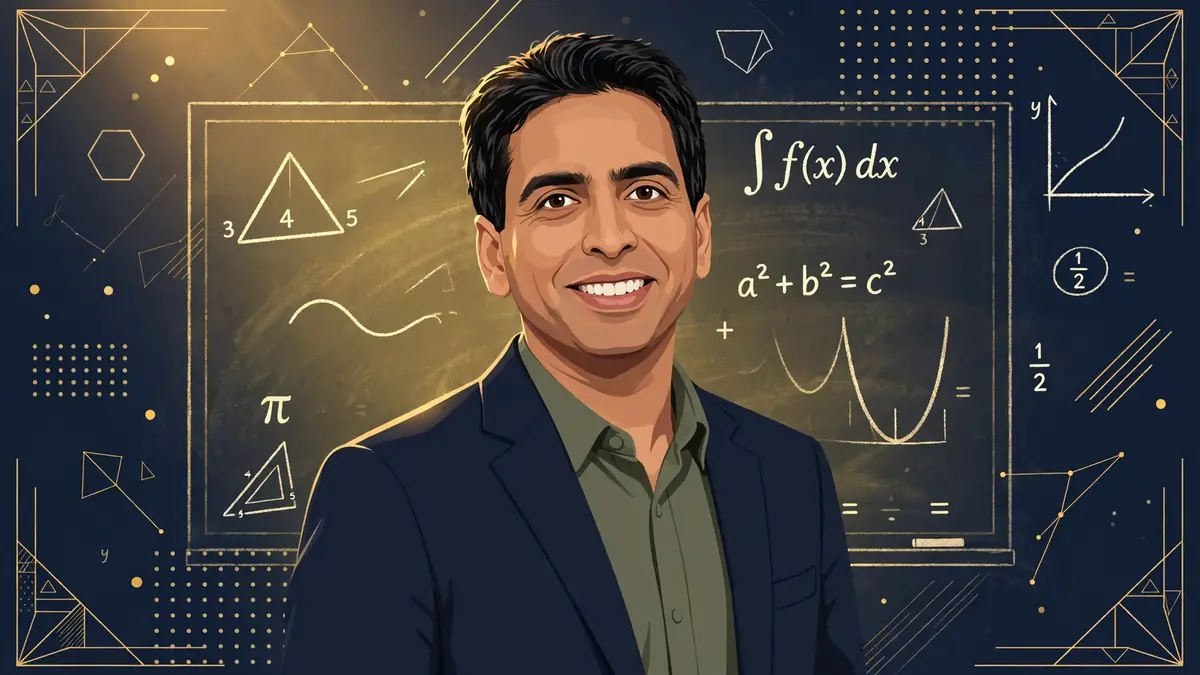
Sal Khan‘s net worth is estimated at $10 million to $20 million as of November 2026. The Khan Academy founder built a nonprofit that pulled in a record $117.5 million in its latest fiscal year — yet he draws a nonprofit chief executive’s salary, not a tech founder’s payout — and the gap between the organization’s money and his own is the first thing to get straight about his fortune.
Sal Khan: Quick Facts
| Estimated net worth | $10 million to $20 million (range: $10M–$20M) |
|---|---|
| Profession | Educator, entrepreneur, founder and CEO of Khan Academy |
| Nationality | American |
| Born | October 11, 1976 (age 50) |
| Height | Around 5 feet 8 inches (173 cm, as reported by profile sites — not officially confirmed) |
| Primary income sources | Khan Academy CEO salary, book royalties, speaking fees, prior hedge-fund earnings |
| Active years | 2004–present |
| Last reviewed | November 2026 |
- Early Life and Background
- Education
- Career Journey
- Rise to Fame
- Main Sources of Income
- Salary and Earnings
- Businesses and Investments
- Brand Deals and Sponsorships
- Houses, Cars and Other Assets
- Awards and Achievements
- Net Worth Growth Over the Years
- Social Media Presence
- Personal Life
- Sources & Reporting
- Frequently Asked Questions
First, the name. Sal Khan is Salman Amin Khan, the American educator who founded Khan Academy. He is a different person from Salman Khan, the Bollywood actor born in Indore, India, in 1965 — and the two get mixed up constantly in search results, including in net-worth articles. The actor’s fortune runs to roughly $300 million to $375 million; the educator’s is a fraction of that. If a page tells you “Sal Khan” is worth hundreds of millions, check which Khan it is describing. This article is about the educator, and every figure in it belongs to him.
Early Life and Background
Salman Amin Khan was born on October 11, 1976, in Metairie, Louisiana, and grew up in New Orleans. His father, Fakhrul Amin Khan, was a Bangladeshi pediatrician from Barisal, Bangladesh; his mother, Masuda Khan, was born in Calcutta, India. The family was Bengali Muslim, and money was tight. Khan has said his mother earned $16,000 in 1993 — about $37,000 in 2026 dollars — a figure he knew because he had to do her taxes to apply for financial aid. That detail matters to the wealth story: unlike many founders who start with family money, Khan started with none, and the habit of doing the household’s numbers himself showed up early.
New Orleans shaped the way he teaches. He has described a childhood spent figuring things out on his own, and teachers who noticed a kid who liked explaining problems to classmates as much as solving them. The tutoring instinct that later became Khan Academy was visible long before there was a camera or a website: at MIT he built math software for children with ADHD and tutored fourth- and seventh-grade public school students. He was not a child prodigy with a famous mentor; he was a bright student from a working household who learned to teach by teaching.
His father died when Khan was young, and his mother raised the family on a single income. The financial pressure of those years is part of why the later decision to walk away from a hedge-fund salary looks so stark in hindsight — he knew exactly what a steady paycheck was worth, and gave one up anyway. Friends from his Harvard years recall him saying, only half joking, that he planned to work in finance “long enough to become independently wealthy.” He left before that plan paid off.
Education
Khan’s academic record is the strongest single credential in his story, and it is fully documented. He entered the Massachusetts Institute of Technology and graduated in 1998 with three degrees: a Bachelor of Science in mathematics, a Bachelor of Science in electrical engineering and computer science, and a Master of Engineering in electrical engineering and computer science. He then earned an MBA from Harvard Business School in 2003.
The MIT years also produced the first public sign of where his career would go. In 2012 he returned to MIT to deliver the commencement address at age 35, making him the university’s youngest commencement speaker in at least 30 years. He has since collected honorary degrees from the same institutions that trained him: an honorary Doctor of Laws from Harvard University on May 27, 2021, and an honorary Doctor of Humane Letters from Dartmouth College the same year.
What the degrees bought him, financially, was a ticket into high-paying work: engineering at Oracle, venture capital, Silicon Valley startups, and then a hedge-fund analyst job. What they did not buy him was wealth on their own. He graduated with the tools to earn a large salary, spent six years doing exactly that, and then traded the salary for a nonprofit. The education section of this profile is therefore less a story of credentials turning into cash than of credentials being spent on a mission — a pattern that explains why his net worth looks nothing like those of his classmates who stayed in finance.
Career Journey
Khan’s working life splits cleanly into two halves: six years in finance, then seventeen years building a nonprofit. After MIT he came to the Bay Area in 1998, worked in engineering at Oracle, and moved through venture capital and startups, including a stint at MeVC, a company that tried to bring venture capital to the public, just as the tech market fell apart in 2000. He went to Harvard Business School from 2001 to 2003, and from 2003 until late 2009 he worked as a hedge fund analyst at Connective Capital Management.
The second half began by accident in August 2004. His 12-year-old cousin Nadia, living in New Orleans, was struggling with unit conversion in math. Khan was in Boston, working at the hedge fund, so he started tutoring her by phone, using Yahoo’s Doodle notepad to sketch problems after work. It worked. Nadia’s younger brothers, Armand and Ali, joined. Then other relatives and friends asked for the same help. By 2006 he was recording the lessons and putting them on YouTube — he created the Khan Academy channel on November 16, 2006 — because writing the same explanation for the tenth time was slower than filming it once.
The videos spread without any marketing. Strangers started writing in: a parent said they were praying for him, and he was, as he later told a Stanford audience, “an analyst at a hedge fund.” Bill Gates has said he watched the videos with his own children, and Gates later became one of the organization’s earliest and largest backers. In 2008 Khan incorporated Khan Academy as a 501(c)(3) nonprofit. In September 2009 he quit the hedge fund and went full-time, digging into his own savings for the first eight months while the organization had almost no income. That stretch — a man with a Harvard MBA and an MIT engineering background living off savings to make free math videos — is the single most revealing fact about his finances. The fortune he could have built in finance was traded, deliberately, for the organization.
From 2009 onward the career story is the organization’s growth story. Khan Academy went from a one-man YouTube channel to a staff of 337 people by 2025, with content in more than 50 languages and registered learners in the millions. Khan stayed chief executive throughout, which is unusual: founders of organizations this size usually hand the job to a professional manager. He did not, and the pay he took stayed at nonprofit scale the whole time.
Rise to Fame
Khan’s public profile arrived in a rush between 2011 and 2012. His TED Talk in 2011, “Let’s use video to reinvent education,” has become one of the most-watched education talks ever recorded, and a second TED Talk in 2023 carried the same argument into the AI era. In 2012 Time named him one of the 100 most influential people in the world, and Forbes put him on its cover with the tagline about a “$1 Trillion Opportunity” in education. He was profiled by 60 Minutes and became a fixture at education and technology conferences.
The fame was real but it was the wrong kind for getting rich. A Forbes cover about a nonprofit founder does not come with stock options. The attention did bring money into Khan Academy — the Gates Foundation and Google were early supporters, and donations are the organization’s lifeblood — but donations to a 501(c)(3) belong to the organization, not to its founder. This is the confusion that powers most of the inflated net-worth figures online: they treat Khan Academy’s fundraising as if it were Sal Khan’s personal income. It is not, and the IRS filings prove it.
His second wave of fame came with artificial intelligence. In the summer of 2022, OpenAI’s Sam Altman and Greg Brockman contacted Khan Academy months before ChatGPT’s public release, hoping the nonprofit could show what the technology could do for learning. Khan’s team got early access to GPT-4 and built Khanmigo, an AI tutor designed to guide students with questions instead of handing them answers. They launched it on March 15, 2023, the same day GPT-4 went public. Khan wrote about the experience in his 2024 book and became one of the most-quoted voices on AI in schools — a role that brings speaking invitations and book sales, but still no equity windfall.
In April 2026, Chalkbeat reported a more honest turn in that story: Khan himself said the AI revolution he predicted had not arrived in classrooms. “For a lot of students, it was a non-event,” he said of Khanmigo. “They just didn’t use it much.” Khan Academy has since rebuilt the product so the tutor sits inside ordinary practice work rather than as a separate chatbot. The candor is characteristic, and it is also a financial signal: Khanmigo is a product of a nonprofit, not a startup with a valuation, so its slow start costs the organization momentum, not the founder a fortune.
Main Sources of Income
Sal Khan’s income comes from four streams, and only one of them is large. Understanding the mix is the key to understanding why his net worth sits where it does.
1. Khan Academy salary. This is his main income and has been since 2009. As chief executive of a nonprofit, his pay is disclosed on the organization’s public IRS Form 990. The last individually reported figure widely cited is $839,000 in total compensation for 2019. Later filings report officer pay in aggregate — $5.8 million across all officers and key staff in the 2024–25 fiscal year — so no exact recent figure for Khan alone is public. What is certain is the scale: nonprofit chief-executive pay in the high six figures, not the eight- or nine-figure packages of for-profit tech founders.
2. Book royalties. Khan has published two books. The One World Schoolhouse: Education Reimagined came out in 2012 and lays out his vision for mastery-based learning. Brave New Words: How AI Will Revolutionize Education (and Why That’s a Good Thing) was published by Viking, an imprint of Penguin Random House, on May 14, 2024, and runs 272 pages. Neither book’s sales or advance have been disclosed, and neither was a runaway bestseller on the scale that mints millions. Royalties are a real but modest stream.
3. Speaking fees. Khan is a regular keynote speaker at education, technology and business events, and paid talks are a known revenue line for Khan Academy itself — its filings record fees the organization receives when its people, usually Khan, give paid talks. Whether a given fee goes to him personally or to the organization depends on the engagement, and the split is not public. Either way, speaking is a five- or low-six-figure annual stream, not a fortune-maker.
4. Hedge-fund earnings, 2003–2009. Six years as an analyst at Connective Capital Management, on top of earlier engineering and venture-capital pay, gave Khan his financial base. No salary figure from those years has ever been disclosed, and hedge-fund analyst pay in the 2000s varied enormously with bonuses. What is known is that he spent eight months living off savings after quitting in 2009, which suggests a comfortable cushion but not vast wealth — a person with tens of millions banked does not need to count the months. This period is the most likely source of whatever investments he holds, and also the least documented part of his finances.
What he does not have is the stream that makes most founders rich: equity. Khan Academy is a nonprofit. There are no shares, no options, no acquisition, no IPO. The organization’s $117.5 million in annual revenue and its $342 million in all-time grants are not his assets, and treating them as such is the single biggest error in the published estimates.

Salary and Earnings
The honest answer to “how much does Sal Khan make?” is: less than the internet thinks, and the exact current number is not public. Here is what the record shows, year by year.
Before 2009, Khan earned a finance salary. As a hedge-fund analyst at Connective Capital from 2003 to 2009, he would have earned a base salary plus a bonus tied to fund performance; industry pay for that role in the mid-2000s commonly ran from the low six figures to well over $500,000 in good years, but no figure for Khan has ever been published, so any number attached to those years is guesswork. Earlier, he worked in engineering at Oracle and in venture capital — solid professional pay, not founder money.
From 2009, his pay became public by law. Khan Academy files IRS Form 990 every year, and the 2019 filing lists $839,000 in total compensation for Khan as CEO. That is the last clean, individually attributed number in the public record. It is also the number that anchors the whole estimate: a man earning under $1 million a year from his main job, in a nonprofit, does not accumulate $100 million without a second fortune somewhere — and no second fortune shows up anywhere in the record.
Later filings are less transparent about individuals. Class Central’s analysis of the 990s found that total pay for officers and key staff reached $5.8 million in the 2024–25 fiscal year, across the whole leadership team. GiveFreely’s charity data lists Khan Academy’s executive compensation at $904,919 in its most recent snapshot, but that figure is presented without a clear attribution to Khan alone and should not be quoted as his salary. The safe statement is that his pay remains in the high six figures, consistent with a large nonprofit, and far below for-profit chief-executive pay.
Two other numbers frame his earnings. First, the organization he runs paid $68.2 million in salaries, compensation and benefits in fiscal 2025 — about 78% of its total expenses — to 337 employees. He runs a real payroll; he is not the main beneficiary of it. Second, Khan Academy’s revenue in fiscal 2025 hit a record $117.5 million, roughly double the $59.3 million it raised in 2021. None of that revenue is his. The discipline of the nonprofit form is that the money stays in the mission, and Khan’s personal earnings are the salary line, not the revenue line.
Book and speaking income sits on top of the salary. Brave New Words was published by a major trade publisher in 2024, and trade nonfiction advances for an author of Khan’s profile typically run into the low-to-mid six figures, with royalties after that — but no advance or sales figure has been disclosed, so we do not invent one. Speaking fees are real but undisclosed, and some portion flows to the organization rather than to him. A fair summary of his annual earnings in 2026 is: a nonprofit chief-executive salary in the high six figures, plus book and speaking income that likely adds a smaller sum on top.
Businesses and Investments
Khan’s business record is a study in what he chose not to monetize. The organization he founded is a nonprofit, and the two schools he started are nonprofits too. That is a deliberate structure, and it caps his wealth by design.
Khan Academy is the core venture. Founded in 2008 and incorporated as a 501(c)(3), it offers more than 10,000 free video lessons, interactive exercises and personal learning dashboards, and Khan himself has produced over 6,500 of the video lessons. The scale in 2026 is large by any measure: more than 150 million learners in more than 190 countries since its founding, 185 million-plus registrations in the 2024–25 school year alone (about 21 million of them new), a YouTube channel with 9.46 million subscribers as of September 2026 and more than two billion total views. Financially, fiscal 2025 was a record: $117.5 million in total revenue, made up of $90.4 million in contributions and grants plus $22.2 million in program service revenue. Donors include the Gates Foundation, Google, the Musk Foundation, Bank of America, the Amgen Foundation, Ann and John Doerr, Reed Hastings, the Overdeck Family Foundation and the Valhalla Foundation. Candid’s grant data puts all-time grants received at $342.5 million, including a $46 million Gates Foundation grant in 2024 to build district-facing classroom products for 11.2 million students over five years, and a $5 million gift from the Musk Foundation in January 2021. Every dollar of that belongs to the organization.
Khan Lab School, founded in 2014 in Mountain View, California, is a private, in-person school where Khan tests the mastery-based learning model from his book. It is a separate nonprofit. Its 2024 revenue was $11.2 million, with 87 employees. It is a laboratory for the ideas, not a profit center for the founder.
Schoolhouse.world launched in early 2020, during the COVID-19 pandemic, as a free nonprofit offering small-group tutoring to students worldwide over Zoom. Its certification program, built with the University of Chicago, tests mastery of subjects and certifies student knowledge; MIT, Caltech and Case Western Reserve University have signed on to recognize the certifications. A newer venture, Khan World School, extends the same model. None of these is a commercial business, and none pays Khan a founder’s return.
Khanmigo, the AI tutor launched on March 15, 2023, is the closest thing Khan has to a product with commercial value — and it sits inside the nonprofit too. Built with OpenAI on GPT-4, it is designed to act as a tutor and teaching assistant that asks questions rather than giving answers. Microsoft has supported making Khanmigo free for all teachers in the United States. Program service revenue — the category that includes paid products such as Khanmigo and Khan Academy Kids — reached a record $22.2 million in fiscal 2025, up from $12.1 million in 2023. That growth is real, but it is organizational revenue, and it is a rounding error next to the valuations of for-profit AI companies.
On personal investments, the record is thin, which is itself informative. No property portfolio, no startup equity, no disclosed investment account appears in any credible source. Content-farm profiles claim he holds a portfolio of tech startups, but none of them names a single company, a round, or a stake, and the claim appears to be invented to fill a template. The one investment that is documented is the simplest: six years of hedge-fund earnings, saved and presumably invested conventionally, plus the savings he lived on in 2009. A disciplined saver with a high-six-figure salary and no lavish spending can plausibly build $10 million to $20 million over two decades. Building $100 million would need a windfall that no source has ever found.
Brand Deals and Sponsorships
Sal Khan has no brand deals in the sense the word is used for celebrities — no endorsement contracts, no sponsored posts, no product lines. What he has instead is the nonprofit version: institutional partnerships that fund the organization rather than the man.
The partnership list is long and reads like a roll call of American philanthropy and big tech. Google gave more than $2 million in 2010 to expand Khan Academy’s content into new languages, won its Project 10^100 competition backing early, and later donated Google shares worth $10.8 million in 2020. The Gates Foundation is the largest single backer, with a $46 million grant in 2024 and a further $4.6 million in 2025 for a pre-K assessment suite. Microsoft supports Khanmigo and made it free for American teachers. Other supporters include Bank of America, the Amgen Foundation, General Motors, MathWorks and the Overdeck Family Foundation.
The distinction matters for the net-worth question. When a for-profit founder signs a partnership, some of the value usually flows to the founder. When a nonprofit chief executive signs one, the value flows to the mission. Khan’s name opens doors that bring tens of millions into Khan Academy; the doors do not put tens of millions into his bank account. The only personal benefit is indirect: a bigger organization, a bigger platform, more books sold, more speaking invitations. That is real value, but it is not a brand-deal fortune, and no article should present the Gates Foundation’s grants as his income.
One more partnership deserves a note because it is often misread. In 2016, Khan Academy briefly ran an advertising pilot, then banned ads after a backlash from users who felt advertising clashed with the free-education mission. The organization chose donations and sponsored content over advertising revenue, and that choice has held. It is a reminder that the organization’s business model is built on trust, and that Khan has repeatedly picked the mission over money — a pattern that runs through every section of this profile.

Houses, Cars and Other Assets
There is almost nothing to report here, and the silence is the story. Khan lives with his wife and children in Mountain View, California, near Khan Academy’s offices, in a home that has never been the subject of a property report. No mansion, no property portfolio, no fleet of cars, no watch collection, no private jet appears in any credible source — and for a public figure of his profile, that absence is meaningful. Real-estate records for wealthy founders usually surface quickly; for Khan, they have not, which fits a life built on a nonprofit salary rather than a liquidity event.
Content-farm profiles do publish property claims about him, but they contradict each other and name no addresses, no purchase prices and no dates. One site puts his real-estate holdings in the same breath as a $120 million net worth; another claims a $100 million fortune built partly on property. None of them shows a deed, a listing or a tax record. We do not repeat those claims as fact, and a reader should treat any site that lists his houses with prices and no source as fiction.
What can be said with confidence is about lifestyle, not assets. Khan has described growing up in a household where his mother earned $16,000 in a year, and nothing in his public life suggests he abandoned that frugality. He flies commercial, speaks at conferences, and works out of a nonprofit office. The asset column of his balance sheet is most likely the ordinary kind: a family home in Silicon Valley, retirement savings, and whatever remains of six years of hedge-fund pay, invested quietly. That is a comfortable life. It is not a billionaire’s life, and it was never meant to be.
Awards and Achievements
Khan’s trophy shelf is long, and it is the one part of his profile where the superlatives are earned rather than assigned by content farms. The list below covers the honors that are documented by the awarding bodies themselves.
In 2012 he was named one of Time‘s 100 most influential people in the world, and the same year he received the American Academy of Achievement’s Golden Plate Award for public service and appeared on the cover of Forbes. In 2014 he received the 19th Annual Heinz Award in the Human Condition category, one of five recipients that year. In 2016 he received the Padma Shri, India’s fourth-highest civilian award, from the President of India, for his contributions to education. Earlier, in 2009, Khan Academy received the Microsoft Tech Award for education.
The academic honors came later. In 2021 he received an honorary Doctor of Laws from Harvard University and an honorary Doctor of Humane Letters from Dartmouth College. He delivered MIT’s commencement address in 2012, the youngest speaker to do so in at least 30 years, and has given two TED Talks, in 2011 and 2023, along with a 60 Minutes profile.
The achievements that matter more than the awards are the numbers. More than 150 million learners in more than 190 countries. More than 10,000 free lessons. A YouTube channel with 9.46 million subscribers and more than two billion views. A school, a tutoring network and an AI tutor, all free at the point of use. No award on the list above pays a dividend, and that is the point: the honors recognize impact, not wealth, and they sit alongside a net worth that is modest precisely because the work that earned them was given away.
Net Worth Growth Over the Years
Any year-by-year table for Sal Khan has to be honest about what it is: a reconstruction, not a filing. No rich list tracks him, and no audited personal figure exists for any year. The table below uses the published estimates that can be traced to a source, with the unreliable ones marked as such, and the anchor is the salary record rather than the content farms.
| Year | Estimated net worth | What was happening |
|---|---|---|
| 2004 | Under $1 million | Tutoring his cousin by phone while working as a hedge-fund analyst; no public wealth. |
| 2009 | $1 million – $3 million (estimated) | Quits the hedge fund after six years; lives off savings for eight months while Khan Academy earns almost nothing. |
| 2012 | $3 million – $5 million (estimated) | Time 100, Forbes cover, first book published; nonprofit salary now his main income. |
| 2018 | $5 million – $10 million (estimated) | Khan Academy revenue around $31 million (2018 filing); CEO pay reported at $839,000 in 2019. |
| 2021 | $8 million – $15 million (estimated) | Honorary doctorates from Harvard and Dartmouth; Musk Foundation gives $5 million to Khan Academy. |
| 2024 | $10 million – $20 million | Brave New Words published; Gates Foundation gives $46 million to the organization; fiscal year switches to June 30. |
| 2026 | $10 million – $20 million | Khan Academy posts record $117.5 million revenue; Khanmigo rebuilt after slow classroom adoption. |
Now the part other profiles skip: the published range for 2026 runs from $10 million to $250 million, and the top end is not credible. The $10 million to $20 million anchor comes from the most careful recent estimate (The Urdu Club, January 2026) and fits the salary record. Net Worth List puts him at $100 million for 2025; The Most 10’s cluster of near-identical pages claims $100 million to $120 million for 2026; one site claims $250 million; another claims $6 billion. None of the high figures names a source, a holding, or a valuation method, and all of them collapse against the same fact: his main income is a nonprofit salary last individually disclosed at $839,000, and Khan Academy’s money is not his. The $6 billion claim is the easiest to dismiss — it appears on a spam site, puts his birth year and his fortune in the same breathless paragraph, and is larger than the organization’s entire cumulative fundraising. A reader who sees $100 million or more should ask the site to show its work. None of them can.
The growth curve itself is the real story. Khan’s wealth grew slowly and steadily, the way a high earner’s does when the earner saves and does not cash out — because there was never anything to cash out of. There was no IPO, no acquisition, no equity event, and there never will be while Khan Academy remains a nonprofit. His net worth in 2026 is best understood as the savings of a man who earned well for six years in finance and then spent seventeen years on a nonprofit salary, plus book and speaking income. That is a good fortune. It is not a tech fortune, and the difference is the choice he made in September 2009.
Social Media Presence
Khan’s social presence is institutional rather than personal, which fits the rest of the profile. Khan Academy’s YouTube channel is the main stage: 9.46 million subscribers as of September 2026, with videos viewed more than two billion times, and over 6,500 lessons produced by Khan himself. The channel is where the tutoring began — the first videos were uploaded in November 2006 — and it remains the organization’s largest free distribution channel.
His own accounts are used mainly to talk about education, AI in schools, and Khan Academy’s work, not to show a lifestyle. There are no car collections, no property tours, no sponsored posts. That restraint is consistent with the financial picture: there is no luxury lifestyle to display, and the brand is the mission. For readers, the practical consequence is that social media is a poor source for his wealth — it documents his ideas, not his assets — and any net-worth claim that cites his social following as evidence is confusing reach with riches.
Personal Life
Khan married Umaima Marvi, a Pakistani physician who specializes in rheumatology, in 2004. They met during his MIT years and reconnected while he was at Harvard, where she was studying medicine. The couple live in Mountain View, California, with their three children. Their eldest child, a son, suffered from childhood epilepsy and later outgrew it — an experience Khan has said left the family with a lasting sense of what matters.
The family keeps a low profile, and the children are not public figures, so this profile does not name them beyond what is already widely reported. What is worth noting is how little of Khan’s private life is commercialized: no reality television, no memoir about the marriage, no family brand. The one personal detail that does bear on the money story is the household’s history. Khan has spoken about his mother doing the family’s taxes on $16,000 a year, and about the eight months he lived off savings after quitting his job. A household that knows what it is to count every dollar tends to keep counting — and the absence of lavish spending in his public life is consistent with a man whose wealth is real but deliberately unshowy.
He is also, to repeat the point because search results keep getting it wrong, not the Bollywood actor. The actor Salman Khan was born Abdul Rashid Salim Salman Khan on December 27, 1965, in Indore, India, and has never been called “Sal.” The educator was born Salman Amin Khan on October 11, 1976, in Metairie, Louisiana, and has gone by “Sal” since his MIT days. Same first name, same surname, different people, different countries, different fortunes.
Sources & Reporting
Reporting window: October–November 2026. Figures were checked against live reporting and public filings in that window; Khan Academy’s latest full fiscal year is the year ended June 30, 2025.
Wikipedia — biographical spine: birth date and place, MIT and Harvard degrees, Connective Capital employment dates, the 2004 tutoring of cousin Nadia, the 2019 Form 990 CEO compensation figure of $839,000, the 2012 Time 100 listing, the Heinz Award, the Padma Shri, honorary doctorates, marriage and family, and the September 2026 YouTube subscriber count of 9.46 million.
Khan Academy — the organization’s own history: founded in 2008 as a 501(c)(3), the August 2004 start with Nadia, the move to YouTube in 2006, and the mission statement; also its supporters page listing founding partners including the Gates Foundation and Google.
Class Central — “The Business of Online Education: Khan Academy Tax Returns Analysis (2008–2025)”: record fiscal 2025 revenue of $117.5 million ($90.4 million in contributions and grants, $22.2 million in program service revenue), 337 employees, $68.2 million in staff compensation, the fiscal-year switch that makes the January–June 2024 short return non-comparable, and 185 million-plus registrations in 2024–25.
InfluenceWatch — Khan Academy funding history and financials drawn from Candid data: all-time grants received of $342.5 million, the $46 million Gates Foundation grant in 2024, total assets and revenue by year, and the donor list.
Chalkbeat — April 2026 reporting on Khanmigo: Khan’s own admission that classroom adoption disappointed (“For a lot of students, it was a non-event”), the OpenAI approach in summer 2022, the March 15, 2023 launch, and the product overhaul folding Khanmigo into practice work.
Penguin Random House — Brave New Words publication details: published May 14, 2024, 272 pages, Viking imprint, with praise from OpenAI’s Sam Altman and Microsoft’s Satya Nadella.
Stanford Graduate School of Business — Khan’s 2011 talk account: the tutoring origin, the parent who said they were praying for him, and the decision to quit the hedge fund in 2009.
UC Berkeley Haas — Dean’s Speaker Series account: 150 million-plus users in more than 190 countries, the hedge-fund years, and Khan’s description of the “delusional optimism” behind the nonprofit.
GuideStar — Khan Academy’s public Form 990 filings, including the 2023 and 2024 returns showing the organization as a 501(c)(3) with Salman Khan as principal officer and CEO.
The Urdu Club — the most careful recent published estimate ($10 million to $20 million) and the clearest statement of the Sal Khan versus Salman Khan confusion, including the distinction between the educator’s personal wealth and the nonprofit’s donations.
Net Worth List and The Most 10 — the higher published estimates ($100 million to $120 million) and biographical details such as height and family; treated here as weak sources because they cite no filings, holdings or valuation method, and their figures conflict with the Form 990 pay record.
How we estimated: the anchor is the documented salary record and the nonprofit structure, not the content-farm consensus. The $10 million to $20 million range is what a disciplined saver with six years of hedge-fund earnings, seventeen years of high-six-figure nonprofit pay, and modest book and speaking income can plausibly hold. The $100 million-plus figures were tested against the same record and rejected: they require an undisclosed windfall that no filing, interview or credible report has ever shown. If new evidence emerges — a disclosed investment, a book-advance figure, a later 990 with an individual pay number — this estimate will be corrected.
Frequently Asked Questions
What is Sal Khan’s net worth in 2026?
Sal Khan’s net worth is estimated at $10 million to $20 million as of November 2026. No rich list has ever valued him and no audited personal figure exists, so the estimate is built from his documented income: a nonprofit chief-executive salary last individually disclosed at $839,000 in 2019, six years of hedge-fund earnings before 2009, and book and speaking income. Higher figures of $100 million or more circulate online, but they cite no source and conflict with the public pay record.
Is Sal Khan the same person as Salman Khan the Bollywood actor?
No. Sal Khan is Salman Amin Khan, an American educator born on October 11, 1976, in Metairie, Louisiana, who founded Khan Academy. Salman Khan the actor was born Abdul Rashid Salim Salman Khan on December 27, 1965, in Indore, India. They share a first name and surname but are different people with different careers and very different fortunes — the actor is worth roughly $300 million to $375 million, while the educator is worth an estimated $10 million to $20 million.
How much does Sal Khan make as CEO of Khan Academy?
His last individually disclosed pay figure is $839,000 in total compensation for 2019, from Khan Academy’s public IRS Form 990. Later filings report officer pay only in aggregate — $5.8 million across all officers and key staff in the 2024–25 fiscal year — so no exact recent figure for Khan alone is public. His pay is at nonprofit chief-executive scale, in the high six figures, not the eight- or nine-figure packages of for-profit tech founders.
How did Sal Khan make his money?
He made it in two phases. From 2003 to 2009 he worked as a hedge-fund analyst at Connective Capital Management, after engineering work at Oracle and stints in venture capital. Since 2009 his income has been his Khan Academy salary, plus royalties from two books — The One World Schoolhouse (2012) and Brave New Words (2024) — and speaking fees. He owns no equity in Khan Academy because it is a nonprofit, so there was never an IPO or acquisition to make him rich.
Is Sal Khan a billionaire?
No. Claims that he is worth billions — one spam site says $6 billion — confuse Khan Academy’s money with his own. Khan Academy has raised more than $342 million in grants over its lifetime and took in a record $117.5 million in fiscal 2025, but as a 501(c)(3) nonprofit, that money belongs to the organization, not to its founder. His personal fortune is estimated at $10 million to $20 million.
Who is Sal Khan’s wife?
Sal Khan is married to Umaima Marvi, a Pakistani physician who specializes in rheumatology. They married in 2004 after meeting during his MIT years and reconnecting at Harvard, where she studied medicine. They live in Mountain View, California, with their three children.
How old is Sal Khan?
Sal Khan is 50 years old. He was born on October 11, 1976, in Metairie, Louisiana, and turned 50 on October 11, 2026.
What is Khan Academy worth?
Khan Academy is a nonprofit, so it has no market valuation the way a company does. Its latest fiscal year (ended June 30, 2025) brought in a record $117.5 million in revenue — $90.4 million in contributions and grants plus $22.2 million in program service revenue — and it has received $342.5 million in grants over its lifetime, according to Candid data. It serves more than 150 million learners in more than 190 countries, with 185 million-plus registrations in the 2024–25 school year.
Final Thoughts
Sal Khan’s net worth — an estimated $10 million to $20 million — is the least interesting number in his story, and also the most revealing. It is the number you get when a person who could have stayed rich in finance chooses, at 33, to spend his working life giving the product away. The hedge-fund analyst who quit in 2009 could have had the standard Silicon Valley fortune by now. Instead he has a nonprofit salary, two books, a house in Mountain View, and an organization that taught 150 million people for free.
The lesson for anyone reading this page to answer the search question is simple: do not confuse the size of Khan Academy with the size of Sal Khan’s bank account. The $117.5 million in revenue, the $342 million in lifetime grants, the 9.46 million YouTube subscribers — those belong to the mission. His fortune is the savings of a disciplined earner, and the gap between the two is not an accident or a mystery. It is the whole point of Khan Academy.
Published on November 10, 2026. Last reviewed November 2026. Found an error? See our corrections policy.