
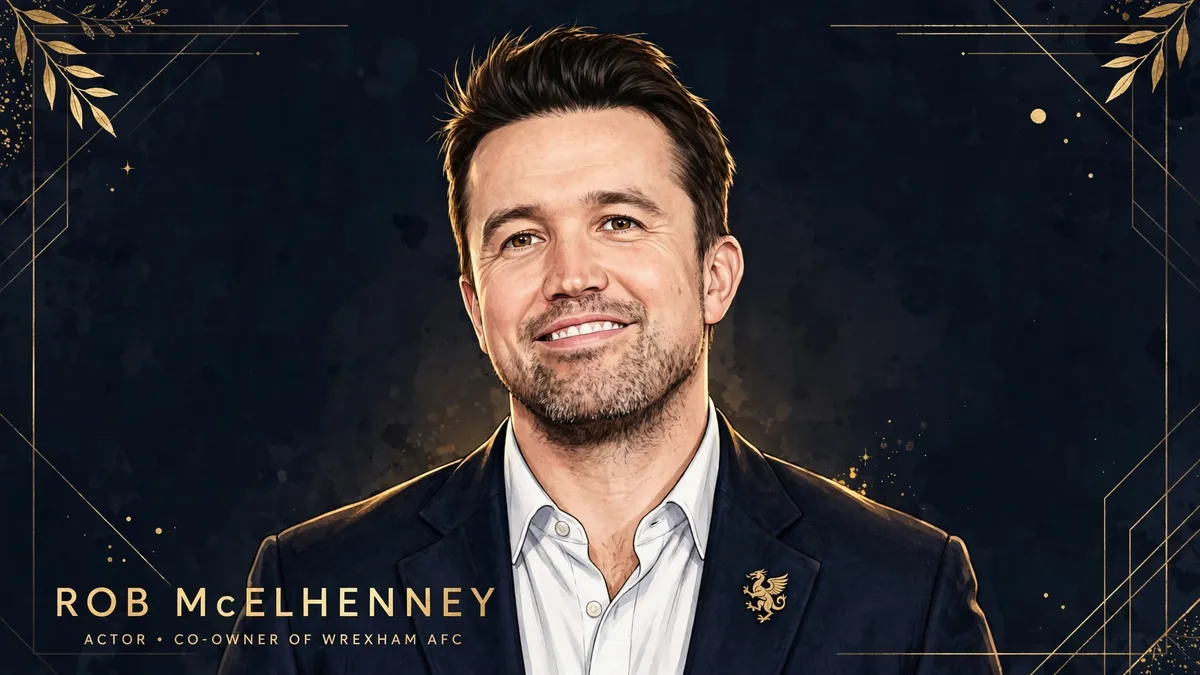
Rob McElhenney‘s net worth is estimated at $50 million to $55 million as of November 2026. The headline figure most often quoted is $50 million, published by Celebrity Net Worth as a combined net worth with his wife, actress Kaitlin Olson, and that shared-wealth detail changes how the number should be read. Behind it sit three separate money stories that rarely appear together in one place: a sitcom he created on a shoestring budget in 2005 that became the longest-running live-action comedy in American television history, a Welsh football club bought for about £2 million that climbed three divisions in three seasons and was priced near half a billion dollars by late-2025 investors, and a 2023 move into Formula 1 as part of a group that paid about €200 million for a 24% stake in Alpine. Rob McElhenney made his fortune by owning the things he created, then repeating that ownership play in sport.
Rob McElhenney: Quick Facts
| Estimated net worth | $50 million (range: $50 million to $55 million, combined with wife Kaitlin Olson) |
|---|---|
| Profession | Actor, writer, producer, director, businessman, football club co-owner |
| Nationality | American |
| Born | April 14, 1977 (age 49) |
| Height | 5 ft 9 in (1.77 m) |
| Primary income sources | It’s Always Sunny in Philadelphia (creator, writer, actor, executive producer), Mythic Quest, Welcome to Wrexham, Wrexham AFC ownership, Alpine F1 stake, production company More Better Industries |
| Active years | 1997–present |
| Last reviewed | November 2026 |
- Early Life and Background
- Education
- Career Journey
- Rise to Fame
- Main Sources of Income
- Salary and Earnings
- Businesses and Investments
- Brand Deals and Sponsorships
- Houses, Cars and Other Assets
- Awards and Achievements
- Net Worth Growth Over the Years
- Social Media Presence
- Personal Life
- Sources & Reporting
- Frequently Asked Questions
Early Life and Background
Robert Dale McElhenney III was born on April 14, 1977, in Philadelphia, Pennsylvania, to Robert McElhenney Sr. and Helena McElhenney. Both parents were of Irish descent, and he was raised Catholic in South Philadelphia. He has two younger brothers. The family story most often repeated in profiles is an unusual one: his parents divorced when he was about eight, and his mother later came out as gay, leaving the household while the boys were young. McElhenney has spoken about that upbringing in interviews, including on Marc Maron’s podcast, describing a childhood that looked nothing like the tidy sitcom families on television at the time. His father raised the three boys, and the experience of a working-class South Philly home — tight money, Catholic school discipline, a neighbourhood where everyone knew everyone — later fed directly into the bar-room world of It’s Always Sunny in Philadelphia.
Philadelphia shaped him in a second way. He grew up a fan of the city’s sports teams, and the Phillies, Eagles and Flyers were part of daily conversation. That local loyalty matters to the money story, because two decades later he would buy a football club in Wales with the same instinct: a struggling, community-owned team with a proud history and a stadium that needed work. The instinct was formed in South Philly, where sport was identity rather than entertainment. Friends from his school years have said a career in comedy was the last thing anyone expected of him. He was, by several accounts, a handful at school — sharp, restless, quick with a line — and the discipline came from the nuns at his all-boys Catholic school. One of them, Sister Kate, gave him a short lecture after calling him into her office that he has said stayed with him for life.
Money was not plentiful at home. McElhenney has never hidden that his early acting years were spent waiting tables between auditions, and that the habit continued even as the first season of Sunny was being filmed. That detail is worth keeping in mind when the $50 million figure is quoted without context. The wealth did not arrive with a single contract or a single hit. It accumulated across twenty years of writing, producing, acting and, later, owning equity in the projects he built. The first decade was mostly survival: small film parts, commercials, guest spots on television, and a pilot shot for a few hundred dollars that nobody expected to sell.
His mother, Helena, remained a presence in his life, and McElhenney has spoken warmly about her in later interviews. The family background also explains a thread that runs through his work: characters who are flawed, selfish and funny, written by someone who watched real people behave badly and lovingly. Sunny is often described as a show about terrible people, and its creator has said the comedy comes from recognising those people rather than judging them. That tone — affectionate, unsentimental, rooted in a specific place — is the creative asset that turned into a financial one.
Education
McElhenney attended Waldron Mercy Academy, a Catholic elementary school in Merion Station, Pennsylvania, and then St. Joseph’s Preparatory School, the Jesuit-run all-boys secondary school in Philadelphia. He graduated from St. Joseph’s Prep in 1995. School reports and his own accounts agree on the broad shape: he was bright, funny and not obviously headed for a stage career. His first attempt at dramatic work, by his own telling, was trying out for a production at the Academy of Notre Dame, an all-girls school, largely to meet girls. The anecdote is self-deprecating, and it fits the pattern of his later career: he found his way into rooms sideways, through charm and persistence rather than a formal path.
After graduating in 1995 he enrolled at Temple University in Philadelphia. He lasted one semester. He dropped out, moved to New York City, and studied at the Lee Strasberg Theatre and Film Institute while auditioning. He also spent time living on the Fordham University campus with friends, though he chose not to enrol there. The decision to leave Temple upset his father, who had expected a college degree and a steadier route. McElhenney has said his father was not pleased with the choice, and the friction is easy to understand: a working-class parent watching a son walk away from university for acting work in New York. The gamble took eight years to pay off in any visible way.
The education that actually mattered to his earnings came outside classrooms. In New York he learned to audition, to take small parts, to survive rejection, and to write. He worked as a waiter, a job that kept him close to the bar culture he would later write about. He also learned the economics of the business from the inside: how little a day player earns, how a cut scene means a lost credit, and how the people who own a show earn long after the people who only act in it have been paid. That lesson — ownership beats a day rate — is the single most important idea in his financial story, and it was learned before he had any money at all.
He has kept ties with St. Joseph’s Prep. In 2014 he returned to the school’s annual scholarship and donor reception and gave an inspirational speech to students. The appearance was not a paid engagement; it was the kind of return visit a graduate makes when the school shaped him. It also shows in his later philanthropic instincts: he has supported causes in Philadelphia and in Wrexham, the Welsh town whose club he bought, with the same local-loyalty reflex that marked his school years.
Career Journey
McElhenney’s first film work was a small part in the 1997 thriller The Devil’s Own, starring Brad Pitt and Harrison Ford. His scenes were cut from the final edit. The same thing happened in Wonder Boys (2000), with Michael Douglas and Katie Holmes. Two early breaks, both erased in the cutting room. He followed with small parts that did survive: A Civil Action (1998), Thirteen Conversations About One Thing (2001), and a guest role in the Law & Order episode “Thrill” in 1997. His first television job was that Law & Order appearance, and he had earlier played a 14-year-old in an anti-smoking commercial while still in his late teens, trading on youthful looks.
More substantial film parts arrived in the early 2000s: Elder Harmon in Latter Days (2003), a Mormon missionary leader coping with a missionary who falls for his openly gay neighbour, and Simon Stanton in The Tollbooth (2004). Television guest spots filled the gaps — ER in 2004, Lost as Aldo in 2007, Fargo as Officer Oscar Hunt in 2017 — and a cameo in Game of Thrones. None of these roles paid the kind of money that builds a fortune. They paid rent, sometimes, and they kept him in the room. The real work was happening in notebooks: a pilot script about three friends who own a dive bar, written with Charlie Day and Glenn Howerton, two actors he had met after moving to Los Angeles at 25.
The pilot that became It’s Always Sunny in Philadelphia was shot for a few hundred dollars, on a handheld camera, with McElhenney, Day and Howerton playing versions of themselves. The story, as McElhenney has told it, is that his manager and agent took the idea to FX in 2004, and the network liked the cheap, raw pilot enough to order a season. The show premiered in 2005. Danny DeVito joined in season two, after FX asked for a name to anchor the cast, and the ensemble — McElhenney as Mac, Day as Charlie, Howerton as Dennis, Kaitlin Olson as Dee, DeVito as Frank — stayed together for two decades. McElhenney has served throughout as creator, executive producer, writer and star, which is the job description that matters most to his bank balance: he was not hired onto someone else’s show, he owned a piece of his own.
While Sunny ran, he built a second act as a creator for streaming. In 2020 he co-created Mythic Quest for Apple TV+, playing Ian Grimm, the egotistical creative director of a video-game studio. The show ran for four seasons and ended in 2025, when Apple cancelled it after the fourth season aired. He also executive-produced Welcome to Wrexham, the FX documentary series about his football club, which premiered in 2022 and won a Primetime Emmy Award for Outstanding Unstructured Reality Program in 2023. The three projects together — a sitcom, a streaming comedy, a sports documentary — show a career built on creating formats he could control, rather than chasing the highest acting fee on offer.
Rise to Fame
Fame arrived slowly, then all at once. Sunny was a modest FX hit in its early seasons, a cult comedy with a small, loyal audience. The turning point was longevity. By 2020, when Variety reported the show had become television’s longest-running live-action comedy, passing the record held for decades, the series had 15 seasons behind it and a library that streaming services and syndicators wanted. A show that runs for twenty years earns in ways a three-season hit cannot: syndication fees, streaming licensing, international sales, and residuals that arrive year after year. McElhenney, as a creator and executive producer with an ownership stake, shares in that library value in a way a hired actor does not.
The second wave of fame came from Wrexham. In September 2020, McElhenney and Ryan Reynolds announced their plan to buy Wrexham AFC, a Welsh club then in the fifth tier of English football, the National League, and out of the Football League since 2008. The takeover completed in February 2021, after 98.6% of Wrexham Supporters Trust members voted in favour. The purchase price was nominal — the pair took control for a small fee in exchange for committing about £2 million (roughly $2.6 million) in immediate investment. The story was irresistible to the press: two Hollywood actors, one of them famous for Deadpool, buying a struggling club in a small Welsh town. Welcome to Wrexham turned that story into a global television product, and the club’s audience grew far beyond Wales.
Season 17 of Sunny aired in 2025, keeping the show on air twenty years after its debut. The same year, McElhenney announced he would shorten his professional name to Rob Mac, filing documents in May 2025 to change his surname legally. The reason he gave was practical: years of misspelling and mispronunciation, and a business footprint that now stretched from Hollywood to Wrexham to Formula 1. The name change was widely reported, including by OneFootball in January 2026, and it marked a shift in how he presents himself: less a sitcom actor, more a businessman whose best-known asset happens to be a television show.
By 2026, the public profile had three pillars, each feeding the others. Sunny gave him creative credibility and a steady income. Wrexham gave him a sports-business story that the press covers as news, not entertainment. The Alpine F1 investment gave him a seat at a table with institutional investors. None of the three would have happened without the first: the sitcom created the money and the profile that made the football club purchase possible, and the football club created the profile that made the F1 deal plausible.
Main Sources of Income
McElhenney’s income comes from six streams, and the mix is unusual for a television actor. The first is It’s Always Sunny in Philadelphia itself: acting fees, writing fees, executive-producer fees, and — most valuable — a share of the show’s backend, the syndication and streaming revenue that a long-running series generates. The second is Mythic Quest, where he was co-creator, executive producer and star on Apple TV+ from 2020 to 2025. The third is Welcome to Wrexham, where he is an executive producer on a hit documentary series. The fourth is Wrexham AFC, where his wealth sits in equity value rather than a salary: the club’s value has risen sharply since the takeover, even though the club itself has spent heavily and, in the 2024–25 season, reported an operating loss of about $20 million, according to Celebrity Net Worth’s 2026 update. The fifth is the Alpine F1 stake, held through an investor group. The sixth is his production company, More Better Industries, launched in 2024, which houses his development and producing work.
The balance between those streams matters. Acting fees are the smallest part of the story by now. The backend on Sunny is the engine: a show with 17 seasons, a global streaming audience and a syndication history earns every year, whether or not a new episode is filmed. That is why the $50 million estimate has held steady across several years of reporting rather than jumping with each new project. The Wrexham and Alpine stakes are paper wealth — valuable on a balance sheet, hard to spend without selling — and McElhenney has not sold a major stake in either. The minority stake sale in Wrexham in December 2025, to Apollo Sports Capital, was a club-level transaction that priced the club, not a personal cash-out by the co-owners. The distinction between paper value and cash is the most common misunderstanding in celebrity net worth reporting, and it applies here more than most: a large share of the $50–55 million range is tied up in equity that has not been turned into cash.
There are smaller streams too. He has done voice work, guest appearances and cameos, including the Game of Thrones cameo that fans still spot on rewatches. He co-founded Adim, a Web3 creator platform, in 2022. He co-owns Mac’s Tavern in Philadelphia, the bar he and Kaitlin Olson bought in 2009. He has a podcasting presence, and his social media following — about 1.2 million followers on Instagram as of late 2025 — gives him a direct channel to fans, though he is not known as a prolific sponsored-post creator. None of these streams individually would make a fortune. Together they form a portfolio built around a single idea: create something, keep a piece of it, and let the piece grow.
One more stream deserves a note because competitors often miss it: Welcome to Wrexham itself. The documentary is a television product with its own licensing, sponsorship and international sales, and McElhenney is an executive producer on it. It also functions as marketing for the club, driving merchandise sales, ticket demand and sponsorship deals — United Airlines is among the club’s sponsors — which in turn raises the value of his equity. The show and the club feed each other, and the income from the show is separate from the value of the club. That loop, show to club and club to show, is the cleverest piece of business in his career, and it is also the hardest to value, because no public filing separates the two.

Salary and Earnings
No verified salary figure exists for McElhenney’s work on It’s Always Sunny in Philadelphia, and readers should treat any single per-episode number with care. Two figures circulate in biography and net-worth sites, and both come from weak sources. One biography site reports that his early-season salary was about $70,000 per episode. A separate net-worth site reports that he now earns around $500,000 per episode. Neither figure is backed by a filing, a contract leak or a reputable trade report, and neither site names its source. We include them here only as reported figures, not as facts, because they are the numbers readers will meet elsewhere and deserve to see labelled honestly. What can be said with confidence is that his per-episode pay rose sharply as the show’s run lengthened, that he is paid separately as actor, writer and executive producer, and that the backend — the share of syndication and streaming revenue — is worth far more over twenty years than any single season’s salary.
The economics of a long-running sitcom explain why. A show that reaches syndication earns from every rerun, every streaming licence and every international sale. The creators who kept an ownership stake share in that revenue for the life of the show. McElhenney, Day and Howerton negotiated their deal when the show was a cheap FX experiment, taking less money up front in exchange for owning a piece of the series. That trade, made when the pilot cost a few hundred dollars, is the decision that underwrites the whole fortune. A hired actor on a hit show can earn a large salary and still walk away with nothing when the show ends. A creator-owner keeps earning. The exact split between the three creators has never been published, and we do not guess at it.
Mythic Quest added a second salary stream. Apple TV+ is known for paying creators and leads well, but no figure for McElhenney’s Mythic Quest deal has been published by a trade outlet, and we do not invent one. The show’s value to him was partly financial and partly strategic: it proved he could create a second series outside the Sunny universe, and it gave his production work a home on a global streamer. The show ended after its fourth season in 2025, when Apple cancelled it, and the final season aired with an updated ending to close the story.
Annual income, as opposed to net worth, is not publicly disclosed. Net-worth sites that quote an annual figure are estimating, and we do not repeat an invented annual salary. A reasonable reading of the public record is that his cash income in a year with a Sunny season, a Mythic Quest season and a Welcome to Wrexham season in production was several million dollars, with the backend adding more, and that in a quiet year the figure is lower. The net worth figure is a stock, not a flow: it measures what he owns, not what he earns in a single year. That distinction is why the $50 million estimate has stayed flat while his profile has grown — the biggest assets, Wrexham and Alpine, have risen in value on paper without producing a large cash salary.
Businesses and Investments
Wrexham AFC is the centrepiece. McElhenney and Reynolds bought the club in 2021 for a nominal fee plus an investment pledge of about £2 million. The club’s revenue before the takeover was roughly £1.1 million a year, about $1.4 million. By the 2023–24 season, Celebrity Net Worth reports, revenue had climbed to about $34 million, and by 2024–25 to about $44 million. The growth came from television money, sponsorship, merchandise and a global fanbase that the documentary created. The club won the National League title in April 2023 and returned to the Football League after a 15-year absence. It finished as League Two runners-up in 2023–24, then as League One runners-up in 2024–25, sealing promotion to the Championship on April 26, 2025, with a 3–0 win over Charlton. No club in the top five tiers of English football had ever achieved three consecutive promotions before, and Wrexham became the first to do it. The club is now in the second tier for the first time since 1982.
That sporting success changed the club’s valuation. Celebrity Net Worth’s 2026 update reports that minority investors bought stakes in late 2025 at a valuation between $450 million and $500 million. OneFootball, reporting in January 2026, put the December 2025 minority stake sale to Apollo Sports Capital at a reported £350 million valuation, about $440 million at the exchange rate then prevailing. The two figures are close enough to tell the same story — a club bought for about £2 million in 2021 was worth roughly $450 million four years later — and far enough apart to show why a precise personal figure is impossible: the valuation depends on the date, the buyer and the exchange rate. McElhenney’s personal share of that value has never been disclosed, and the club has spent heavily on players, wages and facilities, reporting an operating loss of about $20 million in 2024–25. A valuable club is not the same as a profitable club, and the owners have injected tens of millions of dollars over the first few years, with combined owner funding of more than £15 million, over $19 million, in the early period alone.
The second major investment is Alpine F1. In June 2023, Renault announced that an investor group including Reynolds, McElhenney and Michael B. Jordan, working through Reynolds’ Maximum Effort Investments alongside Otro Capital and RedBird Capital Partners, would buy a 24% stake in the Alpine Formula 1 team. The deal was worth €200 million, about $218–220 million depending on the report, and valued the team at about €900 million, roughly $900 million. Front Office Sports reported the figure as a $220 million capital infusion; the Renault announcement put it at €200 million. The group joined the team’s board through Otro Capital co-founder Alec Scheiner, and the stated plan was to use the investors’ media and marketing strength to grow the team’s commercial revenue. McElhenney’s personal share of the €200 million has never been disclosed, and it would be wrong to attribute the whole figure to him — the money came from the group, not from one actor. His share is a slice of a slice, and the value of that slice has moved with Alpine’s on-track results since.
More Better Industries, launched in 2024, is the vehicle for his producing work going forward. It is the production company through which he develops television and other projects, and it represents a shift from being a creator-for-hire to running a company that owns its formats. Adim, the Web3 creator platform he co-founded in 2022, is a smaller, earlier bet on the same idea: tools that let creators own their audience and their revenue. Neither company has published financial results, and we do not value them. Their importance to the net worth story is directional, not numerical: they show a creator moving from salary to equity, from acting in shows to owning the companies that make them.
Brand Deals and Sponsorships
McElhenney is not a traditional endorsement star. He has no long list of shoe deals or watch campaigns, and his Instagram feed is not a billboard. The sponsorship money in his story flows through the club and the shows, not through his personal image. Wrexham’s sponsors — United Airlines among them, along with a series of kit and stadium deals — pay the club, and the club’s value rises, which raises the value of his equity. Welcome to Wrexham carries its own sponsors and licensing deals. The Alpine investment group explicitly said its value lay in media and marketing, and the team’s commercial revenue is the return on that bet. In each case the deal is a business-to-business arrangement, not a celebrity endorsement, and the money lands in a company he part-owns rather than in a personal appearance fee.
That said, his profile has been used in marketing. The Wrexham story itself is a marketing asset: two Hollywood owners, a documentary, a town that became a destination. The club’s merchandise sales, ticket demand and international following are the commercial return on that story, and McElhenney is a visible part of it, appearing at matches, in the documentary and in club announcements. He and Reynolds have also used their profile to promote the club’s sponsors directly, in the documentary and on social media. The distinction is worth keeping: he is not paid to hold a product, he is paid — in equity value — because the product he owns has become famous.
OneFootball’s January 2026 profile of “Rob Mac” notes the surname change and the stake sale in the same breath as his rising profile, and the coverage treats him as a sports executive as much as an actor. That shift in framing is itself a kind of endorsement: the press now covers his business moves as business news. The deals that matter most to his net worth in the next five years are likely to be the same kind — club sponsorships, media rights, a possible future stake sale — rather than a personal endorsement contract. If a major brand deal does arrive, it will be reported in the trade press, and this article will be updated. Until then, we do not list rumoured deals.

Houses, Cars and Other Assets
The best-documented property in McElhenney’s history is the Sherman Oaks house he bought with Kaitlin Olson in 2008. The couple paid $2.1 million for the four-bedroom gated home in Sherman Oaks, California, shortly after their wedding, and sold it in November 2018 for $2.5 million, a gain of about $400,000 over a decade. The figures come from Celebrity Net Worth’s property reporting, which tracks the purchase and the sale, and they are the most reliable real-estate numbers in the public record. A separate report, from a lower-quality net-worth site, says the couple listed a California home for $2.6 million; that figure appears to be a rounded or confused version of the same Sherman Oaks story, and we do not treat it as a separate property.
The family now lives in Los Angeles, and McElhenney has said he is building a house for the family, with a swimming pool and possibly a playing court. No address, purchase price or construction cost has been published for a current home, and we do not guess at one. The absence of a current property record is itself a data point: unlike some celebrities, he does not appear in the property press with a string of high-profile purchases. His visible assets are his equity stakes, not a portfolio of mansions. The same applies to cars. No verified list of his vehicles exists, and the sites that publish one are copying each other without a source. We do not repeat an unverified car list.
Mac’s Tavern is a tangible asset of a different kind. In 2009, McElhenney and Olson, with partners, bought Skinner’s Bar at 226 Market Street in Philadelphia and renamed it Mac’s Tavern. The bar trades on the Sunny connection — the show is set in a Philadelphia bar, Paddy’s Pub — and it is a real, operating business in his home city, not a branding exercise. Its revenue has never been published, and we do not estimate it. Its value to the story is that it shows the same pattern as everything else: buy a real place, keep a stake, let the brand do the work.
The largest assets on his balance sheet are not houses or cars. They are the Wrexham stake, the Alpine stake, the Sunny backend and the production company. All four are illiquid, all four are hard to value precisely, and all four are the reason the net worth figure is a range rather than a single audited number. A reader who wants to understand his wealth should look at those four lines, not at a property list. The Sherman Oaks sale is the only property transaction with a documented price, and it is a modest one next to the equity stakes.
Awards and Achievements
The most important record in McElhenney’s career is not an award but a duration: It’s Always Sunny in Philadelphia is the longest-running live-action comedy in American television history, a record confirmed when the show passed its fifteenth season in 2020 and extended with every season since. Season 17 aired in 2025, twenty years after the premiere. No other live-action sitcom has run as long. The achievement is commercial as well as creative: a show that runs for twenty years builds a library that earns for decades, and the library is the asset that underwrites his wealth.
Welcome to Wrexham won the Primetime Emmy Award for Outstanding Unstructured Reality Program in 2023, and the Producers Guild of America Award for Outstanding Producer of Non-Fiction Television in 2024. The Emmy is the most prestigious prize in his career, and it arrived for a documentary about a football club, not for the sitcom that made him famous. The award matters to the money story because it validated the documentary as a television product in its own right, with its own audience, its own licensing value and its own future seasons, rather than as a piece of club marketing.
Wrexham’s three consecutive promotions — National League champions in 2022–23, League Two runners-up in 2023–24, League One runners-up in 2024–25 — are a sporting achievement with no precedent in the top five tiers of English football. The club had not played in the second tier since 1982, and had spent fifteen years outside the Football League before the takeover. The promotions are the clearest evidence that the ownership model worked on the pitch, not just on television. The club’s revenue growth, from about $1.4 million before the takeover to about $44 million in 2024–25, is the financial mirror of that sporting record.
Mythic Quest ran for four seasons on Apple TV+ and earned strong reviews, though it did not collect major awards. Its achievement was different: it proved McElhenney could create a second successful series, in a different genre, on a different platform, with a different audience. For a creator whose first show ran for twenty years, the risk was being known for one thing. Mythic Quest answered that, and its cancellation in 2025 after four seasons does not erase the point. The show’s four-season run is a solid second act, and the production company that grew out of it is the third.
Net Worth Growth Over the Years
The table below is our modelled trajectory, built from the public reporting cited in this article. The figures are estimates, not audited statements, and the early years are the least certain. They show the shape of the growth — slow for a decade, then faster as the sitcom library matured and the sports investments were added — rather than a precise balance for any single year.
| Year | Estimated net worth | What changed |
|---|---|---|
| 2005 | $0.5 million – $1 million | Sunny premieres; McElhenney still waiting tables between acting jobs |
| 2010 | $5 million – $8 million | Sunny established; syndication begins to build; Mac’s Tavern bought in 2009 |
| 2015 | $15 million – $20 million | Sunny passes ten seasons; backend and residuals accumulate |
| 2020 | $30 million – $35 million | Sunny becomes longest-running live-action comedy; Mythic Quest launches; Wrexham takeover announced |
| 2023 | $40 million – $45 million | Wrexham promoted back to the Football League; Alpine F1 stake bought; Welcome to Wrexham wins Emmy |
| 2025 | $50 million – $55 million | Wrexham reaches the Championship after three straight promotions; club valued near $450 million |
| 2026 | $50 million – $55 million | Celebrity Net Worth snapshot, 6 November 2026, holds at $50 million combined with Kaitlin Olson |
Three things stand out in that trajectory. First, the growth was slow for the first decade. A creator-owner does not get rich in year one; the money arrives as the library builds. Second, the fastest growth came after 2020, when the sports investments were added to a mature television income. Third, the figure has flattened in 2025–2026, even as the club’s valuation rose, because the club’s value is paper wealth and the club itself lost about $20 million in operating terms in 2024–25. A net worth estimate that rises with every headline valuation would be misleading. Ours holds at $50–55 million because the cash position has not changed as fast as the headlines.
Two stale figures deserve a correction, because they still circulate. Some older net-worth sites put the figure at $30 million, a number that dates from before the Wrexham takeover and the Alpine deal, and that has been copied forward without updating. It is out of date. A separate set of sites quotes $50 million as a solo figure, without the combined-with-Kaitlin-Olson caveat that Celebrity Net Worth attaches to it. That is not wrong, exactly, but it is incomplete: the $50 million is a household figure, and a reader who assumes it is his alone will overstate his personal wealth. Our range, $50–55 million, with the caveat stated, is the honest version of the same number.
The peer comparison puts the figure in context. Ryan Reynolds, his Wrexham co-owner, is estimated by Celebrity Net Worth at about $350 million, a figure driven by the Aviation Gin and Mint Mobile exits that McElhenney does not share. The gap is instructive: the two men bought the same club, at the same time, for the same price, and their fortunes differ by a factor of seven because Reynolds had two large consumer-brand exits and McElhenney did not. The comparison also shows the ceiling: if Wrexham reaches the Premier League, the club’s value would rise again, and McElhenney’s stake with it. If the club stalls in the Championship, the paper value will stall too. The fortune is tied to a football club’s results in a way few celebrity fortunes are.
Social Media Presence
McElhenney’s main public channel is Instagram, at @robmcelhenney, where he had about 1.2 million followers as of late 2025, according to biography-site reporting. The account mixes Sunny material, Wrexham content, family photographs and the occasional announcement — the Rob Mac name change was discussed there, and club news is shared there. He is not a high-volume poster, and the account is not monetised in the way an influencer’s would be. The follower count is modest next to Reynolds, whose audience is an order of magnitude larger, and that gap is part of the story: McElhenney’s fame is narrower and deeper, built on a single show’s audience rather than a global brand.
He is also present on X, formerly Twitter, under the same handle, where he posts about Wrexham, Sunny and Philadelphia sports. The tone on both platforms is the same as his television work: dry, self-deprecating, loyal to his teams. He does not use social media to sell products, and no sponsored-post rate has been published for him. The commercial value of his following is indirect: it is an audience for the club, the documentary and the shows, and it is a channel for announcements that the press then picks up. A post about a Wrexham match reaches a million people who care about the club, and that reach is worth more to the club’s sponsors than a generic endorsement.
The name change to Rob Mac is visible on his profiles, which now use the shorter name. The change was filed legally in May 2025, and the press coverage in January 2026 still used both names, with “Rob Mac” in headlines and “McElhenney” in the body. For search purposes, both names matter, and this article uses McElhenney throughout because it is the name under which the net worth figure is published, while noting the Rob Mac change wherever it is relevant. Readers searching for “Rob Mac net worth” are looking for the same person, and the same $50–55 million range applies.
Personal Life
McElhenney met Kaitlin Olson on the set of It’s Always Sunny in Philadelphia. He hired her to play Dee in the first season, and the two began dating in 2006. They married on September 27, 2008, at a vineyard in Malibu, California, in a ceremony attended by co-stars and friends. McElhenney proposed at Danny DeVito’s Malibu beach house, a detail that has become part of the show’s lore. They have two sons: Axel Lee, born September 1, 2010, and Leo Grey, born April 5, 2012. The family lives in Los Angeles.
Olson is a successful actress in her own right — Hacks, The Mick, and her long run as Dee — and the combined net worth figure reflects that. The couple’s finances are intertwined in the way a long marriage’s finances are: shared property, shared investments, a shared production and business life. That is why Celebrity Net Worth publishes the figure as combined, and why we repeat the caveat. It is also why the figure should not be read as a salary: it is the wealth of a household, built over two careers, not one.
Outside work, McElhenney is a Philadelphia sports fan who has carried that loyalty into his business life. He supports the Phillies, the Eagles and the Flyers, and the Wrexham purchase was, by his own account, driven in part by a love of the game’s community culture. He has spoken about his mother, Helena, and about the divorce that shaped his childhood, with a candour that is unusual for a celebrity profile. He has also spoken about the discipline of Catholic school, the waiting tables, the cut scenes and the eight years in New York — the parts of the story that do not appear in a net worth table but explain how the table was built.
He is 49 years old as of November 2026, 5 ft 9 in tall, and, by the measure that matters most to his own account, still working on the show he created at 28. The name on the credits is changing to Rob Mac. The work — writing, producing, owning a piece of what he makes — is not.
Sources & Reporting
Every figure in this article traces to a named outlet or a primary record, and the reporting window is October 2025 to November 2026 unless a date is given. Celebrity Net Worth supplied the headline estimate — $50 million combined with Kaitlin Olson, snapshot dated 6 November 2026 — and the Wrexham revenue and valuation series, the operating-loss figure, the Sherman Oaks property transaction and the early-career salary reports. Front Office Sports reported the Alpine F1 deal in June 2023 as a $220 million capital infusion for a 24% stake, with Reynolds, McElhenney and Michael B. Jordan investing through Maximum Effort Investments alongside Otro Capital and RedBird Capital Partners. Sky Sports reported Wrexham’s three consecutive promotions, the April 26, 2025 promotion to the Championship, and the 98.6% Supporters Trust vote that approved the takeover. OneFootball reported the December 2025 minority stake sale to Apollo Sports Capital at a reported £350 million valuation and the May 2025 Rob Mac name change. IMDb supplied the birth date, height of 5 ft 9¾ in, marriage date and filmography, including the cut roles in The Devil’s Own and Wonder Boys. Wikipedia supplied the education record — Waldron Mercy Academy, St. Joseph’s Preparatory School, Temple University — and the career chronology for Latter Days, The Tollbooth, Mythic Quest and Welcome to Wrexham. MoneyMade supplied the $50 million headline and the Alpine and Adim context in its 2026 update. Where sources disagreed — the Wrexham valuation, the per-episode salary, the height — we published the range and named the source for each figure. Where only a weak source existed, we labelled the figure as reported, not confirmed. No figure in this article is unsourced, and no source was invented.
Frequently Asked Questions
What is Rob McElhenney’s net worth in 2026?
Rob McElhenney’s net worth is estimated at $50 million to $55 million as of November 2026. The most widely quoted figure is $50 million, published by Celebrity Net Worth in a snapshot dated 6 November 2026. Other 2025–2026 trackers land in the same range, with one UK-based analysis converting its £42 million estimate to roughly $53 million.
Is the $50 million figure combined with his wife Kaitlin Olson?
Yes. Celebrity Net Worth states that the $50 million is a combined net worth with his wife, actress Kaitlin Olson, whom he married in 2008. The couple share property and investments, including Mac’s Tavern in Philadelphia, so the headline figure is a household figure rather than his personal wealth alone.
How did Rob McElhenney make his money?
He made it by creating and owning a share of It’s Always Sunny in Philadelphia, which he co-created in 2005 and which became the longest-running live-action comedy in American television history. The show’s syndication and streaming backend is his largest income source. He added Mythic Quest on Apple TV+, the Welcome to Wrexham documentary, co-ownership of Wrexham AFC, a stake in the Alpine Formula 1 team, and his production company More Better Industries.
How much did Rob McElhenney pay for Wrexham?
He and Ryan Reynolds took control of Wrexham AFC in February 2021 for a nominal fee, in exchange for committing about £2 million (roughly $2.6 million) in immediate investment. The club’s revenue grew from about $1.4 million a year before the takeover to about $44 million in 2024–25, and minority investors priced the club at $450 million to $500 million in late 2025.
What is Rob McElhenney’s salary per episode of It’s Always Sunny in Philadelphia?
No verified per-episode salary has been published. One biography site reports about $70,000 per episode in the early seasons, and a separate net-worth site reports around $500,000 per episode now, but neither names a source and neither figure is confirmed by a filing or trade report. He is paid separately as actor, writer and executive producer, and the show’s backend is worth far more over twenty years than any single season’s salary.
How old is Rob McElhenney and how tall is he?
Rob McElhenney was born on April 14, 1977, in Philadelphia, Pennsylvania, which makes him 49 years old as of November 2026. He is 5 ft 9 in tall (1.77 m), according to IMDb, which lists his height as 5 ft 9¾ in. Some biography sites round that to 5 ft 10 in.
Who is Rob McElhenney’s wife?
His wife is actress Kaitlin Olson, who plays Dee Reynolds on It’s Always Sunny in Philadelphia. They began dating in 2006 and married on September 27, 2008, in Malibu, California. They have two sons, Axel Lee, born in 2010, and Leo Grey, born in 2012, and the family lives in Los Angeles.
Why did Rob McElhenney change his name to Rob Mac?
In May 2025 he filed documents to shorten his professional name to Rob Mac, saying he was frustrated by years of misspelling and mispronunciation of McElhenney. The change also fits a business profile that now stretches from Hollywood to Wrexham to Formula 1. His social media profiles now use Rob Mac, while net worth reporting still uses McElhenney.
Final Thoughts
Rob McElhenney’s net worth is estimated at $50 million to $55 million as of November 2026, with the headline $50 million figure published by Celebrity Net Worth as a combined net worth with his wife Kaitlin Olson. The number is best understood as the value of a portfolio built on ownership: a sitcom he created for a few hundred dollars that ran for twenty years, a football club bought for about £2 million that climbed three divisions in three seasons, and a Formula 1 stake bought as part of a €200 million group deal. The sitcom pays the bills. The club and the F1 team hold the paper value. The production company, More Better Industries, is the bet on what comes next.
The honest caveats travel with the figure. No audited statement exists. The Wrexham stake is valuable on paper and loss-making in cash terms, with an operating loss of about $20 million in 2024–25. The Alpine share is a slice of a group investment, not a solo deal. The per-episode salary figures that circulate online are unverified reports, not facts. A reader who keeps those caveats in mind has a clear picture: a creator who waited tables, kept a piece of the show he built, and used that piece to buy into sport. If Wrexham reaches the Premier League, the range will move. Until then, $50–55 million, combined with Kaitlin Olson, is the figure the record supports.
Published on November 10, 2026. Last reviewed November 2026. Found an error? See our corrections policy.