
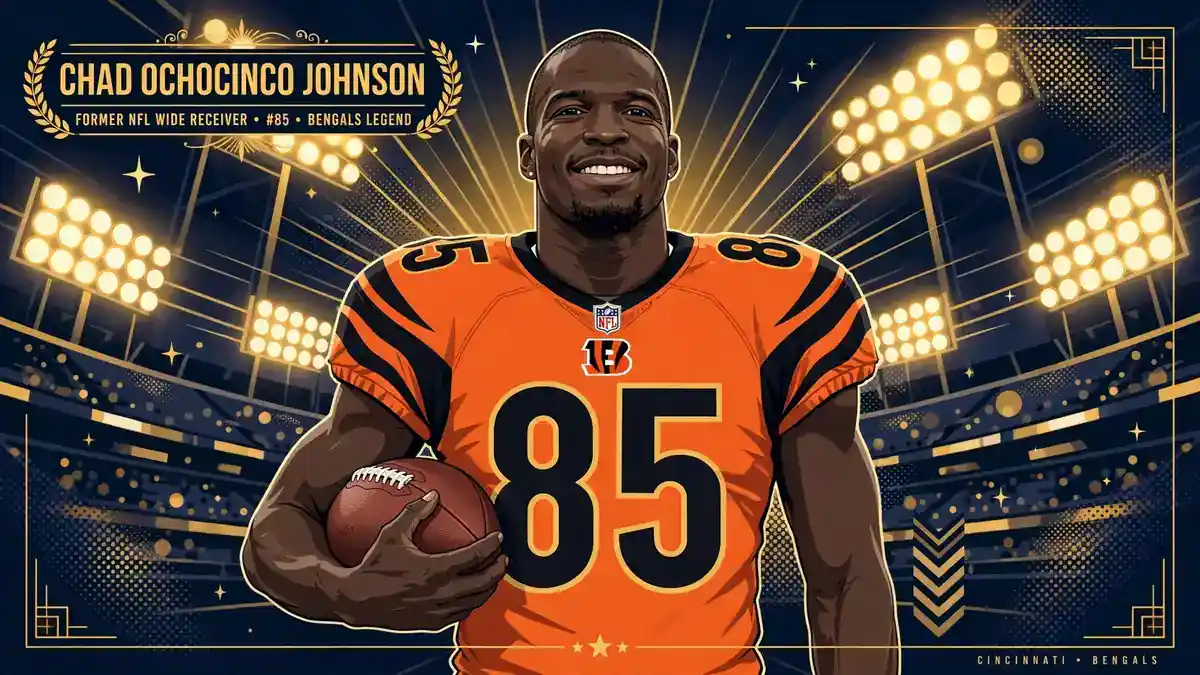
Chad Johnson‘s net worth is estimated at $5 million–$15 million as of November 2026, with $15 million the figure most current outlets carry. The former Cincinnati Bengals wide receiver banked close to $49 million in NFL salary across 11 seasons, then did something almost no star of his era managed: he kept most of it. Johnson says he saved 80 to 83 percent of his playing salary by sleeping in the Bengals stadium for his first two seasons, wearing fake jewelry from Claire’s and flying Spirit Airlines instead of chartering jets. That discipline is the real story behind the Ochocinco fortune — a career built on touchdown dances and trash talk, and a bank balance protected by habits that looked cheap and turned out to be smart.
Chad Johnson: Quick Facts
| Estimated net worth | $15 million (range: $5 million–$15 million) |
|---|---|
| Profession | Former NFL wide receiver; sports media host and analyst |
| Nationality | American |
| Born | January 9, 1978 (age 48) |
| Height | 6 ft 1 in (1.85 m) |
| Primary income sources | NFL salaries, sports media and podcasting, television, endorsements |
| Active years | 2001–present |
| Last reviewed | November 2026 |
- Quick Facts
- Early Life and Background
- Education
- Career Journey
- Rise to Fame
- Main Sources of Income
- Salary and Earnings
- Businesses and Investments
- Brand Deals and Sponsorships
- Houses, Cars and Other Assets
- Awards and Achievements
- Net Worth Growth Over the Years
- Social Media Presence
- Personal Life
- Sources & Reporting
- Frequently Asked Questions
- Final Thoughts
- Related Profiles
Early Life and Background
Chad Javon Johnson was born on January 9, 1978, in Miami, Florida, is of Bahamian descent, and grew up in a household where money was tight and football was the way out. He was raised largely by his grandmother, a detail that matters to the money story because it shaped everything that came later: the man who slept in an NFL stadium to save rent and refused to buy real jewelry learned his habits long before he had millions to protect. Miami in the late 1980s and 1990s produced a generation of swaggering wide receivers, and Johnson absorbed that culture completely — the trash talk, the showmanship, the belief that a receiver’s job was to entertain as much as to catch passes.
At Miami Beach Senior High School, Johnson’s talent was obvious but his path was not straight. He graduated in 1997 and briefly attended Langston University in Oklahoma, where he did not play football. That detour could have ended his career before it started. Instead, he transferred to Santa Monica College in California, a junior-college program that gave him a field, a route tree and a second chance. Two seasons there rebuilt his profile, and by 2000 he was being recruited hard by major programs. Oregon State head coach Dennis Erickson pursued him aggressively, and Johnson transferred to Corvallis for his final college season.
The Miami roots stayed with him his whole career. He never hid where he came from, never softened the accent or the attitude, and later built his post-playing media persona around the same unfiltered voice he grew up with. The frugality stories that now define his financial reputation — the stadium couch, the discount clothes, the budget flights — all trace back to a kid from Miami who watched money disappear fast and decided, early, that he would not let it happen to him.
Education
Johnson’s education reads like a map of second chances. Miami Beach Senior High School gave him the diploma in 1997. Langston University, a historically Black university in Oklahoma, gave him a semester that produced no football and no momentum — he left without playing a down. Santa Monica College, a community college in California, gave him the reset: two seasons (1997–1999) with the Corsairs, where he rebuilt his game and his grades far from the distractions of home.
Oregon State University was the payoff. In his single season with the Beavers in 2000, Johnson caught passes in an offense that went 11–1 and beat Notre Dame in the Fiesta Bowl, the finest season in school history to that point. He set a school record with a 97-yard touchdown reception, a play that still sits in Oregon State lore and that scouts circled when they graded his deep speed. One year of major-college tape was all NFL teams got — and it was enough for the Bengals to spend a second-round pick on him.
The stop-start schooling explains a lot about Johnson’s later career. He arrived in the NFL older and hungrier than most rookies, with a chip on his shoulder about every program that passed on him. It also explains his comfort with unconventional paths: a man who reached the NFL through a community college was never going to follow the standard script for spending a fortune, either.
Career Journey
The Cincinnati Bengals selected Johnson in the second round of the 2001 NFL Draft with the 36th overall pick. He was not an instant star. As a rookie he caught 28 passes for 329 yards and one touchdown, learning behind a thin Bengals roster. The breakout came fast: in 2002 he caught 69 passes for 1,166 yards, the first of six straight 1,000-yard seasons. From 2002 through 2007, Johnson topped 1,000 receiving yards every single year, a run of consistency that put him among the best receivers of his generation.
His peak seasons were 2005 and 2006. In 2005 he caught 97 passes for 1,432 yards and nine touchdowns; in 2006 he led the NFL with 1,369 receiving yards. Quarterback Carson Palmer threw him open, and Johnson’s route running — sharp, precise, and backed by a showman’s confidence — made the Bengals’ passing game dangerous. He finished his Bengals career as the franchise’s all-time leader in receptions (751), receiving yards (10,783) and receiving touchdowns (66). Across 11 NFL seasons he totaled 766 catches for 11,059 yards and 67 touchdowns.
The Bengals years ended after the 2010 season. In July 2011, Cincinnati traded him to the New England Patriots, where he played one season, caught 15 passes, and appeared in Super Bowl XLVI — a 21–17 loss to the New York Giants. It was a quiet end to a loud career: the Patriots’ system never fit his improvisational style. In 2012 he signed with his hometown Miami Dolphins, but he was released in August after an arrest connected to a domestic incident involving his then-wife Evelyn Lozada. He never played another NFL down.
Football did not stop there. In March 2011, while still an active NFL player, Johnson took a four-day trial with Sporting Kansas City of Major League Soccer — a publicity stunt with real effort behind it that ended without a contract. He played semi-professionally with Boca Raton FC, joined the Montreal Alouettes of the Canadian Football League in 2014, and in 2017 suited up for the Fundidores de Monterrey in Mexico. None of those stops paid NFL money, but they kept the Ochocinco brand alive and showed a player who genuinely loved competing. In 2023, the Bengals inducted him into the team’s Ring of Honor, a formal homecoming that closed the circle on his Cincinnati career.
His Bengals legacy now sits next to a new generation. Joe Burrow’s net worth story starts where Johnson’s ended — a Bengals franchise quarterback carrying the same city hopes Johnson once carried as its star receiver. The two eras connect through the same stadium Johnson once slept in to save money.
Rise to Fame
Johnson became famous for more than catching footballs. He was the NFL’s great showman: touchdown celebrations that included a Riverdance jig, a proposal to a cheerleader, a gold jacket, and a Hall of Fame jacket bit that drew fines. The league fined him repeatedly during his career, with his official fines totalling over $115,000, according to Spotrac’s records quoted by EssentiallySports — a small price for celebrations that made him one of the most recognizable players in the sport.
The name change made him a household name beyond football. On October 25, 2006, during Hispanic Heritage Month, he announced he wanted to be called “Ocho Cinco” — Spanish for “eight five,” his jersey number 85. The NFL fined him $5,000 for wearing the name on his jersey during warm-ups. On August 29, 2008, he made it legal: Chad Ochocinco. He kept the name until July 23, 2012, when he changed it back to Chad Johnson at a Broward County courthouse. The stunt was pure marketing instinct — a player turning a jersey number into a brand years before personal branding became standard athlete business.
Television carried him further. In 2010 he competed on season 10 of ABC’s Dancing with the Stars alongside professional partner Cheryl Burke, finishing fourth and showing a mainstream audience the charm that Bengals fans already knew. He appeared on reality television, hosted segments, and built a social media following that stayed loyal long after his last catch. Where other receivers of his era faded, Johnson’s personality kept him employable — and that employability is now the second act of his fortune.
His rise also ran parallel to receivers who defined the same era. Calvin Johnson’s net worth tells the story of another great receiver of the 2000s, a physical freak who retired early; Johnson’s path ran the other way, stretching fame into media instead of walking away from it.
Main Sources of Income
Four streams built Johnson’s wealth, in order of size. NFL salary is the foundation — close to $49 million in gross career earnings, per Spotrac’s ledger. Sports media is the second act and the stream still growing: co-hosting Nightcap with Shannon Sharpe, analyzing for Inside the NFL on The CW, and serving as a contributing analyst on FOX Sports’ FIFA World Cup Tonight during the 2022 tournament. Television and reality appearances form the third stream, from Dancing with the Stars in 2010 through years of guest spots. Endorsements and appearances round it out — smaller than the salary years, but steady, and boosted by a social media following that brands still pay to reach.
The media money matters because it arrived after the playing money stopped. Most retired receivers see income fall off a cliff; Johnson replaced his salary with a microphone. Nightcap, launched in September 2023 on The Volume and Shay Shay Media, debuted at No. 46 in the Top 50 U.S. podcasts and later won the 2025 Webby People’s Voice Award for Best Sports Show. A hit podcast with a Hall of Fame co-host pays in advertising, live shows, sponsorships and clips that travel for days — and Johnson owns half the chemistry that makes it work.
His income profile is unusual for a retired athlete in one more way: his expenses stayed low while his income stayed high. The frugality that defined his playing years — no mortgage for his first seasons, no real jewelry, no private jets — meant the money he earned compounded instead of leaking. The 2013 court filing is the proof of the pressure he was under: even while listing assets near $5 million, he reported monthly outgoings of about $45,000 against income of roughly $3,000 a month, covering child support for his eight children, mortgages, food and car payments. He survived that squeeze without the bankruptcy filings that swallowed other stars of his era, and the media career that followed rebuilt the balance.

Salary and Earnings
Spotrac’s contract ledger, quoted by Sporting News, puts Johnson’s career NFL earnings at $48,866,500. Celebrity Net Worth’s own table totals a slightly lower $46,678,000, a gap that comes down to how bonuses and guarantees are counted year by year. Either way, the shape is the same: nearly $49 million gross across 11 seasons, with the biggest paydays arriving in the middle of his Bengals prime.
His rookie deal set the pattern. Drafted 36th overall in 2001, Johnson signed a four-year contract worth about $3.09 million, including a $1.436 million signing bonus. The 2003 season paid him $7.43 million, most of it a $7 million signing bonus tied to his first big extension. The real money came with extensions: a five-year deal worth $27.1 million with a $7 million signing bonus, followed by a six-year, $35.35 million extension in 2006 that averaged $5.89 million a year. Those two deals, stacked on each other, made him one of the best-paid receivers in football at his peak.
The Patriots chapter paid less. Traded in 2011, he played under a three-year deal worth $11.95 million with $4.75 million guaranteed, but he collected only $5.75 million for his single season in New England. His 2012 Dolphins contract, one year at $925,000, paid him nothing — he was cut before the regular season. The year-by-year ledger, per Spotrac via Sporting News, tells the story plainly:
| Season | Team | Earnings |
|---|---|---|
| 2001 | Cincinnati Bengals | $1,737,000 |
| 2002 | Cincinnati Bengals | $376,250 |
| 2003 | Cincinnati Bengals | $7,426,500 |
| 2004 | Cincinnati Bengals | $826,750 |
| 2005 | Cincinnati Bengals | $4,850,000 |
| 2006 | Cincinnati Bengals | $11,850,000 |
| 2007 | Cincinnati Bengals | $2,950,000 |
| 2008 | Cincinnati Bengals | $3,250,000 |
| 2009 | Cincinnati Bengals | $4,500,000 |
| 2010 | Cincinnati Bengals | $5,350,000 |
| 2011 | New England Patriots | $5,750,000 |
| Total | $48,866,500 |
Gross earnings are not net worth, and Johnson’s case shows why the two numbers diverge. Taxes on $49 million take roughly 40 percent. Agent fees, fines (over $115,000 in official fines, per Spotrac), child support for eight children, mortgages and the cost of a very public lifestyle all came out of the same pot. The 2013 filing — assets just under $5 million, monthly outgoings of $45,000 — captures the low-water mark. The climb back to $15 million came from saving early, spending little, and earning again in media. Compared with peers who earned similar money and kept almost none of it, Johnson’s ledger is a success story: Terrell Owens, who earned about $80 million in salaries and endorsements, is listed by Celebrity Net Worth at roughly $500,000 today. Johnson earned less and kept far more.
His frugality claim is specific and repeated. On Shannon Sharpe’s Club Shay Shay podcast in January 2023, Johnson said he saved 80 to 83 percent of his NFL salary. The habits behind the number are the stuff of his legend now: he stayed in the Bengals stadium for his first two years because everything he needed was already there; he did not move out of his grandmother’s house until his fourth year in the NFL; he never bought real jewelry while playing — “I went to Claire’s,” he told Sharpe; he flew Spirit Airlines, exit row, window seat, and asked why he would ever pay for private. On that same show he said his whole outfit cost $6, bought off a sale rack. Each story sounds like a joke. Added up, they explain a bank balance.
Businesses and Investments
Johnson never built a public business empire to rival the venture portfolios of modern stars, and that is part of the point. His investment strategy was defensive: keep the money, avoid the traps. Where other players of his era poured cash into restaurants, car dealerships and record labels that failed, Johnson’s big financial move was refusing to spend. The 83 percent savings rate he claims is, in effect, his business model — a low-cost base that let a $49 million career turn into lasting wealth instead of a cautionary tale.
His working investments sit in media. Nightcap is the centerpiece: a nightly sports talk show he co-hosts with Shannon Sharpe, produced by The Volume and Shay Shay Media, streaming live on YouTube with audio on podcast platforms. The show’s 2025 Webby People’s Voice Award for Best Sports Show and its top-50 debut gave it real commercial value — advertising, sponsorships, live appearances and the clip economy that turns a two-minute argument into a week of traffic. Johnson’s stake in that success is his persona: the unfiltered, funny, self-deprecating ex-player who says what analysts will not.
He has also monetized his name in smaller ways: paid appearances, autograph and memorabilia work, social media partnerships, and the soccer cameos that kept him in headlines. Reports have linked him to a sports bar venture under the Ocho Cinco name, though details of ownership and scale are thin in public reporting, and we do not count it as a verified asset. The honest summary of his business record is that his best investment was his own discipline — and his second-best was a media career that pays him to be himself.
That discipline-first approach is the mirror image of the flashier athlete-entrepreneur playbook. Deion Sanders’ net worth story runs on a different engine — coaching contracts, endorsements and a brand built across two sports — while Johnson’s fortune rests on the money he refused to give away.
Brand Deals and Sponsorships
Johnson’s endorsement career peaked with his on-field fame. As the NFL’s most entertaining receiver in the mid-2000s, he drew deals that traded on his celebrations and his name change — the kind of personality-led partnerships that paid for appearances, commercials and licensed products. Specific contract values for those deals were never made public, and we do not invent them here. What the record shows is a player whose brand was bigger than his stat line: the Ochocinco name sold jerseys, the touchdown dances sold highlights, and the persona sold airtime.
The name change itself was the shrewdest branding move of his career. Turning “85” into “Ochocinco” gave him a trademark-ready identity that worked in Spanish and English, on jerseys and on television. It cost him a $5,000 fine and earned him years of free publicity. Modern athletes hire agencies to do what Johnson did on instinct in 2006.
Today his sponsorship value runs through Nightcap and his social channels rather than traditional shoe or soft-drink deals. Podcast advertising, live-show sponsorships and branded segments pay for reach with a young, sports-obsessed audience — and Johnson’s clips routinely travel beyond the show’s own audience. He also still draws appearance fees for Bengals alumni events, most visibly around his 2023 Ring of Honor induction. The money is smaller than a prime endorsement portfolio, but it arrives without the physical risk that paid his first fortune.
The current generation of receivers monetizes fame faster than Johnson ever could. Tyreek Hill’s net worth reflects the modern math — bigger contracts, bigger shoe deals, bigger social followings — yet Hill’s story also shows the same lesson Johnson learned early: the contract is only the beginning of the fortune.
Houses, Cars and Other Assets
Johnson’s asset story is defined by what he did not buy. He has said openly that he never owned the trappings people expect from a $49 million career: no fleet of exotic cars — he leased the ones he drove — no mansion bought to impress teammates, no jewelry case full of real diamonds. The fake jewelry from Claire’s was not a bit; it was policy. “Why am I buying a $50,000 watch? An $80,000 watch? What time is it real quick? Time is free,” he told Sharpe on Club Shay Shay.
The hard numbers on his property come from the June 2013 court filing, which listed two houses and two luxury cars among assets totaling just under $5 million. That filing is the only sworn inventory of his holdings ever made public, and it shows a modest footprint for a man who had earned nearly $49 million: two homes, two cars, and cash. He lived for years in a home in Miami, the city he never really left, and he has described his lifestyle in interviews as deliberately ordinary — fast food, budget flights, sale-rack clothes.
His cars tell the same story. The exotics he was photographed with were leased, not owned — a distinction that saved him the depreciation and insurance costs that drain other athletes. His daily reality, by his own account, was closer to a McDonald’s No. 1 with a Coke, no ice, than to a private jet. That gap between image and spending is the whole financial story: the showman on the field, the accountant off it.
What he does own outright, beyond property, is an audience. Millions of followers across X and Instagram, a hit podcast, and a name that still trends whenever he speaks — those are assets that pay in media fees and appearance money, and they do not depreciate like a car. His 2021 claim of a $15 million bank balance, shown on the Full Send podcast, suggests the cash position is the core of the fortune, not property or equity.
Awards and Achievements
Johnson’s trophy case is a Pro Bowl case. He was selected to six Pro Bowls (2003–2007 and 2009) and named to three All-Pro teams — First-Team in 2005 and 2006, Second-Team in 2003, the formal recognition that he was, for a stretch, one of the two or three best receivers alive. He led the NFL in receiving yards in 2006 with 1,369, and he led the AFC in receiving yards in 2005 and 2006. He finished as the Bengals’ all-time leader in receptions, receiving yards and receiving touchdowns — records that still stand.
The team honor that capped it came in 2023, when the Bengals inducted him into the Ring of Honor. He took the field at Paycor Stadium with his children beside him, and the moment carried weight precisely because his Bengals career had ended so messily in 2011. Cincinnati chose to remember the six straight 1,000-yard seasons, not the exit.
His media honors are newer but real: Nightcap won the 2025 Webby People’s Voice Award for Best Sports Show, and the show’s debut inside the Top 50 U.S. podcasts put it ahead of legacy sports programs with far bigger budgets. His Dancing with the Stars run — fourth place in season 10 with Cheryl Burke — is a different kind of achievement, the proof that his fame was never only about football. And his soccer trial with Sporting Kansas City in 2011, however brief, remains one of the stranger footnotes in American sports: an NFL star trying, seriously, to make an MLS roster.
The numbers behind the honors: 766 career receptions, 11,059 receiving yards, 67 touchdowns, six 1,000-yard seasons in a row, and a franchise record book he still owns. Rob Gronkowski’s net worth offers a useful contrast — another larger-than-life pass-catcher who turned a big personality into a long media career after the pads came off.
Net Worth Growth Over the Years
Johnson’s wealth did not grow in a straight line. It spiked with his contracts, dipped hard around his divorce and legal troubles, and climbed again on the back of media work. The timeline below uses the only dated figures the public record supports: Spotrac’s salary years, the 2013 sworn filing, Johnson’s own 2021 bank-balance claim, and the 2026 published consensus.
| Year | Milestone | Estimated net worth |
|---|---|---|
| 2001 | Drafted 36th overall; rookie deal worth $3.09 million | Under $1 million |
| 2003 | First Pro Bowl; $7.43 million bonus year | $3 million–$5 million |
| 2006 | Led NFL in receiving yards; biggest cash year (Spotrac tally: $11.85 million) | $10 million–$12 million |
| 2008 | Legally becomes Chad Ochocinco | $12 million–$15 million |
| 2011 | Traded to Patriots; Super Bowl XLVI appearance | $10 million–$12 million |
| 2013 | Sworn court filing lists assets just under $5 million | About $5 million |
| 2021 | Shows $15 million bank balance on Full Send podcast | About $15 million |
| 2023 | Nightcap launches with Shannon Sharpe | $12 million–$15 million |
| 2026 | Current published consensus (Celebrity Net Worth, July 2026 update) | $15 million |
The 2013 dip deserves a straight explanation. Johnson’s divorce from Evelyn Lozada, child support for eight children, legal costs and a period with almost no income — he told the court he was earning about $3,000 a month — drained the balance his contracts had built. Older estimates that still circulate today, including some that put him at $5 million, are frozen snapshots of that moment. The $15 million figure reflects the recovery: a decade of low spending, a media career that pays, and the savings he protected from the start. Readers who see both numbers online are looking at two different years, not two different men.
Social Media Presence
Johnson’s social media is his second stadium. As @ochocinco on X, he has spent more than a decade posting unfiltered takes on football, money and life, building an audience in the millions that treats him as a friend rather than a brand. His posts mix football analysis, jokes about his own frugality, and direct replies to fans — the same voice that made Nightcap work, in 280 characters. Instagram carries the visual side: training clips, family moments, podcast highlights and the occasional throwback to a touchdown dance.
The following is an audience that pays. Podcast clips featuring Johnson travel far beyond Nightcap‘s own channel, sponsored posts and appearance offers follow the engagement, and his willingness to say the thing no one else will say keeps him in the news cycle. He has also used the platform to teach: his savings stories, told as jokes, have become some of the most-shared financial advice ever given by an athlete, quoted by MoneyWise, Upworthy and The SportsRush alike.
His online presence carries risk, too. The same unfiltered style that built the audience has produced controversies, and the 2012 incident that ended his Dolphins career began with a public, messy personal dispute. He has kept posting through it all — the consistency is the point. Where other retired players hire managers to sanitize their feeds, Johnson still sounds like Johnson.
Personal Life
Johnson is the father of eight children, a fact he discusses openly and that shaped his finances as much as any contract. His son Chad Johnson Jr. followed him into football, playing wide receiver at Arizona State University. His youngest daughter, Serenity “Hurricane” Paula Johnson, was born in January 2022 to his then-fiancée Sharelle Rosado, a real estate agent and star of Netflix’s Selling Tampa.
His most public relationship was with Basketball Wives star Evelyn Lozada. He proposed on November 16, 2010, and the two married on July 4, 2012. The marriage lasted barely a month: in August 2012, Johnson was arrested after a domestic incident involving Lozada, the Dolphins released him the next day, and the divorce was finalized on September 19, 2012. The episode cost him his final NFL job and is the darkest chapter of his public life; he has pleaded no contest to the charge and spoken since about the damage it did.
He got engaged to Sharelle Rosado in January 2023, after the couple had begun dating in 2020. By 2024, reporting indicated the engagement had ended, and Johnson has since focused publicly on co-parenting his eight children. He has said he lets his kids enjoy designer clothes and the nice things he denied himself — “I allow the kids to do the designer and the nice stuff, because I done saved 80, 83 percent of my salary,” he told Sharpe — while teaching them that the payroll eventually ends.
Family is also the reason his frugality stories land. The grandmother whose house he refused to leave until his fourth NFL season raised him; the children he supports are the reason the savings matter. His personal life is not a footnote to the fortune — it is the reason the fortune had to survive.
Sources & Reporting
Celebrity Net Worth — the $15 million net worth figure (updated July 2, 2026), career earnings table totaling $46,678,000, the June 2013 court filing details (assets just under $5 million, $45,000 monthly outgoings, $3,000 monthly income), and the November 2021 Full Send podcast claim of a $15 million bank balance.
Spotrac — the contract ledger behind the $48,866,500 career earnings total, the year-by-year salary breakdown, and the fines record (over $115,000 in official fines), as quoted by EssentiallySports.
Sporting News — the full year-by-year earnings table and the 2001 rookie contract ($3.09 million, $1.436 million signing bonus), the five-year extension ($27.1 million, $7 million bonus) and the 2006 extension ($35.35 million).
Sportscasting — career totals of 766 catches, 11,059 yards and 67 touchdowns; the stadium-sleeping story; and the “broke since ’78” interview with Graham Bensinger.
MoneyWise — the 83 percent savings claim, the Claire’s jewelry and Spirit Airlines details, and the Club Shay Shay quotes on watches and private jets.
The SportsRush — the February 2025 account of the Club Shay Shay interview, including the stadium stay and the “I went to Claire’s” quote.
Upworthy — the 80 to 83 percent savings range and the Spirit Airlines exit-row quote.
EssentiallySports — the October 2026 account of Johnson’s studio-analyst role on The CW’s Inside the NFL and his FOX FIFA World Cup Tonight analyst stint; and the April 2026 fines report (Spotrac: official fines over $115,000).
The Shadow League — the September 2023 launch of Nightcap with Unc and Ocho.
Wikipedia — Nightcap podcast history (September 2023 launch, The Volume/Shay Shay Media, 2025 Webby People’s Voice Award for Best Sports Show) and the career timeline (draft, teams, name changes, Sporting Kansas City trial, Montreal Alouettes, Fundidores de Monterrey).
Pro-Football-Reference — career statistics cited by Sportscasting, including the six straight 1,000-yard seasons from 2002 to 2007.
Reporting window: career and contract figures cover 2001–2012; court records are from June 2013; media and podcast reporting runs through November 2026. Where sources disagree on the net worth — $5 million in older estimates and the 2013 filing versus $15 million in current reporting — this article publishes the range and names who says what.
Frequently Asked Questions
What is Chad Johnson’s net worth in 2026?
Chad Johnson’s net worth is estimated at $15 million in 2026, according to Celebrity Net Worth’s July 2026 update. We publish a range of $5 million to $15 million because his own sworn court filing in June 2013 listed assets just under $5 million, while current reporting and his own 2021 claim of a $15 million bank balance support the higher figure. The $5 million number is a snapshot of his low point; $15 million is the current consensus.
How much did Chad Johnson make in the NFL?
Johnson earned $48,866,500 in NFL salary across 11 seasons, according to Spotrac’s contract ledger quoted by Sporting News. The bulk came with the Bengals — about $43 million — with $5.75 million more from his single season with the New England Patriots. Celebrity Net Worth’s own table totals a slightly lower $46,678,000, a difference that comes down to how bonuses are counted year by year. Spotrac’s tally puts his biggest single season in 2006 at $11.85 million.
How did Chad Johnson save 83 percent of his salary?
Johnson told Shannon Sharpe on Club Shay Shay in January 2023 that he saved 80 to 83 percent of his NFL salary. He lived in the Bengals stadium for his first two seasons instead of renting or buying a house, did not move out of his grandmother’s house until his fourth year in the league, wore fake jewelry from Claire’s instead of buying real diamonds, flew Spirit Airlines in the exit row instead of chartering private jets, and leased exotic cars instead of buying them. On that same show he said his whole outfit cost $6, bought off a sale rack.
Why did Chad Johnson change his name to Ochocinco?
Johnson wore jersey number 85, and “ochocinco” is a playful Spanish rendering of “eight five.” He announced in October 2006 that he wanted to be called Ocho Cinco, was fined $5,000 by the NFL for wearing the name during warm-ups, and legally changed his name to Chad Ochocinco on August 29, 2008. He changed it back to Chad Johnson on July 23, 2012, at a Broward County courthouse.
What is Chad Johnson doing now?
Johnson co-hosts Nightcap, the nightly sports podcast with Shannon Sharpe, which launched in September 2023 and won the 2025 Webby People’s Voice Award for Best Sports Show. He also works as a studio analyst on The CW’s Inside the NFL and served as a contributing analyst on FOX Sports’ FIFA World Cup Tonight during the 2022 tournament. He was inducted into the Cincinnati Bengals Ring of Honor in 2023.
How many children does Chad Johnson have?
Chad Johnson has eight children. His son Chad Johnson Jr. played wide receiver at Arizona State University, and his youngest daughter, Serenity “Hurricane” Paula Johnson, was born in January 2022. His 2013 court filing said he was paying about $45,000 a month at that time covering child support, mortgages, food and car payments.
Was Chad Johnson married to Evelyn Lozada?
Yes, briefly. Johnson proposed to Basketball Wives star Evelyn Lozada on November 16, 2010, and they married on July 4, 2012. The marriage ended after an August 2012 domestic incident led to his arrest and his release from the Miami Dolphins; their divorce was finalized on September 19, 2012. He later got engaged to Sharelle Rosado in January 2023; reporting in 2024 indicated that engagement had ended.
Did Chad Johnson try to play professional soccer?
Yes. In March 2011, while still an NFL player, Johnson had a four-day trial with Sporting Kansas City of Major League Soccer. He did not earn a contract, but he later played semi-professionally with Boca Raton FC in Florida, joined the Montreal Alouettes of the Canadian Football League in 2014, and played for the Fundidores de Monterrey in Mexico in 2017.
Final Thoughts
Chad Johnson’s fortune is the rare athlete money story with a happy middle. He earned close to $49 million, hit a public low point in 2013 when a court filing showed assets near $5 million, and rebuilt to an estimated $15 million by 2026 — not through a lucky investment or a comeback contract, but through habits he started as a rookie and a media career he built on being himself. The stadium couch, the fake jewelry and the Spirit flights looked like punchlines. They were the plan.
The lesson travels beyond football. Johnson’s career proves that the size of the contract matters less than the size of the gap between what you earn and what you spend — and that a famous name, kept in good repair, can pay for decades after the body stops cashing checks. Ochocinco the brand outlasted Ochocinco the receiver, and the man who once changed his name for a joke now gets paid to talk about the game he left. That is a $15 million story worth telling straight.
Published on November 11, 2026. Last reviewed November 2026. Found an error? See our corrections policy.