
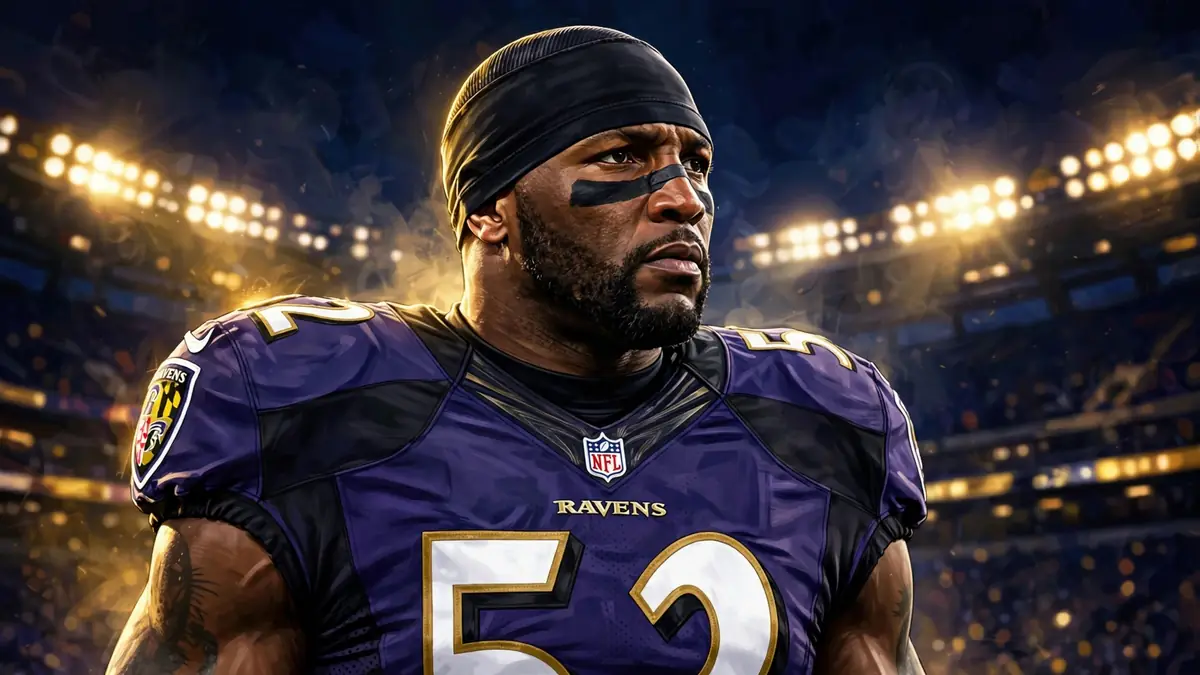
Ray Lewis‘s net worth is estimated at $30 million–$45 million as of November 2026. The Baltimore Ravens linebacker banked $95.7 million in NFL salary across 17 seasons with one franchise, then added broadcast pay from ESPN and Fox Sports, a New York Times bestselling memoir, and a string of business ventures — yet the honest figure stays a range, because the loudest single numbers floating around his name do not survive a check against his actual contracts.
Ray Lewis: Quick Facts
| Estimated net worth | approximately $35 million (range: $30 million–$45 million) |
|---|---|
| Profession | Former NFL linebacker, sports broadcaster, author, motivational speaker |
| Nationality | American |
| Born | May 15, 1975 (age 51) |
| Height | 6 ft 1 in (1.85 m) |
| Primary income sources | NFL salaries and bonuses, broadcasting, book sales, endorsements, business ventures, speaking |
| Active years | 1996–2012 (NFL); 2013–present (media and business) |
| Last reviewed | November 2026 |
- Early Life and Background
- Education
- Career Journey
- Rise to Fame
- Main Sources of Income
- Salary and Earnings
- Businesses and Investments
- Brand Deals and Sponsorships
- Houses, Cars and Other Assets
- Awards and Achievements
- Net Worth Growth Over the Years
- Social Media Presence
- Personal Life
- Sources & Reporting
- Frequently Asked Questions
Early Life and Background
Raymond Anthony Lewis Jr. was born on May 15, 1975, in Bartow, Florida, and grew up in the Lakeland area as the eldest of five children. His mother, Sunseria, raised the family largely on her own, and Lewis has spoken openly in his memoir and in interviews about a childhood shaped by absence — his father was not part of his daily life — and by the discipline his mother demanded. Money was tight. The boy who would become one of the most feared defenders in football history learned early that effort was the one thing nobody could take from him, and he carried that chip into every locker room that followed.
At Kathleen High School in Lakeland, Lewis played football, wrestled, and ran track. He was not a polished blue-chip prospect in the way recruiting magazines measure one; he was a relentless one. Coaches noticed the speed first — Lewis ran like a safety in a linebacker’s body — and then the hitting. By his senior year he had turned himself into a scholarship athlete, and the University of Miami, then the most feared program in college football, came calling. The decision shaped everything after it: Miami gave Lewis a stage, a standard, and a network of teammates who would scatter across the NFL.
The financial backdrop matters to the net worth story. Lewis did not come from money, and his first professional contract, a five-year rookie deal worth $4.805 million, was the first real wealth his family had ever seen. He has said the promise he made to his mother — that football would change their lives — drove him through the unglamorous years before the big contracts arrived. That promise also explains a pattern that runs through his whole financial life: loyalty to one team, one city, and a set of business interests rooted in Baltimore and Florida rather than scattered across the map.
Education
Lewis enrolled at the University of Miami in 1993 and played three seasons for the Hurricanes, from 1993 to 1995. Miami in the mid-1990s was a program under pressure — NCAA sanctions, coaching turnover, a roster rebuilding its identity — and Lewis became its emotional center. He started as a freshman, led the team in tackles as a sophomore and a junior, and earned All-American honors in 1995, his final college season. His game film from those years already showed the traits that would define his pro career: sideline-to-sideline range, violent tackling, and a pre-snap command of the defense that made him look like a coach on the field.
He left Miami after his junior year to enter the 1996 NFL Draft, forgoing his senior season. The choice was a financial one as much as a football one: his draft stock was high, his family needed the income, and another year of unpaid college football carried injury risk with no upside for a player already projected as a first-round pick. The Baltimore Ravens, an expansion franchise playing their first season after relocating from Cleveland, selected him 26th overall — the second pick in franchise history, after offensive tackle Jonathan Ogden at No. 4. The two men would anchor opposite sides of the ball for the next decade, and both would end up in the Pro Football Hall of Fame.
Lewis never finished a degree at Miami, and he has never pretended otherwise. His education, in the sense that mattered to his earnings, came from the film room and the negotiating table: four contracts across 17 years, each one bigger than the last, negotiated by agent Roosevelt Barnes. The classroom version of his story is thinner than that of many athletes, but the business education — how to turn on-field dominance into guaranteed money — is the part that built the fortune.
Career Journey
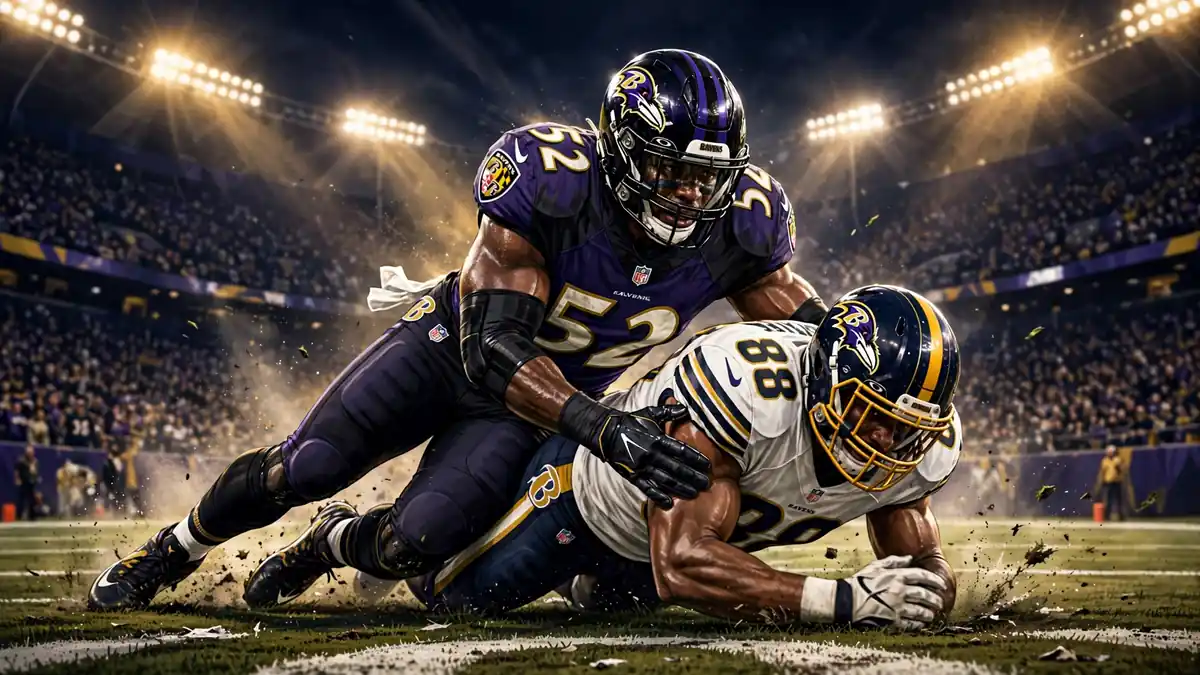
Lewis started from his first weeks as a Raven. As a rookie in 1996 he led the team in tackles, and he led the Ravens in tackles in each of his first six seasons — a run that tells you how quickly a 21-year-old became the defense’s center of gravity. The Ravens were a young franchise finding its footing, and Lewis became its identity before it had won anything: the pregame dance, the sideline speeches, the refusal to leave the field. By 1999 he was a first-team All-Pro. In 2000, everything clicked.
The 2000 season is the hinge of Lewis’s career and his earning power. The Ravens’ defense allowed 165 points across 16 games, the fewest ever in a 16-game NFL season, and steamrolled through the playoffs to Super Bowl XXXV, where Baltimore beat the New York Giants 34–7 and Lewis was named Super Bowl MVP after 11 tackles and four passes defended. He was also named NFL Defensive Player of the Year that season. A linebacker had not been the face of a championship team that way in years, and the contract market noticed: his next deal, signed in 2002, carried a $19 million signing bonus — at the time, one of the largest ever paid to a defensive player.
The middle years brought injuries and roster churn, but Lewis’s pay kept climbing. He missed most of the 2002 season with a shoulder injury, then returned to win his second Defensive Player of the Year award in 2003 with a 184-tackle season. The Ravens rebuilt around him twice. Through it all he never tested free agency in a serious way; Baltimore kept paying, and Lewis kept producing. His final contract, signed in March 2009, was reported at first as a three-year, $22 million deal — then NFL Players Association records showed it was actually a seven-year, incentive-laden pact worth $44.5 million, with $15.5 million guaranteed and $10 million due in the first year alone, according to NBC Sports’ reporting on the filings. The confusion itself is instructive: even the business press struggled to pin down the structure of Lewis’s deals, which is one reason so many net worth pages about him disagree.
October 2012 brought the torn triceps that nearly ended his story a game early. Lewis missed ten games, then returned for the playoffs and announced, on January 2, 2013, that he would retire after the postseason. The farewell run became the stuff of highlight reels: four playoff wins, capped by Super Bowl XLVII on February 3, 2013, when the Ravens beat the San Francisco 49ers 34–31 in New Orleans. Lewis retired on the field, a champion, in the same uniform he had worn since draft day. Seventeen seasons, one team, 228 games — a one-franchise career almost unheard of in the modern NFL, and a big part of why his brand stayed so clean and marketable after retirement.
The Ravens connection runs forward, too. The franchise Lewis defined eventually handed its offense to Lamar Jackson, whose own rise in Baltimore owes something to the standard Lewis set for what a Raven is supposed to be. When Lewis returned to M&T Bank Stadium for ceremonies and Ring of Honor events, the ovations were for a player the city still treats as its own.
Rise to Fame
Fame arrived for Lewis in layers. First came the play: the tackles, the Pro Bowls — 13 of them — and the reputation as the most intimidating middle linebacker of his generation. Then came the image: the pregame dance, the “squirrel” celebration, the sermons in the huddle that television cameras loved. By the early 2000s Lewis was the most recognizable defensive player in the league, the rare linebacker who sold jerseys like a quarterback.
The hardest chapter of his public life came in January 2000, after a Super Bowl party in Atlanta, when two men were killed in a fight outside a nightclub. Lewis was charged with murder. The case dominated the run-up to the 2000 season, and it remains the first thing many casual fans associate with his name. The legal outcome was this: the murder charges were dropped, and Lewis pleaded guilty to obstruction of justice, receiving 12 months’ probation and a $250,000 fine. He has addressed the episode in his memoir and in interviews since, and the 2000 season that followed — the record-setting defense, the Super Bowl MVP award — played out under a glare few athletes have ever faced. Whatever view a reader takes of the case, its effect on his marketability is a matter of record: the biggest endorsement money of his career came after it, not before it, as brands decided his on-field standing outweighed the controversy.
The second wave of fame was cultural rather than statistical. In 2004, Lewis became the cover athlete of Madden NFL 2005, the best-selling sports video game in America — a placement that paid him and put his face in millions of homes that had never watched a Ravens game. His memoir, “I Feel Like Going On: Life, Game, and Glory,” published in 2015 with co-author Daniel Paisner, became a New York Times bestseller. In 2017 he beat Tony Gonzalez on Spike’s “Lip Sync Battle,” and in 2019 he joined season 28 of “Dancing with the Stars,” withdrawing early after a toe injury. None of those appearances paid like a football contract, but together they kept Lewis famous — and therefore employable — long after his last tackle.
The Hall of Fame sealed it. On February 3, 2018, the fifth anniversary of his final game, Lewis was selected to the Pro Football Hall of Fame in his first year of eligibility. First-ballot induction is the sport’s highest honor, and it carries a commercial afterlife: paid appearances, autograph circuits, and speaking fees all rise for a Hall of Famer, and they stay high. Lewis’s post-career income depends on that status more than most retired players’ does, because he never had a quarterback’s salary scale to fall back on.
Main Sources of Income
Lewis’s wealth breaks into six streams, and the order matters: NFL salary dominates, everything else is a supplement. Over The Cap puts his career earnings at $95,735,000 across 17 seasons — salary, signing bonuses, roster bonuses, and incentives combined. No other stream comes close to that total, and any net worth page that implies endorsements or business ventures rival his playing pay is guessing.
Broadcasting is the second stream. Lewis joined ESPN as an NFL analyst in March 2013, weeks after retiring, working mainly on “Monday Night Countdown” and “Sunday NFL Countdown.” ESPN let him go in May 2016, and in June 2017 Fox Sports 1 hired him as a commentator. Analyst pay for a former star of Lewis’s stature is not publicly disclosed, and figures quoted online are speculation — but two separate network contracts across four-plus years represent steady six-figure-plus annual income, and the television exposure fed his speaking and endorsement work at the same time.
Third is endorsements. Lewis’s most durable brand relationship is with Under Armour, the Baltimore-based apparel company, for whom he fronted the “Earn Your Armour” campaign and later a Hall of Fame collection. He also partnered with Reebok during his playing career and with EA Sports around the Madden cover. One correction is needed here, because several low-quality net worth pages repeat it: a few sites claim Lewis signed a “$44.5 million, 7-year contract” with Under Armour. That figure is real, but it is his 2009 Baltimore Ravens contract, documented by Over The Cap and NBC Sports — not an endorsement deal. No credible reporting supports a $44.5 million Under Armour contract, and repeating the mix-up inflates his off-field income by tens of millions.
Fourth is his book. “I Feel Like Going On” (2015) reached the New York Times bestseller list, and a bestselling sports memoir by a Hall of Famer earns a meaningful advance plus royalties — though, as with most celebrity books, the money is a fraction of what a single NFL season paid. Fifth is motivational speaking: Lewis is represented for corporate keynotes and has spoken for companies including SAP and Under Armour. His fees are not public, and this article will not invent them, but a Hall of Fame linebacker with his stage presence commands the top tier of the sports-speaker market. Sixth is business equity — the ventures covered in the section below — plus foundation work that costs him money rather than making it, and is best read as philanthropy, not income.
Salary and Earnings
The contract record is the strongest part of this article, because Over The Cap has published it in full. Here is what Lewis actually signed, deal by deal:
| Contract | Years | Total value | Guaranteed |
|---|---|---|---|
| Rookie deal (1996) | 5 | $4,805,000 | $1,300,000 |
| Extension (1998) | 4 | $26,010,000 | $7,000,000 |
| Extension (2002) | 5 | $39,000,000 | $19,000,000 |
| Free-agent deal (2009) | 7 | $44,500,000 | $12,250,000 |
| Career total | 17 seasons | $95,735,000 earned | $39,550,000 |
A few details deserve attention. The 2002 extension is the one ESPN reported at the time as a seven-year, roughly $50 million agreement with a $19 million signing bonus — the headline number and the contract-table number differ because the extension folded in two years remaining on his old deal. The 2009 deal is the one first reported as three years and $22 million before NFLPA records showed the seven-year, $44.5 million structure; Over The Cap records $26.95 million actually earned on it before Lewis retired in 2012, leaving three years and a large sum uncollected. His largest single cash payment, $10,525,000, came in 2002, and his largest salary-cap number, $9,428,574, came in 2008. Career average pay: $5,631,471 per season.
That $95.7 million is gross pay, and the gap between it and a $30–$45 million net worth is where honest accounting lives. Federal and Maryland state taxes on a top-bracket athlete take roughly half of peak-year income. Agent fees run about 3 percent. Then there are 17 years of living: homes, family support, travel, and the entourage costs that follow a star. Lewis also played his prime years before the salary cap exploded — his $5.6 million career average annual pay is less than a third of what a top linebacker earns today, and a fraction of quarterback money. For comparison, today’s elite quarterbacks earn more in a single season than Lewis earned in several of his best years combined; Patrick Mahomes signed a deal worth up to $503 million, and Aaron Rodgers has earned more than $380 million in his career. Lewis’s fortune was built in a cheaper era, which is why the estimate lands where it does despite the huge career total.
Year by year, the money rose in steps. The rookie deal paid under $1 million a year on average. The 1998 extension pushed him past $6.5 million a year. The 2002 deal, with its $19 million bonus, was the payday that changed his family’s life — the largest cash year of his career. The 2009 deal paid $10 million in its first year alone, including a $6.25 million signing bonus and a $2.75 million roster bonus. After retirement, the checks got smaller and steadier: broadcast salaries, speaking fees, book royalties, and business income replacing the eight-figure football years.
Businesses and Investments
Lewis’s business record is real but modest next to his playing earnings, and this article separates what is documented from what is merely rumored. The best-documented venture is the Ray Lewis Full Moon Bar-B-Que, a restaurant he opened in Baltimore’s Canton neighborhood in February 2005. It traded on his name and his postgame appetite for barbecue, and it closed in 2008. Restaurants are a graveyard for athlete money, and Lewis’s closed within three years — a useful reminder that a famous name does not guarantee a working business, and that the venture likely cost him money rather than making it.
In 2006, Lewis joined Hall of Fame running back Gale Sayers and entrepreneur Mark Bloomquist to form S&L Racing, a venture intended to race cars and trucks from a North Carolina base. The project generated headlines at launch and little verifiable revenue afterward; there is no public record of its results, and this article will not assign it a value. The pattern here is common for athletes of his era: a burst of venture announcements, a few of which survive, most of which fade without a public accounting.
The venture with the most substance is Power52, the community solar company Lewis co-founded in 2015. Power52 builds solar installations aimed at bringing affordable renewable energy and job training to inner-city communities, starting in Baltimore. It is a genuine operating business with a social mission, and Lewis remains its public face. Its private valuation is not public, so no dollar figure belongs in a net worth estimate for it — but it is the one Lewis business that is still active a decade after launch, which is more than can be said for the restaurant or the race team.
More recently, Lewis became a partner, brand ambassador, and investor with SPIRE Academy, the Ohio-based athletic training school, where he has hosted the NFL Under Armour Combine and mentored young athletes. The size of his stake is not disclosed. He has also been linked in lower-quality write-ups to real estate investing, including a supposed $20 million portfolio and a $10 million Atlanta mansion. No property record or credible outlet supports those figures, and this article does not repeat them. What is verifiable is that Lewis has lived for years in the Baltimore area, where the Ravens are based, and keeps ties to Florida, where he grew up. The honest statement is that his real estate holdings are not publicly documented — not that they are worth a round number invented by a content farm.
His charitable vehicle, the Ray Lewis 52 Foundation, is a nonprofit that provides personal and economic assistance to disadvantaged youth in Baltimore — holiday family adoptions, an annual celebrity auction and bowling tournament, the Great Maryland Duck Derby, Thanksgiving food drives on North Avenue, and a summer youth program. Foundations of this kind are spending, not wealth-building, and they belong in the story because they show where a share of the $95.7 million went: back into the city that paid it.
Brand Deals and Sponsorships
Endorsements were never Lewis’s biggest income stream, but they were the one that lasted longest. Under Armour is the centerpiece: a Baltimore company and a Baltimore star, a natural fit that produced the “Earn Your Armour” campaign and, after his 2018 Hall of Fame induction, a dedicated Ray Lewis Hall of Fame collection. The relationship has outlasted his playing career by more than a decade, and it is still active through community programs and appearances. Under Armour has never disclosed what it pays him, and neither has any other brand — so any article quoting a precise endorsement total for Lewis is inventing it.
During his playing years, Lewis also partnered with Reebok on football apparel and footwear, and with EA Sports, whose Madden NFL 2005 cover made him the face of the year’s biggest sports game. The Madden cover is worth pausing on: cover athletes receive a fee and a licensing arrangement, but the real value is exposure. In 2004, Madden sold millions of copies, and every one of them carried Lewis’s face. That kind of placement feeds the speaking circuit and the autograph market for years afterward, in ways that never show up as a single line item.
After retirement, the endorsement pattern shifted from apparel to appearances: corporate events, brand ambassador roles, and paid partnerships tied to his motivational speaking. His agency representation — Paradigm for entertainment and brand partnerships — handles that side of the business. The honest summary is that endorsements added low-eight-figures across his career in total, on top of his salary, and continue to pay in smaller amounts today. They explain part of the gap between $95.7 million earned and $30–$45 million kept, because they kept money coming in after the football checks stopped — but they do not explain a $65 million net worth, which is why this article does not use that figure.
Houses, Cars and Other Assets
This is the section where most net worth pages about Lewis go wrong, so it is worth being plain about what is known and what is not. No credible outlet has published a verified property record for Lewis — no purchase price, no address, no listing — for a home in Baltimore, Florida, or anywhere else. The “$10 million Atlanta mansion” that circulates on content-farm pages traces to no deed, no listing, and no reputable report. Lewis has long been based in the Baltimore area, near the Ravens’ facility in Owings Mills, and he maintains ties to Florida, but the value of his homes is not public information, and this article will not invent it.
The same applies to cars. Lewis has been photographed with luxury vehicles over the years, as most athletes are, but there is no verified inventory of a collection, no reported purchase prices, and no basis for a dollar figure. A car section that lists specific models and values for Lewis would be fiction. What can be said is that vehicles are a small part of any athlete’s balance sheet — a depreciating one — and they move the estimate by almost nothing either way.
What is documented on the asset side is less glamorous and more valuable: the equity in Power52, the SPIRE Academy stake, and the long tail of his brand — book royalties, speaking fees, appearance income, and the licensing value of a Hall of Fame name. His most valuable asset may be the least tangible one: first-ballot Hall of Fame status, which keeps his appearance fee high and his phone ringing at 51, thirteen years after retirement. Add in the Ray Lewis 52 Foundation’s community footprint, and the picture is of a man whose wealth is real but ordinary in shape for a retired star: a paid-off life, business stakes that are hard to value, and a name that still earns.
Awards and Achievements
Lewis’s trophy case is the reason his name still commands a fee. The headline honors: two Super Bowl championships (XXXV in 2001, XLVII in 2013), Super Bowl XXXV MVP, two NFL Defensive Player of the Year awards (2000 and 2003), 13 Pro Bowl selections, and seven first-team All-Pro selections. He was inducted into the Pro Football Hall of Fame in 2018, his first year of eligibility, and named to the NFL 2000s All-Decade Team.
The numbers behind the honors are just as strong. Across 228 games he recorded 2,059 combined tackles — an NFL record — including 1,568 solo tackles, also a record. He added 41.5 sacks, 31 interceptions for 503 yards, 17 forced fumbles, 20 fumble recoveries, and three defensive touchdowns. His 156 solo tackles in 1997 remain the most in a single season. In the playoffs he added 218 combined tackles, another record, across 21 postseason games. Few defenders in history combine that volume with that longevity; Lewis played at an elite level for a decade and a half, and the honors followed the production rather than the other way around.
How does he stack up against the other great linebackers? The table below compares him with three peers on the field, not on the bank balance — because on-field production is documented and net worth is not.
| Linebacker | Super Bowls | Pro Bowls | Defensive Player of the Year | Hall of Fame |
|---|---|---|---|---|
| Ray Lewis | 2 | 13 | 2 (2000, 2003) | 2018 |
| Lawrence Taylor | 2 | 10 | 3 (1981, 1982, 1986) | 1999 |
| Brian Urlacher | 0 | 8 | 1 (2005) | 2018 |
| Derrick Brooks | 1 | 11 | 1 (2002) | 2014 |
Lewis’s case for the best middle linebacker of his era rests on that table: the most Pro Bowls, the most tackles, and two rings. Taylor has the stronger peak and the league MVP award Lewis never won; Brooks and Urlacher have the longevity but not the jewelry. The comparison matters to the money story because Hall of Fame peers with similar careers earn similar post-career income — and none of them, Taylor included, turned linebacker pay into a nine-figure fortune. The economics of the position were the same for all of them.
Net Worth Growth Over the Years
Published estimates of Lewis’s net worth only exist for recent years, and the honest growth table says so rather than filling earlier rows with invented numbers. What the record does show is the money coming in, year by year, and the estimates catching up afterward.
| Year | Milestone | Reported estimate / earnings |
|---|---|---|
| 1996 | Drafted 26th overall; rookie deal $4.805M | Career earnings begin |
| 2000 | Super Bowl XXXV MVP; Defensive Player of the Year | Peak prime begins |
| 2002 | $19M signing bonus; largest cash year ($10.5M) | Career earnings pass $30M |
| 2009 | Final contract: 7 years, $44.5M | Career earnings pass $80M |
| 2012 | Retirement after Super Bowl XLVII win | Career earnings $95.7M |
| 2015 | Memoir becomes a NYT bestseller; Power52 co-founded | No public estimate |
| 2018 | Hall of Fame, first ballot | No public estimate |
| 2022 | Content-farm estimates begin circulating | $30M (Celebrity Net Worth) |
| 2025 | Broadcasting, speaking, SPIRE Academy | $35M (DailyWikiBio) |
| 2026 | Estimates converge on a range | $30M–$45M |
Two things stand out. First, the wealth was built between 1996 and 2012 and has been managed, not grown, since: Lewis’s post-career income replaces spending rather than adding tens of millions. Second, the $65 million figure that some pages publish for 2026 appears in only one low-quality source, TheMost10, whose own table contradicts itself across years ($50M in 2022, $55M in 2023, $60M in 2024, $65M in 2026 — a suspiciously smooth staircase with no reporting behind it). CollegeNetWorth, the most careful of the recent estimators, gives $30–$45 million and notes the $95 million career earnings figure; Celebrity Net Worth, the longest-running estimator in this niche, holds at $30 million. This article’s range honors all three serious sources and discards the outlier.
The honest way to read the trajectory is this: Lewis earned $95.7 million, paid roughly half of it in taxes and fees across his career, spent like a star for 17 years, and kept the rest in a mix of business equity, property, and savings. A $30–$45 million net worth at 51 is the arithmetic that follows — not a disappointment, and not a mystery. It is what a great linebacker from a cheaper salary-cap era keeps.
Social Media Presence
Lewis is active on Instagram and X, where his feed reads the way his post-career life does: faith, family, motivation, and Baltimore. He posts workout clips, clips from speaking engagements, tributes to former teammates, and messages about his foundation’s work with young people. The tone is preacher as much as athlete — short sermons on discipline and fatherhood, often filmed in a gym or a car, usually ending with a line about God and hard work.
This article does not quote follower counts, because they shift weekly and no count was verified at the time of writing. What matters for the money story is that social media is a working asset for Lewis, not a hobby: it is the channel through which he sells speaking dates, promotes the foundation, and keeps his name in front of the brands that hire him. A Hall of Famer with a large, engaged following can charge for a single sponsored post what a lesser-known former player earns in a month of appearances. Lewis’s feed is not a major income stream on its own, but it is the marketing engine for the streams that are.
Personal Life
Lewis is the father of six children. His three eldest sons — Ray Lewis III, Rayshad, and Rahsaan — are from his relationship with Tatyana McCall, whom he met at the University of Miami; the couple never married. His other children are son Ralin and daughters Diaymon and Kaitlin. Several of his sons followed him onto the football field: Ray Lewis III played at Miami, Coastal Carolina, and Virginia Union; Rayshad played wide receiver at Utah State, Maryland, and Kentucky.
The family suffered a devastating loss in June 2023, when Ray Lewis III died at 28 of an accidental overdose in Central Florida. In May 2024, the Concussion Legacy Foundation announced that Lewis III had been posthumously diagnosed with Stage 2 chronic traumatic encephalopathy (CTE) by researchers at Boston University’s CTE Center, after his brain was donated for study. The family launched the RL3 Foundation in November 2023 in his memory, supporting children, football, and music, and funding education on CTE and substance misuse. Lewis has spoken about the loss rarely and briefly, and this article will not mine a family’s grief for detail beyond what the public record already holds.
Faith is the other constant in Lewis’s personal life. He is a Christian, and his commitment to his faith was the subject of a Sports Illustrated cover story in 2006. It runs through his memoir, his speeches, and his foundation work, and it is the frame he uses for his own story: a kid from Bartow who was given a gift, lost his way, found it again, and now measures success by what he gives back. Whether a reader shares the faith or not, it is the through-line of his second act, and it is why his speaking career works — audiences are not paying for football stories alone; they are paying for the redemption arc that comes with them.
Sources & Reporting
Over The Cap supplied the contract record used throughout this article: career earnings of $95,735,000, the four contracts and their guarantees, the $10,525,000 largest cash payment in 2002, and the $9,428,574 largest cap number in 2008. ESPN reported the 2002 extension as a seven-year, roughly $50 million agreement with a $19 million signing bonus, and reported Lewis joining its NFL coverage in March 2013. NBC Sports reported the 2009 contract’s true structure — seven years, $44.5 million, $15.5 million guaranteed — from NFL Players Association records, after early reports called it three years and $22 million. Pro Football Reference and Wikipedia supplied career statistics (228 games, 2,059 tackles, 41.5 sacks, 31 interceptions) and honors, including the 2018 first-ballot Hall of Fame selection. Celebrity Net Worth lists Lewis at $30 million; CollegeNetWorth estimates $30–$45 million; DailyWikiBio estimates $35 million. Sports Illustrated reported the posthumous Stage 2 CTE diagnosis of Ray Lewis III. Hello Magazine reported the details of Lewis’s six children. The Concussion Legacy Foundation’s announcement, carried by the RL3 Foundation, supplied the CTE and foundation details. Reporting window: contracts and career records through 2013; post-career and estimate reporting through November 2026.
Frequently Asked Questions
What is Ray Lewis’s net worth in 2026?
Ray Lewis’s net worth is estimated at $30 million–$45 million as of November 2026, with $35 million as the midpoint. Celebrity Net Worth lists $30 million, CollegeNetWorth gives a $30–$45 million range, and DailyWikiBio estimates $35 million. The $65 million figure on some content-farm pages is unsourced and conflicts with his contract record, so this article does not use it.
How much did Ray Lewis earn in the NFL?
Ray Lewis earned $95,735,000 in NFL salary and bonuses across 17 seasons with the Baltimore Ravens, according to Over The Cap. His four contracts were a $4.805 million rookie deal in 1996, a $26.01 million extension in 1998, a $39 million extension in 2002 with a $19 million signing bonus, and a $44.5 million deal in 2009. His largest single cash payment was $10,525,000 in 2002.
What is Ray Lewis doing now?
Since retiring in 2013, Lewis has worked as an NFL television analyst for ESPN (2013–2016) and Fox Sports 1 (from 2017), written the bestselling memoir “I Feel Like Going On” (2015), and built a career as a motivational speaker. He co-founded the community solar company Power52, is a partner and brand ambassador with SPIRE Academy, and runs the Ray Lewis 52 Foundation’s youth programs in Baltimore.
How many Super Bowls did Ray Lewis win?
Ray Lewis won two Super Bowls with the Baltimore Ravens: Super Bowl XXXV in January 2001, when the Ravens beat the New York Giants 34–7 and Lewis was named Super Bowl MVP, and Super Bowl XLVII in February 2013, when the Ravens beat the San Francisco 49ers 34–31 in the final game of his career.
How tall is Ray Lewis?
Ray Lewis is 6 feet 1 inch tall (1.85 m). He played at around 250 pounds (113 kg) during his NFL career, unusually fast for a middle linebacker of his size — part of why he could cover sideline to sideline for 17 seasons.
What happened in Ray Lewis’s murder trial?
In January 2000, after a Super Bowl party in Atlanta, two men were killed in a fight and Lewis was charged with murder. The murder charges were dropped, and Lewis pleaded guilty to obstruction of justice, receiving 12 months’ probation and a $250,000 fine. He went on to win Super Bowl XXXV and its MVP award the following season.
Is Ray Lewis married?
Ray Lewis has never publicly confirmed a marriage. He is the father of six children: sons Ray Lewis III, Rayshad, Rahsaan, and Ralin, and daughters Diaymon and Kaitlin. His three eldest sons are from his relationship with Tatyana McCall, whom he met at the University of Miami. His eldest son, Ray Lewis III, died in June 2023 at age 28.
Is Ray Lewis in the Hall of Fame?
Yes. Ray Lewis was selected to the Pro Football Hall of Fame in 2018, his first year of eligibility, on February 3, 2018 — the fifth anniversary of his final game, Super Bowl XLVII. His career totals include 2,059 tackles (an NFL record), 41.5 sacks, 31 interceptions, 13 Pro Bowl selections, and two NFL Defensive Player of the Year awards.
Final Thoughts
Ray Lewis’s net worth — $30 million to $45 million, anchored at about $35 million — is the honest answer, and it is more interesting than the inflated one. He earned $95.7 million playing football, in an era when linebackers were paid like linebackers, and he kept roughly a third of it after taxes, fees, and seventeen years of living like a star. The $65 million figure some pages publish would require him to have kept two-thirds of gross pay while running a restaurant that closed, a race team that vanished, and a foundation that spends — and the math does not work.
What Lewis did keep is the part that still pays: a first-ballot Hall of Fame name, a bestselling book, two network contracts’ worth of broadcast credibility, a solar company with a real mission, and a speaking career built on a story audiences actually want to hear. At 51, thirteen years after his last tackle, he is still earning from the career he built between 1996 and 2012. That is the real fortune — not a round number on a content farm, but a name that never stopped being worth something.
Published on 2026-11-13. Last reviewed November 2026. Found an error? See our corrections policy.