
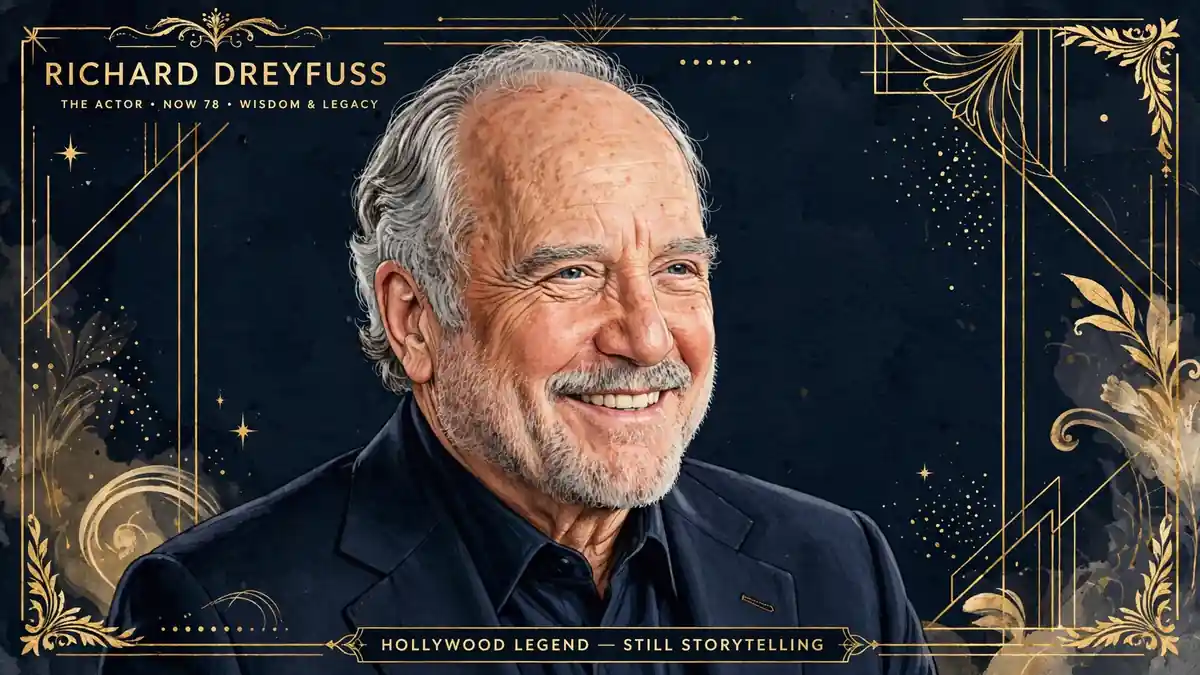
Richard Dreyfuss‘s net worth is estimated at $1 million–$5 million as of November 2026. The Oscar-winning star of Jaws and Close Encounters of the Third Kind once earned $2 million for a single film and $5 million paydays in the 1990s, yet he has told interviewers plainly that he is broke — and in November 2025 his own son confirmed the money is gone.
Richard Dreyfuss: Quick Facts
| Estimated net worth | $1 million–$5 million (range: $1 million–$5 million) |
|---|---|
| Profession | Actor |
| Nationality | American |
| Born | October 29, 1947 (age 79) |
| Height | 5 ft 5 in (165 cm) |
| Primary income sources | Film salaries, television roles, residuals, SAG-AFTRA pension |
| Active years | 1964–present |
| Last reviewed | November 2026 |
- Early Life and Background
- Education
- Career Journey
- Rise to Fame
- Main Sources of Income
- Salary and Earnings
- Businesses and Investments
- Brand Deals and Sponsorships
- Houses, Cars and Other Assets
- Awards and Achievements
- Net Worth Growth Over the Years
- Social Media Presence
- Personal Life
- Sources & Reporting
- Frequently Asked Questions
- Final Thoughts
Early Life and Background
Richard Stephen Dreyfuss was born on October 29, 1947, in Brooklyn, New York, and grew up first in the Bayside neighborhood of Queens before his family moved to Los Angeles when he was nine. His father, Norman Dreyfuss, was an attorney and restaurateur; his mother, Geraldine, had worked as an actress. The move west put the boy within reach of the studios, and he started acting as a teenager, long before anyone knew his name.
That early start matters to the money story. Dreyfuss built his career the slow way, through television guest spots and stage work across the 1960s, rather than arriving as an overnight discovery. By the time Steven Spielberg cast him in Jaws, he had already spent more than a decade learning the trade in small parts — and he had already learned how little Hollywood pays most working actors.
He has spoken openly in interviews about living with bipolar disorder, a diagnosis he has discussed publicly in the years since his 1980s struggles with cocaine. The condition, and the addiction that ran alongside it for a stretch of his early career, shaped both his working life and his finances: a 1982 car crash while under the influence became the turning point that pushed him toward treatment, and he has credited recovery with saving his career.
His family background also carried a financial dispute that later spilled into court. In 2008, Dreyfuss sued his father and his uncle over an $870,000 loan he said he made to relatives in 1984, tied to an interest in a downtown Los Angeles office building. He alleged the loan, with interest, had never been repaid across 24 years, and sought repayment plus punitive damages. The case is a reminder that the actor’s money troubles were never only about spending — family loans and long-running disputes played a part as well.
Education
Dreyfuss attended Beverly Hills High School, where he acted in school productions and started building the stage craft that would carry him into film. After high school he studied briefly at San Fernando Valley State College — now California State University, Northridge — while continuing to work as an actor.
He also took acting classes at the Westside Jewish Community Center in Los Angeles, where he trained alongside other young performers of his generation. Formal schooling never became the center of his life; the classroom that counted was the set. By his early twenties he was working steadily in television, and the education that shaped his earning power was the decade of guest roles that followed.
Career Journey
Dreyfuss started on television in 1964, with guest appearances on shows including Bewitched, Gidget, Peyton Place and The Mod Squad. His first film work came in small parts, and his first real notice arrived with American Graffiti in 1973, George Lucas’s nostalgic ensemble hit, where he played Curt Henderson. The pay told the story of a working actor rather than a star: he reportedly earned about $480 a week on American Graffiti.
He followed it with the title role in The Apprenticeship of Duddy Kravitz (1974), a Canadian production that showed he could carry a film, and then came the two pictures that changed his life. Jaws arrived in 1975, Close Encounters of the Third Kind in 1977, and The Goodbye Girl later the same year. Three films, three hits, one Oscar — and the first actor in history to headline three consecutive films that each passed $100 million at the box office, a record Collider revisited in April 2025.
The 1980s tested him. Addiction and the 1982 crash stalled his momentum, and he spent time in treatment before rebuilding with Down and Out in Beverly Hills (1986), Stakeout (1987) and Nuts (1987). He reunited with Spielberg for Always in 1989. The 1990s brought his biggest paydays — What About Bob? in 1991, Mr. Holland’s Opus in 1995 and The American President the same year — plus an Academy Award nomination for Mr. Holland’s Opus.
The summer of 2025 brought Jaws back into the spotlight for its 50th anniversary, with retrospectives, re-releases and interviews that put Dreyfuss back in front of audiences as the film’s surviving conscience. He used the attention to repeat the story he has told for years: the film made history, the studio kept the money, and he kept the principle. The anniversary coverage also reminded a younger audience how unusual his record is — three different films, three different genres, each one a nine-figure hit, all inside two years. Few actors of any generation can match that run, and none of them did it while being paid a flat fee for the biggest of the three.
From the late 2000s onward, Dreyfuss stepped back from full-time acting to run his civics-education nonprofit, taking film and television work more selectively. He played Bernie Madoff in the ABC miniseries Madoff in 2016, and in 2025 he returned to screens in the shark thriller Into the Deep and in Waltzing with Brando. At 79 he is still working, still taking roles, and still talking about the business that made him famous.
Rise to Fame
Jaws made Dreyfuss a star in the summer of 1975. As Matt Hooper, the young oceanographer who boards the Orca with Roy Scheider’s Chief Brody and Robert Shaw’s Quint, he supplied the film’s humor and its science in equal measure. The movie grossed about $260 million in North America against a $7 million budget and is widely credited with inventing the summer blockbuster. Dreyfuss was paid $250,000 for the role, according to Matt Taylor’s book Jaws: Memories from Martha’s Vineyard — roughly $1.15 million in today’s money, a solid fee for 1975 and a fraction of what the film earned.
What still rankles him, five decades later, is what came after the payday. In January 2026, speaking on The Daily Jaws podcast, Dreyfuss said he has refused to work for Universal Pictures ever since Jaws because the studio never paid him or his co-stars a bonus, despite the film banking hundreds of millions. He turned down the sequels and every Universal picture since, a boycott he says he does not regret. The stand cost him money — sequels and studio goodwill both — and it explains part of why his career earnings never compounded the way a modern franchise star’s would.
Close Encounters of the Third Kind followed in 1977, with Dreyfuss as Roy Neary, the electrician who becomes obsessed with UFOs. Spielberg’s film grossed $303 million worldwide on a $20 million budget, and Dreyfuss earned $2 million for the part — about $8.7 million in today’s dollars, and his highest salary of the decade. Then The Goodbye Girl made him, at 30, the youngest Best Actor winner in Academy history at the time, and the first romantic comedy to pass $100 million. Three consecutive $100 million films, three different genres, one actor: no one had done it before.
The record still stands out because it arrived before the age of backend points and franchise contracts. Dreyfuss was paid upfront fees in an era when stars did not share in a film’s gross the way they later would, and Jaws in particular paid him a flat salary with no bonus for the biggest hit in movie history to that point. That pay structure is the first key to understanding why a man who headlined the three biggest films of the late 1970s is not a rich man today.
Main Sources of Income
Film salaries were always Dreyfuss’s main income, from the $480-a-week days of American Graffiti through the $5 million paydays of the 1990s. His peak earning window ran roughly from 1991 to 1995, when What About Bob? and The American President each paid him a reported $5 million. Between the two Spielberg blockbusters and the 1990s hits, his career gross earnings likely ran into the tens of millions before tax, agents’ commissions and the long gaps between jobs.
Television added a second stream. He worked steadily in TV movies and miniseries across the 2000s and 2010s, including the title role in ABC’s Madoff in 2016, and he has kept taking guest roles and independent films into his late seventies, including Into the Deep in 2025. These jobs pay working-actor rates rather than star salaries, but they keep income flowing.
Residuals from Jaws and Close Encounters still arrive, though they are far smaller than fans imagine. Without backend points on those films, his residuals come from standard union formulas for television airings and streaming — real money, but not the kind that sustains a fortune. As CelebAmerica noted in its own profile of the actor, he also draws a SAG-AFTRA pension after more than 50 years of eligible union service, a defined-benefit payment that provides steady, modest income in retirement.
Stage work, voice work and the occasional speaking appearance round out the picture. Dreyfuss has never had a major endorsement portfolio, a product line, a production company with a hit slate, or a business that scaled — the four income streams that turned many of his peers into centimillionaires simply never existed for him. His money came from acting fees, and acting fees stop when the work stops.
Salary and Earnings
The salary record is the clearest part of Dreyfuss’s financial picture, because several of his fees are documented in books and trade reporting. American Graffiti paid about $480 a week in 1973. Jaws paid $250,000 in 1975, worth roughly $1.15 million today. Close Encounters of the Third Kind paid $2 million in 1977, worth about $8.7 million today. Those two Spielberg films together earned him the modern equivalent of about $10 million — a fortune in the 1970s, and one he has said he did not protect well.
His peak came in the 1990s. He earned a reported $5 million for What About Bob? (1991) and another $5 million for The American President (1995). Those two fees alone, plus Mr. Holland’s Opus the same year, made the mid-1990s his richest window, with career peak salaries estimated at $15 million to $20 million across the decade’s biggest roles. After tax and a standard 10% agent commission, the take-home on those fees was far less than the headline numbers — and the 1990s were also the years of his second divorce and the start of his long pivot toward unpaid civic work.
| Project | Year | Reported salary |
|---|---|---|
| American Graffiti | 1973 | About $480 per week |
| Jaws | 1975 | $250,000 (no bonus) |
| Close Encounters of the Third Kind | 1977 | $2,000,000 |
| What About Bob? | 1991 | $5,000,000 |
| The American President | 1995 | $5,000,000 |
Two structural facts limited how far those fees could carry him. First, the 1970s hits paid flat salaries with no share of the gross, so the hundreds of millions Jaws and Close Encounters earned never flowed back to him. Second, his output slowed sharply after the late 1990s: the leading-man years ended, the character roles that followed paid less, and the years he gave to his nonprofit were years he was not earning. A $5 million fee in 1995, taxed and split with representatives, supports a comfortable life for a few years — it does not fund three decades.
Businesses and Investments
Dreyfuss never built a business empire, and that is one of the main reasons his net worth sits where it does. He founded The Dreyfuss Civics Initiative in 2006 — later known as The Dreyfuss Initiative — a nonprofit pushing to restore civics education in American schools. He has described the work as a calling, and he gave it years of his time and attention at the cost of acting income. It was a mission, not an investment: the initiative consumed time and money without returning any.
He has no known production company with a library of hits, no restaurant chain, no brand, and no reported venture-capital portfolio. His investments, as far as public records show, were property — and property is where his money story turns mixed. He bought and sold houses across Los Angeles and San Diego County for three decades, with results that ranged from a strong sale to a loss. Richard Dreyfuss’s career earnings and financial setbacks are covered in detail on our sister site CelebAmerica, which reaches the same broad conclusion: a big career, a modest fortune, and setbacks that ate into it.
The pattern his son described in November 2025 fits the record. Ben Dreyfuss wrote that the family has no money from their father and that “my dad has no money,” a claim that landed hard because it matched what Richard himself had said for a decade. The money did not vanish in one event. It drained across divorces, legal fights, years of unpaid advocacy work, property losses, and long stretches without a major payday — the slow leak of a career that peaked early and never rebuilt its earning power.
Brand Deals and Sponsorships
There is no record of a major endorsement deal in Dreyfuss’s career. He never fronted a watch campaign, a car brand, a fragrance, or a clothing line, and he never lent his name to a product range the way many of his contemporaries did. In the 1970s and 1980s, when he was at his most famous, celebrity endorsement deals for film actors were far smaller than they are today, and Dreyfuss’s public profile — intense, political, outspoken — never matched the safe, polished image brands paid for.
His later public appearances have been about causes, not commerce: civics education, the Academy’s inclusion standards, which he criticized publicly in May 2023, and film-history events such as the 50th anniversary of Jaws in 2025. He has appeared at conventions and retrospectives, which pay appearance fees, but nothing in the public record suggests a sponsorship portfolio of any size. For an actor whose peers turned fame into brands, the absence of endorsement income is a real part of the net worth gap.

Houses, Cars and Other Assets
Property is the one asset class where Dreyfuss still holds real value. His main known asset is the Encinitas, California, home he bought in April 2008 for $1 million, using an $850,000 mortgage, on a 1.2-acre lot. Celebrity Net Worth reports the property is now worth around $2 million, with an outstanding mortgage balance of about $660,000 as of 2021. If he still owns it — and the reporting says he does — that house is likely the largest single item on his balance sheet, and it is illiquid: a place to live, not cash to spend.
His earlier property moves show how much money passed through his hands. In 1995 he sold a Los Angeles home to Kevin Costner for $2.7 million. In 2005, the year he divorced his second wife Janelle Lacey, he sold a Sherman Oaks home for $1.9 million, after listing it a year earlier for $2.4 million. In May 2006 he and his third wife, Svetlana, paid $1.02 million for a home in Carlsbad, California, and sold it in July 2008 for $820,000 — a loss of about $200,000 before costs. The Encinitas purchase followed two months before that sale closed, so 2008 was a year of overlapping mortgages and a falling market.
Cars, jewelry and collectibles do not feature in any reporting about Dreyfuss. He is not known as a collector of classic cars or art, and no auction record or listing ties a luxury vehicle collection to him. The Oscar statuette itself has sentimental value and cannot be sold — Academy rules bar winners from selling their awards without offering them back to the Academy for $1. His remaining assets, on the public record, are the Encinitas house, his pension, and the residuals that still trickle in from a handful of the most rewatched films ever made.
Awards and Achievements
Dreyfuss won the Academy Award for Best Actor in 1978 for The Goodbye Girl, beating a field that included Woody Allen, and at 30 he was the youngest winner in the category’s history at the time. He won the Golden Globe for Best Actor in a Musical or Comedy the same year, and the BAFTA for Best Actor in 1979. He earned a second Academy Award nomination in 1996 for Mr. Holland’s Opus, along with a Golden Globe nomination for the same role.
The record that still sets him apart is the box-office one: he was the first actor to star in three consecutive films that each earned more than $100 million — Jaws, Close Encounters of the Third Kind and The Goodbye Girl. Collider’s April 2025 piece on that record noted that the feat is easy to miss precisely because Dreyfuss was never a franchise star; he did it with three unrelated films in three different genres in the space of two years.
His stage work earned respect as well, including a 2004 London run in The Producers and a Broadway appearance in Sly Fox. But awards never translated into the kind of wealth his peers accumulated. Jack Nicholson, a contemporary with a similar Oscar pedigree, built a fortune estimated in the hundreds of millions through backend deals and a longer run at the top; Clint Eastwood turned directing and producing into a second fortune. Dreyfuss took the acting fees and walked away from the studio system that would have paid him more.
Net Worth Growth Over the Years
The honest version of Dreyfuss’s wealth curve is a steep rise, a long plateau, and a slow fall. He earned little in the 1960s and early 1970s, then banked the modern equivalent of about $10 million from Jaws and Close Encounters alone. The 1990s peak likely put his paper wealth at its highest, somewhere in the low tens of millions before tax and divorce settlements. From there the line bends down: fewer big roles, two expensive divorces, the 2008 property churn, years of unpaid nonprofit work, and a 2016 admission that the money was gone.
| Year | Estimated net worth | What drove it |
|---|---|---|
| 1973 | Under $100,000 | TV guest roles; $480 a week on American Graffiti |
| 1977 | About $3 million | Jaws ($250,000) and Close Encounters ($2 million) fees |
| 1995 | About $10–15 million (peak) | $5 million fees for What About Bob? and The American President |
| 2005 | About $5–8 million | Divorce settlement year; Sherman Oaks sale $1.9 million |
| 2016 | About $1–5 million | Public “broke” admission to the Daily Mail |
| 2026 | $1 million–$5 million | Encinitas home equity, pension, residuals; son’s November 2025 account |
These are estimates built from reported fees, property records and the actor’s own statements — not figures from a filing. The range matters more than any single number. Celebrity Net Worth lists $1 million; other trackers, including Healthy Celeb and Limerick Time, put the figure near $5 million. The gap between the two reflects the Encinitas house: count its equity and the figure rises; count only liquid wealth and it falls toward $1 million. Both readings agree on the direction of travel — down from a peak that never survived the decades after it.
Social Media Presence
Dreyfuss’s social media history is tangled up in the family rift. For years his son Ben managed his father’s account on X (formerly Twitter), posting on his behalf. That arrangement ended in the fallout from 2017, when Ben posted support for his brother Harry — who had accused Kevin Spacey of groping him at 18 — from Richard’s account, and the post drew a MeToo allegation against Richard himself from writer Jessica Teich, over an alleged 1984 incident Dreyfuss denies.
He has no verified Instagram presence of note and no large, monetized social following. His November 2025 family drama played out on his children’s accounts rather than his own: Ben’s posts on X and Substack, and his daughter Emily’s response on X. For a net worth profile, the point is simple — social media is not an income stream for Dreyfuss, and his online presence is a family story, not a brand.
Personal Life
Dreyfuss has been married three times. His first marriage, to actress Jeramie Rain, ran from 1983 to 1995 and produced three children: Emily, Benjamin and Harry. His second marriage, to Janelle Lacey, lasted from 1999 to 2005. In 2006 he married Svetlana Erokhin, a Russian-born schoolteacher, and they remain together. The three children from his first marriage are now adults — Emily is a journalist, Ben is a journalist, and Harry is an actor and writer.
The family story turned public in November 2025. On November 13, Ben Dreyfuss posted on X that he and his siblings are estranged from their father, writing: “Everyone assumes my siblings and I are wealthy from our dad. We’re all a bit too uncomfortable to make it clear, but we have no money from my dad. My dad has no money.” On November 17 he published a longer Substack post with the last email exchange between them, from January 2024, and wrote that he had sent many messages since without reply. Men’s Journal reported on November 20, 2025, that Ben, 39, had not spoken to his father since the January 2024 exchange, and that his sister Emily, 42, and brother Harry, 35, were likewise estranged. Ben said the rift began in 2017, over the MeToo fallout, and that he always understood his father was no longer wealthy — the estrangement, he insisted, was not about inheritance.
Dreyfuss’s public controversies in recent years include his May 2023 criticism of the Academy’s inclusion standards, delivered in a television interview, and a May 2024 appearance at the Cabot Theater in Massachusetts that drew criticism and coverage of his on-stage remarks. He has also been open about his bipolar disorder diagnosis and his recovery from cocaine addiction in the 1980s. He lives in Encinitas, California, with his wife Svetlana, and continues to take acting roles into his late seventies.
Sources & Reporting
Celebrity Net Worth — the $1 million net worth figure, the 2016 Daily Mail “broke” interview account, the 2017 statement, the Encinitas purchase price and mortgage details, and the full property history (Costner sale, Sherman Oaks sale, Carlsbad loss); also its November 21, 2025 article on Ben Dreyfuss’s Substack posts. Reporting window: profile updated December 2, 2025.
Men’s Journal — Ben Dreyfuss’s November 2025 posts, the estrangement timeline, the January 2024 last contact, and the children’s ages; published November 20, 2025.
Yardbarker — the January 2026 Daily Jaws podcast account of Dreyfuss’s refusal to work for Universal since Jaws over unpaid bonuses; published January 29, 2026.
Collider — the three-consecutive-$100-million-films record and its context; published April 11, 2025.
Daily Mail — the February 2016 interview in which Dreyfuss called himself “broke” and said he could no longer afford the retirement cruises he wanted.
Healthy Celeb — the $5 million figure and biographical details including height; last updated February 7, 2026.
Vindy — the 2008 lawsuit against his father and uncle over the $870,000 loan from 1984.
CelebAmerica — the $1–5 million range and the SAG-AFTRA pension detail in its October 26, 2026 profile; also the sister-site cross-link in this article.
Salary figures for Jaws ($250,000) and Close Encounters ($2 million) are reported via the secondary sources cited in research, including the book Jaws: Memories from Martha’s Vineyard by Matt Taylor and trade-era reporting; the $480-a-week American Graffiti figure and the $5 million fees for What About Bob? and The American President are reported figures from entertainment coverage. Where sources disagreed on the net worth total, we published the range and named each side.
Frequently Asked Questions
What is Richard Dreyfuss’s net worth in 2026?
Richard Dreyfuss’s net worth is estimated at $1 million to $5 million in 2026. Celebrity Net Worth lists $1 million, while other trackers put the figure near $5 million. The range reflects his Encinitas home equity, his SAG-AFTRA pension and residuals, set against his own statements that he is broke and his son’s November 2025 confirmation that the money is gone.
Why does Richard Dreyfuss say he is broke?
In a February 2016 Daily Mail interview, Dreyfuss said he was “broke” and taking any acting job he could get, explaining that he no longer had the money he once had and could not afford the retirement cruises he wanted with his wife. He repeated the claim in 2017, and in November 2025 his son Ben confirmed it, writing “my dad has no money.” The causes, on the public record, are divorces, legal disputes, property losses, years of unpaid nonprofit work and the long gap since his last major payday.
How much did Richard Dreyfuss make for Jaws?
He was paid $250,000 for Jaws in 1975, according to Matt Taylor’s book Jaws: Memories from Martha’s Vineyard — about $1.15 million in today’s money. The film grossed about $260 million in North America on a $7 million budget, but Dreyfuss received no bonus, which is why he has refused to work for Universal Pictures ever since.
How much did Richard Dreyfuss make for Close Encounters of the Third Kind?
He earned $2 million for Close Encounters of the Third Kind in 1977, roughly $8.7 million in today’s dollars. The film grossed $303 million worldwide on a $20 million budget, and it was his highest salary of the 1970s.
How old is Richard Dreyfuss?
Richard Dreyfuss was born on October 29, 1947, which makes him 79 years old as of November 2026. He won his Academy Award for The Goodbye Girl at 30, the youngest Best Actor winner of his era.
Is Richard Dreyfuss still alive?
Yes. As of November 2026, Richard Dreyfuss is alive and still acting. His recent work includes Into the Deep and Waltzing with Brando in 2025, and he gave a widely covered podcast interview about Jaws in January 2026.
What happened between Richard Dreyfuss and his children?
His three children — Emily, Ben and Harry — are estranged from him. His son Ben said in November 2025 that they have not spoken since an email exchange in January 2024, and that the rift began in 2017 after Ben posted support for his brother Harry from their father’s social media account, which drew a MeToo allegation against Richard. Ben also confirmed his father’s money troubles in the same posts.
Where does Richard Dreyfuss live?
He lives in Encinitas, California, with his wife Svetlana Erokhin. He bought the Encinitas home in April 2008 for $1 million on a 1.2-acre lot; it is now reported to be worth around $2 million, and it is likely the largest single asset he still holds.
Final Thoughts
Richard Dreyfuss’s fortune is the strangest in Hollywood: a man who headlined the three films that invented the modern blockbuster, won an Oscar at 30, and earned $5 million a picture in the 1990s — and who tells anyone who asks that he is broke. The numbers support him. Flat salaries with no share of the gross, a principled boycott of the studio that owed him a bonus, two divorces, a family loan dispute, property losses and years given to an unpaid cause drained a fortune that never had the business engine to rebuild itself.
The $1 million–$5 million range is honest about what remains: a house in Encinitas with real equity, a union pension, residuals from films the world never stops watching, and acting work he still takes at 79. It is a comfortable retirement on paper and a tight one in cash — which is exactly what Dreyfuss himself has been saying since 2016. His son’s November 2025 words only confirmed it. The lesson of his career is not that stardom pays badly; it is that stardom pays once, and what you do with the once is everything.
Published on 2026-11-13. Last reviewed November 2026. Found an error? See our corrections policy.