
Micky Dolenz‘s net worth is estimated at $6 million to $12 million as of November 2026. The last surviving member of The Monkees went from a $400-an-episode television salary in 1966 to six decades of royalties, reunion tours, directing work and a solo career that is still selling tickets at 81 — and his 2026 “60 Years of The Monkees” tour proves the catalog still pays.
Micky Dolenz: Quick Facts
| Estimated net worth | $6 million – $12 million (anchored near $9 million) (range: $6 million to $12 million) |
|---|---|
| Profession | Singer, drummer, actor, television and stage director |
| Nationality | American |
| Born | March 8, 1945 (age 81) |
| Height | 5 ft 11 in (1.82 m) |
| Primary income sources | Music royalties, touring, television residuals, directing, books and licensing |
| Active years | 1956–present |
| Last reviewed | November 2026 |
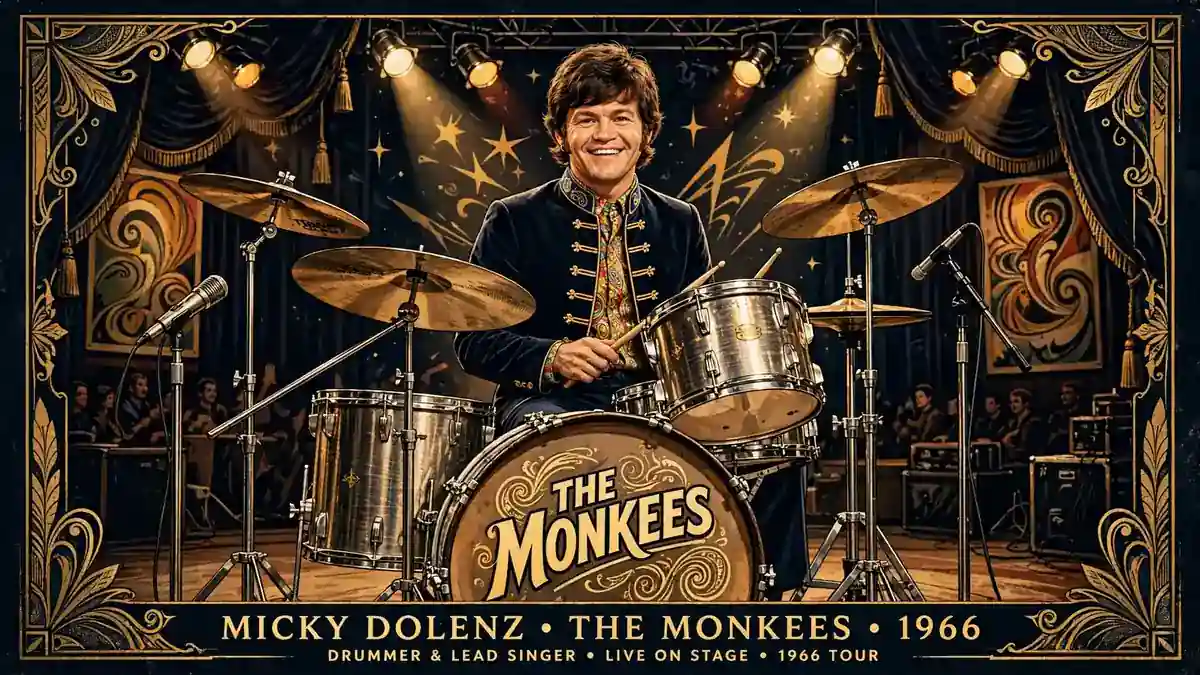
- Quick Facts
- Early Life and Background
- Education
- Career Journey
- Rise to Fame
- Main Sources of Income
- Salary and Earnings
- Businesses and Investments
- Brand Deals and Sponsorships
- Houses, Cars and Other Assets
- Awards and Achievements
- Net Worth Growth Over the Years
- Social Media Presence
- Personal Life
- Sources & Reporting
- Frequently Asked Questions
- Final Thoughts
- Related Profiles
Early Life and Background
George Michael Dolenz Jr. was born on March 8, 1945, in Los Angeles, California, into a household where show business was the family trade. His father, George Dolenz, was a film actor who had worked his way from Trieste to Hollywood, and his mother, Janelle Johnson, was also in the business. Micky grew up on and around sets, with a younger sister, Coco, who would later sing backup for the band and work in the music world herself.
Childhood threw him a hard curve. Dolenz suffered from Perthes disease, a condition that affects the hip joint and cut off blood supply to the top of the thigh bone. It left his right leg weaker and shorter than his left, and it shaped the way he moved for the rest of his life — including the way he sat at a drum kit. He has spoken about the condition openly in interviews, and it is one reason his drumming style looked different from a textbook drummer’s: he learned to play around a body that did not cooperate in the usual way.
By age 11 he was already a working actor. Cast as Corky in the NBC children’s western Circus Boy, he appeared in 49 episodes across the 1956–57 seasons under the name Mickey Braddock, riding and performing alongside a circus troupe on screen. The show gave him his first steady paycheck, his first fan mail and his first taste of what a television career could pay — and it put him in front of casting directors who would remember him a decade later.
The early start also gave him something money cannot buy: comfort in front of a camera. When he walked into the Monkees audition room in 1965, he was not a nervous amateur hoping to be discovered. He was a 20-year-old with nine years of professional credits, a singer’s ear, a comedian’s timing and a face television audiences already half-recognized.
Education
Dolenz attended Ulysses S. Grant High School in Van Nuys, California, fitting classes around acting work the way child performers of his era did — tutors on set, school between shoots, and a schedule that bent around production calls rather than the other way around.
After high school he enrolled at Los Angeles Valley College, where he was still studying when the Monkees audition changed his life. He has said in interviews that he was drifting toward a conventional path at the time, and that the audition felt like a long shot rather than a plan. The college years matter to his money story in a quieter way: they gave him a fallback he never needed, and they left him with the habit of reading contracts and asking questions that would serve him well when the band’s business affairs turned messy.
His real education in the business came after 1966, and it was hands-on. He learned recording by watching producers work, learned directing by standing behind the camera on his own show, and learned the economics of music by living through the Monkees’ royalty disputes first-hand. That practical schooling — in studios, edit rooms and rehearsal halls — shaped the second half of his career, when directing and producing became steady income streams alongside performing.
Career Journey
Dolenz’s career splits into four clear acts, and each one paid differently. The first act was the child actor: Circus Boy in 1956–57, then guest spots and small film roles through his teens, including an uncredited appearance in the 1960s as he kept one foot in the business while finishing school.
The second act began in 1965, when producers Bob Rafelson and Bert Schneider set out to cast a television show about a struggling rock band. The open call drew 437 hopefuls. Dolenz, who had his own rock band at the time and had cut two unreleased singles that year, won a spot alongside Davy Jones, Michael Nesmith and Peter Tork. The pilot was shot in San Diego and Los Angeles on a shoestring budget — the cast often wore their own clothes — and NBC picked the series up for the fall of 1966.
What followed was two years of saturation. The Monkees ran for 58 episodes from September 12, 1966, to March 25, 1968, and the band attached to it became one of the biggest-selling acts on the planet. Dolenz sang lead on most of the group’s hits, learned drums on the job — he had been a guitarist before the show — and directed episodes of the series when the producers let him behind the camera.
The third act, after the band split in 1970, was the rebuild. Dolenz moved to London and built a second career as a television director and producer, working on British children’s series and stage productions, and recorded and toured with former bandmates in various lineups, including the 1976 Dolenz, Jones, Boyce & Hart album and tour. He kept performing, kept directing, and kept the Monkees catalog alive through the long quiet years when the band was a nostalgia act rather than a chart act.
The fourth act is the reunion era, and it has lasted longer than the original band did. The 1986 twentieth-anniversary tour — boosted by an MTV marathon of the old episodes — put the Monkees back on the road and back on the charts. Reunions followed in 1996 (the Justus album, written and played by all four members), 2001, 2011, and the 2018–19 “Mike & Micky Show” with Nesmith. The Farewell Tour of 2021 closed the book on the group as a touring unit, with Dolenz and Nesmith playing their final show together at the Greek Theatre in Los Angeles on November 14, 2021. Since then Dolenz has carried the catalog alone as a solo touring act, releasing tribute albums and, in 2022, suing the FBI to force the release of its files on the band — a story that put him back in the headlines for reasons no one in 1966 could have predicted.
Rise to Fame
The Monkees’ rise was fast even by 1960s standards. The debut single, “Last Train to Clarksville,” reached number one in November 1966, two months after the show premiered. “I’m a Believer,” written by Neil Diamond and released that December, held the top spot for seven weeks and went on to sell more than 10 million copies worldwide, making it one of the best-selling singles of all time. Dolenz sang lead on both, and his voice — bright, clear, and built for radio — became the sound most listeners associate with the band.
1967 was the year the numbers turned absurd. The Monkees placed four albums at number one in a single calendar year — The Monkees, More of the Monkees, Headquarters and Pisces, Aquarius, Capricorn & Jones Ltd. — a feat no act, not even the Beatles, matched that year. The band’s records outsold the Beatles and the Rolling Stones combined in 1967, according to contemporary trade reporting, and total Monkees record sales now stand at more than 75 million worldwide. The television show won two Emmy Awards in 1967, including Outstanding Comedy Series, which gave the “manufactured band” a credential its critics could not dismiss.
Dolenz was at the center of it because he was the group’s main voice. Beyond the two number ones, he sang lead on “A Little Bit Me, A Little Bit You” (number two in 1967), “Pleasant Valley Sunday” (number three), “Words,” and “Randy Scouse Git,” a song he wrote himself that reached number two in the UK. When the band fought its producers for control of its own records — the famous 1967 showdown with music supervisor Don Kirshner — Dolenz was one of the voices pushing for the group to play its own instruments, a fight that produced the largely self-played Headquarters album.
Fame at that scale came with a catch the public did not see: the four members were salaried employees, not owners of the machine. The money story of the Monkees is, in large part, the story of how little of that 1967 fortune reached the band itself — and how the decades of royalties, reunions and touring that followed slowly made up for it.
Main Sources of Income
Dolenz’s income in 2026 comes from five streams, and their balance has shifted sharply over the decades. In 1967 the salary dominated. In 2026 the catalog and the road dominate.
Music royalties. The largest long-term stream. As the lead vocalist on the Monkees’ biggest hits, Dolenz earns from record sales, streaming, radio play, film and television licensing, and synchronization — every time “I’m a Believer” or “Last Train to Clarksville” appears in a film, an advert or a playlist. The Monkees’ catalog has stayed in print for six decades, and the 1986 MTV revival, the Rhino Records reissue campaigns and the streaming era each produced a fresh wave of royalty income. Catalog valuations for legacy acts of the Monkees’ stature run into the tens of millions, which is why some 2026 estimates push toward the top of our range.
Touring. The biggest current stream. Dolenz has toured almost continuously since the 1986 reunion, and his solo “60 Years of The Monkees” tour — which began on February 12, 2026, in Solana Beach, California — plays theatres and performing-arts centers across the United States, with dates extended into 2027 and a 10-show Australian leg announced for May 2027. Ticket prices for the run run well into three figures at premium venues — SeatGeek listed a July 2, 2026, Atlanta date at $144 — and the shows sell on the strength of one name and sixty years of songs.
Television residuals and directing. The Monkees series has been in syndication and on Saturday-morning repeats since 1969, and it streams today. Residuals from 58 episodes across six decades add up, even at the modest rates of the era. His directing work — episodes of The Monkees, British television including Metal Mickey and Luna, and stage productions — paid separate fees and kept income flowing in the years when the band was dormant.
Books, records and solo projects. His memoir, I’m a Believer: My Life of Monkees, Music, and Madness (first published in 1993, updated in 2004), his children’s book Gakky Two-Feet (2006), and his solo albums — Dolenz Sings Nesmith (2021) and the Dolenz Sings R.E.M. EP (2023) — each generate their own modest revenue and, just as importantly, keep his name in front of the audience that buys concert tickets. The tribute albums are a smart piece of economics: familiar songs, low recording costs, and a built-in market of Monkees fans.
Licensing and appearances. Voice work, radio hosting (including a morning-show stint at New York’s WCBS-FM in 2005), convention and cruise appearances, and merchandise tied to the Monkees brand round out the picture. None of these is a fortune on its own. Together they form the steady floor under the bigger, lumpier income from tours and royalties.
What is missing matters too. Unlike some of his 1960s peers, Dolenz never built a large business empire, never sold a catalog for a nine-figure sum, and never had a signature endorsement deal. His wealth is the slow accumulation of sixty years of working musician’s income, not a single windfall — which is exactly why the published estimates cluster in single-digit millions rather than the hundreds of millions attached to peers who cashed out catalogs. For a sense of how those peers’ fortunes compare, see our profile of Art Garfunkel’s net worth, another 1960s hitmaker whose catalog and touring economics run on a similar track.

Salary and Earnings
The most revealing document in Dolenz’s financial story surfaced in October 2025, when he posted his original 1965 Monkees contract on Instagram to mark its sixtieth anniversary. Parade reported the details: he was paid $600 for the pilot episode, and the contract set his pay at $400 per episode for season one, rising to $550 in season two. Had the show run five seasons, the scale would have climbed to $700 in season three, $900 in season four and $1,100 in season five.
The show ran for two seasons, so the top of that scale never arrived. Dolenz has also described the arrangement more bluntly in interviews, telling a radio interviewer in 2022 that the band worked for “four hundred dollars a week, including the concerts for 10,000, 20,000 people.” Do the rough math on the television side alone: 58 episodes at $400 to $550 works out to roughly $25,000 to $30,000 across the show’s run — a solid middle-class income in 1966, when the median American household earned about $7,400 a year, but a tiny slice of what the franchise generated.
Adjusted for inflation, that $400 weekly wage equals roughly $3,900 a week in 2026 dollars — about $200,000 a year. Respectable, and far from the starvation wages the story sometimes gets told as. The real imbalance was not the weekly pay but the ownership: the band did not own the recordings, the publishing or the merchandising in the early years, and the producers and the record label captured most of the upside while the four members collected salaries and, later, renegotiated royalty shares.
What changed the math was time. The Monkees’ catalog never went away. The 1986 revival — MTV ran a marathon of the old episodes and the band toured to packed houses — produced the single “That Was Then, This Is Now,” which reached number 20 on the Billboard Hot 100, twenty years after the band’s first hits. Reunion tours in 1986, 1996, 2001, 2011 and 2021 each paid far better than the 1960s road work, because by then Dolenz was touring as a legacy headliner setting his own terms, not as a salaried employee of a television production.
Current earnings are not publicly disclosed, and no reliable outlet publishes an annual income figure for Dolenz. What can be said with confidence is that his income today is tour-led: a theatre tour with tickets in the $100–150 range, playing dozens of dates a year, generates gross box-office revenue in the low millions per leg, of which the headliner takes a substantial share after costs. Add catalog royalties, residuals and licensing, and a working year in the 2020s plausibly brings in a high-six-figure to low-seven-figure gross — comfortable, but consistent with a net worth in the $6–12 million range rather than the inflated $28–35 million figures some content-farm pages assert without sourcing.
Businesses and Investments
Dolenz never became a mogul, and his business record reads as a working entertainer’s portfolio rather than an investor’s. He has described himself in interviews as a musician, actor and director first, and his business moves have mostly been extensions of the performance career rather than separate ventures.
The most concrete business asset is the catalog itself — or rather, his share of it. The Monkees’ recordings have been reissued, repackaged and licensed continuously since the 1960s, most recently through Rhino Records, and the band’s publishing has been administered by major rights holders. Dolenz’s royalty participation in those recordings is the closest thing he has to an annuity: it pays every quarter, it requires no touring, and it grows whenever a film, advert or streaming playlist reaches for a Monkees song. The 2026 market for legacy catalogs is strong — Bob Dylan’s catalog sale reset valuations across the whole 1960s generation — but there is no public record of Dolenz selling his own rights, and no reason to treat his catalog share as anything other than a steady earner.
He also owns his name and likeness as a working brand. The official mickydolenz.com site sells tour tickets and merchandise, and his 2026 tour is marketed directly under his own name rather than through a promoter’s package. The tribute albums on 7A Records — Dolenz Sings Nesmith in 2021 and Dolenz Sings R.E.M. in 2023 — function as small businesses in their own right: low-cost recordings aimed at a known audience, released on a label that specializes in exactly that market.
One purchase tells a story about how he thinks about gear. In the late 1960s Dolenz bought the third modular Moog synthesizer ever sold commercially — the first two went to Wendy Carlos and Buck Owens — and played it on the band’s recordings. It was a musician’s investment in sound, not a financial one, and it fits the pattern: his money has gone into the work, not into side businesses.
There are no public records of significant property flipping, startup stakes or venture investments in his name, and the wilder claims that circulate on low-quality net-worth pages — tech startup investments, a $13.5 million streaming deal, multi-million-dollar annual real-estate income — trace back to pages that contradict themselves from one paragraph to the next and name no source. We have left those claims out of the estimate entirely.
Brand Deals and Sponsorships
Brand work has never been a major line in Dolenz’s income, and that is itself a useful fact. The Monkees were a merchandising phenomenon in 1967 — lunchboxes, dolls, bubblegum cards, clothing — but the merchandising rights belonged to the production company and the licensors, not to the four members. Dolenz has been candid about the arrangement across his career: the band were employees of a television show that happened to sell records, and the ancillary money flowed to the owners of the show.
In the decades since, his endorsement record is thin by design. He has lent his name to Monkees-branded merchandise sold through his own site and at concerts, and he has appeared in advertising and promotional work tied to the band’s anniversary campaigns. He has not fronted a major consumer brand, a watch, a car or a beverage deal in the way some of his contemporaries did, and there is no reported multi-million-dollar sponsorship in his history.
The modern version of the brand deal is the tour sponsorship and the nostalgia package: the Flower Power Cruise, fan conventions and Monkees anniversary events pay appearance fees, and his 2026 tour is promoted with the kind of legacy-act marketing — “60 Years of The Monkees” — that sells on the brand equity of the name itself. The most valuable brand he owns is the one he helped build in 1966, and it still does the work.

Houses, Cars and Other Assets
Public records on Dolenz’s property are thin, and the specifics that do circulate on low-quality net-worth pages should be treated with care. One fact is solid: biographical records show he bought a house in Bell Canyon, California, in 2001, a gated community in the hills west of the San Fernando Valley that has long been popular with entertainment figures. Beyond that purchase, there is no verified public record of a property portfolio, and claims of a Hollywood Hills mansion bought for $2 million and sold for $8 million appear only on pages that also get his birth name and career dates wrong.
What is known is that he has lived in California for most of his adult life, with long stretches in Los Angeles and, during his directing years, in London. He has never been a conspicuous collector of cars or houses in the press, and interviews with him tend to focus on the work — the tour, the albums, the band’s history — rather than on possessions.
The asset that matters most to his net worth is not a house or a car. It is the royalty stream from one of the most durable catalogs of the 1960s, plus the touring business he still operates at 81. Those are intangible assets, and they are hard to photograph, but they are the reason his net worth has held up while many of his contemporaries’ fortunes faded with their chart runs.
Awards and Achievements
Dolenz’s trophy shelf is modest next to his sales figures, but the entries on it are the ones that count. The Monkees won two Emmy Awards in 1967, including Outstanding Comedy Series — an unusual honor for a show about a pop band, and one that settled the argument about whether the series was a serious piece of television. The show’s star on the Hollywood Walk of Fame, awarded to the group, marks the same achievement in concrete.
The chart record is the real award. Four number-one albums in a single year, 1967. Three number-one singles in the United States with Dolenz on lead vocal — “Last Train to Clarksville,” “I’m a Believer” and, with Davy Jones sharing the spotlight, “Daydream Believer.” “I’m a Believer” sold more than 10 million copies and remains one of the best-selling singles ever released. The Monkees’ total of more than 75 million records sold worldwide puts the band in the top tier of all-time sellers, ahead of many acts with far longer careers.
The later honors are about endurance. The 1986 reunion produced a top-20 single two decades after the band’s debut. The 2021 Farewell Tour sold out theatres across the country. The 2026 “60 Years of The Monkees” tour — launched sixty years after the show’s premiere — is the longest victory lap in pop history, and Dolenz is the only person left who can take it. He has also been recognized for the work behind the camera: his directing credits on British television and in the theatre, and his 2005 morning radio show on New York’s WCBS-FM, each added a second career to the one the public already knew.
One achievement that belongs in a different column: in 2022 he sued the FBI to obtain its files on the Monkees, after a Freedom of Information Act request filed that June went unanswered beyond an acknowledgment. The suit, handled by lawyer Mark S. Zaid, drew on a file first released in heavily redacted form in 2011, which showed that an FBI informant had attended a 1967 Monkees concert and reported “subliminal messages” in the band’s on-stage projections. It is a strange coda to a pop career, and it is also a measure of how seriously Dolenz takes the band’s history: sixty years on, he is still fighting to get the record straight.
Net Worth Growth Over the Years
No audited figures exist for Dolenz’s wealth in any year, so the table below is an illustrative reconstruction built from the career milestones in this article — the salary years, the royalty era, the reunion tours and the touring income of the 2020s — not a set of reported balances. It shows the shape of the fortune rather than a precise ledger: flat in the salaried years, growing slowly through the royalty and reunion decades, and holding steady in the touring years.
| Year | Estimated net worth | What drove it |
|---|---|---|
| 1966 | Under $100,000 | Television salary of $400 per episode; no ownership of recordings |
| 1970 | About $250,000 | End of the show and the band; early royalties and UK directing work |
| 1980 | About $1 million | Directing fees, reunion-era licensing, steady catalog royalties |
| 1986 | About $2 million | Twentieth-anniversary tour and MTV revival; top-20 comeback single |
| 2000 | About $4 million | Reunion tours, memoir and radio work, reissue campaigns |
| 2010 | About $6 million | Continued touring, licensing and the streaming-era catalog revival |
| 2021 | About $8 million | Farewell Tour, tribute albums, catalog strength |
| 2026 | $6 million – $12 million | Sixtieth-anniversary tour, royalties, licensing; anchored near $9 million |
The peer comparison puts that range in context. The Monkees’ four members ended up in very different financial places, and the gap says a lot about publishing and songwriting ownership. Celebrity Net Worth lists Michael Nesmith — the group’s chief songwriter, whose mother invented Liquid Paper — at about $50 million, Davy Jones at about $5 million at his death in 2012, and Peter Tork at about $2 million. Dolenz sits between Jones and Nesmith: the voice of the hits, but not their writer, and that single fact explains most of the spread.
| Artist | Estimated net worth | Why the figure differs |
|---|---|---|
| Micky Dolenz | $6 million – $12 million | Lead voice of the hits; royalties and touring, no songwriting catalog |
| Michael Nesmith | About $50 million | Songwriter’s publishing share plus a Liquid Paper inheritance |
| Davy Jones | About $5 million | Frontman and teen idol; similar salaried start, smaller catalog share |
| Peter Tork | About $2 million | Multi-instrumentalist; later career outside the mainstream |
| Bob Dylan | About $500 million | Songwriting catalog sold for a reported nine-figure sum in 2020 |
| Mick Jagger | About $500 million | Rolling Stones songwriter, frontman and touring machine since 1962 |
The lesson of the table is the lesson of the whole article. In the music business, the money follows the writing credit and the ownership, not the face on the record sleeve. Dolenz had the voice and the fame. Nesmith had the songs. Dylan and Jagger had both, plus the catalogs to sell. Dolenz’s $6–12 million is the fortune of a great singer who was paid as an employee in the years that made him famous — and who spent the next six decades turning that fame into a working living.
Social Media Presence
Dolenz runs his public presence the way he runs his tours: personally, and with the fans in mind. His official website, mickydolenz.com, is the hub — tour dates, ticket links, merchandise and news — and his Instagram and Facebook accounts carry the same material to the audience that still buys tickets. The accounts are active rather than massive: the posts that travel furthest are the personal ones, like the October 2025 photograph of his 1965 Monkees contract, which was picked up by Parade and a string of other outlets within days.
There is no verified public follower count that would support a precise audience figure, and the low-quality net-worth pages that attach numbers to his accounts do not cite a source, so we are not repeating them here. What matters for the money story is the function, not the follower count: social media is his box office. Tour announcements, new dates and ticket links go out on his own channels first, and the audience that follows him there is the audience that fills the theatres on the “60 Years of The Monkees” tour.
He also uses the platforms to protect the band’s history. The FBI lawsuit, the anniversary posts, the stories from the road — all of it is framed as a first-person record from the last person who was there. That is a form of brand management no manager could buy, and it is one reason the 2026 tour keeps adding dates instead of winding down.
Personal Life
Dolenz has been married three times and is the father of four daughters. He met his first wife, Samantha Juste, a co-presenter on the BBC’s Top of the Pops, while touring the UK with the Monkees in 1967. They married in 1968, and their daughter Ami Bluebell Dolenz was born on January 8, 1969; Ami went on to act through the 1980s and 1990s. The marriage ended in divorce in 1975, though the two remained close friends until Juste’s death after a stroke on February 5, 2014.
His second marriage, to Trina Dow in 1977, produced three daughters: Charlotte Janelle, born August 8, 1981; Emily Claire, born July 25, 1983; and Georgia Rose, born September 3, 1984. That marriage ended in divorce in 1991. In 2002 he married Donna Quinter, his wife of more than two decades, who has been a steady presence on the road and at the anniversary events.
Family runs through the career in other ways too. His sister Coco sang with the band and worked in the music business. His daughter Ami’s acting career gave the family a second generation in the industry. And the Monkees themselves were, for Dolenz, a kind of family: he has described the band as brothers, and the loss of Jones in 2012, Tork in 2019 and Nesmith in December 2021 left him, in his own telling, carrying the group’s story alone.
He turned 81 on March 8, 2026, in the middle of the anniversary tour — a birthday that the tour itself marked on stage. He lives in California, where he has been based for most of his adult life, and he shows no sign of retiring: the 2026 tour was extended in October with a dozen more dates, most of them in 2027, plus ten shows in Australia beginning in May 2027.
Sources & Reporting
Celebrity Net Worth — the $6 million net-worth figure for Dolenz, updated June 3, 2025, and the peer figures for Nesmith, Jones and Tork used in the comparison table. This is the lowest published estimate and the anchor for the bottom of our range.
Parade — the October 2025 report on Dolenz’s original 1965 Monkees contract, including the $600 pilot fee and the $400/$550 per-episode scale rising to $1,100 by season five.
Wikipedia — biographical spine of the article: birth date and place, Circus Boy (49 episodes, 1956–57), the 58-episode Monkees run, the four number-one albums of 1967, the Moog synthesizer purchase, the 2021 Dolenz Sings Nesmith album, the 2023 R.E.M. covers EP, marriages and children, and the 2001 Bell Canyon house purchase.
American Songwriter — the August 2022 report on Dolenz’s FBI lawsuit, including the June 2022 Freedom of Information Act request, lawyer Mark S. Zaid, and the 1967 concert informant report on “subliminal messages.”
The Spun — the October 2026 report on the “60 Years of The Monkees” tour extension, including the dozen added dates, the November 17, 2026, Huntingdon date, the March 2027 Collingswood date, and the 10-show Australian leg beginning May 2027.
SeatGeek — tour dates and ticket pricing for the 2026 run, including the July 2, 2026, Atlanta date listed at $144 and the February 12, 2026, Solana Beach opening.
Gold Radio — biographical details on Dolenz’s marriages, children and career, updated July 2024.
IMDb — filmography and physical details, including height of 5 ft 11¾ in and the 2004 Broadway role as Zoser in Elton John’s Aida.
Reporting window: October 2025 – November 2026, with the estimate anchored to November 2026. Figures from content-farm pages that could not be traced to a named source — including the $28 million and $35 million estimates and the claimed $13.5 million streaming deal — were checked and excluded. Where sources disagree, the article publishes the range and names who says what. No figure in this article comes from an unnamed source.
Frequently Asked Questions
What is Micky Dolenz’s net worth in 2026?
Micky Dolenz’s net worth is estimated at $6 million to $12 million as of November 2026, anchored near $9 million. Celebrity Net Worth puts him at $6 million, several outlets cluster around $9 million, and a 2026 analysis lands at $9–12 million. The range reflects how his wealth is counted — touring income and royalty shares are not publicly disclosed, so every published figure is an informed estimate.
How old is Micky Dolenz?
Micky Dolenz was born on March 8, 1945, in Los Angeles, California, which makes him 81 years old as of November 2026. He turned 81 in the middle of his “60 Years of The Monkees” anniversary tour.
Is Micky Dolenz still alive? Is he the last Monkee?
Yes. Micky Dolenz is alive and still touring, and he is the last surviving member of The Monkees. Davy Jones died in 2012, Peter Tork in 2019, and Michael Nesmith in December 2021. Since the 2021 Farewell Tour, Dolenz has carried the band’s catalog alone as a solo touring act.
How much was Micky Dolenz paid for The Monkees?
His 1965 contract, which he shared on Instagram in October 2025, paid $600 for the pilot episode, $400 per episode in season one and $550 in season two, rising to $1,100 by season five if the show had run that long. He has also said the band worked for about $400 a week including concerts. Across 58 episodes that works out to roughly $25,000 to $30,000 in television salary — a solid income in 1966, but a small slice of what the franchise earned.
Which Monkees songs did Micky Dolenz sing lead on?
Dolenz sang lead on most of the band’s biggest hits, including “Last Train to Clarksville,” “I’m a Believer,” “A Little Bit Me, A Little Bit You,” “Pleasant Valley Sunday” and “Words.” He also wrote “Randy Scouse Git,” which reached number two in the UK. “Daydream Believer,” the group’s other number one, was sung by Davy Jones.
Is Micky Dolenz still touring in 2026?
Yes. His “60 Years of The Monkees” tour began on February 12, 2026, in Solana Beach, California, and was extended in October 2026 with a dozen more dates, most of them in 2027, plus a 10-show Australian leg beginning in May 2027. The show plays the Monkees’ hits in chronological order with stories from his career.
Who is Micky Dolenz married to?
Dolenz has been married three times. His first wife was Samantha Juste (1968–1975), with whom he had daughter Ami. His second wife was Trina Dow (1977–1991), with whom he had three daughters: Charlotte, Emily and Georgia. He married his third wife, Donna Quinter, in 2002, and they remain married.
Why did Micky Dolenz sue the FBI?
In June 2022 Dolenz filed a Freedom of Information Act request for the FBI’s files on the Monkees, and in August 2022 he sued after receiving only an acknowledgment. A partially released file from 2011 showed an FBI informant had attended a 1967 Monkees concert and reported “subliminal messages” in the band’s on-stage projections, which the informant read as anti-Vietnam War messaging. Dolenz sought the full, unredacted record on himself and his bandmates.
Final Thoughts
Micky Dolenz’s fortune is the fortune of a working musician who outlasted the machine that made him famous. He was paid $400 an episode to become one of the most recognizable voices of the 1960s, and he spent the next sixty years turning that voice into a living: royalties that never stopped, reunion tours that kept getting bigger, directing work that paid when the band was quiet, and a solo touring career that is still adding dates at 81.
The $6–12 million range is honest about what can and cannot be known. Nobody outside his accountants sees the royalty statements or the tour settlements. What the record does show is a man who never had a nine-figure windfall and never needed one — a catalog that still fills theatres, a name that still sells tickets, and a 2026 tour that keeps extending because the audience keeps showing up. As the last Monkee standing, he is preserving a legacy and still earning from it, one show at a time.
Published on November 14, 2026. Last reviewed November 2026. Found an error? See our corrections policy.