
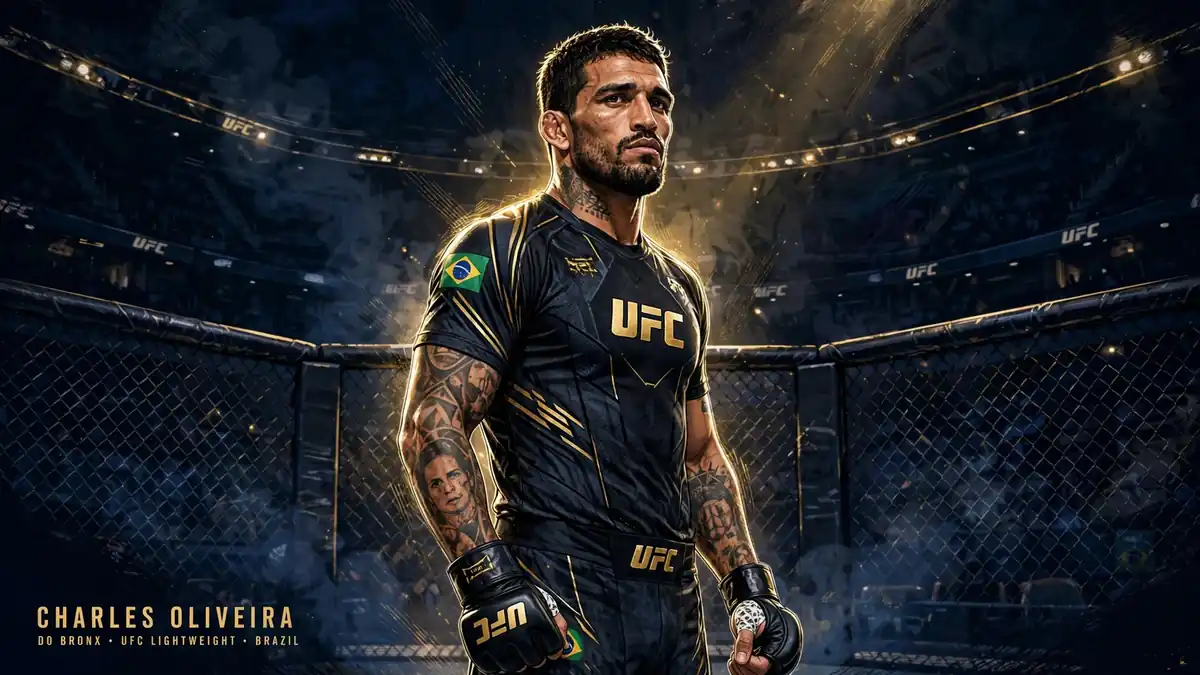
Charles Oliveira‘s net worth is estimated at $5 million to $7 million as of November 2026. The former UFC lightweight champion from Guarujá, Brazil, built that fortune across 16 years in the UFC — more than $14 million in career fight purses, a record 21 finishes, a record 17 submission wins, and a March 2026 win over Max Holloway that added the BMF title to his resume.
Charles Oliveira: Quick Facts
| Estimated net worth | $5 million – $7 million (range: $5 million – $7 million) |
|---|---|
| Profession | Professional mixed martial artist, former UFC Lightweight Champion, current BMF titleholder |
| Nationality | Brazilian |
| Born | October 17, 1989 (age 37) |
| Height | 5 ft 10 in (178 cm) |
| Primary income sources | UFC fight purses, pay-per-view points, performance bonuses, endorsements, appearances |
| Active years | 2008–present (UFC debut 2010) |
| Last reviewed | November 2026 |
- Quick Facts
- Early Life and Background
- Education
- Career Journey
- Rise to Fame
- Main Sources of Income
- Salary and Earnings
- Businesses and Investments
- Brand Deals and Sponsorships
- Houses, Cars and Other Assets
- Awards and Achievements
- Net Worth Growth Over the Years
- Social Media Presence
- Personal Life
- Sources & Reporting
- Frequently Asked Questions
- Final Thoughts
Early Life and Background
Charles Oliveira da Silva was born on October 17, 1989, in the Vicente de Carvalho favela of Guarujá, a port town in São Paulo state, Brazil. His parents, Ozana Oliveira and Luiz Oliveira, raised him in a neighbourhood where money was scarce and opportunity scarcer. The family home sat in a community better known for hardship than for producing world champions, and Oliveira has never hidden where he came from — his nickname, “Do Bronx”, is a direct nod to the Bronx-like streets of his childhood.
As a child, Oliveira dealt with rheumatic fever and a heart murmur, conditions that kept him away from sport for a time and left doctors cautious about his physical activity. He has spoken in interviews about those early health scares shaping his outlook: a boy told to take it easy grew into a fighter famous for never taking a backward step. When he did get moving, it was through a neighbourhood social project that offered free Brazilian jiu-jitsu classes to local children. He was 12 years old when he first stepped onto the mats, and the sport gave him structure his surroundings could not.
The gym belonged to the Macaco Gold Team, run by coach Jorge Patino, known as “Macaco”. Training was free for kids from the favela, and Oliveira took to grappling with a speed that surprised even his coaches. Within a few years he was winning junior jiu-jitsu competitions across São Paulo state, collecting medals while still living in the same streets he had grown up in. The discipline of the mats — showing up daily, cutting weight, learning to lose without quitting — became the foundation of everything that followed.
By his late teens, Oliveira had shifted his focus to mixed martial arts. He turned professional in 2008 at 18 years old, fighting on small regional cards in Brazil where purses were measured in hundreds of dollars rather than thousands. He won his first 12 professional fights, every one of them by stoppage — knockouts and submissions in equal measure — and the run earned him a reputation as the most dangerous young finisher in Brazilian MMA. The UFC noticed. In 2010, still only 20, he signed with the promotion and made his debut that August against Darren Elkins, winning by submission and collecting a Submission of the Night bonus in his very first appearance.
What makes the early story matter for his money story is the starting point. Oliveira did not arrive in the UFC with a college wrestling pedigree, a wealthy backer, or a famous gym behind him. He arrived from a favela gym that charged nothing, and his first UFC paychecks were modest by modern standards — his earliest disclosed purse, for the Elkins fight, was $12,000 including a $6,000 win bonus, according to Salary Sport’s commission records. The distance between that $12,000 night in 2010 and the seven-figure paydays of his title run is the whole arc of his fortune.
Education
There is no public record of Charles Oliveira attending university or completing formal higher education, and no credible profile claims otherwise. His schooling was the state system in Guarujá, and his real education happened on the mats of the Macaco Gold Team gym and, later, in the UFC’s performance institutes and fight camps. That matters because it frames how he learned his trade: not through classrooms, but through thousands of hours of live grappling against better opponents.
He earned his Brazilian jiu-jitsu black belt under Jorge Patino, and Wikipedia lists him as a fourth-degree black belt as of 2026 — a rank that takes well over a decade of continuous training and teaching to reach. In practical terms, the black belt is his credential. It is the qualification that underpins his record 17 submission wins in the UFC, and it is the skill that has paid him more directly than any diploma could: submission bonuses, title fights, and pay-per-view points all trace back to the grappling he learned for free as a 12-year-old.
Since reaching the top of the sport, Oliveira has turned that education outward. The institute he founded in Guarujá in 2012 offers free jiu-jitsu, tutoring, and meals to children from the same neighbourhoods he grew up in — a direct copy of the social-project model that took him in. His coaches and teammates describe him as a constant student of the sport even now, at 37, drilling new positions between camps and cornering younger fighters from his team. The classroom never really ended; it just moved into the gym he now helps to run.
Career Journey
Oliveira’s professional career splits cleanly into three acts: the Brazilian regional run, a long and uneven UFC apprenticeship, and the late-blooming title run that made him rich. The first act lasted from 2008 to 2010. Fighting for promotions such as Predador FC and Jungle Fight, he went 12-0 with every win by finish, a streak that remains one of the most violent introductions to professional MMA by any future UFC champion. The purses were tiny, but the tape was undeniable.
The second act began on August 1, 2010, with his UFC debut against Darren Elkins at UFC Live: Jones vs. Matyushenko. He won by armbar in the first round and took home Submission of the Night. What followed was a decade of brilliance mixed with frustration. Oliveira beat respected names — Efrain Escudero, Jonathan Brookins, Jeremy Stephens, Myles Jury — and collected bonus after bonus, but he also lost to the division’s elite: Frankie Edgar at UFC 162 in 2013, Cub Swanson, Anthony Pettis, Max Holloway in 2015, and Paul Felder. He missed weight several times, which cost him money and momentum, and he twice dropped to featherweight and back. Through it all, one pattern held: when he won, he usually finished, and when he finished, the UFC paid him a $50,000 bonus.
For readers who want the full fight-by-fight story of those years, Charles Oliveira’s full biography and career timeline on our sister site GuideNetWorth covers his early career in detail. The short version is that by 2018, after eight years in the UFC, Oliveira was a respected veteran with a reputation for excitement and a bank balance that did not match his talent. His purses were still in the tens of thousands per fight, and the lightweight title felt far away.
The turn came in 2019 and 2020. Oliveira won five straight fights, all by stoppage, including a third-round submission of Kevin Lee in March 2020 in an empty arena during the pandemic — a performance that announced him as a genuine contender. Then, in May 2021, Khabib Nurmagomedov’s retirement left the lightweight title vacant, and Oliveira faced Michael Chandler for it at UFC 262 in Houston. Dropped in the first round, he rallied to stop Chandler by technical knockout early in the second. Eleven years after his debut, at 31 years old, he was UFC lightweight champion.
His first title defence came at UFC 269 in December 2021 against Dustin Poirier, one of the division’s biggest stars. Oliveira survived an early knockdown and submitted Poirier with a standing rear-naked choke in the third round. The win was worth a reported $1,142,000 in disclosed pay, per SurpriseSports, and it confirmed that his championship was no accident. Then came the strangest chapter of his career: in May 2022, ahead of his defence against Justin Gaethje at UFC 274, he weighed in half a pound over the lightweight limit. He was stripped of the title before the fight began — and then beat Gaethje by rear-naked choke in the first round anyway, in a fight that paid him a reported $1,732,000.
Because he had missed weight, the belt stayed vacant, and his next fight was for the empty title against Islam Makhachev at UFC 280 in Abu Dhabi in October 2022. Makhachev submitted him in the second round, and the $1,757,000 Oliveira earned that night — his largest reported payday, per both SurpriseSports and UFCalendar — was cold comfort. He rebuilt with a first-round stoppage of Beneil Dariush at UFC 289 in June 2023 ($1,371,000 reported), then lost a split decision to Arman Tsarukyan at UFC 300 in April 2024, then outpointed Chandler in their rematch at UFC 309 in November 2024 ($1,071,000 reported) in a five-round war that won Fight of the Night.
The setback that hurt most came at UFC 317 in June 2025, when he challenged Ilia Topuria for the vacant lightweight title and was knocked out in the first round. At 35, with two failed title shots in three years, many observers wrote him off as a former champion on the slide. Oliveira answered the only way he knows how: by taking the biggest fight available. On March 7, 2026, he rematched Max Holloway — the man who had beaten him back in 2015 — for the symbolic BMF title at UFC 326 in Las Vegas, and dominated all five rounds to win a unanimous decision, 50-45 on all three judges’ cards, per the UFC’s official scorecards. The win made him the BMF titleholder and, at 36, put him back in the lightweight title picture. His next assignment is already set: a BMF title defence against Diego Lopes at UFC 335 on December 12, 2026.
Rise to Fame
Oliveira’s rise was slow by UFC standards, and that slowness is central to understanding his wealth. Most champions arrive young and cash in early; Oliveira spent a decade as a mid-card attraction before his pay caught up with his ability. His fame grew in stages, each one tied to a finish that travelled far beyond MMA’s core audience.
The first stage was the bonus machine. Between 2010 and 2018, Oliveira collected Performance of the Night and Submission of the Night awards at a rate no other fighter matched, and each $50,000 cheque added up. UFCalendar’s purse tracking credits him with about $940,000 in bonus money alone across his career, while Sportskeeda’s reporting puts the total above $1.07 million — either way, it is a sum most fighters never approach. Fans learned his name because his fights rarely went to the judges: 21 of his UFC wins ended inside the distance, the most finishes in the promotion’s history.
The second stage was the title. Winning the lightweight belt at UFC 262 changed his commercial value overnight. Champions get pay-per-view points, bigger show money, and main-event slots, and Oliveira’s purses jumped from the low six figures into seven figures. The Poirier defence at UFC 269 was one of the best-selling lightweight pay-per-views of its year, and the Gaethje fight at UFC 274 — even with the weight-miss stripping him of the belt — paid him more than any fight before it. His record after the title win tells the story of a fighter who stayed relevant at the very top: wins over Poirier, Gaethje, Dariush, and Chandler, losses only to Makhachev, Tsarukyan, and Topuria, all of them champions or title challengers.
The third stage is the one unfolding now. The BMF title win over Holloway at UFC 326 in March 2026 was the most-watched moment of Oliveira’s career in Brazil, where he is a genuine mainstream celebrity, and it reset his market value at an age when most lightweights are retired. The UFC’s official scorecards show a clean sweep — 50-45, 50-45, 50-45 — and the performance, five takedowns and more than 20 minutes of control time, reminded promoters that he can still headline a pay-per-view. As of late 2026 he sits at No. 3 in the UFC lightweight rankings, per Wikipedia’s citation of the Meta UFC rankings, and his December defence against Diego Lopes at UFC 335 is positioned as one of the year’s final big cards.
His fame also rests on something money cannot buy: he is, by the numbers, the most prolific finisher the UFC has ever employed. The records he holds — most submission wins (17), most finishes (21), most post-fight bonuses (21) — are the kind that get quoted every time he fights, and they keep his name in the conversation even between camps. Fighters with records like that do not fade quietly, and promoters pay for the certainty that an Oliveira fight will end with someone tapping or going to sleep.
Main Sources of Income
Oliveira’s money comes from five streams, and fight purses dominate them. The breakdown below reflects the best available reporting as of November 2026, and the salary section that follows puts hard numbers on the biggest stream.
UFC fight purses are the foundation. UFCalendar’s model, which combines athletic-commission disclosures with its own estimates for undisclosed bouts, puts his career fight earnings at roughly $14,253,800 — $11,696,800 recorded across 34 fights, plus about $2,557,000 in model estimates for three fights no commission ever disclosed. SurpriseSports, working from the same public record, puts recorded career earnings above $12 million. Either way, purses account for the large majority of his lifetime income, and his recent main-event paydays of $1 million or more per fight are what pushed his net worth into the $5–$7 million range.
Pay-per-view points sit on top of show money for his championship and main-event fights. The UFC does not disclose PPV splits, so no outlet can give an exact figure, but the structure is well understood: champions and headliners on pay-per-view cards earn a share of buys above a threshold, and the reporting around Oliveira’s recent fights consistently puts his total per-fight compensation at $1.5 million to $2.5 million once PPV money is included, per BollywoodShaadis’ March 2026 reporting. That gap between his disclosed purse and his real take-home is the single biggest reason net-worth estimates for fighters vary so widely.
Performance bonuses are the third stream, and Oliveira is the most successful bonus hunter in UFC history. His 21 bonuses — each worth $50,000 under the old structure, and $100,000 for Performance of the Night under the new bonus structure introduced in 2026, per SillySeason’s UFC 326 payout reporting — add up to roughly $1 million across his career. No other fighter has turned the bonus system into a revenue line the way he has.
Endorsements and sponsorships form the fourth stream, and it has grown sharply since 2024. The UFC’s Venum outfitting deal pays him $21,000 in compliance pay per bout, per UFCalendar, but his outside deals are worth far more — his February 2026 appointment as an Aviator brand ambassador for SPRIBE, the gaming company behind the UFC’s Octagon branding, put him on a roster alongside Alex Pereira and Arman Tsarukyan, and his deals with Life Strong Energy Drink, MuscleMeds, and Project Rock, tracked by Booking Agent Info, show a fighter whose commercial appeal now extends well beyond fight week. BollywoodShaadis’ March 2026 reporting put his annual endorsement income at $500,000 to $1 million.
Appearances and media round out the picture. Oliveira appeared as an Aviator ambassador at SBC Summit 2026 in Lisbon in September and October 2026, taking the Super Stage alongside figures such as Michael Jordan and DraftKings chief Jason Robins, per Canadian Gaming Business — paid keynote and meet-and-greet work that did not exist for him five years ago. A biopic of his life is in development with 405 Films, per The Borgen Project, which could add a further income line if it reaches production. For context on how the very top of the sport monetises fame, our athletes section covers fighters and sports stars whose endorsement machines dwarf their purses — Oliveira is now moving in that direction, even if his purses still do most of the work.

Salary and Earnings
Oliveira’s salary history is a study in delayed gratification. His earliest disclosed purses, tracked by Salary Sport from state athletic commission filings, show just how far he has come: $12,000 for his UFC debut against Darren Elkins in August 2010 ($6,000 to show, $6,000 to win), $32,000 against Jonathan Brookins in 2012, $54,000 against Jeremy Stephens in 2014, and $66,600 against Myles Jury in December 2015. Salary Sport holds only five of his purses on record — the UFC’s pay is private for most events, and Nevada and California disclose only selectively — which is why model-based estimates such as UFCalendar’s matter so much to any honest accounting of his earnings.
The modern pay scale looks nothing like those early numbers. Multiple outlets reporting in March 2026 put Oliveira’s base pay per fight at $750,000 to $1 million, before pay-per-view points and bonuses. BollywoodShaadis, citing multiple reports, put his total per-fight compensation at $1.5 million to $2.5 million for recent main events, while SillySeason’s pre-fight estimate for UFC 326 put his guaranteed purse alone at $1.5 million to $2.5 million, with a $100,000 Performance of the Night bonus available on top under the UFC’s new 2026 bonus structure. UFCalendar’s model estimates his typical show money at about $878,000 per fight, with a range of $636,000 to $1,212,000 depending on the card.
The fight-by-fight purse table below uses the reported figures carried by SurpriseSports and Parties365, which draw on commission disclosures and contemporaneous reporting. Figures are disclosed or reported pay for the bout, excluding most pay-per-view money and locker-room bonuses the UFC does not publish.
| Event | Opponent | Reported purse |
|---|---|---|
| UFC 262 (May 2021) | Michael Chandler | $557,000 |
| UFC 269 (Dec 2021) | Dustin Poirier | $1,142,000 |
| UFC 274 (May 2022) | Justin Gaethje | $1,732,000 |
| UFC 280 (Oct 2022) | Islam Makhachev | $1,757,000 |
| UFC 289 (Jun 2023) | Beneil Dariush | $1,371,000 |
| UFC 300 (Apr 2024) | Arman Tsarukyan | $750,000 |
| UFC 309 (Nov 2024) | Michael Chandler | $1,071,000 |
| UFC 317 (Jun 2025) | Ilia Topuria | $1,320,000 |
Year by year, SurpriseSports’ tally of his UFC purses shows the shape of his prime: $1.699 million in 2021, $3.489 million in 2022 — the year of the Gaethje and Makhachev paydays — $1.371 million in 2023, and $1.821 million in 2024. The 2022 figure alone exceeds his entire career earnings from his first eight years in the UFC, which is the clearest single illustration of what the title did for his bank balance.
To put those numbers in perspective, the gap between Oliveira and the sport’s richest star remains enormous. Conor McGregor’s fortune, built on pay-per-view superstardom and his Proper No. Twelve whiskey sale, is reported at around $200 million — roughly thirty times Oliveira’s estimated net worth. The comparison is instructive rather than discouraging: McGregor is the exception in MMA, and Oliveira’s $14 million-plus in career purses places him comfortably among the best-paid lightweights ever, ahead of most of the division’s former champions. His earnings also compare well with boxing’s pay scale at the lighter weights, though they sit far below the nine-figure paydays of a heavyweight draw such as Floyd Mayweather, whose exhibition-era purses rewrote what a single fight can pay.
One more number deserves attention because it explains why Oliveira’s net worth is lower than his career earnings might suggest. Fighters pay their teams, managers, coaches, and taxes out of gross purses, and a common rule of thumb in the sport is that a fighter keeps roughly half of a disclosed purse after those costs. Apply that to $14.25 million in career purses and the $5–$7 million net worth range starts to look exactly right — it is, in effect, the after-costs residue of a 16-year career, topped up by endorsements and bonuses.
Businesses and Investments
Oliveira is not known as a businessman in the way some fighters are — he has no whiskey brand, no gym franchise, and no public investment portfolio — and it would be dishonest to pretend otherwise. What he has built is smaller, closer to home, and arguably more durable: a community institution and a personal brand rooted in the neighbourhood that raised him.
The centrepiece is the Instituto Charles do Bronx, which he founded in Guarujá in 2012, while he was still a mid-card UFC fighter earning modest purses. The institute offers free jiu-jitsu classes, education, nutrition support, and mentorship to underprivileged young people in São Paulo state, and The Borgen Project reports it has served more than 150 young people, expanding in 2023 to add sign-language classes and academic tutoring. Oliveira funds much of it himself and trains there between camps. It is a cost as much as a business — but it is also the asset that underpins his public image in Brazil, where brands increasingly pay for authenticity rather than reach alone.
That image paid off in 2025, when the UFC named Oliveira the winner of its Forrest Griffin Community Award, the promotion’s annual honour for charitable work, personally selected by UFC chief executive Dana White. The award was presented during the UFC Hall of Fame ceremony in June 2025 and came with a $25,000 donation to his chosen charity, per MMA UK. Awards of this kind do not carry a direct paycheque, but they change how sponsors value a fighter — and Oliveira’s endorsement roster expanded noticeably in the months that followed.
On the media side, a biopic chronicling his rise from the favelas to UFC gold is in development with 405 Films, per The Borgen Project. Film projects at this stage are speculative income — most never reach production — so we count it as potential rather than money in the bank. If it does get made, it would be his first meaningful income stream unrelated to fighting, and a sign that his story has commercial value beyond the cage.
What about property and financial investments? No public records tie Oliveira to a property portfolio, a stock portfolio, or a startup stake, and no credible outlet has reported one. Brazilian fighters of his generation commonly hold wealth in real estate in their home towns, and Oliveira owns his home in Guarujá, but anything beyond that is speculation and we do not publish it as fact. His wealth, as far as the public record shows, sits in fight earnings, endorsements, and the institute — not in a diversified portfolio. That concentration is a risk the net-worth range already reflects: when the fighting stops, the purses stop with it, which is why the BMF title defence in December 2026 matters so much to his finances.
Brand Deals and Sponsorships
Oliveira’s sponsorship story has two eras. In the first, he wore what the UFC told him to wear: the Reebok outfitting deal that ran from 2015 to 2021, then the Venum deal that replaced it. Under the Venum arrangement, his compliance pay — the UFC’s term for the outfitting fee — is $21,000 per bout, per UFCalendar. That is real money, but it is a fraction of what a star of his standing earns from outside deals, and it explains why fighters of his generation pushed so hard for the right to sign their own sponsors.
The second era began in earnest in 2024. Booking Agent Info, which tracks celebrity endorsements, lists five current or recent deals for Oliveira: Life Strong Energy Drink and MuscleMeds, both signed in July 2024, and Project Rock — Dwayne Johnson’s training-apparel line — which began in August 2025. The Project Rock deal is notable because it places Oliveira on a roster built around Johnson’s brand, a signal that his image now travels beyond MMA’s core audience.
The biggest deal of his career arrived in February 2026, when SPRIBE, the gaming company behind the Aviator crash game, announced Oliveira as its latest brand ambassador. The announcement, covered by iGaming Business and G3 Newswire, described a 12-month campaign of marketing activations aimed at Brazil and other international markets, with Aviator counting more than 77 million unique active players a month. The deal sits inside SPRIBE’s multi-year, multi-million-dollar marketing partnership with the UFC, which includes a brand ambassador fund for fighters — Oliveira joined a roster that includes Alex Pereira, Arman Tsarukyan, Diego Lopes, and Merab Dvalishvili. The companies do not disclose what ambassadors are paid, so we do not put a number on it; what matters is that it is his first deal structured as a year-long ambassador role rather than a one-off appearance, and it arrived the month before his BMF title win, when his commercial stock was rising fastest.
BollywoodShaadis’ March 2026 reporting, which also named Stake among his sponsors, put his annual endorsement income at $500,000 to $1 million. That range is plausible for a fighter of his profile in 2026: below the multi-million-dollar deals of crossover stars such as Cristiano Ronaldo, whose endorsement income runs into nine figures, but comfortably ahead of most UFC fighters, who earn little or nothing outside the promotion. His September 2026 appearance at SBC Summit in Lisbon — a paid keynote and meet-and-greet as an Aviator ambassador, sharing a stage programme with Michael Jordan — shows the same trajectory: the deals are becoming events, not just logos.
The honest caveat is that endorsement income in MMA is lumpy. A loss can cool a brand’s interest overnight, and a fighter’s commercial value is tied to his next fight as much as his last one. Oliveira’s December 2026 defence against Diego Lopes is therefore a commercial event as well as a sporting one: a win keeps the ambassador deals flowing, while a loss would slow them. His net worth range already prices in that uncertainty.

Houses, Cars and Other Assets
Oliveira still lives in Guarujá, near the Vicente de Carvalho neighbourhood where he grew up, and that choice says a lot about how he handles money. Fighters who make millions often relocate to Las Vegas or Miami; Oliveira stayed home, close to his family, his gym, and his institute. His house in Guarujá is his primary residence, and while Brazilian property records for it are not public in the sources we reviewed, the home is consistently described in profiles as a family house rather than a showpiece mansion.
His most publicised possession is a Ferrari Portofino, the 600-horsepower grand tourer that EssentiallySports singled out in its March 2026 lifestyle profile as his prized car. The Portofino, which retails from around $250,000, is the kind of purchase that marks the transition from contender to champion: bought after his title run, photographed often, and a fixture of his social media. Beyond the Ferrari, there is no reliable public inventory of his garage, and we do not invent one — profiles that list half a dozen supercars for Oliveira are guessing, and the guesswork is usually wrong.
Other assets are harder to pin down, which is normal for a Brazilian athlete whose wealth is held privately. He owns training equipment and a stake in the gym infrastructure around his team, and his fight-worn memorabilia — gloves, shorts, and the BMF belt itself — carries collector value, though none of it has been sold publicly. The BMF belt, a symbolic title rather than a divisional championship, is not a financial asset in the conventional sense, but it is the single most valuable object he owns in commercial terms: it guarantees him main-event slots, and main-event slots are what pay seven figures.
The overall picture is of a fighter who spends modestly by the standards of his income. No yacht, no reported property empire, no fleet of supercars in the press — just a house in his home town, a Ferrari, and a community institute that absorbs a meaningful share of his money. That restraint is part of why the $5–$7 million estimate holds together: his lifetime earnings are large, his visible spending is not, and the gap between the two is where net worth lives.
Awards and Achievements
Oliveira’s record book is the strongest part of his case for a place among the sport’s greats, and it is also the most verifiable. The numbers below come from the UFC’s own records and from Sherdog’s fight database as cited by Wikipedia, and they are current as of November 2026.
- Former UFC Lightweight Champion — won the vacant title against Michael Chandler at UFC 262, May 15, 2021; defended once, against Dustin Poirier at UFC 269.
- Current BMF titleholder — beat Max Holloway by unanimous decision (50-45, 50-45, 50-45) at UFC 326, March 7, 2026; first defence scheduled against Diego Lopes at UFC 335, December 12, 2026.
- Most submission wins in UFC history — 17, ahead of every other fighter in the promotion’s 30-plus years.
- Most finishes in UFC history — 21, a record that spans knockouts and submissions.
- Most post-fight bonuses in UFC history — 21, worth roughly $1 million in bonus money across his career.
- 2025 Forrest Griffin Community Award — the UFC’s annual honour for charitable work, presented at the Hall of Fame ceremony in June 2025, with a $25,000 donation to his institute.
- Professional record 37-11-1 across 49 fights, with 22 wins by submission, 10 by knockout, and 5 by decision (Sherdog, via Wikipedia).
- Ranked No. 3 in the UFC lightweight division as of January 2026, and No. 15 on the pound-for-pound list as of June 2026.
The submission record deserves a closer look because it is the achievement that defines him. Seventeen submission wins in the UFC is not just a record — it is a record by a wide margin, built across 16 years against every style the division could offer: wrestlers, strikers, and fellow grapplers alike. His rear-naked choke has ended title fights against Poirier and Gaethje, and his guillotine and triangle finishes fill highlight reels that the UFC replays before every one of his fights. For a fighter whose pay depends on excitement, that record is a commercial asset in its own right.
Net Worth Growth Over the Years
Nobody publishes Oliveira’s tax returns, so a year-by-year net worth table built from primary documents does not exist — and any site that prints one is inventing numbers. What the public record does support is a table of his disclosed career purses by year, which tracks the growth of his earning power, alongside the milestones that drove it. SurpriseSports’ year-by-year purse tally, combined with UFCalendar’s career total, gives the following picture:
| Period | Reported UFC purses | What changed |
|---|---|---|
| 2010–2015 | Tens of thousands per fight | UFC debut and apprenticeship; earliest disclosed purse $12,000 in 2010 |
| 2016–2020 | Five-figure purses, rising | Bonus machine years; five-fight finishing streak into 2020 |
| 2021 | $1,699,000 | Won lightweight title at UFC 262; defended against Poirier at UFC 269 |
| 2022 | $3,489,000 | Gaethje win and Makhachev title fight — his two biggest paydays |
| 2023 | $1,371,000 | Dariush win at UFC 289; one fight that year |
| 2024 | $1,821,000 | Tsarukyan loss at UFC 300; Chandler rematch win at UFC 309 |
| 2025–2026 | $1,320,000 reported for UFC 317; UFC 326 purse undisclosed | Topuria title loss, then BMF title win over Holloway; SPRIBE deal signed |
Three things stand out. First, the money arrived late: more than half of his career purses came after he turned 31, which is unusual in a sport where most stars peak in their twenties. Second, 2022 was the outlier year — $3.489 million in a single calendar year, driven by two seven-figure paydays in the space of six months. Third, the trajectory after the Topuria loss in June 2025 could easily have gone the other way; instead, the Holloway win and the SPRIBE ambassadorship rebuilt his earning power within nine months, which is why the current $5–$7 million estimate sits higher than the $3 million figure Celebrity Net Worth still carries.
That stale $3 million figure is worth addressing directly, because readers will find it. Celebrity Net Worth’s page, as cited by EssentiallySports in March 2026, lists Oliveira at $3 million — but the figure predates his title run’s biggest paydays and the BMF win, and it sits well below the $5.5 million Wealthy Gorilla figure, the $6 million SurpriseSports figure updated in October 2026, and the $5–$7 million range used by two separate outlets in March 2026. When four recent estimates cluster between $5 million and $7 million and one older page says $3 million, the honest conclusion is that the older page has not been updated. The $10 million figure carried by Velontia is the opposite outlier — it appears to count gross career purses as net worth, which no careful estimate does, since fighters pay teams, managers, and taxes from gross pay. Our $5–$7 million range is the middle of the credible cluster, and it is the figure we would defend.
Social Media Presence
Oliveira’s social media following runs into the millions, with Instagram as his main platform, and it is a genuine commercial asset rather than a vanity metric. His posts mix fight camp footage, family moments, institute work, and sponsor content — the SPRIBE Aviator campaigns of 2026 ran heavily through his own channels, which is how modern ambassador deals are structured. Brazilian fighters with his following can command meaningful fees for sponsored posts, and his engagement rates benefit from a fanbase that treats him as a national figure rather than just a sports star.
His online persona is notably different from the trash-talk model that made Nate Diaz famous — Diaz built a fortune on confrontation, while Oliveira built his on warmth. He posts in Portuguese first, replies to fans from Guarujá, and films much of his content at the institute rather than in nightclubs. That tone is part of why brands such as SPRIBE and Project Rock want him: he is trusted in Brazil in a way that a louder fighter might not be. His following also gives him bargaining power the UFC cannot ignore — a champion with millions of Brazilian fans is a pay-per-view draw in the promotion’s fastest-growing market, and that strength shows up in his purse negotiations.
One practical note for readers: Oliveira’s verified accounts are the ones linked from the UFC’s official fighter pages, and impersonator accounts are common around fight week. Sponsor announcements, such as the SPRIBE deal, are worth checking against the brand’s own channels before trusting them — a habit that applies to every fighter’s feed, not just his.
Personal Life
Oliveira married Talita Roberta Pereira in 2014, and the couple’s daughter, Tayla, was born in 2017. Wikipedia’s biography records that he also has a son, Dominic, born on October 5, 2024, with his girlfriend Vitoria Brum. He keeps his family life largely out of the spotlight — his social media shows his children, but he rarely discusses relationships in interviews, and we do not speculate beyond what the public record states.
Outside the cage, his life revolves around Guarujá. He trains at the gym he grew up in, runs the institute a short distance from his childhood home, and has spoken about distributing meal kits to residents of the Prainha community during the COVID-19 pandemic, per The Borgen Project. His mother, Ozana Oliveira, remains a visible presence in his corner on fight nights, and his nickname — “Do Bronx” — is a permanent reminder of the streets that raised him. He is a practising Christian, and he has credited his faith publicly after major wins, including the Holloway victory in March 2026.
The personal detail that best explains his finances is his loyalty to place. Fighters who leave home often spend heavily on new lives in new cities; Oliveira stayed, kept his costs low, and put his money into the institute and his family. That is not a story of deprivation — the Ferrari and the seven-figure paydays are real — but it is a story of a man whose spending never chased his income, which is the simplest explanation for how a fighter with $14 million in career purses still holds an estimated $5–$7 million of it.
Sources & Reporting
Figures in this article were checked against the following reporting, reviewed between March and November 2026. Where outlets disagreed, the article publishes the range and names the disagreeing sources rather than picking one silently.
- SurpriseSports — net worth estimate of $6 million, updated October 10, 2026; career earnings above $12 million; fight-by-fight purse table and year-by-year purse totals (2021–2024).
- PlayersBio — net worth of $5.5 million per Wealthy Gorilla, updated November 2026; biographical details including family, early career record, and base salary of $750,000.
- Parties365 — net worth range of $5–$7 million as of early 2026; career earnings above $14 million; purse table including UFC 317 ($1,320,000) and UFC 280 ($1,757,000).
- BollywoodShaadis — net worth range of $5–$7 million, March 2026; base pay of $750,000–$1 million per fight; total per-fight compensation of $1.5–$2.5 million including pay-per-view; endorsement income of $500,000–$1 million a year.
- UFCalendar — career fight earnings of about $14,253,800 ($11,696,800 recorded across 34 fights plus model estimates); biggest recorded payday $1,757,000 at UFC 280; model show money of about $878,000 per fight; Venum compliance pay of $21,000 per bout.
- EssentiallySports — March 2026 net worth profile citing Celebrity Net Worth’s $3 million figure and explaining why it lags current earnings; UFC 274 purse of $1.73 million; Ferrari Portofino; Max Holloway net worth of $5–$6 million; UFC 326 payout reporting.
- UFC — official scorecards for UFC 326 (Oliveira defeated Holloway by unanimous decision, 50-45, 50-45, 50-45, March 7, 2026); official records for most finishes, submissions, and bonuses.
- Wikipedia — biography drawing on Sherdog’s fight record (37-11-1 across 49 fights); birth details; UFC records (17 submissions, 21 finishes, 21 bonuses); rankings (No. 3 lightweight, No. 15 pound-for-pound); family details.
- Bloody Elbow — UFC 326 result and BMF title change; November 2026 reporting on the UFC 335 defence against Diego Lopes on December 12, 2026.
- MMA Mania — UFC 326 results and matches to make, including the Arman Tsarukyan rematch discussion and the new $100,000 performance bonus structure.
- iGaming Business — SPRIBE’s February 18, 2026 announcement of Oliveira as an Aviator brand ambassador, including the 77-million monthly player figure and the UFC partnership context.
- Canadian Gaming Business — Oliveira’s SBC Summit 2026 appearance as an Aviator ambassador, September–October 2026, Lisbon.
- The Borgen Project — Instituto Charles do Bronx profile: founded 2012, 150-plus young people served, 2023 expansion, 2025 Forrest Griffin Community Award, biopic in development with 405 Films.
- MMA UK — 2025 Forrest Griffin Community Award details, including the $25,000 charity donation and the Hall of Fame ceremony presentation.
- Booking Agent Info — endorsement tracker listing Life Strong Energy Drink, MuscleMeds (July 2024), and Project Rock (August 2025).
- Salary Sport — disclosed commission purses from 2010–2015, including the $12,000 debut purse and the $66,600 Myles Jury purse.
- SillySeason — UFC 326 payout estimates, including the $1.5–$2.5 million guaranteed purse estimate and the new $100,000 performance bonus.
Reporting window: March 2026 – November 2026. Estimates are labelled as estimates throughout; disclosed purses are labelled as reported or recorded, and model-based figures are identified as models, not disclosures.
Frequently Asked Questions
What is Charles Oliveira’s net worth in 2026?
Charles Oliveira’s net worth is estimated at $5 million to $7 million as of November 2026. SurpriseSports puts the figure at $6 million, PlayersBio and Wealthy Gorilla at $5.5 million, and two outlets reporting in March 2026 used the $5–$7 million range. Celebrity Net Worth’s older $3 million figure has not kept pace with his title-run paydays and the BMF title win.
How much does Charles Oliveira make per fight?
His base pay is reported at $750,000 to $1 million per fight, and his total compensation for recent main events — including pay-per-view points — is estimated at $1.5 million to $2.5 million, per BollywoodShaadis’ March 2026 reporting. UFCalendar’s model puts his typical show money at about $878,000 per fight. His largest reported payday was $1,757,000 for the Islam Makhachev fight at UFC 280.
What is Charles Oliveira’s biggest fight purse?
His biggest reported payday was $1,757,000 for UFC 280 against Islam Makhachev in October 2022, a fight he lost by submission in the second round. His next-biggest reported purses were $1,732,000 against Justin Gaethje at UFC 274 and $1,371,000 against Beneil Dariush at UFC 289. These are disclosed or reported purses and exclude most pay-per-view money.
What is Charles Oliveira’s career earnings total?
UFCalendar’s model puts his career fight earnings at roughly $14,253,800 — $11,696,800 recorded across 34 fights, plus about $2,557,000 in model estimates for three fights no commission disclosed. SurpriseSports puts recorded career earnings above $12 million. Both totals cover fight purses only, not endorsements or pay-per-view shares that were never disclosed.
How many UFC records does Charles Oliveira hold?
He holds three major UFC records: most submission wins (17), most finishes (21), and most post-fight bonuses (21). His professional record stands at 37 wins, 11 losses, and 1 no-contest across 49 fights, with 22 wins by submission, 10 by knockout, and 5 by decision.
Who is Charles Oliveira’s wife?
Charles Oliveira married Talita Roberta Pereira in 2014, and the couple’s daughter, Tayla, was born in 2017. He also has a son, Dominic, born on October 5, 2024. He keeps his family life largely private and continues to live in his home town of Guarujá, Brazil.
Did Charles Oliveira beat Max Holloway at UFC 326?
Yes. On March 7, 2026, Oliveira beat Max Holloway by unanimous decision — 50-45 on all three judges’ cards — to win the BMF title at UFC 326 in Las Vegas. It was a rematch of their first meeting in 2015, which Holloway won, and it set up Oliveira’s BMF title defence against Diego Lopes at UFC 335 on December 12, 2026.
How tall is Charles Oliveira?
Charles Oliveira is 5 ft 10 in (178 cm) tall, with a 74-inch (188 cm) reach, and he competes in the UFC lightweight division at 155 lb. He was born on October 17, 1989, in Guarujá, São Paulo, Brazil, which makes him 37 years old as of November 2026.
Final Thoughts
Charles Oliveira’s $5–$7 million net worth is the honest residue of one of the longest, hardest roads in UFC history. He did not arrive rich, young, or connected — he arrived from a favela gym that charged nothing, earned $12,000 for his first UFC fight, and spent a decade collecting $50,000 bonuses while the title felt out of reach. The money came late, in his thirties, when the championship, the pay-per-view points, and the seven-figure purses finally matched the talent. The BMF title win over Holloway in March 2026 and the SPRIBE ambassadorship that preceded it show a fighter whose earning power is still rising at 37, not fading. If he beats Diego Lopes in December and earns another title shot, the range will move up; if he loses, it will hold roughly where it is. Either way, the record books already say what the bank balance confirms: no fighter in UFC history has finished more opponents, submitted more opponents, or been bonused more often than Charles Oliveira — and that consistency, more than any single payday, is what built his fortune.
Published on November 14, 2026. Last reviewed November 2026. Found an error? See our corrections policy.