
Vincent D’Onofrio‘s net worth is estimated at $14 million to $30 million as of November 2026. The most quoted figure, $14 million from Celebrity Net Worth, sits at the bottom of the range; InfoSeeMedia puts him at $20 million, and Finance Monthly stretches the estimate to $30 million once residuals and long-running syndication income are counted. Nobody outside his own household knows the exact number — D’Onofrio has never confirmed a figure — but the shape of the fortune is clear: a decade as the highest-profile detective on network television, a film career that runs from Stanley Kubrick to a billion-dollar dinosaur franchise, and a second act as Marvel’s Wilson Fisk that carried him from Netflix in 2015 all the way to a mayoral storyline on Disney+ in 2026.
Vincent D’Onofrio: Quick Facts
| Estimated net worth | $20 million (range: $14 million to $30 million) |
|---|---|
| Profession | Actor, director, producer, screenwriter |
| Nationality | American |
| Born | June 30, 1959 (age 67) |
| Height | 6 feet 3 inches (192 cm) |
| Primary income sources | Television salaries, film salaries, residuals and syndication, Marvel franchise work, directing and producing |
| Active years | 1983–present |
| Last reviewed | November 2026 |
- Early Life and Background
- Education
- Career Journey
- Rise to Fame
- Main Sources of Income
- Salary and Earnings
- Businesses and Investments
- Brand Deals and Sponsorships
- Houses, Cars and Other Assets
- Awards and Achievements
- Net Worth Growth Over the Years
- Social Media Presence
- Personal Life
- Sources & Reporting
- Frequently Asked Questions
Early Life and Background
Vincent Philip D’Onofrio was born on June 30, 1959, in Bensonhurst, Brooklyn, New York, the youngest of three children and the only son of Gene D’Onofrio, an interior designer and theatre production assistant, and Phyllis Meyer. His parents divorced while he was still young, and the split shaped a childhood spent moving. His mother remarried George Meyer, and the family lived for stretches in Hawaii and in the Miami area of Florida, where D’Onofrio spent much of his teenage years. The moves gave him a restless, observant streak that later showed up in his acting: he has described himself as a kid who learned to read rooms quickly because he kept entering new ones.
Before acting paid anything, D’Onofrio worked the kind of jobs that fill a young New Yorker’s twenties. The best known was as a bouncer at the Hard Rock Cafe in Manhattan, a job that put a skinny, 190-pound kid in charge of a door full of strangers. He has told interviewers that the work taught him how to size people up in seconds — a skill that later fed directly into his portrayal of Detective Robert Goren, a character whose whole method is reading suspects. He also did bodyguard work, including for the singer Robert Plant. The rest of the pre-fame years were spent in acting classes and off-Broadway rooms, scraping together rent while waiting for a break that took the better part of a decade to arrive.
His family background is Italian-American on his father’s side, and D’Onofrio has spoken about growing up in a household where theatre and design were ordinary dinner-table subjects. His father worked in theatre production, so the stage was never a distant idea. Two older sisters, Antoinette and Elizabeth, completed a household that valued performance without ever treating it as a safe career. That tension — a practical family, an impractical ambition — runs through the first ten years of his working life, and it explains why his breakthrough, when it came, arrived with a physical commitment most actors would refuse.
Education
D’Onofrio did not take a conventional university route into acting. After high school in Florida, he returned to New York and trained at the American Stanislavski Theatre, where he studied the Stanislavski method that prizes emotional memory and lived-in behaviour over surface performance. He later continued his training at the Actors Studio, the New York institution that has shaped generations of American screen actors, and he has remained connected to the Studio throughout his career, eventually serving in leadership roles there.
The training mattered more than any diploma. Stanislavski work is slow, repetitive and physical, and it suited an actor who would later rebuild his body for a role and spend months inside a single character’s walk and voice. His Broadway debut came in 1984 in Open Admissions, and the early stage credits that followed — including work at the Public Theater — gave him the stage discipline that casting directors noticed. Stage work paid little, and D’Onofrio has been open about the lean years: the bouncer shifts, the shared apartments, the auditions that went nowhere. What the classes gave him was a method for turning that grind into usable craft, and the audition tape that changed his life was made with the same do-it-yourself spirit — he rented a video camera, recorded himself in a borrowed space, and mailed the tapes to England.
Career Journey
D’Onofrio’s screen career began in the mid-1980s with small film parts, but the role that made him was the one almost nobody else wanted. In 1986, on a tip from Full Metal Jacket co-star Matthew Modine, he mailed audition tapes to Stanley Kubrick in England. It took four tapes to win the part of Private Leonard “Gomer Pyle” Lawrence, the overweight, clumsy Marine recruit at the centre of the film’s harrowing first half. Kubrick had rethought the character as a big, soft man, and D’Onofrio agreed to become him: he gained 70 pounds, climbing from roughly 200 pounds to about 280 pounds, and shaved his head. The gain beat even Robert De Niro’s famous 60-pound transformation for Raging Bull, and it came at a price — D’Onofrio injured his left knee on the film’s obstacle course, and the extra weight made the damage bad enough to need surgical reconstruction. It took him nine months after filming to lose nearly all the weight.
Full Metal Jacket opened in 1987 to critical acclaim, and D’Onofrio’s performance was singled out as the film’s emotional core. The trouble with a debut that strong is that it stamps an actor. For the next decade he worked steadily but often in the shadow of Pyle, taking roles that used his size and his willingness to vanish into a part: the fiancé in Mystic Pizza (1988), a hungry screenwriter in Robert Altman’s The Player (1992), Bill Newman in Oliver Stone’s JFK (1991), a small turn in Spike Lee’s Malcolm X (1992), and Orson Welles — twice, in Ed Wood (1994) and the short film Five Minutes, Mr. Welles (2005). The role that proved his range as a leading man came in The Whole Wide World (1996), where he played pulp writer Robert E. Howard; he also produced the film, an early sign of the behind-the-camera ambitions that would later become a second income stream. Critics praised the performance, and the film picked up festival attention, but it was a small independent release — the kind of work that builds a reputation without building a bank balance.
Then came the bug. In Barry Sonnenfeld’s Men in Black (1997), D’Onofrio played Edgar, a farmer whose body is hijacked by an alien creature. He studied insects to build the character’s jerky movement and wore knee braces that locked his legs to force the unnatural gait. The film grossed about $589 million worldwide, and his performance became one of the most quoted turns in 1990s blockbuster cinema. He returned to the character’s voice in Men in Black: The Series (1997–2001). Three years later he played the serial killer Carl Stargher in The Cell (2000), a visually extreme thriller that grossed about $104 million worldwide and confirmed his gift for playing men who frighten audiences without raising their voices. He gained weight again for The Salton Sea (2002), a pattern that would follow him for years: directors kept asking his body to do the acting, and he kept saying yes.
Television changed the economics of his career. In 2001 he took the role of Detective Robert Goren on Law & Order: Criminal Intent, the third series in Dick Wolf’s franchise. The show ran for ten seasons and 195 episodes, and D’Onofrio appeared in 141 of them. Goren was unlike any TV detective of the era: a brilliant, socially awkward interrogator who solved cases by understanding the criminal’s mind better than the criminal did. The role demanded an enormous workload — D’Onofrio has described staying two days ahead on dialogue — and the grind took a visible toll. In 2004 he collapsed on set and at home and was diagnosed with exhaustion. By season five, in 2006, production split the 22-episode order between two detective teams, bringing in Chris Noth’s Mike Logan and Annabella Sciorra’s Carolyn Barek so D’Onofrio and co-star Kathryn Erbe could work alternate episodes. He left after season eight, returned for the tenth and final season in 2011, and the show’s syndication afterlife — it still airs in reruns and on streaming services around the world — is the quiet engine behind much of his wealth. Actors in long-running procedurals earn residuals every time an episode re-airs, and 141 episodes of a hit franchise is a durable asset.
After Criminal Intent ended, D’Onofrio kept working across film and television without chasing the spotlight: supporting turns in Charlie’s Angels (2000) and The Break-Up (2006), a season on Godfather of Harlem (2019–2023) as mob boss Vincent Gigante, and Governor George Wilburn in Ryan Murphy’s Ratched (2020). The biggest film payday of this period came from Jurassic World (2015), where he played Vic Hoskins, the head of InGen’s security operation. The film grossed about $1.67 billion worldwide, the third-highest-grossing film of its year, and put D’Onofrio in front of the largest audience of his career. He also moved behind the camera in earnest: he directed the western Don’t Go in the Woods (2010) and then The Kid (2019), a western starring Ethan Hawke, Dane DeHaan and Chris Pratt, which he also produced. Directing pays less than starring in a franchise film, but it pays in a different way — fees, producer points, and a reputation that keeps the phone ringing when acting roles thin out.
Rise to Fame
D’Onofrio’s fame arrived in three separate waves, and each one paid differently. The first wave was Full Metal Jacket in 1987: critical fame, the kind that gets an actor remembered by directors but does not fill a bank account. The film’s box office was modest by blockbuster standards, and D’Onofrio spent the next several years proving he was more than one role. The second wave was Men in Black in 1997 and Law & Order: Criminal Intent from 2001: commercial fame, the kind that comes with a salary that can be negotiated upward season after season. By the middle of the Criminal Intent run he was, by the widely repeated reports, earning about $350,000 per episode at his peak — the kind of money that turns a working actor into a wealthy one, especially across a ten-season run with residuals attached.
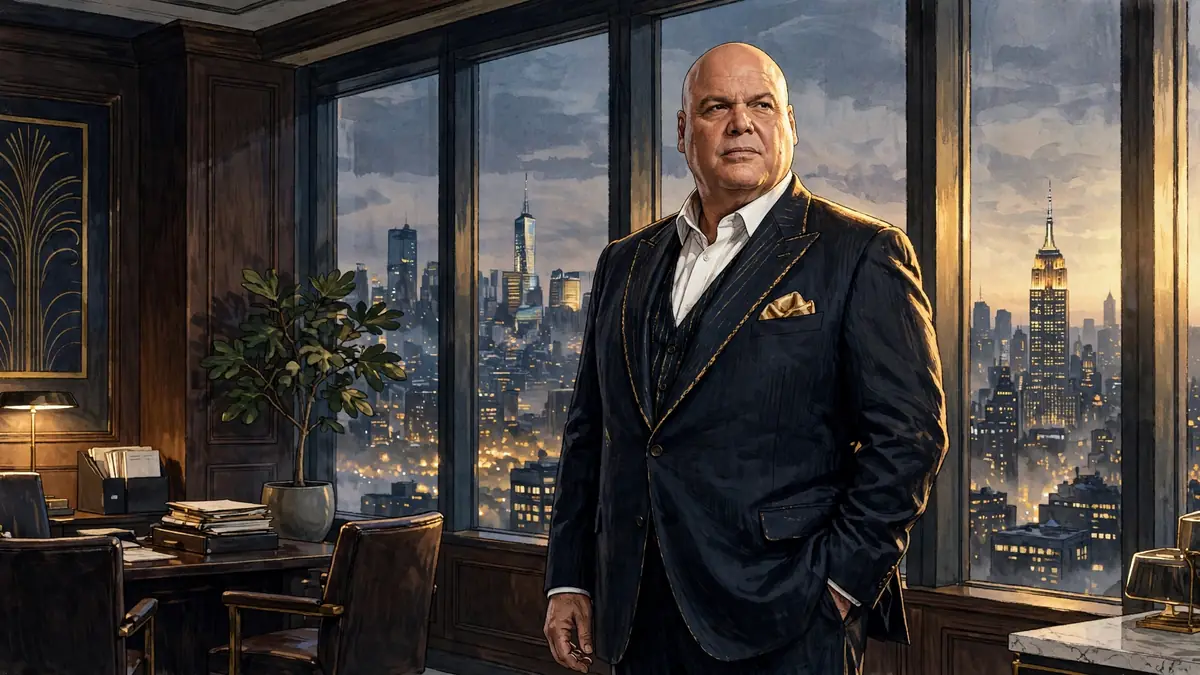
The third wave is the one still running. In 2015 Marvel cast him as Wilson Fisk, the Kingpin, in Netflix’s Daredevil, and the performance reset his public image for a new generation. Fisk is a crime lord who can be tender and murderous in the same scene, and D’Onofrio played the gap between those two registers so precisely that the character became the centre of the series. He shares the Marvel screen universe with stars such as Tom Holland, whose Spider-Man films anchor the same franchise, and the scale of that universe is part of why the role pays the way it does. He gained about 40 pounds for the first Netflix season, then stopped: after years of gaining and losing weight for roles, he now plays Fisk in a padded suit built by Marvel, telling interviewers in 2026 that the constant physical transformation was no longer healthy. The role followed him across the Marvel universe — Hawkeye in 2021, Echo in 2024 — and then into Daredevil: Born Again on Disney+, which premiered in 2025. The second season arrived in March 2026 with Fisk as the mayor of New York, running a masked task force under emergency powers, and a third season has already been filmed for release in 2027, reported to be the last. For an actor of 67, a franchise role with that kind of longevity is rare, and it is the single biggest reason his net worth estimates keep climbing rather than flattening.
What ties the three waves together is a reputation for total commitment. Directors return to D’Onofrio because he does the unglamorous work — the weight gain, the voice work, the months of preparation — and audiences remember him because the commitment shows on screen. That reputation is also why the estimates of his wealth vary so widely: much of his income comes from the kind of work that is never publicly priced. Television salaries leak; film fees mostly do not; residuals are private by contract. The range we publish reflects that reality rather than hiding it.
Main Sources of Income
D’Onofrio’s money comes from five streams, and their balance has shifted across his four-decade career. Television salaries dominate: ten seasons of Law & Order: Criminal Intent at a reported peak of about $350,000 per episode is the largest single block of earnings in his career, and the Marvel series that followed — Daredevil, Hawkeye, Echo and Daredevil: Born Again — added a second long-running television income line. Industry reporting around Daredevil: Born Again has suggested earnings of roughly $200,000 per episode, though that figure is unverified and should be treated as an estimate rather than a fact.
Film salaries form the second stream. His filmography runs to more than 100 credits, and the biggest paydays attached to the biggest films: Men in Black at about $589 million worldwide, Jurassic World at about $1.67 billion worldwide, and a long list of mid-budget films in between. Character actors rarely command the eight-figure fees of leading men, but a busy film actor with four decades of credits accumulates real money, especially when the films keep selling on home video and streaming.
Residuals and syndication are the third stream, and for D’Onofrio they may be the most valuable over time. Law & Order: Criminal Intent has aired in syndication and on streaming platforms continuously since it ended in 2011, and every re-air generates residual payments to its principal cast under union rules. With 141 episodes in the catalogue, that is a long tail of income that continues whether or not he takes a new job. The same logic applies to Men in Black and Jurassic World on streaming, and to the Marvel series on Disney+.
His fifth stream is the quietest: writing and voice work, including voice roles in animation and video games, plus screenwriting credits on projects he directed. The exact income from those credits is not publicly documented, so we do not assign it a dollar value. What is documented is the pattern: a working actor who kept four or five income lines open at once, which is how a character actor builds a $20 million fortune without ever headlining a $200 million franchise as its star.

Salary and Earnings
The best-documented salary in D’Onofrio’s career is the Law & Order: Criminal Intent figure. Multiple entertainment outlets have repeated a peak pay rate of about $350,000 per episode, and the arithmetic behind it is worth spelling out. In the show’s early seasons the order ran to 22 episodes a year, so a full season at peak pay would be worth about $7.7 million before tax, agents’ commission and management fees. D’Onofrio did not work every episode at that rate — his episode count fell after the season-five split, when he and Kathryn Erbe began alternating episodes with the second detective team — and his starting salary in 2001 was certainly lower than his peak. Still, across 141 episodes and ten seasons, the show is plausibly a $30 million-plus gross career earner, which is why the lower net worth estimates look too low to some analysts and the higher ones look too generous to others: the gross is large, but so are the taxes, the 10 percent agent commission, the manager’s share, and two and a half decades of living costs.
The salary story has a second chapter that is less happy. When Criminal Intent moved from NBC to USA Network, the cast’s salaries were frozen, and by the time D’Onofrio left after season eight it was reported that the network was only willing to pay him half his previous salary. He declined, and he and Erbe both walked away; he returned for the final season in 2011 on renegotiated terms. The episode is a useful reminder that television money is negotiated season by season, and that even a star of a hit show can face a pay cut.
His Marvel pay is less transparent. Industry reporting around Daredevil: Born Again has suggested earnings of roughly $200,000 per episode, but Marvel and Disney do not publish streaming salaries, and no filing or contract has confirmed the number — treat it as an informed estimate, not a fact. What is certain is that the Marvel work is steady: Daredevil ran for three seasons on Netflix, and Born Again has already run two seasons on Disney+ with a third filmed. Streaming series typically pay per episode with fewer episodes per season than network television, so the Marvel cheques are probably smaller than his Criminal Intent peak, but they arrive alongside the most valuable thing in an actor’s career — relevance, which keeps the next offer coming.
Film salaries are the least documented part of his earnings. Men in Black and Jurassic World were ensemble blockbusters in which D’Onofrio was a supporting player, not the star, so his fees for those films were likely in the high six figures to low seven figures rather than the $10 million-plus that the leads commanded. His independent films paid far less — festival films like The Whole Wide World typically pay scale plus a producer’s share — and his directing fees on The Kid would have been modest by studio standards. Put together, the honest picture is a career of high television earnings, solid film fees, and a long residual tail, rather than a single lottery-ticket payday.
Businesses and Investments
D’Onofrio has never built a public business empire, and that is itself a useful fact. Unlike actors who launch tequila brands or production companies with nine-figure valuations, his business activity has stayed close to the work: producing films he cared about, directing westerns, and taking producer credits that carry backend participation. The Whole Wide World (1996), which he produced and starred in, was a small independent film about the pulp writer Robert E. Howard; it earned critical praise and festival attention, but its commercial returns were modest. The Kid (2019), which he directed and produced, starred Ethan Hawke and Chris Pratt and was released by Lionsgate — a bigger commercial bet, but still a mid-budget western, not a franchise play.
No public record shows D’Onofrio holding equity in a startup, a restaurant chain, or a consumer brand, and no filing links him to a major investment portfolio. That does not mean he has no investments — working actors of his seniority typically hold property, retirement accounts and managed portfolios — but the details are private, and we do not invent them. The absence of a visible business empire is one reason the higher net worth estimates, like Finance Monthly’s $30 million and TheRichest’s $40 million, look optimistic: they assume asset growth that the public record does not support. The $14 million floor from Celebrity Net Worth and the $20 million midpoint from InfoSeeMedia both fit a career built on salaries and residuals better than on business exits.
One investment is documented and worth noting: his time. D’Onofrio has served in leadership at the Actors Studio, the institution where he trained, and he has spent years teaching and mentoring younger actors. That work pays little in cash and a great deal in standing, and standing is what keeps a 67-year-old actor employed in an industry that discards most performers by 50. His other long-term investment is the Kingpin character itself — a role he has now played across five series and more than a decade, and one that Marvel keeps returning to because audiences keep responding.
Brand Deals and Sponsorships
Here the record is thin, and the thinness is honest. D’Onofrio is not a brand ambassador in the modern sense: no sneaker deal, no watch campaign, no fragrance line, no paid social media partnerships of the kind that pad the net worth pages of younger stars. His public appearances are tied to his work — Comic-Con panels for Marvel, film festival appearances, interviews about Daredevil: Born Again — rather than to sponsored products. That is consistent with his career: he is a character actor whose value is in performance, not in lifestyle marketing, and brands pay lifestyle marketers.
What he does have is the kind of indirect endorsement that money cannot buy but that indirectly protects his income: Marvel’s continued use of him as Fisk is itself a brand association, and his appearances at fan conventions command appearance fees that are standard for franchise actors, though the amounts are not publicly disclosed. We do not assign a dollar value to either. Readers should treat any site that lists specific endorsement figures for D’Onofrio with suspicion — no credible outlet has published them, because the deals, if they exist, are small and private.

Houses, Cars and Other Assets
The most reported property in D’Onofrio’s life is the Manhattan home he shared with his wife Carin van der Donk: a townhouse at Gramercy Park, in the Christodora House, reported to be worth about $2.6 million. The couple raised their sons there, and the address has appeared in property reporting for years. A second property has also been reported: a home in Southern California, described as a three-bedroom house with a master suite and high ceilings, which reporting says he sold a couple of years ago. The sale price was not publicly confirmed, so we do not state one.
Beyond property, the public record on his assets is quiet. D’Onofrio is not known as a car collector, and no reporting ties him to a fleet of luxury vehicles or to a watch collection of the kind that celebrity finance pages like to itemise. He has been photographed over the years in the practical cars of a New York actor rather than in supercars, and that fits the broader picture: his spending has been private, his lifestyle has been low-key for a man of his earnings, and the wealth is held in the unglamorous forms — property, savings, residuals — rather than in display assets. That low profile is also why the $275 million figure published by TheCityCeleb can be dismissed outright: nothing in his documented income, property record or business activity supports a fortune of that size, and the site offers no sourcing for it. We include it here only to warn readers away from it.
The divorce filing of June 2023 adds a caveat to any property discussion. D’Onofrio filed for divorce from Carin van der Donk in Manhattan Supreme Court after 26 years of marriage, and property division in a divorce of that length can reshape a net worth materially. No settlement terms have been made public, so we cannot say how the Gramercy Park home or any other asset was divided. The estimate in this article reflects his career earnings and reported assets as they stand in the public record; a reader should understand that a divorce settlement, if it transferred significant assets, would sit on the other side of that number.
Awards and Achievements
D’Onofrio’s trophy shelf is thinner than his reputation, and the gap is part of his story. His most notable recognition is a Primetime Emmy nomination in 1998 for Outstanding Guest Actor in a Drama Series, for his appearance on Homicide: Life on the Street — a reminder that his television talent was visible years before Criminal Intent made him a household name. He was also nominated for a Saturn Award for Best Supporting Actor for Men in Black, and his performance in The Whole Wide World drew an Independent Spirit Award nomination. None of those nominations became wins that the record books highlight, and he never received an Emmy nomination for Criminal Intent itself — a fact that surprises many fans, given how central Goren was to the show.
The achievements that matter more to his wealth are commercial rather than ceremonial. Men in Black grossed about $589 million worldwide. Jurassic World grossed about $1.67 billion worldwide. Law & Order: Criminal Intent ran for ten seasons and 195 episodes. Daredevil and its revival have kept him employed at the top of streaming television for more than a decade. And Full Metal Jacket, the film that started it all, is now regarded as one of the great war films — a legacy credit that keeps his name in film history regardless of awards. For a net worth article, those are the numbers that count: a career measured in decades of employment is worth more than a shelf of trophies, because employment is what the paycheques attach to.
Net Worth Growth Over the Years
Year-by-year net worth tables for actors are almost always invented — no actor publishes annual accounts, and a table that adds exactly a million dollars a year is fiction dressed as data. The honest version is era-based, and it shows a fortune built in three stages rather than a smooth climb.
| Era | What happened | Estimated position |
|---|---|---|
| 1987–1996 | Breakout in Full Metal Jacket; steady film work; The Whole Wide World as actor-producer | Working actor; low seven figures at best |
| 1997–2000 | Men in Black blockbuster; The Cell; voice and supporting film work | A few million dollars; first real wealth |
| 2001–2011 | Ten seasons of Law & Order: Criminal Intent; peak salary years; residuals begin | High single-digit to low teens of millions |
| 2012–2014 | Post-Criminal Intent film and TV work; directing Don’t Go in the Woods | Plateau; residuals sustain the level |
| 2015–2024 | Jurassic World; Kingpin across Daredevil, Hawkeye, Echo; Godfather of Harlem | Mid-teens of millions; Marvel era lifts the range |
| 2025–2026 | Daredevil: Born Again seasons 1–2; third season filmed | $14 million–$30 million; working estimate $20 million |
The pattern to notice is the plateau between 2012 and 2014. When a long-running series ends, an actor’s income drops sharply until the next long job arrives, and D’Onofrio’s next long job — Marvel — did not start until 2015. Residuals from Criminal Intent bridged the gap, which is exactly what residuals are for. The second pattern is the Marvel lift: a franchise role in your late fifties and sixties is the best late-career insurance an actor can hold, and it is the main reason the 2026 estimates sit higher than the ones published five years ago.
Social Media Presence
D’Onofrio keeps an active but low-key social media presence, centred on Instagram and X, where he posts about his work — Daredevil: Born Again production, convention appearances, and tributes to collaborators — rather than about his private life. He does not run the kind of sponsored-content feed that turns followers into income, and we do not publish follower counts here because they move daily and add nothing to a wealth estimate. What his accounts do show is a working actor in regular contact with his audience: set photos, rehearsal notes, and the occasional political post, all in his own voice.
For a net worth article, the social media point is a negative one: unlike younger stars whose Instagram deals are a real income line, D’Onofrio’s social presence is a publicity tool, not a business. His money comes from the screen, not from the feed, and that is consistent with everything else in his career. Fans looking for him online will find him most reliably on Instagram under his own name, where Marvel and Daredevil news is usually the first thing he shares.
Personal Life
D’Onofrio’s personal life has been long, complicated, and — for a Hollywood actor — unusually private. In the early 1990s he was in a relationship with the Italian-Australian actress Greta Scacchi, and the two had a daughter, Leila George, born on March 20, 1992, in Sydney, Australia. Leila followed her parents into acting, appearing in films including Mortal Engines, and in 2020 she married the actor Sean Penn; the marriage ended in divorce in 2022. D’Onofrio also briefly dated Cameron Diaz in 1995, a relationship that the tabloids covered at the time and that he has rarely discussed since.
On March 22, 1997, he married the Dutch model and photographer Carin van der Donk. The couple had two sons: Elias Gene D’Onofrio, born in December 1999, and Luka D’Onofrio, born in 2008. The marriage was tested early — the couple separated in 2000, three years after the wedding — but they reconciled, and for more than two decades they were presented as one of Hollywood’s durable couples, raising their children in the Gramercy Park townhouse in Manhattan. In June 2023, after 26 years of marriage, D’Onofrio filed for divorce in Manhattan Supreme Court. No public statement explained the filing, and no settlement terms have been published. The couple continue to co-parent their younger son, Luka.
Health has shaped his career as much as any casting decision. The knee injury from Full Metal Jacket required surgery and left a lasting mark. In 2004 he collapsed on the set of Law & Order: Criminal Intent and at home, and was diagnosed with exhaustion — the result, by his own account, of a workload that left him two days ahead on dialogue and with no time to recover. And the weight gains that defined his early career — 70 pounds for Kubrick, 40 pounds for the first season of Daredevil, another gain for The Salton Sea — eventually stopped: in 2026 he told interviewers that he now plays Fisk in a padded suit because the constant gaining and losing was no longer healthy. At 67, with a third season of Daredevil: Born Again already filmed, he has traded physical transformation for craft — and the work has not suffered for it.
Sources & Reporting
Every figure in this article traces to a named source or is labelled an estimate. Celebrity Net Worth supplies the $14 million baseline and the conservative methodology behind it. InfoSeeMedia supplies the $20 million midpoint estimate and the biographical details on age, height and family. Finance Monthly supplies the $30 million ceiling, built on residuals and long-term assets. TheRichest supplies the older $40 million figure, which we treat as stale and unsupported by the salary record. Wikipedia supplies the verified career spine — birth date, filmography, episode counts, the 70-pound Full Metal Jacket weight gain, the knee injury, and the Marvel series dates — cross-checked against the trade press. Looper supplies the Criminal Intent production history: the season-five cast split, the workload that led to the 2004 collapse, and the salary-freeze reporting around his departure. Martin Cid Magazine supplies the 2026 reporting on Daredevil: Born Again season two, the padded suit, and the filmed third season due in 2027. Box Office Mojo-reported grosses (via the trade press) supply the Men in Black figure of about $589 million and the Jurassic World figure of about $1.67 billion. The $350,000-per-episode Criminal Intent salary and the roughly $200,000-per-episode Born Again figure are both widely repeated in entertainment reporting and are labelled as such; neither has been confirmed by a contract or filing. The $275 million figure from TheCityCeleb is noted only to dismiss it — it carries no sourcing and conflicts with every other estimate. Reporting window: sources published or updated between 2024 and November 2026, reviewed November 2026.
Frequently Asked Questions
What is Vincent D’Onofrio’s net worth in 2026?
Vincent D’Onofrio’s net worth is estimated at $14 million to $30 million as of November 2026, with a working estimate of about $20 million. Celebrity Net Worth puts him at $14 million, InfoSeeMedia at $20 million, and Finance Monthly at $30 million. He has never publicly confirmed a figure, so every published number is an estimate built from his reported salaries, residuals and assets.
How much did Vincent D’Onofrio make per episode on Law & Order: Criminal Intent?
Entertainment outlets have widely reported a peak salary of about $350,000 per episode for his role as Detective Robert Goren. At a 22-episode season that would be about $7.7 million for a full season, though his episode count fell after season five, when the show split its order between two detective teams, and his starting salary in 2001 was lower than his peak.
How old is Vincent D’Onofrio?
Vincent D’Onofrio was born on June 30, 1959, in Brooklyn, New York, which makes him 67 years old as of November 2026. He is 6 feet 3 inches (192 cm) tall.
How much weight did Vincent D’Onofrio gain for Full Metal Jacket?
He gained about 70 pounds for the role of Private Leonard “Gomer Pyle” Lawrence, climbing from roughly 200 pounds to about 280 pounds, and shaved his head. The extra weight contributed to a knee injury on the obstacle course that needed surgical reconstruction, and it took him nine months after filming to lose nearly all the weight.
Is Vincent D’Onofrio still playing Kingpin in Daredevil: Born Again?
Yes. He returned as Wilson Fisk, the Kingpin, in Daredevil: Born Again on Disney+, which premiered in 2025. The second season arrived in March 2026 with Fisk as the mayor of New York, and a third season has already been filmed for release in 2027, reported to be the last. He previously played Fisk in Netflix’s Daredevil (2015–2018), Hawkeye (2021) and Echo (2024).
Who is Vincent D’Onofrio’s wife?
He married the Dutch model and photographer Carin van der Donk on March 22, 1997. The couple had two sons, Elias Gene (born 1999) and Luka (born 2008), separated briefly in 2000, and reconciled. In June 2023, after 26 years of marriage, D’Onofrio filed for divorce in Manhattan Supreme Court. No settlement terms have been made public.
Who are Vincent D’Onofrio’s children?
He has three children: Leila George, born March 20, 1992, in Sydney, Australia, from his relationship with actress Greta Scacchi; and two sons with Carin van der Donk, Elias Gene D’Onofrio (born December 1999) and Luka D’Onofrio (born 2008). Leila is an actress, and she was married to Sean Penn from 2020 to 2022.
What movies has Vincent D’Onofrio been in?
His best-known films include Full Metal Jacket (1987), Mystic Pizza (1988), JFK (1991), The Player (1992), Ed Wood (1994), The Whole Wide World (1996), Men in Black (1997), The Cell (2000), The Salton Sea (2002) and Jurassic World (2015). On television he is best known for Law & Order: Criminal Intent (2001–2011) as Detective Robert Goren and for playing Wilson Fisk, the Kingpin, in Marvel’s Daredevil series.
Final Thoughts
Vincent D’Onofrio’s fortune is the fortune of a working actor who never stopped working. The $14 million to $30 million range reflects a career built the slow way: a breakout that paid in reputation, a decade of network television that paid in cash, and a Marvel second act that is still paying in his late sixties. The working estimate of about $20 million sits where the evidence sits — above the conservative floor, below the optimistic ceiling, and honest about the gap between them.
The lesson of his career is durability. Most actors who break out in a Kubrick film at 27 are forgotten by 40. D’Onofrio is 67, filming the final season of a Marvel series, and still the first call when a director needs a character who can be terrifying and tender in the same scene. That is not a lottery win. It is four decades of showing up, and the net worth is the receipt.
Published on November 15, 2026. Last reviewed November 2026. Found an error? See our corrections policy.