
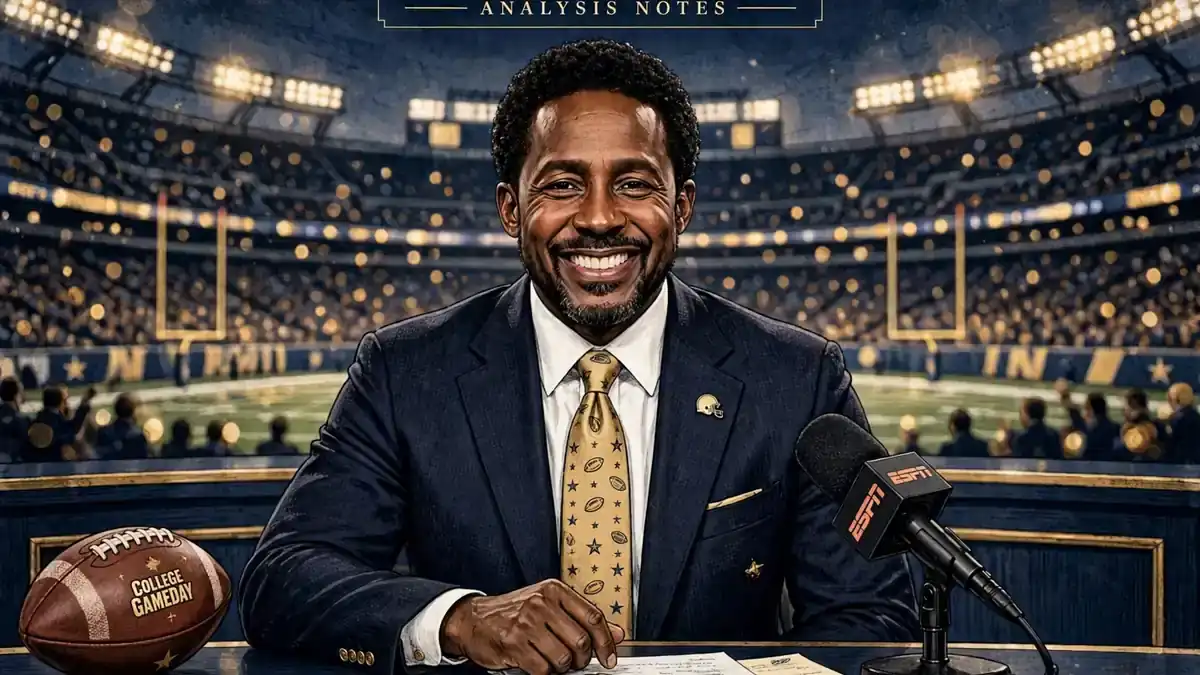
Desmond Howard‘s net worth is estimated at $10 million – $14 million as of November 2026. The 1991 Heisman Trophy winner turned a four-year, $5.9 million rookie contract into roughly $12.25 million in documented NFL earnings, then built a second fortune as the longest-serving analyst on ESPN’s College GameDay — a chair he has held since 2005 and, after a new multiyear extension signed in August 2025, will keep into a third decade.
Desmond Howard: Quick Facts
| Estimated net worth | $14 million (range: $10 million – $14 million) |
|---|---|
| Profession | Former NFL wide receiver and return specialist; ESPN college football analyst |
| Nationality | American |
| Born | May 15, 1970 (age 56) |
| Height | 5 ft 10 in (1.78 m) |
| Primary income sources | NFL contracts (1992–2002), ESPN broadcasting salary, appearances and speaking |
| Active years | 1988–present (Michigan 1988–1991; NFL 1992–2002; ESPN 2005–present) |
| Last reviewed | November 2026 |
- Early Life and Background
- Education
- Career Journey
- Rise to Fame
- Main Sources of Income
- Salary and Earnings
- Businesses and Investments
- Brand Deals and Sponsorships
- Houses, Cars and Other Assets
- Awards and Achievements
- Net Worth Growth Over the Years
- Social Media Presence
- Personal Life
- Sources & Reporting
- Frequently Asked Questions
Early Life and Background
Desmond Kevin Howard was born on May 15, 1970, in Cleveland, Ohio, to J.D. and Hattie Howard. Cleveland in the 1970s and 1980s was a hard-edged football town, and Howard grew up in it as a fast, slight kid who played bigger than his frame. He has three brothers, and the household ran on the kind of discipline that shows up later in a return man’s game: patience, timing, and a refusal to flinch when eleven men are running at you.
At St. Joseph High School in Cleveland, Howard became the player every college recruiter in the Midwest wanted to see in person. He played running back, receiver, and defensive back, and his speed — the trait that would define his whole career — separated him from everyone else on the field. St. Joseph’s program had a reputation for producing college-ready talent, and Howard left it as one of the most recruited athletes in Ohio, a state that has never been short of high-school football stars.
The choice he made next shaped everything. Michigan, under head coach Bo Schembechler and then Gary Moeller, was a program that sold structure, national television, and a direct line to the NFL. Howard picked the Wolverines, and the decision put him on the biggest stage in college football before he had played a snap. It also put him in Ann Arbor, a town where a wide receiver who could change a game in one touch becomes a folk hero fast.
What the early years explain about the money story is simple: Howard was never the biggest player on the field. At 5 ft 10 in and around 185 pounds, he was a receiver who had to win with speed, hands, and field vision. That profile made him a spectacular college player and, later, a tricky professional evaluation — a pattern that runs through his contracts. His rookie deal paid him like a star because of what he did at Michigan; his later deals paid him like a specialist because of what he did in the NFL. Both halves of that story are visible in the earnings record.
Education
Howard enrolled at the University of Michigan in 1988 and played four seasons for the Wolverines, from 1988 through 1991. Michigan in that era was a machine: Big Ten titles, Rose Bowl trips, and a roster full of future NFL players. Howard’s first two seasons were quiet by the standards of what came later — he was learning the offense, returning kicks, and waiting for his turn in a crowded receiver room.
The classroom side of his Michigan years rarely makes the highlight reels, but it matters to the second half of his career. Howard left Ann Arbor with a degree and with four years of film study under two of the sharpest coaching staffs in the sport. That schooling shows up every Saturday on College GameDay: his analysis leans on route concepts, special-teams angles, and the kind of detail that comes from having played the position at the highest college level, not from a teleprompter.
His junior season, 1991, is the year that paid for everything after it. Howard caught 62 passes for 985 yards and 19 receiving touchdowns, scored 23 touchdowns in all — as a receiver, a runner, and a return man — and won the Heisman Trophy by what was then the second-largest margin in the award’s history. He also collected the Maxwell Award and the Walter Camp Award, and he was a unanimous All-American. Michigan won the Big Ten and went to the Rose Bowl, and Howard’s No. 21 became the most famous number in the program.
The single play that sealed the Heisman came on November 23, 1991, against Ohio State. Howard fielded a punt, raced 93 yards for a touchdown, and struck the Heisman pose in the end zone — one arm extended, the other cradling the ball — in front of a roaring Michigan Stadium. The photograph of that pose is still one of the most reproduced images in college football. It was also, in a very literal sense, the image that made him rich: it turned a great college season into a national brand, and that brand is what Washington paid for with the fourth pick of the 1992 draft.
Michigan has honored him twice since. In 2010 he was named to the College Football Hall of Fame — the announcement came on May 27, 2010, from the University of Michigan athletic department — and in 2015 the school officially retired his No. 21, making him the first Michigan Football Legend. Those honors are not money, but they are the reason the money kept coming: every Hall of Fame ceremony, every anniversary segment, and every Heisman presentation keeps his name in front of the audience that ESPN pays him to reach.
Career Journey
Howard’s professional career ran for 11 seasons and five franchises, and it divides cleanly into two acts. The first act was the disappointment: a top-five pick who never became the star receiver Washington drafted him to be. The second act was the reinvention: a return specialist who found the one job in football where his speed was worth more than his size, and who turned a single season in Green Bay into a Super Bowl MVP trophy and a second contract worth millions.
Washington took him fourth overall in the 1992 NFL Draft, behind only Steve Emtman, Quentin Coryatt, and Sean Gilbert. The Redskins were the defending Super Bowl champions, and the pick was supposed to add a game-breaker to a roster that already had one. Howard signed a four-year, $5.9 million rookie contract with a $2.85 million signing bonus, serious money for a receiver in 1992 and a figure that still anchors his career earnings today. The production never matched the price. Over three seasons in Washington he caught 23 passes in total, and the team moved on.
The Jacksonville Jaguars took him in the 1995 expansion draft, and he spent one season there — 26 catches, one touchdown — before the league’s newest franchise let him go too. By the spring of 1996, Howard was 25 years old, on his third team in five years, and running out of chances. Then Green Bay called with a one-year deal worth $300,000, the kind of contract teams hand to players they expect to cut in August.
What happened next is the pivot point of his financial life. Packers head coach Mike Holmgren and special-teams coach Nolan Cromwell used Howard almost entirely as a return man, and he delivered the greatest return season the league had seen: a then-NFL record 875 punt return yards, a league-leading 15.1-yard punt return average, and six return touchdowns in the regular season, per Celebrity Net Worth’s contract-by-contract account of his career. He was named first-team All-Pro as a returner, and the Packers went to the Super Bowl.
Super Bowl XXXI, played on January 26, 1997, at the Louisiana Superdome against the New England Patriots, is the game that defines him. With Green Bay leading 27–14 in the third quarter and New England having just scored, Howard fielded the kickoff and returned it 99 yards for a touchdown — the longest kickoff return in Super Bowl history at the time. He finished the game with 244 total return yards, a Super Bowl record, and was named the game’s Most Valuable Player. He remains the first and only special-teams player ever to win Super Bowl MVP, a distinction that has survived nearly three decades of Super Bowls since.
The MVP trophy did what three years of receiver play could not: it made him a free agent worth paying. In 1997 he signed a four-year, $6 million deal with the Oakland Raiders. His two seasons in Oakland were quiet, and his final act came in Detroit, where he played from 1999 through 2002 and earned a Pro Bowl selection in 2000 as a return specialist. A late-career deal with the Lions worth $5.7 million, as Celebrity Net Worth reports it, closed out his playing earnings. He retired after the 2002 season, eleven years after Washington made him the fourth pick in the draft.
The honest accounting of the playing career is that it paid less than the hype promised and more than the critics allow. Roughly $12.25 million in total NFL earnings, per Celebrity Net Worth, is a strong return for a player whose receiving numbers never justified his draft slot — and it is almost entirely a product of the Green Bay season. Without the $300,000 gamble in 1996, there is no $6 million Oakland contract and no $5.7 million Detroit deal. One season, one return, and one trophy re-priced his whole career.
Rise to Fame
Howard’s fame arrived in three waves, and each wave paid differently. The first wave was Michigan, where the Heisman pose made him a national figure before he could legally drink. College fame does not pay directly — this was decades before name, image, and likeness deals — but it paid in draft position, and draft position in 1992 meant a $2.85 million signing bonus before he had caught an NFL pass.
The second wave was Super Bowl XXXI. A return man winning Super Bowl MVP was unprecedented, and the novelty of it gave Howard a kind of fame that outlasted his playing stats. He was the answer to a trivia question, the clip that plays every January, and the name that comes up whenever a returner does something spectacular. That durable fame is a financial asset: it is the reason he was hireable as a broadcaster the moment he stopped playing.
The third wave is the one still running. Howard joined ESPN in 2005, three years after retiring, and took a seat on College GameDay, the Saturday morning pregame show that is college football’s most-watched studio program. Twenty-one seasons later he is still there, alongside host Rece Davis and analysts Kirk Herbstreit, Pat McAfee, and, since 2024, Nick Saban. The 2025 season opened with Howard in his 21st year on the show, and ESPN announced a new multiyear extension on August 28, 2025, keeping him on GameDay, College Football Playoff studio coverage, ABC’s NFL Draft programming, and the Heisman Trophy presentation.
Few football figures have managed all three acts. Heisman winners usually fade; Super Bowl heroes usually retire into quiet lives; television analysts usually come from the quarterback room. Howard did all three, and the third act is the one that has paid the longest. His NFL career lasted eleven seasons. His ESPN career has already lasted twenty-one, and the 2025 extension takes it into a third decade.
The through-line is the Heisman pose. It was a spontaneous celebration in 1991, and it became a personal logo that has followed him through every stage: the Michigan highlight packages, the Hall of Fame induction, the ESPN open, the anniversary features every November. A player with a signature image is easier to remember, easier to book, and easier to keep on television. Howard understood that early, and he has never run from the pose — he has built a career standing in front of it.
Main Sources of Income
Howard’s money comes from three streams, and their order has flipped over time. In the 1990s, NFL contracts were nearly all of it. In the 2000s and 2010s, the ESPN salary took over. Today, broadcasting is the engine, appearances and speaking are the supplement, and the playing career is the backstory that makes the broadcasting chair valuable.
NFL contracts (1992–2002). Five contracts across five teams, totaling roughly $12.25 million in career earnings, per Celebrity Net Worth’s contract-by-contract tally. The rookie deal with Washington ($5.9 million over four years, $2.85 million signing bonus) was the biggest single payday of his playing life. The Oakland deal ($6 million over four years) was the biggest total contract. The Detroit deal ($5.7 million) closed the career. The Green Bay deal ($300,000 for one year) was the smallest — and the most valuable, because it produced the Super Bowl MVP that made the Oakland and Detroit deals possible.
ESPN broadcasting (2005–present). Howard has been an ESPN college football analyst for 21 seasons, a run that now exceeds his playing career by a decade. His roles cover College GameDay on Saturdays, College Football Live on weekdays, SportsCenter hits, College Football Playoff studio programming, ABC’s NFL Draft coverage, and the Heisman Trophy presentation. ESPN has never disclosed his pay, and the network re-signed him to multiyear extensions in 2017 and again in August 2025 — the second of those taking him into his 21st season and a third decade with the network. Broadcasting is the steadiest income he has ever had: no injury risk, no free-agency cliff, and a contract that renews on the strength of a chair he has held longer than anyone else on the set.
Appearances, speaking, and alumni work. As a Heisman winner, a Super Bowl MVP, and a College Football Hall of Fame member, Howard is a regular on the paid-appearance circuit: Michigan alumni events, corporate speaking, charity golf tournaments, and Heisman-related programming. These fees are not publicly reported, and we do not guess at them. What is clear is that the three honors stack: each one on its own books appearances, and together they keep his calendar full every fall.
What he does not earn from. Howard has no coaching career — CollegeNetWorth notes he never took a coaching role in the NFL — and no public record of a major endorsement portfolio. His name does not appear on the sneaker, beverage, or betting deals that pad the net worth pages of bigger stars. That absence is part of the estimate: his fortune is built on contracts and a salary, not on brand deals or business exits, which is why the range stays in the low eight figures rather than climbing toward the $25 million or $100 million figures attached to some of his peers.
Salary and Earnings
The contract record is the strongest part of Howard’s file, because Celebrity Net Worth published it deal by deal in its January 2026 update, and the numbers line up with the contract history reported across his career. Here is the full ledger, as reported:
| Contract | Team | Reported terms |
|---|---|---|
| Rookie deal, 1992 | Washington Redskins | 4 years, $5.9 million; $2.85 million signing bonus |
| Expansion draft, 1995 | Jacksonville Jaguars | One season; terms not publicly reported |
| One-year deal, 1996 | Green Bay Packers | $300,000 |
| Free-agent deal, 1997 | Oakland Raiders | 4 years, $6 million |
| Late-career deal, 1999–2002 | Detroit Lions | $5.7 million |
| Career total | Five teams, 11 seasons | ≈ $12.25 million |
Two things stand out. First, the rookie signing bonus alone — $2.85 million in 1992 — was more than most players of his era earned in a career, and it arrived before he had played a down. That is the Heisman premium, and it is the single biggest reason his net worth sits where it does. Second, the Green Bay season is the best return on investment in his file: a $300,000 salary produced a Super Bowl MVP, and the MVP produced roughly $11.7 million in later contracts. No other single season in his career comes close to that ratio.
The ESPN salary is the one number nobody can pin down, and honest reporting says so. ESPN does not disclose analyst pay. Online estimates put Howard’s annual ESPN salary at $2 million to $3 million a year — CollegeNetWorth reports that range, and Media Coverage reported a $3 million figure in December 2023 — but neither outlet cites a contract, a filing, or an ESPN source, so we treat the range as an unverified estimate, not a fact. Other pages on the internet quote figures as low as $78,108 a year, which is a generic industry average for sports broadcasters pulled from salary-aggregation sites, not a number attached to Howard in any reporting. The spread between $78,000 and $3 million is itself the story: when a network keeps pay private, the internet fills the gap with guesses, and the guesses disagree by a factor of forty. What is verifiable is the tenure — 21 seasons, two multiyear extensions, and a 2025 deal that carries him into a third decade — and tenure at ESPN’s flagship college show is not a minimum-wage job.
One claim deserves a direct correction. Several content-farm pages state that Howard earned around $190 million in his football career, with one page putting the figure at $190,585,000 over 12 seasons. That number is false, and the contract ledger proves it: his five documented NFL deals total roughly $12.25 million, and the salary-cap era of the 1990s never paid a return specialist anything approaching $190 million. The figure appears to be a garbled import from another player’s page, repeated from site to site without a source. Readers who see it should treat it as a copy error, not a fact. It is the single most repeated wrong number attached to Howard’s name, and it is why this article publishes a range built from named contracts rather than a single borrowed figure.
Put together, the earnings picture is a player who made about $12.25 million on the field and has now spent twice as long earning a television salary off it. If the ESPN estimates are anywhere near right, his broadcasting career has already earned him more than his playing career did — the quiet reversal that explains why his net worth has held up, and grown, more than two decades after his last NFL game.
Businesses and Investments
Here is where an honest profile has to say what it does not know. There is no public record of Desmond Howard owning a business, holding a franchise portfolio, or making a venture investment that has been reported by a credible outlet. No SEC filing, no business-journal profile, and no interview ties him to a company as an owner or investor. That does not mean he has no investments — a man with two decades of ESPN income and a $12.25 million playing career almost certainly has a portfolio — but it means none of it is public, and this article will not invent holdings to fill the section.
One claim that circulates should be handled with care. A handful of low-quality content sites state that Howard is part of the Detroit Lions’ ownership group. We found no reporting from the Lions, the NFL, ESPN, or any business outlet to support that, and the claim appears only on pages that also repeat the false $190 million earnings figure. Until a credible source confirms it, it stays out of the estimate. The same goes for real estate: no property records, no home profiles, and no verified purchases appear in reporting on Howard, so this article makes no claim about houses he may or may not own.
What can be said is what the structure of his career implies. His income has been salary income — first from teams, then from a network — which means his wealth is the product of saving and compounding over thirty years rather than a single liquidity event. That is a slower way to build $10–$14 million, and it is a more durable one: there is no startup to fail, no restaurant chain to close, and no crypto position to unwind. The risk profile of a broadcaster’s fortune is the risk profile of a steady paycheck held for twenty years.
The comparison with his peers sharpens the point. Barry Sanders, whose Lions career overlapped with Howard’s Detroit years, built his fortune the same way — contracts, then a long second act — and sits at a reported $20 million. The difference between the two men is mostly the size of the playing contracts: Sanders was a franchise running back, Howard was a return specialist. The shape of the fortune is the same. The scale follows the position.
Brand Deals and Sponsorships
Howard’s endorsement record is thin, and that thinness is informative. He has no signature shoe, no national commercial campaign, and no long-running brand partnership documented in reporting. The Heisman Trophy win in 1991 came before college athletes could sign endorsement deals, so the most marketable moment of his life arrived in an era when it could not be monetized directly. By the time he reached the NFL, he was a return specialist on his third team, not the kind of player brands build campaigns around.
His marketable asset today is the ESPN chair, not a product line. College GameDay is sponsored — the show’s full title carries a home-improvement retailer’s name — but that sponsorship pays the network, not the analyst. Howard’s name appears in ESPN’s own promotion, in Heisman Trophy presentation coverage, and in Michigan’s alumni programming, all of which pay in salary and appearance fees rather than endorsement checks.
The honest way to put it: endorsements are not a material line in this estimate. If a future deal emerges — a Michigan-themed campaign, a broadcasting-adjacent brand, a Hall of Fame partnership — it would be new income, not a correction to the record. For now, the $10–$14 million range is built on contracts and salary, and the absence of a brand portfolio is one of the reasons the top of the range stops at $14 million rather than stretching toward the $18 million or $20 million figures that some content sites publish without sourcing.
Houses, Cars and Other Assets
Howard and his wife, Rebkah, live in Miami, Florida, with their three children — a fact the University of Michigan’s athletic department confirmed in its 2010 Hall of Fame announcement. Beyond that, the public record on his homes and cars is empty. No real-estate outlet has profiled a purchase, no property record has been tied to his name in reporting, and no car collection has been documented. This article does not fill that gap with guesses.
What can be described is the asset that matters most to the estimate: the career itself. A Heisman Trophy, a Super Bowl MVP award, a Pro Bowl selection, and a College Football Hall of Fame induction are not liquid assets, but they are the reason the income keeps coming. The MVP trophy in particular has a market: Super Bowl MVP awards and game-worn memorabilia from that era trade at auction, and Howard’s 99-yard return is one of the most replayed plays in the game’s history. We do not assign a dollar value to the hardware — no appraisal exists — but its role in the money story is real: it is the credential that turned a $300,000 player into a $6 million free agent.
For readers comparing him with other athletes on this site, the contrast is instructive. Deion Sanders, the other great return man of Howard’s era, built a far larger fortune on a prime-time persona, a baseball career, and a coaching salary — a reported figure several times Howard’s. Howard’s version of the same career is quieter: fewer headlines, fewer assets on display, and a fortune built on longevity rather than flash. The Miami home, the cars, and the portfolio stay private, and the estimate respects that privacy by staying in the range the public record supports.
Awards and Achievements
Howard’s trophy case is the densest part of his file, and it is worth listing in full, because the honors are the spine of his earning power. Each one is documented by the University of Michigan, the Heisman Trust, the NFL, or ESPN.
- Heisman Trophy, 1991 — won as a junior at Michigan, by what was then the second-largest margin in the award’s history.
- Maxwell Award, 1991 — college football’s player of the year, voted by coaches and media.
- Walter Camp Award, 1991 — the nation’s outstanding player, as selected by coaches and sports information directors.
- Unanimous All-American, 1991 — the first unanimous selection at Michigan in more than a decade.
- Chicago Tribune Silver Football, 1991 — the Big Ten’s most valuable player.
- Super Bowl MVP, Super Bowl XXXI (1997) — first and only special-teams player ever to win the award; 99-yard kickoff return touchdown, 244 total return yards.
- First-team All-Pro, 1996 — as a punt returner, after a then-NFL record 875 punt return yards.
- Pro Bowl selection, 2000 — as a return specialist with the Detroit Lions.
- College Football Hall of Fame, class of 2010 — announced May 27, 2010; the only Heisman winner in that year’s class.
- University of Michigan Hall of Honor, 2008.
- Michigan No. 21 retired, 2015 — the first Michigan Football Legend, with his number retired in a ceremony at Michigan Stadium.
Two records from that list still stand out. The 875 punt return yards in 1996 was an NFL single-season record when he set it, and the 99-yard kickoff return in Super Bowl XXXI was the longest in Super Bowl history at the time. Records get broken — the punt return mark has since fallen — but the MVP distinction has not: no special-teams player before or since has won the Super Bowl’s top individual honor. That is the kind of fact that keeps a name in circulation for thirty years, and circulation is what a broadcasting career runs on.
Net Worth Growth Over the Years
Howard’s wealth did not grow in a straight line. It arrived in lumps — a signing bonus, a Super Bowl season, a television contract — with long flat stretches in between. The table below tracks the anchor points that the public record actually supports. Figures between anchors are estimates, and they are labeled as such.
| Year | Milestone | Estimated net worth |
|---|---|---|
| 1992 | Drafted 4th overall; $2.85 million signing bonus | ≈ $2–3 million |
| 1996 | Record return season; Super Bowl MVP | ≈ $5–6 million |
| 1999 | Oakland and Detroit contracts signed | ≈ $8–10 million |
| 2002 | Retires after 11 NFL seasons; ≈ $12.25 million career earnings | ≈ $9–11 million |
| 2010 | College Football Hall of Fame induction | ≈ $11–13 million |
| 2017 | Multiyear ESPN extension; 13th season on GameDay | ≈ $12–14 million |
| 2025 | Second multiyear ESPN extension; 21st season | ≈ $10–14 million |
| 2026 | Range across current reporting | $10–14 million |
The shape of the curve is the point. The playing career built the base: by retirement, the contract ledger alone put him near $10 million before taxes, agent fees, and living costs. The broadcasting career then did the quiet work of holding the line — replacing the spending of a retired athlete with a steady salary for twenty-one years, so the fortune never had to be drawn down the way so many ex-players’ fortunes are. The range widened in recent years not because his wealth fell, but because the outlets disagree: Celebrity Net Worth’s January 2026 update says $10 million, while College Sports Network and Daily Wiki Bio say $14 million, and a handful of content sites stretch to $18 million or $20 million without sourcing. We publish the range the two most careful outlets bracket, and we note the stretch figures only to warn readers away from them.
Peer comparison puts the range in context. Brett Favre, the quarterback who threw the passes in that Super Bowl XXXI win, sits at a reported $100 million — the scale of a franchise quarterback’s contracts and endorsements. Patrick Mahomes, the modern standard for quarterback money, operates on a different planet entirely. Howard’s fortune is smaller because his position paid less and his fame was narrower — but it is also steadier, because it rests on twenty-one years of television rather than a single contract cycle. Among the men on that 1996 Packers roster, his second act is one of the longest-running in the sport.
Social Media Presence
Howard is active on social media, primarily on X (formerly Twitter) as @DesmondHoward and on Instagram, where he posts a mix of College GameDay behind-the-scenes material, Michigan football content, and family moments. His accounts function as an extension of the broadcast chair: clips from Saturday’s show, reactions to the week’s games, and the occasional Heisman-season throwback.
We do not publish follower counts in this article, because they move daily and no outlet we rely on reports them with a date. What matters for the money story is the function: social media keeps Howard visible to the college football audience between Saturdays, and that visibility is part of what ESPN is paying for. A GameDay analyst who trends on Saturday morning is worth more than one who does not, and Howard’s posts — especially during Heisman season, when his own 1991 campaign becomes the reference point for every candidate — reliably do.
For readers who want to follow him, the verified accounts are the ones linked from ESPN’s own talent pages and from his College GameDay profile. Impersonator accounts exist, as they do for every public figure of his profile; the checkmark and the ESPN affiliation are the tell.
Personal Life
Howard married his longtime girlfriend, Rebkah Howard, on May 31, 2003. Rebkah — also spelled Rebekah in some profiles — is a licensed attorney and a marketing, public relations, and event-management executive with more than fifteen years of experience, and she has served as executive director of the Tamika Huston Foundation. The couple have three children: twin sons, Desmond Jr. and Dhamir, and a daughter, Sydney. The family lives in Miami, Florida, a base that puts Howard a short flight from ESPN’s Charlotte studios and from the college towns he visits every fall.
He keeps the family largely out of the public eye. His children do not have public profiles, and Howard rarely discusses them on air beyond the occasional mention. That privacy is consistent with everything else about his off-field life: no reality television, no public feuds, no tabloid cycle. The contrast with the loudest voices on his own GameDay desk is part of his brand — he is the analyst who played the game at its highest level, won its biggest individual awards, and then went home.
His parents, J.D. and Hattie Howard, raised four boys in Cleveland, and Howard has spoken over the years about the discipline of that household — the early mornings, the expectation that talent came with work. He returns to Cleveland and to Michigan regularly, for alumni events and for the Hall of Fame ceremonies that keep pulling him back to Ann Arbor. The No. 21 retirement ceremony in 2015, with his family on the field at Michigan Stadium, was the public capstone of a relationship with the university that began when he was a seventeen-year-old recruit from St. Joseph High School.
Health-wise, Howard has been open about the physical cost of the return game — the collisions that come with fielding kicks at full speed — but he has not reported any major post-career health issue in public, and this article does not speculate about his medical history. What is public is the durability: eleven NFL seasons as a return man, then twenty-one more on television, is a long run in a sport that retires most of its players before thirty.
Sources & Reporting
Celebrity Net Worth — the $10 million net-worth figure (January 2026 update) and the contract-by-contract earnings tally: the $5.9 million rookie deal with its $2.85 million signing bonus, the $300,000 Green Bay deal, the $6 million Oakland contract, the $5.7 million Detroit deal, and the ≈ $12.25 million career total. Also the 1991 season line of 985 receiving yards and 19 touchdowns, and the six return touchdowns in 1996.
College Sports Network — the $14 million estimate (September 2025), the two-income-source framing (NFL career plus ESPN analyst role), the 1991 Heisman win by the second-largest margin at the time, and the five-franchise career summary.
ESPN Press Room — the August 28, 2025 multiyear extension announcement, the 21st season on College GameDay, the 2005 start date, and the roles across College Football Playoff studio coverage, ABC’s NFL Draft programming, and the Heisman Trophy presentation; also the 2017 multiyear extension.
University of Michigan Athletics — the May 27, 2010 College Football Hall of Fame announcement, the Miami residence, and the children’s names (daughter Sydney; twin boys Dhamir and Desmond Jr.).
Daily Wiki Bio — the $14 million estimate for 2025, the 875-yard then-record punt return season, and the 11-season career framing.
CollegeNetWorth — the unverified $2–3 million annual ESPN salary estimate, the 2005 ESPN start, and the note that Howard never took an NFL coaching role. The $190,585,000 career-earnings figure on the same page is contradicted by the contract ledger and is flagged in this article as false.
Reporting window: November 2026. Figures are estimates built from public reporting, not audited financial statements. Where outlets disagree, this article publishes the range and names who says what.
Frequently Asked Questions
What is Desmond Howard’s net worth in 2026?
Desmond Howard’s net worth is estimated at $10 million to $14 million as of November 2026. Celebrity Net Worth puts the figure at $10 million in its January 2026 update, while College Sports Network and Daily Wiki Bio report $14 million. We publish the range because the two most careful outlets disagree, and the range is the honest answer.
How much does Desmond Howard make at ESPN?
ESPN has never disclosed his salary. Online estimates put his annual pay as a College GameDay analyst at $2 million to $3 million a year, but neither outlet behind that range cites a contract or an ESPN source, so it is an unverified estimate. What is verifiable is the tenure: he joined ESPN in 2005, signed multiyear extensions in 2017 and August 2025, and is now in his 21st season on College GameDay.
How much did Desmond Howard make in the NFL?
About $12.25 million in total, according to Celebrity Net Worth’s contract-by-contract tally: a four-year, $5.9 million rookie deal with Washington (including a $2.85 million signing bonus), a $300,000 one-year deal with Green Bay in 1996, a four-year, $6 million deal with Oakland in 1997, and a $5.7 million late-career deal with Detroit. Claims online that he earned around $190 million are false and contradict the documented contracts.
Did Desmond Howard win the Heisman Trophy?
Yes. Howard won the Heisman Trophy in 1991 as a junior at the University of Michigan, by what was then the second-largest margin in the award’s history. He caught 62 passes for 985 yards and 19 receiving touchdowns that season, scored 23 touchdowns in all, and also won the Maxwell Award and the Walter Camp Award. His 93-yard punt return touchdown against Ohio State — finished with the famous Heisman pose — sealed the award.
Was Desmond Howard the Super Bowl MVP?
Yes. Howard was named Most Valuable Player of Super Bowl XXXI on January 26, 1997, after returning a kickoff 99 yards for a touchdown and totaling 244 return yards for the Green Bay Packers against the New England Patriots. He remains the first and only special-teams player ever to win Super Bowl MVP.
Who is Desmond Howard’s wife?
Desmond Howard is married to Rebkah Howard (also spelled Rebekah), a licensed attorney and marketing, public relations, and event-management executive. They married on May 31, 2003, and have three children — twin sons Desmond Jr. and Dhamir, and a daughter, Sydney. The family lives in Miami, Florida.
How tall is Desmond Howard and how old is he?
Howard is 5 ft 10 in (1.78 m) tall and weighs around 185–188 pounds. He was born on May 15, 1970, in Cleveland, Ohio, which makes him 56 years old as of November 2026.
What teams did Desmond Howard play for in the NFL?
Howard played 11 NFL seasons for five teams: the Washington Redskins (1992–1994), the Jacksonville Jaguars (1995), the Green Bay Packers (1996), the Oakland Raiders (1997–1998), and the Detroit Lions (1999–2002). He was drafted fourth overall by Washington in 1992, won Super Bowl XXXI with Green Bay, and made the Pro Bowl in 2000 with Detroit.
Final Thoughts
Desmond Howard’s fortune is the story of two careers, and the second one mattered more. The first made him famous: a Heisman Trophy, a $2.85 million signing bonus, a Super Bowl MVP trophy that no special-teams player before or since has matched. The second made him rich in the durable sense: twenty-one seasons on College GameDay, two multiyear extensions, and a salary that has run longer than his playing career ever did. Add the two together and you get $10–$14 million — not the biggest fortune in football, and not the flashiest, but one of the steadiest.
The number to remember is not the net worth, though. It is $300,000: the one-year Green Bay deal that bought the season that bought the MVP that bought the rest. Howard’s career is a reminder that in football, as in money, the cheapest contract can be the most valuable one — if the player holding it is ready when the kickoff comes down.
Published on November 17, 2026. Last reviewed November 2026. Found an error? See our corrections policy.