
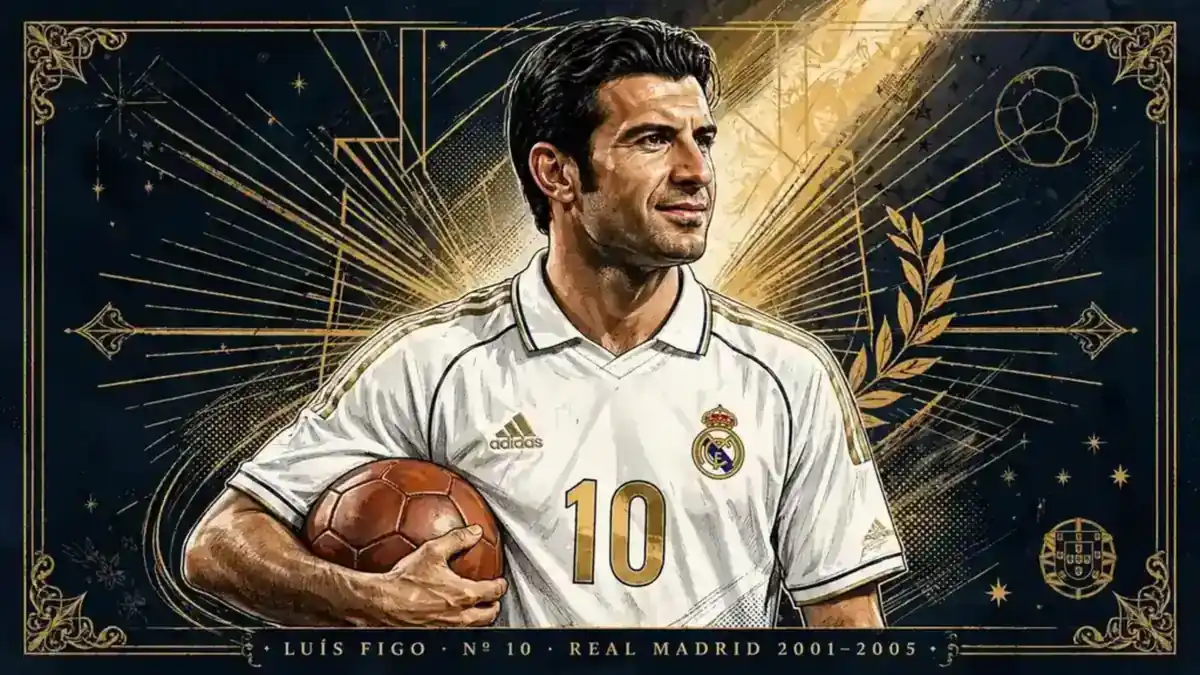
Luis Figo‘s net worth is estimated at $50 million to $60 million as of November 2026. The figure comes with a twist no other net-worth page has: asked on Spanish television in November 2026 how much money he had in the bank, Figo answered himself — between twenty and fifty million euros, adding “I have more than you think and less than what I want.” The Portuguese winger earned his fortune the old-fashioned way for a footballer of his era: a world-record transfer, five years as the first Galactico at Real Madrid, a Ballon d’Or, and then a second career as a businessman with stakes in mining, chocolate, fashion and property.
Luis Figo: Quick Facts
| Estimated net worth | $50 million (range: $50 million to $60 million) |
|---|---|
| Profession | Retired professional footballer (winger), businessman |
| Nationality | Portuguese |
| Born | November 4, 1972 (age 54) |
| Height | 1.80 m (5 ft 11 in) |
| Primary income sources | Club salaries, endorsements (Nike, Pepsi, Gillette), real estate, mining and food-industry investments, ambassadorial roles |
| Active years | 1989–2009 (playing career); 2009–present (business) |
| Last reviewed | November 2026 |
- Early Life and Background
- Education
- Career Journey
- Rise to Fame
- Main Sources of Income
- Salary and Earnings
- Businesses and Investments
- Brand Deals and Sponsorships
- Houses, Cars and Other Assets
- Awards and Achievements
- Net Worth Growth Over the Years
- Social Media Presence
- Personal Life
- Sources & Reporting
- Frequently Asked Questions
- Final Thoughts
Early Life and Background
Luís Filipe Madeira Caeiro Figo was born on November 4, 1972, in Almada, a working-class city across the Tagus river from Lisbon, Portugal. He grew up in the Cova da Piedade neighbourhood, where football was played on concrete and dirt pitches rather than manicured grass. His father worked in construction and his mother cleaned houses, and the family had no money to spare for the luxuries that surround young footballers now. Figo has spoken in interviews about playing barefoot in the street and about the ball being the one possession that mattered, a detail that still shapes how he talks about money: as something to be kept, not flashed.
Scouts from Sporting CP, one of Portugal’s big three clubs, spotted him playing youth football when he was 11, and he joined the club’s famed Alcochete academy in 1984. The academy system gave him board, schooling and daily coaching, and it also gave him his first taste of structure: training schedules, diet, discipline. By 17 he was training with Sporting’s senior squad, and he made his first-team debut in 1989, still a teenager, in a Portuguese league that was then a long way from the money of Spain, Italy or England. The six seasons that followed turned a quick, two-footed winger into the most valuable young player in Portugal.
Figo was part of Portugal’s celebrated “Golden Generation”, the group that won the FIFA World Youth Championship in 1991 in Lisbon, beating Brazil on penalties in front of a packed Estadio da Luz. That tournament put Figo, Rui Costa, Paulo Sousa and Joao Pinto on the map together, and it is the reason Portuguese football still talks about that generation as a single unit. For Figo personally, it was the launchpad: within four years he would be playing for Barcelona, and within nine he would be the most expensive footballer on the planet.
The early years also explain the shape of his fortune. Figo came from a household where money was tight, and teammates and business partners have described him across the years as careful with it — the kind of player who asked about contracts and investments while others spent. That caution shows in the numbers: unlike many stars of his generation, he never went through a public bankruptcy, a fire sale of assets, or a court case over unpaid tax that reached the headlines. His wealth grew slowly, then jumped with the Madrid transfer, then compounded quietly after retirement.
Education
There is no record of Figo attending university or holding a degree, and no credible source claims one for him. His education was the Sporting CP academy system, which combined regular schooling with full-time football training from the age of 11. In Portugal in the 1980s, that was the standard route for a talented boy from a working-class family: the club handled the classroom hours, and the pitch handled the rest.
What the academy did teach him, and what shows up later in his business career, was languages and adaptability. Figo speaks Portuguese, Spanish, Italian and English, picked up across four leagues and two decades of dressing rooms, press conferences and sponsor events. He has also spent his post-playing years in boardrooms and investor meetings, and the people who have worked with him — at UEFA, at his own foundation, at the companies he has backed — describe a man who learned deal-making on the job rather than in a lecture hall. For a net-worth profile, the honest line is this: his financial education came from agents, lawyers and his own mistakes avoided, not from a diploma.
Career Journey
Figo’s senior career ran from 1989 to 2009 across four clubs in three countries, and each move raised his market value sharply. At Sporting CP he made 137 league appearances and won the Portuguese Cup in 1995, his final season in Lisbon. By then every big club in Europe knew his name, and the summer of 1995 produced one of the strangest transfer sagas of the decade: Figo signed pre-contracts with both Juventus and Parma, the two Italian clubs went to war over him, and FIFA responded by banning him from playing in Italy for two years. The ban pushed him toward Spain instead, and Barcelona paid a fee TheRichest records at $2.69 million to take him to the Camp Nou.
Barcelona, from 1995 to 2000, was where Figo became a star rather than a prospect. He played 172 league games for the club, won La Liga in 1997–98 and 1998–99, the Copa del Rey in 1997 and 1998, the Cup Winners’ Cup in 1997 and the UEFA Super Cup in 1997. He wore the captain’s armband, learned to carry a team that expected to win every week, and became one of the most recognisable faces in world football. His salary at Barcelona was modest by the standards of what came next — the big money in Spanish football in the late 1990s still sat well below the figures of the 2010s — but the five years in Catalonia built the reputation that made the next fee possible.
Then came July 24, 2000, the date that defines Figo’s career and his bank balance. Florentino Perez had won the Real Madrid presidency on a promise to sign Figo, and he kept it by paying Barcelona the player’s buyout clause: €62 million, a world record at the time, reported in Britain as £37.5 million. The fee made Figo the most expensive footballer in history and the first Galactico, the template for the superstar-per-summer policy that would bring Zinedine Zidane, Ronaldo and David Beckham to the Bernabeu in the years that followed. For Figo, the move also meant a large pay rise: the Daily Record, citing France Football’s pay survey, put his Real Madrid salary at about £3 million a year, roughly £57,000 a week, in 2001.
Five seasons at Real Madrid brought two more La Liga titles (2000–01 and 2002–03), the Champions League in 2002, the Intercontinental Cup in 2002, the UEFA Super Cup in 2002 and two Spanish Super Cups. His final season in Madrid, 2004–05, turned sour under coach Vanderlei Luxemburgo, and Figo left on a free transfer in the summer of 2005. Real Madrid asked nothing for him, Soccerphile reported at the time, “due to his merits at the Bernabeu”, though the club would have demanded €3.5–€6 million had he joined a Spanish rival. Inter Milan signed him on a two-year deal worth a reported €3.5 million in the first year and €3.6 million in the second.
Inter was a dignified final act. Figo won Serie A in all four of his seasons in Milan — 2005–06, 2006–07, 2007–08 and 2008–09 — plus the Coppa Italia in 2006 and three Italian Super Cups. He announced his retirement on May 31, 2009, at 36, after 20 years as a professional. His Portugal career ran alongside all of it: 127 caps and 32 goals, a semi-final at Euro 2000, a final on home soil at Euro 2004, and a fourth-place finish at the 2006 World Cup in Germany, where Portugal lost the semi-final to France. He retired from international football after that tournament, closing the book on the Golden Generation.
Rise to Fame
Figo’s rise had three distinct jumps, and each one multiplied his earning power. The first was the 1991 World Youth Championship, which turned him from a Sporting prospect into a national talking point. The second was Barcelona, where he went from promising winger to club captain and one of the faces of the late-1990s Spanish game. The third, and by far the biggest, was the transfer to Real Madrid in 2000, which made him a global celebrity overnight — and, for a while, the most hated man in Catalonia.
The hatred was real and it was loud. Barcelona supporters saw the move as a betrayal, and Figo was booed, whistled and threatened every time he returned to the Camp Nou. The low point came in November 2002, when a pig’s head was thrown onto the pitch near him during El Clasico as he prepared to take a corner. The image travelled the world and, perversely, raised his profile further: Figo was no longer just a fine winger, he was the central character in football’s fiercest rivalry, and sponsors pay for characters. Nike, Pepsi and Gillette all built campaigns around him in those years, and his face was on billboards from Lisbon to Tokyo.
The Ballon d’Or in 2000 confirmed the status. Figo won the award in the same year as the transfer, ahead of Zidane, and followed it with the FIFA World Player of the Year award in 2001. Those two trophies matter financially because they are the ones sponsors and clubs price into contracts: a Ballon d’Or winner commands higher appearance fees, higher endorsement rates and a higher place in every pay survey. France Football’s annual earnings ranking put Figo’s total annual income, salary plus endorsements, at around $11 million in the early 2000s, and around $7.6 million in its 2003 survey — serious money for the era, even if it looks small beside the $100 million-plus annual packages of today’s stars. The gap is a reminder of how much football’s economy has inflated since Figo played: his peak pay would not crack the top 50 today, yet it bought him a fortune that has lasted.
His Portugal career added a different kind of fame. Euro 2004, hosted by Portugal, took the national team to the final in Lisbon, where Greece beat them 1–0 in one of the great upsets. Figo wept on the pitch that night, and the image is still shown in Portugal whenever the tournament is remembered. Two years later, at the 2006 World Cup, he captained Portugal to the semi-finals, their best finish since 1966. Those tournaments kept him in front of global audiences every two years for a decade, and that steady exposure is what turned a club star into a national icon — the kind of figure who can sell a fashion label or a chocolate brand twenty years after retiring.
Main Sources of Income
Figo’s money came from four streams, in roughly this order of size: club wages across twenty seasons, endorsement deals at the peak of his fame, business investments made after retirement, and ambassadorial and media work in the years since. The first stream did the heavy lifting. Four contracts — Sporting, Barcelona, Real Madrid and Inter — paid him for two decades, and the Madrid years were the richest: a £3-million-a-year salary, win bonuses, and Champions League prize money on top. France Football’s surveys give the scale: about $11 million a year in total earnings at his peak, and $7.6 million in 2003, counting salary, bonuses and endorsements together.
The second stream, endorsements, mattered most between 2000 and 2005, when Figo was the most marketable Portuguese athlete on earth. Nike dressed him for most of his career, Pepsi put him in its global football campaigns alongside the other stars of the era, and Gillette and Volkswagen used his face in European advertising. None of the brands ever published what they paid him, and the wilder numbers floating around online — one low-quality site claims a €10-million-a-year Pepsi deal — have no reliable source behind them, so we do not repeat them as fact. What is solid is that endorsement income was large enough for France Football to count it as a major share of his annual earnings, and that it kept flowing after retirement through ambassadorial deals rather than boot contracts.
The third stream, business, is where the money has grown since 2009. Figo put his playing earnings into property in Portugal and abroad, took a substantial stake in a mining company, and in 2022 became a shareholder in Elgorriago, Spain’s oldest chocolate and biscuit company, while also launching his own Luis Figo fashion label. He also co-founded Dream Football, a football events business that stages legends matches, and runs the Luis Figo Foundation, his charity. The details are in the business section below, but the shape is clear: Figo treated retirement as a career change, not a holiday.
The fourth stream is the quiet one: ambassadorial roles for UEFA and FIFA, punditry and commentary work, and paid appearances. Figo has worked as a commentator and pundit for broadcasters, appears at UEFA events, and is a regular at legends matches and corporate events, all of which pay appearance fees. None of these is large on its own, but together they explain how a retired player keeps earning without a club salary. His Instagram account, with about 5.4 million followers according to Feedspot’s 2026 tracker, also has commercial value, though Figo posts far less sponsored content than the modern stars who grew up with the platform.

Salary and Earnings
Football salaries in Figo’s era were rarely published in full, and the numbers that survive come from pay surveys, transfer reporting and the occasional leaked contract detail. The table below gathers the figures that can be traced to a named source, and leaves out the ones that cannot. The pattern it shows is a steady climb: modest pay at Sporting, a solid Barcelona wage, a large jump at Real Madrid, and a comfortable landing at Inter.
| Period | Club | Reported pay / fee | Source |
|---|---|---|---|
| 1995 | Sporting CP to Barcelona | Transfer fee $2.69 million | TheRichest |
| 2000 | Barcelona to Real Madrid | Transfer fee €62 million (world record); £37.5 million | Multiple outlets; Daily Record |
| 2001 | Real Madrid | Salary about £3 million a year (£57,000 a week) | Daily Record / France Football |
| Early 2000s | Real Madrid | Total annual earnings about $11 million (salary + endorsements) | France Football pay survey |
| 2003 | Real Madrid | Total annual earnings $7.6 million | France Football via Soccer America |
| 2005–2007 | Inter Milan | €3.5 million (year one), €3.6 million (year two) | Soccerphile |
| 2005 | Real Madrid to Inter | Free transfer | Soccerphile |
Two things stand out. First, the transfer fees were never Figo’s money — the €62 million went to Barcelona, not to him — but the fee set his wage, because a club that pays a world record expects to pay a world-record salary to match. Second, his peak annual earnings of around $11 million look small next to the modern game: Cristiano Ronaldo’s net worth was built on annual packages many times larger, and even Neymar’s fortune rests on wages Figo’s generation never saw. Figo earned his money in a cheaper era, which is one reason his net worth sits at $50–$60 million rather than in the hundreds of millions: he was paid like a king of 2001, not like a king of 2026.
There is also the question of what he kept. Footballers of Figo’s generation paid high tax rates in Spain and Italy, paid agents a percentage of every deal, and funded their own lifestyles. Figo’s advantage was that he never had a public financial collapse: no bankruptcy filing, no forced sale, no tax case in the headlines. The money he made stayed made, and the property and business stakes he bought with it have had fifteen-plus years to grow. That is the unglamorous truth behind most retired-player fortunes: the headline is the salary, but the result is the saving.
One more figure deserves a place here because it is the freshest number attached to Figo’s name. On La Revuelta, the Spanish talk show hosted by David Broncano, in November 2026, Figo was asked the show’s standard question: how much money do you have in the bank? Guests are usually offered a choice between answering that or a question about their sex life. Figo answered both. On the money, he said: “It depends on how much the Treasury values my properties. I have more than you think and less than what I want. Between €20m and €50m.” The clip was reported by Marca and All Football on November 17, 2026. It is the closest thing to a self-declared figure Figo has ever given, and it anchors the lower half of our $50–$60 million range: €20–€50 million in cash and property, before counting business stakes and future income, converts to roughly $23–$58 million at late-2026 rates.
Businesses and Investments
Figo’s second career is the part of his story most net-worth pages get wrong, because they list the same three words — real estate, business ventures, investments — without saying what any of them actually are. The record, pieced together from the Daily Mirror’s February 2025 profile of his post-football life and other reporting, is more specific than that, and it is more interesting.
Property came first. Figo invested heavily in real estate in Portugal and abroad during and after his playing career, holding luxury apartments, commercial buildings and land, according to the Mirror’s reporting and other profiles. He has homes in Lisbon and Madrid, the two cities where his career was built, and property is the asset class he himself pointed to on La Revuelta when he said his wealth depended on “how much the Treasury values my properties”. For a player who earned his money before football wages exploded, property was the sensible store of value: it appreciated while his salary years ended.
Mining is the least expected holding, and the largest single surprise in his portfolio. The Mirror reported that Figo is a main shareholder in a mining company that extracts minerals in Guinea and Senegal, in West Africa. The report does not name the company or value the stake, and we do not guess at either, but the holding is real enough to have been reported in a national newspaper profile, and it fits a pattern: retired players with capital and connections are often offered stakes in resource and infrastructure businesses in markets where their name opens doors. It is also the kind of illiquid, long-horizon investment that explains why Figo’s own estimate of his wealth is a wide range — a mining stake is hard to value until it is sold.
Food and fashion came next. In 2022 Figo became a shareholder in Elgorriago, Spain’s first chocolate and biscuit company, and launched the Luis Figo fashion label, a luxury clothing brand carrying his name. The Mirror’s profile described both moves as part of a deliberate shift into consumer brands, where a famous name is itself an asset. A chocolate company and a clothing line are small beside a mining stake, but they are the kind of businesses a former footballer can promote personally, and Figo has done so, appearing at launches and in campaigns for both.
Football itself remains a business for him. He co-founded Dream Football, a venture that stages legends matches and football events, keeping him inside the game he left in 2009 and paying him for appearances that would otherwise be favours. He also runs the Luis Figo Foundation (Fundacao Luis Figo), his charity, which works with children and young people in Portugal. The foundation is a cost, not a profit centre, but it is part of the same picture: Figo’s post-playing life is organised, commercial and deliberate, and that is why his net worth has held its level for fifteen years after his last pay cheque rather than sliding the way so many retired players’ fortunes do.

Brand Deals and Sponsorships
At his peak, Figo was one of the most marketable footballers in the world, and the brands that signed him tell the story of that era’s football economy. Nike was the longest relationship: the American sportswear giant dressed him through most of his career, put him in its global football campaigns, and kept him as an ambassador after retirement. In the early 2000s, Nike’s football roster was a short list — Figo, Ronaldo, Ronaldinho, later Erling Haaland’s generation would inherit the same model — and membership on it paid far more than any boot deal does today relative to wages.
Pepsi was the other giant. Figo appeared in the soft-drink company’s football advertising at the turn of the millennium, when Pepsi was spending heavily to rival Coca-Cola’s grip on the sport. Gillette used him in shaving campaigns across Europe, Volkswagen put him in front of its performance models in 2005, and EA Sports featured him in its football video games. The pattern is consistent: Figo’s sponsors were global consumer brands, not the betting firms and crypto exchanges that dominate football sponsorship now, and they paid for reach across Europe and Asia rather than for social-media clicks.
What the deals were worth, in hard numbers, is mostly unreported. The brands never published the fees, and Figo has never discussed them. The only solid yardstick is France Football’s pay survey, which counted endorsements as a large share of his roughly $11 million annual earnings at his peak. Readers should treat any site that prints an exact figure for a single Figo deal — the €10-million-a-year Pepsi claim is the most common — with suspicion: it traces to low-quality content farms, not to a named source, and no reputable outlet has confirmed it. The honest summary is that endorsements were worth millions across his career, that Nike and Pepsi were the biggest of them, and that the money arrived when his salary was also at its highest, which is how a $50–$60 million fortune gets built in the first place.
After retirement, the sponsorship model changed. Figo no longer sells boots; he sells his name and his presence. Ambassadorial roles for UEFA and FIFA, appearances at sponsor events, and his own fashion label are the modern version of the same trade. It pays less than the Nike years, but it pays steadily, and it costs him nothing in training-ground hours. For a 54-year-old, that is the point: the brand deals now fit the life, rather than the other way round.
Houses, Cars and Other Assets
Figo keeps his private life private, and his property portfolio is no exception: there is no public register of every home he owns, and no credible outlet has published a room-by-room inventory. What can be said with confidence is that he owns homes in Lisbon and Madrid, the two cities that anchor his life, and holds other property in Portugal and abroad as part of the real-estate portfolio reported by the Mirror and other profiles. He himself framed his wealth in property terms on La Revuelta in November 2026, saying it depended on how the Treasury valued his properties — a remark that only makes sense if property is a large share of what he owns.
His cars are a similar story. Figo has been photographed over the years with high-end cars, as most footballers of his standing are, but no reliable source itemises his garage by model and value, so we do not invent a list. The same honesty applies to watches, art and other collectibles: they may exist, and for a man of his wealth they probably do, but they are not documented, and a net-worth article that prints a specific watch or car without a source is guessing. What is documented is the shape of the portfolio: property first, business stakes second, and a lifestyle that is comfortable rather than performative. Figo does not post fleets of supercars or private jets; his public image is closer to a businessman who happens to have been a footballer than to a footballer playing at being a businessman.
The mining stake deserves a second mention here because it is the hardest asset to value and the most likely reason the published estimates disagree. A stake in a private mining company has no daily share price. It is worth what a buyer will pay, and that depends on commodity prices, reserves and politics in Guinea and Senegal. If the stake is worth little, Figo’s wealth sits near his own €20–€50 million figure. If it is worth a lot, the $60 million estimates from some outlets start to make sense. The range we publish — $50–$60 million — is built to hold that uncertainty rather than hide it.
Awards and Achievements
Figo’s trophy cabinet is the reason his name still carries commercial weight. The headline honours are the Ballon d’Or in 2000 and the FIFA World Player of the Year award in 2001, the two individual prizes that define a career. He also won the Onze d’Or in 2000 and was named World Soccer’s World Player of the Year the same year. Portugal named him its Footballer of the Year six times — in 1995, 1996, 1997, 1998, 1999 and 2000 — a run no Portuguese player had matched before him.
Team honours fill the rest of the shelf. With Barcelona he won La Liga twice, the Copa del Rey twice, the Cup Winners’ Cup in 1997 and the UEFA Super Cup in 1997. With Real Madrid he added two more La Liga titles, the Champions League in 2002, the Intercontinental Cup in 2002, the UEFA Super Cup in 2002 and two Spanish Super Cups. With Inter he won Serie A four times in four seasons, the Coppa Italia in 2006 and the Italian Super Cup three times. With Portugal he won the FIFA World Youth Championship in 1991, reached the Euro 2000 semi-final, the Euro 2004 final on home soil, and the 2006 World Cup semi-final, finishing fourth. He retired from international football with 127 caps and 32 goals, then the most caps of any Portuguese player until Cristiano Ronaldo passed him.
The longer list matters too, because it shows how consistently he was rated. Figo was named in the UEFA Team of the Year in 2003, made Pele’s FIFA 100 list of the greatest living players in 2004, and was selected for the UEFA Euro All-Star teams of 2000 and 2004. He was also named in the FIFPro World XI in 2005. These are the honours that sponsors and clubs priced into his contracts, and they are the reason his name still opens doors in boardrooms: a Ballon d’Or winner is a credential that never expires.
One achievement that rarely makes the lists is the transfer itself. Being the subject of a world-record €62 million fee in 2000 made Figo a financial landmark in football history as well as a sporting one. The fee reset the market for every star who followed, and it is the reason his career is still cited in discussions of football economics. In that sense, Figo’s net worth is more than a personal number — it is a marker of the moment football’s money changed scale.
Net Worth Growth Over the Years
Figo’s wealth grew in steps, not in a straight line. The early Sporting years paid little; Barcelona paid well; Real Madrid paid a lot; and retirement replaced wages with business income. The table below is a NetWorthCraft estimate built from the documented salary and transfer figures in this article, and it is labelled as such — no outlet publishes a year-by-year Figo balance sheet, so any site that prints one without saying it is estimated is dressing up a guess.
| Year | Estimated net worth | What changed |
|---|---|---|
| 1995 | $1 million | First big contract: Barcelona move after six seasons at Sporting |
| 2000 | $12 million | World-record €62 million transfer; Ballon d’Or; first Galactico wages |
| 2005 | $30 million | Five Madrid seasons, Champions League win, peak endorsement years |
| 2009 | $40 million | Retirement after four Inter titles; property portfolio building |
| 2015 | $45 million | Business stakes and ambassadorial income compounding |
| 2020 | $48 million | Property appreciation; Dream Football and foundation years |
| 2026 | $50 million | Elgorriago stake, fashion label, mining holding; Figo’s own €20–€50 million remark |
How does that compare with his peers? Figo sits well below the modern superstars and comfortably alongside the greats of his own era. David Beckham’s net worth, built on a far larger endorsement empire and a long post-playing business career, is published at around $450 million by Celebrity Net Worth — roughly nine times Figo’s. Zinedine Zidane, his Madrid teammate, is generally listed near $120 million, and Ronaldinho near $90 million. The gap is mostly about timing: Beckham, Zidane and Ronaldinho all earned in eras when the money was bigger, and Beckham in particular turned fame into businesses at a scale Figo never attempted. Figo’s $50–$60 million is the fortune of a player who was paid like a king in 2001 and invested like a careful man afterwards, rather than a player who monetised every hour of fame. There is no shame in that comparison — only a reminder that net worth measures business as much as talent.
Why do the published estimates disagree? Celebrity Net Worth and TheRichest both say $50 million, Cine Net Worth gives a $50–$60 million range, and TrendingCelebs says $60 million. The spread is narrow — $10 million on a $50 million base — and it comes from the same cause: nobody outside Figo’s circle knows the value of his private business stakes, above all the mining holding. Figo’s own November 2026 remark, €20–€50 million, suggests the cash-and-property core of his wealth sits at or below the published headline, with the rest depending on how those stakes are valued. Our range holds both readings: $50 million anchored, $60 million at the top, and the man’s own words quoted so readers can judge for themselves.
Social Media Presence
Figo’s social media presence is modest by the standards of the modern game, and that is partly a generational fact: he retired in 2009, the year before Instagram became a force, and he never had to build a following to get a contract. His Instagram account, @luis__figo, has about 5.4 million followers according to Feedspot’s 2026 tracker of Portuguese football influencers, and his bio points followers to his foundation (@fundacaoluisfigo) and his fashion label (@lfluisfigo). He posts a mix of family photos, legends-match appearances, foundation work and the occasional brand post, at a pace far slower than the daily content machines run by active players.
The comparison with his successors is stark. Cristiano Ronaldo has more than 680 million Instagram followers, and Neymar more than 240 million, according to OwlStat’s November 2026 counts. Figo’s 5.4 million is less than one percent of Ronaldo’s audience, which is one reason his endorsement income in retirement is a fraction of what active stars earn from a single post. But the number also flatters him in a different way: 5.4 million followers for a man who has not played a competitive match in seventeen years is a measure of staying power, not of marketing effort. He is also active on X (formerly Twitter) and appears regularly in UEFA and FIFA content, where his Ballon d’Or status still guarantees an audience.
For a net-worth profile, the social numbers matter because they cap the future earning power of the brand. Figo will not sign a $10-million-a-year social deal; his audience is loyal but small beside the modern stars, and his content is personal rather than commercial. What he has instead is a different asset: credibility. When Figo fronts a foundation campaign or a legends match, the audience believes him, because the career behind the post is beyond dispute. That credibility is worth more to a chocolate company or a mining firm than a million extra followers would be.
Personal Life
Figo married Swedish model Helene Svedin in 2001, and the couple have three daughters: Daniela, Martina and Stella. Svedin, born in October 1974, was a successful model in her own right before the marriage, and the family has lived mainly between Lisbon and Madrid, with long spells in Milan during the Inter years. For most of their marriage they were one of European football’s most stable couples, rarely in the tabloids and never the subject of a public scandal.
In 2026, some outlets reported that the couple had separated and were living independently. TheCityCeleb’s October 2026 biography of Figo states that “recent reports suggest that Figo and Svedin have separated”, while OhMyFootball’s November 2026 profile of Svedin covers the marriage without confirming a split. Neither Figo nor Svedin has confirmed a separation publicly, and no divorce filing has been reported by a reputable outlet, so this article records the reports as reports and nothing more. Readers should treat the claim as unconfirmed, and should not expect it to change the net-worth picture: no division of assets has been reported, and Figo’s own November 2026 television appearance gave no sign of a financial upheaval.
Outside football, Figo is known for his charity work through the Luis Figo Foundation, which supports children and young people in Portugal, and for his love of the game in its lighter forms: he plays in legends matches, appears at charity events, and has kept close ties with his former clubs, above all Sporting CP and Real Madrid. He has also dabbled in football politics — in 2015 he briefly ran for the FIFA presidency before withdrawing, citing the organisation’s unwillingness to reform — a move that said more about his ambition than about his bank balance. At 54, he lives the life of a wealthy retired sportsman who stayed in the game on his own terms: business in the morning, football in the evening, family in between.
Sources & Reporting
Celebrity Net Worth — the $50 million net-worth estimate, last updated December 10, 2024. The most-cited figure for Figo and the anchor of our range.
TheRichest — $50 million estimate, plus the transfer-fee record: $2.69 million (Sporting CP to Barcelona, 1994–95) and $64.5 million (Barcelona to Real Madrid, 1999–2000).
Marca (via All Football, November 17, 2026) — Figo’s La Revuelta appearance: his “between €20m and €50m” answer on his bank balance, and his remark that his wealth depends on how the Treasury values his properties.
Daily Mirror (February 8, 2025, via The Free Library) — post-football business profile: main shareholder in a mining company operating in Guinea and Senegal, 2022 shareholder in Elgorriago chocolate and biscuits, and the Luis Figo fashion label.
France Football (via Daily Record and Soccer America) — pay surveys: about £3 million a year salary at Real Madrid in 2001, about $11 million total annual earnings at his peak, and $7.6 million in 2003.
Soccerphile — Inter Milan contract terms (€3.5 million year one, €3.6 million year two), the free transfer from Real Madrid, and the €62 million / $56 million world-record fee context.
Cine Net Worth — $50–$60 million range and $5–$7 million estimated annual income from endorsements and business.
TheCityCeleb (October 2026) — biography details, age 54, retirement in May 2009, and the unconfirmed 2026 separation reports.
OhMyFootball (November 2026) — Helene Svedin’s age and family details, and the $50 million Celebrity Net Worth figure restated with its limits.
Feedspot (2026) — Instagram following of about 5.4 million for @luis__figo.
Reporting window: November 2026. Figures were checked against live reporting between November 17–18, 2026, including Figo’s La Revuelta appearance of November 2026. Where sources disagreed, this article publishes the range and names who says what; where a figure could not be traced to a named source, it was cut.
Frequently Asked Questions
What is Luis Figo’s net worth in 2026?
Luis Figo’s net worth is estimated at $50 million to $60 million as of November 2026. Celebrity Net Worth and TheRichest both put him at $50 million, while other outlets publish up to $60 million. Figo himself said on Spanish TV in November 2026 that he had between €20 million and €50 million, a figure that covers his cash and property before business stakes are counted.
How old is Luis Figo?
Luis Figo was born on November 4, 1972, in Almada, Portugal, which makes him 54 years old as of November 2026. He retired from professional football in May 2009 at the age of 36, after 20 years as a professional.
Who is Luis Figo’s wife?
Luis Figo married Swedish model Helene Svedin in 2001. The couple have three daughters: Daniela, Martina and Stella. Some outlets reported in 2026 that the couple had separated, but neither Figo nor Svedin has confirmed this publicly.
Why did Luis Figo leave Barcelona for Real Madrid?
Figo left Barcelona in July 2000 after Real Madrid paid his €62 million buyout clause, a world record at the time. New Real president Florentino Perez had promised to sign him during his election campaign, and the fee made Figo the first Galactico. Barcelona fans saw it as a betrayal, and he was booed on every return to the Camp Nou, most famously when a pig’s head was thrown at him in November 2002.
Did Luis Figo win the Ballon d’Or?
Yes. Figo won the Ballon d’Or in 2000, the year he moved to Real Madrid, and followed it by winning the FIFA World Player of the Year award in 2001. He was also named Portugal’s Footballer of the Year six times, in 1995, 1996, 1997, 1998, 1999 and 2000.
What was Luis Figo’s salary at Real Madrid?
Figo earned about £3 million a year at Real Madrid, roughly £57,000 a week, according to the Daily Record citing France Football’s pay survey in 2001. His total annual earnings, including endorsements, were put at about $11 million at his peak and $7.6 million in 2003. At Inter Milan he earned a reported €3.5 million in his first season and €3.6 million in his second.
What is Luis Figo doing now?
Since retiring in 2009, Figo has worked as a businessman and ambassador. He invests in property, holds a stake in a mining company, became a shareholder in Spain’s Elgorriago chocolate and biscuit company in 2022, launched the Luis Figo fashion label, co-founded the Dream Football events business, and runs the Luis Figo Foundation charity. He also works as a pundit and appears at UEFA and FIFA events.
How tall is Luis Figo?
Luis Figo is 1.80 metres tall, which is 5 feet 11 inches. He played as a winger, usually on the right, and was known for his dribbling, crossing and two-footed ability rather than his physical size.
Final Thoughts
Luis Figo’s $50–$60 million fortune is the record of a career that changed football’s economics and a retirement that protected the money it made. The world-record €62 million transfer in 2000 did not make him rich by itself — the fee went to Barcelona — but it set the wages, the endorsements and the fame that did. The Ballon d’Or and the Champions League kept the money coming, and the business choices after 2009 — property, mining, chocolate, fashion — kept it from leaking away. Fifteen years after his last match, he is still worth roughly what he was worth when he retired, and among retired footballers, that is an achievement in itself.
The most honest number in this whole profile is the one Figo gave himself: between twenty and fifty million euros, more than you think and less than what he wants. It is the answer of a man who knows exactly what he has and is in no hurry to prove it to anyone. The published estimates will keep arguing over $50 million or $60 million, and the mining stake will keep the true figure private. What is not in doubt is the career behind the number: 127 caps for Portugal, a Ballon d’Or, a world-record transfer, and a second act as a businessman that has outlasted the playing career it followed. That is what $50 million looks like when it is earned slowly, spent carefully, and kept.
Published on November 18, 2026. Last reviewed November 2026. Found an error? See our corrections policy.