
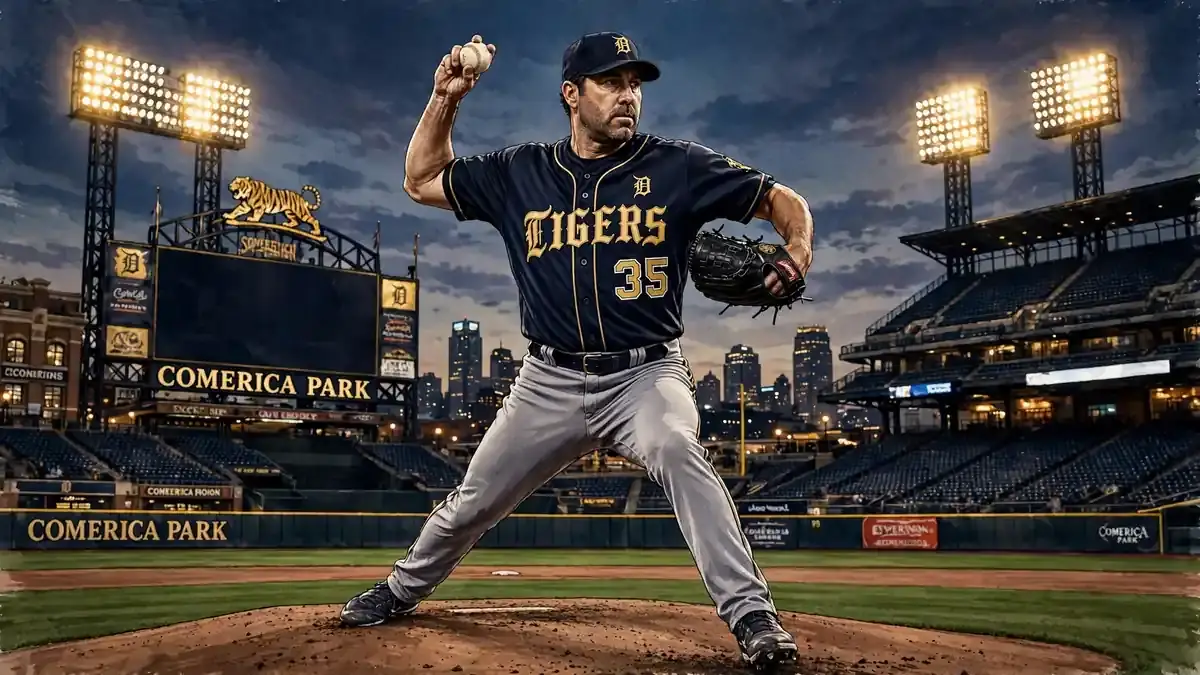
Justin Verlander‘s net worth is estimated at $150 million to $200 million as of November 2026. The figure caps a 21-year pitching career that made him the highest-earning pitcher in baseball history, with $411 million in on-field pay, and it closes with a storybook finish: a farewell start in Detroit, a new broadcasting chair at Fox Sports, and a real estate portfolio that doubled money on a Beverly Hills mansion.
Justin Verlander: Quick Facts
| Estimated net worth | $200 million (range: $150 million to $200 million) |
|---|---|
| Profession | Retired Major League Baseball pitcher; Fox Sports analyst |
| Nationality | American |
| Born | February 20, 1983 (age 43) |
| Height | 6 feet 5 inches (1.96 m) |
| Primary income sources | MLB contracts and salaries, endorsements and commercials, broadcasting, real estate |
| Active years | 2005–2026 (21 MLB seasons) |
| Last reviewed | November 2026 |
- Early Life and Background
- Education
- Career Journey
- Rise to Fame
- Main Sources of Income
- Salary and Earnings
- Businesses and Investments
- Brand Deals and Sponsorships
- Houses, Cars and Other Assets
- Awards and Achievements
- Net Worth Growth Over the Years
- Social Media Presence
- Personal Life
- Sources & Reporting
- Frequently Asked Questions
Early Life and Background
Justin Brooks Verlander was born on February 20, 1983, in Manakin-Sabot, Virginia, a small community in Goochland County outside Richmond. His father, Richard Verlander, worked in communications for a local union; his mother, Kathy, taught school. Baseball filled the house early. Verlander has said he started throwing a ball almost as soon as he could walk, and by his teens he was the kind of local arm that scouts drive out of their way to see.
At Goochland High School, Verlander paired a fastball that touched the mid-90s with a curveball advanced enough to make college recruiters take notice. The raw numbers from those years tell only part of the story. The part teammates still repeat is the chocolate milk story, which Verlander himself told Sports Illustrated: as a sophomore, short 50 cents for a chocolate milk, he promised his friend Daniel Hicks 0.1 percent of his future professional signing bonus in exchange for the coins, and signed the deal on a napkin. Years later, after the Detroit Tigers handed him a signing bonus of just over $3 million, Hicks produced the napkin. Verlander paid him roughly $3,000. Celebrity Net Worth retold the story in 2015, and it has stuck because it captures the two sides of Verlander’s money story at once: the small-town kid who treated a handshake like a contract, and the teenager who already believed the big money was coming.
That belief was not misplaced. By his senior year, Verlander was one of the most sought-after high school arms in the country, and the Tigers made him the second overall pick of the 2004 MLB draft. The signing bonus — just over $3 million — was the first real money of a career that would eventually pay him more than $411 million on the field alone.
Education
Verlander skipped the traditional four-year college path in the usual sense: he enrolled at Old Dominion University in Norfolk, Virginia, in 2002 and spent three seasons pitching for the Monarchs before the draft pulled him into professional baseball. Those three college seasons did the heavy lifting for his development. At Old Dominion he refined the fastball-curveball-changeup mix that would carry him through two decades in the majors, and he set school strikeout records that stood long after he left.
The college years also gave him his first taste of national attention. In 2003 he struck out 17 batters in a single game against James Madison, a performance that put him on every major league scouting list. By his junior year in 2004, he was widely projected as a top-five draft pick, and Detroit’s decision to take him second overall — behind only San Diego State’s Matt Bush — set up the defining relationship of his career. He never finished a degree; the draft made that question moot. Old Dominion has stayed part of his public identity ever since, and he has returned to the school for events and fundraising in the years since turning pro.
Career Journey
Verlander debuted for Detroit on July 4, 2005, at 22, and won American League Rookie of the Year in 2006 with a 17–9 record and a 3.63 ERA, helping the Tigers reach the World Series in his first full season. The early years built steadily toward dominance: his first no-hitter came on June 12, 2007, against Milwaukee, and his first All-Star selection followed the same summer. By 2009 he was leading the league in strikeouts, and the Tigers rewarded him in 2010 with a five-year, $80 million extension.
The peak arrived in 2011. Verlander went 24–5 with a 2.40 ERA and 250 strikeouts, winning the pitching Triple Crown, the American League Cy Young Award, and the AL Most Valuable Player award — the first pitcher to win MVP since Dennis Eckersley in 1992. Detroit doubled down in 2013 with a seven-year, $180 million extension, worth up to $202 million with incentives, that made him the highest-paid pitcher in baseball history at the time. A second no-hitter followed on May 7, 2011, against Toronto, and the Tigers reached the World Series again in 2012.
The middle of the decade tested him. Injuries and a dip in velocity fed whispers that the big contract had aged badly, and in August 2017 the Tigers — rebuilding and shedding payroll — traded him to the Houston Astros for three prospects: outfielder Daz Cameron, pitcher Franklin Perez, and catcher Jake Rogers. The change of scenery revived everything. Verlander went 5–0 down the stretch, won his first World Series that October, and finished fifth in Cy Young voting despite switching leagues midseason. Houston extended him for two years and $66 million in 2019, a deal that set a then-record $33 million average annual value for a pitcher, and he answered with a second Cy Young that season and a third no-hitter on September 1, 2019, again against Toronto.
Tommy John surgery in September 2020 cost him the entire 2021 season, and at 38, plenty of observers wrote him off. He returned in 2022 on a one-year, $25 million deal, went 18–4 with a 1.75 ERA, won his third Cy Young, and won his second World Series. That comeback season, at an age when most power pitchers are long retired, is the single best argument for the size of his career earnings: teams kept paying him like an ace because he kept pitching like one. He then signed a two-year, $86.6 million contract with the New York Mets in December 2022, was traded back to Houston in July 2023, and spent 2024 with the Astros before signing a one-year, $15 million deal with the San Francisco Giants in January 2025.
The Giants season was the hardest of his career. He went winless through his first 14 starts, the third pitcher in franchise history to do that, and spent time on the injured list with shoulder inflammation and neck discomfort. He finished the second half strongly — seven scoreless innings against Arizona in September prompted him to tell reporters he planned to pitch again in 2026 — but the year ended without a playoff appearance and with his future genuinely uncertain.
Then came the homecoming. In February 2026, days before his 43rd birthday, Verlander signed a one-year, $13 million contract to return to Detroit, announcing it himself on social media with a 56-second video set to Eminem’s “Till I Collapse” and the words “Back where it all started.” The deal carried a $2 million base salary with $11 million deferred, paid at $1.1 million a year from 2030 to 2039. His season debut came on March 30 in Arizona, but hip inflammation in April and a hamstring strain kept him to two starts all year. On July 8, 2026 — the same day Commissioner Rob Manfred named him a “Legend Pick” for his 10th All-Star Game in Philadelphia — Verlander announced on social media that 2026 would be his last season, writing that he had always wanted “the game to tell me when it was time” and that he had realized the time had come.
The ending was staged the way he wanted it. On September 26, 2026, at a sold-out Comerica Park against the Pittsburgh Pirates, Verlander made the final start of his career: five and a third innings, two runs on five hits, six strikeouts on 91 pitches. When manager A.J. Hinch came to lift him, it was his seven-year-old daughter Genevieve who walked to the mound to collect him, and father and daughter left the field together to a standing ovation. Detroit won 4–3 on a walk-off. He finished with a 266–159 record, a 3.33 ERA, 3,560 strikeouts — eighth in baseball history — and 557 starts across 21 seasons.
Rise to Fame
Verlander’s fame arrived in layers rather than a single breakout. The 2006 Rookie of the Year award and World Series run made him a Detroit sports figure. The 2007 no-hitter made him a national one. The 2011 MVP season made him the face of pitching in baseball — a starting pitcher winning MVP is rare enough that it still defines his public image, and it arrived in the same season he threw his second no-hitter and won 24 games.
The Astros years added the missing piece: championships. Two World Series rings, in 2017 and 2022, plus the 2019 and 2022 Cy Young awards, turned a very good career into a Hall of Fame case with no real counterargument. His 2022 comeback from Tommy John surgery at 39 drew coverage well beyond sports pages, because it doubled as a story about longevity in a sport that discards pitchers young.
Fame also followed him off the field through his marriage to model Kate Upton, one of the most photographed couples in American sports. The two met in 2012 while filming a commercial, and their relationship — engagement in 2016, a Tuscany wedding in November 2017, two children — has kept Verlander in celebrity coverage as much as sports coverage for a decade. That dual profile matters to the money story: it widened his endorsement appeal beyond baseball fans and kept his name in circulation during the long stretches between starts.
The final layer came after the last pitch. Within days of retiring, Verlander was on The Tonight Show, and on October 6–7, 2026, he debuted as a Fox Sports studio analyst for National League Division Series coverage, sitting alongside Kevin Burkhardt, Derek Jeter, Alex Rodriguez, and David Ortiz. Manny Machado’s on-air line to him — “didn’t you just retire, man?” — became the running joke of the postseason, and it marked the start of a second career that pays him to talk about the game instead of throwing in it.
Main Sources of Income
Four streams built Verlander’s fortune, and their proportions are lopsided in a way that surprises people who assume athletes earn evenly across categories. MLB salaries account for the overwhelming majority — more than $411 million in career cash pay, per Spotrac. Endorsements and commercial work form a distant second: real money, but never the main engine, because baseball’s endorsement market is far smaller than the NBA’s or NFL’s. Broadcasting, which began in October 2026 with Fox Sports, is the newest stream and the one with the longest runway. Real estate is the fourth, and the only one where a single transaction is on the public record with a clean profit: the Beverly Hills house bought for $5.25 million and sold for $11 million.
Postseason shares added smaller sums along the way — World Series winners’ shares are typically in the hundreds of thousands of dollars per player — and All-Star and award bonuses were written into several of his contracts. None of those move the total much. The honest shape of this fortune is simple: two decades of top-of-market pitching contracts, taxed and spent at a normal rate for a high earner, plus a few smart property moves and a broadcasting career that starts the moment the playing checks stop.
Salary and Earnings
Spotrac’s contract-by-contract ledger is the most complete public record of what Verlander actually earned, and it is the backbone of this section. By the end of the 2026 season he had collected $411,254,888 in cash salary across 21 seasons. Counting the $11 million deferred from his final Tigers contract, which pays out at $1.1 million a year from 2030 through 2039, his total career earnings reach $422,254,888. That makes him the highest-earning pitcher in Major League Baseball history and the second-highest-earning player ever, behind only Alex Rodriguez at $485,159,552. Former Tigers teammate Miguel Cabrera, at $393 million, sits third on that list — a reminder of how unusual Detroit’s payroll was in the early 2010s.
The pay curve tells the story of his career in dollars. His first five seasons, 2005 through 2009, paid roughly $10 million combined, including a five-year, $4.45 million early-career deal that bought out his pre-arbitration and arbitration years. The first real payday came in 2010: a five-year, $80 million extension that covered his Cy Young and MVP peak. Then the 2013 extension — seven years, $180 million, up to $202 million with incentives — made him the highest-paid pitcher in the game, and it paid him $20 million in 2012, $28 million in 2019, and $25 million in 2022 under its various structures. The 2019 extension with Houston, two years and $66 million, set a then-record $33 million average annual value for a pitcher. The Mets deal in December 2022 — two years, $86.6 million — tied the highest annual salary ever for a pitcher at just over $43 million a season, with the Astros picking up part of the tab after the mid-2023 trade sent him back to Houston.
| Period | Team(s) | Contract / earnings |
|---|---|---|
| 2005–2009 | Detroit Tigers | ~$10 million — entry-level and arbitration years |
| 2010–2014 | Detroit Tigers | $80 million — five-year extension |
| 2013–2019 | Tigers / Astros | $180 million — seven-year extension (up to $202M with incentives) |
| 2020–2021 | Houston Astros | $66 million — two-year extension, $33M average annual value |
| 2022 | Houston Astros | $25 million — one-year deal; Cy Young and World Series |
| 2023–2024 | Mets / Astros | $86.6 million — two-year deal, $43.33M per season |
| 2025 | San Francisco Giants | $15 million — one-year deal |
| 2026 | Detroit Tigers | $13 million — one-year deal; $2M base, $11M deferred to 2030–2039 |
Two details in that table deserve a second look. First, the 2026 contract: Verlander took only $2 million in cash during the season and deferred $11 million without interest until 2030. For a player with $411 million already banked, the deferral was a gesture — a way to help Detroit’s payroll and to close his career on his own terms rather than chase one more market-rate deal. Second, the Mets contract: at $43.33 million a year, it tied the highest annual salary ever paid to a pitcher, and it came when Verlander was 40. Teams pay for certainty, and for two decades he was the closest thing to a sure thing in the sport.
For comparison, the sport’s current earnings hierarchy puts Verlander’s total in context. Shohei Ohtani’s fortune is built on a $700 million contract structured with massive deferrals, while Aaron Judge’s wealth rests on a nine-year, $360 million Yankees deal. Verlander earned more cash, sooner, than either — and he did it as a pitcher, a position where careers rarely survive past 35.
Businesses and Investments
Unlike some athletes who build visible business empires, Verlander has kept his investment activity private, and the public record reflects that. There is no Verlander-branded company, no disclosed venture portfolio, and no startup equity story with a headline valuation. What the record does show is a disciplined, property-led approach to wealth: buy real estate in strong markets, hold it, renovate it, and sell when the timing is right.
The deferred money in his contracts is itself a form of investment planning. The $11 million deferred from his 2026 Tigers deal pays out at $1.1 million a year from 2030 to 2039 — a decade of guaranteed income that starts four years after he stops playing. Earlier contracts also included deferred money and signing-bonus structures that spread income across years, a common tax-planning tool for players in top brackets. His career also benefited from playing in states with no income tax — Texas with Houston — for several of his highest-paid seasons, though the exact savings are private.
Verlander and Upton also run a family foundation, and his public giving has centered on military and veterans’ causes, including support for service members and their families. The foundation work is modest in scale compared with his playing income, but it has been a constant thread in his public life, from his Detroit years through retirement.
Brand Deals and Sponsorships
Here is where honest reporting has to push back on the usual net worth template. Many Verlander profiles list Nike and Rawlings as endorsements, but those brands are league-wide Major League Baseball partners — Nike supplies on-field uniforms, Rawlings supplies the baseballs and gloves — and there is no verified public record of a personal, paid endorsement deal between Verlander and either company. Repeating them as personal sponsors would be the kind of error this site exists to avoid.
What is verified is thinner and more interesting. Verlander and Upton met in 2012 while filming a commercial for the MLB 2K12 video game, a shoot that put a ballplayer and a Sports Illustrated cover model on the same set and, indirectly, started the most famous baseball marriage of the decade. Verlander has appeared in national advertising campaigns through his career, and his profile — three Cy Young awards, an MVP, a decade of playoff baseball — made him a natural fit for brands that wanted a credible, clean-cut star rather than a loud one.
The honest scale of this stream: endorsement income was always a small fraction of Verlander’s earnings. Baseball players, even the best ones, earn a fraction of what NBA and NFL stars make off the field, because the sport’s marketing is team-first and its stars wear caps and uniforms that hide their faces. No outlet has published a verified annual off-field earnings figure for Verlander, and we do not invent one. His fortune was built on the mound, and the endorsement line in his story is a footnote, not a chapter.

Houses, Cars and Other Assets
Real estate is the best-documented part of Verlander’s wealth outside his contracts, and the numbers are all on the public record. The headline property is the Benedict Canyon estate in Beverly Hills. Verlander and Upton bought it in 2016 for $5.25 million: a 1976 East Coast traditional-style house with 5,521 square feet on a gated 1.5-acre lot, four bedrooms, five bathrooms, a swimming pool, a spa, a tennis court, and rose gardens. The house carried a famous ownership chain — saxophonist Kenny G, tennis great Pete Sampras, actress Kate Jackson, producer-director William Asher, and Hollywood producer Jon Peters had all owned it before them.
The couple renovated the home, including an overhaul of the eat-in kitchen with an oversized marble island, and listed it in October 2022 for $11.7 million as they shifted their primary residence to Florida. The buyer was actor Timothée Chalamet, who paid $11 million — more than double what Verlander and Upton had paid six years earlier, a gain of roughly $5.7 million before renovation costs and fees. Sports Illustrated and The Richest both documented the sale, and it remains one of the cleanest celebrity property flips on the record.
The Florida move was not a downsizing. In 2021 the couple bought a waterfront mansion in Palm Beach County for about $6 million, and after the Mets contract they added a $15.3 million penthouse on Manhattan’s Upper East Side in 2023, a family base built for their life with two young children. Between Beverly Hills, Jupiter, and Manhattan, the couple’s property history tracks the arc of Verlander’s career — Detroit money, Houston money, New York money — with each move matched to the team he was playing for.
On cars, Verlander has kept a lower profile than many athletes of his wealth. No verified public record lists a signature collection, and we do not pad this section with one. What is documented is the lifestyle the properties imply: gated privacy, tennis courts, and a family base in three of America’s most expensive zip codes.
Awards and Achievements
The trophy case is the reason the money followed. Three American League Cy Young Awards (2011, 2019, 2022). One American League Most Valuable Player award (2011), the first for a pitcher in nearly two decades. Ten All-Star selections, including the 2026 “Legend Pick” that became his farewell honor. Two World Series championships, with Houston in 2017 and 2022. Three no-hitters — 2007 and 2011 with Detroit, 2019 with Houston. American League Rookie of the Year in 2006. A pitching Triple Crown in 2011, leading the league in wins (24), ERA (2.40), and strikeouts (250) in the same season.
The career totals, as of his final start on September 26, 2026: 266 wins against 159 losses, a 3.33 ERA, 3,560 strikeouts (eighth all time), and 557 starts across roughly 3,577 innings. He added 17 postseason wins and 244 postseason strikeouts, numbers that matter because October baseball is where reputations — and the next contract — are made.
Hall of Fame eligibility follows the standard five-year wait after retirement, putting him on the ballot for the class of 2032, according to Britannica. Nobody who covers the sport expects a long wait. A pitcher with three Cy Young awards, an MVP, two rings, and the second-highest career earnings in the sport’s history is a first-ballot case by any standard applied in the last thirty years.
Net Worth Growth Over the Years
Verlander’s net worth grew in step with his contracts, not ahead of them. The public estimates trace a steady climb: Celebrity Net Worth put him near $95 million in 2020, PlayersBio estimated $150 million in 2023, Net Worth Breakdown put him at $185 million in 2026, and Celebrity Net Worth’s October 2026 snapshot raised him to $200 million. The spread between those figures is the story of this estimate — nobody outside his accountants knows the exact number, and the honest range is $150 million to $200 million.
| Year | Reported net worth estimate | Source |
|---|---|---|
| 2020 | ~$95 million | Celebrity Net Worth |
| 2023 | $150 million | PlayersBio |
| 2026 | $185 million | Net Worth Breakdown |
| 2026 | $200 million | Celebrity Net Worth (October snapshot) |
The earnings underneath those estimates are exact, and Spotrac’s cumulative ledger shows how the money stacked up: about $16 million banked by the end of 2010, $49 million by 2012, $173 million by 2017, $237 million by 2019, $308 million by 2022, $394 million by 2024, and $411 million by the end of 2026 — with another $11 million in deferred pay arriving through 2039. Net worth trails career earnings by a wide margin for a simple reason: taxes on $411 million of salary, agent fees, living costs across three expensive cities, and two decades of spending. The gap between $411 million earned and $200 million kept is normal for a high earner, and it is why we publish the range rather than a single confident number.
One stale figure deserves a correction. A handful of low-quality sites still list Verlander’s net worth at $75 million and his career earnings above $280 million. Both numbers are years out of date — the earnings figure predates the Mets contract alone — and they should not be trusted. The current record, from Spotrac and Celebrity Net Worth, is $411 million earned and a $150 million to $200 million net worth.
Social Media Presence
Verlander announced both his return to Detroit and his retirement on social media, which tells you how central those channels have become to his public life. The February 2026 homecoming video — 56 seconds, Eminem’s “Till I Collapse” over career highlights — was posted to his own accounts and picked up by every major sports outlet within hours. The July retirement statement went out the same way, in his own words, on the same day he was named a Legend Pick for the All-Star Game.
His accounts mix family life, golf, and baseball commentary, and they have become the primary channel for his post-playing career as well: Fox Sports clipped his studio debut across its social accounts in October 2026, including the moment his wife Kate Upton texted him mid-broadcast about co-panelist David Ortiz’s earpiece. The audience is baseball-first, and it is the audience his broadcasting career is built on.
Personal Life
Verlander met Kate Upton in 2012 on the set of a commercial for the MLB 2K12 video game. They began dating in 2014, got engaged in 2016, and married on November 4, 2017, in Tuscany, Italy — four days after Verlander won his first World Series with Houston. Upton, a Sports Illustrated Swimsuit cover model and actress, has built her own fortune, estimated by Celebrity Net Worth at $20 million, bringing the couple’s combined wealth to roughly $220 million. Our full profile of Kate Upton’s net worth covers her modeling and acting income in detail.
The couple has two children: daughter Genevieve Upton Verlander, born November 7, 2018, and son Bellamy Brooks Verlander, born June 19, 2025 — a birth that put Verlander on the Giants’ paternity list during his season in San Francisco. Genevieve, known as Vivi, has been a fixture at ballparks since she was a toddler, and her walk to the mound to collect her father in his final game was the defining image of his retirement. The family keeps the children’s faces largely off social media and splits its time between Florida and New York.
Off the field, Verlander is a golfer — a serious one, by athlete standards — and a longtime supporter of military and veterans’ causes through his family’s foundation work.
Sources & Reporting
Spotrac — the contract-by-contract career earnings ledger ($411,254,888 cash; $422,254,888 including deferred pay), yearly salary breakdowns, and the 2026 Tigers contract structure ($2 million base, $11 million deferred 2030–2039).
Celebrity Net Worth — the $200 million net worth estimate (snapshot October 5, 2026), the retirement earnings analysis, and the 2015 chocolate milk signing-bonus story.
Sports Illustrated — the 2026 Tigers contract’s effect on all-time earnings, the Beverly Hills real estate portfolio, and the retirement announcement coverage of Verlander’s family.
Associated Press — the Giants’ $15 million contract agreement in January 2025 and the July 2026 retirement announcement.
NBC Sports — the Giants contract reporting, the 2025 winless-stretch coverage, and the final-start recap.
ESPN — the Associated Press retirement report carried across ESPN’s network, including the March 30, 2026 season debut and final-start details.
Britannica — career biography, the July 2026 retirement announcement, and Hall of Fame eligibility in 2032.
Heavy — the retirement earnings reporting, including the September 26, 2026 final game against Pittsburgh.
Athlon Sports — the Beverly Hills home sale to Timothée Chalamet and the September 2025 retirement decision reporting.
People — the June 2025 birth of son Bellamy Brooks Verlander.
Reporting window: January 2025 through November 2026, covering the Giants season, the Tigers return, the retirement announcement, the final start, and the Fox Sports debut. Figures were checked against at least two of the outlets above wherever they appear as facts rather than estimates.
Frequently Asked Questions
How much is Justin Verlander worth in 2026?
Justin Verlander’s net worth is estimated at $150 million to $200 million as of November 2026. Celebrity Net Worth puts him at $200 million in its October 2026 snapshot, while Net Worth Breakdown estimates $185 million and an older PlayersBio figure stands at $150 million. We publish the range because taxes, spending, and private investments make a single exact number impossible to verify from public records.
How much did Justin Verlander earn in his MLB career?
Verlander earned $411,254,888 in cash salary across 21 seasons, according to Spotrac — the most ever by a pitcher and the second-most by any player in MLB history, behind Alex Rodriguez at $485,159,552. Counting $11 million deferred from his final Tigers contract, his total reaches $422,254,888.
What was Justin Verlander’s salary in his final season?
His 2026 contract with the Detroit Tigers was worth $13 million, but only $2 million of it was paid as base salary during the season. The other $11 million was deferred, to be paid at $1.1 million a year from 2030 through 2039.
Is Justin Verlander retired?
Yes. Verlander announced on July 8, 2026 that the 2026 season would be his last, and he made his final start on September 26, 2026, for the Detroit Tigers against the Pittsburgh Pirates. He appeared on the MLBPA free-agent list in October 2026 as a formality, but he is not expected to play again.
Who is Justin Verlander married to, and how many kids do they have?
Verlander is married to model and actress Kate Upton. They met in 2012, married in Tuscany, Italy on November 4, 2017, and have two children: daughter Genevieve, born November 7, 2018, and son Bellamy Brooks, born June 19, 2025.
How many Cy Young Awards and World Series did Justin Verlander win?
Verlander won three Cy Young Awards (2011, 2019, 2022), one American League MVP award (2011), and two World Series championships with the Houston Astros (2017 and 2022). He was a 10-time All-Star and threw three no-hitters.
Where does Justin Verlander live now?
Verlander and Kate Upton moved their primary residence to Florida, where they bought a waterfront home in Palm Beach County for about $6 million in 2021. They also own a $15.3 million penthouse on Manhattan’s Upper East Side, bought in 2023. They sold their Beverly Hills mansion to actor Timothée Chalamet for $11 million in 2022.
What is Justin Verlander doing now after retirement?
Verlander joined Fox Sports as an MLB studio analyst days after retiring, debuting on October 6–7, 2026 during National League Division Series coverage alongside Kevin Burkhardt, Derek Jeter, Alex Rodriguez, and David Ortiz. He also appeared on The Tonight Show shortly after his final start.
Final Thoughts
Justin Verlander’s money story is unusually clean for a celebrity fortune: almost all of it can be traced to contracts that are public record, and the number that matters most — $411 million in career earnings — is exact rather than estimated. The $150 million to $200 million net worth range reflects the honest gap between what he earned and what anyone outside his family can verify he kept, after taxes, fees, and two decades of life in expensive cities.
What sets him apart is the shape of the total as much as its size. He was paid like an ace at 28, at 36, and at 40, when most pitchers are retired or coaching. The $86.6 million Mets contract at age 40, the $33 million average annual value in Houston, and the farewell deal in Detroit that deferred most of its money all point to the same thing: teams kept betting on him because he kept giving them reasons to. He retires as the highest-earning pitcher ever, the second-highest-earning player ever, and a certain first-ballot Hall of Famer — with a broadcasting chair already waiting and $11 million in deferred pay still to come.
Published on November 19, 2026. Last reviewed November 2026. Found an error? See our corrections policy.