
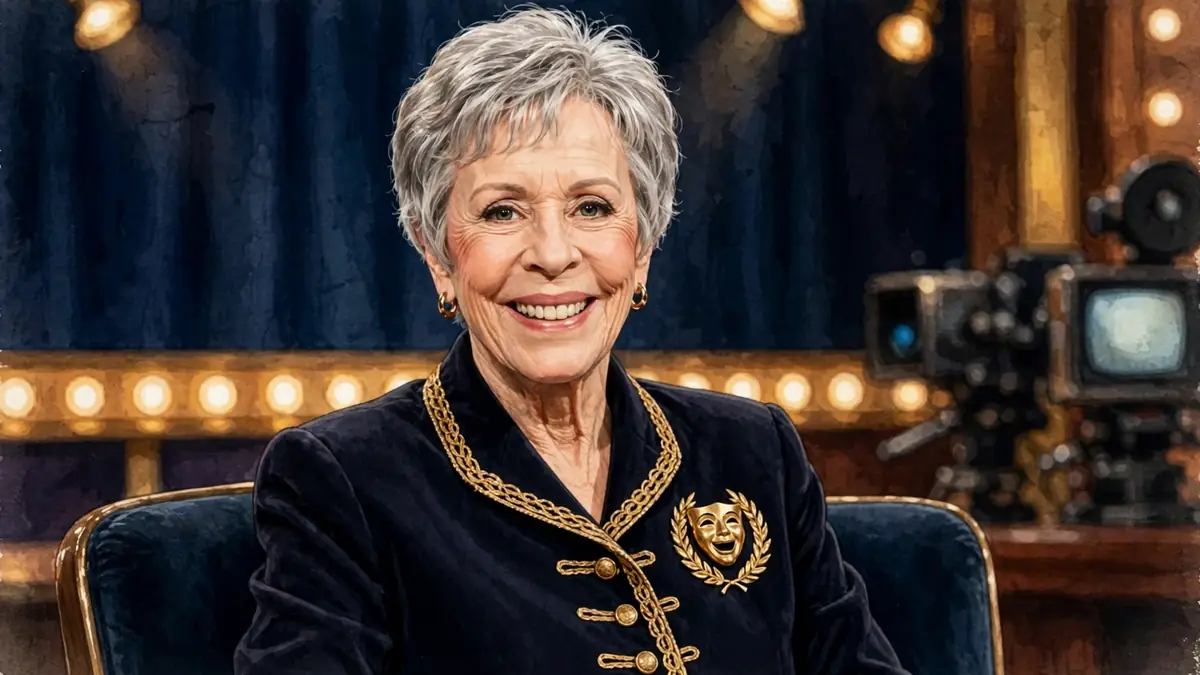
Carol Burnett‘s net worth is estimated at $40 million to $50 million as of November 2026. The figure sits at the top of a career that has now run for more than seventy years, from a $50 gift that paid for her first year at UCLA to an eleven-season variety show that still earns money in reruns, and from a shelf of bestselling memoirs to a starring role on Apple TV+ at the age of 92. Celebrity Net Worth, the outlet most of the press cites on this question, puts the number at $45 million, and Parade repeated that figure in its January 2026 profile — which is why $45 million is the anchor for the range in this article, with Reality Tea’s 2025 estimate of $40 million at the low end and a $50 million reading from other net-worth trackers at the high end.
Carol Burnett: Quick Facts
| Estimated net worth | $45 million (range: $40 million–$50 million) |
|---|---|
| Profession | Actress, comedian, singer, writer |
| Nationality | American |
| Born | April 26, 1933 (age 93) |
| Height | 5 ft 7 in (1.70 m) |
| Primary income sources | Television salaries and syndication, film roles, stage work, bestselling memoirs, live touring, streaming-era acting |
| Active years | 1955–present |
| Last reviewed | November 2026 |
- Early Life and Background
- Education
- Career Journey
- Rise to Fame
- Main Sources of Income
- Salary and Earnings
- Businesses and Investments
- Brand Deals and Sponsorships
- Houses, Cars and Other Assets
- Awards and Achievements
- Net Worth Growth Over the Years
- Social Media Presence
- Personal Life
- Sources & Reporting
- Frequently Asked Questions
Early Life and Background
Carol Creighton Burnett was born on April 26, 1933, in San Antonio, Texas, and the first fact that matters to her money story is that she started with none of it. Her parents, Joseph Thomas Burnett and Ina Louise Creighton, divorced when she was young, and the family moved to Hollywood, where Burnett lived in a low-income boarding house with her grandmother and her younger sister while her mother lived nearby. Parade’s 2026 profile describes a childhood spent inventing characters and voices to entertain friends and classmates, and evenings making music at home with her grandmother, sister and mother. The Smithsonian, which now holds her Charwoman costume in its National Museum of American History, records the same detail: a family without money that went to the movies four or five times a week, saving pennies for double features.
That poverty is not scenery in this story. It explains two things about the fortune that followed. First, Burnett has spent her whole career talking about the $50 that arrived anonymously to pay for her first year of college and the $1,000 interest-free loan, also from an anonymous man, that carried her to New York in 1954 — small sums that only look small until you remember what they bought. Second, it explains why she has always treated work as something to keep doing rather than something to retire from. At 92 she told Parade she wants to keep working as long as she is physically able: “I’m happy to be working and that I’ve got all my parts. I have my hips and my knees — and I think my brain — so as long as I can keep that up and work, then I want to work.”
The Charwoman, the mop-wielding character in a battered coat who became one of her signature creations, came straight out of that early life. Burnett has said the character was inspired by “The Stripper,” David Rose’s 1962 number-one hit, and by the cleaning women she watched as a girl. She introduced the Charwoman in a 1962 television special, and the character ran through the whole life of her variety show. The Smithsonian’s account of the costume’s donation makes the point that the joke was never cruel: the Charwoman lives a humdrum life, and Burnett played her with affection. The character is now museum property, which is a strange and fitting end for a joke born in a boarding house.
San Antonio still claims her, and Hollywood raised her. She graduated from Hollywood High School in 1951, and the city’s studio system was the backdrop of her teens. What her childhood did not give her was connections. Her parents were not in the business, she had no family money, and the two anonymous gifts that launched her education and her move east were exactly that — anonymous. She has honoured the second gift’s condition for seventy years: the man who lent her the $1,000 asked that she repay it within five years, never reveal his name, and pay it forward to someone else in need. She has never named him.
Education
Burnett enrolled at the University of California, Los Angeles, in 1951, intending to study journalism. The anonymous $50 covered her first year — a figure Parade notes with dry amusement, since $50 would not cover a textbook today. She switched her major to English and then to theater arts, and by her own account she had no plan to act at all. She wanted to write plays. That changed in her junior year, during her class’s final performance in 1954, when she got her first real laugh from a live audience and, as she has told interviewers many times since, she was hooked.
The same performance produced the second anonymous gift. A man in the audience offered Burnett and her then-boyfriend $1,000, interest-free, to go to New York and try acting, on three conditions: repay it within five years, never reveal his name, and help someone else the same way later. She moved to New York in 1955 and worked odd jobs while chasing stage work — the classic version of the story, except that the loan that made it possible was itself an act of theatre, a stranger in an audience handing a young woman a future. UCLA gave her the training and the stage; the two gifts gave her the runway. She never finished a degree, and it has never mattered: the education that paid was the one she got onstage in front of a live audience, learning that a laugh is a contract and that keeping it means never repeating yourself.
What is easy to miss about the UCLA years is how directly they shaped her earning power later. Burnett was a writer before she was a star, and the variety show that made her rich was built on writing — sketches she helped shape, characters she invented, parodies she tuned line by line. The English and theater training shows up in the structure of her career: she performed other people’s material and she owned her own, and ownership is where the long money lives. The syndication cheques that still arrive for The Carol Burnett Show are, in the end, payments for writing as much as for performing.
Career Journey
Burnett’s first New York years were the usual grind of bit parts and guest spots. She landed small roles in children’s programmes and a part in the Buddy Hackett sitcom Stanley in 1956, which was cancelled in 1957. Cabaret and nightclub dates followed, then spots on The Ed Sullivan Show and The Tonight Show that put her in front of the national audience she needed. The breakthrough on stage came in 1959, when she was nominated for a Tony Award for playing Princess Winnifred in Once Upon a Mattress, the musical built on The Princess and the Pea. She was twenty-six. The nomination made her a name on Broadway, and she would later reprise the role for television.
Television gave her the steadier paycheque. From 1959 to 1962 she was a regular on The Garry Moore Show, and in 1962 she won her first Emmy for her work on it. The same year she co-starred with Julie Andrews in Julie and Carol at Carnegie Hall, a variety special that paired two of the sharpest musical-comedy talents of the era and still turns up on lists of the great television specials. It was also in 1962 that Lucille Ball took her under her wing. Ball, who had already built a production empire, mentored Burnett on the business of the industry as well as the craft, and the two guest-starred on each other’s shows — Burnett on The Lucy Show, Ball on The Carol Burnett Show. The mentorship matters to the money story: Ball was one of the first women in television to own her work outright, and Burnett watched that model up close.
The film career ran alongside. She starred in Pete ‘n’ Tillie in 1972, The Front Page in 1974, The Four Seasons in 1981 — for which she earned a Golden Globe nomination — and, most famously, as the gin-soaked Miss Hannigan in the 1982 film of Annie. The stage never left her either: she returned to Broadway in 1995 in Moon Over Buffalo, earning another Tony nomination, and in Putting It Together in 1999. Film and stage never paid her the way television did, but they kept her visible between television jobs and they kept her range wide — comedy and drama, musical and straight acting — which is why, at an age when most performers are long retired, casting directors still call.
The later decades read like a second career. She guest-starred on Mad About You, Desperate Housewives, Law & Order: Special Victims Unit and Glee, voiced a character in Toy Story 4 in 2019, and played Joan in the Netflix drama All Together Now in 2020. In 2022 she took a memorable guest arc in the final season of Better Call Saul as Marion, the sharp-eyed widow who helps bring down a con man. In March 2024 she joined the Apple TV+ series Palm Royale as Norma Dellacourt, the high-society Palm Beach matriarch at the centre of the show’s scheming, and she said yes before she had even read a script — “because of who I would be working with.” The second season premiered in November 2025. In 2025 she also appeared as herself in the fourth season of the Max comedy Hacks. NBC’s Carol Burnett: 90 Years of Laughter + Love special aired in 2023, and it streams on Peacock.
Rise to Fame
The turn that made Burnett rich, and famous in the way that lasts, came in 1967 — and it came because of a contract clause. CBS had signed her to a ten-year deal and, in the standard telling that Burnett herself has repeated for decades, the network did not want a woman hosting a variety show. The men in charge believed only men could carry one. But her contract required CBS to give her one season of whatever kind of show she wanted to make. She wanted a variety hour. CBS had to put it on the air. The hour-long The Carol Burnett Show debuted in 1967, moved to Saturday nights in 1968, and stayed there for a decade.
The show ran for eleven seasons and 279 episodes, ending in 1978 because Burnett chose to end it, on her own terms, while it was still winning. The format was hers: long sketches that ran ten or twelve minutes, musical numbers, a question-and-answer opening with the studio audience, no laugh track, and a closing tug of the ear — a private signal to her grandmother — over the song “I’m So Glad We Had This Time Together.” The cast became famous alongside her: Harvey Korman, Vicki Lawrence, Lyle Waggoner until 1974, and Tim Conway, first as a guest and then as a regular after 1975. Bob Mackie designed 60 to 70 costumes a week. The show drew more than 30 million viewers on Saturday nights at its peak, according to contemporary reporting, and it collected 25 Emmy Awards in total, with 70 nominations — a record for a variety series that still stands out in the Smithsonian’s account of the show.
The famous sketches are the ones that still circulate: “Went with the Wind!,” the Gone with the Wind parody in which Burnett descends a staircase wearing a dress made from the curtains, complete with the curtain rod through the hat; the soap-opera parody “As the Stomach Turns”; Mrs. Wiggins, the dizzy secretary opposite Tim Conway’s Mr. Tudball; Eunice, the firecracker from the “Family” sketches that later became the series Mama’s Family for Vicki Lawrence. The 1991 revival attempt lasted only four episodes on CBS before cancellation, undone by creative differences — a footnote that only underlines how much of the original’s success was Burnett’s own judgement about what to put on and what to leave out.
The contract clause is the detail competitors usually rush past, and it is the most instructive part of the fortune. Burnett did not get her show because a network believed in her. She got it because a piece of paper said the network had to give her one season of anything she wanted. She used that season to prove that a woman could carry a variety hour, and the show then ran for eleven years. The clause is also why the money lasted: a hit variety show with 279 episodes is a syndication asset, and syndication is the part of a television fortune that pays long after the applause stops. The daytime-talk lane that Ellen DeGeneres later built her own fortune on owes an obvious debt to the door Burnett forced open.
Main Sources of Income
Burnett’s money comes from five streams, and the balance between them has shifted with every decade of her career. The first and largest is television — the salaries from The Garry Moore Show, The Carol Burnett Show and every series since, plus the syndication and licensing income the variety show still generates. The second is film and stage, a steadier but smaller stream that ran from Once Upon a Mattress in 1959 through Annie in 1982 and Moon Over Buffalo in 1995. The third is publishing: four memoirs, three of them New York Times bestsellers, with audiobook editions that earned Grammy nominations and one Grammy win. The fourth is live performance — decades of one-woman shows, concert dates and the touring production Laughter and Reflection. The fifth, and the one that has kept the total moving upward in her nineties, is streaming-era acting: Better Call Saul, Palm Royale and Hacks all pay current rates, not nostalgia rates.
Syndication is the stream that sets Burnett apart from most of her peers. The Carol Burnett Show has lived in reruns since 1978 — first in syndication, then on cable, and now in edited half-hour form on MeTV and the Catchy Comedy channel, with full-hour episodes streaming on Tubi, Plex and Pluto TV. Parade notes that the show “continues to have success in syndicated reruns,” and the Smithsonian records that it is still widely available in reruns and on YouTube. Every one of those windows pays. The show’s 279 episodes are a library, and libraries are the closest thing television has to a pension: the money arrives in small amounts, year after year, with no new work required. That is the structural reason the net-worth estimates have held up so well into her nineties, when most performers’ incomes have gone quiet.
Publishing is the second-longest tail. One More Time, her first memoir, was published by Random House in 1986 and became a bestseller; she later adapted it for the stage with her daughter Carrie Hamilton as the play Hollywood Arms in 2002. This Time Together: Laughter and Reflection followed in 2010. Carrie and Me: A Mother-Daughter Love Story, published by Simon & Schuster in 2013, is a tribute to her eldest daughter, who died in 2002, and it too became a New York Times bestseller. In Such Good Company: Eleven Years of Laughter, Mayhem, and Fun in the Sandbox, published in 2016, is the behind-the-scenes account of the variety show, written after Burnett rewatched all 276 episodes in the archive and pulled her favourite stills. It became a New York Times bestseller, and its audiobook won the Grammy for Best Spoken Word Album in 2017. Each book earned an advance, royalties, and — for the audiobooks — a separate recording fee and its own royalty stream. Three Grammy nominations for spoken-word recordings, one win: the books paid her three times over, as print, as audio, and as reputation.
Live performance is the stream most net-worth roundups skip, and it matters. Burnett has toured a one-woman show, Carol Burnett: An Evening with Carol Burnett, on and off since the 1980s, playing concert halls and theatres where a single night’s ticket sales run into five figures. The touring show Laughter and Reflection, built around This Time Together, played similar rooms in the 2010s. These are not stadium numbers, but they are real money, and they are money she controls directly — no network, no studio, no split with a cast of dozens. For a performer who has always preferred a live audience to a camera, the stage has been both a paycheque and a habit.

Salary and Earnings
Here is the honest answer, and it is one of the things that separates this article from the roundups above it in the search results: nobody has ever published a verified per-episode salary for Carol Burnett. Parade, in its January 2026 profile, says so directly — “It’s unknown how much Burnett was paid per episode of any of the TV shows in which she’s starred.” The show ran for 279 episodes over eleven seasons, and her pay rose with its success, but the contracts were private, the era predated the salary reporting that now follows every streaming deal, and no filing or leak has ever put a number on it. Any site that quotes you a precise per-episode figure for the 1970s is guessing.
What can be said with confidence is about scale. Top variety stars of the 1970s earned seven-figure annual sums at the peak of a hit show, and Burnett was the star, the creator and the name above the title of one of the biggest hits on CBS. Her eleven-season run at the centre of a Saturday-night anchor show puts her in that bracket, and the syndication income that followed is a matter of record rather than speculation: 279 episodes, still licensed to MeTV, Catchy Comedy, Tubi, Plex and Pluto TV, still selling on DVD and still clipped on YouTube. One net-worth tracker, CAknowledge, claims Burnett earns around $4 million a year with monthly earnings of about $300,000. That figure is not confirmed by any major outlet, and it should be read as an estimate from a single tracker, not as a reported salary. We include it only to show the reader what the number looks like and why it should be treated with caution.
The recent work pays at modern rates, and those rates are public in general terms even when her individual deals are not. A supporting role on a prestige streaming series such as Palm Royale — where Burnett is a billed co-star alongside Kristen Wiig, Laura Dern and Allison Janney — pays a working actor in the high five to low six figures per episode in the current market, and a two-season run on a hit Apple TV+ show is a serious paycheque by any measure. Her guest arc on Better Call Saul and her appearance on Hacks were shorter engagements, but they pay the same market. The point is not the exact number, which is private. The point is that Burnett is still earning new money in her nineties, from work made this decade, and that is rare enough to be the real story of the salary section: the income did not stop when the variety show ended in 1978. It changed shape, and it has kept changing shape ever since.
For scale, the film work tells a similar story of steady rather than spectacular pay. Annie in 1982 was a studio musical with a large ensemble, and Burnett’s Miss Hannigan was a featured role rather than a lead; the film grossed strongly and paid her a studio fee plus the residuals that follow a film through television and home video. The Four Seasons in 1981 and Pete ‘n’ Tillie in 1972 were the same kind of engagement: a respected film actress taking strong supporting roles for studio money. None of these made her fortune on its own. Together, across seven decades, they are the difference between a fortune built on one show and a fortune built on a career.
Businesses and Investments
Burnett never built a production company in the way Lucille Ball built Desilu, and that is a deliberate contrast worth making. Ball owned the studio; Burnett owned the show’s reputation and the rights that came with being its creator and star. Her business has always been herself — her name, her characters, her books, her live show — rather than a company with employees and a slate. That is a narrower business, and it is also a simpler one: there is no studio to run, no overhead to feed, and no partner to split with. The money that arrives is hers, minus the agent, the manager and the taxman.
The closest thing to a business asset she holds is the library itself. The Carol Burnett Show is a 279-episode catalogue with a permanent audience, and its value is in the licensing: cable, streaming, DVD, clips. The show’s 50th-anniversary special aired on NBC in 2020, and the 90th-birthday special aired on NBC in 2023 and streams on Peacock — each of those is a new licensing event for old material, and each one pays. The books are a second asset of the same kind: four memoirs that stay in print, with audiobook editions that keep selling. In Such Good Company is the clearest example — a book that sold in print, won a Grammy as an audiobook, and keeps the show’s name in front of a new audience, which keeps the reruns valuable. The assets feed each other.
On investments, the public record is thin, and this article will not invent a portfolio. No filing, interview or reliable report describes Burnett’s stock holdings, business stakes or private investments in any detail, and the trackers that claim otherwise are extrapolating from the net-worth total rather than reporting. What the record does show is a conservative pattern: the money went into property, into her family, and into keeping the career going. The Montecito home she bought for about $2.85 million roughly a dozen years ago, reported by Fox Business in 2023, sits in one of the most expensive zip codes in California, and it has appreciated with the market. The Los Angeles condo she bought for $1.26 million in 2002 sold for $3.7 million in 2022 — a clean, documented gain of about $2.4 million on a single property held for twenty years. That is the investment story the record actually supports: not a portfolio of startups, but two well-chosen homes held for a long time.
There is one more business fact that belongs here, because it is about ownership. In 2019 the Golden Globes created an award in her name — the Carol Burnett Award, for career achievement in television — and gave her the first one. An award named after a living performer is not a business, but it is an asset: it fixes her name to the idea of television excellence in a way no paycheque can, and it is the reason every profile written about her for the rest of her life will start with the same sentence. The comedy empire that Jim Carrey built on film salaries and the talk-show empire that made Oprah Winfrey one of the richest women in media are different kinds of business from Burnett’s. Hers is smaller, older and built on ownership of a single great show and a shelf of books — and it has lasted longer than either.
Brand Deals and Sponsorships
Burnett has never been an endorsement star, and the absence is itself informative. There is no long list of product deals, no fashion line, no tequila brand, no skincare range. The performers who built nine-figure fortunes in the last twenty years mostly did it with something other than acting — a production company, a brand, a product — and Burnett’s fortune, at $40 million to $50 million, is the size it is partly because she never went down that road. She sold tickets and books and television shows, not products.
What she has done, consistently, is lend her name to causes rather than to commercials. She has supported arts education and children’s charities in interviews and appearances for decades, and the tone has always been personal rather than corporate: a performer talking about the teachers and the gifts that got her started, and about paying them forward, rather than a celebrity fronting a campaign. The $1,000 loan that carried her to New York came with a condition to help someone else the same way, and she has treated that condition as a lifelong instruction. It is not a brand deal, but it is the closest thing to a commercial philosophy she has: the money she was given went into work, and the work went back into other people.
The one commercial relationship that does belong in this section is with the networks themselves. NBC aired her 50th-anniversary special in 2020 and her 90th-birthday special in 2023; Apple TV+ built Palm Royale around her as a co-star; Max put her on Hacks. These are not sponsorships, but they are the modern form of the same thing: a performer’s name used to sell a platform’s programming, and paid for accordingly. The difference between Burnett and the endorsement generation is that the product being sold is the show, and she is in it.

Houses, Cars and Other Assets
Property is the most concrete part of Carol Burnett’s wealth, because property leaves a paper trail and Burnett’s trail is unusually clean. Her primary home for many years has been in Montecito, near Santa Barbara, California, where she lives with her husband, musician Brian Miller. Fox Business reported in 2023 that the couple’s home there was acquired about a dozen years earlier for $2.85 million — a comfortable house in a neighbourhood where comfortable houses routinely sell for eight figures. Local reporting in 2026 still places her in the Montecito and Santa Barbara area, where she celebrated her 93rd birthday in April 2026.
The second property in the record is the Los Angeles pied-à-terre, and its numbers are fully documented. Burnett bought a 2,800-square-foot, three-bedroom unit on the 13th floor of the Wilshire condominium in Westwood for $1.26 million in 2002, renovated it with Miller in 2011, listed it for $4.2 million, and sold it for $3.7 million in October 2022, according to Fox Business and Inman. That is a gain of roughly $2.4 million on a property held for twenty years, and it is the single best-documented investment return in her public record. The sale was handled by Sotheby’s International Realty, and the buyers were not publicly identified.
There is a third property in the story, older and more personal. In 1995 Burnett built a home in the Pueblo Revival style in Santa Fe, New Mexico — a city she has loved for decades, and a style that suited a woman who had spent her life on the road and wanted a place that felt like a retreat rather than a statement. The Santa Fe house has not been the subject of a public sale listing, and this article will not guess at its current value. What the three properties together show is a pattern: Burnett bought houses she wanted to live in, held them for a long time, and sold only when the use for them had passed. That is the opposite of the flip-and-furnish property portfolios that fill other celebrities’ asset sections, and it is consistent with everything else about how she has handled money.
On cars, the record is silent, and the silence is worth reporting rather than filling. No reliable source describes a car collection, a garage of classics, or a single famous vehicle associated with Burnett. She is not known as a car collector, and the trackers that list luxury vehicles for her are copying each other rather than reporting. What can be said is that her visible spending has always been modest for a woman of her wealth: the houses are comfortable rather than ostentatious, the public appearances are about work rather than display, and the fortune has grown because the outgoings stayed smaller than the incomings for seventy years. The most valuable asset she owns is not a house or a car. It is a 279-episode television library that still pays, and a name that still opens doors at 93.
Awards and Achievements
Burnett’s trophy shelf is one of the longest in television, and it is worth setting out in full because it explains why the work kept coming. Parade’s January 2026 profile gives the headline numbers: seven Primetime Emmy Awards from 23 nominations, seven Golden Globe Awards from 18 nominations, one Grammy Award and a Special Tony Award. The show itself won 25 Emmys with 70 nominations. The details behind those numbers, as recorded by Wikipedia’s awards list and the Television Academy, run like this: her first Emmy came in 1962 for The Garry Moore Show; further wins followed for Julie and Carol at Carnegie Hall, for The Carol Burnett Show itself, and for a guest appearance on Mad About You. She was nominated for a Tony in 1960 for Once Upon a Mattress, won the Special Tony Award in 1969, and was nominated again in 1995 for Moon Over Buffalo. Her Grammy nominations came for the audiobook editions of her memoirs, and she won in 2017 for narrating In Such Good Company.
The honours beyond the competitive awards are the ones that mark a career as historic rather than merely successful. She received the Kennedy Center Honor in 2003. In 2005 President George W. Bush awarded her the Presidential Medal of Freedom, the highest civilian honour in the United States, recognising her as, in the citation’s words, one of America’s most cherished entertainers. In 2013 she received the Mark Twain Prize for American Humor at the Kennedy Center. In 2015 she received the Screen Actors Guild Life Achievement Award. She has a star on the Hollywood Walk of Fame, awarded in 1975, and twelve People’s Choice Awards and two Peabody Awards. In 2019 the Golden Globes named their new career-achievement award for television after her — the Carol Burnett Award — and she received the first one. She is one Oscar short of an EGOT, and at 93 she has not ruled out the possibility of completing it, which is a sentence that could only be written about her.
The achievement that does not come with a trophy is the one the Smithsonian recognised when it took her Charwoman costume into its collection: she changed what a woman was allowed to do on television. Before her, the variety hour was a man’s job, and the networks said so out loud. After her, it was a job a woman had done better than anyone, for eleven years, on Saturday nights, in front of 30 million people. The contract clause that forced CBS to give her the show is now a standard anecdote in television history, and the show’s 25 Emmys are the receipt. The awards matter to the money story because they are the reason the phone still rings: a performer with that shelf does not audition. She is asked.
Net Worth Growth Over the Years
No outlet publishes an audited year-by-year series for Burnett’s wealth, so the table below is honest about what it is: the published estimates where they exist, and our estimates where they do not, built from the reporting. The shape of the curve is the point. The fortune was built slowly, in the 1970s, on a hit show and the syndication that followed; it grew in the 1980s and 1990s on film, stage and the first memoir; it held its value in the 2000s on reruns and property; and it has edged upward in the 2020s on streaming work and the continued licensing of the show. There is no spike and no crash in this story, which is exactly why the total is believable.
| Year | Estimated net worth | What moved it |
|---|---|---|
| 1978 | Several million (estimate) | Eleven seasons of The Carol Burnett Show end; syndication begins |
| 1986 | Approaching $10 million (estimate) | One More Time becomes a bestselling memoir; film and stage work continue |
| 2000 | $15 million–$20 million (estimate) | Reruns, touring, stage returns; Montecito move |
| 2016 | About $20 million | TrendCelebs’ decade comparison puts the figure near $20 million a decade ago; In Such Good Company becomes a bestseller |
| 2020 | $30 million–$35 million (estimate) | 50th-anniversary special; Netflix film All Together Now; property appreciation |
| 2025 | $40 million | Reality Tea’s June 2025 estimate; Palm Royale premieres |
| 2026 | $45 million (range $40M–$50M) | Celebrity Net Worth via Parade, January 2026; Palm Royale season two |
Two things stand out in that table. The first is the gap between 2016 and 2026: roughly $20 million to roughly $45 million in a decade, during which Burnett was in her eighties and then her nineties. The second is what drove it. It was not a new fortune. It was the old fortune compounding — reruns, books, a house bought for $1.26 million and sold for $3.7 million, and new work at streaming rates. The peer comparison puts the total in context: the figures below are Celebrity Net Worth estimates, and they are estimates, not bank statements.
| Comedy peer | Estimated net worth | Main source |
|---|---|---|
| Carol Burnett | $45 million | Variety-show syndication, books, streaming roles |
| Lucille Ball | $60 million | Television ownership, Desilu studio, reruns |
| Betty White | $75 million | Seven decades of television, The Golden Girls |
| Julie Andrews | $30 million | Film musicals, stage, books |
| Dick Van Dyke | $50 million | Television, film, stage |
Ball’s higher figure is the instructive one. She owned a studio; Burnett owned a show. Ownership of the means of production pays more than ownership of a single programme, and the $15 million gap between them is, in a sense, the price of that difference. White’s $75 million reflects a career that stayed in front of the camera even longer, through The Golden Girls and a late-career renaissance. Andrews, at $30 million, shows the other side of the same coin: a film career without a long-running syndicated series behind it. Burnett sits in the middle of her generation’s great women of comedy, and the middle is exactly where the evidence puts her.
Social Media Presence
Burnett keeps a light social media presence, and this section will not invent follower counts for her. Unlike the performers who built their fortunes on Instagram and TikTok, she belongs to the generation that built its audience one Saturday night at a time, and her online presence reflects that: official accounts exist, they are used mainly to promote work — the Palm Royale seasons, the anniversary specials, the books — and they are not the engine of her income. No reliable source publishes verified follower figures for her accounts, and the trackers that quote them are guessing.
What social media has done for her is different, and it is worth more than followers. Clips of The Carol Burnett Show circulate constantly on YouTube, where the “Went with the Wind!” sketch and the Mrs. Wiggins routines have found audiences who were not born when the show aired. That circulation keeps the show’s name current, which keeps the licensing valuable, which keeps the money coming. The audience found her again without her having to chase it, and the ear tug — the signal she gave her grandmother at the end of every show — is now a gesture that a generation of viewers recognises without ever having seen it live. For a performer of 93, that is a better social media strategy than any follower count: the work does the posting.
Personal Life
Burnett has been married three times. Her first marriage, to Don Saroyan, ran from 1955 to 1962. Her second, to television producer Joe Hamilton, ran from 1963 to 1984; Hamilton produced The Carol Burnett Show, and the marriage produced three daughters — Carrie, Jody and Erin. Her third marriage, to musician Brian Miller, began in 2001 and continues; Miller is twenty-three years her junior, a fact the press noted at the time and the couple has treated with the same good humour they bring to everything else. They live in Montecito, and Miller has been at her side for the anniversary specials, the book tours and the Palm Royale premieres.
The hardest chapter of her personal life is the one she wrote about herself. Her eldest daughter, Carrie Hamilton, was an actress and writer who co-wrote Hollywood Arms with her mother. Carrie died of lung cancer in 2002, at the age of 38. Burnett’s memoir Carrie and Me, published in 2013, is built from her diaries, photographs and letters from those years, and it is the most personal of her books — funny in places, unsparing in others, and the reason the book became a bestseller. Her younger daughters, Jody and Erin, have stayed largely out of the public eye.
In 2020 Burnett and Miller were granted guardianship of Dylan, Erin’s teenage son, by a Los Angeles court — a family matter that was widely reported at the time and that Burnett has discussed only briefly and with evident care for the boy’s privacy. The guardianship is part of the public record, and it belongs in a complete account of her life; the details of a child’s life do not. What it shows, alongside the memoirs, is a woman whose family life has been as eventful and as closely held as her professional life has been public. She has spent seventy years making strangers laugh, and she has spent the same seventy years keeping the private parts private.
Sources & Reporting
Parade — January 2026 profile by Jessica Sager: the $45 million Celebrity Net Worth figure, the $50 UCLA gift, the $1,000 loan, the per-episode salary unknown, the Palm Royale second season in November 2025, the Hacks season four appearance, and Burnett’s own words on wanting to keep working. Reporting window: January 2026.
Celebrity Net Worth — the $45 million estimate itself, as cited by Parade and by the majority of net-worth trackers. Reporting window: 2025–2026.
Reality Tea — June 2025 estimate of $40 million, the low end of our range, with a breakdown of her income streams. Reporting window: June 2025.
Wikipedia — career chronology, awards counts (seven Primetime Emmys from 23 nominations, seven Golden Globes from 18, Special Tony 1969, Grammy win 2017), honours (Kennedy Center 2003, Presidential Medal of Freedom 2005, Mark Twain Prize 2013, SAG Life Achievement 2015, Carol Burnett Award 2019), bibliography and recent roles (Better Call Saul 2022, Palm Royale 2024, Hacks 2025). Reporting window: 2025–2026.
Smithsonian Magazine — the Charwoman costume in the National Museum of American History, the 279-episode count, 25 Emmys and 70 nominations for the show, and the boarding-house childhood. Reporting window: 2022–2023.
Britannica — The Carol Burnett Show as an eleven-season CBS variety programme, the regular cast, and the show’s move to Saturday nights. Reporting window: 2026.
Fox Business — the Los Angeles condo sale at $3.7 million in October 2022 (bought for $1.26 million in 2002) and the Montecito home acquired for about $2.85 million. Reporting window: 2022–2023.
Simon & Schuster — Carrie and Me as a New York Times bestseller, published April 2013. Reporting window: 2013.
Where sources disagree — the $40 million, $45 million and $50 million estimates — this article publishes the range and names who says what, rather than picking the biggest number. Where no source exists, notably the per-episode salary, this article says so instead of inventing one. Figures are estimates built from public reporting, not audited statements, and they are dated November 2026.
Frequently Asked Questions
What is Carol Burnett’s net worth in 2026?
Carol Burnett’s net worth is estimated at $45 million in 2026, according to Celebrity Net Worth as reported by Parade in January 2026. Because other outlets have published different figures — Reality Tea put it at $40 million in 2025 — we report the honest range of $40 million to $50 million, with $45 million as the anchor.
How old is Carol Burnett?
Carol Burnett was born on April 26, 1933, in San Antonio, Texas. She turned 93 in April 2026, and she is still working — she stars in the Apple TV+ series Palm Royale, whose second season premiered in November 2025.
How much did Carol Burnett make per episode?
Nobody knows, and no reliable source has ever published the figure. Parade states directly that it is unknown how much she was paid per episode of any of her shows. Her variety show ran for 279 episodes over eleven seasons, and her pay rose with its success, but the contracts were private. Any site quoting a precise per-episode salary is guessing.
What is Carol Burnett’s new TV show?
Her current show is Palm Royale on Apple TV+, where she plays Norma Dellacourt, the high-society Palm Beach matriarch. The first season launched in March 2024 and the second season premiered in November 2025. She also appeared as herself in season four of the Max comedy Hacks in 2025.
Where can I watch The Carol Burnett Show?
Edited half-hour reruns air on MeTV and full-hour episodes air on the Catchy Comedy channel. You can also stream edited episodes with ads on Tubi, Plex and Pluto TV, and clips circulate widely on YouTube.
Why did The Carol Burnett Show go off the air?
Burnett ended it herself in 1978, while it was still a hit, because she wanted to do other things and leave on her own terms. A revival attempt in 1991 lasted only four episodes on CBS before cancellation.
Is Carol Burnett still married?
Yes. She has been married to musician Brian Miller since 2001. Her earlier marriages were to Don Saroyan (1955–1962) and to television producer Joe Hamilton (1963–1984), with whom she had three daughters: Carrie, Jody and Erin.
What happened to Carol Burnett’s daughter Carrie?
Carrie Hamilton, Burnett’s eldest daughter, was an actress and writer who co-wrote the play Hollywood Arms with her mother. She died of lung cancer in 2002 at the age of 38. Burnett’s 2013 memoir Carrie and Me is a tribute to her, built from diaries, photographs and letters.
Final Thoughts
Carol Burnett’s $45 million is the least interesting thing about it, and the most instructive. It was not made in a single deal or a single year. It was made by a woman who started with nothing, borrowed $1,000 from a stranger to get to New York, forced a network to give her a variety show by the terms of her own contract, and then kept the show, the books and the career going for seventy years. The syndication money still arrives because the show was good enough to rerun for half a century. The book money still arrives because the memoirs were honest enough to become bestsellers. The new money still arrives because, at 93, she is still the person casting directors call when they need someone who can do anything.
The range matters more than the number. The outlets that publish a single figure with false confidence are selling certainty they do not have. The honest answer is $40 million to $50 million, anchored at $45 million, built on a show that ran for eleven seasons and never really stopped paying. Burnett tugs her ear at the end of every show for her grandmother. The fortune is the same gesture, stretched across a lifetime: a thank-you that kept paying forward.
Published on November 19, 2026. Last reviewed November 2026. Found an error? See our corrections policy.