
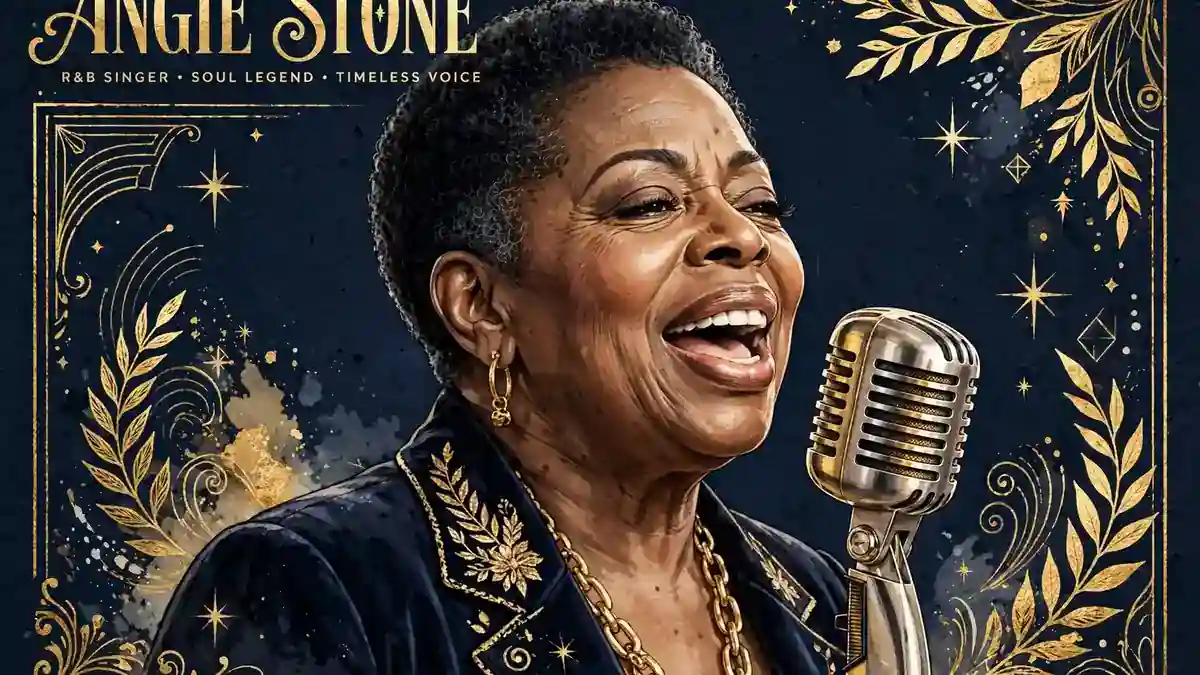
Angie Stone‘s net worth is estimated at $2 million to $3 million as of November 2026. Celebrity Net Worth puts the figure at $3 million, the number most outlets repeated when the neo-soul singer died in a car crash on March 1, 2025, at 63 — after two gold albums, more than five million records sold worldwide, and a late-career public fight over royalties she said were never paid.
Angie Stone: Quick Facts
| Estimated net worth | $3 million (range: $2 million to $3 million) |
|---|---|
| Profession | Singer, songwriter, actress, record producer |
| Nationality | American |
| Born | December 18, 1961 (age 63 at her death on March 1, 2025) |
| Height | 5 feet 3 inches (160 cm) |
| Primary income sources | Music royalties, touring and live shows, songwriting, acting and television |
| Active years | 1979–2025 |
| Last reviewed | November 2026 |
- Early Life and Background
- Education
- Career Journey
- Rise to Fame
- Main Sources of Income
- Salary and Earnings
- Businesses and Investments
- Brand Deals and Sponsorships
- Houses, Cars and Other Assets
- Awards and Achievements
- Net Worth Growth Over the Years
- Social Media Presence
- Personal Life
- Sources & Reporting
- Frequently Asked Questions
- Final Thoughts
Early Life and Background
Angie Stone was born Angela Laverne Brown on December 18, 1961, in Columbia, South Carolina. A small number of online profiles list December 19 instead; the December 18 date is the one carried by Wikipedia and the majority of biographical sources, and it is the date we use here. She grew up singing in the church choir, the training ground that shaped the gospel phrasing listeners later heard in every one of her records — the long vowels, the unhurried delivery, the way she let a line sit before resolving it.
Columbia in the 1970s was not a music-industry town, and Stone’s route out of it ran through hip-hop’s first wave. Still a teenager, she formed The Sequence with Cheryl Cook and Gwendolyn Chisolm, an all-female trio that signed to Sugar Hill Records, the label run by Sylvia Robinson that had released “Rapper’s Delight” in 1979. The Sequence’s debut single, “Funk You Up,” arrived that same year and is widely credited as the first rap single released by a female group. That credit matters to Stone’s money story in two ways: it made her a pioneer, and it put her inside one of the era’s most lopsided contract systems, where the label kept most of the money and the artists kept the reputation.
The Sequence recorded through the early 1980s, releasing singles including “Monster Jam” with Spoonie Gee, and toured the early hip-hop circuit. The group never had a second hit on the scale of “Funk You Up,” and by the middle of the decade it had broken up. Stone was in her early twenties, a published songwriter with a pioneering credit and very little of the money that credit would later be worth. The pattern — cultural impact first, payment much later or never — recurred across her whole career, and it is the key to understanding why a singer with two gold albums and five million records sold died with an estate estimated at $3 million.
After The Sequence, Stone kept working. She sang backup, wrote songs for other artists, and waited for a lane of her own. The 1980s and early 1990s were lean years on paper, but they built the two assets that eventually paid: a songwriter’s catalog and a reputation among musicians as a singer other singers trusted. When the neo-soul movement arrived in the mid-1990s, Stone was already inside it — not as a newcomer, but as a veteran who had helped build the sound.
Education
Almost nothing verifiable is published about Angie Stone’s formal schooling, and this article does not fill that gap with guesses. No reliable profile names a high school, a college, or a degree, and the biographical record concentrates on her church-choir beginnings and her professional work from age 17 onward. That silence is itself a data point: Stone’s education was practical and musical — gospel harmony in Columbia, studio sessions at Sugar Hill Records, and the road.
What the record does show is a working education in the music business, much of it harsh. She learned publishing by writing songs for other people, learned touring by spending her teens and twenties on the road, and learned the record business by signing to a label whose contracts later became a byword for artist exploitation. By the time she signed her solo deal with Arista Records in the late 1990s, she had spent twenty years inside the industry’s machinery. The knowledge showed in her later interviews, where she spoke about royalty statements, publishing splits, and recoupment with the fluency of someone who had read the paperwork — because she had lived with its consequences.
Career Journey
Stone’s career falls into four clear chapters, and each one paid differently. The first, The Sequence (1979–1985), paid in reputation. The second, the session and songwriting years (late 1980s–1998), paid in credits that later became income. The third, the solo breakthrough (1999–2007), paid the most — two gold albums, three Grammy nominations, and a number-one R&B album. The fourth, the independent years (2009–2025), paid mainly through touring, because the record business had changed underneath her.
The second chapter deserves more attention than it usually gets, because it contains the work that made the third chapter possible. In the early 1990s Stone formed Vertical Hold, a sophisticated R&B trio, whose single “Seems You’re Much Too Busy” reached number 17 on Billboard’s R&B chart in 1993. The group released two albums before splitting in 1995. That same year she was brought in to help a newly signed singer named D’Angelo finish his debut album, Brown Sugar. Stone sang backing vocals, co-wrote material, and toured with him on the Brown Sugar tour. She later shared songwriting credits on his first two studio albums, Brown Sugar (1995) and Voodoo (2000), co-writing four songs on the latter. She also sang backing vocals on Lenny Kravitz’s fifth studio album, 5 (1998). In 1996 she teamed with Gerry DeVeaux and Charlie Mole to form Devox, which released one album, Devox featuring Angie B. Stone, in Japan through Toshiba EMI.
None of that work made her famous. All of it made her employable, and it put her songs into catalogs that still generate royalties. The D’Angelo connection also shaped her personal life — the two were partners from 1994 to 1999 and had a son together — and it tied her name to the neo-soul movement at the exact moment the movement went mainstream. When Arista Records signed her as a solo artist in the late 1990s, she was 37 years old, an age at which most labels had already stopped looking. Arista was betting that a veteran with a catalog and a voice could sell to adult R&B listeners, the audience that still bought albums. The bet paid off twice over.
After the Arista and J Records years, Stone moved to the revitalized Stax label for The Art of Love & War (2007), then to independent releases: Unexpected (2009), Rich Girl (2012), Dream (2015), Covered in Soul (2016), and her final album, Full Circle (2019). The later albums sold far less than the first two, and her income shifted toward the live circuit — festivals, casino dates, soul-music cruises, and package tours with other R&B veterans. She was still touring that circuit in February 2025, days before she died.
Rise to Fame
Stone’s solo breakthrough arrived in September 1999 with Black Diamond, released on Arista Records. The album reached the Top 10 of Billboard’s R&B chart and was certified gold by the Recording Industry Association of America (RIAA), and later by the British Phonographic Industry (BPI) as well. Its lead single, “No More Rain (In This Cloud),” became her signature song, and “Everyday” followed it up the R&B chart. The album won her two Soul Train Lady of Soul Awards, including Best Solo R&B/Soul New Artist — a new-artist prize for a singer who had already spent twenty years in the business.
Mahogany Soul followed on October 16, 2001, on J Records, the label Clive Davis built after leaving Arista. The album debuted at number 22 on the Billboard 200 with 71,000 first-week copies, reached number 4 on the Top R&B/Hip-Hop Albums chart, and was certified gold by the RIAA on February 12, 2002. By September 2003 it had sold 758,000 copies in the United States. Its centerpiece was “Wish I Didn’t Miss You,” built around a sample of the O’Jays’ “Backstabbers,” which became one of the defining neo-soul singles of the decade. The album also carried “More Than a Woman,” a duet with Joe that earned Stone her first Grammy nomination, and “Brotha,” a tribute to Black men that became a quiet anthem. Mahogany Soul also went gold in the United Kingdom and the Netherlands.
Stone Love arrived in 2004 with “U-Haul,” which brought a second Grammy nomination, and The Art of Love & War followed in 2007, becoming her first and only number-one album on the Billboard Top R&B/Hip-Hop Albums chart. Its single “Baby,” featuring Betty Wright, earned her third Grammy nomination. Across the four albums she had built the core of her catalog: two gold records, three Grammy nominations, and a run of singles that still anchor neo-soul playlists. Total solo sales over her career exceeded five million records worldwide, with more than 1.4 million albums sold in the United States alone, according to TheRichest.
Television widened her audience further. Stone sang the theme song for the sitcom Girlfriends, which ran on UPN and The CW from 2000 to 2008, putting her voice in millions of living rooms every week. She acted in films including The Hot Chick (2002), The Fighting Temptations (2003), and Ride Along (2014), and appeared on reality television with R&B Divas: Atlanta in 2013 and 2014. In 2021 she received the Soul Music Icon Award at the Black Music Honors. The fame she found in her late thirties and forties was steadier than the flash fame of her teens — adult R&B audiences stay loyal — but it was also smaller in scale than the pop stardom of her peers, and the money matched that scale.
Main Sources of Income
Stone’s income came from five streams, and their balance shifted sharply over time. In the gold-album years, record sales and publishing led. In the last fifteen years of her life, touring led by a wide margin. Understanding that shift is the only way the $3 million figure makes sense.
Record sales and streaming. Two gold albums — Black Diamond and Mahogany Soul — plus more than five million solo records sold worldwide gave Stone a catalog that kept paying long after the release dates. Gold certification in the United States means 500,000 units shipped, and both albums cleared that bar, with Mahogany Soul reaching 758,000 American sales by September 2003. Streaming added a smaller, steadier stream: before her death her catalog earned just over 621,000 official on-demand streams in the United States in a typical week, according to Luminate data reported by Billboard. That is a modest number by pop standards, and it explains why streaming alone never rebuilt her wealth.
Songwriting and publishing. Stone wrote or co-wrote much of her own material, and her credits on D’Angelo’s Brown Sugar and Voodoo put her name on two of neo-soul’s foundational records. Publishing income — the writer’s share of performance and mechanical royalties — was her most durable asset, because it pays whenever a song is played, sampled, or licensed, regardless of whether she was on stage. It was also the income she fought hardest over, as the royalty dispute below shows.
Touring and live performance. By her own account in late 2024, Stone still felt she could not retire because the live circuit was her main income. Soul-music festivals, casino showrooms, package tours with other R&B veterans, and international dates filled her calendar into her sixties. Touring paid the bills, but it paid only while she was working — there was no salary between tours, no pension from the road, and every cancelled date was lost income. She was returning from a Mardi Gras performance in Mobile, Alabama, when she died.
Acting and television. Film roles in The Hot Chick, The Fighting Temptations, and Ride Along, the Girlfriends theme song, and reality television on R&B Divas: Atlanta added fees and kept her visible between albums. These were character roles and theme-song work, not leading-lady paydays, and they supplemented rather than replaced her music income.
Sync and licensing. Her songs appeared in films, television shows, and compilations, generating sync fees and fresh performance royalties each time a placement aired. The exact fees are not public, and this article does not invent them. What is public is that her catalog’s value rose sharply after her death — the week she died, streams jumped 1,263 percent to more than 8.4 million, and sales rose 10,700 percent, per Luminate figures reported by Billboard — which shows the catalog was still commercially alive even when its owner was not earning from it at scale.

Salary and Earnings
No reliable public record states what Angie Stone earned per show, per album, or per year, and this section says so plainly rather than repeating the invented figures that circulate on content-farm biographies. Several low-quality profiles list an annual income of about $400,000 and a monthly income of about $33,000 for 2025. Those numbers appear without a source, a reporting window, or a named outlet behind them, and they are not used here as facts. A reader who sees them elsewhere should treat them as unsourced.
What is documented is more useful than a fake salary table. In 2014 Stone auctioned 56 percent of her BMI writer’s share of public performance royalties through Royalty Exchange, and the auction closed at $25,000. Read that number carefully: a majority share of the performance royalties on her own songs — the income from radio play, live performance, and broadcast use — sold for the price of a modest car. The figure does not mean her catalog was worth $25,000; a writer’s-share auction prices a slice of future income, discounted for risk. But it does show how the market valued her royalty stream a decade before her death, and it is one of the few hard dollar figures in her whole financial record.
The second documented fact is her own testimony. In December 2024, months before she died, Stone went public with claims that Universal Music and other industry structures had diverted or simply never paid royalties owed to her. BusinessDay, reporting on Universal Music Group’s mounting royalty disputes in March 2025, cited Stone’s 2024 claims alongside the disputes raised by Drake, Limp Bizkit, and Iggy Azalea. Stone framed the issue as theft and exploitation, not an accounting error. No settlement, payment, or court ruling on her claims is on the public record, and this article does not assume one exists. What the episode establishes is that the singer herself believed a meaningful part of her lifetime earnings had never reached her.
The third documented fact is the post-death surge. In the week before she died, her catalog earned just over 621,000 official on-demand streams in the United States. In the week of her death, that figure rose 1,263 percent to more than 8.4 million streams, and sales rose 10,700 percent, according to Luminate data reported by Billboard. At typical streaming payout rates, 8.4 million streams generate a five-figure sum, not a fortune — a useful sense of scale. The surge enriched her estate’s catalog income for a few weeks; it did not retroactively make her wealthy. It did, however, prove that demand for her music was far larger than the royalty checks she had been receiving suggested.
One more figure needs debunking, because it dominates search results. A content site called Chemical City Paper claims Stone built a $181 million net worth, “a significant increase from $3 million earlier in her career.” The article offers no source, no filing, no outlet, and no mechanism — no deal, sale, or business — that could produce $181 million. It contradicts Celebrity Net Worth ($3 million), TheRichest ($2 million), and every obituary published in March 2025. We treat the $181 million figure as unsourced and false, and we include it here only so readers who meet it elsewhere know why it does not appear in our estimate.
Put together, the earnings picture is coherent: a peak in 1999–2004, when two gold albums and a number-one R&B record were selling; a long middle period in which touring carried the income; and a final period in which the singer herself said the royalty system was not paying her fairly. The $2 million to $3 million range reflects that arc — a successful career, a durable catalog, and a royalty pipeline that leaked at every joint.
Businesses and Investments
Angie Stone did not build a business empire, and honest reporting says so. No verified record shows her founding a company, launching a product line, or holding an investment portfolio of any scale. The business story of her career is narrower and more interesting: she owned her voice, her name, and a share of her publishing — and the fight over that publishing became the central business event of her final year.
Her independent releases were her main business moves. After the major-label years, she released Unexpected (2009), Rich Girl (2012), Dream (2015), Covered in Soul (2016), and Full Circle (2019) through smaller and independent labels. Independent releases keep more of each sale for the artist but reach far fewer buyers, and none of these albums matched the sales of her first two. The trade-off was creative control and a larger share of a smaller pie — a rational choice for a veteran artist, not a wealth-building strategy.
The Royalty Exchange auction of 2014 is the clearest window into how she managed her publishing. Selling 56 percent of her BMI writer’s share of public performance royalties for $25,000 is the kind of decision an artist makes when she needs cash now more than she trusts the future income — or when she has concluded the future income will not arrive. Either reading fits what she said a decade later about unpaid royalties. The auction is documented by Royalty Exchange’s own records and repeated in later reporting; the $25,000 closing price is one of the few exact figures in her financial life.
Her December 2024 royalty claims against Universal Music were, in business terms, an attempt to reclaim what she believed the system owed her. She described royalties diverted or never paid, and she made the claims publicly, in interviews and on social media, rather than through a quiet audit. The claims were still unresolved when she died three months later. Whether her estate pursues them is not a matter of public record as of November 2026, and this article does not speculate. The claims matter here because they are the best evidence of the gap between her cultural value and her bank balance: a singer whose songs were streamed 8.4 million times in a single week, who said she could not afford to stop touring at 63.
On investments more broadly, there is no public record of stock holdings, startup stakes, or property beyond the Georgia home discussed below. That absence is normal for artists of her generation and income level: the wealth was the catalog, and the catalog’s income was the investment. The lesson of her finances is not that she invested badly. It is that the system that paid her — label contracts from the Sugar Hill era onward, publishing administration, and streaming payouts — returned a small fraction of the value her work created.
Brand Deals and Sponsorships
There is no verified record of a major brand endorsement deal in Angie Stone’s career — no cosmetics line, no fashion collaboration, no beverage or technology sponsorship of the kind that now makes up a large share of a pop star’s income. This article does not invent one. The absence is itself informative: Stone’s audience was adult R&B listeners, a loyal but smaller market than the youth audience brands chase, and her career peak came before the influencer-endorsement economy existed.
What she did have was placement income. Her songs were licensed for film, television, and compilation use, and the Girlfriends theme song put her voice on a network sitcom for eight seasons. Theme-song and sync work pays in fees and in performance royalties each time the program airs, and it is the closest thing in her career to a sponsorship-style income stream. The specific fees are not public, and low-quality blogs that attach dollar figures to individual placements — one claims a six-figure fee for a single film use — offer no sourcing and are not repeated here.
She also earned appearance fees from television, including her run on R&B Divas: Atlanta, and from industry events and speaking engagements in her later years. These were working fees, not brand partnerships. The honest summary is that Stone’s income was almost entirely music-derived: records, publishing, touring, and the screen work that flowed from her music. A reader comparing her to a contemporary pop star should understand that the endorsement column of her balance sheet was effectively empty — one more reason the $3 million figure, modest as it looks next to modern celebrity fortunes, is consistent with the record.

Houses, Cars and Other Assets
The one significant physical asset in Angie Stone’s estate is a house in Locust Grove, Georgia, and its story runs through the whole post-death period. The five-bedroom, five-bathroom home spans about 5,600 square feet. Stone bought it in 2019 for $425,000, and Zillow’s estimate put its value at about $621,000 at the time of her death, according to Gazette Direct’s March 2025 reporting. The $196,000 gain over six years is the largest documented asset appreciation in her financial record — and it is also small next to the figures in her catalog’s streaming surge, which shows where her real value sat.
The house became a news story again in March 2026, when EURweb reported that her children had listed the Atlanta-area home for $670,000. The listing, EURweb reported, was driven by the cost and complexity of managing the estate: two children, a catalog, a wrongful-death lawsuit, and a house that needed selling. The $670,000 asking price, if achieved, would represent a further gain over the Zillow estimate, but it is an asking price, not a sale, and this article does not treat it as realized money.
On cars, the public record is thin and mostly tragic. Stone died as a passenger in a 2021 Mercedes-Benz Sprinter van that overturned on Interstate 65 in the early hours of March 1, 2025, and was then struck by a 2021 Freightliner Cascadia truck. The van belonged to her touring party, not necessarily to her personally. No verified record documents a personal car collection, and none is claimed here. The absence fits the rest of her finances: she was not a collector of luxury assets, and the cars-and-jewelry section that pads other net-worth articles has nothing honest to report for her.
Her real assets were intangible: the publishing rights she retained, the master recordings in her catalog, and the goodwill of a name that still draws millions of streams. Those are the assets her children inherited, and their value depends on how the estate manages them — the royalty claims she raised in 2024, the streaming income that spiked after her death, and any recovery from the wrongful-death lawsuit. The house is the only asset with a price tag a reader can picture. The catalog is the asset that matters.
Awards and Achievements
Stone’s trophy record is modest in size and heavy in meaning: three Grammy nominations without a win, two Soul Train Lady of Soul Awards, an Edison Award, and a late-career icon honor. The nominations trace her peak precisely — one for each of her three strongest records.
| Year | Award | Work | Result |
|---|---|---|---|
| 2000 | Soul Train Lady of Soul Awards — Best Solo R&B/Soul New Artist | Angie Stone | Won |
| 2000 | Soul Train Lady of Soul Awards — Best Solo R&B/Soul Single | “No More Rain (In This Cloud)” | Won |
| 2003 | Grammy Awards — Best R&B Performance by a Duo or Group with Vocals | “More Than a Woman” (with Joe) | Nominated |
| 2004 | Edison Award — R&B/Hip-Hop | Stone Love | Won |
| 2005 | Grammy Awards — Best Female R&B Vocal Performance | “U-Haul” | Nominated |
| 2008 | Grammy Awards — Best R&B Performance by a Duo or Group with Vocals | “Baby” (featuring Betty Wright) | Nominated |
| 2021 | Black Music Honors — Soul Music Icon Award | Angie Stone | Won |
Beyond the trophies, the achievements that define her legacy are structural. “Funk You Up” (1979) made The Sequence the first female rap group to release a single, a first that hip-hop history now records without qualification. Black Diamond and Mahogany Soul were both certified gold in the United States and the United Kingdom. The Art of Love & War (2007) topped the Billboard Top R&B/Hip-Hop Albums chart, her only number-one album. And her songwriting on D’Angelo’s Brown Sugar and Voodoo helped build two records that critics now rank among the most important R&B albums ever made. None of those achievements came with a large check. All of them are why her name still carries weight.
For comparison, her peers in the neo-soul generation built larger fortunes on similar foundations. Mary J. Blige’s net worth reflects a longer run at the top of the charts and a far larger endorsement portfolio, while Janet Jackson’s net worth sits on a different scale entirely, built on pop superstardom and touring at arena level. Babyface’s net worth shows what the songwriter-producer route can pay when the publishing is fully controlled, and Gladys Knight’s net worth reflects a six-decade career at the top of soul music. Stone’s career ran parallel to all four — same rooms, same audiences, same era — and the gap between their fortunes and hers is the story of contracts, timing, and who kept the publishing.
Net Worth Growth Over the Years
Year-by-year net worth figures for a private individual are estimates built from public reporting, not audited statements. The table below uses the documented anchors — the gold-album years, the Royalty Exchange auction, and the $2 million to $3 million range at her death — and labels the rest as estimates. No source publishes an annual series for Stone, and this table does not pretend one exists.
| Period | Estimated net worth | What drove it |
|---|---|---|
| 1979–1989 | Under $100,000 | The Sequence and session work; pioneering credit, Sugar Hill-era contracts, little retained income |
| 1990–1998 | $100,000–$500,000 | Vertical Hold, D’Angelo songwriting and touring, backing vocals; catalog building |
| 1999–2004 | $1 million–$3 million | Two gold albums, Grammy nominations, Girlfriends theme; financial peak |
| 2005–2012 | $2 million–$3 million | Number-one R&B album in 2007, touring, acting roles; independent releases begin |
| 2013–2019 | $2 million–$3 million | Touring-dependent income; Royalty Exchange auction of BMI share for $25,000 in 2014; Georgia home bought for $425,000 in 2019 |
| 2020–2025 | $2 million–$3 million | Continued touring; December 2024 royalty claims against Universal Music; death on March 1, 2025 |
| 2026 | $3 million (estate estimate) | Catalog streaming surge after death; Georgia home listed at $670,000 in March 2026; wrongful-death lawsuit active |
The flat shape of that table is the point. Stone’s wealth did not compound the way a pop star’s does, because her income was tied to her own labor — she earned when she toured, and the royalty pipeline she depended on between tours was, by her own account, not paying her fairly. The two gold albums were the high-water mark, and the years after them were a long plateau, not a decline into poverty and not a rise into riches. The $3 million estimate at her death is best read as the value of a working musician’s lifetime: a house, a catalog, and a name.
Social Media Presence
Stone was active on social media in her final years, using Instagram and other platforms to promote tours, share performances, and — in December 2024 — to air her royalty claims against Universal Music in public. The claims were posted directly, in her own voice, which is why they carried weight with fans and with the trade press: this was not a lawyer’s statement, it was a working singer saying she had not been paid. Her family used her Instagram account to announce her death on March 1, 2025, writing that she had left them at 63 and inviting supporters to celebrate her life.
After her death, her accounts became memorial pages, and the tributes came from across the music world — fellow neo-soul artists, hip-hop pioneers who remembered The Sequence, and younger singers who had sampled her work. The streaming numbers tell the same story in data: her catalog jumped from about 621,000 weekly on-demand streams in the United States to more than 8.4 million in the week she died, a 1,263 percent rise, with sales up 10,700 percent, according to Luminate figures reported by Billboard. “No More Rain (In This Cloud)” led the surge, the song that had introduced her to most listeners in 1999 returning to the top of her catalog a quarter-century later.
This article does not publish follower counts for her accounts. Follower figures for a deceased artist change daily, are easy to inflate, and say nothing about her wealth. The meaningful social-media fact is the one above: her death turned a working catalog into a trending one overnight, and the gap between that demand and the income she had been receiving while alive is the sharpest single illustration of her financial story.
Personal Life
Stone’s personal life was closely tied to her professional one, and the two people who shaped it most were both musicians. She was married to Rodney Stone, known as Lil’ Rodney C!, a member of the hip-hop group Funky Four Plus One; their daughter, Diamond Stone, was born in 1984. Diamond became the public face of the family after her mother’s death, announcing the funeral arrangements and later filing the wrongful-death lawsuit. Stone was also in a relationship with D’Angelo from 1994 to 1999, and their son, Michael D’Angelo Archer II — who records as Swayvo Twain — was born during that period. She had two grandchildren.
D’Angelo’s death added a second loss to the family’s year. He died on October 14, 2025, of pancreatic cancer, at 51 — seven months after Stone. The two had remained connected through their son and through the music they made together in the 1990s, and the tributes after D’Angelo’s death returned again and again to the Brown Sugar and Voodoo sessions Stone had helped build.
Stone died in the early hours of Saturday, March 1, 2025. She had performed at a Mardi Gras event in Mobile, Alabama, on Friday, February 28, and was traveling back toward Atlanta with her band and crew when the 2021 Mercedes-Benz Sprinter van she was riding in overturned on Interstate 65 at about 4:25 a.m., roughly five miles south of Montgomery, and was then struck by a 2021 Freightliner Cascadia truck. Her longtime manager, Walter Millsap III, told the Associated Press the van “flipped over and was subsequently hit by a big rig.” Stone was pronounced dead at the scene. Eight other people in the van were injured and taken to Baptist Medical Center. She was the only fatality. Her family held two celebrations of life: a public memorial in Georgia on March 14, 2025, at the Word of Faith Family Worship Cathedral in Austell, and a service in her home state of South Carolina.
In September 2025 her children, Diamond Stone and Michael D’Angelo Archer, together with crash survivor Sheila Hopkins, filed a wrongful-death lawsuit naming the truck driver, the trucking company CRST, the vehicle manufacturer Daimler Truck, and others. The suit alleges the Sprinter van’s driver lost control, the vehicle veered off the roadway and overturned, and the truck then struck the stationary van at nearly 70 miles per hour without braking, ejecting Stone and pinning her beneath the van. The case was active as of early 2026, and no damages figure or settlement is on the public record. Any recovery would go to her estate and her children, and this article does not count it in the net worth estimate.
Sources & Reporting
Celebrity Net Worth — the $3 million net worth estimate, the anchor for this article’s range; reporting window March 2025. TheRichest — the older $2 million estimate and the figure of more than 1.4 million albums sold in the United States; used to set the bottom of the range. Associated Press — crash details, the 4:25 a.m. time, the Sprinter van and Freightliner Cascadia, and manager Walter Millsap III’s account, as carried in the March 2025 coverage. Billboard — Luminate streaming data: 621,000 weekly streams before her death, more than 8.4 million in the week of her death (up 1,263 percent), sales up 10,700 percent. RIAA — gold certifications for Black Diamond and Mahogany Soul, via the certification record cited in album histories. Wikipedia — birth date of December 18, 1961, discography, Grammy nominations, and the D’Angelo songwriting credits; cross-checked against AllMusic’s artist biography. AllMusic — career history, the Vertical Hold chart position, and the Grammy nomination years. EURweb — the March 2026 report that her children listed the Georgia home for $670,000, and the September 2025 wrongful-death lawsuit details. Zillow — the approximately $621,000 home valuation, as reported by Gazette Direct in March 2025. Reporting window for this article: March 2025 to November 2026. Figures that could not be verified against a named outlet were left out or labeled unverified, including the $181 million claim on Chemical City Paper, which is cited only to debunk it.
Frequently Asked Questions
What was Angie Stone’s net worth?
Angie Stone’s net worth was estimated at $3 million at the time of her death on March 1, 2025, according to Celebrity Net Worth. TheRichest, working from older data, lists $2 million, so this article publishes a range of $2 million to $3 million, anchored at $3 million.
How did Angie Stone die?
Stone died in a car crash on Interstate 65 near Montgomery, Alabama, in the early hours of March 1, 2025. The Mercedes-Benz Sprinter van carrying her and her band overturned at about 4:25 a.m. after a Mardi Gras performance in Mobile, and was then struck by a Freightliner truck. She was 63 and was pronounced dead at the scene; eight other passengers were injured.
How old was Angie Stone when she died?
She was 63. Stone was born Angela Laverne Brown on December 18, 1961, in Columbia, South Carolina, and died on March 1, 2025. A small number of profiles list December 19 as her birth date, but December 18 is the date carried by the majority of sources.
Who are Angie Stone’s children?
Her daughter, Diamond Stone, was born in 1984 during her marriage to Rodney Stone (Lil’ Rodney C!). Her son, Michael D’Angelo Archer II, is her child with neo-soul singer D’Angelo, her partner from 1994 to 1999. She also had two grandchildren. Diamond and Michael filed a wrongful-death lawsuit in September 2025 over the crash.
What was Angie Stone’s biggest song?
“No More Rain (In This Cloud)” from her debut solo album Black Diamond (1999) is her signature song, followed closely by “Wish I Didn’t Miss You” from Mahogany Soul (2001). Earlier, as a member of The Sequence, she sang on “Funk You Up” (1979), the first rap single released by a female group.
Was Angie Stone married?
She was married to Rodney Stone, known as Lil’ Rodney C!, a member of the hip-hop group Funky Four Plus One. They had a daughter, Diamond. She later had a long relationship with D’Angelo, with whom she had a son, Michael D’Angelo Archer II.
Did Angie Stone win a Grammy?
No. She was nominated three times and never won: “More Than a Woman” (with Joe) in 2003, “U-Haul” in 2005, and “Baby” (featuring Betty Wright) in 2008. She did win two Soul Train Lady of Soul Awards in 2000 and the Soul Music Icon Award at the Black Music Honors in 2021.
What happened to Angie Stone’s house?
Her five-bedroom, five-bathroom home in Locust Grove, Georgia — bought in 2019 for $425,000 and valued at about $621,000 at her death — was listed by her children for $670,000 in March 2026, according to EURweb. The listing price is an asking price, not a completed sale.
Final Thoughts
Angie Stone’s net worth was $3 million when she died — a figure that looks small next to the scale of what she built, and that is exactly the point. She helped invent female hip-hop, helped write the records that defined neo-soul, released two gold albums, and spent her last working months saying publicly that the royalty system had not paid her fairly. The money she kept was a house in Georgia, a catalog that still earns, and a name that drew 8.4 million streams in the week she died.
The honest way to read her fortune is as a working musician’s lifetime, not a celebrity windfall. The gold albums paid once. The touring paid while she worked. The publishing — the income that should have paid forever — leaked through contracts signed in 1979 and a system she was still fighting in 2024. Her children now hold the catalog, the house, and the lawsuit, and the value of all three will be settled in the years ahead. What is already settled is the legacy: a voice that carried from “Funk You Up” to “No More Rain,” and a career that proved influence and income were never the same thing in the music business.
Published on November 19, 2026. Last reviewed November 2026. Found an error? See our corrections policy.