
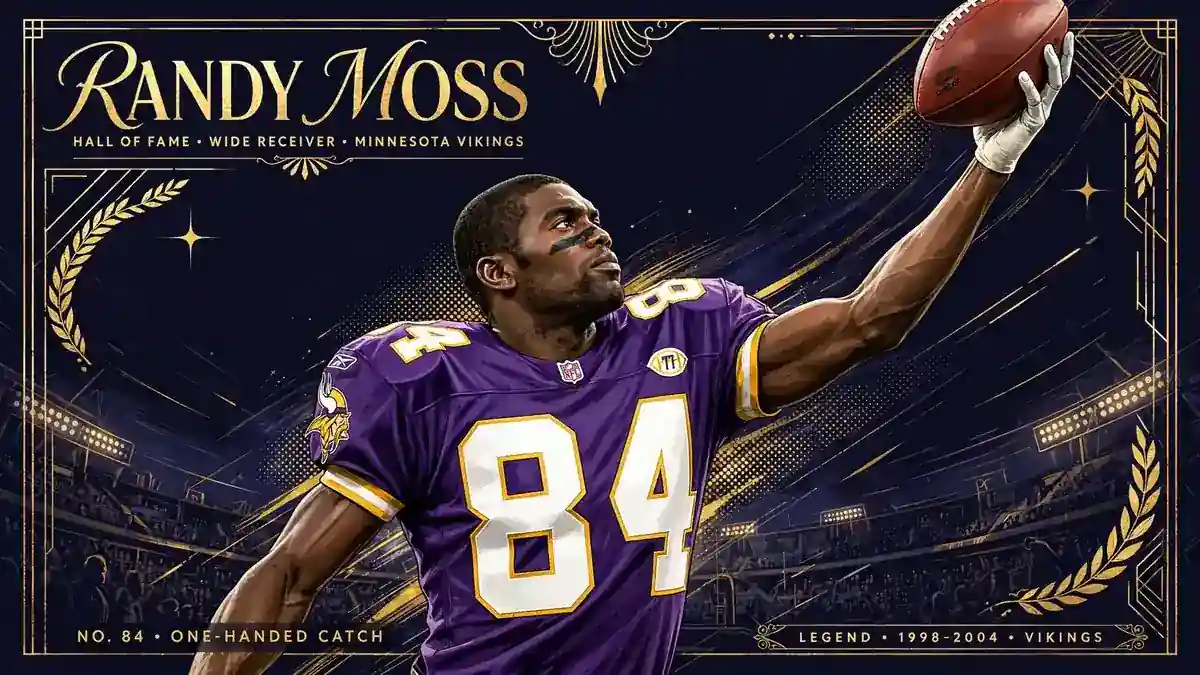
Randy Moss‘s net worth is estimated at $25 million to $30 million as of November 2026. The Hall of Fame wide receiver banked more than $82 million in NFL contracts across 14 seasons, headlined by an eight-year Vikings deal announced at $75 million, then rebuilt his income as an ESPN analyst after beating stage 2 bile duct cancer in 2025.
Randy Moss: Quick Facts
| Estimated net worth | $25 million to $30 million (range: $25M–$30M) |
|---|---|
| Profession | Former NFL wide receiver; ESPN analyst |
| Nationality | American |
| Born | February 13, 1977 (age 49) |
| Height | 6 ft 4 in (1.93 m) |
| Primary income sources | NFL contracts, ESPN broadcasting, endorsements, motorsports business |
| Active years | 1998–2012 (NFL); 2016–present (broadcasting) |
| Last reviewed | November 2026 |
- Early Life and Background
- Education
- Career Journey
- Rise to Fame
- Main Sources of Income
- Salary and Earnings
- Businesses and Investments
- Brand Deals and Sponsorships
- Houses, Cars and Other Assets
- Awards and Achievements
- Net Worth Growth Over the Years
- Social Media Presence
- Personal Life
- Sources & Reporting
- Frequently Asked Questions
Early Life and Background
Randy Gene Moss was born on February 13, 1977, in Rand, West Virginia, a small community outside Charleston, to Maxine Moss and Randy Pratt. He grew up with his mother, a sister named Lutisia, and a half-brother, Eric, who later had a short spell in the NFL as an offensive tackle with the Minnesota Vikings. Money was tight. The family lived in a part of West Virginia where football was one of the few tickets out, and Moss treated it that way from the start.
At DuPont High School in Belle, West Virginia, Moss was a two-sport force — a wide receiver with speed nobody in the state could match and a basketball player good enough to draw college interest in that sport too. He won West Virginia state titles on the track as well. Scouts saw a rare athlete: 6 feet 4 inches tall, fast enough to run away from defensive backs, and able to catch almost anything thrown near him. By his senior year, Notre Dame wanted him. Moss signed a letter of intent with the Fighting Irish in 1995, the school he had dreamed of playing for.
That dream ended before he ever took a snap in South Bend. Before enrolment, Moss was involved in a racially charged fight at his high school that left one person hospitalised. He pleaded guilty to misdemeanour assault and received a 30-day suspended jail sentence. Notre Dame revoked his scholarship and denied his enrolment application. Lou Holtz, the Notre Dame head coach at the time, had wanted him; the university would not admit him. It was the first of several moments when Moss’s talent and his temper collided in public — and the first time a big institution decided the risk was too high.
The episode matters to the money story for a simple reason: it cost Moss draft position three years later. NFL teams in 1998 remembered the Notre Dame story, and the Florida State dismissal that followed it, when they decided where to pick him. A player with his college production would normally go in the top five. Moss went 21st. That slide cost him millions on his rookie contract, and it shaped every negotiation that followed.
Education
After Notre Dame pulled his scholarship, Moss enrolled at Florida State on the suggestion of Notre Dame officials, who pointed to Bobby Bowden’s record of working with troubled players. Because he had signed with Notre Dame, the NCAA treated him as a transfer, so he redshirted the 1995 season and never played for the Seminoles. In 1996, while serving his 30-day sentence in a work-release programme, he tested positive for marijuana, violated his probation, and was dismissed from Florida State. He served a further 60 days in jail for the violation.
Marshall University, about an hour’s drive from his home in Rand, took him in. The move changed his life. In 1996, his first season with the Thundering Herd, Marshall won the NCAA Division I-AA national championship, and Moss set four NCAA freshman records, scoring a touchdown in every game he played — a streak that would reach all 28 games of his college career. In 1997, Marshall’s first season in Division I-A, Moss caught 96 passes for 1,820 yards and 26 touchdowns alongside quarterback Chad Pennington, a Division I-A record at the time. He won the Fred Biletnikoff Award as the nation’s best receiver, finished fourth in Heisman Trophy voting behind Charles Woodson, Peyton Manning and Ryan Leaf, and was named MAC Most Valuable Player and MAC Offensive Player of the Year.
Moss left Marshall after two seasons and entered the 1998 NFL Draft, skipping his final two years of college eligibility. He never completed a degree. The decision was a financial one as much as a football one: his stock would never be higher, and another year in college carried injury risk with no pay. The Vikings took him with the 21st pick of the first round.
Career Journey
Moss played 14 NFL seasons for five teams: the Minnesota Vikings (1998–2004, then a brief return in 2010), the Oakland Raiders (2005–2006), the New England Patriots (2007–2010), the Tennessee Titans (2010) and the San Francisco 49ers (2012). He finished with 982 receptions for 15,292 yards and 156 touchdowns — the fourth-most receiving yards and the second-most receiving touchdowns in NFL history at the time he retired.
Minnesota was where the money started. Drafted 21st overall in 1998, Moss signed a four-year rookie deal worth $4.515 million, with $2.2 million guaranteed, per Over The Cap. He made the Vikings look clever at once: 69 catches, 1,313 yards and 17 touchdowns as a rookie, NFL Offensive Rookie of the Year, and a 15–1 Vikings team that fell one game short of the Super Bowl. His second season brought 80 catches for 1,413 yards and 11 touchdowns. By 2000 he had 77 catches for 1,437 yards and 15 touchdowns, and the Vikings were paying a star on a rookie deal.
The big payday came in 2001. Minnesota signed Moss to an eight-year extension announced at $75 million, with a $10 million signing bonus reported at the time. The headline number needs care — Over The Cap records the deal at $63.5 million in total value, and Front Office NFL lists it at $66.3 million — and Moss actually collected $30.1 million of it before the Vikings traded him, because the back years of the contract were never reached. That gap between announced value and cash received runs through this whole article, and it is the main reason Moss’s career earnings sit near $82 million rather than the $130 million-plus some websites claim.
Minnesota traded Moss to Oakland in 2005 for linebacker Napoleon Harris and two draft picks. The Raiders years were the low point of his career: 60 catches for 1,005 yards in 2005, then 42 catches for 553 yards in an injury-hit 2006, on a team going nowhere. His effort was questioned openly, and his trade value fell with it. Oakland moved him to New England in April 2007 for a fourth-round pick — one of the great bargains in modern NFL history.
The Patriots years rebuilt both his reputation and his bank balance. In 2007 he signed a one-year, $3 million deal and caught 98 passes for 1,493 yards and a single-season record 23 touchdowns from Tom Brady, as New England went 16–0 in the regular season before losing Super Bowl XLII to the New York Giants. In March 2008 he signed a three-year, $27 million contract with $15 million guaranteed, the richest of his career in guaranteed money. His largest single cash year, per Over The Cap, was 2008, when he collected $14 million.
The end came fast. Traded back to Minnesota in October 2010, Moss lasted four games before the Vikings waived him after he criticised the team publicly. Tennessee claimed him off waivers; he caught six passes in eight games. He announced his retirement in August 2011, then came back for one last season with San Francisco in 2012 on a one-year, $2.5 million deal, reaching Super Bowl XLVII, which the 49ers lost to Baltimore. He retired for good in 2013 with 156 career touchdowns, behind only Jerry Rice among receivers.
Broadcasting followed. Moss worked as an analyst for Fox Sports 1’s Fox Football Daily, then joined ESPN in July 2016 as an analyst on Sunday NFL Countdown and Monday Night Countdown. ESPN renewed his multi-year contract in 2022, per EBSCO’s biography summary. He has now spent a decade on television — nearly as long as the second half of his playing career.
Rise to Fame
Moss was famous from his first month in the league. His rookie season in 1998 produced moments that still play on highlight reels: the 17 touchdowns, the deep balls he ran under as if defenders were standing still, and a Thanksgiving Day game in Dallas where he caught three passes — all for touchdowns — for 163 yards. The Vikings went 15–1 with Randall Cunningham at quarterback and Moss stretching defences past breaking point. He was 21 years old and already the most feared deep threat in football.
The 2007 season with New England made him a mainstream star beyond football fans. Twenty-three touchdown catches in a single season broke Jerry Rice’s record of 22, set in 1987, and Moss did it while the Patriots chased a perfect season. Every Sunday that autumn, the question was not whether Moss would score but how many times. The Super Bowl loss to the Giants denied him a ring, but the season fixed his place in the sport’s history: he was inducted into the Pro Football Hall of Fame in 2018, in his first year of eligibility, with his son Thaddeus introducing him in Canton.
Fame also came with incidents that cost him money and goodwill. In January 2005, after a touchdown against the Green Bay Packers in a playoff game at Lambeau Field, Moss pretended to moon the crowd. The NFL fined him $10,000. His response — “Straight cash, homie” — became one of the most quoted lines of his career. Sportskeeda, reviewing his career in 2026, counted at least five reported NFL fines totalling $65,000. None of the fines dented his wealth in any serious way — the mooning fine was about 0.17 percent of his salary that season — but the incidents fed the reputation that had already cost him draft position in 1998 and trade value in 2005 and 2007.
The most recent chapter of his public life had nothing to do with football. In December 2024 Moss stepped away from ESPN to deal with a health problem, then revealed on Instagram Live on December 13, 2024 that he had stage 2 bile duct cancer. He underwent a stent placement around Thanksgiving, a six-hour Whipple procedure in December 2024 that removed parts of his pancreas, gallbladder and bile duct, and spent six days in hospital before chemotherapy and radiation in early 2025. He made a brief return to ESPN’s desk for Super Bowl LIX in February 2025, rang the bell at Atrium Health Levine Cancer Institute in Charlotte on September 8, 2025 to mark the end of treatment, and returned full-time to Sunday NFL Countdown on September 7, 2025. In June 2026, NFL.com reported his cancer was in remission and that he was pursuing bass fishing projects, including hosting the documentary series Chasing 10 and serving as an ambassador for The Champions bass-fishing tournament.
Main Sources of Income
Moss’s wealth comes from four streams, and the first dwarfs the rest. NFL contracts supplied the overwhelming share: between $82.5 million and $84.8 million in career earnings, depending on whether you count by Spotrac’s or Over The Cap’s method. Everything else — broadcasting, endorsements, business — sits on top of that base. That ordering matters, because several net-worth websites describe Moss as if endorsements and investments doubled his fortune. The contract numbers do not support that.
Broadcasting is his main income today. Moss has been an ESPN analyst since July 2016, working Sunday NFL Countdown and Monday Night Countdown, with a multi-year renewal in 2022. ESPN does not publish analyst salaries, and no credible outlet has reported Moss’s figure, so any specific number you see attached to his ESPN pay is guesswork. One widely repeated figure — $6.5 million a year — is worth a closer look, because it shows up on site after site. That number is close to Moss’s career average annual contract value: Over The Cap lists his career APY at $6,057,814, and several net-worth pages appear to have copied a career-average figure and relabelled it as a current salary. We treat his ESPN pay as undisclosed, and we do not repeat the $6.5 million figure as a salary.
Endorsements ran through his playing career. Nike, Reebok and Pepsi are the brands most often named in profiles of Moss, and he appeared in national campaigns during his Vikings and Patriots years, when he was one of the league’s most marketable stars. No verified total exists for his endorsement income, and we do not invent one. The honest statement is that endorsements added millions over a 14-year career at the top of his sport, without a public figure to attach.
Business income is smaller and harder to pin down. Moss owned Randy Moss Motorsports, a NASCAR Camping World Truck Series team run with partners, which gave him a foothold in motorsport after football. He has also worked in youth football coaching, including a role as associate head coach and defensive coordinator at Victory Christian Center High School in Charlotte, North Carolina. Various low-quality net-worth pages credit him with a lifestyle brand, a Bitcoin purchase and other ventures; none of those claims traces to a named, credible source, so they are not repeated here as fact.

Salary and Earnings
The most reliable answer to “how much did Randy Moss earn?” is a range, because the two best contract databases count slightly differently. Over The Cap puts his career earnings at $84,809,392, with total guarantees of $64,285,000 and a career average annual value of $6,057,814. Front Office NFL, working from Spotrac’s figures, puts the total at $82,488,499. Married Celeb, citing Spotrac, rounds it to $82 million. The gap of roughly $2.3 million comes from how each service treats bonuses, incentives and dead money on traded contracts. We publish the range — about $82.5 million to $84.8 million — and note that both figures count gross contract cash before tax, agent fees and expenses.
That range is the number to trust. Several websites put his career earnings at $100 million, $132 million or even $150 million. None of those figures survives a look at the contract record. The $132 million figure, repeated on a Sterling Design page, appears to add headline contract values together — counting the full $75 million Vikings extension, the full $27 million Patriots deal and the full value of contracts that were traded or restructured — instead of counting cash actually received. Moss earned $30.1 million of the Vikings extension before he was traded, not $63.5 million or $75 million. Counting headline values double-counts money that was never paid.
Year by year, the cash tells the story of a star who peaked late. His rookie deal (1998) paid $4.515 million over four years, with a $2 million signing bonus and a $230,000 first-year salary, per Spotrac-cited reporting. The 2001 extension was the turning point: eight years, announced at $75 million, with $10 million guaranteed at signing in the form reported at the time, though Over The Cap records $10 million in guarantees on that deal and $30.1 million actually earned before the trade. In Oakland, he collected about $16 million across the 2005 and 2006 seasons. In New England, the one-year 2007 deal paid $5 million in cash including incentives, per Over The Cap — more than its $3 million base value — and the 2008 extension paid $20.5 million over its life, with a $14 million cash year in 2008, his biggest single season. His final deal, one year with San Francisco in 2012, paid $2.5 million.
Two points keep the earnings in proportion. First, gross is not net. Federal and state tax on $82 million-plus of income across Minnesota, California, Massachusetts, Tennessee and Ohio, plus agent fees at the standard 3 percent and years of training, travel and living costs, leaves a far smaller sum. Second, Moss earned his money in an era before the salary cap exploded. His career average of about $6 million a year looks modest beside today’s receiver deals — Tyreek Hill, a receiver in the same deep-threat mould, signed for far more in a single contract — but in 2001, Moss’s extension made him one of the best-paid players in football. The comparison that matters is with his own era, and there Moss was at the top of the pay scale for his position.
His ESPN income is a separate, smaller stream. He joined the network in July 2016, and his contract was renewed in 2022. ESPN does not disclose analyst pay, and the network’s top studio analysts are generally reported to earn in the low seven figures a year, but that is a range for the role, not a figure for Moss. We do not publish a number for it. What can be said is that a decade on Sunday NFL Countdown and Monday Night Countdown gives him a steady, substantial salary that keeps his wealth growing slowly rather than shrinking — the difference between a retired athlete living off savings and one still earning.
Businesses and Investments
Moss’s best-documented business venture is motorsport. He owned Randy Moss Motorsports, a team in the NASCAR Camping World Truck Series, run with partners. The team gave him a second sporting world after football and a business that traded on his name in a sport with deep roots in the American South. Players Bio, profiling his family, notes the team as part of his post-playing portfolio, and it is the one venture that shows up consistently across credible profiles. No public valuation or sale price exists for the team, so we do not attach a figure to it.
Beyond motorsport, the record gets thin — and the thinness itself is worth reporting. No property records, company filings or investment disclosures tie Moss to a verified real-estate portfolio or a startup portfolio. Several net-worth pages describe real-estate holdings, an art collection, technology startups and a Bitcoin purchase in 2014 that supposedly turned $100,000 into more than $5 million. None of those claims names a source, a property, a company or a wallet. The Bitcoin claim appears only on the same low-quality pages that also give him an 18-season career — he played 14 — and a $21 million-a-year peak salary he never earned. We do not repeat them.
What Moss has done with his name since retirement is steadier and less flashy: television, youth football coaching, and, since 2026, bass fishing. In June 2026, NFL.com reported that Moss, his cancer in remission, was hosting the documentary series Chasing 10 and serving as an ambassador for The Champions bass-fishing tournament. Fishing has been a lifelong passion — he has fished competitively for years — and the documentary and ambassador roles turn it into paid work. It is a modest income stream beside an NFL contract, but it is real, current, and reported by the league’s own outlet.
He has also stayed close to the game as a coach. Moss has served as associate head coach and defensive coordinator at Victory Christian Center High School in Charlotte, North Carolina, where he lives. High-school coaching pays little beside an ESPN salary, but it fits the pattern of his post-playing life: football, television, and the outdoors, rather than a portfolio of businesses.
Brand Deals and Sponsorships
At his peak, Moss was one of the most marketable players in the NFL. Nike, Reebok and Pepsi are the three brands named most often in profiles of his endorsement career, and he appeared in national advertising during his Vikings and Patriots years. The Nike relationship was the natural one — a receiver famous for speed and leaping catches, selling shoes — and the Pepsi work put him in front of audiences far beyond football. Those deals were signed when Moss was winning games and breaking records, which is when endorsement money is at its highest.
No verified total exists for what those deals paid. Endorsement income is private unless a brand or an athlete discloses it, and neither side has put a number on Moss’s deals. Some net-worth pages claim his endorsement portfolio exceeded $50 million. That figure has no source and does not fit the shape of his career: endorsement money on that scale belongs to athletes with long, scandal-free runs at the top of global sports, and Moss’s career included two trades, a reputation for effort questions in Oakland, and a retirement at 35. A realistic reading is that endorsements added several million dollars across 14 seasons — meaningful, but a fraction of his contract earnings.
His marketability today rests on television rather than shoe deals. A decade on ESPN’s flagship NFL studio shows keeps his face in front of millions of viewers every Sunday, and that visibility is what sustains his commercial value at 49. The cancer story added a different kind of public standing: his open Instagram Live announcement in December 2024, his bell-ringing in September 2025, and his return to the ESPN desk made him a figure of public sympathy and respect beyond football. That standing does not carry a price tag, but it is the reason brands and broadcasters still want him.
Houses, Cars and Other Assets
Here is where an honest net-worth article has to say what it does not know. No verified public record ties Randy Moss to a specific mansion, a property portfolio, or a car collection with values attached. He lives in the Charlotte, North Carolina area — the city where he received his cancer treatment at Atrium Health Levine Cancer Institute and where he coaches high-school football — but the address, purchase price and current value of his home are not public. Some net-worth pages describe houses and cars in detail; those descriptions name no addresses, no sale records and no sources, so we do not repeat them.
What can be said with confidence is about the shape of his assets rather than the items. A player who earned $82 million-plus gross over 14 seasons, then spent a decade on a television salary, holds his wealth in the usual mix for a retired athlete: a home, savings and investments built from the contracts, and the ongoing value of his name and broadcasting career. The range we publish — $25 million to $30 million — already reflects the gap between gross career earnings and a net position after tax, fees, fines, living costs and 13 years of retirement spending.
The fines are the one asset-side detail with a paper trail. Moss was fined at least five times during his career, totalling $65,000, per Sportskeeda’s 2026 review. The best-known was the $10,000 fine for the Lambeau Field mooning incident in January 2005. Against a $5.75 million salary that season, the fine was about 0.17 percent of his pay. It is a footnote in financial terms, but it is also a reminder of how small the leakages were beside the headline numbers: the difference between $82 million earned and $25 million kept is tax, fees and time, not fines.
One more asset deserves a mention because it is public and verifiable: his Hall of Fame standing. Moss was inducted into the Pro Football Hall of Fame in 2018, in his first year of eligibility. A gold jacket does not pay a salary, but it keeps a retired player’s name in circulation — appearances, speaking engagements, memorabilia and media work all flow from it — and it is part of why a 49-year-old who last played in 2012 still earns from football.
Awards and Achievements
Moss’s trophy case is the backbone of his earning power, because every contract he signed after 1998 was priced on it. The list below covers the honours that moved his market value.
At Marshall, he won the Fred Biletnikoff Award in 1997 as the nation’s outstanding receiver, finished fourth in Heisman voting, was a consensus All-American, and was named MAC Most Valuable Player and MAC Offensive Player of the Year. He also won an NCAA Division I-AA national championship in 1996. Those two seasons were enough to make him a first-round pick despite the off-field history that had already cost him Notre Dame and Florida State.
In the NFL, the honours stacked up fast. He was NFL Offensive Rookie of the Year in 1998, a six-time Pro Bowl selection, and a four-time first-team All-Pro. He led the league in receiving touchdowns five times. His 23 touchdown catches in 2007 remain the single-season NFL record. He was named to the NFL 2000s All-Decade Team and the NFL 100th Anniversary All-Time Team, and he entered the Pro Football Hall of Fame in 2018.
The numbers behind the honours: 982 receptions, 15,292 yards, 156 touchdowns, and a touchdown in all 28 games he played at Marshall. He never won a Super Bowl — he lost Super Bowl XLII with New England in February 2008 and Super Bowl XLVII with San Francisco in February 2013 — which is the one gap in his record. The missing ring cost him nothing in contract terms; his pay was set by production, not jewellery. But it is the honest answer to a question fans ask, and it belongs in any full account of his career.
For comparison, the receiver Moss is most often measured against is Jerry Rice, the only receiver ahead of him in career touchdowns. Rice’s reported net worth sits near $40 million, built on a longer career and a longer run of endorsements. Moss earned more per season at his peak — his 2008 extension paid $9 million a year against Rice’s era — but Rice played 20 seasons to Moss’s 14, and longevity wins the wealth race. Deion Sanders, another 1990s star who crossed over into television, shows the same pattern: a long second career in media keeps the money coming after the playing cheques stop.
Net Worth Growth Over the Years
No year-by-year balance sheet exists for Moss, so the table below is an estimated trajectory built from his contract cash, not a record of audited figures. It shows the shape of the story: fast growth while he played, a plateau after retirement, and slow growth again once television pay replaced playing pay.
| Year | Estimated net worth | What drove it |
|---|---|---|
| 1998 | About $1 million | Rookie deal: $4.515 million over four years, $2 million signing bonus |
| 2001 | About $8–$10 million | Eight-year Vikings extension announced at $75 million; $10 million guaranteed at signing |
| 2007 | About $18–$20 million | Record 23-touchdown season; Patriots years at $9 million a year |
| 2012 | About $25 million | Final 49ers deal; career earnings pass $82 million gross |
| 2018 | About $25 million | Hall of Fame induction; ESPN salary replaces playing income |
| 2026 | $25 million–$30 million | A decade of ESPN pay; cancer treatment and return; fishing and media projects |
The plateau between 2012 and 2026 is the interesting part. Moss stopped earning NFL money at 35, and the jump from $25 million to $30 million across 14 years of retirement is modest — which is exactly what the evidence supports. Celebrity Net Worth has held him at $25 million since its last update in December 2024. The $30 million top of our range comes from the most careful 2026 reporting, including Velontia’s July 2026 estimate, which credits a decade of ESPN income and post-career ventures. The bottom of the range is the figure the most-cited source still publishes. We print both and say why.
Why not higher? Do the maths. Gross career earnings of $82.5 million to $84.8 million, taxed at the rates that applied across five states over 14 seasons, with a 3 percent agent fee, leaves roughly $45 million to $50 million before living costs. Fourteen years of retirement spending, a divorce-era family life with four children, and a period in the 2010s when some profiles reported financial strain, narrow that further. A $25 million to $30 million net position in 2026 is consistent with that arithmetic. A $100 million net worth would require Moss to have kept more than he earned gross, after tax — which is impossible.
Social Media Presence
Moss is not a constant poster. His most watched social-media moment of recent years was the Instagram Live broadcast on December 13, 2024, in which he announced his stage 2 bile duct cancer diagnosis himself, rather than letting a network statement do it. He then went quiet on Instagram for a full year — his December 27, 2025 post marking one year since his surgery began “Been gone for a whole year off gram” — and returned to the platform with a photo from his surgery day and a thank-you to his doctors and “prayer warriors”.
That year-long silence is unusual for a television personality, and it says something about how Moss uses social media: as a direct line to fans when he has something to say, not as a daily content habit. He is active on X as well, where his surgery-anniversary post in December 2025 drew messages from Tom Brady, Deion Sanders and other figures from his career. We do not publish follower counts here, because they change daily and no reliable count was verified for this article; the point that matters is that his accounts are verified, personal, and followed closely enough that a health announcement on Instagram Live became national news within hours.
Personal Life
Moss is married to Lydia Moss. His former long-term partner is Libby Offutt, with whom he has four children: daughters Sydney and Senali, and sons Thaddeus and Montigo. The family has lived in the Charlotte, North Carolina area in recent years, where Moss coaches high-school football and where he received his cancer treatment.
His son Thaddeus followed him into football. A tight end, Thaddeus set an LSU single-season record for his position with 42 receptions for 534 yards in 2019, played in the NFL, and introduced his father at the Hall of Fame ceremony in Canton in 2018. The father-son story is one of the warmer threads in Moss’s public life, and it runs through his coaching too: the high-school role at Victory Christian Center keeps him on a sideline most weeks.
Moss’s health is now the biggest personal-life story, and the most recent. The bile duct cancer found in December 2024, the six-hour Whipple procedure, months of chemotherapy and radiation, the bell-ringing at Atrium Health Levine Cancer Institute on September 8, 2025, and the return to ESPN’s Sunday NFL Countdown the same month form a single arc: diagnosis, treatment, recovery, return. In June 2026, NFL.com reported his cancer in remission and his attention turned to bass fishing — the documentary series Chasing 10 and an ambassador role with The Champions tournament. At 49, with a Hall of Fame career behind him and a television career still running, his public life is now split between the studio, the sideline and the water.
Sources & Reporting
Celebrity Net Worth — the $25 million net-worth figure, updated December 2024; also the contract summary (rookie deal $4.5 million, 2001 deal $75 million, 2008 Patriots deal $27 million, 2012 49ers deal $2.5 million) and career totals (982 receptions, 15,292 yards, 156 touchdowns).
Over The Cap — career earnings of $84,809,392, career average annual value of $6,057,814, total guarantees of $64,285,000, largest cash payment of $14 million in 2008, and the contract-by-contract breakdown including $30.1 million actually earned on the 2001 Vikings extension.
ESPN — Moss’s son Thaddeus at LSU, the Hall of Fame induction in 2018, and the February 2025 return to Sunday NFL Countdown for the Super Bowl; also the 2016 hiring as an analyst on Sunday NFL Countdown and Monday Night Countdown.
NFL.com — June 2026 report that Moss’s bile duct cancer was in remission and that he was hosting the documentary series Chasing 10 and serving as ambassador for The Champions bass-fishing tournament.
Yardbarker — July 2026 reporting on the cancer remission, the December 13, 2024 diagnosis announcement, and the September 7, 2025 return to Sunday NFL Countdown.
Sportskeeda — career earnings of about $82.5 million, the $10,000 mooning fine and $65,000 in total reported fines, and career rankings (fourth in receiving yards, second in touchdowns).
Velontia — the $30 million 2026 estimate used as the top of our range, published July 2026, with career earnings described as exceeding $70 million.
TheRichest — the outlier $62 million figure, cited here only to show the disagreement: its own page also states $40 million in the body text, which is why we do not use it.
Front Office NFL — career earnings total of $82,488,499 and the contract list (1998 rookie deal $4,515,000; 2001 deal $66,275,000; 2008 Patriots deal $27,000,000; 2012 49ers deal $2,500,000).
EBSCO — biography summary confirming the 2016 ESPN hiring, the 2022 contract renewal, the 2024 leave for bile duct cancer treatment, and the 2025 return.
Reporting window: October–November 2026. Figures were checked against the sources above in November 2026; the net-worth range reflects the disagreement between Celebrity Net Worth ($25 million) and 2026 reporting ($30 million), and the career-earnings range reflects the difference between Over The Cap and Spotrac-cited totals.
Frequently Asked Questions
What is Randy Moss’s net worth in 2026?
Randy Moss’s net worth is estimated at $25 million to $30 million as of November 2026. Celebrity Net Worth puts him at $25 million, while the most careful 2026 reporting lands at $30 million. The range reflects that disagreement rather than hiding it.
How much did Randy Moss earn in his NFL career?
Between about $82.5 million and $84.8 million in gross contract cash, depending on the source. Over The Cap records $84,809,392, while Spotrac-cited figures come to about $82.5 million. The gap comes from how each service treats bonuses, incentives and dead money on traded contracts. Both figures are before tax and agent fees.
What was Randy Moss’s biggest contract?
The eight-year Minnesota Vikings extension he signed in 2001, announced at $75 million with a $10 million signing bonus. The headline needs care: Over The Cap values the deal at $63.5 million, and Moss actually collected $30.1 million of it before Minnesota traded him in 2005. His richest deal in guaranteed money was the three-year, $27 million Patriots contract from 2008, with $15 million guaranteed.
How much does Randy Moss make at ESPN?
ESPN does not publish analyst salaries, and no credible outlet has reported Moss’s pay, so there is no verified figure. The $6.5 million a year quoted on many net-worth sites is not an ESPN salary — it is close to his career average annual NFL contract value of about $6.1 million, relabelled as a salary. He has been an ESPN analyst since July 2016, with a contract renewal in 2022.
Did Randy Moss have cancer?
Yes. In December 2024 Moss announced he had stage 2 bile duct cancer. He had a stent placed around Thanksgiving, a six-hour Whipple procedure in December 2024, and chemotherapy and radiation in early 2025. He rang the bell at Atrium Health Levine Cancer Institute in Charlotte on September 8, 2025 to mark the end of treatment, returned full-time to ESPN’s Sunday NFL Countdown that month, and in June 2026 NFL.com reported his cancer was in remission.
How many touchdowns did Randy Moss score?
156 receiving touchdowns in the regular season, the second-most in NFL history behind Jerry Rice. His best single season was 2007 with New England, when he caught 23 touchdown passes — still the single-season NFL record. He also had 982 receptions for 15,292 yards across 14 seasons.
Did Randy Moss ever win a Super Bowl?
No. He reached the Super Bowl twice and lost both times: Super Bowl XLII with the New England Patriots in February 2008, ending the Patriots’ bid for a perfect season, and Super Bowl XLVII with the San Francisco 49ers in February 2013. He was inducted into the Pro Football Hall of Fame in 2018 despite never winning a ring.
What teams did Randy Moss play for?
Five teams across 14 seasons: the Minnesota Vikings (1998–2004 and a brief return in 2010), the Oakland Raiders (2005–2006), the New England Patriots (2007–2010), the Tennessee Titans (2010) and the San Francisco 49ers (2012). He was drafted 21st overall by Minnesota in the 1998 NFL Draft after two record-breaking seasons at Marshall University.
Final Thoughts
Randy Moss’s money story is simpler than the internet makes it look, and more impressive for it. He earned $82 million-plus playing football, at a time when receiver pay was a fraction of today’s, and he kept enough of it — after tax, fees and 13 years of retirement — to sit at $25 million to $30 million in 2026. The $100 million figures on some sites fail basic arithmetic: you cannot keep more than you earned gross, after tax. The $25 million figure that Celebrity Net Worth still publishes and the $30 million top end from 2026 reporting bracket the truth honestly.
What stands out, a year after his cancer diagnosis, is that Moss is still earning. A decade into his ESPN career, back on Sunday NFL Countdown after beating stage 2 bile duct cancer, coaching high-school football in Charlotte and building a fishing-media sideline, his income has a shape most retired athletes never find: steady, varied, and tied to a reputation that survived the controversies of his twenties. The 23-touchdown season and the Hall of Fame jacket made him rich. The second act is what is keeping him that way.
Published on November 19, 2026. Last reviewed November 2026. Found an error? See our corrections policy.