
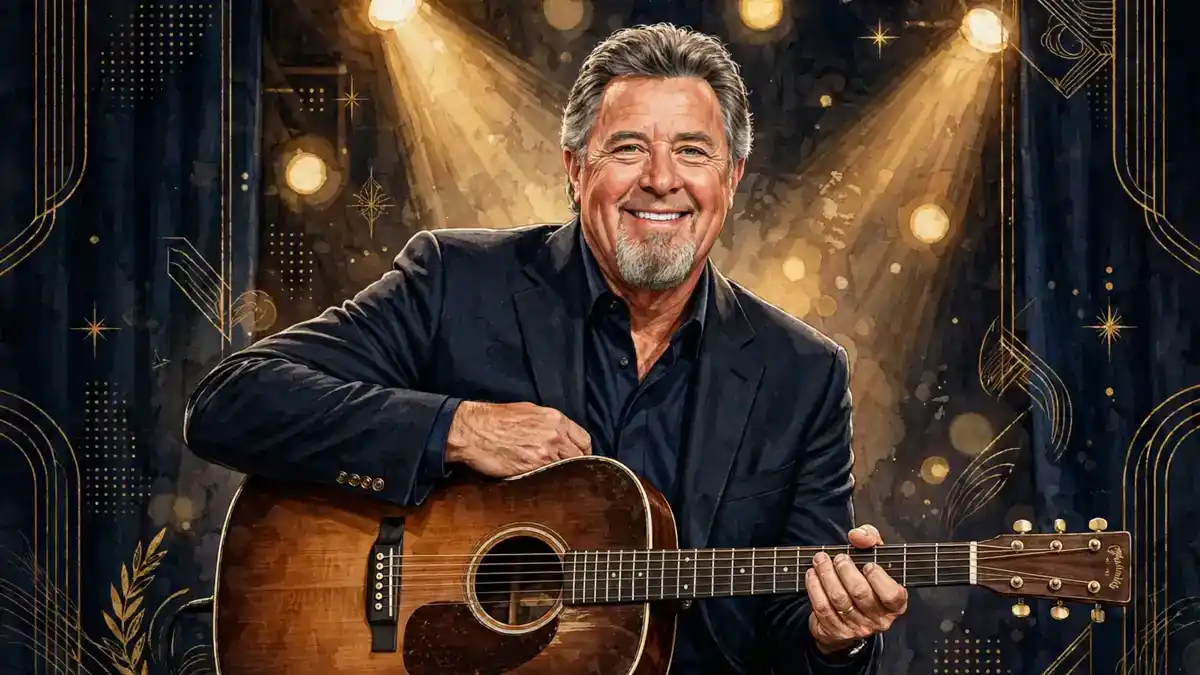
Vince Gill‘s net worth is estimated at $30 million to $40 million as of November 2026. The figure sits at the center of a five-decade career that runs from Oklahoma bluegrass bars to 22 Grammy Awards, more than 30 million albums sold, a Grand Ole Opry membership held since 1991, and a nine-year run touring with the Eagles — a career still adding chapters in 2026, with a lifetime record deal, a monthly EP series, a 50th-anniversary tour, and his 49th and 50th Grammy nominations arriving in November.
Vince Gill: Quick Facts
| Estimated net worth | $30 million (combined with Amy Grant, per Celebrity Net Worth) (range: $30 million–$40 million) |
|---|---|
| Profession | Country singer, songwriter, guitarist |
| Nationality | American |
| Born | April 12, 1957 (age 69) |
| Height | 6 feet 3 inches (1.90 m) |
| Primary income sources | Album sales, songwriting royalties, solo touring, Eagles touring, session work |
| Active years | 1975–present |
| Last reviewed | November 2026 |
- Early Life and Background
- Education
- Career Journey
- Rise to Fame
- Main Sources of Income
- Salary and Earnings
- Businesses and Investments
- Brand Deals and Sponsorships
- Houses, Cars and Other Assets
- Awards and Achievements
- Net Worth Growth Over the Years
- Social Media Presence
- Personal Life
- Sources & Reporting
- Frequently Asked Questions
Early Life and Background
Vincent Grant Gill was born on April 12, 1957, in Norman, Oklahoma, the youngest of three children of Jerene and J. Stanley Gill. His father served as a federal appellate court judge and played guitar and banjo at parties and dances. His mother sang and played harmonica. The family listened to the Grand Ole Opry on the radio at home, and the house filled with both country music and rock and roll. Gill grew up in Oklahoma City, where music was a daily habit rather than a hobby.
His father taught him guitar and banjo, and Gill learned fast. His parents bought him a professional Gibson ES-335 semi-hollow electric guitar when he was ten years old. By 16 he was playing in Oklahoma City bars with a local bluegrass band called Mountain Smoke — a group that once opened for Kiss, which says something about the range of music the teenager was absorbing. He learned to play by ear, picking up bluegrass, rock, and jazz without formal lessons, and he added fiddle, dobro, mandolin, and bass to his kit as he went.
Golf entered his life the same way music did: through his parents, who both played. It stayed with him. Decades later he would still be known around Nashville as a golfer as much as a singer, and the game became a second thread running through his public life, from charity tournaments to the friendships that shaped his career. The discipline of the game — long practice, patience, repetition — matched the way he approached music.
At 18, Gill left Oklahoma to play music full time. He joined the Bluegrass Alliance in Louisville, Kentucky, in 1975, then played briefly with Ricky Skaggs’s band Boone Creek. The move marked the start of a working musician’s life that has now run for more than 50 years. He was not a child star and he was not an overnight success. He spent his late teens and twenties as a sideman, learning the trade in bars, on tour buses, and in studios, building the reputation as a singer and guitar player other musicians wanted on their records.
That apprenticeship matters to the money story. Gill built his fortune the slow way: session fees, touring wages, publishing royalties, and then, much later, headliner money. He never had one record that made him rich in a year. He had fifty years of steady work, and the catalog that work produced is the asset that still pays him in 2026.
Education
Gill attended high school in Oklahoma City, where he was already playing paid gigs while his classmates were doing homework. No college degree or conservatory training sits on his record, and none was needed. His education was the road: bluegrass festivals, bar stages, and the bands that hired him. He has said in interviews over the years that he learned to sing harmony by listening, learned to play guitar by copying records, and learned the music business by watching it from the inside as a teenager.
The absence of formal schooling is worth stating plainly because it shapes how his career reads. Gill is a musician’s musician — the kind of player other artists call when a record needs a guitar part or a harmony that sits exactly right. That standing was earned in rehearsal rooms and on stages, not in classrooms, and it is the reason his name appears on more than 1,000 albums as a collaborator or sideman, a figure Pollstar reported in 2026. Session work of that volume is itself a long income stream, and it kept money coming in during the years before his solo records broke through.
His real classroom was the Bluegrass Alliance and Boone Creek, where he played beside musicians who demanded precision. Bluegrass punishes sloppy playing, and the genre gave Gill the speed, the ear, and the harmony instincts that later set his country records apart. The high tenor voice that became his signature was trained the same way — by singing, night after night, in front of audiences that would let him know if he missed a note.
Career Journey
Gill’s path to Nashville ran through three bands that each taught him something different. After the Bluegrass Alliance and Boone Creek, he spent time with the West Coast band Sundance, then joined Pure Prairie League in 1979. The country-rock group was past its commercial peak, but Gill sang lead on “Let Me Love You Tonight,” which reached No. 1 on the Adult Contemporary chart and put his voice on national radio for the first time. He left the band in 1981 and joined the Cherry Bombs, a Nashville group built around session players, where he met producer Tony Brown and bassist Emory Gordy Jr. — two men who would later shape his solo records.
His solo career began under RCA Records in 1983. The RCA years produced solid singles — “Oklahoma Borderline,” “If It Weren’t for Him,” “Cinderella,” and “Victim of Life’s Circumstances” among them — but no breakout album. He moved to MCA Records in 1989, and the change of label changed everything. His MCA debut, When I Call Your Name, arrived in 1989 and its title track won the Country Music Association’s Single of the Year and Song of the Year awards in 1990, plus a Grammy for Best Country Vocal Performance, Male. Gill was 32. He had been a professional musician for 15 years.
The 1990s were the commercial peak. Pocket Full of Gold followed in 1991, then I Still Believe in You in 1992 — the album that became his biggest seller and later earned quintuple-platinum certification from the Recording Industry Association of America. When Love Finds You arrived in 1994, High Lonesome Sound in 1996, and The Key in 1998, which became his first album to top the Billboard country albums chart. Across the decade he stacked up hit singles — “Look at Us,” “Don’t Let Our Love Start Slippin’ Away,” “One More Last Chance,” “Whenever You Come Around,” “Go Rest High on That Mountain” — and built a catalog that still earns royalties today.
He kept recording through the 2000s and 2010s even as country radio moved toward younger acts. These Days, a four-disc set released in 2006, was a statement of range: 43 songs across country, rock, bluegrass, and acoustic sessions, with guest appearances from a long list of fellow artists. Later albums included Guitar Slinger (2011), Down to My Last Bad Habit (2016), and Okie (2019), a record named for his home state that leaned into his Oklahoma roots. His official site counts 21 albums across the career, with more than 30 million sold and 45 singles charted.
Alongside the solo work, Gill kept his sideman habits. He joined the Time Jumpers, a Nashville western-swing band, and played their regular Monday-night gigs at the Station Inn for years — a working musician’s gig, not a star’s victory lap. He sang on records by other artists, played guitar on sessions, and showed up for tribute concerts and charity shows across Nashville. That willingness to be a supporting player as well as a headliner is one reason his phone kept ringing for five decades.
The biggest late-career turn came in 2017. After Glenn Frey’s death in 2016, the Eagles asked Gill and Frey’s son Deacon to join the band on the road. Gill became co-lead guitarist, sang Frey’s parts — including some of the band’s best-known songs — and played rhythm guitar and harmony vocals. His first show with the band came at Classic West at Dodger Stadium in 2017. Nine years later he is still part of the touring lineup, including the band’s long residency at Sphere in Las Vegas, which became the venue’s longest residency when the band completed its latest twelve-show stretch in March 2026.
Rise to Fame
Gill’s rise was gradual, and the numbers show it. He did not top the charts until his early thirties, and he did not win his first Grammy until 1990. What turned a respected sideman into a star was a run of songs that connected with country radio and with the awards voters at the same time. “When I Call Your Name,” written with Tim DuBois, gave him a signature ballad. “I Still Believe in You” gave him a five-times-platinum album. “Go Rest High on That Mountain,” written after the death of fellow singer Keith Whitley and released in 1995, gave him a song that outlived the charts entirely — it became a standard at funerals across America and one of the most requested songs of his career.
The awards piled up in a way no other male country artist has matched. Gill has won 22 Grammy Awards, the most of any male country artist, and he was nominated for his 49th and 50th Grammys in November 2026. He has 18 Country Music Association Awards, including two Entertainer of the Year wins in 1993 and 1994, and eight Academy of Country Music Awards. He hosted the CMA Awards for 12 consecutive years, from 1992 to 2003 — a run that made him the face of country music on television for a generation and kept his name in front of audiences even between album cycles.
Institutional honors followed the commercial ones. He was invited to join the Grand Ole Opry in 1991 and celebrated his 25th Opry anniversary with a tribute show in August 2016. He entered the Nashville Songwriters Hall of Fame in 2005 and the Country Music Hall of Fame in 2007. He received a star on the Hollywood Walk of Fame in 2012 and the BMI Icon award in 2014. In 2016, Eagles guitarist Joe Walsh inducted him into the Guitar Center Rock Walk. In 2025 he received the CMA Willie Nelson Lifetime Achievement Award, and in 2026 he added the NSAI Kris Kristofferson Lifetime Achievement Award and the Ken Burns American Heritage Prize.
His peers in the 1990s country boom built fortunes on a similar model — big albums, big tours, long catalogs. Ronnie Dunn, half of Brooks & Dunn, built a $45 million fortune on the same era’s touring and record sales, according to our estimate. Clint Black, another star of the same class of 1989, sits at an estimated $25 million to $30 million. Gill’s range of $30 million to $40 million sits squarely in that company, which is exactly where a singer with his sales, his awards, and his touring history would be expected to land.
What set Gill apart from many of his peers was durability. Country radio stopped playing his new singles years ago, as it does for nearly every artist past 50. His income did not stop with it. The catalog kept selling, the Opry kept booking him, the Time Jumpers kept him on stage, and then the Eagles gave him a second arena career in his sixties. Few country singers of his generation found a new nine-figure-grossing touring machine to join at 60. Gill did.
Main Sources of Income
Gill’s money comes from five streams, and the mix has shifted across the decades. In the 1990s, album sales led. In the 2020s, touring leads. Royalties run underneath everything, steady and unspectacular, year after year.
Album sales and streaming. His official site puts career album sales above 30 million; Celebrity Net Worth puts the figure above 26 million. The gap is a reporting difference, not a dispute about scale: Gill is a multi-platinum seller whose biggest album, I Still Believe in You, was certified five-times platinum by the RIAA. When I Call Your Name and Pocket Full of Gold were each certified platinum, and When Love Finds You went double platinum. Streaming pays far less per play than the CD era paid per disc, but a catalog of that size still generates meaningful annual royalty income, and the songs play on country radio, in films, and at events in ways that keep the checks coming.
Songwriting and publishing royalties. Gill wrote or co-wrote most of his hits, which means he collects both the performer’s share and the songwriter’s share. Songs he wrote for himself — “When I Call Your Name,” “Go Rest High on That Mountain,” “I Still Believe in You” — also earn money when other artists record them, when they are licensed for film and television, and when they are played on radio. His 2005 induction into the Nashville Songwriters Hall of Fame and his 2014 BMI Icon award both point to the same thing: the publishing catalog is a real asset, and it is the part of his wealth that keeps working while he sleeps.
Solo touring. Gill tours as a headliner in theaters and performing arts centers, playing three-hour shows with no opening act and no intermission. Pollstar reported in September 2026 that his solo shows since 2021 total 511 performances grossing $67,977,651, with 1,146,883 tickets sold. That is the hardest number in this article: a named outlet, a defined window, a gross figure. His 2026 “50 Years From Home” tour, marking five decades since he left Oklahoma, expanded from 14 markets to 30, including a six-night residency at the Ryman Auditorium, and added December dates at the Ryman for the annual Christmas shows with Amy Grant.
Eagles touring. Since 2017, Gill has toured with the Eagles, one of the highest-grossing live acts in history. The band’s shows gross around $3.5 million per night, according to published reports on Eagles ticket economics, and the Sphere residency in Las Vegas runs premium ticket prices across long stretches of dates. Gill’s exact pay is not public — he is a touring member, not a founding partner — so no honest article can put a number on it. What can be said is that nine years of arena and stadium dates with a band of that scale is a large income stream by any measure, and it arrived at a point in his career when most country singers are winding down.
Session work and collaborations. Gill has appeared on more than 1,000 albums as a collaborator or sideman, according to Pollstar. Session fees for a player of his standing are substantial, and the work also keeps his name on other artists’ records, which feeds back into royalties and touring demand. He has recorded with artists across genres, from Linda Ronstadt, whose own fortune we estimate at $130 million, to Reba McEntire, Dolly Parton, and Kelly Clarkson. The breadth of that list is itself a business asset: few musicians are welcome in that many rooms.

Salary and Earnings
Gill has never disclosed a salary, and no filing or contract has made one public, so any “annual salary” number attached to his name should be treated with care. What the record does support is a clear picture of his earning power, built from the Pollstar touring data and the album certifications.
The Pollstar figures give the cleanest math. From 2021 through September 2026, his solo shows grossed $67,977,651 across 511 dates — an average of roughly $133,000 in gross box office per show, with 1,146,883 tickets sold. That is gross revenue, not Gill’s take-home pay: venue costs, band salaries, crew, travel, and management all come out of it before he is paid. Even so, a solo artist grossing $133,000 a night across more than 500 shows is earning at a level most touring musicians never reach, and the pace has not slowed. His 2026 tour added 16 markets to its original 14 after demand beat expectations.
Third-party blogs often quote $50,000 to $100,000 per solo show as his fee, and $2 million to $3 million a year from touring. Those numbers are unverified estimates from low-authority sites, and we do not present them as fact. The Pollstar gross is the number to trust, and it supports a touring income in the low seven figures a year before costs — consistent with a net worth in the $30 million to $40 million range for a man who has toured at this level for decades.
The Eagles money is the one line nobody can quantify. The band grosses about $3.5 million per show, and the Sphere residency commands some of the highest ticket prices in live music. Gill’s share is a private arrangement. What is known is that he has been on the road with the band since 2017, through the Hotel California tour, the farewell runs, and the Sphere residency — nine years of work with the biggest-grossing touring brand in rock. Even a modest share of that machine is a large annual sum, and it is the single biggest reason his net worth kept growing in his sixties while many of his 1990s peers saw theirs flatten.
Album and publishing income is harder to pin down year by year, but the shape is clear. The 1990s were the peak earning years, when multi-platinum albums paid artist royalties on millions of discs. I Still Believe in You alone, at five-times platinum, represents five million units shipped in the United States. At 1990s royalty rates, an album of that scale paid its artist millions of dollars over its life. The catalog still earns today, at lower streaming rates, and the songwriting royalties on “Go Rest High on That Mountain” — a song played at funerals, memorials, and tribute concerts for thirty years — are the kind of slow, permanent income that few assets in music can match.
Television hosting added a separate income line in the 1990s and early 2000s. Hosting the CMA Awards for 12 straight years paid a fee each year and, just as valuable, kept Gill on network television in front of tens of millions of viewers. He also earned fees from television specials, including the Christmas specials where he first met Amy Grant. None of these fees are public, and we do not guess at them — but they were real, recurring, and spread across a decade.
Putting it together, Gill’s peak annual earnings likely came in the mid-1990s, when platinum albums, arena tours, and television hosting overlapped. His current annual earnings are lower than that peak but still substantial, driven by solo touring, the Eagles, and catalog royalties. The pattern is the opposite of the one-hit star who earns everything in three years and then fades. Gill’s money arrived steadily, over fifty years, and that steadiness is why the estimates cluster where they do.
Businesses and Investments
Gill is not a businessman in the mold of the country stars who built restaurant chains, clothing lines, or tequila brands. He has no public record of founding a company, taking a startup stake, or lending his name to a product empire. His business is music, and his investments are the conservative kind: a catalog, a house, and a guitar collection.
The catalog is the investment. Twenty-one albums, hundreds of songs, and a publishing share in his biggest hits amount to an asset that pays every quarter. Music catalogs have become a serious investment class in recent years, with legacy catalogs selling for large multiples of annual royalties, and Gill’s — anchored by “Go Rest High on That Mountain,” “When I Call Your Name,” and “I Still Believe in You” — would command a strong price if he ever chose to sell. He has given no sign of selling. The catalog stays in his hands, paying as it has for decades.
His most visible tangible investment is his guitar collection. Gill is known among musicians as a serious collector of vintage guitars, and he plays them on stage rather than keeping them behind glass. The Gibson ES-335 his parents bought him at ten started a lifelong habit. Vintage instruments of the kind he owns can be worth tens of thousands of dollars each, and a collection built over fifty years is a real store of value — though no public inventory or valuation exists, and we do not invent one.
In 2025, Gill signed a lifetime contract with MCA, his record label since 1989. The deal, reported by his official site, guarantees his recording home for the rest of his career and frames the “50 Years From Home” project: an EP of new music released every month for a year, with the final installment due in late 2026. A lifetime contract for a 69-year-old artist is unusual, and it signals that the label sees continuing commercial value in his new recordings. It also means his future record income is secured on his own terms.
Golf is the other long-running investment of his time, if not his money. He plays in charity tournaments and hosts golf events in Nashville that raise money for junior golf and local causes. The game has also been a networking asset: the golf course is where Nashville’s music business has done deals for decades, and Gill’s standing in that world is part of why his career has lasted. None of this shows up on a balance sheet, but it is part of how a fifty-year career keeps generating work.
Compared with peers who built side businesses, Gill’s approach looks plain — and it has worked. Kenny G, whose fortune we estimate at $100 million, built wealth partly through business ventures outside music. Gill built his entirely inside music: records, songs, and stages. The result is a smaller number, but it is a number built on assets he controls and understands.
Brand Deals and Sponsorships
Gill has never been a heavy endorser. His name does not appear on the kind of long sponsorship roster that younger country stars carry, and there is no public record of a major brand deal paying him millions. What exists instead is a quieter set of associations with the instrument world, which fits a musician known first as a player.
Guitar makers have featured him for decades, and he has appeared in campaigns and events for the brands whose instruments he plays. These are the natural partnerships for a guitarist of his standing: instrument endorsements, appearances at guitar shows, and the 2016 Guitar Center Rock Walk induction, which Joe Walsh of the Eagles presented. The fees for such work are not public, and we do not estimate them. They are real income, but they are a small line next to touring and royalties.
He has also lent his name to charity causes across Nashville, including the Country Music Hall of Fame and Museum, the Grand Ole Opry, and golf fundraisers for junior players. Charity work is not income, but it is worth noting because it explains where some of his time and money go — and because it is part of why his reputation in Nashville is unusually strong. A musician who shows up for other people’s causes for thirty years builds a kind of goodwill that turns into work, invitations, and loyalty from audiences.
The honest summary is that endorsements are the smallest of Gill’s five income streams. His fortune was built on records and stages, not on ads. That is a useful corrective to the image of the modern celebrity fortune, where brand deals often out-earn the art. For Gill, the art was the business.

Houses, Cars and Other Assets
Gill and Amy Grant live in Belle Meade, the wealthy Nashville neighborhood of large lots and old trees, in a house that dates to 1929. Celebrity-home sites put its value at about $8.2 million and describe a property of more than 10,000 square feet with six bedrooms and six bathrooms on 2.13 acres, with a pool, a pool house, a wine cellar, and a music room. Those details come from home blogs and property listings, not from a public sale record, so treat the $8.2 million as a reported estimate rather than a confirmed price. What county records do confirm, as reported by Velvet Ropes, is the shape of the story: the house dates to 1929, the parcel covers lots 16, 17, and 18 of the Bransford subdivision, and a deed was recorded in August 2000, months after Gill and Grant married. The purchase price was not disclosed.
The couple has lived in the house for more than 25 years, which matters more than the valuation. A home held that long in Belle Meade has appreciated substantially, and the couple has invested in it over the years. Gill told Atlanta Magazine in 2019 that Belle Meade is “the real well-to-do part of town with the prettiest homes,” and the neighborhood’s roster — Keith Urban and Nicole Kidman live nearby — confirms the address as one of Nashville’s most expensive.
Cars are a smaller part of the picture. Home blogs report that Gill owns a classic 1975 Cadillac Fleetwood, which fits his taste for old American things done well. He is not known for a large car collection, and no public record lists a fleet of luxury vehicles. The guitar collection is the real collection, and it is the asset he talks about most.
The couple’s shared life also includes the Ryman Auditorium, in a sense: their annual Christmas at the Ryman residency with Amy Grant has run for years and continues in December 2026, with dates listed through the holiday season. The residency is both an income stream and a Nashville institution, and it is the clearest picture of how the couple’s careers have merged without either of them giving up a solo identity.
Awards and Achievements
No section of this article is easier to verify than the awards, because the awarding bodies publish them. Gill has won 22 Grammy Awards from 50 nominations — the 49th and 50th nominations arrived on November 16, 2026, for Best Traditional Country Album (50 Years From Home: Down At The Borderline) and Best Country Solo Performance (“The Whole World”). He holds the record for the most Grammy wins by a male country artist. His Grammy wins span from 1990, for “When I Call Your Name,” through the 1990s run that made him the dominant male vocalist of the decade, and into the 2000s.
At the Country Music Association Awards he has 18 wins, including Entertainer of the Year in 1993 and 1994, five Male Vocalist of the Year wins, and Single and Song of the Year for “When I Call Your Name.” He hosted the show for 12 consecutive years, from 1992 to 2003, a run no other host has matched. He has eight Academy of Country Music Awards. In 2025 the CMA gave him its Willie Nelson Lifetime Achievement Award, and in 2026 the Nashville Songwriters Association International gave him its Kris Kristofferson Lifetime Achievement Award.
The hall-of-fame honors tell the same story in institutional form. Grand Ole Opry member since 1991. Nashville Songwriters Hall of Fame, 2005. Country Music Hall of Fame, 2007. Hollywood Walk of Fame star, 2012. BMI Icon, 2014. Guitar Center Rock Walk, 2016. Ken Burns American Heritage Prize, 2026. Taken together, they amount to a career that every major body in American music has recognized, and they explain why his name still opens doors — and sells tickets — at 69.
For scale, his 22 Grammys sit beside the careers of other country greats whose fortunes we have covered. Miranda Lambert, one of the most decorated women in country music, has built an estimated $60 million fortune on a similar combination of records, touring, and awards. Gill’s haul is larger in trophies and longer in years, and his fortune is smaller only because his commercial peak came in the CD era’s middle years and his biggest paydays arrived as a touring musician rather than as a brand.
Net Worth Growth Over the Years
The table below tracks published estimates, not verified wealth. No audited figures exist for any year, so read it as a record of what outlets reported, and note how stable the number has been.
| Year | Published estimate | What was happening |
|---|---|---|
| 1995 | Not publicly estimated | Peak album years; When Love Finds You double platinum; CMA Entertainer of the Year |
| 2000 | Not publicly estimated | Marries Amy Grant; Opry member for nine years; catalog royalties compounding |
| 2010 | Not publicly estimated | Hall of Fame member; steady touring; Time Jumpers regular |
| 2020 | $30 million (Celebrity Net Worth) | Combined figure with Amy Grant; catalog and touring income |
| 2022 | $30 million | Estimates hold steady across outlets |
| 2024 | $30 million–$40 million | Some outlets begin publishing $40 million |
| 2025 | $40 million | Lifetime MCA contract; 50th-anniversary project begins; CMA Lifetime Achievement Award |
| 2026 | $30 million–$40 million | 50 Years From Home tour; 49th and 50th Grammy nominations; Eagles Sphere residency |
The flatness of that line is the story. Gill’s estimated net worth has not doubled in five years, and it has not collapsed either. It has held in a narrow band while he kept working, which is what a catalog-and-touring fortune looks like: slow growth, no spikes, no crashes. The outlier numbers that appear in search results — one site claims $120 million to $150 million — come from low-authority pages that cite no sources and contradict every established outlet. We do not use them. The credible range is $30 million to $40 million, and the best-sourced single figure is $30 million, combined with Amy Grant.
Peer comparison puts the range in context. Our own estimates for country artists of his era: Ronnie Dunn at $45 million, Clint Black at $25 million to $30 million, Linda Ronstadt at $130 million, Miranda Lambert at $60 million, Kenny G at $100 million. Gill sits in the middle of that group, which matches his sales and his touring record. Ronstadt and Kenny G sold more records worldwide; Black sold fewer. The numbers line up with the careers behind them, and Gill’s is consistent with the group.
Social Media Presence
Gill keeps a lighter social media footprint than most stars of his stature, and it fits the shape of his career. His official site, vincegill.com, is the hub: tour dates, news, and announcements, including the November 2026 Grammy nomination news, appear there first. He maintains profiles on Instagram, Facebook, and X, where posts center on tour dates, new music, Opry appearances, and the Eagles. The tone is workmanlike — dates, photos from the road, and announcements — rather than personal branding.
He does not run the kind of daily content machine that younger country stars use to sell records, and he does not need to. His audience buys tickets through the Opry, the Ryman, and the Eagles’ channels, and his new music reaches fans through the label and the press. The “50 Years From Home” project, with a new EP every month for a year, has given his channels a steady stream of releases to announce in 2026, and the 50th-anniversary tour has supplied the photos and videos that fill them.
The Christmas at the Ryman shows with Amy Grant are the one annual event that reliably draws social media attention, and the December 2026 dates are already listed. For a 69-year-old artist, the social media picture is best read as a tour bulletin board, not a second career — and it works because the touring never stops.
Personal Life
Gill married Janis Oliver, one half of the country sister duo Sweethearts of the Rodeo, in 1980. The couple had a daughter, Jenny Gill, born in 1982, and divorced in 1997. He first met Amy Grant in 1993, during a Nashville Christmas television special, and the two married on March 10, 2000, in a small private ceremony in Nashville. Their daughter, Corrina Grant Gill, was born on March 12, 2001, and has begun pursuing her own music career. Grant also has three children from her first marriage, and the couple’s blended family has been a quiet, steady part of their Nashville life for more than 25 years.
The marriage matters to the net worth question, and it is the reason this article is careful about the numbers. Celebrity Net Worth states its $30 million figure as a combined net worth with Grant, who built her own large fortune as one of the best-selling contemporary Christian artists of all time, with a No. 1 pop hit in “Baby Baby” in 1991. Some outlets publish separate figures for each of them — up to $55 million for Grant and $40 million for Gill — but those come from less established sources. Readers should understand the distinction: the $30 million figure is the household number, and Gill’s individual share of it is not publicly broken out.
Grant’s health has been part of the couple’s public life in recent years. In July 2022 she was knocked unconscious in a bicycle accident in Percy Warner Park in Nashville, and she later underwent open-heart surgery for a condition she had carried since birth. Gill has spoken publicly about the worry of those years, and the couple’s Christmas shows at the Ryman have carried extra weight since her recovery. The marriage has also survived the kind of public scrutiny that follows two famous people: both were divorced when they met, and the early years of their relationship drew tabloid attention that has long since faded.
Gill’s father died in 1997, and the loss shaped The Key, the 1998 album that became his first to top the country albums chart. His mother, Jerene, sang and played harmonica, and his older siblings, Bob and Gina, were part of the musical household he grew up in. He remains close to Oklahoma, returning for shows and naming his 2019 album Okie for the state, and to Nashville, where he has lived and worked for more than four decades.
He is known in Nashville for showing up: for Opry shows, for charity concerts, for other artists’ records, for the Time Jumpers’ Monday nights. That reliability is the personal quality behind the professional record, and it is why, at 69, he is still being asked to join bands, host shows, and play rooms that other artists his age have left behind.
Sources & Reporting
Celebrity Net Worth — the $30 million estimate, stated as a combined net worth with Amy Grant; album sales above 26 million; 18 CMA Awards; two Entertainer of the Year wins; Grand Ole Opry member since 1991.
Vince Gill (official site) — 22 Grammy Awards; 49th and 50th Grammy nominations on November 16, 2026; 18 CMA Awards; 8 ACM Awards; 21 albums; more than 30 million albums sold; 45 singles charted; Grand Ole Opry member since 1991; Country Music Hall of Fame 2007; Hollywood Walk of Fame 2012; lifetime MCA contract and the “50 Years From Home” EP series; 2026 NSAI Kris Kristofferson Lifetime Achievement Award and Ken Burns American Heritage Prize.
Pollstar — September 2026 report on the “50 Years From Home” tour: 511 solo shows since 2021 grossing $67,977,651 with 1,146,883 tickets sold; more than 1,000 album appearances as a collaborator or sideman; Eagles touring member since 2017.
Recording Industry Association of America — gold and platinum certifications, including quintuple-platinum status for I Still Believe in You.
The Recording Academy (Grammy.com) — Grammy nominations and wins record, including the 49th and 50th nominations in November 2026.
Country Music Association — CMA Awards history, including the 1990 Single and Song of the Year wins for “When I Call Your Name,” the 1993 and 1994 Entertainer of the Year wins, the 12-year hosting run from 1992 to 2003, and the 2025 Willie Nelson Lifetime Achievement Award.
Grand Ole Opry — Opry membership since 1991 and the 25th-anniversary tribute show in August 2016.
Country Music Hall of Fame and Museum — Hall of Fame induction in 2007 and Nashville Songwriters Hall of Fame induction in 2005.
Wikipedia — biographical details: birth date and place, parents’ names and occupations, marriages and children, band history from the Bluegrass Alliance through Pure Prairie League and the Eagles, and the Keith Whitley background to “Go Rest High on That Mountain.”
Velvet Ropes — Belle Meade house details drawn from Davidson County records: 1929 construction, 2.13 acres, deed recorded August 2000.
Reporting window: November 2026. Net worth figures are estimates drawn from the outlets above; where outlets disagree, this article publishes a range and names the source of each figure. Figures of $120 million to $150 million published by low-authority sites were reviewed and set aside for lack of sourcing. Per-show fee figures of $50,000 to $100,000 published by third-party blogs are unverified and are flagged as such in the text.
Frequently Asked Questions
What is Vince Gill’s net worth in 2026?
Vince Gill’s net worth is estimated at $30 million to $40 million as of November 2026. Celebrity Net Worth, the best-sourced outlet on the figure, puts him at $30 million and states that the number is combined with his wife, Amy Grant. Other outlets publish $40 million, and one puts 2026 at $45 million. We publish the range because the sources disagree and no audited figure exists.
Is Vince Gill’s net worth combined with Amy Grant’s?
Yes — at least for the most widely cited figure. Celebrity Net Worth states its $30 million estimate is a combined net worth with Grant, who built her own fortune as a best-selling Christian and pop singer. Some outlets publish separate figures for each of them, but those come from weaker sources, so the honest answer is that the headline $30 million is a household number, not Gill’s alone.
How much does Vince Gill make per show?
His exact fee is not public. Pollstar reported in September 2026 that his solo shows since 2021 grossed $67,977,651 across 511 dates — about $133,000 in gross box office per show. That is gross revenue before venue costs, band pay, crew, and travel. His Eagles pay is also private, though the band grosses about $3.5 million per show.
How many Grammys has Vince Gill won?
Gill has won 22 Grammy Awards, the most of any male country artist. He was nominated for his 49th and 50th Grammys on November 16, 2026 — Best Traditional Country Album for 50 Years From Home: Down At The Borderline and Best Country Solo Performance for “The Whole World.” He has also won 18 CMA Awards and 8 ACM Awards.
Is Vince Gill still in the Eagles?
Yes. Gill joined the Eagles as a touring member in 2017, after Glenn Frey’s death, and he continues with the band in 2026, including the Sphere residency in Las Vegas. He sings Frey’s parts, plays co-lead guitar, and performs alongside Don Henley, Joe Walsh, and Timothy B. Schmit while also running his own solo tour.
How many albums has Vince Gill sold?
His official site puts career album sales above 30 million, with 21 albums released and 45 singles charted. Celebrity Net Worth puts the figure above 26 million. His biggest album, I Still Believe in You (1992), was certified five-times platinum by the RIAA.
Who is Vince Gill married to?
Vince Gill has been married to singer Amy Grant since March 10, 2000. They have a daughter, Corrina Grant Gill, born in 2001. Gill was previously married to Janis Oliver of Sweethearts of the Rodeo from 1980 to 1997, and they have a daughter, Jenny Gill, born in 1982.
Where does Vince Gill live?
Gill lives in Belle Meade, Nashville, Tennessee, with Amy Grant. Their home dates to 1929 and sits on 2.13 acres; celebrity-home sites put its value at about $8.2 million, though the purchase price was never disclosed and a deed was recorded in August 2000, months after they married.
Final Thoughts
Vince Gill’s $30 million to $40 million fortune is the least flashy fortune in country music, and that is the point. No single record made him rich. No brand deal, no business empire, no viral moment did it. Fifty years of work did: bluegrass bars at 16, session calls at 20, a breakthrough at 32, a decade of platinum albums, twelve years hosting the CMA Awards, and then, at 60, a second career with the biggest touring band in rock. The numbers that anchor the estimate are the solid ones — 22 Grammys, more than 30 million albums, 511 solo shows grossing nearly $68 million since 2021 — and they describe a musician whose wealth is still growing because he is still working. In November 2026, with a lifetime label deal, a monthly EP series, a 50th-anniversary tour, and two more Grammy nominations, Gill is not a legacy act coasting on old hits. He is a working musician whose catalog pays, whose tours sell, and whose reputation keeps the phone ringing. That is what a $30 million to $40 million career looks like when it is built to last.
Published on November 20, 2026. Last reviewed November 2026. Found an error? See our corrections policy.