
Don Knotts‘s net worth is estimated at $3 million to $20 million as of November 2026. The range is wide because the sources split: Celebrity Net Worth, the most careful tracker of the figure, puts him at $3 million at his death in 2006, while a long tail of secondary sites repeats $20 million. Knotts earned five Emmy Awards as Deputy Barney Fife on The Andy Griffith Show, walked away from the role over a contract that paid him $1,250 an episode with no ownership stake, rebuilt his career as a Universal film lead, and then found a second television peak as landlord Ralph Furley on Three’s Company. His Beverly Hills condo, bought for $338,170 in 1983, sold after his death for $1.23 million.
Don Knotts: Quick Facts
| Estimated net worth | $3 million to $20 million at death (2006) (range: $3 million–$20 million) |
|---|---|
| Profession | Actor, comedian, voice actor |
| Nationality | American |
| Born | July 21, 1924 (age 81 at death, February 24, 2006) |
| Height | 5 ft 6 in – 5 ft 7 in (1.69 m) |
| Primary income sources | Television salaries, film roles, residuals and syndication, voice work |
| Active years | 1940s–2006 |
| Last reviewed | November 2026 |
- Early Life and Background
- Education
- Career Journey
- Rise to Fame
- Main Sources of Income
- Salary and Earnings
- Businesses and Investments
- Brand Deals and Sponsorships
- Houses, Cars and Other Assets
- Awards and Achievements
- Net Worth Growth Over the Years
- Social Media Presence
- Personal Life
- Sources & Reporting
- Frequently Asked Questions
- Final Thoughts
Early Life and Background
Jesse Donald Knotts was born on July 21, 1924, in Morgantown, West Virginia, the youngest of four sons of farmer William Jesse Knotts and Elsie Luzetta Knotts, who ran a boarding house in town. The household was poor and troubled. His father, an alcoholic who suffered from schizophrenia, was bedridden by the time Don was born, and the family lost its oldest son to pneumonia while Don was still young. His mother held the family together by taking in boarders, and Don grew up watching strangers come and go through a house that doubled as a small business — an early, unglamorous lesson in making a living from other people’s company.
The boy who would become one of television’s great nervous men found his first audience in Morgantown itself. As a child he put on ventriloquist shows around town with a dummy he named Danny, a routine he had picked up from watching Edgar Bergen. The act was his way out of shyness: the dummy did the talking, and the boy behind it learned timing, voices, and how to hold a room. He was still a teenager when he tried New York for the first time, chasing entertainment work, and lasted only a few weeks before coming home. The failure stuck with him. Knotts spent much of his adult life fighting an inferiority complex that friends and family later described openly — a man who could make millions laugh and still go to bed convinced he was not good enough.
That tension between stage confidence and private doubt shaped his money story as much as his comedy did. Knotts was never a negotiator. When the biggest opportunity of his life arrived, he signed the contract put in front of him, trusted the people around him to look after his interests, and discovered years later that the deal had been structured to benefit almost everyone except him. The pattern repeated in smaller ways across his career: steady work, modest pay for the value he created, and a fortune that stayed far smaller than his fame suggested.
Morgantown never forgot him, and he never quite left it behind either. The town later erected a statue of his most famous character, and Knotts’s own roots — a farm family, a boarding-house childhood, a West Virginia accent he learned to use as a comic instrument — stayed visible in every role he played. Barney Fife was a small-town deputy because Knotts knew small towns from the inside, and the nervous energy that made audiences laugh was, in part, the real anxiety of a boy from a struggling family who had learned to perform his way through it.
Education
Knotts graduated from Morgantown High School and enrolled at West Virginia University, where he studied education with a minor in speech and graduated in 1948, according to Wikipedia’s biography of the actor. The Television Academy’s biography records the degree slightly differently, as a theater degree from the same university in the same year — a small discrepancy in the record that reflects how loosely Knotts’s early credentials were documented, but the outline is not in dispute: he went to college intending to become a teacher, and speech and performance pulled him away from the classroom.
His studies were interrupted by the Second World War. Knotts enlisted in the United States Army on June 21, 1943, and served until January 6, 1946, in the Special Services Branch as part of a military comedy troupe. He toured the Pacific with a G.I. variety show called “Stars and Gripes,” doing the ventriloquist act he had honed as a boy. The tour gave him two things that mattered more than any classroom: stage time in front of tough, distracted audiences, and contacts in entertainment who would help him break into New York show business after the war. It also gave him a famous anecdote — he grew to hate the dummy Danny so much that he threw it overboard in the South Pacific, a story he told for the rest of his life as the moment he decided to perform as himself.
After his discharge in 1946, Knotts returned to West Virginia University and finished his degree. He married his college sweetheart, Kathryn Metz, in 1947, and the couple moved to New York so he could try show business again — this time with a degree, a wife, and Army contacts behind him. The education mattered in a practical way, too: teaching was his fallback, and the speech training gave him the vocal control that became his signature. The high, exasperated voice, the stammer that arrived exactly on the beat, the wide-eyed stare — all of it was technique built on a speech minor, not an accident.
Nothing in his schooling prepared him for the business side of entertainment, and that gap would cost him more than any exam ever did. Knotts left university with a performer’s skills and no instinct for contracts, ownership, or negotiation. When Andy Griffith’s manager secured an ownership stake in The Andy Griffith Show before it aired, Knotts signed on as a salaried employee. The difference between those two decisions — one man’s equity, another man’s weekly wage — is the single largest fact in Don Knotts’s financial life.
Career Journey
Knotts’s professional career began on daytime television. In 1953 he landed a regular role as Wilbur Peterson on the soap opera Search for Tomorrow, steady work that kept him in New York and in front of casting directors. The break that changed his trajectory came in 1955, when he was cast in the Broadway play No Time for Sergeants, starring a fellow former monologist named Andy Griffith. The two men — both Southern-raised, both shaped by small-town life, both funny in ways that depended on character rather than jokes — became friends on that stage, and the friendship became the most important professional relationship of Knotts’s life. He recreated his small role in the 1958 film version of the play.
From 1956 to 1960, Knotts was a regular on The Steve Allen Plymouth Show, appearing in 108 episodes by the count in his credits record. The variety format suited his ventriloquism, his character sketches, and his gift for playing flustered men under pressure. Allen’s show put him in front of a national audience every week and made him a known comic quantity in Hollywood — the man you called when you needed a nervous character played with absolute commitment.
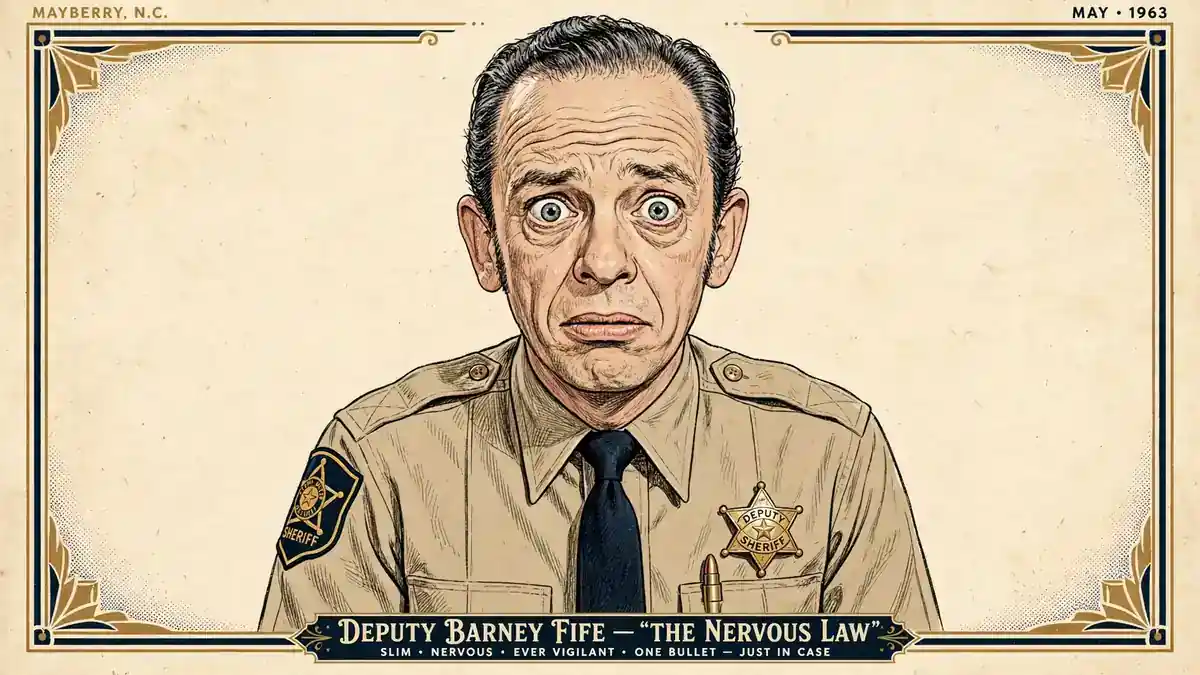
In February 1960, Knotts watched the debut of Sheriff Andy Taylor, Griffith’s character, in a backdoor pilot on The Danny Thomas Show. He called Griffith, and the call led to the role of Deputy Barney Fife on The Andy Griffith Show, which premiered in October 1960. Knotts was the fourth long-term cast member to sign on, behind Griffith, the young Ron Howard, who played Opie Taylor, and Frances Bavier as Aunt Bee. The show never left the Nielsen top 10 in its eight-year run, and Fife — a deputy who carried one bullet in his shirt pocket, who was certain of his own authority and wrong about nearly everything — became one of the most loved comic characters in American television.
Knotts left the show after its fifth season in 1965, believing Griffith’s original plan to end the series after five years. He had already signed a five-film deal with Universal Studios, arranged by studio president Lew Wasserman, who had been impressed by Knotts’s 1964 feature The Incredible Mr. Limpet and saw big-screen star power in him. The Universal years produced a run of family comedies: The Ghost and Mr. Chicken (1966), The Reluctant Astronaut (1967), The Shakiest Gun in the West (1968), The Love God? (1969), and How to Frame a Figg (1971), which Knotts also co-wrote. None of them made him a movie star on the scale Wasserman had imagined, but they kept him working as a leading man through the late 1960s.
After Universal, NBC offered him his own variety show. The Don Knotts Show premiered in 1970 and lasted 22 episodes before poor ratings ended it. Knotts later said he felt uncomfortable in the variety-show host’s chair — he was a character actor, not a master of ceremonies — and the failure stung. The early 1970s were his leanest professional years: guest spots on Here’s Lucy, Fantasy Island, and The Love Boat, small film parts, and no regular paycheque. The comeback arrived in two steps. First, Disney cast him with Tim Conway in The Apple Dumpling Gang in 1975, a hit that paired him with a comic partner who matched his timing. Then, in 1979, he joined Three’s Company as landlord Ralph Furley, replacing the Ropers after their spin-off, and stayed for five seasons and 117 episodes until the show ended in 1984.
The last two decades of his career were quieter but never idle. He reunited with the Mayberry cast for the television movie Return to Mayberry in 1986, played principal Bud McPherson on the syndicated sitcom What a Country! in 1986 and 1987, and spent 1988 to 1992 as the neighbour Les Calhoun on Griffith’s legal drama Matlock, appearing in 17 episodes. He toured with stage plays, did voice work for cartoons and children’s series, and made a guest appearance on That ’70s Show in 2005. His final film roles were voice parts: Mayor Turkey Lurkey in Disney’s Chicken Little (2005) and a part in the direct-to-video Air Buddies (2006), released in the year he died.
Rise to Fame
Knotts’s rise was not a single breakout but a slow build that peaked twice. The first peak was Barney Fife. Within a year of the show’s debut he had won his first Emmy, and he won again in 1962 and 1963 — three consecutive Primetime Emmy Awards for Best Supporting Actor in a Television Comedy during his five regular seasons. When he returned for guest appearances after leaving the regular cast, he won two more, in 1966 and 1967, for a total of five. No other supporting performance in the show’s history collected that many, and the Television Academy’s own record notes that he was nominated five times and won every time.
The fame had a financial shape that is easy to miss. Knotts was the show’s second-biggest draw, but he was paid as a hired hand. His starting salary, set in the extension he signed ahead of the second season, was $1,250 per episode — roughly $35,000 for a 28-episode season. Celebrity Net Worth, drawing on Richard Kelly’s The Andy Griffith Show Book, puts the inflation-adjusted value at about $13,200 per episode in today’s money, or roughly $370,000 a year. Later accounts report his pay rising to around $3,500 an episode by the fifth season, though that figure is reported rather than documented in a contract. Either way, the gap with his co-star was stark: Griffith, whose manager Dick Linke had secured him an ownership interest before the show aired, was reported to earn around $25,000 per episode in later accounts and held a stake in the production itself. Knotts asked for a share of the backend and was refused; ownership stayed with Griffith and producers Sheldon Leonard and Danny Thomas.
His manager, Sherwin Bash, later described the arrangement bluntly. “I worked out this terrible deal for [Don Knotts], where he ended up making no money in five years,” Bash said, as quoted by Daniel de Visé in Andy and Don: The Making of a Friendship and a Classic American TV Show. The quote is the most honest sentence ever published about Knotts’s finances: five years on the most popular show in America, five Emmy Awards, and a contract that left him with a salary and nothing else. Mental Floss, retelling the same history, adds the detail that makes the timing worse — CBS offered Griffith a $1 million annual salary to stay on after season five, so the show went on without Knotts while he tried to build a film career from scratch.
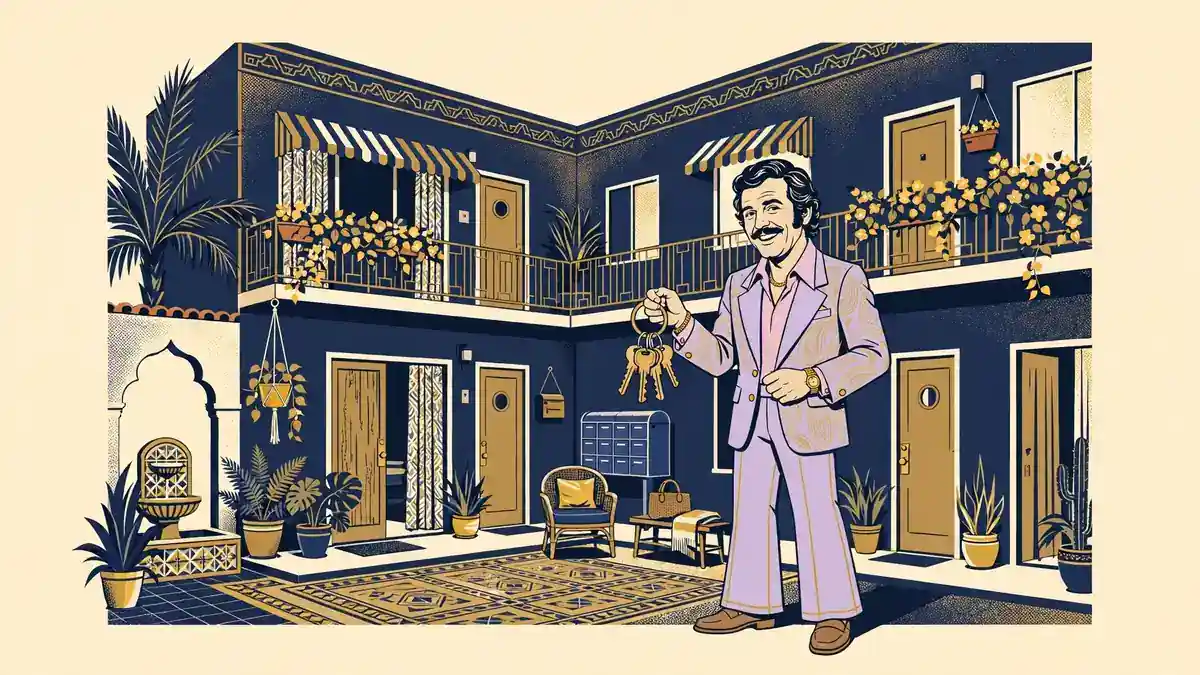
The second peak came fourteen years later, and it was kinder. Ralph Furley on Three’s Company gave Knotts a new generation of fans who had never seen Mayberry. Furley was a different kind of nervous man — a self-styled ladies’ man in loud leisure suits, forever misunderstanding the tenants he was supposed to supervise — and Knotts played him with the same total commitment he had given Fife. The show was one of ABC’s biggest hits, and Furley became a fixture of late-1970s popular culture. Knotts was 55 when he took the role, an age when most television actors are winding down, and it paid him steadily for five seasons.
Between the two peaks, his fame never depended on tabloid heat or reinvention. He was a character actor who became famous by being unmistakable: the voice, the stare, the posture of a man bracing for bad news. Carol Burnett, another television comedy star of the same era, built a career on a similar foundation — a weekly variety and sitcom presence that made her a household name without a film career behind it. Knotts’s version of that path was narrower and, in money terms, thinner, because he never owned a piece of the shows that made him famous.
Main Sources of Income
Television salaries were the spine of Knotts’s income for his whole working life. The Andy Griffith Show paid him a weekly wage for five seasons, Three’s Company paid him for five more, and Matlock, What a Country!, and his guest appearances filled the years between. None of those jobs made him rich on their own — the Mayberry salary was modest even by 1960s standards — but together they gave him something many actors never get: almost continuous employment from 1953 to the early 1990s, with only the early 1970s as a thin stretch. A working actor who is never out of work for long can build a comfortable life on salaries alone, and Knotts did.
Film pay was his second income stream, and it came in two waves. The Universal deal of the mid-1960s paid him as a leading man for five features, and the Disney films of the 1970s paid him as a proven family-comedy draw. The Ghost and Mr. Chicken, his first Universal hit, grossed $4 million in its first five months on a $500,000 budget, according to Wikipedia’s account of the film — an eight-to-one return that proved audiences would pay to watch Knotts carry a picture. The Apple Dumpling Gang, his biggest box-office hit, took $36.85 million worldwide, with $13.5 million in theatrical rentals, and Herbie Goes to Monte Carlo followed with $29 million. An aggregator tally of his credited films puts his career box-office total at $112 million across 39 films, though that figure counts ensemble pictures in which he had small parts alongside his starring vehicles, so it measures his presence in the marketplace rather than his personal pay.
Residuals and syndication were the third stream, and the one that most separated Knotts from a salaried employee in any other trade. The Andy Griffith Show has been in syndication almost continuously since it left prime time, and Three’s Company has run in reruns for decades. Residual payments under the union contracts of the era were modest compared with modern streaming deals, and Knotts owned no backend share, so he collected the standard residual cheques rather than a producer’s cut. Even so, the reruns kept money coming in long after the cameras stopped, and they kept his name in front of audiences who then bought tickets to his stage tours and watched his later shows.
Voice work became a real income stream late in life, when his eyesight and health made on-camera work harder. He voiced characters in two episodes of The New Scooby-Doo Movies in 1972, returned to animation repeatedly in the 1990s and 2000s, and finished his career with Chicken Little in 2005 and Air Buddies in 2006. Voice sessions paid well for short days, and they suited a performer whose instrument was his voice as much as his face. Stage touring filled the same gap: Knotts spent much of the 1990s on the road with plays, earning appearance fees from audiences who wanted to see Barney Fife in person.
His autobiography, Barney Fife and Other Characters I Have Known, published in 1999, added book income and, more importantly, set the record straight on his own terms. In it he admitted he had not yet signed a contract when Griffith announced the show would end, and that he had decided to move on because he believed the chance to make films would not come again. The book is the best single source for his own account of the money decisions that defined his career — including the admission, by implication, that he left Mayberry for a film career that never paid what television had.
What Knotts did not have, and what separates his fortune from those of his richer contemporaries, was an ownership or business income stream. He held no stake in The Andy Griffith Show, no production company of consequence, no merchandising empire, and no restaurant or product line. His money came from showing up and performing, and it stopped growing in the ways that equity grows. That is why the estate figure is $3 million on the careful count rather than the $25 million or $50 million that a man of his fame might have accumulated with a share of his own success.
Salary and Earnings
The salary record for Don Knotts is unusually well documented, because the Mayberry contract became a famous cautionary tale in Hollywood. The numbers below come from Richard Kelly’s The Andy Griffith Show Book and Daniel de Visé’s Andy and Don, as reported by Celebrity Net Worth, MeTV, and CheatSheet. Where later accounts add a figure that the books do not confirm, we say so.
On The Andy Griffith Show, Knotts started on a one-year deal and then signed a five-year extension ahead of the second season. The extension paid $1,250 per episode, or roughly $35,000 for a 28-episode season. Celebrity Net Worth converts that to about $13,200 per episode in today’s money, roughly $370,000 a year — a solid middle-class professional income in 1961, and a small fraction of what the show earned. Later reporting, summarised by MoviesNewsToday from Kelly’s book, says his pay rose to around $3,500 an episode by the fifth season. That later figure is reported, not confirmed by a published contract, and it still left him far behind Griffith, who was reported to earn about $25,000 an episode in later accounts while also holding an ownership stake.
The comparison that stung most was not with Griffith but with the show’s economics. CBS offered Griffith $1 million a year to keep the show going after season five — a single year’s salary for the star that was nearly thirty times Knotts’s annual pay. Knotts had asked for a share of the ownership and been refused. He left believing the show was ending, signed his Universal film deal, and watched the series run for three more years without him, winning two more Emmys for guest appearances in 1966 and 1967 while the show’s profits flowed to its owners.
His Universal film pay is not public in contract form, and we do not invent a figure for it. What is public is the economics of the films: The Ghost and Mr. Chicken cost $500,000 and took $4 million in five months; The Apple Dumpling Gang took $36.85 million worldwide. Knotts was paid as a leading man under a studio deal, not on a profit share, so the box-office multiples enriched Universal far more than they enriched him. The five-film contract gave him security and billing, not backend.
For Three’s Company, no per-episode salary for Knotts has been published in a reliable source, and we do not guess at one. What the record does show is the pay structure around him. His co-star Suzanne Somers was paid $30,000 an episode while John Ritter received $150,000, according to CheatSheet’s account of the salary dispute that split the cast. Knotts supported Somers in that dispute — he knew, from his own Mayberry years, what it felt like to be the performer audiences loved and the payroll undervalued. His own Three’s Company pay, as a veteran supporting player on a hit show in the early 1980s, would have been comfortable without approaching Ritter’s star salary.
Later television work paid at veteran guest-star and recurring rates. Matlock, where he played Les Calhoun in 17 episodes between 1988 and 1992, and What a Country!, where he was a regular in 1986 and 1987, were steady, respectable jobs rather than windfalls. Voice work in his final years — Chicken Little in 2005, Air Buddies in 2006 — paid session fees for a few days’ work, the kind of late-career income that keeps a retired actor comfortable without changing his net worth.
The honest summary of his earnings is this: Knotts earned a professional’s living for fifty years, with two stretches of real television money in the 1960s and the early 1980s, and he never had the one payday — an ownership stake, a syndication backend, a franchise — that turns a famous actor into a wealthy one. His manager’s verdict on the Mayberry deal, that Knotts “ended up making no money in five years,” was an exaggeration, but it pointed at a real fact: the richest years of his working life left him with a salary and memories, not equity.
Businesses and Investments
Knotts was not a businessman, and the record shows it. He never founded a production company, never launched a product line, never bought into a franchise, and never became known as an investor. His business life consisted of the contracts he signed as a performer and the property he owned as a homeowner. That modesty is part of why his estate stayed small: there was no business to sell, no company to take public, no brand to license after his death.
The one investment the record documents is real estate, and it performed well. In August 1983 he bought a condominium near Beverly Hills for $338,170. He lived there for the rest of his life, and after his death his estate sold the unit in October 2007 for $1.23 million — a gain of about $890,000 over twenty-four years, or roughly 3.6 times the purchase price. The figures come from Celebrity Net Worth’s real-estate reporting on the property. It was a home first and an investment second, but it was also the single largest documented asset in his estate, and the sale price is the hardest number in the whole net-worth calculation.
A second property is reported by weaker sources: a house in Glendale, California, said to have been valued at $1.295 million at one point. MarriedCeleb reports the figure; we have not found a deed record or a second outlet to confirm it, so we report it as a claim from that outlet rather than a fact. If the Glendale house was his, it would have been a second substantial property asset; if the report confuses the Glendale area with the Beverly Hills condo, the estate is smaller. Either way, the condo sale is the property figure to trust.
His book, Barney Fife and Other Characters I Have Known (1999), was his only venture into publishing as a business. It sold to his fan base and to readers of television history, and it remains in print in the second-hand market. The advance and royalties were never disclosed, and we do not estimate them. The book’s value to Knotts was reputational: it let him tell the Mayberry story, including the contract story, in his own voice, and it kept his name in bookshops in his final years.
Stage touring in the 1990s deserves a mention as a business activity, even if it was really just work. Knotts toured with plays for much of the decade, playing to audiences who paid to see a television legend in person. Touring paid appearance fees and kept him earning after regular television work dried up, and it required little capital — a performer, a play, and a theatre. It was the right business for a man whose asset was himself.
The absence of business ventures is itself a finding, and it explains the gap between Knotts’s fame and his fortune. Actors of his generation who grew rich — Griffith with his ownership stake, or later stars with production companies — did so by owning a piece of the machine. Knotts rented himself to the machine, brilliantly and for decades, and the machine kept the equity.
Brand Deals and Sponsorships
Knotts did not build a career on endorsements, and there is no record of a major brand deal or sponsorship attached to his name. He was a character actor whose face was famous as Barney Fife and Ralph Furley, not as himself, and advertisers of his era bought leading men and sex symbols rather than nervous deputies. He did commercial and voice work — the kind of one-off advertising jobs that working actors take — but no long-term endorsement contract, no product line, and no brand ambassadorship is documented in the sources we reviewed.
That absence is worth stating plainly, because many net-worth pages invent endorsement income for actors who never had it. Knotts’s income came from acting, and the pages that list “endorsements” among his wealth sources are filling a template, not reporting a fact. His most valuable commercial asset was his voice, which he lent to cartoons, children’s series, and advertising voice-overs in his later years, including the Hermie children’s series. Those were session jobs, paid by the day, not sponsorships.
The closest thing to a brand in his life was Barney Fife himself. The character was merchandised — Mayberry memorabilia, DVDs, and syndication packages have sold for decades — but Knotts did not own the character or the show, so the merchandising revenue flowed to the rights holders. The statue of Barney Fife in Morgantown, erected after his death, is a civic tribute rather than a commercial venture, and the story behind it is telling: Griffith wanted the statue to show Knotts himself, and lost the argument to those who wanted the deputy. Even in bronze, the character owned the likeness.
His Walk of Fame star, awarded in 2000, was the industry’s version of a brand honour — a permanent advertisement for his name on Hollywood Boulevard, paid for by a sponsor as the Walk’s rules require, but not a deal that put money in his pocket. It marked the moment the industry formally recognised what audiences had known for forty years: Don Knotts was a permanent part of American television.
Houses, Cars and Other Assets
The documented core of Don Knotts’s estate was property. The Beverly Hills-area condominium he bought in August 1983 for $338,170 was his primary residence at his death, and his estate sold it in October 2007 for $1.23 million, according to Celebrity Net Worth. That single transaction accounts for more than a third of the $3 million estate figure on the careful count, and it is the only asset in his portfolio with a public paper trail from purchase price to sale price. The condo’s appreciation — about $890,000 over twenty-four years — reflects Los Angeles property inflation rather than any investment strategy on Knotts’s part: he bought a home and lived in it.
The Glendale house reported by MarriedCeleb, valued at $1.295 million at one point, is the only other property attached to his name in the sources. We list it here because readers will find it elsewhere, but we flag it as unconfirmed: no deed record or second outlet backs it in the material we reviewed. If it was a separate property, his real-estate holdings were larger than the condo alone suggests; if it is a garbled version of the Beverly Hills condo, the estate is smaller. The $3 million to $20 million range we publish is wide enough to hold either reading.
No car collection, art collection, or other luxury asset is documented for Knotts. He was not a collector in the public sense, and no auction of his possessions after his death produced headlines. His cars were transportation, not investments, and no source we reviewed names a make or a model worth reporting. That, too, is a finding: a man who earned a performer’s living for fifty years and died with a condo, a modest portfolio of residuals, and his name.
What he did own, in the intangible sense, was a body of work that still earns money. The Andy Griffith Show and Three’s Company remain in syndication and on streaming services, and residual payments continue to flow to his estate under the union contracts that governed his work. The amounts are not public, and they shrink with each passing year as the contracts age, but they are real income — the long tail of a career built on shows people still watch. His voice work, including Chicken Little, continues to earn in the same way.
His papers and memorabilia — scripts, photographs, the autobiography manuscript — have value to collectors and to the town of Morgantown, which preserves his memory with a statue and a museum presence. That value is cultural rather than financial, and we do not put a number on it. The honest picture of his assets is a comfortable, unflashy estate: a condo that tripled in value, residual cheques that still arrive, and a name that still sells DVDs.
Awards and Achievements
Don Knotts won five Primetime Emmy Awards, all for playing Barney Fife, and he won every time he was nominated. The wins came in 1961, 1962, and 1963 for his regular seasons on The Andy Griffith Show, and in 1966 and 1967 for guest appearances after he had left the regular cast. The Television Academy’s own record confirms the sweep: five nominations, five wins, all in the supporting-actor comedy category. No other performer on the show matched it, and few supporting actors in television history have a record as clean.
The Emmys were the headline, but the honours kept coming for forty years. He received a star on the Hollywood Walk of Fame in 2000, a formal recognition that arrived when he was 76 and still working. The TV Land Awards, which celebrate classic television, gave him the Favorite Second Banana award in 2003 and the Legend Award in 2004, shared with the Griffith Show cast and crew. The Online Film and Television Association inducted his character into its TV Hall of Fame in 2007, the year after his death, and again in its 2024 character honours, according to the awards listings.
His achievements outside awards are just as concrete. He carried five Universal feature films as a leading man, starred in two Disney hits, and held regular roles on two of the most successful sitcoms in American television history — The Andy Griffith Show, which never left the Nielsen top 10 in eight years, and Three’s Company, which ran for eight seasons and made him famous to a second generation. He published an autobiography, toured the country with stage plays into his seventies, and worked until the year he died, finishing Chicken Little and Air Buddies in his eighties.
Morgantown’s statue is the honour he would have understood best. After his death, Andy Griffith pushed for a statue of Knotts himself in his hometown; the town chose Barney Fife instead, and the deputy stands there now. Griffith lost the argument, but the statue exists because both men mattered to the town — one as a son, the other as a character the whole country knew. Knotts was also named an honorary deputy sheriff by the Monongalia County Sheriff’s Department, a small honour that would have delighted the man who played the world’s most famous deputy.
Measured against his peers, his trophy count is remarkable for a supporting player. Five Emmys put him ahead of most leading men of his era, and the fact that two of them came for guest appearances — after he had already left the show — says something about how indispensable audiences found him. The awards did not make him rich, but they are the reason his name still commands a page like this one twenty years after his death.
Net Worth Growth Over the Years
Because no audited figures exist for Knotts’s wealth in any year, the table below is an honest reconstruction from the documented money — his salaries, his film economics, and his property — rather than a claim of precise annual net worth. The figures are ranges where the record is thin, and the notes say what each number rests on.
| Period | Estimated position | What drove it |
|---|---|---|
| Early 1960s | Modest — salary of about $35,000 a year | Mayberry contract at $1,250 an episode; three Emmys, no ownership |
| Mid-1960s | Growing — film leading-man pay | Five-film Universal deal; The Ghost and Mr. Chicken returns $4 million on a $500,000 budget |
| Early 1970s | Flat — lean guest-spot years | The Don Knotts Show cancelled after 22 episodes; scattered television work |
| Late 1970s | Recovering — Disney hits | The Apple Dumpling Gang takes $36.85 million worldwide; Herbie Goes to Monte Carlo $29 million |
| Early 1980s | Strongest earning years since Mayberry | Five seasons as Ralph Furley on Three’s Company; condo bought 1983 for $338,170 |
| 1990s | Steady — touring and recurring TV | Matlock recurring role; stage tours; voice work |
| 2006 (at death) | $3 million to $20 million | Celebrity Net Worth: $3 million; most secondary sites: $20 million; condo later sold for $1.23 million |
The shape of the table is the story: a man who earned well in his thirties and fifties, went quiet in his forties, and never had the compounding asset — a show he owned — that would have made the curve bend upward. His wealth grew the way a salary grows, not the way equity grows.
Social Media Presence
Don Knotts died in February 2006, a few months before Twitter launched and years before Instagram, so he never had a social media account of his own. There is no verified Don Knotts profile on any platform, and any account using his name today is a fan page, a tribute, or an impersonation. That matters for readers searching for him online: the “official” pages are not official.
His presence online is carried by his work instead. Clips of Barney Fife’s best scenes circulate widely on video platforms, Mayberry fan communities keep the show’s memory alive in forums and groups, and his daughter Karen Knotts performs a one-woman show about her father that tours theatres and appears in local press. The Andy Griffith Show’s streaming and syndication audience — still substantial sixty years after the show premiered — is his real social footprint: people do not follow him, they rewatch him.
Morgantown keeps his memory in the physical world as well as the digital one. The Barney Fife statue in his hometown is a stop for fans, and local coverage of the town’s Mayberry connections still names him first. His Walk of Fame star, awarded in 2000, draws visitors on Hollywood Boulevard. For a performer who died before social media, that is a durable kind of presence: no follower count, but a character that new viewers keep discovering.
Personal Life
Knotts married three times. His first marriage, to his college sweetheart Kathryn Metz, lasted from 1947 to 1964 and produced two children: a son, Thomas Knotts, and a daughter, Karen Knotts, born on April 2, 1954. After the divorce, Knotts raised the children on his own as a single parent, a fact his daughter has spoken about publicly. Karen followed her father into comedy and acting, and now performs a show about his life; Thomas chose a private life away from the spotlight, working as an electrical engineer, according to family accounts.
His second marriage, to Loralee Czuchna, lasted from 1974 to 1983 and produced no children. His third marriage, to actress Frances Yarborough, began in 2002 and lasted until his death four years later. Yarborough, who had worked as a production assistant on his syndicated series What a Country! in the 1980s, was with him through his final illness. The couple did not tell even his closest colleagues or his children that he was dying, according to accounts of his last months — a private decision that matched the privacy he kept around his health all his life.
That privacy covered real struggles. Knotts lived with depression, anxiety, and hypochondria throughout his adult life, and his daughter has described how he could spiral into days of worry and stay in bed. The hypochondria was a running theme in his own jokes, but it was also a genuine burden: a man who played a nervous wreck on television was, in private, often a worried man. He was diagnosed with macular degeneration at 57, an eye condition that blurred his vision and worsened until he could no longer drive, and in the early 2000s he was diagnosed with lung cancer.
He died on February 24, 2006, at Cedars-Sinai Medical Center in Los Angeles, aged 81, of pulmonary and respiratory complications of pneumonia related to lung cancer, as recorded in his biographical record and reported in the Los Angeles Times obituary account, which quoted his manager Sherwin Bash on the lung cancer. Andy Griffith was among the last people to leave his bedside. The friendship that had begun on a Broadway stage in 1955 ended at a hospital bed fifty-one years later, and Griffith’s grief was public: he fought for the Morgantown statue to honour his friend, not just the character.
His height — commonly listed as 5 feet 6 inches to 5 feet 7 inches (1.69 m), weighing about 70 kg — became part of his comic identity. The slight build, the nervous posture, the voice that climbed when he was flustered: all of it was there in the man, and he turned it into a career. He was, by every account, a kind and private man off camera, generous with younger comics and loyal to the friends he made early. The money story and the personal story point the same way: a man who gave television one of its great characters, was paid a salary for it, and kept the friendships while the ownership went elsewhere.
Sources & Reporting
Celebrity Net Worth — net worth of $3 million at death; the $1,250-per-episode Mayberry salary and $35,000-a-season figure; the Beverly Hills condo bought for $338,170 in August 1983 and sold by his estate for $1.23 million in October 2007; career outline and personal-life details. Page updated November 21, 2026.
Wikipedia — biography: born Jesse Donald Knotts, July 21, 1924, Morgantown, West Virginia; five Emmy wins in 1961, 1962, 1963, 1966, and 1967; West Virginia University degree in education with a speech minor, 1948; Army service June 21, 1943 to January 6, 1946; marriages and children; The Ghost and Mr. Chicken grossed $4 million in five months on a $500,000 budget; The Apple Dumpling Gang box office $36.85 million.
Television Academy — Emmy record: five nominations, five wins, 1961–1967; Steve Allen Show regular from 1956; Three’s Company 1979–1984; Matlock recurring role 1988–1992; death February 24, 2006, aged 81.
Mental Floss — the Universal deal arranged by Lew Wasserman; CBS’s $1 million-a-year offer to Griffith to stay after season five; Knotts earning less than $100,000 a year on the Griffith Show; the Ghost and Mr. Chicken story and his autobiography’s account of leaving Mayberry.
MeTV — the salary dispute: $1,250 an episode, about $35,000 a year; manager Sherwin Bash’s “terrible deal” quote; the refused ownership request; the friendship with Griffith after the split.
CheatSheet — the Three’s Company pay gap: Suzanne Somers $30,000 an episode against John Ritter’s $150,000; Knotts’s support for Somers and his own Mayberry pay history.
TV Guide — fast facts: five Emmys for Barney Fife, Walk of Fame star in 2000, Morgantown statue, death from lung-cancer complications hours after a visit from Andy Griffith.
Reporting window: November 2026. Where sources disagreed on the net worth — $3 million against $20 million — we published the range and named both sides rather than picking the larger number.
Frequently Asked Questions
What was Don Knotts’ net worth when he died?
Estimates split. Celebrity Net Worth, the most careful tracker of the figure, puts Don Knotts at $3 million at his death in 2006. Most secondary net-worth sites publish $20 million, and a few publish $10 million. No probate filing is public, so we publish the honest range: $3 million to $20 million, with $3 million as the best-sourced figure.
How much did Don Knotts make per episode on The Andy Griffith Show?
He earned $1,250 per episode under the five-year extension he signed ahead of the second season — roughly $35,000 for a 28-episode season. Later accounts report his pay rising to about $3,500 an episode by the fifth season. He held no ownership stake in the show, while Andy Griffith was reported to earn around $25,000 an episode and owned a share of the production.
Why did Don Knotts leave The Andy Griffith Show?
He believed Griffith’s original plan to end the show after five years, and he had already signed a five-film deal with Universal Studios to pursue a movie career. Griffith then accepted a $1 million-a-year offer from CBS to stay on, and the show ran three more seasons without Knotts as a regular — though he returned for guest appearances and won two more Emmys for them.
Who was Don Knotts married to?
He married three times: Kathryn Metz from 1947 to 1964, Loralee Czuchna from 1974 to 1983, and actress Frances Yarborough from 2002 until his death in 2006. His first marriage produced his two children, Thomas and Karen Knotts.
How many children did Don Knotts have?
Two: a son, Thomas Knotts, and a daughter, Karen Knotts, born April 2, 1954. Karen became a comedian and actress and performs a one-woman show about her father. After his divorce from Kathryn Metz, Knotts raised both children as a single parent.
What did Don Knotts die of?
He died on February 24, 2006, aged 81, at Cedars-Sinai Medical Center in Los Angeles, of pulmonary and respiratory complications of pneumonia related to lung cancer. He had also lived with macular degeneration, diagnosed at 57, which eventually left him unable to drive. Andy Griffith was among the last visitors at his bedside.
How tall was Don Knotts?
He is commonly listed at 5 feet 6 inches to 5 feet 7 inches tall (1.69 m), weighing about 70 kg. His slight build was part of his comic identity — the nervous deputy who looked like he might blow away in a strong wind.
What was Don Knotts’ last movie?
His final film roles were voice parts: Mayor Turkey Lurkey in Disney’s Chicken Little (2005) and a role in the direct-to-video Air Buddies (2006), released in the year he died. His last on-camera television appearance of note was a guest spot on That ’70s Show in 2005.
Final Thoughts
Don Knotts’s fortune is the smallest honest surprise in this story: a man who gave America two of its most loved television characters died with an estate estimated at $3 million to $20 million, and the careful money says $3 million. The gap is not a mystery. He signed a salary contract on the biggest show of his life while his co-star took ownership, and he spent the next forty years earning a performer’s living — good years on Three’s Company, good years at Disney, lean years in between — without ever owning a piece of the machine. The condo he bought for $338,170 and his estate sold for $1.23 million did more for his net worth than any single acting job.
What he kept was better than money, though it does not show up on a balance sheet: five Emmy Awards, a character that still makes new viewers laugh sixty years on, and a friendship with Andy Griffith that survived the contract dispute and lasted to his deathbed. The lesson of his finances is a plain one for any performer reading this page — the paycheque is not the wealth; the ownership is. Knotts earned the laughs. Somebody else kept the equity.
Published on November 21, 2026. Last reviewed November 2026. Found an error? See our corrections policy.