
Darryl Strawberry‘s net worth is estimated at $1.5 million – $2 million as of November 2026. The eight-time All-Star earned roughly $30.6 million in salary across 17 major league seasons, signed one of the richest contracts of his era with the Los Angeles Dodgers, then lost most of it to taxes, legal trouble and addiction — including a deferred Mets paycheck the IRS auctioned off in 2015. In November 2025, President Donald Trump pardoned his 1995 tax evasion conviction, closing the last open chapter of a 30-year legal saga while Strawberry, now an ordained minister, spends close to 270 days a year preaching on the road.
Darryl Strawberry: Quick Facts
| Estimated net worth | $1.5 million (range: $1.5 million – $2 million) |
|---|---|
| Profession | Former MLB right fielder, ordained minister, author, speaker |
| Nationality | American |
| Born | March 12, 1962 (age 64) |
| Height | 6 ft 6 in (1.98 m) |
| Primary income sources | MLB pension, speaking engagements, ministry, book royalties, memorabilia |
| Active years | 1983–1999 (MLB); ministry and speaking from the 2000s to today |
| Last reviewed | November 2026 |
- Quick Facts
- Early Life and Background
- Education
- Career Journey
- Rise to Fame
- Main Sources of Income
- Salary and Earnings
- Businesses and Investments
- Brand Deals and Sponsorships
- Houses, Cars and Other Assets
- Awards and Achievements
- Net Worth Growth Over the Years
- Social Media Presence
- Personal Life
- Sources & Reporting
- Frequently Asked Questions
- Final Thoughts
Early Life and Background
Darryl Eugene Strawberry was born on March 12, 1962, in Los Angeles, California, the middle child of Henry and Ruby Strawberry’s five children. He grew up in the Crenshaw district with two older brothers, Michael and Ronnie, and two younger sisters, Regina and Michelle. His father worked as a postal worker, and the family lived in a part of Los Angeles where baseball talent was thick on every diamond — his high school games doubled as scouting showcases.
At Crenshaw High School, Strawberry played alongside Chris Brown, another future major leaguer, and faced crosstown stars such as Eric Davis of Fremont High and Chili Davis of Dorsey High. The concentration of talent was so dense that scouts treated Crenshaw-area games like a draft combine. Strawberry stood out anyway. At 6 ft 6 in, with a smooth left-handed swing and a high leg kick that became his signature, he looked like a player built in a laboratory for hitting home runs.
His older brother Michael was a talented athlete in his own right and was selected by the Los Angeles Dodgers in the 31st round of the same 1980 draft that made Darryl the first overall pick. The Strawberry household produced two professional ballplayers in a single draft year — a detail that says plenty about the raw athletic stock in the family, and about the pressure that landed on the younger brother’s shoulders.
The pressure came early and stayed. Strawberry has spoken openly in his memoir and in interviews about a childhood marked by his father’s drinking and harsh discipline, and about the anger he carried into professional baseball. That history matters to the money story, because the same volatility that made him a magnetic star also shaped the decisions — the spending, the trust in the wrong people, the refusal to listen to advisers — that later drained his fortune. The talent was never the problem. The structure around it was.
Education
Strawberry attended Crenshaw High School in Los Angeles, graduating in 1980. He had signed a letter of intent to play college baseball at Oklahoma State under coach Gary Ward, a serious program that wanted him badly. The plan lasted a couple of months. In June 1980, the New York Mets made him the first overall pick of the amateur draft, and he signed with the club in July 1980 for a $200,000 bonus — serious money for an 18-year-old in 1980, and the first of many large cheques that would arrive before he had any training in managing them.
He never attended college. His education in the years that followed came from the minor leagues, from veteran clubhouses, and — much later — from ministry training after he became an ordained Christian minister. The absence of a college buffer is a recurring thread in the finances of players drafted straight out of high school in that era: the money arrived at 18, the advisers were often family friends or agents with mixed incentives, and there was no off-season classroom teaching a teenager how a deferred-compensation clause or a tax bill worked.
Strawberry’s later life added a different kind of schooling. He studied scripture, completed ordination, and built a second career as a preacher and author — work that now pays him in speaking fees rather than signing bonuses. His 2021 book, Turn Your Season Around: How God Transforms Your Life, grew directly out of that education, and his earlier memoir, Straw: Finding My Way (2009, written with John Strausbaugh), remains the fullest first-person account of his rise and collapse.
Career Journey
Strawberry’s minor league apprenticeship was uneven in a way that now looks like a warning label. At Kingsport, Tennessee, in 1980, the 18-year-old hit .268 with five home runs in 44 games and looked homesick enough that some in the organization wondered whether the Mets had wasted the top pick. In 1981 at Single-A Lynchburg, he struggled again and thought about quitting and going home. The breakthrough came in 1982 at Double-A Jackson, Mississippi, where he hit 34 home runs and won league MVP honors. The swing, the power and the patience had finally caught up with the body.
He made his major league debut on May 6, 1983, for the New York Mets, and after a slow first few weeks — he hit .161 early — finished the season at .257 with 26 home runs, seven triples and 74 RBIs. That was enough to win National League Rookie of the Year, and it set the pattern for the next eight seasons: at least 26 home runs in each of his first four years, and a Mets team that finished first or second in its division every year from 1984 through 1990.
The peak ran from 1984 to 1990. Strawberry made eight consecutive All-Star teams, won two Silver Slugger awards (1988 and 1990), and led the National League with 39 home runs in 1988. His 1987 season remains the statistical high-water mark: 39 home runs, 104 RBIs and 36 stolen bases, making him the 10th player in baseball history to join the 30-30 club at that point. He finished his Mets career as the franchise’s all-time home run leader with 252 — a record he still holds.
The turn came after the 1990 season. Strawberry rejected the Mets’ offers — a three-year, $9.2 million extension in July 1990, then a four-year, $15 million free-agent offer — and signed with his hometown Los Angeles Dodgers on November 8, 1990. The deal made him the second-highest-paid player in baseball at the time, behind only Jose Canseco’s five-year, $32.5 million contract with Oakland. He had one good season in Los Angeles, hitting 28 home runs in 1991. Back surgery in 1992 and mounting off-field problems limited him to 75 games over the next two seasons. The Dodgers released him in May 1994 after he failed to show up for a game.
What followed was the wandering phase: 29 games with the San Francisco Giants in 1994, a suspension at the start of 1995 after a positive cocaine test, then 32 games with the New York Yankees for the stretch run. In 1996 he dropped out of the majors entirely and signed with the St. Paul Saints of the independent Northern League on May 3, 1996, in an attempt to rebuild his career. The fans embraced him — he hit .435 with 18 home runs and 39 RBIs in just 29 games — and the Yankees re-signed him on July 4, 1996. He hit 11 home runs in a part-time role that season and won a World Series ring alongside former Mets teammates Dwight Gooden and David Cone.
His last act had real dignity to it. In 1998 he hit 24 home runs in 101 games for the Yankees, then was diagnosed with colon cancer in October and missed the postseason while the team won the championship. He returned in 1999, played his final major league game on October 3, 1999, and retired with career totals of 335 home runs, 1,000 RBIs, 221 stolen bases and a .259 average across 17 seasons. He is one of only three players in history to have played for all four of the former and current New York-based major league clubs — the Mets, Yankees, Dodgers and Giants.
Rise to Fame
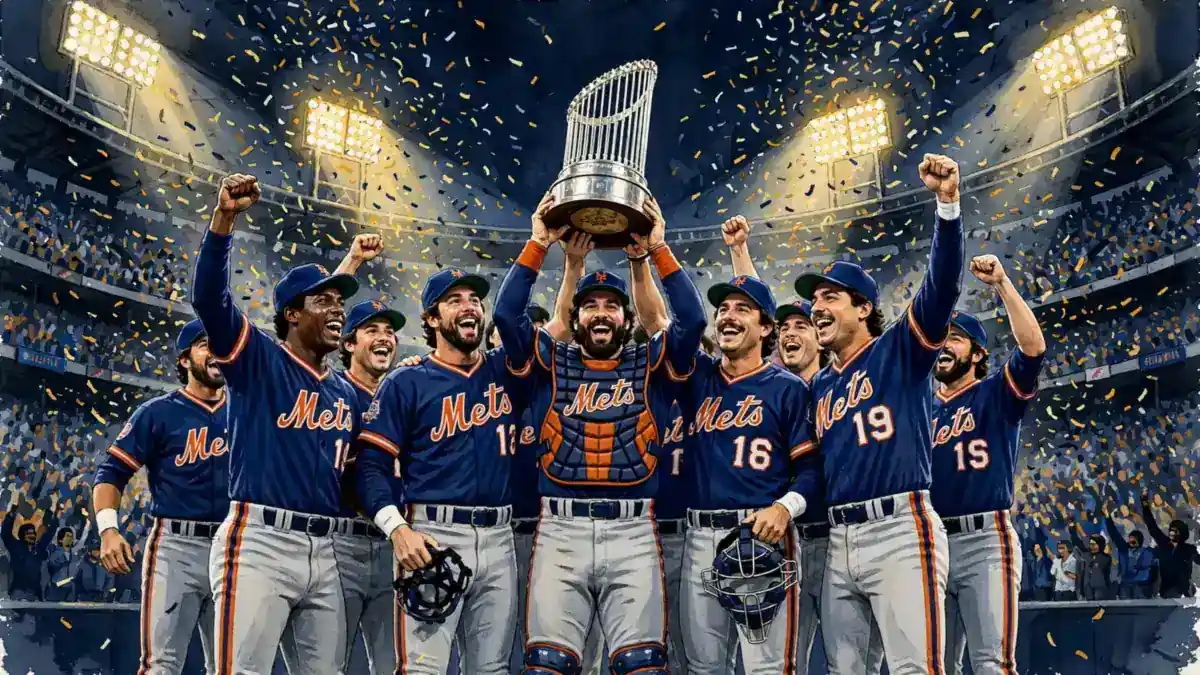
Strawberry’s fame was built in the mid-1980s, when the Mets became the loudest team in baseball and he became its most recognizable face. The 1986 Mets won 108 games, and Strawberry — 27 home runs, a .507 slugging percentage, 28 stolen bases — was the long, loose-limbed slugger at the heart of it. He hit a three-run home run in Game 7 of the World Series against the Boston Red Sox, the blow that stretched the Mets’ lead to 8-5 in the eighth inning and sealed the franchise’s first championship since 1969.
Fame in that Mets clubhouse was industrial-scale. Strawberry’s image appeared on Kenner’s Starting Lineup action figures, posters and banners across New York. He and Dwight Gooden, the pitching prodigy a year his junior, were marketed as the twin faces of a Mets renaissance — two young Black stars carrying a franchise that had been an afterthought for a decade. The city loved them, and the nightlife loved them back. The 1986 team is still argued about as the most talented single-season roster of the modern era, and Strawberry’s name is the first most fans reach for when they describe it.
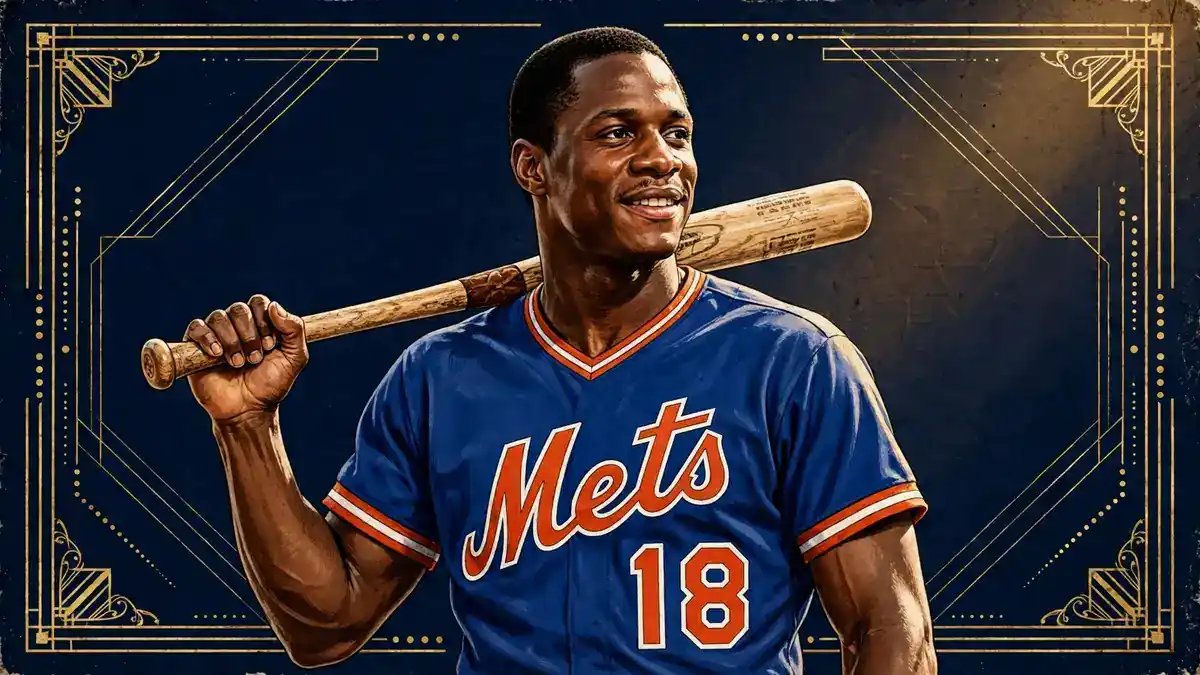
The fame had a price that showed up in the contract negotiations. By 1990, the relationship with the Mets had soured: Strawberry felt the club had never made a serious effort to keep him, while the front office felt it had offered fair money to a player whose off-field life was becoming a distraction. The bitterness lingered for decades. It finally softened in public on June 1, 2024, when the Mets retired his No. 18 at Citi Field before a crowd of 30,600. Strawberry stood on the grass and told the fans, “I’m so sorry for ever leaving you guys.” The home run apple in center field had been transformed into a strawberry for the day, and the public address system played the Beatles’ “Strawberry Fields Forever.” He had nearly died of a heart attack less than three months earlier. The apology landed like a closing scene.
The jersey retirement also settled his place in franchise history in a way statistics alone never could. He is the Mets’ all-time home run leader, a member of the Mets Hall of Fame since 2010, and one of a small group of players whose number the club has retired. For a player whose career is often filed under “what might have been,” the ceremony was a reminder that what actually happened — eight All-Star selections, a Rookie of the Year award, a 1986 ring, 252 Mets home runs — was already a career most players would trade for.
Main Sources of Income
Strawberry’s money has come in two distinct acts, and the second act pays very differently from the first. During his playing career, the income was almost entirely salary: roughly $30.6 million in base pay and signing bonuses across 17 seasons, plus a $200,000 draft bonus in 1980. Endorsement money in the 1980s was modest by modern standards — action figures, posters, local appearances — and there is no public record of a major national shoe or soft-drink deal of the kind that now defines a star’s off-field income.
Today the income mix is steadier and smaller. The largest single pillar is his MLB pension, which he qualified for many times over with 17 seasons of service time. The exact monthly amount is not public, and reporting on it has been muddied by the separate story of his deferred Mets money (covered in the salary section below). What is clear is that the pension arrives every month, does not depend on his health or his travel schedule, and forms the floor under his finances — the reason multiple 2026 profiles describe his net worth as “stable” rather than shrinking.
The second pillar is speaking. Strawberry told the Associated Press in November 2025 that he travels about 260 to 270 days a year to preach and tell his story — churches, recovery conventions, corporate events and sports banquets. That is a punishing schedule for a 63-year-old, and it is also the engine of his current earnings: speaking fees, love offerings and book-table sales at events. His Instagram account, @darrylstrawberry18, functions as the booking funnel for that work, carrying short faith messages and clips from sermons rather than the lifestyle content that fills most former athletes’ feeds.
The third pillar is books. Straw: Finding My Way (2009) and Turn Your Season Around: How God Transforms Your Life (2021) both still sell, and the newer book is a staple of the speaking circuit — signed copies move at events in a way that online sales alone never would. Royalties from two backlist titles will not make anyone rich, but paired with a heavy speaking calendar they add up to a working income.
Smaller streams fill in the gaps: autograph and memorabilia appearances, which ironically were the same income stream that got him into tax trouble in the 1990s; occasional media work, including a past stint as an analyst for SportsNet New York; and donations tied to his ministry and foundation work. There is no evidence of a business empire, a restaurant chain, a clothing line or a real-estate portfolio. The honest picture is a man who earns a living from his story, his faith and his pension — and who, by his own account, is content with that.
Salary and Earnings
The headline number is the one every source agrees on: Darryl Strawberry earned about $30.6 million in salary and bonuses during his major league career. Celebrity Net Worth puts the figure at $30 million flat and notes that it equals roughly $75 million in today’s money after inflation. Spotrac-style salary records, which itemise the earnings team by team and year by year, total $30,615,000. His largest single-season paycheque was the $5 million the Dodgers still owed him for 1995, collected while he was playing for the Yankees.
The year-by-year picture shows how fast the money arrived, and how fast it stopped. The table below uses the salary records published by Spotrac and Celebrity Net Worth. Figures are approximate — the Dodgers years in particular are reported slightly differently by different outlets — but the shape of the career is undisputed.
| Season | Team | Salary (approx.) |
|---|---|---|
| 1983 | New York Mets | $36,000 |
| 1984 | New York Mets | $220,000 |
| 1985 | New York Mets | $600,000 |
| 1986 | New York Mets | $800,000 |
| 1987 | New York Mets | $1,000,000 |
| 1988 | New York Mets | $1,300,000 |
| 1989 | New York Mets | $1,400,000 |
| 1990 | New York Mets | $1,800,000 |
| 1991 | Los Angeles Dodgers | $5,000,000 |
| 1992 | Los Angeles Dodgers | $3,750,000 |
| 1993 | Los Angeles Dodgers | $3,500,000 |
| 1994 | Los Angeles Dodgers | $3,000,000 |
| 1995 | Los Angeles Dodgers / New York Yankees | $5,000,000 + $675,000 |
| 1996 | New York Yankees | $300,000 |
| 1997 | New York Yankees | $750,000 |
| 1998 | New York Yankees | $875,000 |
| 1999 | New York Yankees | $750,000 |
Two contracts did the heavy lifting. The first was the six-year, $7.1 million extension he signed with the Mets before the 1985 season — a huge deal in its day that escalated from $600,000 in 1985 to $1.8 million by 1990 and included deferred-compensation provisions that would come back to haunt him. The second was the Dodgers deal signed on November 8, 1990: five years, a $1.5 million signing bonus, and salaries of $3.5 million in 1991, $3.75 million in 1992, $3.5 million in 1993, $3 million in 1994 and $5 million in 1995, for a base total of $20.25 million. Some outlets, including Wikipedia and several net worth sites, report the deal as $22.25 million — the higher figure appears to include bonuses and incentives on top of the base salaries. We use the $20.25 million base figure because Yardbarker’s contract breakdown itemises it year by year, and note the $22.25 million figure where it appears.
The Dodgers deal is also a case study in how a contract can pay a player long after the relationship ends. The Dodgers released Strawberry in May 1994, having paid him $852,400 of that season’s salary, but remained on the hook for the balance — including the full $5 million due in 1995. He collected that money while playing for the Yankees. It was the last big cheque of his career, and it arrived in the same year he pleaded guilty to tax evasion.
The deferred money is the strangest and saddest part of the earnings story. Nearly 40 percent of his $1.8 million Mets team option for 1990 — $700,000 — was deferred into guaranteed payments running for 43 years at 5.1 percent interest. The arrangement, similar to the one that makes every July 1 “Bobby Bonilla Day” for Mets fans, would have paid Strawberry $8,891.82 a month until August 2033, a total of nearly $2 million. He was expected to give part of it to his ex-wife Charisse under a 2006 divorce settlement, but did not make the payments. A federal judge later ruled that the Internal Revenue Service owned the money because of unpaid taxes from 1989, 1990, 2003 and 2004, and in 2015 the IRS auctioned off the remaining payments. An unidentified bidder paid $1.3 million for the right to receive the monthly cheques. Strawberry no longer receives a dollar of it. The deferred millions that were supposed to be his retirement cushion now belong to a stranger.
Put next to modern baseball money, the $30.6 million career total looks almost quaint. Aaron Judge signed a single nine-year, $360 million contract with the Yankees in December 2022 — more than ten times Strawberry’s entire career earnings. Shohei Ohtani‘s 10-year, $700 million Dodgers deal, signed a year later, is worth more than twenty times what Strawberry earned in 17 seasons. The comparison is not a criticism of Strawberry; it is a measure of how completely baseball’s economics changed after his era. The 1986 Mets’ highest-paid player earned less in a season than a modern middle reliever.
Businesses and Investments
There is no Darryl Strawberry business empire, and any profile that claims otherwise is inventing one. Unlike modern stars who arrive in the league with investment advisers, brand managers and equity stakes, Strawberry’s generation of players mostly invested in two things: houses and trust in other people. Both failed him at different points.
What he does have is a ministry organisation. In 2011, he and his wife Tracy founded Strawberry Ministries, a platform built around his preaching, recovery work and public testimony. The ministry is the institutional home of his speaking career — it handles bookings, sells books at events and channels donations into recovery outreach. It is a working small business rather than a wealth vehicle, and its value to Strawberry is income and purpose rather than equity.
He and Tracy also founded The Darryl Strawberry Foundation, dedicated to children with autism. The foundation runs fundraising events and, in 2010, was the beneficiary of a $25,000 donation from Celebrity Apprentice after Strawberry’s appearance on the show — Donald Trump put up $25,000 and fellow contestant Bret Michaels matched it. The foundation is a charity, not a profit centre, and its accounts are not public.
A White House official noted at the time of the November 2025 pardon that Strawberry had started a recovery centre in Florida that still operates today. Public detail on the centre is thin — no published revenue, no property records attached to it in the reporting — so we will not attach a dollar figure to it. What it represents financially is modest: a facility tied to his ministry work, not a commercial treatment chain.
On investments, the public record is mostly a record of absence. There are no reported stock portfolios, no venture stakes, no restaurant franchises, no memorabilia company bearing his name. He has said himself that at his lowest point he was $3 million in debt and without a driver’s licence. The wealth story of Darryl Strawberry is not a story of compounding investments; it is a story of a very large income, a very expensive decade, and a modest, steady rebuild built on work rather than assets.
Brand Deals and Sponsorships
Strawberry’s endorsement career belongs to a different commercial era. In the 1980s, a star of his stature could expect local car-dealer spots, a sporting-goods tie-in and a licensed-products line — Kenner’s Starting Lineup figures carried his likeness, and his face sold posters and Mets merchandise across New York. But there is no record of the kind of national, multi-year shoe or beverage contract that now anchors an athlete’s brand income, and the money from those 1980s deals was a fraction of his salary in any case.
The most visible brand association of his post-playing life came in 2010, when he appeared on Donald Trump’s Celebrity Apprentice. He finished 12th and was fired in the boardroom, but the appearance paid twice over: the $25,000 show donation to his foundation, and a personal connection with Trump that, fifteen years later, produced the phone call that pardoned him. It is the rare reality-TV appearance with a direct line to a presidential pardon.
He also spent time as an analyst for SportsNet New York, the Mets’ regional network — a natural fit for a franchise icon, and a paycheque that kept him connected to the game. That role has since ended, and his current public presence is built around his own channels rather than a network contract.
Today his “brand” is his testimony. Churches, recovery groups and corporate audiences book him to hear the story of the rise, the fall and the rebuild. The speaking circuit is his endorsement deal, and it pays in fees rather than in free products. It is a smaller, more honest version of the sponsorship game — and, by all accounts, one he would rather have than the 1980s version.
Houses, Cars and Other Assets
Strawberry has talked about his homes in the language of regret rather than pride. “I would sit in my $2 million home, feeling empty,” he said of his life at the height of his troubles — a line that captures the core of his story better than any balance sheet. The $2 million house was real, and it was also, by his own account, a place where he felt nothing at all.
His current home is far more modest in the telling. He and Tracy live in the St. Louis area — St. Peters, Missouri, where they moved in 2006 — in a home that has never been the subject of a glossy real-estate feature, and whose value is not a matter of public record. We will not invent a figure for it. What the reporting does establish is that the couple’s life is organised around the road: with Strawberry travelling 260 to 270 days a year, the house is a base between trips rather than a showcase asset.
On cars, the public record is silent. No verified car collection, no reported luxury purchases in recent years, no auction listings attached to his name. That silence is itself informative. The modern net worth profile usually comes with a garage inventory; Strawberry’s comes with a suitcase.
His remaining assets, as far as the public record shows, are the unglamorous kind: an MLB pension, book royalties, the ministry organisation, and the memorabilia value of his own name and signature. The deferred Mets money is gone — auctioned by the IRS in 2015. The houses of the 1980s are gone. What is left is income, not wealth, and a net worth figure that reflects that: $1.5 million to $2 million, built on a pension and a work schedule rather than on property or investments.
Awards and Achievements
Strawberry’s trophy case is the one part of his story nobody disputes. The list runs: National League Rookie of the Year (1983); eight consecutive All-Star selections (1984–1991); two Silver Slugger Awards (1988, 1990); National League home run leader (1988, with 39); and four World Series championships — 1986 with the Mets, and 1996, 1998 and 1999 with the Yankees. The 1998 title deserves a footnote: he hit 24 home runs in 101 games that season, then missed the postseason after his colon cancer diagnosis, but he was on the championship roster and counts among the team’s World Series winners.
The franchise honours came later, and they matter more than the playing awards because they required the organisation to forgive him first. The Mets inducted him into their Hall of Fame in 2010, and on June 1, 2024, they retired his No. 18 at Citi Field — he is one of a small group of Mets whose numbers hang in the stadium. His 252 home runs remain the most in franchise history, ahead of David Wright’s 242 and Mike Piazza’s 220. The leaderboard tells its own story about longevity and power: Strawberry reached the top of it in eight seasons, and nobody has caught him in the 35 years since.
| Rank | Player | Mets career home runs |
|---|---|---|
| 1 | Darryl Strawberry | 252 |
| 2 | David Wright | 242 |
| 3 | Mike Piazza | 220 |
| 4 | Howard Johnson | 192 |
One honour he does not have is a place in the National Baseball Hall of Fame in Cooperstown. He was nominated and appeared on the ballot in 2004, but the combination of a shortened peak and the off-field record kept him far from induction. The Mets Hall of Fame and the retired number are the formal recognition he did receive, and the June 2024 ceremony — with Dwight Gooden beside him, as always — was the closest thing to a Cooperstown moment his career will produce.
His career numbers still hold up in the record books: 335 home runs, 1,000 RBIs, 221 stolen bases, a .259 average and an .848 OPS over 17 seasons. The 1,000th RBI is a milestone only a few hundred players in history have reached, and the 335 home runs put him in company far more exclusive than the net worth figure suggests. The numbers say he was a great player. The money says he was a great player in an era that paid great players a tenth of what they earn now — and that he kept almost none of it.
Net Worth Growth Over the Years
Strawberry’s net worth curve is the opposite of the usual athlete arc: it peaked early, collapsed, and then flatlined at a modest level for two decades. The table below is a NetWorthCraft estimate built from his reported career earnings, the documented tax and legal liabilities, and the current consensus estimate. The 2026 figure is anchored in live reporting; the earlier years are reconstructions, not audited statements, and should be read as the shape of the story rather than a ledger.
| Year | Estimated net worth | What was happening |
|---|---|---|
| 1983 | $200,000 | Rookie season; $200,000 signing bonus banked |
| 1986 | $3 million | World Series champion; Mets extension paying off |
| 1991 | $10 million | Dodgers contract signed; peak earning years begin |
| 1995 | $6 million | Tax plea; legal bills and settlements mounting |
| 1999 | $4 million | Retirement; earnings stop, liabilities continue |
| 2005 | $1 million | Debts, divorce settlement, IRS claims bite |
| 2015 | $1 million | IRS auctions deferred Mets payments for $1.3M |
| 2020 | $1.5 million | Ministry and speaking income stabilises |
| 2024 | $1.5 million | Heart attack; jersey retired; pension floor holds |
| 2026 | $1.5 – $2 million | Consensus of 2026 reporting; pardon closes legal chapter |
The shape of that table is the point of the article. A player who earned $30.6 million and was, for a time, the second-highest-paid man in baseball, ends up with a net worth roughly equal to a single season of his Dodgers salary. The gap between the two numbers is the cost of the 1990s: unpaid taxes, legal fees, divorce settlements, addiction, and a long stretch of years in which the income stopped but the spending did not.
The flatline since 2015 is also the point. Strawberry’s net worth has not grown much in a decade, but it has not shrunk either — and for a man who once described himself as $3 million in debt, stability is the achievement. The pension pays every month. The speaking calendar pays most weeks. The books sell. Nothing in the current picture suggests a second collapse, and nothing suggests a second fortune either. The estimate for 2026 is best read as a floor that holds, not a number on its way somewhere.
Social Media Presence
Strawberry’s social media presence is narrow, deliberate and on-brand for a minister. His main platform is Instagram, where he posts as @darrylstrawberry18 — the handle combines his name with the number the Mets retired. The feed carries short faith messages, clips from sermons, photos from church appearances and anniversary posts about his sobriety. He has described Instagram as the place where people can find his message, and he uses it as a booking channel for the speaking circuit as much as a personal diary.
He is also present on Facebook and on X (formerly Twitter), where links to his interviews and podcast appearances circulate, and he appears regularly as a guest on faith and sports podcasts — recent appearances include The Ed Mylett Show and Jordan Raynor’s Mere Christians, where he talked about his book, his sobriety and the prayer journal his mother kept for years. The podcast circuit is, in effect, his media strategy: long-form conversations rather than daily posting.
We are not publishing follower counts here, because the numbers move constantly and no verified count is stable enough to print as fact. What can be said with confidence is that his audience is smaller than a current star’s and far more engaged than a typical retired athlete’s — the comments on his posts are dominated by people in recovery and by Mets fans of a certain age, two groups that do not overlap much anywhere else on the internet. His most consequential social media post of recent years was not a highlight reel but a photograph: in November 2025 he posted a picture of himself with President Trump and wrote, “Thank you, President @realdonaldtrump for my full pardon and for finalizing this part of my life, allowing me to be truly free and clean from all of my past.”
Personal Life
Strawberry has been married three times. His first marriage, to Lisa Andrews, ran from 1985 to 1993 and produced two children, Darryl Jr. — known as D.J. — and Diamond. His second marriage, to Charisse Simons, ran from 1993 to 2006 and produced three children, Jordan, Jade and Jewel. His third marriage, to Tracy Boulware, began in October 2006 and continues today. He met Tracy at a drug recovery convention, and the two share the Christian faith that now organises their life together. He has five children in all — D.J., Diamond, Jordan, Jade and Jewel — and the dedication page of his memoir lists them by name.
His children have made their own marks. D.J. Strawberry followed his father into professional sports, but on a basketball court: he played guard at the University of Maryland and was drafted by the Phoenix Suns in the 2007 NBA draft, then played professionally overseas. Diamond Strawberry appeared on the reality series Love & Hip Hop: New York. Jordan Strawberry played college basketball at Mercer University. The family story, in other words, kept producing athletes — just in a different sport.
Strawberry’s health has been the most serious personal story of the last two years. On March 11, 2024, the day before his 62nd birthday, he suffered a heart attack at home in Missouri, underwent a stent procedure at SSM Health St. Joseph Hospital in Lake St. Louis, and came out of surgery with his heart functioning at 32 percent. He credits Tracy with saving his life — she insisted on taking him to the hospital when he wanted to stay home. He recovered in time to attend Dwight Gooden’s number retirement on April 14 and his own on June 1, and he has spoken about the scare in sermons and podcast interviews since, describing it as a second lease on life rather than a warning he intends to ignore.
The other defining fact of his personal life is sobriety. Strawberry has been sober for more than two decades, a stretch that covers his entire ministry career and his marriage to Tracy. He talks about it plainly in his preaching — not as a boast, but as the foundation everything else stands on. The November 2025 pardon, for the 1995 tax evasion conviction and related drug charges, was the legal system catching up with a personal change that had already happened years earlier. As he told the Associated Press after the pardon call, Trump told him: “Today, the way your life is and what you’re doing, your faith and helping people and being sober, I’m giving you a full pardon.”
He lives in the St. Louis area with Tracy, and when he is not on the road — which, at 260 to 270 travel days a year, is not often — he is with family, at church, or working on his ministry. It is a quiet life for a man who once filled Shea Stadium, and by every account he prefers it that way.
Sources & Reporting
Celebrity Net Worth — net worth figure of $800,000, career earnings of about $30 million, and the deferred Mets payment details ($700,000 deferred, $8,891.82 a month to August 2033, IRS auction in 2015). Reporting window: profile updated 2025–2026.
ESPN (via talkSPORT’s reporting of ESPN’s account) — the deferred-compensation math: nearly 40 percent of the $1.8 million 1990 option deferred at 5.1 percent for 43 years, the divorce-settlement dispute, and the IRS auction of the remaining payments for $1.3 million.
Associated Press — the November 7, 2025 pardon: the 1995 guilty plea for failing to report $350,000 of income, the $430,000-plus repayment, the November 6 phone call from President Trump, and Strawberry’s travel schedule of 260 to 270 days a year. Reporting window: November 2025.
CNN — pardon coverage confirming the 1995 tax evasion charge, the White House statement on his sobriety, faith and recovery-centre work, and the 15-year prison exposure the plea deal avoided. Reporting window: November 2025.
NBC Sports — Strawberry’s sermon at Sheridan Church in Tulsa after the pardon, his 11 months in a Florida prison for a 2002 probation violation, and his two decades of sobriety. Reporting window: November 2025.
talkSPORT — the deferred Mets contract, the Bobby Bonilla comparison, the June 2024 jersey retirement, the March 2024 heart attack and 32 percent heart function, and the $25,000 Celebrity Apprentice donation to his foundation.
Yardbarker — the Dodgers contract signed November 8, 1990: five years, $20.25 million, $1.5 million signing bonus, year-by-year salaries, the rejected Mets offers, and the May 1994 buyout terms.
Wikipedia — career timeline and statistics, the 1980 draft, the St. Paul Saints stint in 1996, the 2009 memoir, the 2024 heart attack and the June 1, 2024 number retirement. Cross-checked against Britannica and Baseball Reference where figures are concerned.
Baseball Reference — career statistics: 335 home runs, 1,000 RBIs, 221 stolen bases, .259 average, .848 OPS, and season-by-season lines.
Spotrac — career earnings total of $30,615,000 and the year-by-year salary record used in the earnings table.
Sports Spectrum — the June 1, 2024 number retirement ceremony, Strawberry’s 15-minute address to the Citi Field crowd, and his ministry work. Reporting window: June 2024.
Figures in this article were checked against at least two of the sources above wherever they appear as fact. Where sources disagree — the Dodgers contract total, the exact net worth figure — the article shows the range and names the outlets behind each number. Net worth estimates for retired athletes are inherently uncertain; this article’s figure is a consensus estimate as of November 2026, not a statement from Strawberry’s own financial records, which are private.
Frequently Asked Questions
What is Darryl Strawberry’s net worth in 2026?
Darryl Strawberry’s net worth is estimated at $1.5 million to $2 million as of November 2026, the consensus of current net worth reporting. Celebrity Net Worth puts the figure lower, at $800,000. The range reflects the uncertainty around a retired athlete’s private finances — the pension, speaking income and book royalties are real, but no public record shows the full picture.
How much money did Darryl Strawberry earn in his MLB career?
About $30.6 million in salary and bonuses across 17 seasons, according to Spotrac-style salary records. His biggest deal was the five-year, $20.25 million contract with the Los Angeles Dodgers signed in November 1990. Adjusted for inflation, his career earnings equal roughly $75 million in today’s money.
Is Darryl Strawberry still getting paid by the New York Mets?
No. The Mets owed him deferred payments of $8,891.82 a month until August 2033 under a 1990 contract clause, but the IRS seized the rights to that money over unpaid taxes from 1989, 1990, 2003 and 2004, and auctioned the remaining payments in 2015. An unidentified bidder paid $1.3 million for them. Strawberry receives none of it.
Was Darryl Strawberry pardoned by Donald Trump?
Yes. On November 7, 2025, President Donald Trump granted Strawberry a full pardon for his 1995 guilty plea to tax evasion — failing to report $350,000 of income from autographs, appearances and memorabilia — and related drug charges. Trump called him on November 6 to deliver the news, citing his sobriety, his Christian faith and his ministry and recovery work.
How many World Series did Darryl Strawberry win?
Four. He won with the New York Mets in 1986, hitting a three-run home run in the Game 7 decider, and with the New York Yankees in 1996, 1998 and 1999. He missed the 1998 postseason after a colon cancer diagnosis but was on the championship roster.
Who is Darryl Strawberry’s wife?
Tracy Boulware Strawberry, his third wife. They married in October 2006 after meeting at a drug recovery convention, and live in the St. Louis area. His earlier marriages were to Lisa Andrews (1985–1993) and Charisse Simons (1993–2006). He has five children: D.J., Diamond, Jordan, Jade and Jewel.
What does Darryl Strawberry do now?
He is an ordained Christian minister, author and speaker. He and his wife Tracy run Strawberry Ministries, he travels about 260 to 270 days a year preaching and speaking at churches and recovery events, and he has written two books — Straw: Finding My Way (2009) and Turn Your Season Around (2021). He also receives an MLB pension from his 17 seasons of service.
Is Darryl Strawberry in the Baseball Hall of Fame?
No. He appeared on the Hall of Fame ballot in 2004 but was not elected. He is in the New York Mets Hall of Fame (inducted 2010), and the Mets retired his No. 18 at Citi Field on June 1, 2024. He remains the Mets’ all-time home run leader with 252.
Final Thoughts
Darryl Strawberry’s net worth — $1.5 million to $2 million — is the least interesting number in his story and also the most instructive one. The interesting part is the gap: $30.6 million earned, a fraction of it left. That gap is what happens when the money arrives at 18, the advisers are the wrong people, the taxes go unpaid and the addiction runs the calendar for a decade. It is also what makes the second half of his life worth more attention than the first. A man who was $3 million in debt, without a driver’s licence, now travels the country 270 days a year telling people how he got out — and gets paid for it, steadily, by churches and audiences who want the story more than they want the swing.
The 2025 pardon closed the legal file. The 2024 jersey retirement closed the Mets file. The heart attack in March 2024 nearly closed everything. What is left is a 64-year-old minister with a pension, two books, five children and a number hanging in Citi Field — and a net worth that, for the first time in his adult life, is not falling. That is not the ending anyone predicted for him in 1990. It is a better one than the money ever bought him.
Published on 2026-11-22. Last reviewed November 2026. Found an error? See our corrections policy.