
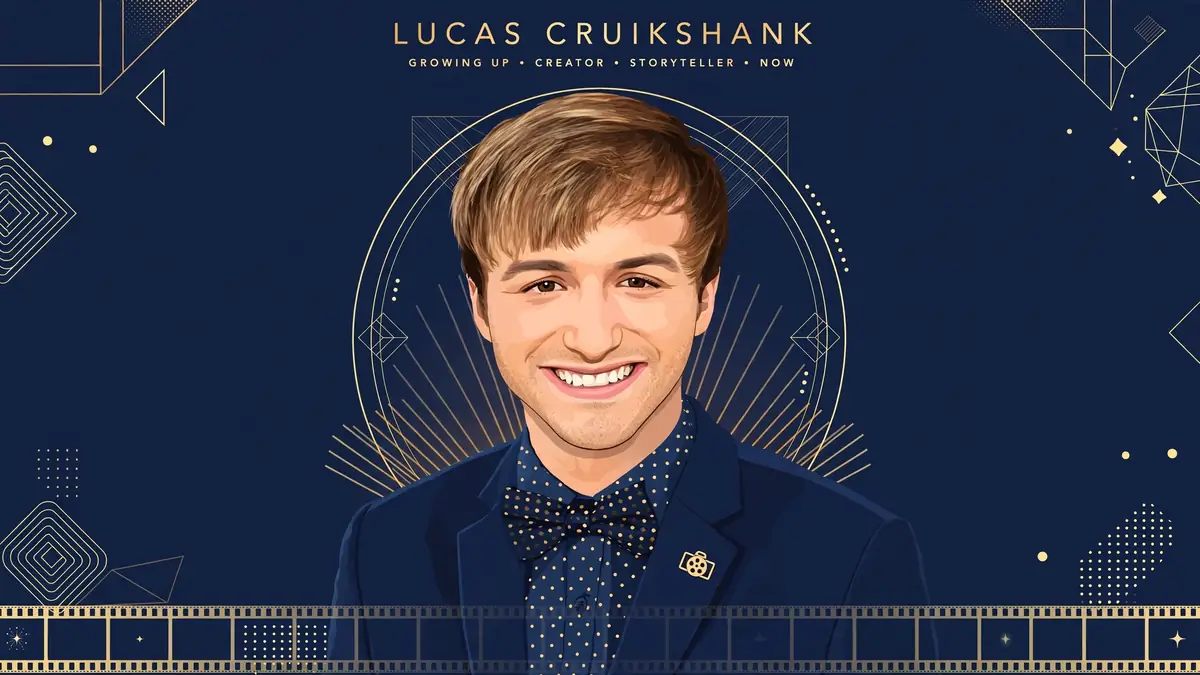
Lucas Cruikshank‘s net worth is estimated at $4.6 million to $6 million as of November 2026, with $5 million the figure most outlets settle on. The Columbus, Nebraska teenager who invented Fred Figglehorn in a Halloween video became the first creator in YouTube history to pass one million subscribers, turned that bedroom character into three Nickelodeon movies, two charting comedy albums and a second television series, and — twenty years later — stepped back into Fred’s shoes for MrBeast’s June 2026 legends special.
Lucas Cruikshank: Quick Facts
| Estimated net worth | $5 million (range: $4.6 million to $6 million) |
|---|---|
| Profession | YouTuber, actor, comedian |
| Nationality | American |
| Born | August 29, 1993 (age 33) |
| Height | 5 feet 8 inches (173 cm) |
| Primary income sources | YouTube ad revenue, Nickelodeon acting contracts, comedy albums, brand deals, merchandise |
| Active years | 2006–present |
| Last reviewed | November 2026 |
- Early Life and Background
- Education
- Career Journey
- Rise to Fame
- Main Sources of Income
- Salary and Earnings
- Businesses and Investments
- Brand Deals and Sponsorships
- Houses, Cars and Other Assets
- Awards and Achievements
- Net Worth Growth Over the Years
- Social Media Presence
- Personal Life
- Sources & Reporting
- Frequently Asked Questions
- Final Thoughts
Early Life and Background
Lucas Alan Cruikshank was born on August 29, 1993, in Columbus, Nebraska, to Dave Alan Cruikshank and Molly Jeanne Cruikshank. He grew up in a big household — two brothers and five sisters — in a town of roughly 24,000 people about 90 miles west of Omaha. Nothing about that setting suggested a future in entertainment. Columbus had no film industry, no talent agencies, and no obvious path to a camera. What it did have, by the mid-2000s, was a broadband connection and a new website called YouTube, and that turned out to be enough.
Cruikshank was the middle child of eight, and the crowded house shaped the comedy. Fred Figglehorn, the character that would make him famous, is a six-year-old with a shrill voice, a short fuse, and a chaotic home life — a mother who is barely present, a grandmother who raises him, and a string of small humiliations at school and at home. The character was not a copy of his own family, which by every account was stable and supportive, but it drew on the noise, the sibling chaos, and the feeling of being a kid shouting to be heard in a full house. That exaggeration is what made Fred land: millions of viewers recognised the feeling even if they had never met the character.
His parents backed the experiment. Dave and Molly Cruikshank let their teenage son film in the house, and the family stayed in Nebraska even after Fred became a national name. Cruikshank has never been a Los Angeles transplant in the usual sense — he built the first phase of his career from his hometown, flew out for shoots, and came home. That rootedness matters to the money story, too: unlike child stars who moved to Hollywood and burned through earnings on coastal living costs, Cruikshank’s early overhead was close to zero. A bedroom, a cheap camera, and free hosting on YouTube were the entire production budget for the thing that made him rich.
The other early detail that gets missed is how young he was when the work started. Cruikshank was 13 when he created Fred. He was not a former child actor with an agent, or a drama-school graduate with a reel. He was a middle-schooler testing character ideas on a channel he ran with his cousins, and the character that stuck was the loudest, strangest one in the batch. That accident — a teenager stumbling onto a voice that millions of other teenagers recognised — is the whole foundation of the fortune. Everything after it, from the Nickelodeon contracts to the albums, was the industry catching up to a kid who had already won the audience.
Education
Cruikshank attended Lakeview High School near Columbus, Nebraska, and his school years ran straight through the Fred explosion. He was filming Fred videos between classes while his subscriber count climbed past every other channel on YouTube. There is no record of him attending college, and no reporting suggests he pursued higher education after high school — by the time he graduated, he was already a working television actor with a Nickelodeon franchise, and the classroom had stopped being where his career was happening.
That is worth stating plainly because net-worth profiles of creators often pad the education section with speculation. The honest version is shorter: Lakeview High School, then a career. His real education was the platform itself. Between 2006 and 2009 he learned, in public and in real time, how to hold an audience, how to pace a joke for a webcam, how to turn a one-note character into a repeatable series, and how to convert attention into sponsorship money. Those are the skills that paid him, and he learned them by posting, watching the view counts, and posting again — a feedback loop no film school could have given him at that speed.
The timing also explains why his earnings curve looks different from a traditional actor’s. A conventional child star spends years auditioning before the first paycheque. Cruikshank was earning from YouTube advertising and sponsorships while still a student, because the platform paid creators directly and the audience arrived before any gatekeeper did. By the time Nickelodeon came calling, he was negotiating from a position of strength: he already owned the character, the channel, and the audience, and the network needed him more than he needed the network.
Career Journey
Cruikshank’s career began in 2005 and 2006 on a channel called JKL Productions, which he ran with his twin cousins Jon and Katie Smet — the initials J, K, and L were theirs. The three of them posted sketches and tested characters, and the channel was a hobby, not a business plan. The turn came when Cruikshank, while trying out character ideas, filmed himself as Fred Figglehorn in a Halloween video. Fred was a hyperactive six-year-old with a digitally pitched-up voice, anger management issues, and a running monologue about his miserable home life. The video worked. Viewers watched it, then asked for more of that specific kid.
Cruikshank listened. He built a series around Fred, and in April 2008 he set up a dedicated Fred channel, moving the character’s videos there. The first official video of the series, “Fred on May Day,” went up on May 1, 2008, and it now carries more than 20 million views — a single upload from a Nebraska teenager that has outlasted most television shows of its era. The channel’s growth from there was not gradual. By April 2009 it had passed one million subscribers, the first channel in YouTube history to do so, and it held the title of the platform’s most-subscribed channel for 318 days, from October 2008 to August 2009. That record is the part of the story competitors usually compress into a single clause, but it deserves its full weight: for nearly a year, the biggest channel on earth was run by a 15-year-old filming in his bedroom.
The industry noticed fast. In December 2009 Cruikshank filmed Fred: The Movie, which aired on Nickelodeon in September 2010 and drew 7.6 million viewers, a strong number for a cable television film built on a web character. Nickelodeon then built a franchise around him: Fred 2: Night of the Living Fred aired on October 22, 2011, and Fred 3: Camp Fred followed in 2012, the same year the network aired Fred: The Show, a 24-episode series. Alongside the Fred work, Cruikshank guest-starred as Fred and as himself on iCarly in the episode “iMeet Fred,” which first aired on February 16, 2009, and appeared on Hannah Montana in December 2009. He also released two comedy albums as Fred — It’s Hackin’ Christmas with Fred in November 2009 and Who’s Ready to Party? in September 2010 — and the second of those reached number one on the Billboard comedy albums chart.
After Fred: The Show was cancelled after one season, Nickelodeon gave him a second lead role: Marvin Forman, an alien teenage boy adjusting to human life in Portland, Oregon, on Marvin Marvin, which ran from November 2012 into the spring of 2013. He also guest-starred on Supah Ninjas in 2011, appeared on Big Time Rush in 2013, and voiced a character on Monsters vs. Aliens. Then, in 2013, he parted ways with Nickelodeon, and the television phase of his career ended almost as quickly as it had begun.
The YouTube phase never stopped. In January 2009 he had set up his own channel under the name “lucas,” where he appeared as himself. Between 2013 and 2014 he partnered with British YouTuber Jennifer Veal on a run of videos, and the channel was renamed “Lucas and Jenny” for the partnership. When Veal left in November 2014, the channel reverted to his name, and he rebuilt it around vlogs, travel content, food reviews, celebrity Cameo reviews, and commentary on reality television and internet culture. The channel was renamed “Lucas” in April 2019. It now counts 3.34 million subscribers and 237 million views, according to Wikipedia’s October 31, 2026 update, and it still runs on a monthly upload schedule. The Fred channel, separately, still counted about 3.67 million subscribers in 2025, according to TheCityCeleb — a back catalogue that keeps earning while its creator moves on.
In 2017 Cruikshank said he was taking a hiatus from acting, and he added that the decision was not by choice — a candid admission that the acting offers had dried up rather than that he had walked away from them. It is a useful corrective to the usual child-star story. He did not flame out; the phone simply stopped ringing, and he went back to the platform where he had always controlled the terms. The most recent twist came on June 13, 2026, when Cruikshank appeared as Fred Figglehorn in MrBeast’s “50 YouTube Legends Fight For $1,000,000,” a special marking MrBeast passing 500 million subscribers. He was eliminated in the first phase, but the appearance itself was the news: twenty years after inventing the character, Fred was still famous enough to be invited to the biggest creator event of the year. That single booking tells you more about the durability of his brand than any earnings estimate does.
Rise to Fame
Fred did not go viral in the modern sense — there was no algorithm push, no TikTok repost cycle, no celebrity retweet. The character spread the slow, old-fashioned way: one viewer showed another, schools talked about it, and the subscriber count compounded week after week until it passed everyone. The numbers tell the story better than adjectives can. The Fred channel became the first on YouTube to cross one million subscribers in April 2009, and it stayed the platform’s most-subscribed channel for 318 days. For comparison, the creators who later held that crown — including PewDiePie, whose own rise defined the next era of YouTube — built on an audience model Fred had proved first: a single personality, a repeatable character, and a direct relationship with viewers that no network mediated.
Three things made Fred catch fire where other early YouTube characters faded. First, the voice. Cruikshank pitched his own voice up in post-production, and the result was instantly recognisable in two seconds — a practical advantage in an era when viewers decided whether to keep watching almost immediately. Second, the format. Fred talked straight to the camera about his day, which meant every video cost nothing to make and could be produced in an afternoon. Volume mattered: the character stayed in viewers’ feeds constantly. Third, the audience fit. Fred was a kid, played by a kid, for kids — and in 2008, YouTube’s audience skewed young in a way it no longer does. Cruikshank was not making content for the internet’s existing audience; he was making it for the audience the internet was about to get.
The mainstream press caught up in 2008 and 2009. The Independent and the Sydney Morning Herald both profiled the phenomenon, and BusinessWeek ran a piece in November 2008 on Fred’s views and ad dollars — an early sign that the business press had started treating YouTubers as economic actors rather than curiosities. The awards followed the attention: Cruikshank won Choice Web Star at the 2009 Teen Choice Awards and was nominated for Favorite User Generated Video at the People’s Choice Awards the same year. He presented at the 2009 Teen Choice Awards and the 2010 Kids’ Choice Awards, and by the time Fred: The Movie aired in September 2010, the character had crossed fully from the internet into mainstream children’s television.
What is easy to forget is how little infrastructure existed around him. There were no multi-channel networks of the modern kind, no brand-deal agencies specialising in creators, no playbook for turning a viral character into a franchise. Cruikshank, his family, and eventually Nickelodeon were inventing the process as they went. That he came out of it with a franchise, two charting albums, and a fortune — rather than a cautionary tale — is the exception among early internet stars, and it is why his net worth still draws searches in 2026 while most of his 2008 peers have vanished from the public record entirely.
Main Sources of Income
Cruikshank’s money comes from five streams, and their balance has shifted completely across his career. The early money was YouTube advertising and sponsorships. The middle money was Nickelodeon — film fees, a series salary, and the associated merchandising and album revenue. The current money is his personal channel’s advertising, plus the long tail of the Fred catalogue, plus sporadic appearances and partnerships. No single stream dominates today, which is both the strength and the limit of his finances: the income is diversified and durable, but nothing in his current output matches the concentrated paydays of the Nickelodeon years.
YouTube advertising is the foundation. The Lucas channel has 237 million views, and the Fred channel’s catalogue adds hundreds of millions more across its run. YouTube pays creators a share of the advertising shown against their videos, and the rate varies by audience, season, and advertiser demand — family-friendly comedy aimed at young viewers typically earns at the lower end of the scale. That is why the raw view counts, impressive as they are, translate into a modest annual figure today rather than a large one. The channel earns steadily, month after month, from old videos as well as new ones, but it is annuity income, not windfall income.
The Nickelodeon years were the windfall. Three television films, a 24-episode series, and a second series lead role meant several years of contracted television pay for a performer who was still a teenager. Nickelodeon does not publish its talent fees, so no exact salary figure is available — and any site that prints one is guessing. What can be said with confidence is that a network franchise built around a single performer, with three films and two series, pays far more than YouTube advertising ever did at that scale, and that this period, roughly 2010 to 2013, is when the bulk of Cruikshank’s wealth was built.
Music added a real, if smaller, stream. Both Fred albums charted on Billboard’s comedy chart, and Who’s Ready to Party? reached number one. Comedy albums do not generate the revenue of mainstream pop, but a number-one chart position means real unit sales and streaming income in 2009 and 2010, plus the touring and appearance fees that come with a charting record. Merchandise — Fred-branded products and T-shirts promoted in the videos themselves — added a direct-sales stream that cut out the middleman entirely.
The fifth stream is the one that is hardest to see and easiest to underrate: the catalogue. Fred’s videos never stopped being watched. “Fred on May Day” alone has passed 20 million views, and the old catalogue earns advertising revenue every day without Cruikshank filming anything new. That is the quiet engine of his current net worth — less a salary than a library.
Salary and Earnings
There is no public record of what Nickelodeon paid Lucas Cruikshank, and no filing or interview has ever disclosed a figure — so any article that states his Fred salary as fact is inventing it. What follows is what can be established honestly: the structure of his earnings, the numbers that are documented, and a transparent calculation of what his YouTube catalogue is worth today.
The documented numbers start with the albums. It’s Hackin’ Christmas with Fred, released November 10, 2009, peaked at number 8 on Billboard’s US Comedy Albums chart, number 24 on the Heatseekers chart, and number 13 on the Holiday Albums chart. Who’s Ready to Party?, released September 21, 2010 on Collective Records, reached number 1 on the US Comedy Albums chart and number 29 on Heatseekers. A number-one comedy album in 2010 meant meaningful sales — comedy albums rarely crack the mainstream charts at all, and a chart-topper in the category was a genuine commercial result, not a vanity release.
For YouTube, the honest way to estimate is to show the working. The Lucas channel has 237 million lifetime views. If those views earned an average of $2 to $4 per thousand monetised views — a realistic range for family-friendly comedy content, after YouTube’s revenue share — the channel’s lifetime advertising gross falls roughly between $475,000 and $950,000, before the split with any network or manager and before tax. The Fred channel’s catalogue, with its far larger view counts across hundreds of videos, would add substantially more over its lifetime, though its exact totals are not published. These are illustrations built on stated assumptions, not reported salaries, and they explain why the $5 million net worth figure makes sense: the YouTube money alone does not reach it, and the Nickelodeon contracts are what close the gap.
One site, SurpriseSports, claims Cruikshank earns around $1.2 million a year and $100,000 a month, and puts his net worth at $8 million. Neither number is sourced, and both sit far above what the view counts and the post-2013 career record support — a channel uploading monthly to 3.34 million subscribers does not generate $100,000 a month from advertising alone. We do not use those figures, and readers should treat them as the outlier they are. The $8 million estimate appears in no other current source; every other outlet lands between $4.6 million and $6 million.
The fairest summary of his earnings arc is this: a short, intense peak from 2009 to 2013, when Nickelodeon fees, album sales, sponsorships, and merchandise stacked on top of each other; then a long, lower plateau from 2014 onward, when the income came mostly from the catalogue and the personal channel. Creators who peak young often spend the windfall as fast as it arrives — Cruikshank’s net worth suggests he did not. A $5 million fortune held a decade after the peak, with no major new payday in between, points to someone who kept the money rather than spending it. That is not a guess about his bank statements; it is arithmetic. The peak earnings had to exceed $5 million for $5 million to remain, and the years since have had to cover his living costs without eating the principal.
For scale, the creator economy around him moved on to vastly bigger numbers. Logan Paul, who built his fortune a decade after Fred, turned a similar audience-first model into boxing paydays and a drinks company — a reminder of how much the monetisation playbook grew after Cruikshank had already proved the audience existed. Cruikshank was early; the creators who came later had better tools for turning attention into money.
Businesses and Investments
Cruikshank has never been a public entrepreneur in the way later creators were. There is no Cruikshank-founded company, no product line with his name on the cap table, and no venture portfolio that shows up in reporting. That absence is itself informative: his wealth is a performer’s wealth, built from fees and royalties, not a founder’s wealth built from equity. The business story of Fred is really the story of a character treated as an asset — and on that front, the record is more interesting than the “investments” label usually allows.
The character was the business. Cruikshank owned Fred before Nickelodeon did, and the franchise only existed because he controlled the underlying property. That ownership is what turned a YouTube series into three films and two television series rather than a single guest spot. It is also what kept the catalogue earning after the network moved on: the videos were his, the channel was his, and the advertising revenue kept flowing to him. Most child stars of his era owned nothing — they were employees of a studio’s property. Cruikshank walked in owning the property, which is a structural advantage worth more than any single paycheque.
Merchandise was the most direct business he ran. Fred-branded products and T-shirts were promoted inside the videos themselves, which meant the marketing cost was zero and the margin went straight to him. In the late 2000s, before creator merchandise platforms existed, that kind of direct selling was rare, and it showed a commercial instinct that the “accidental star” story usually leaves out. He was performing and selling at the same time, to an audience he already held.
On investments, the public record is silent, and the honest thing to say is that it is silent. No property purchases, no stock portfolio, and no startup stakes have been reported, and we do not invent them. RichestLifestyle notes that he has shown an interest in personal finance and in investing wisely, but adds that no specific investments have been publicly detailed — and that is the correct level of certainty. What can be said is that a $5 million net worth surviving a decade past the earnings peak implies careful management rather than speculation. Creators who gamble windfalls on restaurants, crypto, or entourages do not usually still hold the money ten years later. Whether the preservation came from index funds, property, or simply not spending much, the outcome is the same: the fortune endured.
His most recent business-adjacent move is also his most telling. The June 2026 MrBeast appearance was not a business deal in the conventional sense, but it was a brand decision: stepping back into Fred’s shoes for the biggest creator event of the year put the character in front of the largest audience on the platform. If there is a next chapter for Fred — a reunion, a reboot, a licensing deal — that appearance was the audition for it, and it cost him nothing but a day on set.
Brand Deals and Sponsorships
Cruikshank’s brand deals started earlier than almost any creator’s, because he was famous before the influencer industry had a name for what he was doing. The first season of the Fred web series carried a sponsorship from Zipit Wireless Messenger, whose device Fred used on camera — a product placement deal struck in 2008, years before “creator sponsorship” became a standard line item. Walden Media then hired him to promote City of Ember, and he went on to promote the films Year One and Adventures of Power in the same way. He also promoted the musician Kev Blaze by featuring in his song “Watch How I Do This.” These were not the polished, agency-negotiated partnerships of the 2020s; they were studios and brands experimenting with a new channel, and Cruikshank was the test case.
The deals worked because the fit was exact. Fred’s audience was young, online, and unreachable through television advertising — the precise demographic film studios were struggling to reach as teenagers migrated to YouTube. A Fred video promoting a family film was not a celebrity endorsement in the old sense; it was the character himself telling his audience about a movie, in character, in the format they already watched daily. That is why the deals kept coming even though Cruikshank was a teenager with no manager of the usual kind: he could deliver an audience no one else could.
The Nickelodeon years added the usual television-era sponsorships and tie-ins, though the network handled most of that machinery and the details were never disclosed. What matters for the net worth picture is that the brand money was concentrated in the same 2008–2013 window as everything else. After he left Nickelodeon, the big brand deals thinned out along with the acting work — his personal channel’s vlogs and commentary were never the brand-safe, advertiser-friendly format that commands premium sponsorship rates, and he has not pursued the supplement, app, or fashion deals that sustain many creators today.
That is not a failure; it is a choice visible in the output. Cruikshank’s post-Fred channel is looser, funnier, and more personal than a sponsorship-optimised channel would be, and it earns less because of it. The trade-off is the point: he kept creative control of the channel that bears his name, and the income he gave up is the price of that control. For a net worth estimate, the consequence is straightforward — brand deals are a historical contributor to the $5 million, not a growing one.

Houses, Cars and Other Assets
No property record, vehicle purchase, or asset listing for Lucas Cruikshank appears in public reporting, and this section says so rather than filling the gap with guesses. That silence is normal for a creator of his scale: he is wealthy, but not so wealthy that property blogs track his purchases, and he has never used real estate or cars as part of his public image. What can be established is the shape of his life, which points to modest overhead rather than lavish spending.
Cruikshank still has deep roots in Columbus, Nebraska, the town where he grew up, and his content has consistently been made outside the Los Angeles creator economy. Staying out of Los Angeles is a financial decision as much as a personal one: no coastal mortgage, no entourage, no agency-driven lifestyle inflation. The creators who burn through early fortunes usually do it on housing and hangers-on in expensive cities; Cruikshank’s geography worked against that from the start.
His most valuable asset is not a house or a car. It is the Fred catalogue and the character itself — an intellectual property that still draws millions of views a year and still earns advertising revenue with no new work attached. A library of videos that pays every month is, in practical terms, the same as a rental property: it produces income without being sold, and it holds value as long as the audience keeps watching. On top of that sits the Lucas channel, with 3.34 million subscribers and 237 million views, and the personal brand that got him invited onto MrBeast’s 2026 special. None of these appear on a balance sheet, but they are the assets that explain how a fortune built in 2010 is still intact in 2026.
Readers looking for a mansion tour or a car collection will not find one here, and that is the honest answer. The money went into staying power, not display — and the staying power is visible in the fact that, twenty years after the Halloween video, the character still books the biggest stages on the platform.
Awards and Achievements
Cruikshank’s awards shelf is short, but the achievements behind it are not. The headline win came in 2009, when he took home Choice Web Star at the Teen Choice Awards — the first time a YouTuber had been recognised in that category, and a signal that the awards industry had noticed the platform. The same year he was nominated for Favorite User Generated Video at the People’s Choice Awards. He was nominated again at the Teen Choice Awards in 2010, nominated for Iconic Web Star at the J-14 Teen Icon Awards in 2010, and nominated for Favorite TV Actor at the Kids’ Choice Awards in 2013 for his Nickelodeon work.
The real achievements are the records, and they outlast the trophies. First YouTube channel ever to reach one million subscribers, in April 2009. Most-subscribed channel on the platform for 318 days. A television film, Fred: The Movie, that drew 7.6 million viewers on its Nickelodeon premiere. Two Billboard-charting comedy albums, one of them a number-one. Three films and two series from a character invented in a bedroom. Each of those is a first or a best that no one else in his cohort matched, and together they add up to a career that changed what a YouTube channel could become.
The awards recognise the moment; the records recognise the precedent. And the precedent is the reason his name still appears in every history of YouTube: he was the proof that a single person with a camera could outdraw every channel on the site.
Net Worth Growth Over the Years
No audited year-by-year figures exist for Cruikshank, so the table below is an honest reconstruction from the career record: the documented milestones, the published estimates, and the timing of his income peaks. Figures before 2020 are estimates based on the career arc rather than reported numbers, and they are labelled as such.
| Year | Estimated net worth | What drove it |
|---|---|---|
| 2008 | Under $500,000 | Fred channel passes one million subscribers; Zipit sponsorship begins |
| 2010 | $1 million – $2 million | Fred: The Movie draws 7.6 million viewers; second album hits number one on the comedy chart |
| 2012 | $3 million – $4 million | Third Fred film, 24-episode series, and Marvin Marvin lead role stack up |
| 2015 | $4 million – $5 million | Nickelodeon fees banked; personal channel rebuilt after the Jennifer Veal partnership ends |
| 2020 | $5 million | Catalogue income steadies; most outlets converge on $5 million |
| 2026 | $4.6 million – $6 million | Anchored at $5 million; MrBeast legends appearance revives the Fred brand |
The shape of that curve is the story. A steep climb from 2008 to 2012, a plateau from 2015 onward, and no collapse. That plateau is the unusual part. Child stars who peak at 17 usually show a net worth curve that falls off a cliff in their twenties as the work dries up and the spending continues. Cruikshank’s curve flattens instead — the catalogue kept paying, the living costs stayed low, and the fortune held. The 2026 range, $4.6 million to $6 million, is wider than a single figure precisely because the sources disagree at the edges, but every serious outlet lands inside it, and the centre of gravity has not moved from $5 million in years.
Social Media Presence
Cruikshank’s social media footprint is smaller than his fame suggests, and that gap is part of the story. His main platform is YouTube, where the Lucas channel has 3.34 million subscribers and 237 million views, and the Fred channel still holds roughly 3.67 million subscribers. He uploads on a monthly schedule rather than the daily grind that drives the algorithm, and the content is commentary, vlogs, food reviews, and celebrity Cameo reviews — the work of someone making videos because he wants to, not because a schedule demands it.
That slower cadence is a deliberate trade. A monthly upload schedule will never maximise advertising revenue, but it is sustainable for a creator in his thirties who has already made his money and has nothing left to prove to the platform. The audience that stays is the loyal one: viewers who have followed him since Fred, who watch the commentary because they like his voice, and who turned out in force for the Fred revival in 2020 and 2021, when he briefly returned to the character.
Outside YouTube, his presence is modest. He has never been a TikTok-first or Instagram-first creator, and he does not run the multi-platform brand machine that younger stars do. That absence costs him sponsorship money, but it also protects him from the burnout cycle that eats creators who chase every platform at once. His most consequential social media moment of recent years was not even on his own channel: the June 2026 MrBeast video put Fred in front of hundreds of millions of viewers in a single upload, more reach than his own channel could deliver in a year of monthly videos. For a creator whose brand is a character, that kind of borrowed reach is worth more than any follower count of his own.
The comparison with his peers is instructive. Ninja, who turned streaming into a mainstream career in the same creator economy Fred helped create, built a multi-platform empire with daily output and brand partnerships at a scale Cruikshank never pursued. Cruikshank’s model was always narrower: one character, one channel, and then a personal channel run on his own terms. Both models work. Only one of them leaves you with your thirties free.
Personal Life
Cruikshank came out publicly as gay in a YouTube video released on August 20, 2013, telling viewers that his family and friends had known for about three years and that he had simply never felt the need to announce it online. The video was plain, direct, and unadorned — no press release, no magazine cover, just a creator talking to his audience — and it was widely covered at the time, including by the New York Daily News. He had begun dating Australian model Matthew Fawcus on March 18, 2013, after the two were introduced by fellow YouTuber Kingsley at a gay club, and the couple later married. Fawcus appears in Cruikshank’s travel vlogs, including a 2025 video about a trip to Australia, and the relationship is a settled, public part of his life rather than a headline.
Family remains central. He is one of eight children — two brothers and five sisters — and his parents, Dave and Molly, still live in the Nebraska orbit where he grew up. His mother, Molly, has appeared in his music work, singing with him on “The Climb” in 2022, a small detail that says more about the household than any biography paragraph could: the family that let a 13-year-old film a screaming six-year-old in their house is still part of the act.
He has spoken little about his private finances, his home, or his daily routine, and this profile respects that boundary. What is public is enough: a creator who came out on his own terms, built a lasting relationship, stayed close to his family, and kept working on his own schedule. The personal life section of a net-worth profile usually exists to feed gossip; here it exists to explain the stability behind the number. A $5 million fortune held for a decade does not happen by accident, and the steadiness of the life around it is part of the explanation.
Sources & Reporting
Celebrity Net Worth — the $5 million estimate, updated November 20, 2026, plus the career summary: Fred’s 2006 debut, the 2009 million-subscriber milestone, the three Nickelodeon films, the Marvin Marvin lead role, and the Zipit and film-promotion endorsements.
Wikipedia — birth date and place, family details, the 318-day most-subscribed reign, the April 2008 Fred channel launch, the January 2009 “lucas” channel, the Jennifer Veal partnership and its end in November 2014, the April 2019 channel rename, the 3.34 million subscribers and 237 million views as of October 31, 2026, the album chart positions, the awards table, the 2017 acting hiatus, and the June 13, 2026 MrBeast appearance.
UrbanSplatter — the $5 million estimate and the biographical summary, including the Columbus, Nebraska upbringing and the Fred character’s origin.
TheGenzStars — the $4.6 million estimate, the 5 feet 8 inch height, and the marriage to Matthew Fawcus.
TheCityCeleb — the $1 million to $5 million range, the 7.6 million viewers for Fred: The Movie, and the Fred channel’s 3.67 million subscribers in 2025.
RichestLifestyle — the $6 million estimate and the note that specific investments have not been publicly detailed.
SurpriseSports — the $8 million outlier estimate and the unsourced $1.2 million annual earnings claim, both flagged in this article as unsupported.
TheBiography — the October 30, 2006 date for Fred’s first appearance, the Zipit sponsorship detail, and the “Fred on May Day” view count.
Reporting window: sources published or updated between January 2024 and November 2026, with the anchor estimate (Celebrity Net Worth) updated November 20, 2026. Where sources conflict — most visibly on the net worth figure itself — this article publishes the range and names who says what, rather than picking a winner.
Frequently Asked Questions
What is Lucas Cruikshank’s net worth in 2026?
Lucas Cruikshank’s net worth is estimated at $4.6 million to $6 million as of November 2026, with $5 million the figure most outlets report. Celebrity Net Worth, updated November 20, 2026, puts him at $5 million, and UrbanSplatter and Wealtholino agree. TheGenzStars reports $4.6 million and RichestLifestyle reports $6 million. One site claims $8 million, but it offers no sourcing, so we treat $5 million as the anchored estimate.
How did Lucas Cruikshank make his money?
He made it in three phases. First, YouTube advertising and sponsorships from the Fred channel, which became the first channel ever to pass one million subscribers in April 2009. Second, Nickelodeon contracts: three Fred television films, a 24-episode series, and a lead role on Marvin Marvin, plus two charting comedy albums and merchandise. Third, the long tail — advertising from the Fred catalogue and his personal Lucas channel, which has 3.34 million subscribers and 237 million views.
Is Lucas Cruikshank still making videos?
Yes. His personal channel, Lucas, is still active on a monthly upload schedule with vlogs, food reviews, celebrity Cameo reviews, and commentary on reality television. He also returned as Fred Figglehorn in MrBeast’s “50 YouTube Legends Fight For $1,000,000” video on June 13, 2026, twenty years after creating the character.
How old is Lucas Cruikshank?
Lucas Cruikshank was born on August 29, 1993, in Columbus, Nebraska, which makes him 33 years old as of November 2026. He was 13 when he created Fred Figglehorn and 15 when the Fred channel became the first on YouTube to reach one million subscribers.
Was Fred really the first YouTube channel to reach one million subscribers?
Yes. The Fred channel passed one million subscribers in April 2009, the first channel in YouTube history to do so, and it remained the platform’s most-subscribed channel for 318 days, from October 2008 to August 2009. The record is documented by Wikipedia and by contemporary press coverage from 2008 and 2009.
How many Nickelodeon Fred movies are there?
There are three: Fred: The Movie (September 2010), which drew 7.6 million viewers; Fred 2: Night of the Living Fred (October 22, 2011); and Fred 3: Camp Fred (2012). Nickelodeon also aired Fred: The Show, a 24-episode series, in 2012, and Cruikshank went on to star as Marvin Forman in Marvin Marvin from November 2012 to spring 2013.
Is Lucas Cruikshank married?
Yes. He is married to Australian model Matthew Fawcus. The two began dating on March 18, 2013, after being introduced by YouTuber Kingsley, and Fawcus appears in Cruikshank’s travel vlogs. Cruikshank came out publicly as gay in a YouTube video on August 20, 2013.
What happened to Fred Figglehorn, and why did Lucas Cruikshank retire the character?
After Fred: The Show was cancelled in 2012 following poor reviews and low ratings, Cruikshank retired the character and moved on to his personal channel and a second Nickelodeon series, Marvin Marvin. He later said in 2017 that he was taking a hiatus from acting and that the decision was not by choice. He has revived Fred occasionally since, most recently in MrBeast’s June 2026 legends video.
Final Thoughts
Lucas Cruikshank’s $5 million net worth is not the biggest fortune on YouTube, and that is precisely what makes it interesting. He earned it before the creator economy existed — before brand-deal agencies, before multi-channel networks, before anyone had written the playbook for turning a viral character into a franchise. A 13-year-old in Columbus, Nebraska, invented a loud six-year-old, filmed him on a webcam, and became the first person in history to take a YouTube channel past a million subscribers. Nickelodeon turned that into three films, two series, and two charting albums. Then the work dried up, the phone stopped ringing, and the fortune held anyway — because the catalogue kept paying, the living costs stayed low, and the character never stopped being famous.
The June 2026 MrBeast appearance is the fitting coda. Twenty years after the Halloween video, Fred was still famous enough to be invited to the biggest creator event of the year. Most internet stars from 2008 are trivia answers now. Cruikshank is still working, still uploading, still married to the person he met in 2013, and still worth roughly what he was worth a decade ago. In a business built on spikes and crashes, that flat line is the achievement. The money was never the whole story — the story is that a kid who got famous first figured out how to stay standing after the fame moved on.
Published on November 22, 2026. Last reviewed November 2026. Found an error? See our corrections policy.