
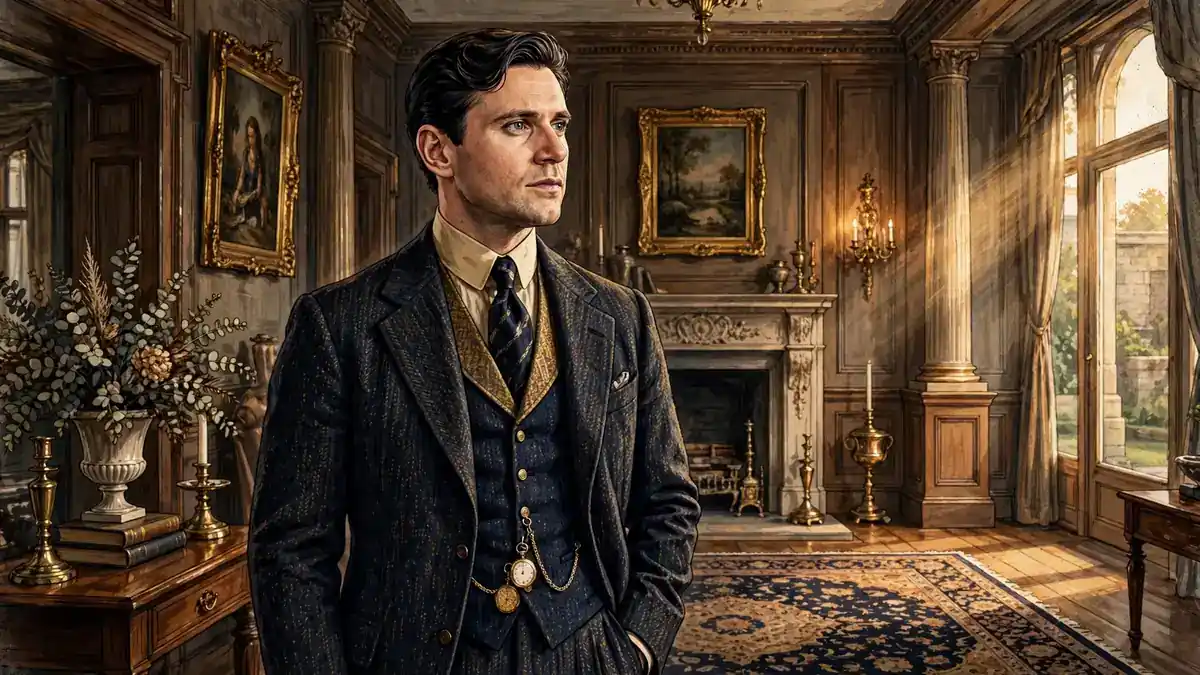
Allen Leech‘s net worth is estimated at $1.2 million to $5 million as of November 2026. Allen Leech built that fortune across 45 episodes of Downton Abbey as Tom Branson, a supporting turn in the $910.8 million hit Bohemian Rhapsody, and a steady run of film, television and stage work that stretches back to 1998 — capped by a return to the Crawley family in Downton Abbey: The Grand Finale (2025) and a new crime drama, The Westies, in 2026.
Allen Leech: Quick Facts
| Estimated net worth | $1.2 million–$5 million (range: $1.2 million–$5 million; most repeated estimate: about $5 million) |
|---|---|
| Profession | Actor (television, film, stage, voice) |
| Nationality | Irish |
| Born | 18 May 1981, Killiney, County Dublin, Ireland (age 45) |
| Height | About 5ft 9in (1.75m), as commonly listed — no first-hand source confirms it |
| Primary income sources | Television series fees, film roles, stage work, voice acting, producing |
| Active years | 1998–present |
| Last reviewed | November 2026 |
- Early Life and Background
- Education
- Career Journey
- Rise to Fame
- Main Sources of Income
- Salary and Earnings
- Businesses and Investments
- Brand Deals and Sponsorships
- Houses, Cars and Other Assets
- Awards and Achievements
- Net Worth Growth Over the Years
- Social Media Presence
- Personal Life
- Sources & Reporting
- Frequently Asked Questions
Early Life and Background
Allen Leech was born Alan Leech on 18 May 1981 in Killiney, a coastal suburb south of Dublin in County Dublin, Ireland. He is the third of four children of David Leech, the chief executive of a computer systems company, and Kay Leech. His older brother is Greg, his older sister is Alli, and his younger brother is Simon. The family home sat in comfortable, professional-class Dublin — far from the world of chauffeurs and country houses he would later play on screen, and far from the financial strain that shapes many actors’ early years.
Leech attended St Michael’s College, a voluntary Catholic boys’ school in Dublin. Acting found him at 11, when he was cast as the Cowardly Lion in a school production of The Wizard of Oz. He has said the experience fixed his course: on the last night of the run, Irish actor Peter McDonald told him acting was a profession, not just a school activity, and Leech decided on the spot that it was what he wanted to do. Drama became the centre of his teenage years. He has spoken openly about leaning on drama and family support to get through school, and about being bullied as a child — a detail he has discussed in interviews with the Sydney Morning Herald and Irish press, and one that makes his later poise on red carpets look less like polish and more like practice.
Killiney mattered in another way. Dublin’s theatre world was close at hand, and Leech went after it early. He asked Dublin’s Gate Theatre for work experience as a teenager and spent time backstage learning how a professional production ran. That initiative paid off faster than anyone expected: at 16, still at school, he was cast in the Gate’s 1998 production of A Streetcar Named Desire as the Gentleman Caller opposite Frances McDormand’s Blanche DuBois. He has told the story since with a schoolboy’s awe intact — the Coen brothers walking backstage while he, a naive 16-year-old, tried to look like he belonged there. A first professional credit opposite an Oscar winner, before he had finished school, set a pattern: Leech kept landing rooms that were bigger than his CV.
One fact worth clearing up early: the name. He was born Alan Leech and worked under that name in his earliest credits, including that Gate debut. Allen Leech is the professional name he performs under, and it is the name every casting list, credit roll and rich list uses now.
Education
Leech matriculated from St Michael’s in 1999 and enrolled at Trinity College Dublin, where he studied Drama and Theatre Studies. He left with both a Bachelor of Arts and a Master’s degree in the subject — a combination that took him through 2005, by some accounts, with the BA completed in 2003. His parents had made a degree a condition of letting him chase acting; Leech later called the Trinity route a “loophole” in that deal, since it let him study the thing he wanted to do for a living while still handing his parents a degree to fall back on.
Trinity was less a classroom than a launch pad. Leech has admitted he did little schoolwork because his time went to auditions and acting jobs, and the record backs him up: he landed his first major screen roles, Cowboys & Angels and Man About Dog, while still a student, and worked at Dublin’s Abbey Theatre and the Gate through his university years. In an interview with uInterview he put it plainly — the whole time at Trinity he was working outside at the national theatre and the Gate, and out of that came a couple of movie roles, then HBO’s Rome, then steady work in the UK.
That dual track — formal training in drama theory and text alongside paid stage work from his teens — explains a lot about the actor Leech became. He arrived on a television set already knowing how a rehearsal room worked, how to hold a stage, and how to take direction from theatre directors. It also explains his range: the same training that let him play a 1920s Irish socialist chauffeur also carried him through Shakespeare-adjacent classical work at the Abbey, a Los Angeles stage run in Constellations in 2017, and voice work in two of the biggest video game franchises of the 2010s. Few actors in the Downton cast had that much stage mileage before television found them, and it shows in how long Leech has stayed employed — 27 years and counting, with no visible gap in the credits.
Career Journey
Leech’s screen career began in Irish film. His first major film role was Vincent Cusack, a gay fashion student, in Cowboys & Angels (2003), a small Irish comedy-drama that earned him a Best New Talent nomination at the Irish Film & Television Awards in 2004. A year later he played Mo Chara in Man About Dog (2004), a cross-country caper film that brought a second IFTA nomination. Neither film made him rich — Irish independent film in the early 2000s paid modest fees — but both put him on casting directors’ lists, and both showed a willingness to take roles other young actors might have dodged. Vincent Cusack, in particular, was a part that asked a 21-year-old from Killiney to carry a film about sexuality and identity; he carried it.
Irish television followed. He played Shane Kirwan in RTÉ’s Love Is the Drug (2004), earning a Best Actor nomination at the IFTAs in 2005, then Willy in Legend (2006), a series about three Irish families, which brought a Best Supporting Actor nomination in 2007. Three IFTA nominations before his 26th birthday, across film and television, marked him out as one of Ireland’s most reliable young actors — the kind of performer producers call when they need a scene to land without fuss.
The step up came in 2007, when HBO cast him as Marcus Agrippa in the second series of Rome. Agrippa was Octavian’s top soldier and closest friend, a role that put Leech on an American prestige set for eight episodes and introduced him to audiences outside Ireland and Britain. HBO money in 2007 was a different order from RTÉ money, and Rome — famously one of the most expensive series ever made at the time — paid its supporting cast accordingly. Leech has said the job opened the UK market to him: after Rome, the work kept coming from London.
The next three years filled in the CV. He played Francis Dereham, the doomed former lover of Catherine Howard, in the fourth series of The Tudors (2010), appearing in three episodes. He turned up as Officer Sam Leonard in Primeval (2011) and as Pike in the first episode of Black Mirror, “The National Anthem” (2011) — a small part in a series that would become a cultural landmark, and a credit that still gets cited whenever his filmography is discussed. Film work ran alongside: Rewind (2010), which opened in Ireland in March 2011; The Sweeney (2012), the film version of the 1970s police series, where he played DC Simon Ellis; and a pair of 2013 thrillers, Grand Piano and In Fear.
Stage never left the picture. After early work at the Abbey and the Gate, Leech played Hippolytus in Phaedra at Dublin’s Project Arts Centre in 2010 and Mick in Ecstasy at London’s Hampstead Theatre and the Duchess Theatre in 2011. In 2017 he crossed the Atlantic for Constellations at the Geffen Playhouse in Los Angeles, playing Roland opposite Ginnifer Goodwin from 14 June to 23 July 2017. Stage pay in London and Los Angeles sits well below television money — a West End or Geffen run pays a weekly salary, not a windfall — but it kept his craft sharp and his name in front of theatre audiences and casting directors who matter for the next screen job. For an actor whose fortune rests on longevity rather than one payday, that trade was sound.
Two supporting film roles in the mid-2010s raised his profile further. In The Imitation Game (2014) he played John Cairncross, the spy inside Bletchley Park, alongside Benedict Cumberbatch’s Alan Turing. The film grossed more than $230 million worldwide and won the Academy Award for Best Adapted Screenplay, and its ensemble — Leech included — was nominated for Outstanding Performance by a Cast at the Screen Actors Guild Awards and for Best Acting Ensemble at the Critics’ Choice Awards. A year later, The Hunter’s Prayer (2017) gave him a leading-man action role as Richard Addison. Neither part made him a star on its own. Together with Downton, they made him impossible to ignore.
Voice work added a quieter income stream. Leech voiced Thomas Hickey in Assassin’s Creed III (2012) and Hjalmar an Craite in the English version of The Witcher 3: Wild Hunt (2015) — two of the biggest-selling games of their era, with The Witcher 3 alone selling tens of millions of copies. Game voice fees for a supporting role are a single session payment plus, in some cases, residuals; they will not match a television series fee, but they are real money for a few days’ work, and they reach an audience that never watches period drama.
Rise to Fame
Everything changed in 2010, when ITV cast Leech as Tom Branson in Downton Abbey. Branson arrived as the Crawleys’ chauffeur — an Irish socialist and republican whose politics clashed with everything the house stood for — and stayed to become one of the series’ emotional anchors. Over six series and 45 episodes, Tom married Lady Sybil, lost her in childbirth, raised their daughter Sybbie, married again to Lucy Smith, and ended the run as the estate’s manager and the family’s bridge to the modern world. It was the kind of long arc television rarely hands a supporting player, and Leech played every stage of it without ever tipping into caricature.
The show’s scale is the key to understanding Leech’s finances. Downton Abbey became a global hit, broadcast in more than 200 territories, and its cast became famous in countries they had never visited. Fame on that scale changes an actor’s fee for every job after it: a supporting player in a hit series can ask for more on the next film, more for a stage run, more for a voice session, because producers know the name on the poster pulls an audience. Leech’s career after 2010 shows that effect in action — The Imitation Game, Bohemian Rhapsody, Bellevue, The Vanishing Triangle, The Westies — a run of work that would have been far harder to land without Tom Branson on the CV.
The ensemble’s awards tell the same story. The Downton Abbey cast won the Screen Actors Guild Award for Outstanding Performance by an Ensemble in a Drama Series in 2013, 2015 and 2016, with nominations in the intervening years. SAG ensemble wins do not come with a cheque, but they come with negotiating power: an actor who can put “SAG Award winner” on a CV bargains from a stronger chair. Leech’s co-star Laura Carmichael, whose own Downton fortune we estimate at $2 million to $3 million, followed a similar path from the same ensemble — the show lifted the whole cast’s earning power, not just its leads.
Leech has spoken about nearly walking away from the show after Lady Sybil’s death in series three, when Tom’s story could easily have ended with him leaving the house. He stayed, and the decision paid off in story and in money: Tom became a series regular through all six series, then returned for all three feature films. Downton Abbey (2019), Downton Abbey: A New Era (2022) and Downton Abbey: The Grand Finale (2025) each brought a film fee, a press tour and a fresh round of residuals — and the 2025 finale, which grossed $103.5 million worldwide on its cinema run, closed the franchise on a high. Tom Branson’s final scenes, as the widower who became the family’s steady hand, gave Leech a farewell lap that few television characters get.
The film that did the most for his bankability outside Downton was Bohemian Rhapsody (2018). Leech played Paul Prenter, Freddie Mercury’s personal manager and lover — the man the film casts as the villain of Mercury’s story, the “Judas” who pulled him away from the band. It was a supporting role in a film that grossed $910.8 million worldwide on a $50–55 million budget, becoming the sixth-highest-grossing film of 2018 and the highest-grossing biopic of its time. A supporting player does not take home a share of $910 million; film salaries are fixed fees agreed before release, and backend points are reserved for stars and producers. But a credit on a $910 million film changes what an actor can ask for next, and the cast — Leech included — was nominated for Outstanding Performance by a Cast in a Motion Picture at the 25th Screen Actors Guild Awards in 2019.
Recent work keeps the run going. He starred with India Mullen in the crime drama The Vanishing Triangle (2023), where he also served as executive producer, and in the 2024 thriller Too Good to Be True, again as executive producer. He played Greg Roddy in the 2025 television film Bulldozer, and in 2026 he appears as Brendan Cahill in The Westies, MGM+’s crime drama about the real-life Irish-American gang that ruled Hell’s Kitchen in the 1980s, created by Narcos creator Chris Brancato and co-starring J.K. Simmons. The part is a deliberate break from Tom Branson — a gang enforcer rather than a chauffeur — and it is exactly the kind of against-type casting that a long television run makes possible.
Main Sources of Income
Leech’s income comes from five streams, and television is the largest of them. A six-series run on a hit drama, plus three feature films, plus later series leads in Bellevue (2017), The Vanishing Triangle (2023) and Too Good to Be True (2024), is the backbone of his fortune. British television pays supporting cast per episode, with fees rising series by series as a show succeeds; a regular on a hit ITV drama in the 2010s could expect low-to-mid five figures per episode in sterling by the later series, before residuals. No contract for Leech’s Downton fee has been published, so we do not state a per-episode figure as fact — but 45 episodes across six series, plus three films, is the volume that turns good fees into a multi-million-pound career.
Film is the second stream. His roles have mostly been supporting — Prenter in Bohemian Rhapsody, Cairncross in The Imitation Game, Ellis in The Sweeney — and supporting film fees for a British character actor run to low six figures per picture, sometimes more when the film is a studio production. The exception, The Hunter’s Prayer (2017), gave him a lead role and a lead’s fee. The arithmetic of his film career is less about any single cheque than about the company he kept: two films that grossed a combined $1.1 billion-plus worldwide put his name in front of every casting director in Hollywood.
Stage is the third stream, and the smallest in cash terms. A Geffen Playhouse run or a Hampstead Theatre production pays a weekly wage that covers a comfortable life in London or Los Angeles for a few months, not a fortune. Its value to Leech has always been reputational — the work that keeps an actor’s instrument tuned and reminds the industry he can do more than one thing.
Voice acting is the fourth. Assassin’s Creed III and The Witcher 3 are session-fee jobs, but they are session fees from two of the largest franchises in gaming, and they pay residuals in some territories. It is a stream most net-worth profiles of Leech ignore entirely, and it is one more reason his income has been steadier than a film-only career would be.
Producing is the fifth, and the newest. Executive producer credits on The Vanishing Triangle and Too Good to Be True mean Leech now earns a producer’s fee on top of his acting fee, and in some deals a share of the project’s backend. Producing is also how mid-career actors protect themselves against the day the phone stops ringing for acting roles: it turns a performer into someone who can generate work, not just take it. If Leech’s fortune grows in the next five years, producing is the likeliest reason.
What is missing from the list is as telling as what is in it. Leech has no public record of a production company, a fashion label, a restaurant, a property portfolio or a tech investment. He has not fronted a brand campaign, launched a product line or bought into a business that the press has reported. His fortune is, by every available account, an actor’s fortune — fees, residuals and producer credits, saved over 27 years, rather than a business empire built on the side.
Salary and Earnings
Here is the honest position: no reliable source has published Allen Leech’s salary for any single role. No Downton Abbey contract has leaked, no Bohemian Rhapsody pay deal has been reported, and Leech himself has never discussed his fees in an interview. Any article that states a precise per-episode figure for him is guessing, and this one will not.
What can be said with confidence is how the money works for an actor in his position. British television pays per episode, and fees rise with each series as a show proves itself. A supporting regular on a hit ITV drama would start on a modest fee in series one and renegotiate upward as the show’s audience grows; by series five and six, the same actor’s per-episode fee can be several times the starting rate. Across 45 episodes, that curve is where the money accumulates. Film fees work differently: a fixed fee agreed before shooting, with no share of the box office unless the actor has negotiated backend points, which supporting players almost never get. Leech’s Bohemian Rhapsody fee was agreed before anyone knew the film would gross $910.8 million — he was paid as a supporting actor in a $50 million biopic, not as a partner in a billion-dollar hit.
Residuals are the quiet earner. Every time Downton Abbey is re-run, streamed or sold to a new territory, the cast earns residual payments under their union agreements. A show that has run for 15 years across more than 200 territories generates residuals long after the cameras stop — and Downton, which is still streaming and still selling, is one of the most residual-friendly shows of its era. The same applies to Bohemian Rhapsody and The Imitation Game on streaming and television. These payments are individually small and collectively large, and they are a major reason a working actor’s net worth can keep growing in years when he shoots nothing new.
Two claims about Leech’s earnings deserve to be named and set aside. The first is a content-farm article that puts his annual income at £200,000 before Downton’s peak, £500,000 during it and £700,000 after it — figures with no source, no contract and no outlet behind them, contradicted by the same page’s own numbers. The second is a site that charts his wealth rising from $5 million in 2022 to $15 million in 2025, driven by “endorsement deals”, “a production company” and “real estate investments” — none of which any reputable outlet has reported. Both are invented. They are worth naming because they are the reason the range at the top of this article is wide: the internet is full of confident numbers for Leech, and almost none of them have evidence behind them.
A realistic reading of his earnings looks like this. The early years — Irish film and RTÉ television in the 2000s — paid working-actor money: enough to live on in Dublin and London, not enough to build wealth. Rome in 2007 was the first HBO-level payday. Downton, from 2010 to 2015, was the first sustained high income: six years of rising per-episode fees on a global hit. The films of 2018 and 2019, plus the Downton features, added studio fees and a fresh wave of residuals. The 2020s — Bellevue, The Vanishing Triangle, Too Good to Be True, The Grand Finale, The Westies — are the mature phase: a respected actor in his forties, paid as a lead or a senior supporting player, with producer fees on top. That curve supports a fortune in the low single-digit millions, not the $15 million some sites claim and not the $1.2 million that would imply he saved almost nothing from 15 years at the top of British television.
Businesses and Investments
Leech has no known business empire, and that is itself a finding. Some actors turn fame into companies — production houses, drinks brands, property portfolios. Leech, by every public record, has not. There is no Companies House filing in his name for a production company, no reported investment in a start-up, no brand he founded, and no property deal the press has covered. The “production company” and “real estate investments” credited to him by low-quality net-worth sites have no source and should be treated as invented.
What he does have is a producing foothold. Executive producer credits on The Vanishing Triangle (2023) and Too Good to Be True (2024) are the first sign of a move behind the camera. An executive producer credit on a television drama usually means the actor helped develop the project, attached himself to it, and took a producer’s fee and sometimes a share of the backend. It is a modest start, but it is a real one — and it is the most plausible route for his wealth to grow from here. Actors who produce their own work earn twice on the same project and, more importantly, stop depending entirely on other people’s casting decisions.
On investments more broadly, there is nothing to report because there is nothing public to report. Leech has not spoken about property, shares, crypto or any other asset class, and no outlet has documented his holdings. That silence is normal for a British character actor — the actors who talk about their portfolios tend to be the ones selling something — and it is one more reason the honest estimate for Leech is a range, not a single number. A fortune built from fees and residuals, with no visible business assets, is harder to pin down than a fortune built from a company sale, and any site that gives you a precise figure for Leech is pretending to know more than the record allows.
The comparison with his peers sharpens the point. Shirley MacLaine’s Hollywood fortune, which we estimate at $50 million, rests on six decades of leading roles, books and a property history the press has followed for years. Leech, at 45, has had one long hit series and a run of strong supporting film roles. His wealth is a working actor’s wealth, and it should be read that way — steady, substantial, and built job by job rather than deal by deal.
Brand Deals and Sponsorships
Leech has no major endorsement deal on the public record. He has never fronted a fashion campaign, a watch brand, a car marque or a grooming line, and no brand has announced a partnership with him. That is unusual only if you compare him with reality stars and social media actors; for a British character actor of his generation, it is the norm. His commercial value has always been in the work, not in his face on a billboard.
What he does have is a reputation for style that the press has noticed. U Magazine voted him sexiest Irish male in 2005, and GQ named him one of the 50 best dressed men in Britain in 2015. Those are editorial honours, not paid deals, but they matter commercially: a best-dressed listing puts an actor on the radar of stylists, photographers and the fashion press, and it feeds the red-carpet economy that keeps a working actor visible between jobs. Leech’s red-carpet appearances — the 2025 Grand Finale premieres in London and New York, the SAG Awards, the Geffen opening nights — are part of that economy, and they cost him nothing but a suit.
His booking agency listing with MN2S, a talent agency that handles commercial appearances and speaking engagements, shows the one commercial channel he does use: paid appearances and corporate work through an agent, priced by the booking rather than by a campaign. It is the kind of work that pays well for a day and leaves no public trace — no press release, no campaign, no figure to add to a net-worth table. For the purposes of this estimate, brand and appearance income is real but small next to his acting fees, and we have not added a separate endorsement figure to the range.
The absence of brand deals is also a clue about his priorities. Leech has kept his public life narrow — acting, premieres, the occasional interview — and has not chased the influencer economy that many actors half his age now depend on. That choice has probably cost him money in the short term and saved him reputation in the long term. A Downton actor selling protein powder would have been a strange sight; Leech, to his credit, never tried it.
Houses, Cars and Other Assets
There is no public record of a house, car or asset that Allen Leech owns, and this section says so plainly rather than inventing one. No property record, no Land Registry entry, no “inside his $X million mansion” feature has been published about him, and the sites that describe his home in detail are describing a home they have never seen. Leech and his wife keep their domestic life private, and the press has respected that — there are no paparazzi house tours, no estate-agent listings tied to his name, and no car collection stories.
What is known is the shape of his life, not its address. He lived in London for 12 years before moving to Los Angeles, a move reported in his biographical profiles and consistent with his work pattern: Constellations at the Geffen in 2017, then a run of American and international projects, then the Los Angeles base from which he and his wife raise two daughters. Los Angeles is where the work is for an actor of his standing, and it is also where the costs are: a family home in Los Angeles, even a modest one by Hollywood standards, is a major asset and a major expense, and it is the single biggest item in most actors’ balance sheets. Without a public record, we do not put a figure on it.
On cars, the only honest statement is the on-screen one: Tom Branson drove the Crawleys’ motor cars, and Leech drove them convincingly. His own garage is not a matter of public record, and we will not fill the gap with a luxury car list. The same applies to watches, art and other collectibles — none have been reported, and none are claimed here.
That absence is worth a sentence of context. Net-worth articles that list a celebrity’s house and cars in loving detail are usually copying each other, and the figures rarely survive a check. For Leech, the verifiable assets are the ones that matter to the estimate: 27 years of fees and residuals, a Los Angeles family life, and a career that is still paying. A house he may or may not own does not change the range at the top of this article, and inventing one would.
Awards and Achievements
Leech’s trophy record is an ensemble record, and that suits his career. His individual nominations came early: Best New Talent at the Irish Film & Television Awards in 2004 for Cowboys & Angels, Best Actor in Television in 2005 for Love Is the Drug, and Best Supporting Actor in Television in 2007 for Legend. Three nominations before 26, none of them wins, but each of them a marker that the Irish industry rated him among its best young actors.
The wins came with Downton. The cast won the Screen Actors Guild Award for Outstanding Performance by an Ensemble in a Drama Series in 2013, 2015 and 2016, with nominations in 2014 as well. Those are peer-voted awards from the actors’ own union, and they carry weight in casting rooms that a critics’ prize does not. Leech was also part of the ensemble nominated for Outstanding Performance by a Cast in a Motion Picture for The Imitation Game in 2015, and for Bohemian Rhapsody in 2019, with a Critics’ Choice Best Acting Ensemble nomination for The Imitation Game in the same year.
Two honours outside the awards circuit round out the picture. U Magazine‘s sexiest Irish male in 2005 was a popularity prize, but it marked his arrival as a public figure in Ireland. GQ‘s 50 best dressed men in Britain in 2015 marked his arrival as a public figure in London. Neither pays a fee, but both are the kind of recognition that keeps an actor’s name in circulation between jobs — and circulation, for a working actor, is a form of wealth.
The achievement that matters most to the estimate, though, is not a trophy. It is the run itself: 45 episodes of a global hit, three feature films from the same franchise, a $910.8 million film, a $230 million-plus film, two of the biggest video games ever made, and a new series lead in 2026 at the age of 45. Very few actors sustain that level of employment for 27 years. The awards are the decoration; the employment record is the fortune.
Net Worth Growth Over the Years
The table below is an editorial estimate, built from the career milestones in this article — not from published totals, because none exist. Each figure is a range, and each range widens where the record thins. Read it as a shape, not a bank statement.
| Year | Estimated net worth | What changed |
|---|---|---|
| 2003 | $50,000–$150,000 | First major film role in Cowboys & Angels; IFTA nomination |
| 2007 | $200,000–$400,000 | Rome on HBO; first American prestige pay |
| 2010 | $300,000–$600,000 | Cast as Tom Branson in Downton Abbey |
| 2015 | $800,000–$1.5 million | Six series of Downton complete; three SAG ensemble wins |
| 2018 | $1.2 million–$3 million | Bohemian Rhapsody grosses $910.8 million; SAG cast nomination |
| 2022 | $1.2 million–$5 million | Downton Abbey: A New Era; producing credits begin |
| 2026 | $1.2 million–$5 million | The Grand Finale (2025) and The Westies (2026) keep fees and residuals flowing |
Three things stand out. First, the growth is slow and then steady — no sudden jump, no lottery win, no single deal that doubled his money. Second, the range widens after 2015 because that is when the public sources start disagreeing: Celebrity Net Worth’s $1.2 million figure dates from the Downton era and has not visibly moved since, while the $5 million figure appears in later profiles and has been repeated since 2023. Third, the top of the range has not moved since 2022, and that is honest: nothing in Leech’s public career since then — a supporting film role, two television leads, a producer credit — suggests a doubling of wealth, and the sites that show his fortune tripling to $15 million in the same period are showing their own invention, not his career.
Peer comparison puts the range in context. The table below uses NetWorthCraft’s own published estimates for the comparison figures, so every number here is one our readers can check on this site.
| Actor | Best known for | Estimated net worth |
|---|---|---|
| Allen Leech | Downton Abbey, Bohemian Rhapsody | $1.2 million–$5 million |
| Laura Carmichael | Downton Abbey (Lady Edith) | $2 million–$3 million |
| Shirley MacLaine | Downton Abbey, six decades of film | $50 million |
| Daniel Radcliffe | Harry Potter | $120 million |
| Emma Watson | Harry Potter, Beauty and the Beast | $85 million |
The gap between Leech and Radcliffe or Watson is the gap between a supporting player and a franchise lead: Radcliffe and Watson carried films that grossed billions, with backend deals to match, while Leech’s biggest hits paid him a supporting fee. The gap between Leech and Carmichael is barely a gap at all — two actors from the same ensemble, on the same pay curve, with fortunes in the same band. And MacLaine’s $50 million is a reminder of what six decades at the top looks like next to one long hit series. Leech’s number is modest by Hollywood standards and substantial by any other measure, and the comparison is the proof.
Social Media Presence
Leech keeps a low profile online, and that is a deliberate choice rather than an accident. He is not a prolific poster, he does not run a personal brand account, and he has never built an audience that he monetises. His public appearances cluster around premieres, press tours and interviews — the 2025 Grand Finale premieres in London and New York, a 2025 interview with People about his youngest daughter’s discovery of his fame — rather than a daily feed.
That restraint has a financial cost and a reputational benefit. An actor with a large following can charge for sponsored posts, and Leech has never played that game, so there is no social media income to add to his fortune. The benefit is that his name, when it appears, appears in connection with work: a premiere, a review, a casting announcement. In an industry where a careless post can cost a job, a quiet feed is a form of career insurance, and Leech has kept his clean for a decade and a half.
For readers looking for him online, the reliable places are the trade press and the official channels for his projects — MGM+ for The Westies, Focus Features for the Downton films — rather than a personal account. Any account claiming to be Leech that solicits money, sells merchandise or asks for personal details should be treated as fake: he has no record of selling anything to fans directly.
Personal Life
Leech married American actress Jessica Blair Herman on 5 January 2019, in an outdoor ceremony at the Alisal Ranch and Resort in Solvang, California. They had met three years earlier on a dance floor at an Entertainment Weekly SAG Awards afterparty, and announced their engagement in February 2018. The wedding guest list read like a cast reunion: his Downton Abbey co-stars Michelle Dockery and Dan Stevens, and his Bohemian Rhapsody co-stars Rami Malek, Gwilym Lee and Lucy Boynton were all there.
Herman is an actress and producer in her own right, best known for playing Kim Goldman in American Crime Story, with credits across How I Met Your Mother, Modern Family, New Girl and 9-1-1. The couple have two daughters: their first was born in 2020, announced in September 2019, and their second arrived in 2022, announced at the Downton Abbey: A New Era premiere in April 2022. The girls’ names have not been made public, and Leech and Herman keep them out of the spotlight — a decision that has held through two film premieres and a press tour.
One story from 2025 shows how the family handles fame. In an interview with People around The Grand Finale, Leech and Herman described their younger daughter, born in late 2022, recognising her father’s face on Downton-themed bus stops around Los Angeles and asking to be taken to Downton Abbey itself. The elder daughter had already visited the set during filming of the first Downton film; the younger one, Herman said, would get her turn. It is a small, human detail, and it is the closest Leech has come to letting the public inside his family life.
Before Herman, Leech was reported to have been in a relationship with television presenter Charlie Webster, though he has never discussed past relationships in detail and the record is thin. Since the marriage, his personal life has been notably quiet: no tabloid drama, no public rows, no second act in the gossip columns. He has also spoken about the harder parts of his past, including being bullied as a child, with a candour that sits oddly with the polished image of a period-drama star — and that is probably the point. The man who played a socialist chauffeur in a house full of aristocrats has never pretended to be one of them.
Leech’s family background is worth a line too. His father, David, ran a computer systems company; his mother, Kay, kept the household. He is the third of four children, with an older brother Greg, an older sister Alli and a younger brother Simon. None of his siblings is a public figure, and Leech has kept them out of his press coverage — another boundary, held for 27 years.
Sources & Reporting
Wikipedia — biographical spine of this article: birth date and place, family, education at Trinity College Dublin, Gate Theatre debut in 1998, full filmography and television credits, SAG and IFTA awards record, marriage and children. Cross-checked against the outlets below wherever a figure or date was in dispute.
Biography Tribune — the $5 million estimate, the August 2023 reporting window, height as commonly listed (5ft 9in / 1.75m), marriage date and venue, and the two daughters. Treated as a secondary source: its figure is repeated, not verified, and is shown here as the top of the range, not as a fact.
Celebrity Net Worth — the $1.2 million figure, as carried by TheRichest’s Downton Abbey cast ranking. Treated as the bottom of the range; the figure appears to date from the Downton era and has not been updated in the sources that cite it.
Limerick Time — August 2026 profile that states plainly that no verified net-worth total is public, and that precise figures on celebrity sites lack financial evidence. Its scepticism shaped the range published here, and its reporting on Leech’s age, family and recent work was used for the 2026 freshness check.
People — the 2025 interview with Leech and Herman about their younger daughter recognising his face on Downton bus stops in Los Angeles, the New York premiere of The Grand Finale on 8 September 2025, and the announcement of the second pregnancy at the A New Era premiere in April 2022.
Hello! magazine — Leech joining the cast of The Westies as Brendan Cahill, the MGM+ crime drama from Narcos creator Chris Brancato, and the 2026 series context.
Rotten Tomatoes — filmography and career timeline, including Downton Abbey: The Grand Finale (2025), Bulldozer (2025) and The Westies (2026).
GQ — 50 best dressed men in Britain, 2015. SAG Awards — ensemble wins for Downton Abbey (2013, 2015, 2016) and cast nominations for The Imitation Game and Bohemian Rhapsody.
Wikipedia (Bohemian Rhapsody) — $910.8 million worldwide gross on a $50–55 million budget, and the $103.5 million worldwide gross for Downton Abbey: The Grand Finale. Box-office figures are reported grosses, not money paid to any actor.
Reporting window: career facts checked against sources published or updated between 2023 and November 2026, with the freshest material — The Grand Finale (September 2025) and The Westies (2026) — drawn from 2025–2026 coverage. Where sources disagreed on money, this article publishes the range and names who says what. No salary, property value or business holding in this article rests on a single weak source.
Frequently Asked Questions
What is Allen Leech’s net worth in 2026?
Allen Leech’s net worth is estimated at $1.2 million to $5 million as of November 2026. No verified total is public. The $1.2 million figure comes from Celebrity Net Worth, while about $5 million is the figure repeated by Biography Tribune and Celebrity Birthdays. We publish the range because the sources disagree and neither shows its working.
How much did Allen Leech earn per episode of Downton Abbey?
No reliable source has published his per-episode salary, and no Downton contract has leaked. British television pays supporting cast per episode with fees rising series by series, and Leech appeared in 45 episodes across six series plus three feature films, so the role was his largest single source of income — but any precise per-episode figure you see online is a guess.
Who is Allen Leech’s wife?
Allen Leech is married to American actress Jessica Blair Herman. They met at an Entertainment Weekly SAG Awards afterparty in 2016, announced their engagement in February 2018, and married on 5 January 2019 at the Alisal Ranch and Resort in Solvang, California. Herman is best known for playing Kim Goldman in American Crime Story.
Does Allen Leech have children?
Yes. Allen Leech and Jessica Blair Herman have two daughters, born in 2020 and 2022. The couple have not made the girls’ names public and keep them out of the spotlight.
How old is Allen Leech?
Allen Leech was born on 18 May 1981 in Killiney, County Dublin, Ireland, which makes him 45 years old as of November 2026. He was born Alan Leech and performs under the name Allen Leech.
How tall is Allen Leech?
Allen Leech is commonly listed at about 5ft 9in (1.75m) tall. No first-hand source confirms the figure, and different sites list different heights, so treat it as a commonly repeated listing rather than a verified measurement.
What is Allen Leech doing now?
Allen Leech returned as Tom Branson in Downton Abbey: The Grand Finale, released in cinemas on 12 September 2025, and in 2026 he plays Brendan Cahill in The Westies, MGM+’s crime drama about the Irish-American gang that ruled Hell’s Kitchen in the 1980s. He also played Greg Roddy in the 2025 television film Bulldozer.
Who did Allen Leech play in Bohemian Rhapsody?
Allen Leech played Paul Prenter, Freddie Mercury’s personal manager and lover, in Bohemian Rhapsody (2018). The film grossed $910.8 million worldwide, and its cast — Leech included — was nominated for Outstanding Performance by a Cast in a Motion Picture at the 25th Screen Actors Guild Awards in 2019.
Final Thoughts
Allen Leech’s fortune is a working actor’s fortune, and it deserves to be read as one. The range at the top of this article — $1.2 million to $5 million — is wide because the public record is thin, and any site that gives you a single precise number for Leech is selling certainty it does not have. What the record does show, clearly, is 27 years of steady employment: a Gate Theatre debut at 16, three IFTA nominations before 26, HBO’s Rome, 45 episodes of a global hit, a $910.8 million film, three SAG ensemble wins, and a new series lead at 45. That is not a lottery ticket. It is a career built job by job, fee by fee, residual by residual — and it is still going, with The Westies in 2026 and producer credits that point to a second act behind the camera. The chauffeur who married into the Crawley family turned out to be the most durable investment Leech ever made: the role that paid him for six series, three films and fifteen years of residuals, and the role that will keep paying him for years after the cameras stop.
Published on 2026-11-23. Last reviewed November 2026. Found an error? See our corrections policy.