
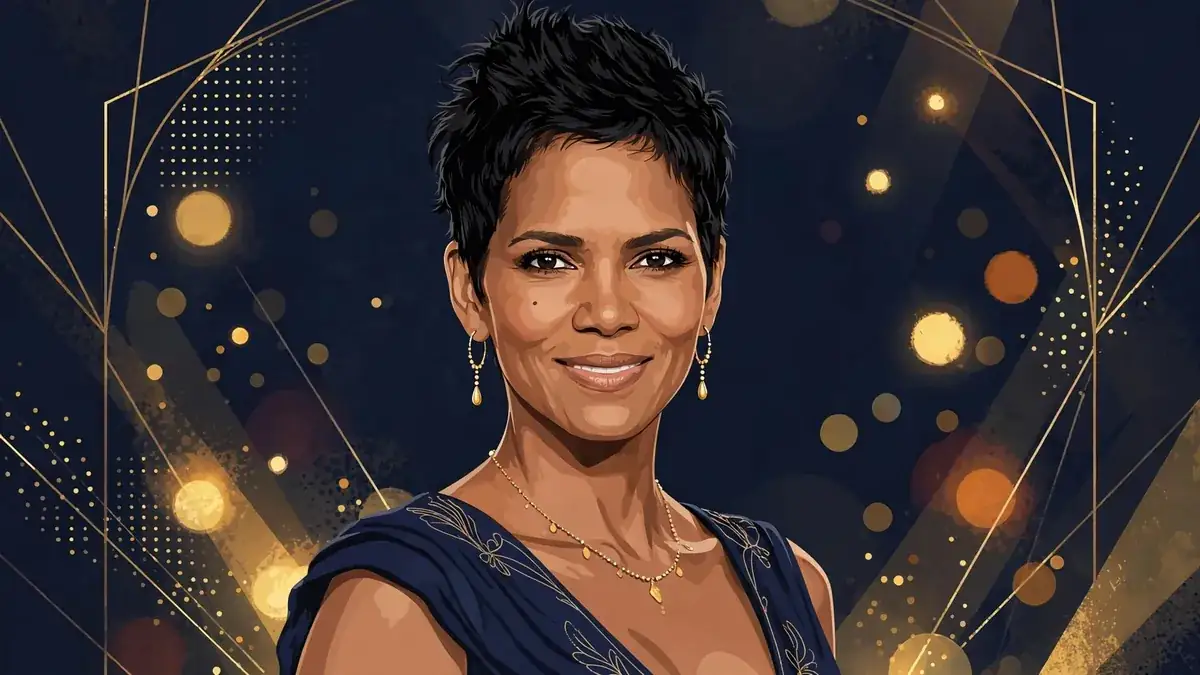
Halle Berry‘s net worth is estimated at $90 million to $100 million as of November 2026. The range exists because the two most-cited sources moved apart this year: Celebrity Net Worth raised its figure to $100 million in a November 2026 update, while Parade held its January 2026 estimate at $90 million. Behind the number sits one of the longest money stories in Hollywood — a $14 million Catwoman payday, an Academy Award that doubled her endorsement rate overnight, a Revlon partnership that has run since 1996, and a Hollywood Hills estate she listed for just under $12 million in October 2026.
Halle Berry: Quick Facts
| Estimated net worth | $90 million–$100 million (range: $90 million–$100 million) |
|---|---|
| Profession | Actress, director, producer, former model |
| Nationality | American |
| Born | August 14, 1966 (age 60) |
| Height | 5 ft 5 in (1.65 m) |
| Primary income sources | Film salaries, Revlon endorsement, producing and directing, fragrance line, real estate |
| Active years | 1986–present |
| Last reviewed | November 2026 |
- Early Life and Background
- Education
- Career Journey
- Rise to Fame
- Main Sources of Income
- Salary and Earnings
- Businesses and Investments
- Brand Deals and Sponsorships
- Houses, Cars and Other Assets
- Awards and Achievements
- Net Worth Growth Over the Years
- Social Media Presence
- Personal Life
- Sources & Reporting
- Frequently Asked Questions
Early Life and Background
Halle Maria Berry was born on August 14, 1966, in Cleveland, Ohio. Her mother, Judith Ann Hawkins, worked as a psychiatric nurse. Her father, Jerome Jesse Berry, worked as a hospital attendant. Her parents divorced when she was four years old, and her mother raised Halle and her older sister Heidi in the Cleveland suburb of Oakwood, Ohio. Berry has spoken openly about growing up biracial in a mostly white neighborhood, and about a childhood shaped by her mother’s long nursing shifts and by the distance from her father, who died in 2003.
The money story starts earlier than most people realize. Berry did not come from wealth, and her first brush with paid work in the public eye came through beauty pageants, which paid in prizes, exposure, and modeling contracts rather than salaries. In 1985 she won Miss Teen All American. In 1986 she won Miss Ohio USA and finished as first runner-up at Miss USA, then represented the United States at Miss World 1986. Pageants gave her a national profile before she had a single acting credit, and modeling work followed. She has described those years as the moment she learned that her image had commercial value — a lesson that later turned into the most durable endorsement deal of her career.
What set Berry apart from other pageant-to-Hollywood crossovers was the speed with which she treated acting as a craft rather than a side job. She moved to New York in 1989 with little money and worked as a model while auditioning. She has said she slept in a homeless shelter for a short stretch during that period after her money ran out, a detail that still frames how she talks about financial security: she has spent a career building income that does not depend on any single film.
Education
Berry attended Bedford High School in Bedford, Ohio, where she was an honor student, a cheerleader, and prom queen, and edited the school newspaper. After graduating, she enrolled at Cuyahoga Community College in Cleveland to study broadcast journalism. She left before finishing the degree when modeling and pageant work began paying, and acting took over. She has never hidden the incomplete degree, and it matters to the financial story in one respect: unlike actors who arrive in Hollywood with family money or a university safety net, Berry’s early career had no fallback. Every paycheck in the late 1980s and early 1990s went toward staying in the business.
Career Journey
Berry’s first television role came in 1989, in the ABC sitcom Living Dolls, a short-lived spin-off of Who’s the Boss?. She followed it with a recurring role on the prime-time soap Knots Landing in 1991. Her film debut arrived the same year, as Vivian in Spike Lee’s Jungle Fever — a small, raw part as a crack addict that showed casting directors she would take risks other former models would not. Strictly Business and Boomerang, both in 1992, kept her visible, and The Flintstones in 1994 put her in a family blockbuster as Sharon Stone.
The mid-1990s built her range and her rate. Losing Isaiah (1995) gave her a dramatic lead opposite Jessica Lange. Executive Decision (1996), alongside Kurt Russell and Steven Seagal, delivered her first seven-figure film paycheck — $1 million, as reported by Celebrity Net Worth — and proved she could hold her own in an action ensemble. The same year she signed with Revlon, a deal that would quietly become the spine of her fortune. Introducing Dorothy Dandridge, the 1999 HBO film in which she played the pioneering Black actress, won her an Emmy and a Golden Globe and marked her as a producer with taste: she had fought to get the project made.
From 2000 onward, Berry worked at the top of the studio system. She played Storm in X-Men (2000) and returned for X2 (2003), X-Men: The Last Stand (2006), and X-Men: Days of Future Past (2014). She won the Academy Award for Best Actress for Monster’s Ball in 2002, becoming the first Black woman to win the award — a line that has introduced nearly every profile of her since. She played Jinx in the James Bond film Die Another Day (2002), headlined the thriller Gothika (2003), and took the title role in Catwoman (2004). Later credits include Perfect Stranger (2007), the CBS series Extant (2014–2015), Kingsman: The Golden Circle (2017), John Wick: Chapter 3 – Parabellum (2019), her directorial debut Bruised (2020, released on Netflix in 2021), Moonfall (2022), Never Let Go (2024), and Crime 101, released on February 13, 2026, in which she plays insurance broker Sharon Combs opposite Chris Hemsworth and Mark Ruffalo.
Her production company, 606 Films, founded with producer Elaine Goldsmith-Thomas, has been the vehicle for much of her later work, including Bruised and Never Let Go. The shift from hired actor to producer-director changed the economics of her career: instead of a single salary per film, she now takes producer fees, backend participation, and ownership stakes in the projects she makes.
Rise to Fame
Berry’s rise had three distinct waves, and each one raised her price. The first wave was the pageant-to-modeling pipeline of 1985–1989, which made her face nationally recognizable. The second was the acting breakthrough of 1991–1996, from Jungle Fever to Executive Decision, which turned recognition into a seven-figure salary. The third, and the one that changed her earning power for good, was the Oscar win for Monster’s Ball on March 24, 2002.
The Oscar story itself is a study in financial trade-offs. Berry accepted a reported $600,000 for Monster’s Ball — a steep cut from the $2.5 million she had just earned for Swordfish — because she believed in the part. The gamble paid off in the most literal sense: the very next year she earned $4 million for Die Another Day, then $6 million for Gothika, then a career-high $14 million for Catwoman. Her acceptance speech, in which she honored the Black actresses who had never had the chance to win, became one of the most replayed moments in Oscar history and fixed her name to a piece of film history no paycheck can buy.
The X-Men franchise kept her in the global box-office conversation for fourteen years. X-Men: Days of Future Past (2014) grossed $746 million worldwide, the biggest film of her career by box office, followed by X-Men: The Last Stand at $460 million and Die Another Day at $432 million. Even as Storm’s screen time stayed modest, the franchise gave her the kind of recurring global exposure that keeps endorsement rates high between films — and it explains why her net worth held steady through years when she released little new work.
The comeback chapter began with John Wick: Chapter 3 – Parabellum in 2019, where she played Sofia, an assassin with two Belgian Malinois dogs, after months of firearms and fight training. The film grossed $328 million worldwide and reintroduced her to a younger action audience. She followed it by directing Bruised, playing a disgraced MMA fighter, and by launching her wellness company Respin. At 60, with Crime 101 in cinemas in 2026 and an engagement to musician Van Hunt confirmed in February 2026, she is working as steadily as at any point in the last decade.
Main Sources of Income
Berry’s fortune rests on four pillars, and their balance is what makes her net worth unusually stable for an actress. Film salaries supplied the big lump sums in the 2000s. The Revlon endorsement supplied a steady annual floor for three decades. Producing and directing added fees and ownership in the 2010s and 2020s. Real estate supplied appreciation on two California properties bought in the 2000s. A fragrance line and smaller brand deals added a fifth, smaller stream.
The proportions matter. Celebrity Net Worth’s salary table lists about $38.1 million in reported pay for just seven films between 1996 and 2007 — and Berry has more than 70 screen credits. Her real career earnings from acting are far higher than that table, because most of her salaries were never reported. The Revlon deal, by the same logic, may be the single largest contributor to her wealth: even at a conservative average of $5 million a year over thirty years, the partnership would account for roughly $150 million in gross earnings before tax, agents’ fees, and expenses. That is why the $90 million–$100 million net worth figure is plausible even though her disclosed film pay totals far less: net worth is what remains after three decades of taxes, divorces, child support, and spending, not a running total of paychecks.
Her income today looks different from her income in 2004. She no longer commands $10 million–$14 million per film, and she has said she picks projects for the part rather than the paycheck. The money now comes from a mix of acting fees for films like Crime 101, producer fees through 606 Films, her Respin wellness business, and the Revlon relationship, which she still holds. The pattern is a slow shift from salary to ownership — the same shift that keeps veteran stars wealthy long after their peak per-film rates pass.

Salary and Earnings
The reported salary record for Berry is unusually complete for the 1996–2007 stretch, because Celebrity Net Worth and trade reporting tracked her rise in real time. The figures below come from those reports and should be read as reported salaries, not audited payments.
| Film | Year | Reported salary |
|---|---|---|
| Executive Decision | 1996 | $1,000,000 |
| Swordfish | 2001 | $2,500,000 |
| Monster’s Ball | 2001 | $600,000 |
| Die Another Day | 2002 | $4,000,000 |
| Gothika | 2003 | $6,000,000 |
| Catwoman | 2004 | $14,000,000 |
| Perfect Stranger | 2007 | $10,000,000 |
| Selected total | $38,100,000 |
Three details in that table explain her whole salary arc. First, the Swordfish figure started at $2 million and rose by $500,000 after Warner Bros. paid extra to keep a topless scene Berry had reservations about — a negotiation that shows how much bargaining power a star’s consent carries. Second, the Monster’s Ball pay cut to $600,000 was a deliberate bet on prestige over cash, and it paid for itself many times over in the raises that followed. Third, Catwoman remains her highest reported single-film payday at $14 million, even though the film itself was a box-office disappointment — a reminder that an actor’s salary is locked in before a film opens, and that a flop costs a studio far more than it costs its star.
After Catwoman, Berry commanded $10 million–$12 million per major film through the rest of the 2000s, according to OK Magazine and TheThings, placing her among the best-paid actresses in Hollywood alongside Angelina Jolie, Cameron Diaz, and Jennifer Aniston. Her television work paid on a different scale: she reportedly earned $100,000 per episode for the CBS science-fiction series Extant (2014–2015). Salaries for her later films — John Wick: Chapter 3, Moonfall, Never Let Go, and Crime 101 — have not been publicly reported, which is normal for an actress of her seniority working on a mix of studio and independent productions.
The highest-grossing films of her career, by worldwide box office, are a separate ledger from her salaries, and they explain why studios kept hiring her. X-Men: Days of Future Past took $746 million in 2014, X-Men: The Last Stand took $460 million in 2006, Die Another Day took $432 million in 2002, and John Wick: Chapter 3 – Parabellum took $328 million in 2019. Her films have grossed well over $3 billion worldwide in total, though her personal share of that gross is a small fraction — actors are paid salaries and, sometimes, backend points, not box-office percentages.
Businesses and Investments
Berry’s most important business move was founding 606 Films, her production company, with Elaine Goldsmith-Thomas. The company produced Bruised, which Berry directed and starred in, and Never Let Go. Producing changes the math of an acting career: a producer earns fees on top of an acting salary and keeps a stake in the finished film. Bruised was sold to Netflix, which gave the project a global release without a theatrical gamble. Berry has also developed projects through a second banner, HalleHolly, with reported titles including The President Is Missing and Bad Cop, Bad Cop, though none has yet reached production.
Her highest-profile venture of the 2020s is Respin, a women’s health and wellness company focused on menopause. Berry launched Respin after her own experience of being misdiagnosed during perimenopause, and she has made it a personal cause, advocating for legislation that would direct $275 million in government funding toward menopause research and education. Respin sells coaching memberships reported at roughly $100–$150 a month and partners with health brands. It is an early-stage business, not a proven money-maker, and no public figure exists for its revenue — but it is the venture Berry herself talks about most, and the one she described in a 2026 NPR interview as her “second groove” alongside acting.
Berry is also an investor in Pendulum Therapeutics, a gut-health biotech company, where she serves as Chief Communications Officer. The role combines an equity stake with a public-facing job, a pattern common among celebrity investors who lend their name and audience to a startup. She has also sought outside investors for Respin to fund its growth, which means she is spending her own capital and other people’s money to build the company rather than treating it as a licensing deal.
Her fragrance line, launched with Coty in 2009 with Halle by Halle Berry and followed by scents including Reveal, was a more conventional celebrity business: a licensing arrangement in which she lent her name and image to a product line. Fragrance royalties are a modest income stream next to film pay, but they run for years after launch with little ongoing work.
Brand Deals and Sponsorships
The Revlon deal is the single most important commercial relationship of Berry’s life, and it is also the most misreported. The facts, as far as public reporting can establish them: she signed as a Revlon spokesmodel in 1996 and renewed the contract in 2004. Her starting pay is reported at either $1.5 million or $3 million a year, depending on the source — Wealthy Gorilla cites $1.5 million, while Celebrity Net Worth and OK Magazine cite $3 million. After her Oscar win, she asked for a raise, and her pay rose to $5 million a year. Current estimates put her Revlon earnings at $10 million or more a year.
Here is the honest caveat, and it is one competitors skip: Celebrity Net Worth’s own page now notes that there is not sufficient current evidence to support the claim that she earns more than $10 million a year from Revlon. The $10 million figure is an estimate built on the deal’s history, not a confirmed contract term. What is certain is the duration — thirty years with one brand is almost unheard of in celebrity endorsements, where two- or three-year deals are the norm — and the direction of travel, which has been upward at every renewal.
The Revlon relationship survived the brand’s own troubles, including its 2022 bankruptcy filing, which makes its longevity even more striking. Berry has stayed with Revlon through ownership changes and restructuring, and she remains one of its global ambassadors. She has also worked with Versace, Michael Kors, Coty, Finishing Touch Flawless, and Harry Winston, and in 2026 she added a partnership with the women’s health brand Joylux. None of those deals approaches Revlon in scale or duration.
Why does one endorsement matter so much to a net worth estimate? Because it is the closest thing to a salary Berry has ever had. Film work is lumpy — a $14 million year followed by a quiet year. Revlon paid every year, including the quiet ones. Over thirty years, even at the lower reported figures, the deal likely delivered well over $100 million in gross income. After tax, agent commissions, and expenses, that stream alone could account for a large share of the $90 million–$100 million she is worth today.

Houses, Cars and Other Assets
Berry’s property portfolio is concentrated in California, and 2026 brought the biggest change to it in years. She bought her Malibu beach house in 2004 for $8.5 million. The oceanfront home in the Malibu Cove Colony, with floor-to-ceiling windows, an elevator, and an open-plan design, has likely appreciated well beyond its purchase price after two decades on one of the most expensive stretches of coastline in the United States. She also owns a Canadian vacation home reported to be worth around $1 million.
The Hollywood Hills estate is the headline property. Berry bought the 5,900-square-foot Italianate home on the Sunset Strip in 2006 for $5.995 million. The five-bedroom, six-bathroom property, built in 1926, sits on more than 25,000 square feet of land and includes a guesthouse, a studio, a pool, a spa, a gym, a massage room, a pizza oven, a fire pit, and a meditation garden. In October 2026, TMZ reported that Berry had listed the estate for $11,995,000 — almost exactly double what she paid twenty years earlier. The listing arrived days after her former husband Olivier Martinez sought a temporary restraining order and primary custody of their son Maceo, though no reporting has established a connection between the sale and the custody proceedings. A second, smaller property of 2,274 square feet was also listed earlier in October 2026, after her daughter Nahla left for college.
The estate carries a piece of Hollywood history: it was the site of the Thanksgiving 2012 altercation between Martinez and Berry’s former boyfriend Gabriel Aubry. That history does not appear to have hurt its value — a $12 million asking price on a $6 million purchase is the kind of return that explains why property, not film salaries, is often the quiet engine of a celebrity fortune.
Berry keeps her car collection private, and no reliable reporting attaches specific vehicles or values to her name. She has been photographed in luxury cars over the years, but unlike some celebrities she does not use vehicles as a public status display. Her most valuable assets, beyond property, are her production company, her stake in Respin, and her equity in Pendulum Therapeutics — all of which are illiquid and hard to value from the outside, and all of which the $90 million–$100 million range treats conservatively.
Awards and Achievements
Berry’s awards shelf is headlined by the Academy Award for Best Actress for Monster’s Ball in 2002 — the first ever won by a Black woman in that category, a record that still stands. She won an Emmy Award and a Golden Globe for Introducing Dorothy Dandridge in 1999, and a Screen Actors Guild Award for the same role. She has been nominated for a BAFTA and for multiple Golden Globes, and she has won several NAACP Image Awards across her career.
She also holds a less flattering record that she has turned into a trademark story. For Catwoman she won the Golden Raspberry Award for Worst Actress, and she showed up in person to accept it — holding her Oscar in one hand and the Razzie in the other — and gave a speech parodying her own Oscar acceptance. The moment is still replayed because it showed a star willing to laugh at a failure that cost a studio roughly $100 million. The film grossed about $82 million worldwide against a budget reported near $100 million, making it one of the biggest commercial disappointments of her career. Her $14 million salary, already banked, was untouched by the flop.
Beyond competitive awards, Berry’s achievements include the longevity record itself: a career that has run from 1986 to 2026 without a gap longer than a couple of years, a directing debut at 54, and a business launch at 57. She served as a jury member at the Cannes Film Festival, has been named to numerous most-beautiful and most-influential lists, and in 2026 she joined the Tribeca CHANEL Through Her Lens women’s filmmaker program, mentoring the next generation of directors.
Net Worth Growth Over the Years
No public record tracks Berry’s wealth year by year, so the table below is a reconstruction from reported salaries, contract milestones, and the estimates published at the time. Treat it as an approximate trajectory, not a bank statement.
| Year | Estimated net worth | What moved it |
|---|---|---|
| 1996 | About $2 million | First $1 million film salary; Revlon deal signed |
| 2000 | About $10 million | X-Men franchise begins; Revlon renewals |
| 2002 | About $25 million | Oscar win; $4 million Bond payday; Revlon raise to $5 million a year |
| 2005 | About $45 million | $14 million Catwoman salary; $10 million Perfect Stranger payday |
| 2010 | About $65 million | Steady film work; Malibu property appreciation |
| 2015 | About $80 million | Extant television salary; X-Men: Days of Future Past box office |
| 2020 | About $90 million | Bruised directing debut; Revlon at full rate |
| 2026 | $90 million–$100 million | Crime 101 release; Respin launch; Hollywood Hills listing at $11.995 million |
The shape of that curve is the story. Berry’s wealth grew fastest in the five years after her Oscar, when her film rate quadrupled and her endorsement rate nearly doubled. It grew more slowly in the 2010s, when she worked less and spent more on family life and legal proceedings. It has been roughly flat since 2020 — the $90 million figure has barely moved in public reporting for years, and the $100 million update from Celebrity Net Worth in November 2026 is the first meaningful upward revision in a long time. A flat net worth is not a sign of trouble: it means her spending, taxes, and the roughly $206,000 a year she pays in reported child support have roughly matched her income in recent years.
How does she compare with her peers? The table below uses reported estimates from Celebrity Net Worth and other public sources, all of which carry the same caveats as Berry’s own figure.
| Actress | Reported net worth | Best-known for |
|---|---|---|
| Halle Berry | $90 million–$100 million | Monster’s Ball, X-Men, John Wick 3 |
| Angelina Jolie | About $120 million | Mr. & Mrs. Smith, Maleficent, directing |
| Jennifer Garner | About $80 million | Alias, 13 Going on 30, Once Upon a Farm |
| Keanu Reeves | About $380 million | The Matrix, John Wick franchise |
| Jamie Foxx | About $170 million | Ray, Django Unchained, Collateral |
The comparison puts Berry’s fortune in perspective. She sits below the franchise-leading men and below Angelina Jolie, whose directing and producing career added a second income engine, and above Jennifer Garner, whose fortune was built on a similar mix of acting and business. Her John Wick co-star Keanu Reeves, whose Matrix backend deal is legendary, sits far above them all — a reminder that a single backend participation clause can be worth more than a decade of salaries.
Social Media Presence
Berry uses Instagram as her main public channel, where she has millions of followers and posts a mix of workout videos, family moments, film promotion, and menopause advocacy for Respin. Her account is also where much of her 2026 news has broken: she marked her 60th birthday in August 2026 with photos from a Pacific island getaway with Van Hunt, and she has used the platform to talk about perimenopause, fitness at 60, and her work with the Tribeca CHANEL program. She is less active on X and Facebook, and she does not run a YouTube channel. Unlike many celebrities, she does not appear to monetize her social following through paid posts as a primary income stream — the account works as promotion for her films and her company rather than as a business in itself.
Personal Life
Berry has two children. Her daughter, Nahla Ariela Aubry, was born on March 16, 2008, and her father is the model Gabriel Aubry, Berry’s partner from 2005 to 2010. Her son, Maceo-Robert Martinez, was born on October 5, 2013, and his father is the French actor Olivier Martinez, whom Berry married in 2013 and separated from in 2015. In the fall of 2026, Nahla left home for college in another state, a milestone Berry discussed publicly at a Create & Cultivate festival panel in September 2026.
Berry has been married three times: to baseball player David Justice from 1993 to 1997, to singer Eric Benét from 2001 to 2005, and to Olivier Martinez from 2013 until their divorce was finalized in 2023, seven years after they separated. She has been in a relationship with the musician Van Hunt since 2020, and in February 2026 she confirmed on The Tonight Show Starring Jimmy Fallon that Hunt had proposed and she had accepted. She wore a new diamond ring to the Crime 101 premiere in Los Angeles that same month.
The financial side of her personal life is unusually public, because it runs through the courts. Under the divorce settlement finalized with Martinez in 2023, Berry pays him $8,000 a month in child support. She also pays Gabriel Aubry up to $110,000 a year for their daughter Nahla, according to reporting on the court orders. Together, the two obligations come to roughly $206,000 a year — a large sum in absolute terms, and a small one against a $90 million–$100 million fortune. The custody dispute with Martinez escalated again in October 2026, when Martinez accused Berry of physically abusing their son during an argument over a virtual-reality video game, sought a temporary restraining order and primary custody, and a judge granted the temporary order and modified the custody arrangement. Berry denies the allegation. In November 2026, Martinez filed a new request seeking increased child support. These proceedings are ongoing, and they are the reason her Hollywood Hills home listing and her family news have been reported together in the same stories.
Berry has spoken publicly about her health, including her type 1 diabetes diagnosis in her early twenties and her experience of perimenopause, which led directly to the founding of Respin. She has said she manages her diabetes with diet and insulin, and that fitness — including the boxing and firearms training she did for Bruised and John Wick 3 — is a daily discipline rather than a film-preparation chore.
Sources & Reporting
Celebrity Net Worth — the primary net worth source: $100 million in its November 2026 update, the reported film salary table ($1 million–$14 million), the Revlon contract history, and its own caveat that the $10 million-a-year Revlon figure lacks sufficient current evidence. Reporting window: page updated November 2026.
Parade — the $90 million estimate published in January 2026, the lower end of our range. Reporting window: January 2026.
OK Magazine — the $10 million–$12 million per-film rate after Catwoman, the Revlon $3 million-to-$5 million raise, and the salary timeline. Reporting window: archived profile, accessed November 2026.
Wealthy Gorilla — the $38.1 million selected-earnings total, the $1.5 million starting Revlon figure (conflicting with Celebrity Net Worth’s $3 million), and the highest-grossing films list. Last updated November 21, 2026.
Wikipedia — career chronology, Revlon contract renewal in 2004, the Ron Perelman raise anecdote, and the Oscar history. Page reviewed November 2026.
TMZ — via EURweb and Entertainment Now, the October 2026 Hollywood Hills listing at $11,995,000 and the custody proceedings with Olivier Martinez. Reporting window: October 2026.
NPR — via WCMU Public Media, Berry’s February 2026 interview about Crime 101, turning 60, Respin, and her “second groove.” Reporting window: February 2026.
Rotten Tomatoes — Crime 101 cast, crew, and February 13, 2026 release date. Reporting window: 2026.
PEOPLE — via Entertainment Now, Nahla leaving for college and Berry’s September 2026 festival panel remarks. Reporting window: September–October 2026.
TheThings — the per-film salary arc and the $100,000-per-episode Extant figure. Reporting window: archived, accessed November 2026.
Estimates in this article are dated November 2026 and will be corrected when new evidence emerges. Figures that rest on a single source are labeled as reported; where sources conflict, the range is published and the disagreement is named.
Frequently Asked Questions
What is Halle Berry’s net worth in 2026?
Halle Berry’s net worth is estimated at $90 million to $100 million in 2026. Celebrity Net Worth raised its figure to $100 million in a November 2026 update, while Parade held its January 2026 estimate at $90 million. The true figure sits inside that range; no audited financial statement exists.
How much did Halle Berry make for Catwoman?
Berry earned a reported $14 million for Catwoman (2004), the highest single-film salary of her career. The film was a box-office disappointment, grossing about $82 million worldwide, but her salary was agreed before release and was unaffected by the result.
How much does Halle Berry earn from Revlon?
Berry has been a Revlon spokesmodel since 1996. Her pay started at a reported $1.5 million to $3 million a year, rose to $5 million after her Oscar win, and is currently estimated at $10 million or more a year. Celebrity Net Worth itself notes there is not enough current evidence to confirm the $10 million figure, so treat it as an estimate.
How old is Halle Berry?
Halle Berry was born on August 14, 1966, in Cleveland, Ohio, which makes her 60 years old in 2026. She marked the milestone with a Pacific island getaway alongside her fiancé, Van Hunt.
Who is Halle Berry engaged to?
Berry is engaged to the musician Van Hunt, her partner since 2020. She confirmed in February 2026, during an appearance on The Tonight Show Starring Jimmy Fallon, that Hunt had proposed and she had accepted.
How many children does Halle Berry have?
Berry has two children: her daughter Nahla Ariela Aubry, born in 2008, whose father is model Gabriel Aubry; and her son Maceo-Robert Martinez, born in 2013, whose father is actor Olivier Martinez. Nahla left for college in the fall of 2026.
How much does Halle Berry pay in child support?
Under court orders reported in the press, Berry pays about $206,000 a year in total: $8,000 a month to Olivier Martinez and up to $110,000 a year to Gabriel Aubry. In November 2026 Martinez filed a request seeking increased child support, so the figure may change.
What is Halle Berry’s highest-grossing movie?
X-Men: Days of Future Past (2014) is her highest-grossing film, with $746 million at the worldwide box office. X-Men: The Last Stand ($460 million) and Die Another Day ($432 million) follow, with John Wick: Chapter 3 – Parabellum at $328 million.
Final Thoughts
Halle Berry’s $90 million–$100 million fortune is a story of patience as much as talent. The Oscar win in 2002 quadrupled her film rate in three years, but the money that lasted was the Revlon deal she signed in 1996 and never let go of — thirty years of annual pay that kept arriving through quiet years, flops, and divorces. Her $14 million Catwoman salary remains the high-water mark of studio-era pay, while her second act as a director, producer, and founder of Respin is building the kind of ownership income that outlives any single role. The flat net worth curve since 2020 is not a warning sign; it is what a mature fortune looks like when the owner spends on family, legal costs, and a new business instead of chasing the next payday. At 60, with a new film in cinemas, a wedding to plan, and a wellness company to grow, Berry’s wealth is less about the next big check than about the three decades of checks that came before it.
Published on November 23, 2026. Last reviewed November 2026. Found an error? See our corrections policy.