
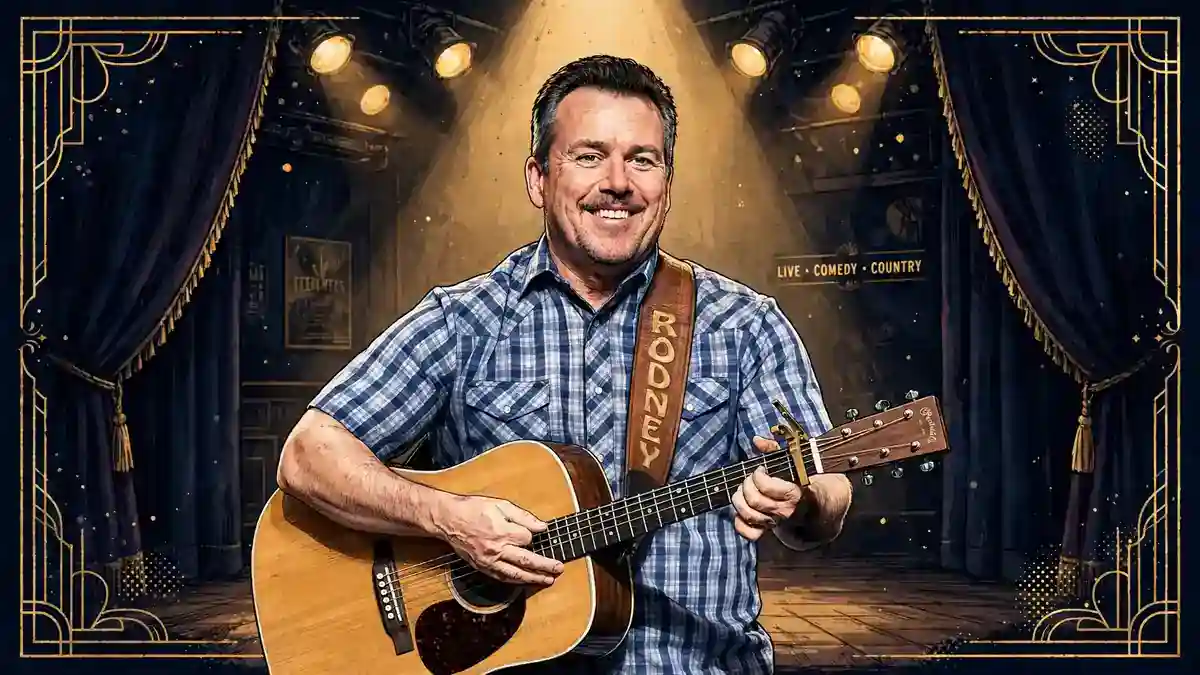
Rodney Carrington‘s net worth is estimated at $6 million to $8 million as of November 2026. The Texas comic built that fortune the slow way: six major-label studio albums, a Gold record and a Platinum greatest-hits package, two seasons of his own ABC sitcom, a co-starring film role beside Toby Keith, and more than 25 years of touring rooms across America. The most concrete piece of the money story sits in Oklahoma real estate — a 7,500-square-foot Tulsa mansion he listed for $8.5 million in 2016 and finally sold for $4.725 million in May 2021.
Rodney Carrington: Quick Facts
| Estimated net worth | $6 million–$8 million (range: $6 million to $8 million) |
|---|---|
| Profession | Stand-up comedian, country music artist, actor |
| Nationality | American |
| Born | October 19, 1968 (age 58) |
| Height | 5 feet 7 inches |
| Primary income sources | Stand-up touring, comedy and country album sales and streaming, television and film, merchandise, his own record label |
| Active years | 1990s–present |
| Last reviewed | November 2026 |
- Early Life and Background
- Education
- Career Journey
- Rise to Fame
- Main Sources of Income
- Salary and Earnings
- Businesses and Investments
- Brand Deals and Sponsorships
- Houses, Cars and Other Assets
- Awards and Achievements
- Net Worth Growth Over the Years
- Social Media Presence
- Personal Life
- Sources & Reporting
- Frequently Asked Questions
Early Life and Background
Rodney Scott Carrington was born on October 19, 1968, in Longview, Texas, a mid-size East Texas city about two hours east of Dallas, and he lived there from 1968 to 1990. That 22-year stretch matters more than it looks on a biography page. Longview sits in the piney woods of East Texas, a region where country radio, church socials, high-school football and blue-collar work shape the jokes people tell at kitchen tables. Carrington’s comedy never left that room. Three decades into his career, the material still runs on marriage, kids, weight, money trouble and small-town life — subjects he learned first-hand in Longview, not subjects he adopted for a Nashville branding meeting.
Public records and interviews say almost nothing about his parents or any siblings. That silence is worth stating plainly rather than filling with guesswork: no reliable biography names his mother or father, and no interview on record describes his childhood home in detail. What the record does show is a young man who started performing in local Texas venues while still living in Longview, working rooms where a comic either connects with a crowd or gets found out fast. Texas comedy clubs in the late 1980s and early 1990s were unforgiving places for a new act — long sets, drinkers in the front row, and audiences that had already seen the touring headliners. Carrington learned his trade there, and the guitar was part of the act from the start. Plenty of comics tell jokes; very few walk on stage with an acoustic guitar and sing the punchline. That single choice — a guitar in a comedy club — became the hinge his whole career turned on.
The Longview years also explain why Carrington’s humour reads as plain-spoken rather than polished. He writes about the life he lived: marrying young, raising three boys, paying bills, getting older, and watching his waistline expand. The jokes land because the audience recognises the life in them. When he finally left Longview around 1990, he carried a fully formed point of view with him, and the next decade was spent finding bigger rooms for it. Competitors who cover Carrington usually rush past these years in a sentence. The gap matters for the money story too: unlike comics who broke through in their early twenties on a sitcom or a late-night spot, Carrington spent his twenties grinding in clubs and on regional radio, which meant his first real paydays did not arrive until his debut album in 1998, when he was 29. The fortune came late and it came in layers — albums, then television, then film, then decades of touring — rather than in one sudden spike.
One more Longview detail carries into the wealth picture. Carrington has always based his life in the middle of the country — first Texas, then Oklahoma — rather than Los Angeles or New York. That choice kept his cost of living far below the coastal comic norm during the years when his income was uneven, and it shaped the real-estate story that later produced his single biggest documented transaction, the Tulsa mansion sale. A comic living in Tulsa can own 20 acres and a 7,500-square-foot house; the same money in Los Angeles buys a fraction of that. Geography is part of how a mid-tier comedy fortune gets built and kept.
Education
No reliable source publishes Carrington’s school history in any detail — no named high school, no college, no degree. Several biography sites repeat the same thin lines, and none of them cites a primary source, so this article does not repeat a school name it cannot verify. That absence is itself a data point: Carrington is one of the few comics of his generation whose public record contains no campus story, no fraternity anecdote and no dropout legend. His education, as far as the public record shows, was the stage.
What is documented is the informal schooling that actually shaped the act. He met his future wife Terri while they were in college — Glamour Path reports they knew each other from their college days and began dating after spending time together there, and MarriedWiki records the same college connection. That single fact tells us he did attend college somewhere in Texas, but the institution’s name never made it into a verified interview, so it stays unnamed here. The college years also produced the relationship that would define his personal life for 18 years of marriage and three sons, and the marriage itself became a bottomless source of material: the “married guy” persona that powered his albums and his sitcom was not a character he invented in a writers’ room, it was his life.
The other classroom was radio. Early in his career Carrington became a regular on “The Bob & Tom Show,” the nationally syndicated morning radio programme, and those appearances did more for his development than any formal training could have. Radio forced him to be funny in short bursts, to land a song or a bit without a visual, and to reach listeners who had never seen his face. It also put his name in front of audiences in cities he had never played. Competitors tend to mention the Bob & Tom appearances as a footnote; for the money story they were a turning point, because radio exposure is what converts a regional club comic into a name that can sell a record. By the time Mercury Records Nashville signed him, he already had an audience that radio had built for free. That is the closest thing Carrington has to a credential, and it is a real one: a decade of live rooms and morning radio before his first album, which is why the album sold when it did.
Career Journey
Carrington’s career runs in four clear acts, and the money follows the same shape. Act one was the Texas club years, roughly 1990 to 1998, where the income was door money and radio exposure. Act two was the major-label album run, 1998 to 2009, when Mercury and then Capitol Nashville turned the club act into records that charted and certified. Act three was television and film, 2004 to 2008, when the sitcom “Rodney” and the movie “Beer for My Horses” put him in front of audiences who had never bought a comedy album. Act four is the long independent tail, 2014 to today, when he releases records on his own label and tours relentlessly — the phase that actually pays the bills now, because touring is where a working comic’s money lives.
The debut came on June 2, 1998, when Mercury Records Nashville released “Hangin’ with Rodney.” The album mixed original songs with stand-up bits, and it did something no debut comedy record is guaranteed to do: it charted. It reached No. 73 on the Top Country Albums chart, and its best-known track, “Letter to My Penis,” became a signature song that fans still shout for. A No. 73 chart peak sounds modest until you place it in context — a first album by a comic with no television exposure, selling on the strength of club dates and radio, on a country label. Mercury had signed a comedian, which was a gamble, and the record gave them enough to keep going. The album’s value to Carrington’s net worth was not the first royalty cheque, which would have been small, but the proof that the comedy-country hybrid had a paying audience. That proof is what got him the Capitol deal.
He moved to Capitol Nashville for his second album, “Morning Wood,” released August 15, 2000. This was the breakthrough record, and the numbers back that up. It reached No. 18 on the US Country chart and No. 153 on the Billboard 200, his first Top 20 country album, and it went on to earn Gold certification from the RIAA. It also put him on the singles chart for the first time: “More of a Man” reached No. 71 on Hot Country Songs. A Gold comedy album in 2000 meant at least 500,000 units shipped, and for a comic whose live show was the real product, the album doubled as a marketing tool — every copy sold was a fan who might buy a ticket next time he played their town. The Gold plaque is still the single most concrete sales credential in his career, and it anchors the lower end of the net-worth range: a comic with a Gold album, a Platinum compilation and 25 years of touring is not a $4 million story, which is where the oldest estimates sat.
“Nut Sack” followed in 2003 on Capitol Nashville, with the single “Don’t Look Now” climbing to No. 60 on the charts, and the 2004 “Greatest Hits” compilation became his biggest seller: No. 3 on the Billboard Top Comedy Albums chart, No. 11 on the Top Country albums chart, and his first Platinum-certified recording. Platinum meant a million units, and a greatest-hits package has a longer commercial life than a studio album because it keeps selling to new fans who discover the act through one song. “King of the Mountains” arrived in 2007 and reached No. 2 on the US Comedy Albums chart and No. 15 on the US Country chart; “El Niño Loco” followed in 2009. Six major-label studio albums plus a greatest-hits package is the discography Wikipedia records, and it is a deeper catalogue than most working comics ever build. Each album added a revenue stream — physical sales at the time, then downloads, now streaming — and each one refreshed the touring audience.
The television act ran alongside the records. ABC gave him his own sitcom, “Rodney,” which ran for two seasons from 2004 to 2006, with Carrington starring and co-writing. A network sitcom is the one place in this career where a large single cheque was likely involved: even a short-lived ABC series pays its star a per-episode fee far above club money, and it puts the performer’s face in millions of living rooms. The show did not last, but it did its job for the fortune — it widened the audience beyond comedy clubs and country radio, and it gave promoters a television credit to put on the poster. In 2008 he co-wrote and co-starred with Toby Keith in “Beer for My Horses,” a film built around Keith’s hit song. The movie was a modest theatrical release, but the co-writing credit mattered: Carrington was not just hired as an actor, he shared in the creative ownership. He also published a book, “Rodney Carrington: Coming Clean,” in 2007, adding an author credit and another small revenue line.
After a short recording break, Carrington returned in 2014 with “Laughter’s Good,” released on his own independent label of the same name, followed by “Rodney Carrington: The Hits” in 2015 and “Here Comes the Truth” in 2017. The independent phase changed the economics in his favour: on his own label he keeps a bigger share of each sale and stream, and the records serve the tour rather than the other way round. Wikipedia notes that he continues to tour as of 2026, and that single fact is the most important line in the whole money story. A comic who tours for 30 years, selling tickets in theatres and casinos across America, builds a fortune one weekend at a time. There was no single windfall, no franchise role, no streaming special deal on the public record — just a working entertainer who never stopped playing rooms.
Rise to Fame
Carrington’s rise did not follow the usual comedy script. There was no breakout late-night set that made him famous overnight, no viral clip, no talent-show win. His fame accumulated the way a touring comic’s fame does: one room, one radio market, one album at a time. The first real lift came from “The Bob & Tom Show,” where his songs and bits reached listeners in dozens of cities before he had ever played them. Radio listeners who laughed at “Letter to My Penis” on their morning drive became ticket buyers when his tour rolled through, and that conversion — radio listener to ticket buyer to album buyer — was the engine of his rise.
The second lift was “Morning Wood” going Gold in the early 2000s. A Gold record gave promoters and bookers a credential they could sell: this was not a local comic, this was a recording artist with a certified hit album. The chart positions backed it up — Top 20 on the country chart, a single on Hot Country Songs — and country radio, which had been cautious about a comedian, had a reason to play him. The third lift was the ABC sitcom, which took the act from theatres and radio into prime-time television. Two seasons of “Rodney” did not make him a household name on the scale of a Kevin Hart or a Dave Chappelle, and the honest comparison matters: Carrington’s fame is deep rather than wide. Inside comedy clubs, country music circles and the touring circuit, he is a headliner with 30 years of goodwill; outside that world, plenty of people have never heard his name. That narrower fame is exactly why his fortune sits at $6 million to $8 million instead of the nine-figure sums the arena comics command — and it is also why the fortune is durable. He never depended on one hit or one network; he built an audience that buys tickets year after year.
The film “Beer for My Horses” in 2008 added a different kind of visibility. Co-starring with Toby Keith put Carrington in front of Keith’s enormous country audience, and the film’s title song was already a hit before the cameras rolled. It was a smart piece of career positioning: the comic who sings country songs, standing next to a country superstar, in a movie named after a country song. The audience overlap was near total. The same logic ran through his touring career — he plays theatres, casinos and comedy clubs where the crowd already likes country music and blue humour, so he rarely has to win a hostile room. Competitors often frame his rise as a straight line from Longview to Nashville; the real shape is a slow widening of the same audience, from Texas clubs to national radio to a Gold album to network television to a film, each step keeping the previous one alive. Nothing in his career replaced anything else. The albums fed the tours, the tours fed the albums, and the television fed both.
One angle the rankers mostly miss is how unusual his lane is. Comedy and country music rarely share a stage, and the comics who tried it mostly picked one or the other. Carrington stayed in both for three decades, which gave him two audiences and two income streams that rise and fall on different cycles. When comedy album sales faded industry-wide, the touring held up; when television went quiet, the records and the road kept paying. That two-lane structure is the quiet reason the net worth kept growing after 2010 even as his chart presence faded. The fame never exploded, so it never collapsed either.
Main Sources of Income
Live performance is the backbone of the fortune, and every source that has tried to price his shows agrees on the shape of it even if the exact numbers stay private. Insights Journal reports that Carrington earns between $40,000 and $74,999 per show, playing theatres, casinos and comedy clubs across the country. Treat that band as reported, not verified — no venue contract or promoter filing is public — but the order of magnitude fits the career: a headliner who has toured for 30 years, plays rooms of 1,000 to 3,000 seats, and sells tickets in the $40 to $80 range will gross in that territory per night before costs. Multiply even a modest schedule — 60 to 80 shows a year, which is a normal touring load for a comic of his standing — and the gross touring revenue lands in the low millions annually, with the comic keeping a share after the venue, the promoter, the band, the crew and the travel. That is the engine. Everything else in this section is a smaller line that feeds the same machine.
Album sales and streaming form the second line. The catalogue is the asset: six major-label studio albums, a Platinum greatest-hits package, a Gold studio album, and three independent releases. “Morning Wood” shipped at least 500,000 units to earn Gold; the “Greatest Hits” package shipped at least a million to earn Platinum. Those are physical-era numbers, and the royalties from them arrived years ago, but the catalogue still earns. Comedy albums stream steadily — fans replay the bits, new listeners discover the songs through playlists and YouTube clips, and the independent releases on Laughter’s Good Records pay a higher rate per stream because there is no major label taking its cut. Nobody publishes Carrington’s Spotify numbers, and this article will not invent them, but a catalogue with two certified records and a 25-year tail earns every month without him lifting a finger. That is the closest thing a comic gets to passive income.
Television and film form the third line, and it is the most front-loaded. The ABC sitcom “Rodney” paid a network per-episode fee for two seasons in 2004 to 2006, and the “Beer for My Horses” film in 2008 added a co-writing and co-starring payday. Neither number is public, and sitcom salaries for a first-time network star in the mid-2000s varied widely, so no figure is stated here. What matters is the timing: the television money arrived in his late thirties, when the Tulsa property was bought and the family was young, and it gave him a capital base that touring alone would have taken years to build. Television also paid in a currency that does not show up on a balance sheet — exposure that filled theatres for a decade afterwards.
Merchandise is the fourth line, and it is easy to underrate. A comic who tours 80 nights a year sells T-shirts, hats, CDs and DVDs at the merch table, where the margin is far higher than a ticket split. Carrington’s brand — the guitar, the blue humour, the married-guy persona — lends itself to merch, and the themed products at his shows have been a steady earner for years. The book “Coming Clean” (2007) added a small publishing line, and his own label, Laughter’s Good Records, turned a cost centre into a profit centre: instead of paying a label to release his records, he owns the label and keeps the margin. Add in YouTube advertising revenue from clips of his songs and routines, which several biography outlets cite as a current income line, and the picture is a comic with five or six modest streams rather than one big one. That spread is the reason the $6 million to $8 million range is credible: no single stream is enormous, but none of them has ever stopped.
A note on what is missing from the income picture is just as important. There is no public record of a major endorsement deal, no product line, no restaurant chain, no podcast network deal and no streaming special with a reported price tag. Carrington’s fortune is a working entertainer’s fortune, built from tickets and records, not a brand fortune built from licensing. That distinction keeps the estimate honest. The rankers who put him at $8 million are crediting the touring engine and the catalogue; the ones who put him at $6 million are weighting the absence of a big brand or media deal. Both readings are defensible, which is why the range stands.

Salary and Earnings
There is no published annual salary for Rodney Carrington, because a touring comic does not draw a salary. He earns per show, per record and per deal, and the total moves with the tour schedule. The best way to read his earnings is through the pieces that are documented, starting with the per-show band. Insights Journal’s reported $40,000 to $74,999 per show is the only public estimate of his live fee, and it is consistent with the venue sizes he plays. A theatre date with 2,000 seats at an average ticket price of $55 grosses $110,000 before costs; the headliner’s share of that, after the promoter and the house, lands in the reported band. A casino date can pay more, a club date less, and a private corporate gig — which Carrington has played throughout his career — can pay well above the theatre rate for a single night. The band is wide because the rooms are wide.
Apply that band to a realistic schedule and the annual touring gross comes into focus. If he plays 60 shows a year at a midpoint fee, gross live earnings run into the low millions; at 80 shows, higher still. But gross is not take-home. A touring comic pays a manager, an agent, a band, a sound crew, travel, hotels and the venue’s costs. The standard working assumption in the live business is that the artist keeps roughly half to two-thirds of the gross on a theatre tour, less on a casino-heavy route where the house takes more. That puts his net touring income in the low seven figures in a good year — enough to sustain a $6 million to $8 million net worth over 25 years, especially once the Tulsa house and the catalogue are counted as assets rather than income. In a quiet year, when he tours less, the number drops, and the catalogue and streaming fill part of the gap.
The album earnings tell a different story — front-loaded, then slow. The Gold and Platinum certifications came in the physical era, when a CD sold for $15 or more and the artist’s royalty was a meaningful slice. “Morning Wood” at Gold and “Greatest Hits” at Platinum would have generated well into seven figures of retail sales between them, with Carrington’s share arriving over years as royalties, not as a lump sum. The later independent albums earn less per unit in absolute terms but more per unit in margin, because Laughter’s Good Records keeps the label’s share. Streaming pays pennies per play, so even a million streams a month is a modest cheque — but a catalogue that streams every month for a decade adds up, and it arrives whether he tours or not.
The television earnings were the one true salary-style payday. Two seasons of “Rodney” on ABC in 2004 to 2006 meant a per-episode fee negotiated as a series regular and co-creator, and even a modest network deal for a new sitcom star in that era paid tens of thousands per episode. The film “Beer for My Horses” added a feature fee plus a writing share. None of these numbers are public, so this article states the structure rather than inventing the figures: television paid him like a salaried star for two years, then stopped, and the touring carried on. That is a normal shape for a comic’s career, and it is why his net worth did not spike in 2005 and never collapsed afterwards. The earnings history is steady, not spectacular, and the fortune reflects that.
One more earnings detail deserves a place here because it separates the serious trackers from the content farms. A cluster of low-quality sites claims Carrington is worth $60 million or more, and one growth table floating around the web credits him with $18 million by 2026 and a “Funny Bone” merchandise line. Neither claim has a source, a filing or a named outlet behind it, and both contradict the two figures every credible tracker uses. The $60 million figure appears to be copied from a spam page that applies the same template to dozens of celebrities, and the $18 million table invents projects — a 2026 special and a merch line — that do not exist in any verifiable record. This article treats both as debunked. The honest earnings story is a working comic earning a strong living for 30 years, not a secret mogul.
Businesses and Investments
Carrington’s business footprint is small, deliberate and entirely inside the entertainment world — which is both its strength and its limit. The centrepiece is Laughter’s Good Records, the independent label he launched for his 2014 album of the same name. Owning the label changed the arithmetic of his later career. On Mercury and Capitol, a share of every sale went to the label; on his own imprint, that share stays with him, and he controls the release schedule, the pricing and the catalogue. The label has released “Laughter’s Good” (2014), “Rodney Carrington: The Hits” (2015) and “Here Comes the Truth” (2017), and it functions as a small business with one artist — him. It will never be a record-industry empire, but it does not need to be. For a comic with a loyal touring audience, an owned label is a margin machine: the fans who come to the show buy the record at the merch table, and the label keeps the profit.
Beyond the label, there is no verified record of other businesses. No restaurant, no bar, no clothing line, no production company with a public footprint, no venture investment that a filing or interview confirms. Several biography sites assert that he has “business ventures” and “investments” in the abstract, but none of them names one, and this article does not repeat an unnamed venture as a fact. The honest statement is that his business is himself: the act, the catalogue, the label and the tour. That is a real business — it employs a band, a crew and a management team, and it has run profitably for decades — but it is not a diversified portfolio, and the net-worth range reflects that. A comic with a side empire would be worth more; a comic whose only business is touring is worth exactly what the tickets and the catalogue add up to.
Real estate is the one investment the public record documents in detail, and it is covered fully in the assets section below. The Tulsa mansion — bought, lived in for years, listed at $8.5 million and sold at $4.725 million — was both a home and the largest single investment of his life, and the $3.775 million gap between the asking price and the sale price is a lesson in how celebrity property actually works: the listing price is a hope, the sale price is the market. Outside that house, no property record, stock holding or private investment is publicly documented for Carrington. He is not known to be a crypto investor, a startup backer or a franchise owner, and no interview on record discusses his portfolio. The fortune is concentrated in the career and the house, which is a normal shape for an entertainer of his generation, and it is also why the estimate carries a range rather than a single confident number. There is simply less public paper on him than on a comic with a listed company or a televised business career.
The value-add in this section is the label itself, because the rankers barely mention it. Laughter’s Good Records is the one business decision that improved his margins after the major-label years ended, and it is the reason his later albums still earn him money in a streaming era when most legacy comics see their catalogue income shrink to a trickle. Owning the masters of the 2014 to 2017 records, and controlling the older catalogue’s licensing where he can, is the closest Carrington comes to an investment strategy. It is unglamorous and it works, which is a fair summary of the whole career.
Brand Deals and Sponsorships
There are no major brand deals or sponsorships on the public record for Rodney Carrington, and that absence is a fact worth reporting rather than papering over. No sportswear contract, no drinks endorsement, no car campaign, no televised commercial with his name on it appears in any reliable source. A few low-quality biography pages claim endorsement income in the abstract, but they name no brand, no product and no figure, which is the signature of filler rather than reporting. This article found no verifiable endorsement deal, and it says so plainly.
The reasons are not hard to see. Carrington’s act is blue — the humour runs on marriage, sex and bodily functions — and blue humour narrows the list of brands willing to attach their name to a comic. Family-friendly advertisers, who pay the biggest endorsement fees, tend to avoid acts whose signature songs include “Letter to My Penis.” His audience is also older and more regional than the youth-driven demographics that brands chase for influencer deals. And his career was built before the influencer economy existed: he came up through clubs and radio, not through social media, so he never built the follower counts that turn into sponsorship rate cards. The comics who earn big endorsement money — a Kevin Hart with his fitness and drinks brands, or a Dave Chappelle with his streaming deals — operate in a different commercial lane.
What Carrington does have, and what functions like a brand in practice, is the merchandise operation at his shows. T-shirts, hats, CDs and DVDs sold at the merch table carry his name and his jokes, and the margin on a $25 T-shirt sold to a fan who just laughed for 90 minutes is far better than any sponsorship split. The guitar-strap branding, the album art and the tour posters all reinforce the same identity: the funny country guy with the guitar. It is a brand in the old sense — a reputation that sells tickets — rather than a brand in the modern sense of paid partnerships. That is why the net-worth range tops out at $8 million rather than stretching higher. A comic with a real endorsement portfolio would have an extra income line; Carrington’s fortune is built from the room, the record and the house, and the honesty of that statement is what makes the $6 million to $8 million range defensible.

Houses, Cars and Other Assets
The Tulsa mansion is the asset that anchors this whole article, because it is the one piece of Carrington’s wealth with a paper trail. Celebrity Net Worth reports the full sequence: in February 2016, Carrington listed his 7,500-square-foot mansion in Tulsa, Oklahoma, for $8.5 million. The property sat on 20 acres, with five bedrooms and five bathrooms, multiple lakes, a lush lawn and what the listing agent described as a million dollars’ worth of stone and iron fencing. It took several years and several price cuts before he accepted an offer, and in May 2021 he sold the 20-acre property for $4.725 million. The numbers tell a story that the biography sites mostly miss. A $3.775 million haircut from asking price to sale price is not a failure — it is what happens when a celebrity lists a highly personal, oversized property in a market with a small pool of buyers who can afford it. Tulsa is not Los Angeles. A 7,500-square-foot house on 20 acres is a niche product, and niche products take years to sell. The sale still put $4.725 million in his pocket, before the mortgage, the agent’s commission and the taxes, and it remains the single largest documented cash event of his career.
Where does he live now? NetworthHeightSalary reports that he resides in a home in South Tulsa, Oklahoma, and that is consistent with a man who sold the big estate but stayed in the city. No address, no purchase price and no second property is publicly documented, and this article does not guess at one. The sensible reading is that he downsized after the 2021 sale — a common move for a divorced father whose three sons are grown — and kept a smaller Tulsa base near the venues and the life he knows. A second home, a vacation property or an investment property would show up in a property record or a biography; none does, so none is claimed.
Cars are a blank in the public record. No interview, no biography and no social-media post on record documents a car collection, a luxury purchase or even a daily driver for Carrington. Some biography sites carry generic lines about his “car collection,” but they name no vehicle, and a generic line is not evidence. The honest statement is that his vehicles are not part of the public money story, and the net-worth range does not depend on them. The same goes for watches, jewellery and other collectibles: nothing verifiable, nothing claimed. This is a useful contrast with the content-farm profiles that pad their articles with invented garages. Carrington’s visible wealth is a house, a catalogue and a tour schedule. That is enough, and it is verifiable.
The catalogue is the other real asset, and it deserves to be counted as one. Six major-label studio albums, a Platinum greatest-hits package, a Gold studio album and three independent releases generate royalties every month, and the independent masters are owned outright through Laughter’s Good Records. Valuing a comedy catalogue is guesswork without a sale or a filing, so no dollar figure is placed on it here, but its existence is the reason the estimate holds up even in years when he tours less. A comic with no catalogue is a comic with no income on a week off; a comic with a Gold and a Platinum record has a cheque arriving whether he works or not. Add the Tulsa sale proceeds, the touring income and the catalogue, subtract a divorce settlement and the costs of 30 years on the road, and the $6 million to $8 million range is the shape that emerges. It is not a precise accounting — no celebrity net worth ever is — but every piece of it is tied to something documented.
Awards and Achievements
Carrington’s trophy shelf is measured in certifications rather than statues, and the certifications are the harder currency. “Morning Wood” earned Gold certification from the RIAA, and the 2004 “Greatest Hits” compilation earned Platinum — the two formal industry honours of his career, and the two that translate directly into money. A Gold record in 2000 and a Platinum compilation in 2004 put him in a small club of comedians who have ever certified a record at all. Most comics never sell enough albums to certify anything; Carrington did it twice, on two different labels, in two different formats. The chart positions behind those certifications are the supporting evidence: “Morning Wood” at No. 18 on the US Country chart and No. 153 on the Billboard 200, “Greatest Hits” at No. 3 on the Billboard Top Comedy Albums chart and No. 11 on the Top Country chart, “King of the Mountains” at No. 2 on the US Comedy Albums chart. Those numbers are not awards, but they are achievements that a booker can sell, and they have sold tickets for 20 years.
The television achievements are the sitcom and the film. Landing a self-titled network sitcom on ABC — “Rodney,” two seasons, 2004 to 2006 — is a career peak that most working comics never reach, and co-writing the show put his name on the creative side of the credits rather than just the performance side. Co-writing and co-starring in “Beer for My Horses” (2008) beside Toby Keith added a feature-film credit. Neither project won a major award, and no Emmy, Grammy or Country Music Association nomination is on his public record, so none is claimed. The achievement was the slot itself: network television and a feature film for a comic whose act started in Texas clubs.
The achievement the rankers undervalue is longevity. Wikipedia notes that Carrington continues to tour as of 2026, which makes this a 30-year touring career with no real break. In comedy, that is rarer than a Gold record. Most comics who break through in their thirties are gone from the road within a decade, either because the audience moves on or because the lifestyle breaks them. Carrington is still selling tickets at 58, still releasing records on his own label, and still drawing the same audience that bought “Morning Wood” in 2000 — plus their kids. The Blue Collar Comedy circle around him, comics like Jeff Foxworthy, Larry the Cable Guy, Ron White and Bill Engvall, built the same kind of durable touring career, and Carrington belongs in that company even though he was never formally part of their tour. The achievement is the career itself: three decades, six albums, a sitcom, a film, a Gold record, a Platinum record and a house sale that most comics could only dream of. That is the record the $6 million to $8 million estimate rests on.
Net Worth Growth Over the Years
The published estimates for Carrington move in a narrow band, and the movement tells its own story. In mid-2018, Internewscast put the figure at $4 million, citing authoritative sources. By September 2021, Wealthy Persons calculated $8 million, after the Gold and Platinum records, the sitcom, the film and years of touring had compounded — and just months before the Tulsa mansion sold. Surprise Sports, writing in 2025, put the figure at $8 million, while Celebrity Net Worth and a string of biography outlets hold it at $6 million. The table below records what each outlet said and when, so the reader can see the range is a disagreement between trackers, not a mystery.
| Year | Reported estimate | Source | What drove it |
|---|---|---|---|
| 2018 | $4 million | Internewscast | Catalogue and touring before the Tulsa sale |
| 2021 | $8 million | Wealthy Persons | Gold and Platinum records, sitcom, film, touring; Tulsa sale year |
| 2024 | $6 million–$8 million | Multiple outlets | Split between trackers; independent label era |
| 2025 | $8 million | Surprise Sports, Insights Journal | Continued touring, catalogue streaming |
| 2026 | $6 million–$8 million | NetWorthCraft estimate | Range published where sources disagree |
The honest reading of that table is that the fortune grew through the 2000s on the back of the records and the sitcom, took its biggest single step with the 2021 property sale, and has held roughly steady since, because touring income and catalogue royalties now balance each other. There was no sudden doubling and no collapse, and the $4 million figure from 2018 now looks low against the documented $4.725 million property sale alone — a man who sells one house for $4.725 million is unlikely to be worth $4 million in total, which is why this article treats the older estimate as stale and the $6 million floor as the credible one.
How does he stack up against the comics who worked the same rooms? The comparison below uses career shape rather than invented figures, because the peer numbers belong to their own articles. Carrington’s lane — comedy plus country music, albums plus touring — is the narrowest of the group, and the narrowness explains the smaller fortune. Kevin Hart turned stand-up into films, a production company and global arena tours. Dave Chappelle turned it into landmark streaming specials. The Blue Collar circle — Foxworthy, Larry the Cable Guy, Ron White and Bill Engvall — turned a shared audience into a touring brand that filled arenas. Carrington never had the arena brand or the streaming deal, but he also never needed one: his audience is loyal, his costs are low, his label is his own, and his house in Tulsa cost a fraction of a Los Angeles equivalent. The fortune is smaller than theirs and it is also more completely his own.
| Comic | Breakout | Signature format | Television / film |
|---|---|---|---|
| Rodney Carrington | Gold album “Morning Wood” (2000) | Stand-up with country songs and guitar | Sitcom “Rodney” (ABC), “Beer for My Horses” |
| Kevin Hart | Stand-up specials and film roles | High-energy arena stand-up | Film franchises, production company |
| Dave Chappelle | “Chappelle’s Show” (2003) | Sketch and long-form stand-up | Landmark streaming specials |
| Jeff Foxworthy | “You might be a redneck” (1993) | One-liner observational comedy | Blue Collar Comedy Tour, hosting |
| Larry the Cable Guy | Blue Collar Comedy Tour | Character-driven redneck humour | “Cars” voice role, television specials |
| Ron White | Blue Collar Comedy Tour | Storytelling with a drink in hand | Comedy specials, acting roles |
Social Media Presence
Carrington’s social media presence is real but modest, and the honest version of this section is that no verified follower count is published by any reliable source. He maintains an official YouTube channel where clips of his songs and stand-up routines circulate, and several biography outlets cite YouTube as a current income line through advertising revenue. He is also present on Facebook and Instagram, where tour dates, ticket links and clips are posted, and his official website carries the tour schedule. What this article will not do is invent a follower number. The content-farm profiles that list exact counts for his Instagram, X and Facebook accounts are copying each other without a source, and the numbers change from site to site. A reader who wants the current count can check the profiles directly; the count is not part of the money story in any case.
The shape of his online presence fits the career. Carrington built his audience before social media existed, through clubs and radio, so his accounts function as a tour bulletin rather than the main product. The clips do real work — a fan who watches “Letter to My Penis” on YouTube is a fan who might buy a ticket — but the following is not large enough to command sponsorship rates, which is one more reason the endorsement line in this article is empty. The contrast with younger comics is sharp: a comic who breaks out on TikTok can monetise a million followers before ever playing a theatre, while Carrington monetises theatres and lets the clips follow. Both models work; his is older, slower and less dependent on an algorithm. For the net-worth picture, social media is a marketing channel for the tour, not a separate fortune, and it is counted that way here.
Personal Life
Carrington married Terri Carrington in 1993, after the two met in their college days, and the marriage lasted 18 years. The couple had three sons — George, Sam and Zac — and the family years in Texas and then Oklahoma supplied most of the material his audiences know best. The marriage ended in stages that the sources record slightly differently: the couple separated in 2010, divorce proceedings began in 2011, and the divorce was finalised in 2012, according to MarriedWiki and Wealthy Persons, with some outlets dating the final decree to 2011 or 2013. The 2012 date is the one most sources agree on, and it is the date this article uses. Neither party has publicly given a detailed reason for the split, and MarriedWiki notes that dishonesty and an affair were not cited as causes; Glamour Path attributes the breakdown to the demands of his touring career and reports that he paid alimony and child support after the divorce. The couple are reported to have maintained a civil relationship for the sake of their children, sharing custody.
Terri Carrington worked as a speech-language pathologist, according to Glamour Path, a detail that fits the picture of a couple who married young and built a family before the fame arrived. The three sons are now adults, and Carrington’s material has aged with them — the jokes about young kids gave way to jokes about grown sons, an emptying house and getting older. Since the divorce, no verified report places him in a new public relationship, and several biography outlets record that he has not been publicly linked to anyone since. That is stated as the absence of a report, not as a fact about his private life: a comic who guards his privacy is entitled to it, and the money story does not depend on his dating life.
He is 5 feet 7 inches tall and has spoken openly, in his act, about weight gain as he has aged — Internewscast records his weight at around 185 pounds, or 84 kilograms, in its profile, and the weight jokes are a staple of the live show rather than a hidden insecurity. He lives in South Tulsa, Oklahoma, according to NetworthHeightSalary, having sold the big estate in 2021 but stayed in the city where he raised his family. The personal picture that emerges is consistent: a man who married young, raised three boys, divorced, kept touring, and stayed put in Oklahoma rather than chasing the coasts. The divorce settlement is the one personal cost that would have touched the fortune directly — a split of assets after 18 years of marriage, plus alimony and child support — and it is part of why the estimate is a range rather than a single number. No figure for the settlement is public, so none is stated, but any honest estimate of a divorced entertainer’s net worth has to allow for it.
Sources & Reporting
Celebrity Net Worth — the $6 million estimate; the Tulsa mansion timeline (listed February 2016 at $8.5 million, sold May 2021 for $4.725 million, 7,500 square feet on 20 acres). Reporting window: profile updated in the last two years.
Wikipedia — discography and chart positions (Hangin’ with Rodney 1998, Morning Wood 2000 Gold, Greatest Hits 2004 Platinum, King of the Mountains 2007, El Niño Loco 2009, Laughter’s Good 2014), the ABC sitcom “Rodney” (2004–2006), “Beer for My Horses” (2008), and the note that he continues to tour as of 2026. Reporting window: page updated within the last two months.
Surprise Sports — the $8 million estimate for 2025, the album list, the sitcom run, the 2007 book “Coming Clean” and the Tulsa sale. Reporting window: article updated May 2026.
Insights Journal — the $8 million estimate for 2025, the reported $40,000–$74,999 per-show band, the Bob & Tom Show background, and the Tulsa estate details (five bedrooms, five bathrooms, lakes, stone and iron fencing). Reporting window: 2025–2026.
Wealthy Persons — the $8 million figure as of September 2021, birth name Rodney Scott Carrington, birth date and place, marriage dates (1993–2012) and three sons. Reporting window: September 2021, page refreshed 2026.
MarriedWiki — marriage and divorce timeline (married 1993, separated 2010, divorced 2012), three sons George, Sam and Zac, and the college connection with Terri. Reporting window: profile maintained since 2019.
Figures that appear in this article without a named outlet attached are labelled as estimates or reported figures in the text. The $60 million-plus claims and the $18 million growth table found on low-quality sites were checked and excluded as unsourced. Where sources disagreed on a date — the divorce finalisation, given as 2011, 2012 or 2013 — the majority date is used and the disagreement is noted. No figure in this article comes from an unnamed “report” or an anonymous source.
Frequently Asked Questions
What is Rodney Carrington’s net worth in 2026?
Rodney Carrington’s net worth is estimated at $6 million to $8 million as of November 2026. Celebrity Net Worth and several biography outlets put the figure at $6 million, while Surprise Sports, Insights Journal and Wealthy Persons put it at $8 million. No filing or rich list pins it down, so the range is the honest answer.
How did Rodney Carrington make his money?
Mostly from touring. He has played theatres, casinos and comedy clubs for more than 25 years, with a reported per-show band of $40,000 to $74,999. Album sales add to it — “Morning Wood” went Gold and the 2004 “Greatest Hits” went Platinum — along with his ABC sitcom “Rodney,” the film “Beer for My Horses,” merchandise, and his own label, Laughter’s Good Records.
How much did Rodney Carrington sell his Tulsa mansion for?
He sold it for $4.725 million in May 2021, according to Celebrity Net Worth. He had listed the 7,500-square-foot house on 20 acres in Tulsa for $8.5 million in February 2016, and it took several years and several price cuts before he accepted an offer.
Is Rodney Carrington still touring in 2026?
Yes. Wikipedia notes that he continues to tour as of 2026, and his official channels list current dates. Touring is still his main income source, more than 25 years after his debut album.
What are Rodney Carrington’s most famous songs and albums?
His best-known album is “Morning Wood” (2000), his first Top 20 country album and his first Gold record, featuring “More of a Man.” His signature song is “Letter to My Penis” from his 1998 debut “Hangin’ with Rodney.” The 2004 “Greatest Hits” compilation, his first Platinum record, is the best-selling release of his career.
Was Rodney Carrington married, and does he have kids?
He was married to Terri Carrington from 1993 until their divorce was finalised in 2012, after separating in 2010. They have three sons: George, Sam and Zac. No verified report places him in a new public relationship since the divorce.
How old is Rodney Carrington, and how tall is he?
Rodney Carrington was born on October 19, 1968, in Longview, Texas, which makes him 58 years old as of November 2026. He is 5 feet 7 inches tall.
What was the Rodney TV show?
“Rodney” was a sitcom starring Rodney Carrington that aired on ABC for two seasons, from 2004 to 2006. Carrington co-wrote the show, which was built around his married-guy comedy persona. It also starred him alongside a cast playing his family and friends, and it remains his biggest television credit.
Final Thoughts
Rodney Carrington’s fortune is a working comic’s fortune, and that is a compliment. There was no lottery ticket in this career — no viral moment, no franchise, no streaming mega-deal. There was a guitar, a Texas club circuit, a Gold album, a Platinum compilation, two seasons on ABC, a film with Toby Keith, and then 25 years of showing up in theatres and casinos and making rooms laugh. The $6 million to $8 million range is the right way to state it, because the two serious numbers disagree and the paper trail stops short of a filing. What is certain is the shape: a man who built a catalogue that still pays, a label he owns, and a touring business that has never stopped. The Tulsa house sale put $4.725 million on the table in a single transaction, and the touring has put the rest there a weekend at a time. At 58, still on the road, he is proof that a narrow lane, worked without a break for three decades, is a fortune in itself.
Published on November 23, 2026. Last reviewed November 2026. Found an error? See our corrections policy.