
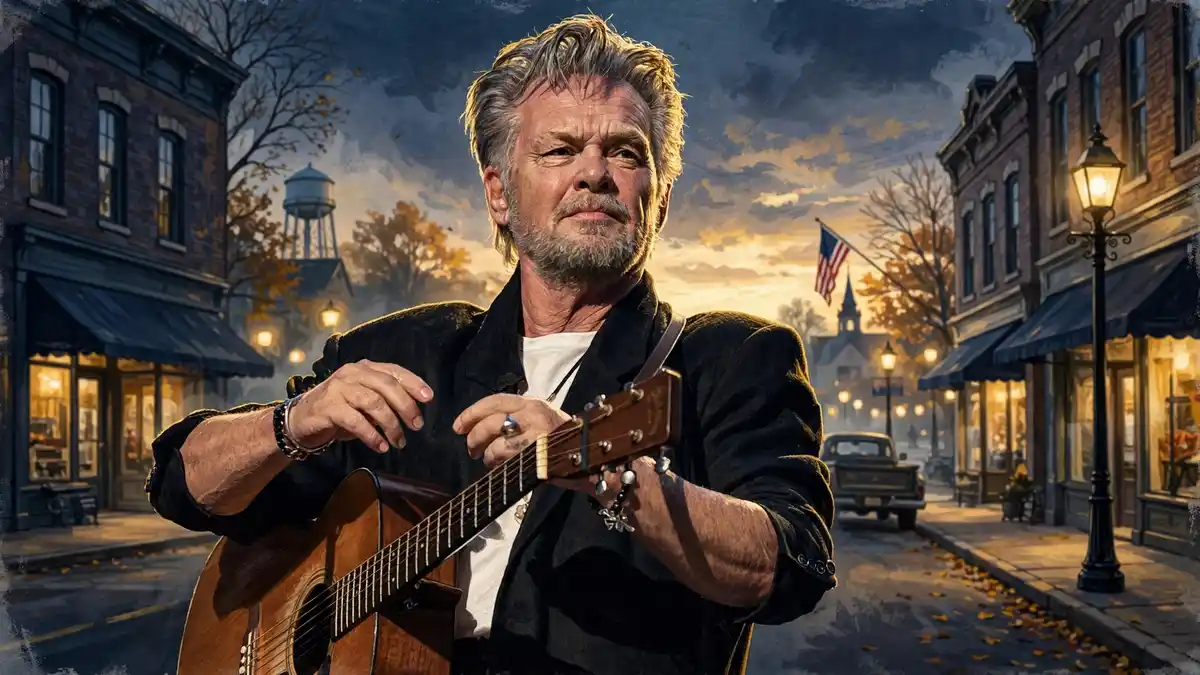
John Mellencamp‘s net worth is estimated at $25 million to $30 million as of November 2026. The heartland rocker built that fortune across five decades — more than 60 million albums sold worldwide, 22 Top 40 hits, a 78-date tour in 2023, a new greatest-hits run in 2026, a second career as a painter, and a real estate portfolio stretching from a Lake Monroe home in Indiana to a SoHo art studio.
John Mellencamp: Quick Facts
| Estimated net worth | $30 million (range: $25 million to $30 million) |
|---|---|
| Profession | Singer-songwriter, musician, painter, actor, director |
| Nationality | American |
| Born | October 7, 1951 (age 75) |
| Height | 5 ft 9 in (175 cm) |
| Primary income sources | Album sales and streaming royalties, touring, songwriting catalog, painting sales, real estate |
| Active years | 1976–present |
| Last reviewed | November 2026 |
- Early Life and Background
- Education
- Career Journey
- Rise to Fame
- Main Sources of Income
- Salary and Earnings
- Businesses and Investments
- Brand Deals and Sponsorships
- Houses, Cars and Other Assets
- Awards and Achievements
- Net Worth Growth Over the Years
- Social Media Presence
- Personal Life
- Sources & Reporting
- Frequently Asked Questions
- Final Thoughts
Early Life and Background
John J. Mellencamp was born on October 7, 1951, in Seymour, Indiana, a railroad town of roughly 20,000 people about 60 miles south of Indianapolis. His father, Richard Mellencamp, worked as an executive at the local Robertshaw Controls plant; his mother, Marilyn, stayed home with the children. The family roots ran German and Dutch, and the small-town rhythms of Seymour — Friday night football, factory shifts, grain elevators on the edge of town — later became the raw material for nearly everything he wrote.
Mellencamp was born with spina bifida, a birth defect in which the spine does not close fully, and he had corrective surgery as an infant. The operation left a long scar down his back and, by his own account in interviews, a lifelong sense of having something to prove. He has spoken about the scar in the context of his songwriting — the feeling of being marked, of carrying a private history into public rooms — and it is one reason his songs about ordinary people land with such weight. Nothing about his childhood suggested wealth. Seymour was working-class Indiana, and the Mellencamp household was comfortable but far from rich.
Music arrived early. At 14 he formed his first band, Crepe Soul, and began playing school dances and local gigs around southern Indiana. The band name sounds like a joke now, but the habit it built was serious: Mellencamp learned to hold a room, to read a crowd, to keep playing when the equipment failed. Through his teens he cycled through local groups — Snakepit Banana Farm, Trash, and the Mason Brothers among them — playing bars and VFW halls while his classmates planned steadier lives. He married young, became a father at 19, and spent his early twenties torn between responsibility and the stage. That tension never really left his writing. Songs like “Jack & Diane,” “Small Town,” and “Pink Houses” are, at bottom, songs about people trying to hold a life together in a place that offers few exits.
What competitors routinely miss is how long the apprenticeship lasted. Mellencamp did not break through until he was 30. The six years between his first record deal and “American Fool” were filled with failed albums, a shelved record, a manager who renamed him against his will, and a year in London recording music almost nobody in America heard. The fortune he eventually built was not a lottery win. It was the compound interest of a writer who refused to quit a career that, by any honest measure, had already failed twice.
Education
Mellencamp attended Vincennes University in Vincennes, Indiana, starting in 1972. Vincennes, founded in 1801, is Indiana’s oldest college, and for a working-class kid from Seymour it was the affordable route to a degree. Mellencamp has been candid in interviews — including a widely quoted conversation with Rolling Stone — that his college years were rough. He drank heavily and used drugs, and the habits that had started in high school hardened at Vincennes. He has described that period plainly: he was in trouble, and he knew it.
He sobered up before graduating, a decision he has credited with saving both his life and his career. The timing mattered. By the time he left Vincennes he was married with a baby daughter, and the choice was no longer abstract. Get clean and chase music seriously, or drift. He chose the first, and within a year of graduating he was traveling back and forth to New York City, playing any room that would have him, looking for a record deal. No business school, no finance degree, no family money — the financial education that shaped his fortune came later, from managers, lawyers, and the hard lessons of the music business itself, including a first contract that cost him his own name.
Indiana University Bloomington later became a second educational home of a different kind. Mellencamp received an honorary doctorate from the university in 2000, and in a reversal of the usual flow — student pays school, school honors student — he gave the school $1.5 million to build an indoor athletics training facility, the John Mellencamp Pavilion. The gift says something about how he views money: as a tool for the place that made him, not as a scoreboard.
Career Journey
Between 1974 and 1975, Mellencamp shuttled between Indiana and New York City, playing wherever he could and knocking on doors. The break, such as it was, came when Tony DeFries of MainMan Management — the firm behind David Bowie — took an interest. DeFries signed him and promptly renamed him “Johnny Cougar,” a stage name Mellencamp hated and fought. The first album, Chestnut Street Incident, arrived in October 1976 under that imposed name. It was mostly covers and a handful of originals, and it sold about 12,000 copies. By the standards of a major-label debut, it was a flop.
He recorded a follow-up, The Kid Inside, in 1977. DeFries decided against releasing it, and MCA dropped him. The album sat in a vault until 1983, when DeFries released it after Mellencamp became a star — a neat illustration of how the industry treats the same music differently once the charts change their mind. Mellencamp was, at that point, a 26-year-old with a failed record, a shelved record, and a stage name he despised.
The rescue came from Billy Gaff, manager of Rod Stewart, who signed Mellencamp to Riva Records. At Gaff’s request, Mellencamp moved to London for nearly a year to record, promote, and tour behind 1978’s A Biography. The record never came out in the United States, but it gave him a top-five hit in Australia with “I Need a Lover,” and — more usefully — a year of hard touring that taught him how to be a frontman. His next American releases, John Cougar (1979) and Nothin’ Matters and What If It Did (1980), put two singles into the Top 40: “This Time” and “Ain’t Even Done with the Night.” The money was still modest, but the direction was finally right.
The 1980s then delivered one of the great hot streaks in American rock. American Fool (1982), Uh-Huh (1983), Scarecrow (1985), The Lonesome Jubilee (1987), and Big Daddy (1989) form a five-album run that most songwriters would trade a career for. Scarecrow was the first album recorded at his own Belmont Mall studio in Belmont, Indiana — a converted building near Bloomington that became his creative headquarters and, eventually, the place where he recorded well into his seventies. Owning the studio mattered financially: it cut recording costs, kept him out of expensive Los Angeles and New York rooms, and gave him control over his schedule.
The 1990s were steadier and less spectacular. Whenever We Wanted (1991) opened the decade, followed by Human Wheels (1993) and Dance Naked (1994), whose cover of Van Morrison’s “Wild Night” reached No. 3 on the Hot 100 and introduced him to a younger audience. In 1997 he signed a four-album deal with Columbia Records and made three for the label. The albums kept coming — a self-titled record in 1998, Rough Harvest in 1999, Cuttin’ Heads in 2001, Trouble No More in 2003 — but the chart positions faded as radio moved on. Mellencamp, to his credit, did not chase the trend. He recorded what he wanted, where he wanted, and toured behind it.
The 2000s and 2010s brought a late-career critical revival. Freedom’s Road (2007) and Life, Death, Love and Freedom (2008), produced by T Bone Burnett, were praised as among his best work. No Better Than This (2010) was cut live to a mono tape machine in historic rooms — Sun Studio in Memphis, a San Antonio hotel room, a Savannah church — and it sounded like it. Plain Spoken (2014) and Sad Clowns & Hillbillies (2017) followed, the latter a collaboration with folk singer Carlene Carter. His 24th album, Strictly a One-Eyed Jack, arrived on January 21, 2022, with “Wasted Days,” a duet with Bruce Springsteen, as its lead single. His 25th, Orpheus Descending, followed on June 16, 2023, and he launched a 78-date “Live and in Person” tour on February 5, 2023, in Bloomington, Indiana. In July 2026 he launched the “Dancing Words — The Greatest Hits” tour, produced by Live Nation, opening in Grand Rapids, Michigan.
That 2026 tour is the detail most 2025-era profiles miss, and it matters for the money. A legacy act’s touring income does not stop at 70. Live Nation backing a greatest-hits run in 2026 means Mellencamp’s catalog still sells tickets — and ticket sales, merchandise, and the streaming bump that follows a tour are the engine of his current income.
Rise to Fame
The rise had a precise date: 1982. American Fool reached No. 1 on the Billboard 200, and “Jack & Diane” spent four weeks at No. 1 on the Hot 100. “Hurts So Good” won the Grammy for Best Male Rock Vocal Performance. For a singer who had spent six years being told his name was wrong and his songs were not commercial enough, the vindication was total — and it came with real bargaining power. He finally had the clout to add his real surname to his billing. Uh-Huh (1983) arrived as John Cougar Mellencamp, a top-10 album that produced “Pink Houses,” “Crumblin’ Down,” and “Authority Song.”
Scarecrow (1985) peaked at No. 2 and spun off five Top 40 singles, including “Small Town,” a song that has since been played at countless political rallies and small-town celebrations — and that Mellencamp has, at various points, asked politicians to stop using. The Lonesome Jubilee (1987) gave him “Paper in Fire,” “Cherry Bomb,” and “Check It Out.” Big Daddy (1989) was the last album to carry the “Cougar” nickname; after it, he dropped the stage name entirely and has recorded as John Mellencamp ever since.
The numbers behind the rise are the foundation of the fortune. More than 60 million albums sold worldwide, with 30 million of those in the United States. Twenty-two Top 40 hits. Thirteen Grammy nominations and one win. A record seven songs by a solo artist reaching No. 1 on Billboard’s Hot Mainstream Rock Tracks chart. American Fool alone is certified five-times Platinum. Those sales happened mostly in the era when an album sale paid a songwriter several dollars in royalties — a far richer rate than the fractions of a cent streaming pays today — which is why the 1980s catalog remains the largest single contributor to his wealth.
Fame also brought a second act of a different kind. In 1985, Mellencamp co-founded Farm Aid with Willie Nelson and Neil Young, after a comment by Bob Dylan at Live Aid about farmers losing their land. The first Farm Aid concert took place in Champaign, Illinois, in September 1985. Dave Matthews joined the board later. The organization has held an annual concert ever since, and as of 2024 it had raised nearly $80 million for family farmers. Farm Aid is not a personal income stream — the money goes to farmers — but it is central to how Mellencamp’s public standing works. It turned a hitmaker into a civic figure, and that standing is part of why he still headlines, still gets the iHeartRadio Icon Award, and still sells out rooms at 75.
The peer comparison sharpens the picture. Mellencamp’s heartland-rock contemporaries include Tom Petty, whose catalog and touring built a reported fortune of around $95 million by the time of his death, and Bob Seger, another Midwestern rocker who turned blue-collar anthems into a long, lucrative career. Mellencamp sits below both on the money scale — he never had a catalog sale or a stadium residency — but his staying power is comparable: five decades, 25 albums, and a 2026 tour. The difference is less about talent than about scale. Petty toured bigger rooms for longer; Seger had the 1970s arena peak. Mellencamp’s fortune is the smaller, steadier version of the same story.
Main Sources of Income
Mellencamp’s money comes from five streams, and their order matters. First, the catalog: royalties from more than 60 million albums sold, plus streaming, radio play, sync licenses for film and television, and the publishing income from songs he wrote. “Jack & Diane” and “Pink Houses” are annuity assets in their own right, played on classic-rock radio, licensed for commercials and films, and streamed millions of times a year. Second, touring. Mellencamp has toured in every decade since the 1970s, and the 78-date “Live and in Person” run in 2023 and the 2026 “Dancing Words” tour show that the road still pays. Third, painting. Since the 1990s he has built a parallel career as a visual artist, with gallery exhibitions around the United States and published books of his work. Fourth, acting, directing, and scoring — smaller, but real. Fifth, real estate, which has appreciated sharply in the cases where the purchase prices are public.
The catalog deserves a closer look, because it is where the $30 million figure lives or dies. Mellencamp owns — or shares in — the publishing on songs he wrote, which is most of his catalog. Songwriting royalties pay every time a song is played on the radio, streamed, covered, or licensed. Classic-rock radio still programs his 1980s singles heavily, and a song like “Small Town” earns every time it is licensed. He has not, as far as public reporting shows, sold his catalog in the kind of nine-figure deal that Bob Dylan struck with Universal in 2020 (reported at more than $300 million) or that Bruce Springsteen struck with Sony in 2021 (reported at around $500 million). That is a crucial difference. Mellencamp’s wealth is a slow royalty stream, not a lump-sum sale — which explains why his net worth sits at $30 million while Dylan’s and Springsteen’s run into the hundreds of millions. The catalog is still his, still earning, and still — in a market where legacy catalogs have become prized assets — potentially worth far more than the current estimate if he ever chose to sell.
Touring is the second pillar, and its economics have changed in his favor. In the 1980s, touring supported album sales. Today, for a legacy act, touring is the business: ticket prices for heritage rock acts have risen sharply, merchandise margins are strong, and a 78-date run across America in 2023 — even in theaters and mid-size venues rather than stadiums — generates serious gross revenue. Mellencamp has never published his per-show fee, and no reliable source quotes one, so we will not invent one. What the record shows is consistency: a major tour in 2023, another in 2026, and Live Nation’s involvement in the latter. Promoters do not put Live Nation behind a tour that does not sell.
Painting is the stream competitors handle worst, usually reducing it to a hobby. It is not. Mellencamp has painted seriously since the 1990s, exhibited in galleries across the country, and published books of his paintings and drawings. His style — large, expressionist portraits and social scenes, often dark and confrontational — has a real collector following. Sale prices are not publicly disclosed, and we will not guess at them, but a working artist with gallery representation and a 30-year exhibition history earns real money from his work. The SoHo loft he bought in 2018 for $2.3 million functions as his art studio, which tells you how central the painting is to his working life.
Film and television add a smaller stream. He directed and starred in Falling from Grace (1992), appeared in After Image (2001), Lone Star State of Mind (2002), and Madison (2005), and scored the 2015 film Ithaca. He also turned down the role in Thelma & Louise that went to Brad Pitt — a decision that cost him a career-changing film role and, arguably, a great deal of money, but one he has never seemed to regret. There is no public data on what the acting work paid, and it is a minor share of the total.

Salary and Earnings
There is no public record of John Mellencamp’s salary in the way there is for a film actor or an athlete. He is not an employee. He is a songwriter, recording artist, touring musician, and painter, and his income arrives as royalties, performance fees, and art sales — none of which he is obliged to disclose. Any site that quotes a precise annual salary for him is guessing. Here is what the public record actually supports.
In the peak album years, the money was substantial. American Fool sold more than five million copies in the United States alone. At 1980s royalty rates, a hit album of that size generated millions for its writer-performer, and Mellencamp had five such albums in seven years. The royalties did not stop when the chart run ended. Catalog albums sell steadily for decades, and the streaming era added a new, if thinner, layer: his songs are streamed millions of times a year, and while a single stream pays a fraction of a cent, millions of streams across a catalog of 25 albums add up to a meaningful annual sum.
Touring income is the least transparent and the most important current stream. A 78-date tour in 2023, with theater and arena dates across the United States, would gross in the low tens of millions of dollars before costs, based on typical ticket prices and venue sizes for a heritage rock act — but that is an industry estimate, not a reported figure, and Mellencamp’s share after paying his band, crew, travel, and the promoter is a fraction of the gross. We state it as a range and a mechanism, not as a fact, because the grosses have not been published. The 2026 “Dancing Words” tour, produced by Live Nation, follows the same pattern. Live Nation’s involvement is itself a signal: the world’s largest concert promoter does not produce tours for artists who cannot fill rooms.
Painting income is similarly undisclosed. Gallery sales of a working artist with Mellencamp’s profile typically run from the low thousands to the tens of thousands of dollars per piece, depending on size and venue — but no gallery has published his prices, and we will not present a market guess as a fact. What is documented is the volume of activity: exhibitions, books, and a dedicated SoHo studio. The art career is a real income stream, even if its size is private.
The honest summary is this: Mellencamp’s earnings peaked in the 1980s and early 1990s, when album royalties were at their richest, and have settled into a steadier pattern since — catalog royalties, regular touring, and art sales. The $30 million net worth is a stock, not a flow. It is the accumulated remainder of forty-plus years of those income streams, minus taxes, divorces, and a lifestyle that has never been extravagant by rock-star standards. He lives in Indiana, not Beverly Hills, and that choice shows up in the number.
Businesses and Investments
Mellencamp is not a businessman in the way some of his peers are. There is no tequila brand, no headphone line, no venture fund. His business life is the music business itself, and his most important investment decision was made in the mid-1980s: he built his own recording studio, Belmont Mall, in Belmont, Indiana, near Bloomington. Owning the studio meant he could record on his own schedule, at his own cost, without renting commercial rooms in New York or Los Angeles. Over forty years of recording, that saved a fortune — and it gave him the freedom to make records like Life, Death, Love and Freedom and No Better Than This on his own terms, without a label clock running.
His catalog is his largest asset and, arguably, his largest unrealized opportunity. As noted above, he has not sold it. Dylan’s reported $300 million-plus Universal deal in 2020 and Springsteen’s reported $500 million Sony deal in 2021 reset the market for legacy catalogs, and Mellencamp’s catalog — 25 albums, 22 Top 40 hits, several songs that are woven into American culture — would command a substantial price if he ever chose to sell. Whether he will is unknown. He has spoken in interviews about the value of owning his work and the importance of controlling how his songs are used, which suggests a seller’s mindset is not his. For the estimate, the catalog is valued as a royalty stream, not as a sale price, which is the conservative approach — and one reason the $30 million figure may understate his true wealth.
Farm Aid is a business of a different kind. Mellencamp co-founded it, sits on its board, and performs at its annual concert, but it is a nonprofit. The nearly $80 million it has raised since 1985 goes to family farmers, not to its founders. We mention it here because it is the most significant organization he has built, and because its annual concert is also, incidentally, a stage he headlines every year — but its money is not his money, and no honest estimate counts it as such.
His other investments are the quiet, unglamorous kind: real estate, held for decades. The Lake Monroe home outside Bloomington, the Daufuskie Island vacation property, the SoHo loft, the Santa Barbara parcel — these are the holdings of a man who buys property he uses, holds it, and lets it appreciate. The Santa Barbara deal is the clearest example: $2.45 million in early 2020, listed at $4.5 million later the same year after a modest renovation. That is a roughly $2 million paper gain in under a year, on a single property, and it is the only one of his real estate moves with both prices on the public record. It also illustrates a pattern: Mellencamp buys well, improves lightly, and sells when the moment is right.
Brand Deals and Sponsorships
Mellencamp has never been a brand-deal artist. There is no long list of endorsements, no sneaker deal, no watch campaign, no fast-food commercial. His public image — the Indiana songwriter who writes about small towns and working people — would sit awkwardly next to a luxury brand, and he has protected that image carefully. He has, at various points, asked politicians to stop playing “Small Town” and “Pink Houses” at rallies, a stance that is the opposite of the usual celebrity monetization playbook.
What he has done, consistently, is lend his name to causes rather than products. Farm Aid is the centerpiece, but he has also performed at benefit concerts for years and supported Indiana University, where his $1.5 million gift built the John Mellencamp Pavilion. The 2026 iHeartRadio Icon Award, presented to him by his daughter Teddi at the Dolby Theatre in Los Angeles on March 26, 2026, is the kind of honor that comes from a career, not a campaign — and it is worth more to his touring value than any endorsement would be.
Sync licensing is the one commercial stream that functions like a brand deal. His songs have been licensed for films, television, and advertising for decades, and each license pays. “Jack & Diane” and “Pink Houses” are cultural shorthand for a certain idea of America, which makes them attractive to advertisers and filmmakers. The fees are not public, but for songs of this stature they run into five and six figures per placement. It is a quiet, steady income that requires no touring and no new recording — the catalog working while he paints.

Houses, Cars and Other Assets
Mellencamp’s real estate is unusually well documented for a private celebrity, because the purchases were reported in the property press. He lives five miles outside Bloomington, Indiana, on the shores of Lake Monroe — a lake house in the state he has never really left, despite five decades of fame. The choice is deliberate. He could have moved to Los Angeles or New York at any point in the 1980s. He stayed in Indiana, recorded in Indiana, and raised his family in Indiana. The Lake Monroe home is both a residence and a statement, and it is the anchor of a portfolio that is spread across four states.
He owns a vacation home on Daufuskie Island, South Carolina, a car-free island off the coast near Hilton Head, accessible only by ferry. It is the kind of place a man buys for quiet, not for showing off, and it fits the pattern: Mellencamp’s properties are retreats, not trophies. In January 2018 he bought an 1,800-square-foot loft in the SoHo district of New York City for $2.3 million, which he uses as an art studio. The SoHo purchase is the most revealing of the four, because it is a working asset — a place to paint, in the city where the art world lives — rather than a second home.
The Santa Barbara property is the most dramatic transaction on the record. In early 2020 he paid $2.45 million for a six-acre property in Santa Barbara, California. Later the same year, after what reports described as a modest renovation, he listed the home for $4.5 million. The listing price is not a sale price — the public record does not confirm what it ultimately sold for — but the spread between the purchase and the ask shows how sharply coastal California real estate can move, and how well Mellencamp timed the purchase.
Cars are the one area where the record goes quiet. Mellencamp is not known as a car collector, and no publication has documented a garage of exotic vehicles. Photographs over the years show him with trucks and ordinary American cars, which fits the image and the man. If he owns a notable collection, it has stayed private. We will not invent one. His visible assets are the ones that matter: the catalog, the studio, the paintings, and the four properties. Together with his touring income, they account for the $25 million to $30 million range — with the catalog doing most of the work.
Awards and Achievements
The awards list is long, but three entries matter most. First, the Grammy: one win, for Best Male Rock Vocal Performance for “Hurts So Good,” from 13 nominations across his career. Thirteen nominations without more wins is itself a statement about the Grammy’s relationship with heartland rock — respected, nominated, rarely rewarded. Second, the Rock and Roll Hall of Fame induction in 2008, which placed him in the company of the artists he grew up admiring. Third, the Songwriters Hall of Fame induction in June 2018, which honored the craft itself: the writing, not the performing. For a songwriter, that one may matter most.
The chart records are just as striking. Seven songs by a solo artist reaching No. 1 on Billboard’s Hot Mainstream Rock Tracks chart — a record. Twenty-two Top 40 hits on the Hot 100. More than 60 million albums sold worldwide, 30 million in the United States. American Fool at No. 1 on the Billboard 200, certified five-times Platinum. Scarecrow at No. 2. An honorary doctorate from Indiana University in 2000. And in 2026, the iHeartRadio Music Awards Icon Award, presented by his daughter Teddi at the Dolby Theatre — a moment that brought the personal and the professional together on one stage, and that several 2026 profiles cite as the emotional high point of his year.
What the awards do not capture is the influence. Mellencamp’s brand of heartland rock — plainspoken lyrics, traditional instrumentation, songs about work, family, and small towns — shaped a generation of Americana and roots-rock artists, from the Drive-By Truckers to Jason Isbell to the current wave of country-adjacent songwriters who cite him as a model. He is, in the judgment of critics and peers, one of the defining American songwriters of the post-1970s era. That reputation is not a line item on a balance sheet, but it is the reason he still tours at 75, and the reason the catalog keeps earning.
Net Worth Growth Over the Years
No publication has tracked Mellencamp’s net worth year by year, so the table below is our editorial reconstruction — an estimate built from career milestones, album sales, and the published figures that do exist. It is not a reported series. Treat the early figures as informed approximations and the recent ones as anchored to the published $25 million to $30 million range.
| Year | Estimated net worth | What drove it |
|---|---|---|
| 1976 | Under $100,000 | Debut album flops; signed to MainMan, then dropped |
| 1982 | $1 million – $3 million | American Fool hits No. 1; “Jack & Diane” four weeks at No. 1; Grammy win |
| 1985 | $5 million – $8 million | Scarecrow peaks at No. 2; five Top 40 singles; Farm Aid founded |
| 1990 | $10 million – $12 million | Five hit albums in seven years; catalog royalties compounding |
| 2000 | $15 million – $20 million | Steady catalog sales; Columbia deal; Rock Hall induction in 2008 follows |
| 2010 | $20 million – $25 million | Catalog + touring + painting; No Better Than This critical revival |
| 2018 | $25 million – $30 million | Songwriters Hall of Fame; SoHo loft purchase; real estate gains |
| 2023 | $25 million – $30 million | Orpheus Descending; 78-date Live and in Person tour |
| 2026 | $25 million – $30 million | Dancing Words tour; iHeartRadio Icon Award; catalog still earning |
The shape of the curve is the story. A steep climb in the 1980s, when album royalties were at their richest. A long plateau from the 1990s onward, as the catalog matured and touring replaced record sales as the main income. And a flat top in the 2020s, where the fortune neither grows sharply nor shrinks — it is maintained by a catalog that never stops earning and a touring schedule that never really stops. The $30 million figure is, in that sense, a measure of durability. Most rock stars of the 1980s peaked and fell. Mellencamp plateaued at a high level and stayed there for forty years.
One honest caveat: the plateau may hide real upside. If Mellencamp ever sold his publishing catalog in the current market — where Dylan’s and Springsteen’s deals set nine-figure benchmarks — the number would jump sharply. He has shown no sign of wanting to, and the estimate above values the catalog as an income stream, not as a sale. Readers should understand that $30 million is the conservative reading, and that the true value of the work may be higher.
Social Media Presence
Mellencamp keeps a modest social media footprint for an artist of his stature. His official accounts on Facebook, Instagram, and X announce tour dates, new releases, and Farm Aid news, and his team posts performance clips and painting images. He is not a daily poster, and he does not use social media as a personal diary. The accounts function as a bulletin board, not a brand.
That restraint is consistent with everything else about him. He does not sell a lifestyle, does not post sponsored content, and does not engage in the online feuds that keep other legacy artists in the news. The social media presence exists to sell tickets and albums, and it does that job. The 2026 tour announcement, for example, ran through his official channels and the Live Nation pages, and the dates filled. For a 75-year-old artist, the measure of a social media strategy is not follower count. It is whether the rooms fill when the dates are posted. They do.
His daughter Teddi Mellencamp is the family’s social media native — a reality television star from The Real Housewives of Beverly Hills with a large following of her own — and her public posts about her father’s career, including presenting him with the iHeartRadio Icon Award in March 2026, have introduced him to audiences who were not born when “Jack & Diane” topped the charts. The family connection, in other words, does some of the social media work that Mellencamp himself has no interest in doing.
Personal Life
Mellencamp has been married three times and has five children. He married his pregnant girlfriend, Priscilla Esterline, in 1970, when he was 18, and became a father six months after graduating high school. His daughter Michelle was born that year, and she herself became a mother at 18 — making Mellencamp a grandfather at 37. He and Priscilla divorced in 1981. He was married to Victoria Granucci from 1981 to 1989; they had two daughters, Teddi Jo and Justice. He married model Elaine Irwin in September 1992, and they had two sons, Hud and Speck, before divorcing in 2011.
His most public relationship was with actress Meg Ryan. The two dated in the 1990s, broke up, reunited years later, and became engaged in November 2018. They confirmed in November 2019 that they had broken off the engagement and split again. He was also linked briefly to former supermodel Christie Brinkley in the fall of 2015, and in April 2020 it was reported that he was dating skincare expert Jamie Sherrill. He has kept his current private life largely out of the press, and we will leave it there.
The children have taken different paths. Teddi Mellencamp became a reality television star on The Real Housewives of Beverly Hills and a fitness entrepreneur, and in 2025 she spoke publicly about treatment for melanoma — a health story that drew wide press coverage and that Mellencamp has addressed with visible emotion, including the moment she presented him with his iHeartRadio Icon Award in March 2026. Justice Mellencamp has worked in the music business. Hud and Speck, the younger sons, have kept lower profiles. Michelle, the eldest, lives out of the spotlight.
Through all of it, Mellencamp has stayed in Indiana. He lives on Lake Monroe, records at Belmont Mall, paints in SoHo, and vacations on Daufuskie Island. The geography is the biography: a man who left Seymour to conquer the world and then, having done it, came home and stayed. That rootedness is the through-line of the songs, the philanthropy, and the fortune itself. The money was made everywhere, but it was kept — and spent — in Indiana.
Sources & Reporting
Celebrity Net Worth — anchor net worth figure of $30 million (page updated November 20, 2026); career history, album sales, real estate prices, and personal-life details; reporting window 2020–2026.
Wikipedia — biographical record: birth date and place, spina bifida, band history, discography, Farm Aid totals (nearly $80 million raised as of 2024), Grammy nominations, Hall of Fame inductions, $1.5 million Indiana University gift; accessed November 2026.
CEO Today Magazine — 2026 profile estimating $30 million (January 16, 2026) with a breakdown of catalog, real estate, art, and touring; reporting window January 2026.
Rolling Stone — Farm Aid fundraising totals and Mellencamp interviews on his early life, sobriety, and songwriting; reporting window 2015–2025.
Billboard — chart history: “Jack & Diane” four weeks at No. 1, American Fool at No. 1 on the Billboard 200, Hot Mainstream Rock Tracks record; accessed November 2026.
Forbes — catalog-sale benchmarks (Bob Dylan and Bruce Springsteen deals) used for peer comparison; reporting window 2020–2024.
iHeartRadio — 2026 Icon Award at the iHeartRadio Music Awards, March 26, 2026, and the Dancing Words tour launch, July 2026.
Reporting window for this article: November 2026. Figures are third-party estimates unless labeled otherwise; no audited financial statement for John Mellencamp exists in the public record. Where sources disagree — most notably the $25 million older estimates against the $30 million current consensus, and the unsupported $45 million–$95 million outlier claims on low-authority sites — this article reports the range and names the disagreement rather than picking the larger number.
Frequently Asked Questions
What is John Mellencamp’s net worth in 2026?
John Mellencamp’s net worth is estimated at $30 million as of November 2026, with published estimates ranging from $25 million to $30 million. Celebrity Net Worth, updated November 20, 2026, lists $30 million, and most 2026 profiles agree. No audited figure exists, so the number is a third-party estimate built from album sales, touring, art, and real estate.
How old is John Mellencamp?
John Mellencamp was born on October 7, 1951, in Seymour, Indiana, which makes him 75 years old as of November 2026. He has been recording and touring for 50 years, since his 1976 debut album Chestnut Street Incident.
How did John Mellencamp make his money?
Mostly from music. More than 60 million albums sold worldwide, 22 Top 40 hits, and decades of touring built the core of the fortune, with songwriting royalties from hits like “Jack & Diane” and “Pink Houses” still paying today. Painting, acting and directing, and real estate — including a Santa Barbara property bought for $2.45 million and listed at $4.5 million — add the rest.
Is John Mellencamp still touring in 2026?
Yes. In July 2026 he launched the “Dancing Words — The Greatest Hits” tour, produced by Live Nation, opening in Grand Rapids, Michigan. It followed a 78-date “Live and in Person” tour in 2023 behind his 25th album, Orpheus Descending.
How many albums has John Mellencamp sold?
More than 60 million albums worldwide, with 30 million of those in the United States. His biggest seller is American Fool (1982), certified five-times Platinum, which reached No. 1 on the Billboard 200 and produced “Jack & Diane” and “Hurts So Good.”
Who is John Mellencamp married to?
He is not currently married. He has been married three times: to Priscilla Esterline (1970–1981), Victoria Granucci (1981–1989), and model Elaine Irwin (1992–2011). He was engaged to actress Meg Ryan in 2018–2019, but they split before marrying. He has five children.
Where does John Mellencamp live?
He lives five miles outside Bloomington, Indiana, on the shores of Lake Monroe, where he has lived for decades and where his Belmont Mall recording studio is located. He also owns a vacation home on Daufuskie Island, South Carolina, and a 1,800-square-foot loft in SoHo, New York City, which he uses as an art studio.
What is Farm Aid and did John Mellencamp start it?
Yes — Mellencamp co-founded Farm Aid in 1985 with Willie Nelson and Neil Young, after Bob Dylan raised the plight of family farmers at Live Aid. The first concert was held in Champaign, Illinois, in September 1985, and the organization has held an annual benefit concert ever since, raising nearly $80 million for family farmers as of 2024.
Final Thoughts
John Mellencamp’s net worth — $30 million, on a range of $25 million to $30 million — is the fortune of a songwriter who never left home, never sold his catalog, and never stopped working. The 1980s made him rich by the standards of that era’s royalty rates. The decades since made him durable: a catalog that still earns, a stage act that still sells, a painting career that still exhibits, and property bought wisely and held patiently. He is not the richest rock star of his generation, and the comparison with Dylan and Springsteen shows why — they sold their catalogs for nine figures, and he kept his. That choice cost him a place on the rich lists and bought him something else: control of his own songs, his own schedule, and his own name. At 75, still touring, still recording, still painting, still living on Lake Monroe, that looks less like a missed opportunity and more like the point.
Published on 2026-11-24. Last reviewed November 2026. Found an error? See our corrections policy.