
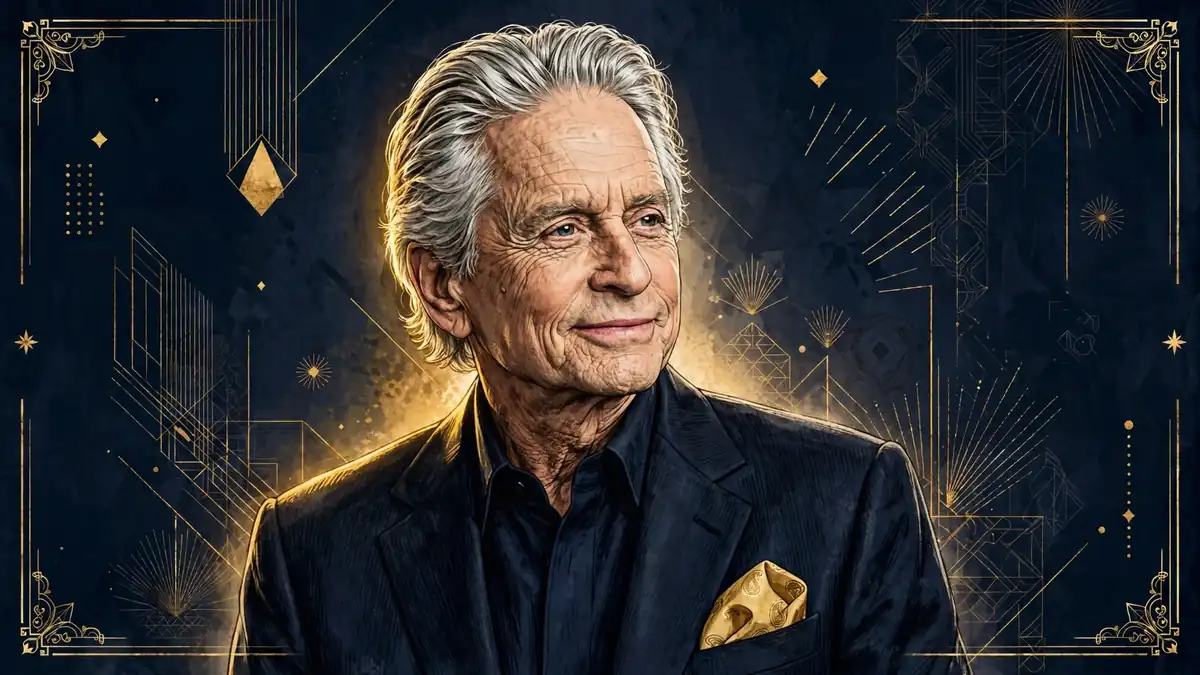
Michael Douglas‘s net worth is estimated at $300 million to $350 million as of November 2026. The headline figure most outlets cite is $350 million, published by Celebrity Net Worth in an October 2026 update, while older estimates sat near $300 million — a gap that reflects how much of a working actor-producer’s wealth sits in residuals, producing stakes and property rather than a bank balance anyone can audit. Douglas built the fortune twice over: first as the producer who turned a book his father could not get made into an Oscar-winning film, then as one of the highest-paid leading men of the 1980s and 1990s, commanding $15 million to $20 million a picture at his peak. A reported $45 million divorce settlement in 2000 cut deep into it, and a Mallorca estate bought for $3.5 million in 1990 has spent a decade on and off the market. In July 2025, at 80, he told reporters at the Karlovy Vary Film Festival that he had not worked since 2022 on purpose and had “no real intentions” of going back — a step back that changes nothing about the fortune, and everything about how it will be remembered.
Michael Douglas: Quick Facts
| Estimated net worth | $350 million (range: $300 million to $350 million) |
|---|---|
| Profession | Actor and film producer |
| Nationality | American (also holds Bermudian status through his mother) |
| Born | September 25, 1944 (age 82) |
| Height | 5 ft 9 in (176 cm) |
| Primary income sources | Film salaries, producing profits and backend participation, television, residuals, real estate |
| Active years | 1966–2022 (acting); producing from 1975; stepped back from acting in 2025 |
| Last reviewed | November 2026 |
- Early Life and Background
- Education
- Career Journey
- Rise to Fame
- Main Sources of Income
- Salary and Earnings
- Businesses and Investments
- Brand Deals and Sponsorships
- Houses, Cars and Other Assets
- Awards and Achievements
- Net Worth Growth Over the Years
- Social Media Presence
- Personal Life
- Sources & Reporting
- Frequently Asked Questions
Early Life and Background
Michael Kirk Douglas was born on September 25, 1944, in New Brunswick, New Jersey, the eldest son of Kirk Douglas — already one of Hollywood’s biggest stars — and actress Diana Dill. The surname was a Hollywood invention itself: his father had been born Issur Danielovitch to Belarusian Jewish immigrants in Amsterdam, New York. Michael grew up in the long shadow of that name, splitting his childhood between Connecticut and Massachusetts after his parents divorced when he was young, and spending summers in California on film sets where his father worked. He has said the divorce, and the distance it put between him and his father, shaped his determination to build a career that did not depend on Kirk’s phone calls.
His mother was born in Devonshire Parish, Bermuda, to a family with deep roots on the island — her father, Lieutenant-Colonel Thomas Melville Dill, had served as Bermuda’s Attorney General and as a Member of Parliament, and her brother was the politician Sir Nicholas Bayard Dill. Through her, Michael holds Bermudian status alongside his American citizenship, a legal fact that later mattered to his property life: Bermuda became one of the three corners of his real-estate map, next to New York and Mallorca. He grew up partly in the orbit of wealth and fame and partly outside it, attending the Allen-Stevenson School in New York, Eaglebrook School in Massachusetts and Choate in Connecticut — the kind of expensive schooling that his father’s money paid for and that he later described as leaving him determined to prove he could earn his own way.
The family story most people miss is the one about the book. Kirk Douglas had bought the rights to Ken Kesey’s novel One Flew Over the Cuckoo’s Nest in the early 1960s and spent a decade trying to get a film version made, with himself as the rebellious patient Randle McMurphy. Studios passed, Kirk aged out of the part, and the rights sat. Michael, still in his twenties, took the project over from his father — a handover that would become the single most profitable decision of his life and the founding story of his fortune. He has told the story many times since, most recently at Karlovy Vary in July 2025, where he presented a restored print of the film for its 50th anniversary: the son finishing the job the father could not.
Douglas’s younger half-brothers from his father’s second marriage — Joel, Peter and Eric Douglas — also worked in film, Peter as a producer and Eric as an actor and comedian before his death in 2004. The Douglas name opened doors, and Michael has never pretended otherwise; his career is better understood as a long effort to show that what walked through those doors could hold a room on its own. That effort started in television, where nobody cared whose son he was once the camera was rolling, and it ended — if it has ended — with two Academy Awards, one for producing and one for acting, a combination only a handful of people in Hollywood history have managed.
Education
Douglas studied drama at the University of California, Santa Barbara, graduating in 1968 with a degree in drama. UCSB gave him two things that mattered more than the diploma: distance from New York and Los Angeles, where his father’s name was inescapable, and a theatre department that treated him as a student rather than a celebrity’s son. He had already decided he wanted to act, but he also wanted the craft — the training that would let him survive a bad review without a famous surname to fall back on.
After graduation he moved to New York and trained under Wynn Handman at the American Place Theatre, one of the city’s serious actor-training grounds. Handman, who coached a generation of American stage actors, drilled the unglamorous fundamentals: voice, body, text, repetition. Douglas spent the late 1960s in New York theatre and small film parts, including his screen debut in Hail, Hero! (1969), for which he received a Golden Globe nomination as most promising newcomer. The pay was small and the work was steady — the opposite of the overnight fame people assumed a Douglas would get, and the reason his later producing instincts were so sharp. He had seen, from the inside, what a production cost and what it returned.
His education also included a less formal course: watching his father negotiate. Kirk Douglas was famous in Hollywood for hard bargaining — he had fought the studios for control of his films through his own company, Bryna Productions, and he had broken the blacklist by crediting Dalton Trumbo on Spartacus. Michael absorbed the lesson that an actor who only acts is an employee, while an actor who produces owns a piece of the picture. That idea, picked up at the dinner table and on sets before he was twenty, explains the shape of his whole fortune: salary was the income, producing was the wealth.
Career Journey
Douglas’s first real break came on television. In 1972 he was cast as Inspector Steve Keller opposite Karl Malden in the ABC crime drama The Streets of San Francisco, and he stayed with the show for four seasons, appearing in 98 episodes. The series made him a recognisable face in American living rooms and, just as usefully, paid him a regular salary while he worked on the film project that would change his life. He left the show in 1976, at the height of its run, to concentrate on producing — a decision that looked reckless to his agents and proved to be the smartest of his career.
One Flew Over the Cuckoo’s Nest reached cinemas in 1975, produced by Douglas and Saul Zaentz and directed by Miloš Forman, with Jack Nicholson in the role Kirk Douglas had wanted for himself. The film cost about $4.4 million to make and grossed roughly $163 million worldwide, winning five Academy Awards including Best Picture — only the second film in history to take all five major Oscars. For a first-time producer in his early thirties, the result was both a fortune and a credential: Douglas now owned a share of one of the most profitable films of the decade, and every studio in town knew he could get a difficult picture made. He has described the film ever since as the foundation of his financial independence, and the numbers back him up — a producer’s share of a $163 million grosser on a $4.4 million budget is the kind of return that working actors almost never see.
He followed it with The China Syndrome in 1979, which he produced and starred in alongside Jane Fonda and Jack Lemmon. The thriller about a near-meltdown at a nuclear power plant opened twelve days before the real Three Mile Island accident, a coincidence that turned a solid film into a cultural event and a box-office success. The same year he proved he could carry a film as a leading man, and the two halves of his career — acting fees and producing profits — were now running side by side. His production company, which he ran through the 1970s and 1980s, kept him in the room where financing decisions were made, and his pay for acting began to climb because studios were bidding for a star who could also deliver a finished picture.
The 1980s made him a movie star. Romancing the Stone (1984), a romantic adventure he produced and starred in with Kathleen Turner and Danny DeVito, grossed more than $115 million worldwide and spawned a sequel, The Jewel of the Nile. Then came the run that defined him: Fatal Attraction (1987), which grossed about $320 million worldwide and became one of the most talked-about films of the decade; Wall Street (1987), Oliver Stone’s portrait of 1980s greed, for which Douglas won the Academy Award for Best Actor as Gordon Gekko; and The War of the Roses (1989), reuniting him with Turner and DeVito in a black comedy about a divorcing couple. Three films in three years, three different registers — thriller, drama, comedy — and a salary that climbed with each one. By the end of the decade he was one of the few actors in Hollywood who could open a film on his name alone.
The 1990s were his peak earning years. Basic Instinct (1992) grossed more than $350 million worldwide and made him, at 47, a global sex symbol in a way that surprised even him. Falling Down (1993), Disclosure (1994) and The American President (1995) kept him at the top of the casting lists, and The Game (1997) and A Perfect Murder (1998) paid him $20 million apiece — the top of the market for a dramatic leading man who did not make action franchises. He was not a superhero and he did not carry a franchise; he was paid like a star because adult dramas and thrillers still filled cinemas in the 1990s, and he was the most reliable name in them. Al Pacino, his great contemporary from the same generation of 1970s-trained actors, followed a parallel path through the same decade — and the comparison is instructive: Pacino’s estimated fortune sits far below Douglas’s, because Pacino never built the producing business that turned Douglas’s salaries into ownership.
The 2000s brought a shift. Traffic (2000), which Douglas made through his own production banner, won the Academy Award for Best Picture and grossed more than $207 million worldwide; Wonder Boys the same year earned him some of the best reviews of his career. He worked steadily through the decade — Don’t Say a Word, One Night at McCool’s, It Runs in the Family (with his father Kirk and his son Cameron, the only film the three generations made together), The Sentinel — but the $20 million paydays stopped coming as the market for adult dramas thinned and the studios turned to franchises. In 2010 he was diagnosed with stage 4 throat cancer. He has spoken plainly since about the treatment, the months he could barely eat or speak, and the way the illness reset his priorities. He came back with Wall Street: Money Never Sleeps (2010), returning as Gordon Gekko twenty-three years on, and then delivered the performance of his late career as Liberace in Steven Soderbergh’s Behind the Candelabra (2013), winning a Primetime Emmy.
His last decade of work was prestige television and Marvel. The Kominsky Method (2018–2021) on Netflix, opposite Alan Arkin, won him a Golden Globe for Best Actor in a comedy series and introduced him to a streaming audience. As Dr. Hank Pym in Marvel’s Ant-Man films (2015–2023) and Avengers: Endgame (2019), he joined the biggest franchise in film history late and on his own terms — a supporting role, a steady cheque, and no obligation to carry the picture. His last major acting work was Franklin (2024), the Apple TV+ miniseries in which he played Benjamin Franklin, and Looking Through Water (2025), a drama in which he appeared with his son Cameron. Then, in July 2025, came the announcement that he was stepping back.
Rise to Fame
Douglas’s rise happened in two distinct waves, and the gap between them is the interesting part. The first wave was The Streets of San Francisco: four years of weekly television that made his face familiar without making him a star. The second was the run from 1984 to 1992, when he went from respected working actor to one of the five most bankable leading men in the world. What separated the waves was producing. The Oscar for One Flew Over the Cuckoo’s Nest gave him a kind of authority no television role could — studios took his calls because he had delivered a Best Picture winner, not because his father was Kirk Douglas.
Fatal Attraction was the film that turned fame into cultural ubiquity. The story of a married lawyer whose weekend affair becomes a nightmare tapped directly into late-1980s anxieties about marriage, fidelity and AIDS, and it grossed $320 million on a $14 million budget. Douglas’s performance — ordinary, weak, recognisable — was the engine of the film, and it made him the go-to actor for stories about successful men coming apart. Wall Street, released the same year, gave him the role that would define him for the rest of his life. Gordon Gekko’s “greed is good” speech entered the language, the Academy gave Douglas its Best Actor award, and the character became shorthand for an entire era of American finance. The irony has followed him ever since: the man who played the most famous fictional capitalist in film history is himself a real-life case study in how Hollywood money is actually made — slowly, through ownership, not through salary alone.
What competitors’ profiles usually skip is how deliberately Douglas managed the fame once he had it. He did not chase franchises in the 1990s when his peers did, and he did not take the action-hero paydays that were on offer. He stayed in adult dramas and thrillers, where his name meant something and his producing stake meant more. When the market for those films collapsed in the 2000s, he moved to television and supporting roles rather than discounting himself into straight-to-video work — a choice that protected both his reputation and his fee. The Kominsky Method and the Marvel films were the payoff for that patience: prestige work and franchise money, taken on his own schedule, in his seventies.
The other half of the rise was his father’s shadow, and Douglas handled it by out-producing it. Kirk Douglas was a bigger star than Michael ever was, and Michael knew it; his answer was to win the Oscar his father never won for acting — Kirk was nominated three times and never took home a competitive award — and to win it first as a producer, with the film his father had tried and failed to make. That is the story Men’s Journal led with in its 2026 profile, and it is the story that makes the $350 million figure credible: this is not a fortune inherited from a famous father. Kirk Douglas died in 2020 aged 103, and the bulk of his reported $60 million estate went to charity through the Douglas Foundation, not to his children. Michael’s money was earned, film by film, deal by deal, over sixty years.
Main Sources of Income
Douglas’s income has always come from four streams, and the balance between them is what makes his fortune different from a pure actor’s. First, acting salaries: the $15 million to $20 million paydays of the 1990s, the television fees from The Streets of San Francisco and later The Kominsky Method, and the Marvel cheques. Second, producing profits: his share of One Flew Over the Cuckoo’s Nest, The China Syndrome, Romancing the Stone and later films made through his own banner, where he participated in the backend — the profits after the studio recouped its costs — rather than taking a flat fee. Third, residuals: the payments that flow every time one of his films is shown on television, streamed or licensed, a stream that runs for decades on a catalogue as deep as his. And fourth, real estate: the Mallorca estate, the Bermuda compound and the New York properties, bought early, held for decades, and sold — or listed — at multiples of their purchase prices.
The producing stream is the one most profiles understate. A $20 million salary is taxed once and spent; a producer’s share of a hit film pays for years. One Flew Over the Cuckoo’s Nest alone, on a $4.4 million budget and $163 million in worldwide gross, generated producing income that dwarfed anything Douglas earned as an actor in the 1970s. Romancing the Stone repeated the pattern: he produced it, starred in it, and shared in its $115 million gross. Traffic, made through his production company in 2000, grossed $207 million and won Best Picture. Each of those films also generated the residual stream that still pays today — every streaming licence, every television rerun, every airline screening of Fatal Attraction or Basic Instinct sends a small payment back to the people who made it, and Douglas is on the list for more of those films than almost any actor of his generation.
Television became a serious income stream late in his career, which is unusual. The Streets of San Francisco paid a working actor’s wage in the 1970s. The Kominsky Method, forty years later, paid a star’s streaming fee: Parade reported that his per-episode pay for the Netflix series was not public, but estimated it in the high hundreds of thousands given his standing, and the three-season run plus a Golden Globe made it one of the most lucrative television jobs of his life. The Marvel films worked the same way in reverse — a supporting role in a franchise that grossed billions, with a fee that Parade and other outlets have put in the single-digit millions across the three Ant-Man films, plus the backend participation that Marvel’s senior cast members negotiate. He did not need the money by then; he took the work because it kept him visible to the audience that would buy the next ticket, and the money followed.
There is also the income nobody can see: investments. Douglas has never spoken in detail about a stock portfolio or a business empire, and no filing or rich list has ever itemised one — which is itself a useful fact. Unlike some of his peers, he did not put his name on a tequila brand or a clothing line, and he did not build a second career as a venture investor. His wealth is concentrated in the two things he understands best: films and houses. That concentration is a risk in theory and a strength in practice, because both were bought with knowledge he actually had — he knew what a film cost and what it returned, and he knew what a clifftop in Mallorca was worth before the market did.

Salary and Earnings
The salary record is unusually well documented, because Celebrity Net Worth has published a named list of Douglas’s biggest paydays and the trade press has repeated them for years. Six of them, added together, come to $85 million — and they cover only a slice of a career that spans more than sixty films. The list is: Basic Instinct (1992), $15 million; The American President (1995), $15 million; The Game (1997), $20 million; A Perfect Murder (1998), $20 million; Wonder Boys (2000), $5 million; and Traffic (2000), $10 million. The drop between 1998 and 2000 tells its own story: Wonder Boys was a small literary adaptation he took for the part, not the pay, and Traffic was his own production, where he traded salary for ownership. The $20 million peak, reached twice in two years, put him at the very top of the dramatic-actor market — the same bracket as the biggest stars of the decade, without a single franchise film to his name.
Earlier paydays were smaller but the pattern was already there. For Fatal Attraction (1987), reports put his pay at $13 million to $15 million including base salary and gross participation — a figure that looks modest next to the film’s $320 million gross until you remember that the participation, the share of the gross, was the point. For Disclosure (1994), trade reports put his fee near $12 million. The contrast that still gets quoted is Basic Instinct: Sharon Stone, his co-star, was paid $500,000 for the same film, while Douglas took home a reported $13.5 million to $14 million. Stone has spoken about the gap herself, at the New York Women in Film and Television Muse Awards, where she noted that she had already made seventeen films and that Douglas was simply the bigger star. The gap is a period fact, not a judgement — and it shows how steeply Hollywood paid its male leads in 1992, and how much of Douglas’s fortune was built in a market that no longer exists.
What did he earn per year at his peak? Parade estimated that he took home upwards of $30 million a year through his combined acting and producing work during his busiest years — a figure that blends salary, producing fees and backend, and that no single source can verify line by line. It is best read as an order of magnitude, not an audit: two $20 million films in two years, plus producing income, plus residuals from a catalogue that was already deep, easily clears $30 million in a good year before tax, agents’ commissions and the divorce settlement that followed. After tax, a working actor in California keeps roughly half of gross earnings, and Douglas’s agents and managers took their standard percentages on top. The $350 million net worth is what survived sixty years of that arithmetic — which is why it is more impressive than the salary list alone suggests.
The Marvel years paid differently. His fee for the first Ant-Man (2015) was never disclosed, and the often-quoted $850,000 figure for Ant-Man and the Wasp: Quantumania (2023) is unsubstantiated — Parade flagged it as such, and no trade outlet has confirmed it. What is safe to say is that a senior Marvel supporting player with his standing earns in the single-digit millions per film, and that the franchise work was never about the fee. It was about staying in the biggest films on earth in his seventies, and about the residuals that a Marvel film generates for decades. The same logic applied to Franklin and The Kominsky Method: prestige work, streaming money, and a fee that reflected sixty years of standing rather than a single opening weekend.
Businesses and Investments
Douglas’s business was producing, and he ran it as a business rather than a hobby. After One Flew Over the Cuckoo’s Nest he kept his hand in production through the 1970s and 1980s, developing projects, arranging financing and taking a producer’s share of the returns — the work that turned a salary earner into an owner. His later production banner, Further Films (founded as Furthur Films), produced Traffic, Wonder Boys, Don’t Say a Word and One Night at McCool’s, among others. The company never became a mini-studio, and that was the point: it was a vehicle for films Douglas wanted to make, structured so that he shared in the upside when they worked and limited his exposure when they did not.
He also held the rights that mattered. The Cuckoo’s Nest rights, bought by his father and carried by the son, are the textbook case: a piece of intellectual property held for a decade, developed patiently, and turned into a Best Picture winner. He has never built a portfolio of the kind that fills rich-list profiles — no restaurant chain, no sports team, no venture fund with a press release. The absence is worth stating plainly, because profiles that invent a business empire for him are inventing it: his investments, as far as the public record shows, are films and property, and both are visible in the numbers. A 2010s profile in Men’s Journal put it well — the fortune was built by a movie his father could not make, and then by the salaries that movie made possible.
His other long-running commitment is public, not commercial. Douglas has served as a United Nations Messenger of Peace since 1998, working on disarmament and nuclear non-proliferation — a role that pays nothing and that he has kept for nearly three decades. He has also been a long-time supporter of gun-control campaigning in the United States, writing and speaking on the subject after his own family’s experience with gun violence. None of this adds to the net worth, and it belongs in the picture anyway: it is where a share of his time and money has gone for most of his adult life, and it is part of why the post-acting years look like a choice rather than a retreat.
Brand Deals and Sponsorships
Douglas never built a career on endorsements, and the record shows it. There is no long list of brand deals, no signature product, no fashion line and no spirits brand with his name on the label — the standard second fortune for actors of his generation. He appeared in advertising early in his career, as most working actors did, and he has lent his name to causes rather than products since. The contrast with his peers is sharp: where other stars of the 1980s and 1990s turned fame into licensing income, Douglas turned it into producing equity, which pays longer and depends less on staying fashionable.
That restraint is part of the financial story. Endorsement money is fast, visible and short-lived; a producer’s backend on a film that grosses $163 million pays for decades. The absence of a brand-deal portfolio is also why the $350 million estimate holds up under scrutiny: it is built from documented salaries, documented producing hits and documented property, not from a guessed endorsement value. Readers should treat any profile that credits Douglas with a major brand fortune as guessing — the public record does not support one, and neither does his own account of his career.

Houses, Cars and Other Assets
Property is the most visible part of Douglas’s wealth, and the Mallorca estate is its centrepiece. S’Estaca, a historic estate near Valldemossa on the west coast of Mallorca, was bought by Michael and his first wife Diandra in 1990 for $3.5 million. The property traces its history to Archduke Ludwig Salvator of Austria, who developed it in the 19th century, and it includes a collection of residences and guest accommodation with 10 bedrooms and 11 bathrooms, a library, a home theatre, a wine cellar, a vineyard, a heated pool, terraces and direct views of the Mediterranean. How big is it? Earlier accounts described 250 acres; Douglas himself described it as 190 acres in a 2026 interview, and the smaller figure is the one he gave most recently. Either way, it is a large estate, and the price history shows what three decades of holding prime Mediterranean land does: the couple put it on the market in 2014 for $60 million, and it was still on the market in January 2025 at $10.75 million, with the asking price falling to $9.75 million by 2026, according to Celebrity Net Worth’s updated profile. The gap between the 2014 ask and the 2026 ask is a lesson in how illiquid a trophy property can be — a house can be worth a fortune on paper and still not sell.
The estate also carried the divorce. After Diandra filed in 1995 and the divorce was finalised in 2000, the former couple kept joint ownership of S’Estaca and divided their time there — six months each, an arrangement Douglas later told the Mallorcan newspaper Ultima Hora in 2021 was uncomfortable for everyone. He eventually bought out her share and now owns the estate outright with his wife, Catherine Zeta-Jones. Celebrity Net Worth dates the buyout to 2020; other reports put it a year later. The exact year matters less than the outcome: the estate that once split a marriage now belongs to one household, and it remains the single most valuable property Douglas owns.
Bermuda was the second corner. Douglas and Zeta-Jones owned a three-acre compound in Warwick Parish, Bermuda — an eight-bedroom, eight-bathroom retreat with a gym, sauna, tennis court and swimming pool, on the island where his mother was born and where he holds status. They sold it in 2019 for $10 million, about $30 million less than the price they had originally listed it for, according to Hello! magazine. The sale is the mirror image of the Mallorca story: a trophy property, bought for family reasons, sold at a steep discount to its asking price when the moment came to let it go. Between them, the two sales tell the truth about celebrity property portfolios — the purchase prices are bargains in hindsight, the asking prices are ambitions, and the sale prices are the only numbers that count.
The rest of the portfolio is quieter. Douglas and Zeta-Jones own four properties between them, according to biographical reporting: one in Canada, one in Spain, and two in New York — a Manhattan apartment and a home upstate, in the Bedford area where they have lived for years. Hello! magazine, which has tracked the couple’s property moves in detail, has put the combined value of their homes at around $60 million. They have also lived in a flat in central London with ties to St James’s Palace. Cars, by contrast, barely register in the record: Douglas has never been a collector in the public eye, and no profile credibly attaches a car collection to his name. The wealth sits in houses and film rights, not in a garage.
Awards and Achievements
The awards list is short, heavy and unusual, because it spans both sides of the camera. Douglas has won two Academy Awards: Best Picture as a producer of One Flew Over the Cuckoo’s Nest (1975), and Best Actor for Wall Street (1987). He has won five Golden Globes, including Best Actor for Wall Street and Best Actor in a television comedy for The Kominsky Method, and the Cecil B. DeMille Award for lifetime achievement. He won a Primetime Emmy for Behind the Candelabra (2013), and he holds the AFI Life Achievement Award, presented in 2009. The combination matters: very few people have won Oscars for both producing and acting, and the two together are the reason his name carries weight in rooms where money is decided as well as in rooms where awards are handed out.
The career honours also include the practical kind. One Flew Over the Cuckoo’s Nest won five Academy Awards — Best Picture, Director, Actor, Actress and Adapted Screenplay — only the second film ever to sweep the five major categories. Traffic won four Academy Awards including Best Picture and Best Director. Fatal Attraction was nominated for six Academy Awards. And the Karlovy Vary Film Festival, where he announced his step back from acting in July 2025, gave him its President’s Award in 2025 and screened the restored Cuckoo’s Nest for its 50th anniversary — a festival honour that doubled as a career retrospective, with the film that started his fortune at the centre of it.
His contemporaries offer a useful yardstick. Clint Eastwood, who also moved between acting and directing and built a fortune on ownership rather than salary alone, is estimated by Celebrity Net Worth at around $375 million — close to Douglas, and built the same way. Jack Nicholson, his Cuckoo’s Nest co-star, sits near $400 million on the same source’s figures. Douglas’s $350 million puts him in the same bracket as the greats of his generation, and ahead of most of them — including Kevin Costner, whose estimated $250 million fortune was built on a similar mix of acting and producing, and Tom Cruise, whose fortune comes from a very different model of franchise stardom. The peer table in the next section lays the comparison out in full.
Net Worth Growth Over the Years
The table below is an editorial reconstruction, not a bank statement: it combines the documented salary record, the known producing hits, the reported $45 million divorce settlement and the published estimates at each stage. No source publishes a year-by-year balance sheet for a private individual, so the figures are approximate and the direction of travel is the point — a slow build through the 1970s, a steep climb through the 1980s and 1990s, a cut in 2000, and a long plateau as property and residuals replaced salary.
| Year | Estimated net worth | What moved it |
|---|---|---|
| 1975 | About $1 million | One Flew Over the Cuckoo’s Nest wins Best Picture; first producing profits arrive |
| 1980 | About $10 million | The China Syndrome; steady television and film work |
| 1987 | About $40 million | Fatal Attraction and Wall Street in the same year; Oscar for Best Actor |
| 1992 | About $100 million | Basic Instinct grosses $350 million; $15 million salary |
| 1998 | About $180 million | Back-to-back $20 million paydays for The Game and A Perfect Murder |
| 2000 | About $200 million | Divorce settlement of a reported $45 million finalised; Traffic grosses $207 million |
| 2010 | About $300 million | Older published estimates cluster near $300 million; cancer diagnosis and comeback |
| 2020 | About $300 million | Bermuda compound sold for $10 million; Mallorca buyout completed |
| 2026 | $300 million to $350 million | Celebrity Net Worth updates its estimate to $350 million in October 2026 |
The peer comparison puts the figure in context. All figures below are Celebrity Net Worth estimates, published on the same basis, and all are approximate:
| Actor | Estimated net worth | How it was built |
|---|---|---|
| Michael Douglas | $350 million | Acting salaries plus producing ownership |
| Jack Nicholson | $400 million | Acting salaries plus profit participation and property |
| Clint Eastwood | $375 million | Acting plus directing and producing ownership |
| Dwayne Johnson | $800 million | Franchise salaries plus business ventures and endorsements |
| Kevin Costner | $250 million | Acting plus producing and land |
| Al Pacino | $120 million | Acting salaries, limited producing |
Two things stand out. First, Douglas sits above Pacino by a wide margin despite parallel careers, and the difference is producing: Pacino acted, Douglas acted and owned. Second, he sits below Dwayne Johnson by an even wider margin, and the difference runs the other way: Johnson built a business empire on top of acting, while Douglas built a producing business inside film. Both models work; Douglas’s is the older one, and it has the advantage of depending on nothing but the films themselves.
Social Media Presence
Douglas keeps a low, personal social media presence, and it has never been a source of income. His Instagram account, where he posts family photographs, tributes to his father and the occasional behind-the-scenes image, has a following in the low millions — large for a man of 82 who joined the platforms late, small next to the stars of the streaming era. He uses the accounts the way a private person does: birthdays, anniversaries, photographs with Catherine Zeta-Jones and their children, and tributes on the anniversaries of his father’s death. There are no sponsored posts, no product launches and no brand partnerships on the feed, which is consistent with the rest of his career: the audience is a by-product of the work, not a product in itself.
That modesty has a financial meaning. For actors of the current generation, a social following is a line on the balance sheet — brands pay for reach, and reach is priced. For Douglas, whose fortune was built before social media existed, the following is reputation rather than revenue. It matters to his standing, and to the way his step back from acting was received — the July 2025 announcement travelled through his own posts and the festival coverage, not through a press release — but it does not move the net worth figure, and no honest estimate should pretend it does.
Personal Life
Douglas married Diandra Luker in March 1977, when he was 32 and she was 19, after meeting at a party for President Jimmy Carter’s inauguration. Their son Cameron was born in 1978. The marriage lasted more than two decades, and its end was one of the most expensive divorces in Hollywood history: Diandra filed in 1995, and the divorce was finalised in 2000 with a settlement reported at $45 million, plus homes in Beverly Hills and Mallorca. The settlement also left her with a share of the proceeds of films made during the marriage, and in 2011 she brought a claim over his earnings from Wall Street: Money Never Sleeps, arguing that the sequel’s profits derived from a character created during their marriage. The claim was fought in New York and California courts and resolved in Douglas’s favour on jurisdictional grounds — but the episode shows how long a divorce settlement can keep costing, a decade after the papers are signed. Adjusted for inflation, the $45 million of 2000 would be roughly $92 million to $95 million in today’s money, according to EntertainmentNow’s calculation — a scale that puts the settlement next to the fortune itself, and explains why the net worth figure stayed near $300 million for so long after it.
He began dating Catherine Zeta-Jones in March 1999, while his divorce was still being finalised, and married her in November 2000 at the Plaza Hotel in New York. Their children, Dylan and Carys, were born in 2000 and 2003. The marriage has lasted twenty-six years, through his cancer diagnosis in 2010, a brief separation in 2013 that the couple reconciled, and the long, public business of being one of Hollywood’s most photographed couples. Zeta-Jones has her own substantial fortune — Celebrity Net Worth puts it at $45 million — and the couple’s combined property portfolio, valued by Hello! magazine at around $60 million, is held jointly. Their finances are separate in the ways that matter and shared in the ways that show: the houses, the holidays in Mallorca, the life in Bedford, New York, where they have lived for years.
His son Cameron, born in 1978, has spoken openly about addiction and a prison sentence for drug offences, and about his father’s support through both. The three generations of Douglas men appeared together in It Runs in the Family (2003), and father and son acted together again in Looking Through Water (2025) — a late-career pairing that Douglas has described as one of the satisfactions of his final working years. His father Kirk died in February 2020 at 103; his mother Diana died in 2015 at 92. Douglas has said that losing his father, and then surviving his own cancer, changed his sense of what the remaining years were for — a remark that reads differently now that he has stopped working, on purpose, at 80.
Sources & Reporting
Celebrity Net Worth — the $350 million estimate (profile updated October 2026), the six named film salaries totalling $85 million, the $45 million divorce settlement, the S’Estaca purchase price of $3.5 million and its asking-price history, and the Bermuda property details.
Parade — the $350 million figure for 2026, the $10 million to $20 million peak salary range, the $30 million-a-year peak earnings estimate, and the unconfirmed nature of the reported Marvel pay figures.
Men’s Journal and The Spun — the October 2026 update of the $350 million estimate and the story of One Flew Over the Cuckoo’s Nest as the film his father could not get made.
Variety — the July 5, 2025 Karlovy Vary report of Douglas’s step back from acting, including his words: “I have not worked since 2022 purposefully because I realized I had to stop.”
AARP — the July 2025 account of the Karlovy Vary appearance, the Franklin and Kominsky Method career summary, and the “if something special came up, I’d go back” qualification.
Hello! magazine — the couple’s property portfolio (valued near $60 million), the S’Estaca history and the 2021 buyout account, the Bermuda sale at $10 million, and the divorce settlement reporting.
The Guardian — coverage of the July 2025 step-back announcement, carried in reporting of the Karlovy Vary remarks.
Wikipedia — biographical background (birth date, family, Bermudian status, filmography dates) cross-checked against the reporting above.
Reporting window: October–November 2026. Figures are estimates drawn from public reporting, not audited statements. Where sources conflict — the $300 million versus $350 million estimates, the size of S’Estaca, the year of the Mallorca buyout — the article gives the range and names the source for each figure.
Frequently Asked Questions
What is Michael Douglas’s net worth in 2026?
Michael Douglas’s net worth is estimated at $350 million as of November 2026, according to Celebrity Net Worth, which updated its profile in October 2026. Older estimates put the figure near $300 million, so the honest answer is a range of $300 million to $350 million. The figure is an estimate built from public reporting — salaries, producing profits and property — not an audited balance sheet.
How did Michael Douglas make his money?
He made it in two ways: as an actor and as a producer. His acting peak paid $15 million to $20 million per film in the 1990s, and six named salaries alone total $85 million. His producing work paid more over time — he produced One Flew Over the Cuckoo’s Nest, which cost about $4.4 million and grossed roughly $163 million, and shared in the profits of The China Syndrome, Romancing the Stone and Traffic. Residuals from a catalogue of more than sixty films and a property portfolio led by the Mallorca estate S’Estaca make up the rest.
How much was Michael Douglas paid for Basic Instinct?
Michael Douglas was paid a reported $15 million for Basic Instinct (1992), according to Celebrity Net Worth. His co-star Sharon Stone was paid $500,000 for the same film, a gap Stone has discussed publicly. Douglas’s own pay for the film has also been reported at $13.5 million to $14 million in other accounts, so the $15 million figure is the most widely cited rather than a confirmed contract figure.
Is Michael Douglas still acting?
Not currently. In July 2025, at the Karlovy Vary Film Festival, Douglas said he had not worked since 2022 on purpose and had “no real intentions” of going back, after nearly sixty years of working. He stopped short of calling himself retired, saying he would return “if something special came up” — and he mentioned one small independent film he was trying to get a good script for. His last major roles were Benjamin Franklin in the Apple TV+ miniseries Franklin (2024) and Looking Through Water (2025), with his son Cameron.
How much did Michael Douglas pay in his divorce from Diandra Luker?
The settlement was reported at $45 million, plus homes in Beverly Hills and Mallorca, when the divorce was finalised in 2000 after Diandra filed in 1995. She also received a share of proceeds from films made during the marriage, which led to a further court dispute in 2011 over Wall Street: Money Never Sleeps. Adjusted for inflation, the $45 million of 2000 would be roughly $92 million to $95 million today.
Who is Michael Douglas married to?
Michael Douglas has been married to Welsh actress Catherine Zeta-Jones since November 2000. They have two children, Dylan (born 2000) and Carys (born 2003). He was previously married to film producer Diandra Luker from 1977 to 2000, and they have a son, Cameron, born in 1978.
How much did Michael Douglas inherit from Kirk Douglas?
Very little, as far as the public record shows. Kirk Douglas died in 2020 aged 103 with a reported fortune of about $60 million, and the bulk of it went to charity through the Douglas Foundation rather than to his children. Michael’s $350 million fortune was built from his own acting salaries, producing profits and property over sixty years — not from an inheritance.
How much does Michael Douglas make per movie?
At his peak in the 1990s he commanded $15 million to $20 million per film — $20 million each for The Game (1997) and A Perfect Murder (1998). By the 2000s the paydays had fallen: $5 million for Wonder Boys and $10 million for Traffic, both in 2000. His later work paid less per project — his Marvel and streaming fees were never disclosed — and since 2022 he has not taken a role at all.
Final Thoughts
Michael Douglas’s $350 million fortune is the record of a career built the hard way: a producer’s share of a film his father could not make, a decade of the highest salaries in Hollywood, and a property portfolio bought early and held for decades. The number itself is an estimate, and the honest range is $300 million to $350 million — but the shape of it is not in doubt. He earned it as an owner rather than only as a star, and that is why it survived a $45 million divorce, a cancer diagnosis and the collapse of the adult drama that made him rich.
His step back from acting in 2025, announced at 80 with the words “I have not worked since 2022 purposefully”, closes the earning chapter without closing the story. The films still pay residuals, the Mallorca estate still sits on its cliff, and the two Oscars — one for producing, one for acting — still mark a combination almost nobody else in Hollywood has managed. If something special comes up, he says he will go back. If it does not, the fortune is already made, and it was made by the man himself.
Published on 2026-11-24. Last reviewed November 2026. Found an error? See our corrections policy.