
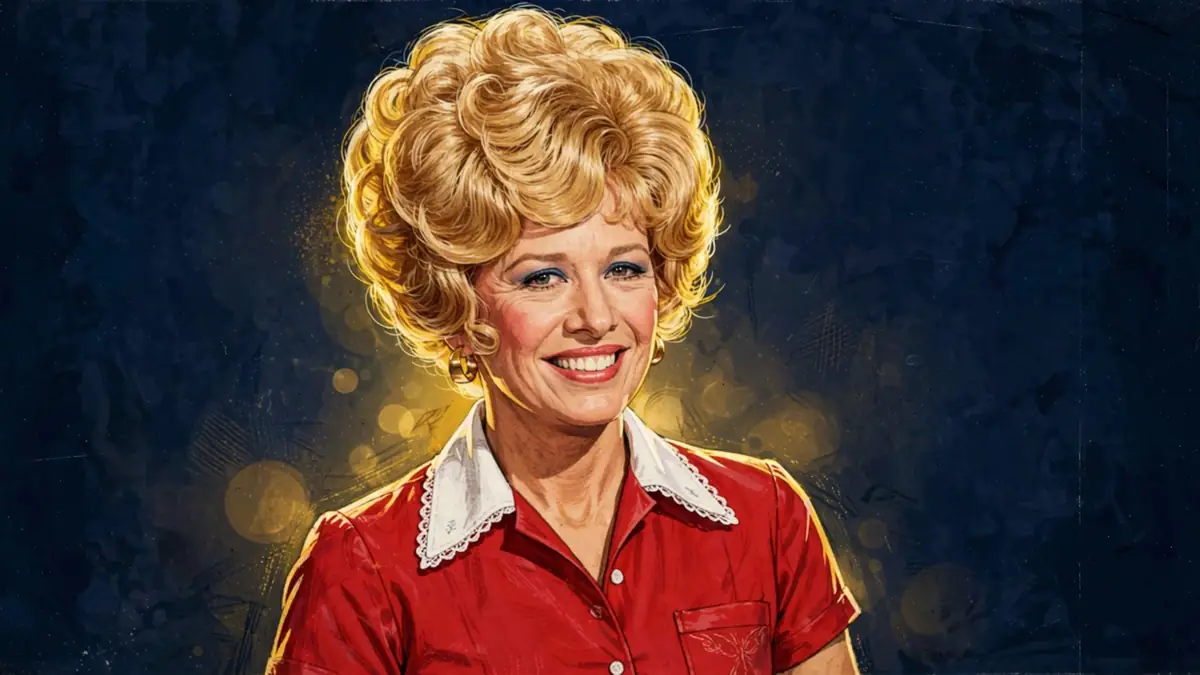
Polly Holliday‘s net worth is estimated at $4 million as of October 2026. Celebrity Net Worth set that figure at the time of her death on September 9, 2025, and it remains the most-cited anchor: other outlets put her anywhere from $2 million to $5 million, so our honest range is $2M–$5M. Holliday built that fortune the old-fashioned way — four seasons as sassy waitress Flo Castleberry on CBS’s Alice plus her own spin-off Flo, a decade of classical stage work before anyone knew her name, film roles in Gremlins and Mrs. Doubtfire, and decades of syndication residuals. Unlike the Hollywood moguls of her generation, she left no public filings, no business empire, and no memoir — so this estimate is assembled from named reporting, not guesswork.
Polly Holliday: Quick Facts
| Estimated net worth | $4 million (range: $2M–$5M) |
|---|---|
| Profession | Actress (television, film, stage) |
| Nationality | American |
| Born | July 2, 1937 (died September 9, 2025, aged 88) |
| Height | 5 ft 8 in (1.73 m) |
| Primary income sources | TV salaries (Alice, Flo), residuals, film roles, stage work |
| Active years | 1963–2010 |
| Last reviewed | October 2026 |
- Quick Facts
- Early Life and Background
- Education
- Career Journey
- Rise to Fame
- Main Sources of Income
- Salary and Earnings
- Businesses and Investments
- Brand Deals and Sponsorships
- Houses, Cars and Other Assets
- Awards and Achievements
- Net Worth Growth Over the Years
- Social Media Presence
- Personal Life
- Sources & Reporting
- Frequently Asked Questions
- Final Thoughts
- Related Profiles
Early Life and Background
Polly Dean Holliday was born on July 2, 1937, in Jasper, Alabama, and grew up in nearby Childersburg. Her father, Ernest Sullivan Holliday, drove a truck for a living; her mother, Velma Mabell Cain Holliday, kept house. Money was working-class and honest — the summers she spent riding along in her father’s truck would later feed directly into her most famous character. At Childersburg High School she was voted “most talented” in her senior class, a small early signal of where the piano lessons were heading.
Her brother Doyle grew up alongside Jim Nabors — the future star of The Andy Griffith Show — in nearby Sylacauga, a detail that ties Holliday’s Alabama childhood to the same small-town Southern television world she would eventually help define. The contrast between that upbringing and the Manhattan apartment where she died 88 years later is the whole arc of her financial story: a girl from a truck-driver’s household who became one of the most recognizable faces on American television.
Education
Holliday’s formal training was in music, not drama. She attended the Alabama College for Women at Montevallo (now the University of Montevallo) in the late 1950s, where she played the leads in The Lady’s Not for Burning and Medea while majoring in piano. She graduated in 1959, then pursued graduate work in music education at Florida State University — facts confirmed by her New York Times obituary reporting and her Legacy.com obituary.
One correction worth making: several net-worth sites, including Celebrity Net Worth, list Texas Christian University as her school. The obituary record from the outlets that actually reported her death is consistent — Montevallo, then Florida State — and that’s what we’ve used. It’s a small thing, but it illustrates the verification standard: the biographies that copy each other get the school wrong; the ones that reported her death get it right.
After school she worked as a piano teacher in Alabama and Florida. Her first paid acting work came at age 19, in the summer of 1956, when she joined the outdoor drama Unto These Hills in North Carolina as a choir singer and square dancer. The pay was $40 a week plus room and board — a figure she herself recalled in interviews, including one with Actors’ Equity cited by People. That $40-a-week job is the earliest documented paycheck of a career that would end, seven decades later, with an estate worth millions.
Career Journey
Holliday’s professional stage career began at the Asolo Repertory Theatre in Sarasota, Florida, where she spent a full decade as a company member (1962–1972), playing everything from Major Barbara to As You Like It to the title role in Candida. Regional theater wages in that era were modest — enough to live on, not enough to build wealth — and she supplemented them by teaching piano and music in elementary schools. This was a working actress’s apprenticeship, not a shortcut.
She moved to New York in the early 1970s. Her off-Broadway debut came in Orphee in 1964, and her Broadway debut in 1974 in All Over Town — notably directed by Dustin Hoffman, who later returned the favor by casting her as Dorothy Michaels’s Southern-accented foil in the 1982 film Tootsie. Small film parts followed: The Catamount Killing (1974), W.W. and the Dixie Dancekings (1975), and a bit part as Dardis’s secretary in All the President’s Men (1976). None of them paid real money. What they did was put a 39-year-old character actress — unusually late for a television breakthrough — in front of the right casting directors at exactly the right moment.
Her last screen credit was Fair Game (2010), playing Diane Plame, the mother of Valerie Plame. She retired quietly after that, with an active career spanning 1963 to 2010.
Rise to Fame
In 1976, at 39, Holliday landed the role of Florence Jean “Flo” Castleberry, the gum-cracking, man-hungry waitress at Mel’s Diner on CBS’s Alice — a sitcom spun off from the 1974 Martin Scorsese film Alice Doesn’t Live Here Anymore. Flo’s catchphrase, “Kiss my grits!”, became a national catchphrase within a season, printed on T-shirts and quoted by schoolchildren. Holliday later told the Sarasota Herald-Tribune (via the Associated Press) that the truck-stop waitresses she’d watched as a girl — women “not well-educated, but very sharp, with a sense of humor” — were the model.
The role earned her two Golden Globe Awards (1979 and 1980, Best Supporting Actress in a Television Series) and three Primetime Emmy nominations. At the height of Flo’s popularity, CBS gave Holliday her own spin-off: Flo (1980–1981), relocating the character to her native Texas. It ran two seasons and earned her a fourth Emmy nomination plus a 1981 Golden Globe nomination for Best Actress in a Comedy Series — but the show never caught fire, and she left the role behind.
Walking away from Alice at the peak of Flo-mania was a calculated financial gamble. In 1980, Holliday was the breakout supporting player on a hit network show; trading that for a lead vehicle meant betting she could carry a series — and lead-actress money — on her own. Flo lasted 29 episodes over two seasons: respectable, but the cancellation ended her run as a series lead, and she never headlined a show again. That makes 1980–81 the clear high-water mark of her earning power. The move also cost her five more seasons of Alice salary and a larger residual base — a trade-off that likely trimmed her lifetime earnings, even though the two Golden Globes she already owned kept her quote high for everything that followed.
She was strategic about not getting trapped. In 1981 she replaced Eileen Brennan on the television adaptation of Private Benjamin after Brennan’s car accident, then rebuilt herself as a character actress for hire: Rose Nylund’s blind sister Lily on The Golden Girls, Jill Taylor’s mother Lillian on Home Improvement (a recurring role across multiple seasons), and parts on Murder, She Wrote, The Dukes of Hazzard, Designing Women, The Equalizer, The X-Files, and the legal drama The Client. The character-actress years that followed were steady rather than spectacular. On Private Benjamin (1981–1983), she stepped in as Captain Doreen Lewis after Eileen Brennan’s car accident — a high-profile replacement gig on an established hit. She played Rose Nylund’s blind sister Lily in two episodes of The Golden Girls, recurred across multiple seasons of Home Improvement as Jill Taylor’s mother Lillian, and co-starred in the CBS legal drama The Client (1995–1996). None of these paid leading-lady money, but together they kept her continuously employed through the 1980s and 1990s — the working actor’s version of diversification. On film she was unforgettable as the ruthless Ruby Deagle in Gremlins (1984) — a Saturn Award-winning turn — and later as Gloria Chaney in Mrs. Doubtfire (1993) and Marva Kulp Sr. in The Parent Trap (1998). She never headlined a hit again; she didn’t need to. Flo had already done the compounding.
Main Sources of Income
Holliday’s $4 million was assembled from four streams, none of them exotic:
- Network television salaries (1976–early 2000s). Alice ran nine seasons; Holliday starred in four. Flo gave her two more seasons as a lead. Recurring roles on Home Improvement, The Client, and Private Benjamin, plus dozens of guest spots, kept her employed into the 2000s.
- Syndication residuals. Alice aired in reruns for decades after its 1985 finale. Under SAG-AFTRA residual formulas, principal cast members receive payments each time episodes re-air — a diminishing but remarkably long tail that likely paid Holliday well into her retirement. NetWorthRanker and DailyWikiBio both identify residuals as a core pillar of her wealth, and the math supports it: four seasons of a show that aired in syndication for 30+ years.
- Film paychecks. Supporting roles in studio pictures — Gremlins, Mrs. Doubtfire, The Parent Trap, Moon Over Parador, The Heartbreak Kid — paid per-picture fees, with Gremlins (one of 1984’s biggest hits) the most lucrative by far.
- Stage work. Broadway paid real money by the 1980s and 1990s: Arsenic and Old Lace (1986), the Tony-nominated Cat on a Hot Tin Roof (1990), Picnic (1994), and Lincoln Center’s The Time of the Cuckoo (2000). Weekly Broadway salaries for featured players in that era ran into the low thousands — respectable, not fortune-making, but steady.

Salary and Earnings
Here is where honesty requires a correction. One net-worth site, MediaCoverage.com, claims Holliday earned $200,000 per episode at her peak on Alice. That number is unsourced, appears nowhere else, and does not survive contact with television economics. In the late 1970s, even the biggest sitcom stars earned a fraction of that per episode — six-figure weekly sitcom salaries did not become standard until the 1990s (Seinfeld, Friends era). No contemporaneous trade reporting, no memoir, no interview ever attached a dollar figure to Holliday’s Alice contract. We treat the $200,000 figure as unreliable and exclude it from our estimate.
What the record actually supports: NetWorthRanker, the most careful of the estimator sites, puts her peak Alice pay in the “several thousand dollars per episode” range, with residuals of hundreds to low thousands per re-air — plausible for a breakout supporting player on a hit 1970s network sitcom, and consistent with what guild minimums plus star bumps produced in that era. The spin-off Flo would have paid a lead-actress premium over her Alice supporting salary, though the exact number was never reported.
One outlet, CineNetWorth, claims her annual income was around $300,000 as of 2025 from acting, residuals, and other streams. That figure comes from a single source with no cited basis, so we report it as claimed-by-one-outlet rather than verified. It is, however, directionally consistent with a comfortable retirement funded by residuals, union pension benefits, and savings — which is exactly how IASmania describes her later years: financially prudent, self-sufficient, living modestly in Manhattan with no extravagant spending on record.
The big-picture earnings arc is clear even without exact contracts: near-zero through the 1960s (regional theater + teaching), a sharp step up in 1976 that lasted through the early 1980s, steady working-actress income through the 1990s and 2000s, and a long residual tail after 2010.
The residual math deserves a closer look, because it is the least understood part of her fortune. Alice produced 202 episodes across nine seasons (1976–1985), and Holliday appears in roughly the first 90 — four seasons as a series regular. Under the SAG residual formulas of the era, each network rerun and syndication airing triggered a payment scaled to her original session fee, declining with each cycle but never reaching zero. A show that aired in syndication from the mid-1980s into the 2000s could plausibly generate a five-figure annual trickle for a four-season regular decades after cancellation — and Holliday collected that trickle for roughly 25 years after she stopped working. Add a vested SAG-AFTRA pension from 47 years of union work, and her retirement income was structurally sound even before savings entered the picture.
She worked from 1963 to 2010 — 47 years — and the compounding of a frugal lifestyle over that span is what turns a character actress’s career into a $4 million estate.
Businesses and Investments
Holliday had no documented business ventures — no production company, no restaurant chain trading on Flo’s name, no lifestyle brand. In an era when every sitcom star seemed to open a theme restaurant, she conspicuously did not. There is also no public record of stock portfolios, startup investments, or endorsement equity, and unlike modern celebrities she filed no disclosures that would reveal them.
That absence is itself informative. The estimator sites that credit her with “investments in stocks and bonds” (CineNetWorth) offer no evidence beyond assertion. What we can say with confidence: she was a lifelong SAG-AFTRA member with access to the union’s pension and health plans, she lived well below her means in her later years according to multiple obituary-adjacent profiles, and she never married or had children — which simplified her finances and likely kept her savings intact. The $4 million, in other words, looks like the product of earnings minus modest spending over five decades, not of deal-making.
Brand Deals and Sponsorships
None are documented. Despite creating one of the most merchandisable catchphrases in television history — “Kiss my grits!” appeared on T-shirts, mugs, and bumper stickers at the height of Flo-mania — there is no record of Holliday cutting personal endorsement or licensing deals around it. Catchphrase merchandise of that era was typically controlled by the network and studio, not the performer, and no reporting suggests she negotiated a carve-out.
She did appear as herself in a 2010 advertising campaign for the Episcopal Church, but that was a faith-based public-service appearance, not a paid brand deal of any meaningful value. Competitors that imply endorsement income contributed to her wealth are speculating; the honest accounting is that brand deals contributed effectively nothing.

Houses, Cars and Other Assets
Holliday died in her home in Manhattan on September 9, 2025, and multiple profiles describe her as having lived there modestly for years. The property’s value was never publicly reported, but Manhattan real estate — even a modest apartment held for decades — represents a meaningful asset in a $4 million estate.
CineNetWorth claims she also owned a home in Los Angeles and a ranch in Texas purchased in the 1980s. That claim appears in exactly one outlet with no property records cited, so we flag it as unverified rather than fact. No vehicle collection, yacht, or luxury-asset trail exists in any reporting — consistent with a performer who, by every account, spent quietly.
She is buried at Green Hill Memorial Gardens in Childersburg, Alabama, beside her mother — a final detail, reported by Wikipedia’s obituary-sourced entry, that says something about where her loyalties (and her money) stayed.
Awards and Achievements
Holliday’s trophy case is the financial subtext of this whole article — awards don’t pay directly, but they set the salary floor for everything after. Her record:
- Golden Globe Awards: won Best Supporting Actress in a Television Series in 1979 and 1980 for Alice; nominated in 1981 for Flo (Best Actress, Comedy/Musical).
- Primetime Emmy Awards: four nominations — three for Alice (1978, 1979, 1980) and one for Flo (1980, Outstanding Lead Actress in a Comedy Series).
- Tony Award: nominated in 1990 for Best Featured Actress in a Play as Big Mama in the Broadway revival of Cat on a Hot Tin Roof.
- Saturn Award: won Best Supporting Actress in 1985 for Gremlins (as Ruby Deagle).
- Alabama Stage and Screen Hall of Fame: inducted in 2000.
The two Golden Globes in consecutive years are the standout: in the late 1970s, that made her one of the most decorated comedic actresses on television, and it was the leverage behind the Flo spin-off deal — the closest thing she ever had to a leading-lady payday.
The stage work between and after the television fame is the part of her résumé competitors compress into a single line. Her Broadway debut in 1974’s All Over Town came via Dustin Hoffman, who directed the play; she played Martha Brewster opposite Jean Stapleton in the 1986 Broadway revival of Arsenic and Old Lace, earned the 1990 Tony nomination as Big Mama in Cat on a Hot Tin Roof, appeared in the 1994 Broadway production of Picnic, and returned to Lincoln Center in 2000 for Arthur Laurents’s The Time of the Cuckoo. Broadway contracts for featured players in that era paid weekly salaries in the low thousands — not life-changing, but across four Broadway runs plus regional work, a meaningful supplement to the television money.
Net Worth Growth Over the Years
Only the final figure in this table traces to a named outlet — Celebrity Net Worth’s $4 million valuation at her death in September 2025. The earlier rows are NetWorthCraft estimates built from her career timeline; they are labeled as such, not presented as reported facts.
| Year | Milestone | Estimated net worth |
|---|---|---|
| 1965 | Asolo Repertory company member; teaching piano | Under $50K (est.) |
| 1976 | Cast as Flo on Alice | ~$150K (est.) |
| 1980 | Second Golden Globe; Flo spin-off launches | ~$800K (est.) |
| 1985 | Gremlins Saturn win; syndication tail begins | ~$1.5M (est.) |
| 1998 | The Parent Trap; steady character-actress years | ~$2.5M (est.) |
| 2010 | Final role (Fair Game); retirement | ~$3M (est.) |
| 2025 | Death, September 9 — estate valuation | $4M (Celebrity Net Worth) |
How she compared to her Alice co-stars puts the $4 million in context. Linda Lavin, the show’s title star, died on December 29, 2024 with an estimated $6 million (Celebrity Net Worth, via Sportskeeda) — a longer Broadway producing career and more years as a lead explain the gap. Vic Tayback, who played Mel Sharples, has no reliably documented net worth figure; the estimator sites list his as “under review,” and we won’t invent one. Holliday sits where you’d expect: the breakout supporting player, well behind the title star, well ahead of where a working character actress usually lands — the Flo premium, essentially.
Social Media Presence
Holliday had no public social media presence. She retired from acting in 2010 and lived privately in Manhattan for her final 15 years, dying at 88 in September 2025. No verified Instagram, X, TikTok, or Facebook accounts exist for her, and fan-run tribute pages carry no financial footprint. For a performer whose fame peaked in the broadcast era, the absence of a social-media brand is unremarkable — and it means zero of her estimated net worth came from the influencer economy.
Personal Life
Holliday never married and had no children — a fact confirmed by the New York Times, the New York Post, and her Legacy.com obituary alike. In a 1980 People interview she put it plainly: “My work is my life.” The financial consequence is straightforward: no divorce settlements, no estate division among heirs, and a lifetime of earnings that compounded in one person’s hands.
She was a devout Episcopalian who sang in the St. Andrews Episcopal Choir in Montevallo as a young woman and, in New York, sang with the Episcopal Grace Church Choral Society in Greenwich Village, where she also ran a chamber music series. In January 2010 she appeared as herself in an official Episcopal Church advertising campaign — a fitting late-life footnote for the piano major who never really left church music behind. Friends described a private, church-centered life far removed from Hollywood.
Her health declined over several years before her death from an apparent bout of pneumonia at her Manhattan home on September 9, 2025, at 88. She was the last surviving member of Alice‘s original principal cast. She was buried beside her mother at Green Hill Memorial Gardens in Childersburg, Alabama.
Sources & Reporting
- Celebrity Net Worth — the $4 million anchor figure, reported as her net worth at death in September 2025; also the Texas Christian University education claim we flag as contradicted by obituary reporting.
- The New York Times — death confirmation (September 9, 2025, Manhattan, age 88) via agent Dennis Aspland; reported through Film-News.co.uk’s obituary coverage.
- Legacy.com — obituary details: Montevallo and Florida State education, four Emmy nominations, three for Alice and one for Flo, Golden Globe wins 1979–1980, Saturn Award for Gremlins, Tony nomination for Cat on a Hot Tin Roof, never married.
- TV Guide — full awards record including the 1985 Saturn win and 1981 Golden Globe nomination for Flo; career timeline 1963–2010.
- IMDb — biography and filmography: Asolo Repertory decade, Broadway debut in All Over Town (1974), Tootsie connection via Dustin Hoffman, final role in Fair Game (2010).
- Wikipedia — birth/death dates, parents’ names, Jasper/Childersburg upbringing, burial at Green Hill Memorial Gardens, complete filmography.
- NetWorthRanker — ~$4 million corroboration; the “several thousand dollars per episode” salary plausibility analysis; residuals as core income pillar.
- CineNetWorth — $4 million estimate; the single-source claims we flag as unverified (Los Angeles home, Texas ranch, ~$300,000 annual income as of 2025).
- Sportskeeda — Linda Lavin’s $6 million estate figure (via Celebrity Net Worth) for the peer comparison, December 2024 reporting.
- Notednames — the $2 million low-end estimate that sets our range floor.
- CelebsMoney — algorithmic $100K–$1M range, cited only to explain why we exclude it as unreliable.
- MediaCoverage — the $200,000-per-episode claim, cited to debunk it as unsourced.
Reporting window: September 2025 – October 2026. Money figures were re-checked against live sources in October 2026.
Frequently Asked Questions
What was Polly Holliday’s net worth when she died?
Her net worth was estimated at $4 million at the time of her death on September 9, 2025, according to Celebrity Net Worth — the most widely cited figure. Other outlets range from $2 million (Notednames) to about $5 million (IASmania), which is why we publish an honest range of $2M–$5M anchored at $4M.
How much did Polly Holliday make per episode of Alice?
No verified figure was ever published. One low-quality site claims $200,000 per episode, but that number is unsourced and inconsistent with 1970s television pay scales — we consider it unreliable. The realistic estimate, per NetWorthRanker, is several thousand dollars per episode at her peak, with her spin-off Flo paying a lead-actress premium.
What does “Kiss my grits!” mean?
It was Flo Castleberry’s signature catchphrase on Alice — a sassy Southern dismissal, roughly “get lost” with a smile. It became a national catchphrase in the late 1970s, appearing on T-shirts and in everyday speech, and remains one of the most quoted lines in sitcom history.
Was Polly Holliday married? Did she have children?
No. Holliday never married and had no children, as confirmed by the New York Times and her Legacy.com obituary. In a 1980 People interview she said, “My work is my life.”
How did Polly Holliday die?
She died on September 9, 2025, at her home in Manhattan at age 88, following several years of declining health. Her agent, Dennis Aspland, confirmed the death to the New York Times; People reported the cause as an apparent bout of pneumonia. She was the last surviving member of Alice‘s original cast.
Why did Polly Holliday leave Alice?
She left after four seasons (1976–1980) to star in her own spin-off, Flo, which moved her character to Texas. The spin-off ran for two seasons (1980–1981) and earned her an Emmy nomination, but it never matched Alice‘s success, and she moved on to other television and film work.
What movies was Polly Holliday in?
Her best-known films are Gremlins (1984) as the villainous Ruby Deagle — which won her a Saturn Award — Mrs. Doubtfire (1993), The Parent Trap (1998), All the President’s Men (1976), Moon Over Parador (1988), and Fair Game (2010), her final role.
How many awards did Polly Holliday win?
She won two Golden Globe Awards (1979, 1980, both for Alice), a Saturn Award (1985, for Gremlins), and was inducted into the Alabama Stage and Screen Hall of Fame (2000). She was also nominated for four Primetime Emmys and one Tony Award (1990, for Cat on a Hot Tin Roof).
Final Thoughts
Polly Holliday’s $4 million is a case study in how a character actress builds wealth without ever becoming a tabloid fixture: one culturally seismic role, a decade of unglamorous stage work on either side of it, and the discipline to live modestly for fifty years. She never chased a business empire, never sold a catchphrase, and never married — so nearly everything she earned stayed hers, compounding quietly in Manhattan while the residuals from Mel’s Diner kept arriving.
The honest caveats matter. No one has ever published her actual Alice salary, the $200,000-per-episode figure floating around the internet doesn’t hold up, and her estate’s exact composition was never disclosed. What the named record supports is a $2M–$5M range anchored at $4 million — the fortune of Flo, carefully kept.
Published on 2026-10-12. Last reviewed October 2026. Found an error? See our corrections policy.