
Alex Van Halen‘s net worth is estimated at $95 million to $110 million as of November 2026. The drummer and co-founder of Van Halen built that fortune across five decades of diamond-selling albums, arena tours, songwriting royalties and a publishing catalogue that still pays — then added a new income stream in 2024, when his memoir Brothers became an instant New York Times bestseller, and a new honour in 2026, when the Netherlands knighted him for his contribution to music.
Alex Van Halen: Quick Facts
| Estimated net worth | $95 million – $110 million (range: $95 million to $110 million) |
|---|---|
| Profession | Drummer, co-founder of Van Halen, author |
| Nationality | Dutch-born American |
| Born | May 8, 1953 (age 73) |
| Height | 6 feet 0 inches (183 cm) |
| Primary income sources | Album royalties, touring, songwriting and publishing royalties, merchandise and licensing, book sales |
| Active years | 1962–2020, 2024–present |
| Last reviewed | November 2026 |
- Early Life and Background
- Education
- Career Journey
- Rise to Fame
- Main Sources of Income
- Salary and Earnings
- Businesses and Investments
- Brand Deals and Sponsorships
- Houses, Cars and Other Assets
- Awards and Achievements
- Net Worth Growth Over the Years
- Social Media Presence
- Personal Life
- Sources & Reporting
- Frequently Asked Questions
Early Life and Background
Alexander Arthur Van Halen was born on May 8, 1953, in Amsterdam, Netherlands, the elder son of Jan van Halen and Eugenia van Beers. His father, Jan (1920–1986), was a Dutch jazz saxophonist and clarinetist who played professionally; his mother was of Indo-Dutch descent, born in the Dutch East Indies. Music was not a hobby in the Van Halen house — it was the family trade, and it was also the family’s ticket out. Jan played in dance bands and took whatever gigs paid, and the two boys grew up hearing rehearsals, records and the working musician’s life at close range.
Alex was 20 months older than his younger brother Edward, born January 26, 1955, also in Amsterdam. The brothers were inseparable from childhood, and that closeness — the subject of Alex’s 2024 memoir Brothers — became the emotional spine of everything that followed. On February 22, 1962, the family left Holland for the United States, arriving in Pasadena, California, with little money and no English. Alex has described the crossing and the early Pasadena years as the defining hardship of his life: the family lived lean, the boys were outsiders at school, and the piano and the instruments their father insisted they practise were both discipline and refuge.
The instrument swap that made rock history happened in those Pasadena years. Alex began on guitar and Eddie on drums, but the brothers traded places after it became clear where each one’s gift lay — Alex behind the kit, Eddie on guitar. It is one of the most consequential accidents in rock: the drummer who would become famous for speed, power and swing paired with a guitarist who rewrote what the instrument could do. The two practised obsessively, played in school bands, and by their teens were gigging around Pasadena, first as the Broken Combs, then as the Trojan Rubber Company, and then, in 1972, as Mammoth.
Pasadena in the early 1970s was a working-class rock laboratory. The brothers played backyard parties, high-school dances and small clubs, hauling their own gear and learning the economics of live music the hard way: door money, broken equipment, and the slow accumulation of a local following. Those years matter to the money story because they explain what came later. Alex did not arrive at fame as a hired gun. He was a co-owner of the enterprise from the first backyard party, and when Van Halen became a business worth tens of millions, he held a founder’s share of it — as a performer, a songwriter and a partner in the band’s publishing.
Education
Alex graduated from Pasadena High School in 1971. He then attended Pasadena City College, where he studied music theory, composition, scoring and arranging. The formal training shows up in his drumming in ways casual listeners miss: his sense of arrangement, his use of dynamics, and the orchestral touches — the gong, the Rototoms, the tuned percussion — that made his kit sound like more than a timekeeping instrument. He did not stay in college long; the band was already pulling him toward full-time gigging, and by the mid-1970s the choice between a degree and the Sunset Strip had effectively made itself.
That brief college stint is worth noting for a second reason. While Eddie was largely self-taught on guitar, Alex arrived at the band with a working knowledge of how music is written down, arranged and scored. In the studio, that made him a partner in shaping songs rather than simply a player of parts. Songwriting credits and the publishing income that flows from them follow that kind of contribution, and Alex’s name sits on the writing credits of the Van Halen catalogue — the durable asset that still generates royalties decades after the last tour.
Career Journey
Mammoth became Van Halen in 1974. The story, told many times and retold by Alex in Brothers, is that the band took the brothers’ surname after singer David Lee Roth joined and bassist Michael Anthony completed the classic lineup. The four spent the mid-1970s grinding through Los Angeles clubs — Gazzari’s on the Sunset Strip, the Starwood, the Whisky a Go Go — building a reputation as the loudest, tightest live act in town. Gene Simmons of KISS saw them, paid for a demo, and tried to get them signed. Warner Bros. Records eventually did, in 1977, after the band’s club following became impossible to ignore.
The self-titled debut album, Van Halen, arrived on February 10, 1978. It peaked at No. 19 on the Billboard 200 and then simply never went away, selling steadily for decades until the Recording Industry Association of America certified it diamond for 10 million copies sold in the United States. Alex’s drumming on that record — the swing of “Runnin’ with the Devil,” the double-bass attack of “I’m the One,” the controlled thunder of “Eruption”‘s backing track — announced a drummer who played with a jazz musician’s touch and a heavyweight’s power. Four more albums followed in quick succession: Van Halen II (1979), Women and Children First (1980), Fair Warning (1981) and Diver Down (1982), all certified multi-platinum. By the early 1980s, Van Halen was among the most commercially successful rock acts in America.
The band’s commercial peak came with 1984, released January 9, 1984. It reached No. 2 on the Billboard 200 — held off the top spot only by Michael Jackson’s Thriller — and produced four hit singles, including “Jump,” the band’s only No. 1 on the Billboard Hot 100, and “Panama.” The album has sold more than 10 million copies in the United States, making Van Halen one of only a handful of rock bands with two diamond albums. The 1984 tour filled arenas across America, and the band’s fee per show climbed into the top tier of rock touring. Then, in 1985, the original lineup broke apart: Roth left, and the band’s first era ended.
What followed is the part of the story most net-worth profiles rush past, and it is where Alex’s money story gets interesting. He and Eddie did not fold the band. They recruited Sammy Hagar, and the Hagar era produced four consecutive No. 1 albums in the United States — 5150 (1986), OU812 (1988), For Unlawful Carnal Knowledge (1991) and Balance (1995) — with combined global sales of more than 23 million copies, according to ChartMasters’ sales analysis. The band won its only Grammy in 1992, for Best Hard Rock Performance, for For Unlawful Carnal Knowledge. Hagar left in 1996, Gary Cherone fronted one album (Van Halen III, 1998), and the band then went quiet for years — a long fallow stretch during which Alex’s income came almost entirely from catalogue royalties rather than new work.
The reunion era paid handsomely. Roth returned in 2007, and the 2007–08 reunion tour — with Eddie’s son Wolfgang Van Halen on bass — grossed more than $93 million at the box office, according to Billboard’s Boxscore reporting, across a run of sold-out arenas. A final studio album with Roth, A Different Kind of Truth, arrived in 2012, followed by a 2012–13 tour and a final tour in 2015. When Eddie died on October 6, 2020, at 65, from complications of cancer, the band effectively ended. Alex and Eddie had been the only two constant members across the band’s entire run, and Alex has said plainly that Van Halen cannot continue without his brother. He has not performed publicly as a drummer since, apart from a July 30, 2026 appearance with Roth at a TEDxFargo talk session — a reunion of the two surviving members of the classic lineup that drew wide press coverage.
Rise to Fame
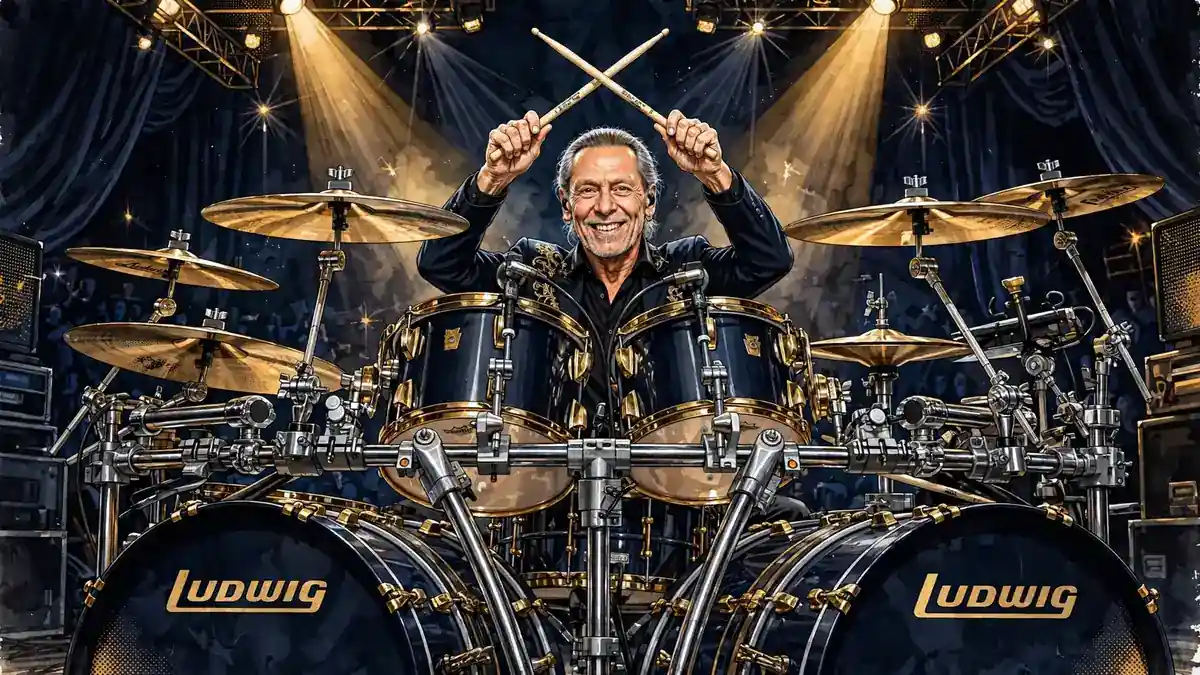
Alex Van Halen’s fame rests on a paradox: he was the drummer of one of the biggest bands in the world and, for most of his career, the least interviewed member of it. Eddie’s guitar innovations made the headlines; Roth’s showmanship filled the posters; Alex held the centre. Drummers and critics, though, rated him from the start as one of the greats — a player noted for technical speed, power and a swing feel borrowed from jazz and big-band drumming. His kit became a signature in itself: huge Ludwig drums, multiple bass drums, Rototoms, octobans, electronic percussion, oversized Paiste cymbals and a famous orchestral gong, all deployed with a showman’s sense of theatre.
The fame translated into money in the classic rock-band pattern, but with a founder’s multiplier. Van Halen has sold more than 80 million albums worldwide and 56 million in the United States, where the RIAA ranks the band 20th among best-selling artists. Two albums went diamond. The band holds the record for the most No. 1 hits on Billboard’s Mainstream Rock chart, and it was inducted into the Rock and Roll Hall of Fame in 2007 — a ceremony Alex and Eddie did not attend, leaving Michael Anthony and Sammy Hagar to accept the honour. The catalogue’s durability is the financial point: a band that sold that many records in the 1970s and 1980s, with songs licensed constantly to film, television, advertising and video games, generates publishing and master royalties for decades. Alex, as co-founder, songwriter and co-owner of the band’s publishing interests, sits at the receiving end of that stream.
Fame also brought the second act that revived his public profile. After four years of near-silence following Eddie’s death, Alex returned in October 2024 with Brothers, written with New Yorker writer Ariel Levy and published by Harper. The 240-page memoir — an instant New York Times bestseller — deliberately stops in 1985, at the breakup of the original lineup, and reads as a love letter to his brother rather than a tell-all. It includes never-before-seen photographs from Alex’s private archive, and its audiobook, narrated by Alex himself, contains “Unfinished,” the last piece of music he and Eddie wrote together. The book’s success opened a new chapter: a second, archival volume followed in 2026, and Alex re-emerged as a public figure on his own terms — author, archivist and keeper of the band’s legacy, rather than a retired drummer.
Main Sources of Income
Alex Van Halen’s money comes from five streams, and their balance has shifted sharply over time. In the touring years, live fees dominated. Today, with no touring since 2015, the catalogue does the work.
Album and streaming royalties form the base. Van Halen released 12 studio albums, and the catalogue has sold more than 80 million copies worldwide. The two diamond albums alone — the 1978 debut and 1984 — account for more than 20 million American sales, and the Hagar-era run added four chart-topping albums with combined global sales above 23 million. Streaming has replaced physical sales as the growth engine, and Van Halen’s best-known tracks — “Jump,” “Panama,” “Hot for Teacher,” “Runnin’ with the Devil,” “Ain’t Talkin’ ’bout Love” — sit permanently on rock playlists with hundreds of millions of plays. Royalty rates on recordings of that age are modest per play, but the volume is enormous, and Alex’s share flows through both artist royalties and his songwriting credits.
Songwriting and publishing royalties are the second, quieter stream, and probably the most valuable per dollar of effort. Alex is credited as a songwriter across the Van Halen catalogue, which means he earns publishing income every time a song is played on radio, streamed, covered, or licensed. In 2015, Alex and Eddie signed an exclusive worldwide publishing administration agreement with Atlas Music Publishing, a deal that put professional administration behind the catalogue and is the kind of arrangement that typically commands a substantial advance. Publishing is also the income that survives the end of touring: a song earns whether or not its writer ever plays it again.
Touring was the biggest single earner during active years. Van Halen toured arenas for four decades, and the late-career tours were the most lucrative per show. The 2007–08 reunion tour grossed more than $93 million, and the band’s headline fees in the 1980s and again after 2007 placed it in the top bracket of rock touring acts. Tour income for a band of Van Halen’s structure — four members, a large crew, and a famously elaborate stage show — was shared after heavy costs, but the grosses were large enough that the members’ cuts ran into millions per tour leg.
Merchandise and licensing add a steady layer. Van Halen’s logo, album art and the striped “Frankenstrat” imagery remain among the most merchandised in rock, and the band’s songs are licensed to films, television, commercials and video games. Licensing fees for a track like “Jump” or “Panama” in a major film or advertising campaign run into six figures per use, and the catalogue’s familiarity keeps those requests coming.
Books and archival projects are the newest stream. Brothers was an instant New York Times bestseller in October 2024, published by Harper in hardcover, deluxe autographed hardcover and audiobook editions, with a paperback following in October 2025. A bestselling hardcover memoir by a rock star of Alex’s stature typically earns a six-figure advance and meaningful royalties, and the book’s success spawned the second archival volume, Van Halen, published by Genesis Publications in November 2026 as a limited edition of 1,500 signed and numbered copies — a premium product aimed squarely at collectors, with pricing to match. Alex also controls, with the estate, the band’s archive of photographs, recordings and memorabilia, which the Genesis volume draws on. That archive is an asset in its own right, and its commercial exploitation has only just begun.

Salary and Earnings
No public filing or contract has ever disclosed Alex Van Halen’s salary, and Van Halen, as a private partnership, never published its internal split. Any article that prints a precise annual salary for him is inventing it. What the record does show is the scale of the business he shared in, and the shape of a rock star’s earnings curve across a 48-year career.
In the early years, the money was small and hard-won: club fees split four ways, a Warner Bros. recording advance that had to be repaid from royalties, and touring costs that ate most of the gross. The debut album’s slow climb to diamond status meant royalties arrived over years, not weeks. By the 1984 era, the band was an arena headliner, and per-show guarantees for a band of that size in the mid-1980s ran into six figures — shared, after crew, transport and production costs, among the four members and their management. The Hagar era’s four consecutive No. 1 albums kept the machine at full volume through the late 1980s and early 1990s, and the 1991 album For Unlawful Carnal Knowledge won the band its Grammy while its tour filled sheds and arenas across North America.
The most precisely documented payday is the 2007–08 reunion tour, which Billboard’s Boxscore put at more than $93 million in gross ticket sales. That figure is gross, not profit — a tour of that size carries enormous costs — but it is the clearest single number in Alex’s earnings history, and it came when he was in his mid-50s, long after most rock drummers have stopped earning at that level. The 2012–13 tour behind A Different Kind of Truth and the final 2015 tour added further eight-figure grosses. Taken together, the reunion-era tours are the likeliest source of the largest single-year earnings of his career.
Since 2020, the earnings profile has inverted. Touring income stopped entirely. What remains is catalogue income — recording royalties, publishing, licensing and merchandising — plus book income. Catalogue income for a band with Van Halen’s sales history is typically estimated in the low seven figures a year, split among the rights holders, though the exact figure is private. The honest summary is this: Alex earned like a top-tier rock star for roughly 35 touring years, banked the catalogue, and now lives on the long tail of one of the best-selling catalogues in rock, topped up by a bestselling memoir.
Businesses and Investments
Alex Van Halen has never been a public entrepreneur in the mould of a Sammy Hagar, whose tequila business made him the wealthiest former member of the band. There is no Van Halen restaurant chain, no Alex Van Halen clothing line, and no record of venture-capital bets or startup stakes. His business life has been the band itself — and, more precisely, the ownership structure around it.
The core asset is the Van Halen partnership and its publishing. As co-founder, Alex held an ownership stake in the band’s business from the start, and the 2015 Atlas Music Publishing administration deal shows that he and Eddie were actively managing the catalogue as a commercial asset late in the band’s life, rather than letting it sit. Publishing administration deals of that kind typically involve an advance against future royalties and professional placement of songs in film, television and advertising — work that increases the catalogue’s yield without requiring the artist to tour.
The second asset is the archive. Brothers revealed that Alex holds a private archive of photographs, correspondence, recordings and memorabilia spanning the band’s whole history, and the 2026 Genesis volume Van Halen — 312 pages drawn from that archive, published in a signed limited edition of 1,500 copies — is the first systematic commercial use of it. Archives of this kind, for a band of Van Halen’s stature, have real market value: unreleased recordings, unseen photographs and original documents can be licensed, exhibited and published for decades. The Genesis volume also includes a 7-inch vinyl record featuring “Glitter,” a previously unreleased demo recorded in 1974 — a sign that unreleased music from the archive is now being released commercially, which creates a new royalty stream from material recorded half a century ago.
Beyond the band, there is no verified record of property development, equity investments or business ventures in Alex’s name, and this article does not invent any. His wealth is concentrated, almost unusually for a celebrity of his standing, in one enterprise: the music he made with his brother.
Brand Deals and Sponsorships
Alex Van Halen’s endorsement career is a study in loyalty over volume. He has never been a celebrity endorser of consumer products — no soft-drink deal, no fashion line, no fragrance. His deals are all with instrument makers, and they are long-term partnerships rather than paid placements.
He is a longtime Ludwig endorser, playing Ludwig drums, pedals and hardware throughout his career, and his signature oversized kits became a Ludwig showcase. He began working with Paiste cymbals in the early 1980s and has stayed with the Swiss maker since. He also endorses Remo drumheads and Regal Tip drumsticks, which produce his signature series sticks. These are endorsement relationships in the musician’s sense: the companies supply equipment and use his name and image in their marketing, and the artist receives gear, a fee, and a signature product line. They pay a fraction of what a consumer-brand deal would, but they last for decades and they carry credibility with the drumming world that a one-off advertisement never would.
That credibility is itself an asset. Alex is widely regarded as one of the greatest drummers in rock history, and his name on a product moves units among drummers. The signature sticks and the association with Ludwig’s top-end kits generate modest but steady royalty-style income. Compared with the catalogue, it is a footnote — but it is a footnote that has run, uninterrupted, for more than 40 years.

Houses, Cars and Other Assets
This is the section where most net-worth profiles about Alex Van Halen go wrong, so it is worth being direct: there is no reliable public record of his current home, its value, or a car collection. He lives a private life in California, and the major outlets that cover him — Celebrity Net Worth, The Legit, Wikipedia — do not publish a verified property portfolio for him. Some low-quality net-worth sites claim his real estate is “worth several million dollars” without naming a property, a price or a source. That is not reporting; it is padding, and we do not repeat it.
What can be said with confidence is that a man who earned at Alex’s level for four decades, in California, owns substantial property — but the details are private, and publishing an invented address or valuation would be fabrication. The same applies to cars. Alex is a known car enthusiast in the band’s lore — Brothers recounts how the roar that opens “Runnin’ with the Devil” was made by ripping the horns out of the brothers’ cars — but no verified list of his vehicles exists in public reporting. The honest position is that his visible assets are his catalogue share, his publishing interests, his archive and his book rights, and that his property holdings are private.
One asset deserves a line of its own: the Van Halen name and brand. The band’s trademarks, logo and likeness rights continue to generate merchandising income, and Alex, as co-founder, holds an interest in them. For a band whose imagery remains among the most recognisable in rock, that interest has durable value even with no new music and no touring.
Awards and Achievements
Alex Van Halen’s trophy shelf is thinner than his influence, and that gap is part of his story. Van Halen won one Grammy — Best Hard Rock Performance in 1992 for For Unlawful Carnal Knowledge — from multiple nominations across the band’s career. The band’s real honours are commercial and institutional: more than 80 million albums sold worldwide, 56 million in the United States, two diamond albums, the most No. 1 hits on Billboard’s Mainstream Rock chart of any band, and induction into the Rock and Roll Hall of Fame in 2007.
As a drummer, Alex’s standing rests on peer and critical regard rather than awards. He is routinely named on lists of the greatest rock drummers, and his playing — the speed, the swing, the sheer physical power — influenced a generation of hard-rock and metal drummers who came up in the 1980s. Ozzy Osbourne‘s band and Mick Jagger‘s Rolling Stones defined the same arena era from different corners of rock, and Alex’s drumming belongs in that conversation about the players who set the standard for the stadium age. The 2024 memoir added a literary honour his music career never offered: instant New York Times bestseller status, with the Times itself praising the book as “a tale of understanding, of acceptance, of love.”
The most recent honour is also the most personal. In September 2026, Alex was appointed a Knight in the Order of the Netherlands Lion, one of the Netherlands’ oldest and highest civilian honours, at a ceremony in Nijmegen — the city where he spent part of his childhood before the family emigrated. The citation recognised his contribution to music. For a boy who left Holland at eight with no English and little money, it closed a circle that no record sale could.
Net Worth Growth Over the Years
Net worth figures for a private individual are estimates, and the year-by-year table below is NetWorthCraft’s reconstruction from career milestones — not a set of reported figures. It shows the shape of the fortune, not an audited balance sheet. The pattern is the classic rock-career curve: slow accumulation, a sharp rise at the commercial peak, a long plateau sustained by the catalogue, and a late lift from the memoir and archival projects.
| Year | Estimated net worth | What drove it |
|---|---|---|
| 1978 | $1 million | Debut album released; club-era earnings plus first royalties |
| 1984 | $10 million | 1984 goes diamond; arena-headliner touring fees |
| 1990 | $30 million | Four consecutive No. 1 albums in the Hagar era; catalogue compounding |
| 2000 | $50 million | Two decades of album sales, publishing and touring banked |
| 2010 | $70 million | Reunion tour grossed over $93 million; catalogue still selling |
| 2020 | $90 million | Final tours banked; Eddie’s death ends touring, catalogue carries on |
| 2024 | $95 million | Brothers becomes a New York Times bestseller |
| 2026 | $95 million – $110 million | Archival Genesis volume, knighthood, continued catalogue royalties |
The peer comparison puts the range in context. At his death in 2020, Eddie Van Halen’s net worth was estimated at around $100 million by Celebrity Net Worth — a fraction above his brother’s, reflecting Eddie’s additional income as the band’s primary songwriter and guitar innovator. Sammy Hagar, who built a tequila fortune outside music, is estimated at around $150 million by the same outlet, making him the wealthiest former member. David Lee Roth, the band’s original frontman, is estimated at around $60 million. Alex sits second among the band’s members by wealth — the co-founder’s share of a catalogue that has sold more than 80 million albums, without a side business to lift him past Hagar.
Why do the published estimates disagree? Celebrity Net Worth’s $95 million is the most recent and the most widely cited, and it anchors our range. The Legit and Wealthy Persons both publish $110 million, a figure that appears to trace to older estimates from 2021, when the reunion-tour earnings were fresher and the post-2020 catalogue slowdown had not yet been priced in. Lower-quality sites publish figures from $85 million to $130 million with no sourcing at all. The honest answer is the range: $95 million to $110 million, with $95 million the better-supported figure for 2026.
Social Media Presence
Alex Van Halen has no verified personal social media presence. He does not run a public Instagram, X or TikTok account under his own name, and he has given almost no interviews in the decades since the band stopped touring. That absence is deliberate — he withdrew from public life after Eddie’s death in 2020 and returned on his own terms, through the book, rather than through a feed.
The band’s official channels carry the public-facing presence: the official Van Halen accounts promote catalogue reissues, the memoir and the archival Genesis volume. Alex’s public appearances since 2024 have been event-based rather than digital: the Brothers book tour and signing events in October 2024, a live conversation event in Los Angeles, and the July 2026 TEDxFargo session with Roth. For a net-worth profile, the social-media gap is itself a data point: unlike many celebrities of his generation, Alex earns nothing from sponsored posts, and his wealth is entirely a product of the music and the books, not of an online audience.
Personal Life
Alex Van Halen has been married three times. He married Valeri Kendall in June 1983 after a two-year engagement; the marriage ended in divorce about two months later. In 1984 he married Kelly Carter, and their son Aric Van Halen was born on October 6, 1989. Aric became a distance runner at the University of Colorado, earning All-American honours in cross country and track and field, and competed in the Olympic trials for the steeplechase in 2016. Alex and Kelly divorced in August 1996.
In 2000, Alex married Stine Schyberg, an art director and designer, after a relationship that began in 1996. Their son Malcolm Van Halen was born in August 1999. Alex has said that Stine helped him overcome drug addiction during the 1990s, and she is widely credited — including in coverage of Brothers — with steadying his life after the band’s most chaotic years. The couple live privately in California, and Stine has stayed out of the spotlight even as her husband’s memoir put their family story in print.
Two personal facts shape the public understanding of Alex. The first is his hearing: years of playing loud music have left him with major hearing loss in both ears, a common cost of a career spent behind a drum kit in arenas. The second is his grief. Brothers is frank about the four years after Eddie’s death, and Alex has said he still wakes up thinking of his brother. He has also been frank about the fracture in the band’s family: he has not spoken to Sammy Hagar in more than two decades, and Brothers largely skips the Hagar era — an omission Hagar publicly called “blasphemy” against Eddie’s legacy. Alex, promoting the book, declined to read Hagar’s memoir and dismissed the criticism. The feud is unresolved, and it is the reason no Van Halen reunion of any kind is on the horizon.
Sources & Reporting
Celebrity Net Worth — the $95 million estimate, the most recent and most widely cited figure for Alex Van Halen, plus details of the Atlas Music Publishing deal, the 2026 knighthood and the 2026 Genesis archival volume; reporting window 2020–2026.
The Legit — the $110 million estimate, birth and family details, marriages and children, height and education; published March 2026.
Wikipedia — birth date and place, family emigration date, discography and sales figures, Rock Hall induction, marriages, hearing loss and the September 2026 knighthood; updated November 2026.
Billboard — chart positions for the debut album and 1984, the “Jump” No. 1, and Boxscore reporting of the 2007–08 reunion tour gross above $93 million.
RIAA — diamond certifications for the debut album and 1984, and the band’s ranking among best-selling American artists with 56 million albums sold in the United States.
The New York Times — coverage of the Brothers memoir and its review, quoted in the publisher’s description.
HarperCollins — publication details for Brothers: October 22, 2024, 240 pages, written with Ariel Levy, instant New York Times bestseller, audiobook narrated by Alex with the unreleased song “Unfinished.”
ChartMasters — album sales analysis, including the Hagar era’s four consecutive No. 1 albums and combined global sales above 23 million.
Reporting window: October 2024 – November 2026. Figures are estimates from public reporting; no audited financial statement for Alex Van Halen exists. Where sources disagree, this article publishes the range and names who says what.
Frequently Asked Questions
What is Alex Van Halen’s net worth in 2026?
Alex Van Halen’s net worth is estimated at $95 million to $110 million as of November 2026. Celebrity Net Worth, the most recently updated tracker, puts him at $95 million, while The Legit and Wealthy Persons put him at $110 million. His fortune comes from Van Halen album royalties, touring, songwriting and publishing income, licensing, and his bestselling 2024 memoir Brothers.
How old is Alex Van Halen?
Alex Van Halen was born on May 8, 1953, in Amsterdam, Netherlands, which makes him 73 years old as of November 2026. He is 20 months older than his late brother Eddie Van Halen, who was born on January 26, 1955.
Is Alex Van Halen still alive?
Yes. Alex Van Halen is alive and living in California. He largely withdrew from public life after his brother Eddie died in October 2020, but returned in 2024 with his memoir Brothers, was knighted in the Netherlands in September 2026, and appeared with David Lee Roth at a TEDxFargo session in July 2026. He has not toured or performed as a drummer since Van Halen’s final tour in 2015.
Who is Alex Van Halen’s wife?
Alex Van Halen has been married to Stine Schyberg, an art director and designer, since 2000. They began their relationship in 1996 and have a son, Malcolm Van Halen, born in August 1999. Alex was previously married to Valeri Kendall in 1983 and to Kelly Carter from 1984 to 1996; his elder son Aric Van Halen, born in 1989, is from his marriage to Carter.
How many albums did Van Halen sell?
Van Halen has sold more than 80 million albums worldwide and 56 million in the United States, where the RIAA ranks the band 20th among best-selling artists. Two albums — the 1978 debut and 1984 — are certified diamond in the US for sales above 10 million copies each. The band released 12 studio albums between 1978 and 2012.
What is Alex Van Halen’s book Brothers about?
Brothers, published by Harper on October 22, 2024, is Alex Van Halen’s memoir of his life with his younger brother Eddie, written with New Yorker writer Ariel Levy. The 240-page book covers their childhood in the Netherlands and Pasadena, the formation of Van Halen, and the original lineup’s rise, ending with the band’s breakup in 1985. It became an instant New York Times bestseller, and its audiobook includes Unfinished, the last song the brothers wrote together.
Why did Van Halen break up and will they ever reunite?
Van Halen effectively ended when Eddie Van Halen died on October 6, 2020, at age 65. Alex has said the band cannot continue without his brother, and he has not performed as a drummer since the final tour in 2015. A reunion is not expected: Alex has not spoken to former singer Sammy Hagar in more than two decades, and his memoir largely skips the Hagar era. His July 2026 appearance with David Lee Roth at TEDxFargo was a talk, not a performance.
Was Alex Van Halen knighted?
Yes. In September 2026, Alex Van Halen was appointed a Knight in the Order of the Netherlands Lion, one of the Netherlands’ oldest and highest civilian honours, at a ceremony in Nijmegen — the city where he spent part of his childhood. The honour recognised his contribution to music, and it came 64 years after his family emigrated from the Netherlands to California.
Final Thoughts
Alex Van Halen’s $95 million to $110 million fortune is the co-founder’s share of one of the great catalogues in rock — more than 80 million albums, two diamond records, and a publishing stream that has paid for decades and will keep paying. He earned it the slow way: fifty years behind a drum kit, four decades of touring, and a partnership with a brother who is gone. The numbers matter less than the shape of the story. Most rock fortunes fade when the touring stops. Alex’s did not, because the music kept selling and because, at 71, he found a second career as an author — turning the archive and the grief into a bestseller, then into a collector’s edition, then into a knighthood in the country he left as a boy. He is the rare rock star whose wealth, in 2026, is still growing after the band is over.
Published on November 13, 2026. Last reviewed November 2026. Found an error? See our corrections policy.