
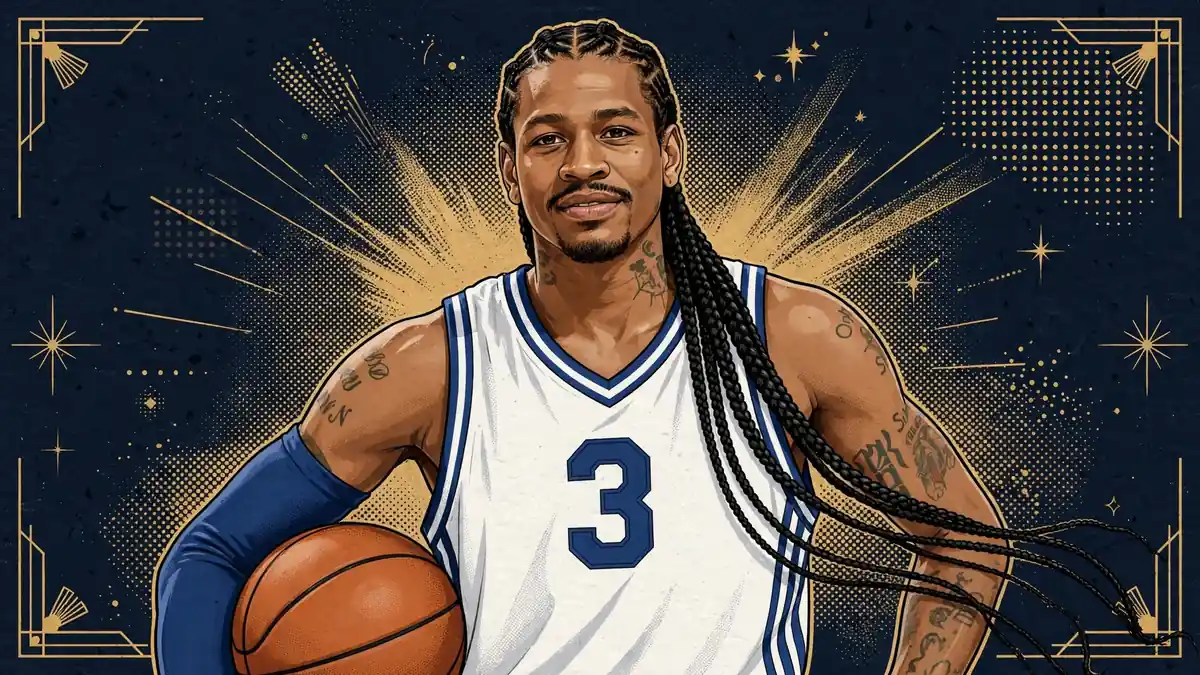
Allen Iverson‘s net worth is estimated at $1 million as of October 2026. The number sounds like a punchline for a player who collected $154.8 million in NBA salary alone — until you learn the rest of the story. Back in 2001, at the peak of his powers, Iverson signed a Reebok lifetime deal that still pays him $800,000 a year for life and parks $32 million in a trust he cannot touch until he turns 55 in June 2030. In 2023 he rejoined the brand as its vice president of basketball. So is “The Answer” broke? The answer is more interesting than the headlines.
Allen Iverson: Quick Facts
| Estimated net worth | $1 million (accessible assets; the $32M Reebok trust vests in 2030) |
|---|---|
| Profession | Former NBA player, Reebok vice president of basketball |
| Nationality | American |
| Born | June 7, 1975, Hampton, Virginia (age 51) |
| Height | 6 ft 0 in (183 cm) |
| Primary income sources | Reebok lifetime payments, Reebok executive role, NBA pension, endorsements and appearances, cannabis brand partnership |
| Active years | 1996–2011 (playing); 2023–present (executive) |
| Last reviewed | October 2026 |
- Early Life and Background
- Education
- Career Journey
- Rise to Fame
- Main Sources of Income
- Salary and Earnings
- Businesses and Investments
- Brand Deals and Sponsorships
- Houses, Cars and Other Assets
- Awards and Achievements
- Net Worth Growth Over the Years
- Social Media Presence
- Personal Life
- Sources & Reporting
- Frequently Asked Questions
- Final Thoughts
Early Life and Background
Allen Ezail Iverson was born on June 7, 1975, in Hampton, Virginia, to Ann Iverson, who was 15 at the time. His father, Allen Broughton, left the picture early, and Iverson grew up in a cramped household where basketball became both escape and identity. By the time he reached Bethel High School in Hampton, he was not just a basketball prodigy — he was a two-sport phenomenon. As a quarterback, he led Bethel’s football team to a Virginia state championship; as a guard, he did the same for the basketball team. He was named the Associated Press High School Player of the Year in both football and basketball as a senior, a feat almost no one in American sports history can match.
Then came the night that nearly ended everything. On February 14, 1993, Iverson was among a group of Black teenagers involved in a brawl at a Hampton bowling alley. He was convicted of “maiming by mob,” a felony, and sentenced to 15 years in prison. The case drew national attention and criticism for its severity — Iverson maintained he left the alley before the worst of the violence began. He served four months at the Newport News City Farm before Virginia governor L. Douglas Wilder granted him clemency in December 1993, and an appeals court later overturned the conviction entirely. He missed most of his junior year of high school. He returned for his senior year and put up the two-sport season that made him a national recruit.
The arrest nearly scared off every college program. Georgetown’s legendary coach John Thompson flew to Hampton, sat with Ann Iverson, and promised to keep her son on a short leash. Thompson’s intervention is the hinge of Iverson’s entire story — without it, there is no Georgetown, no number-one pick, no “Answer,” and no $200 million fortune to analyze decades later.
Education
Iverson spent two seasons at Georgetown (1994–1996) and turned them into one of the most electric college careers of the decade. As a freshman he averaged 20.4 points per game and was named Big East Rookie of the Year. As a sophomore he averaged 25.0 points, earned All-American honors, and was named Big East Defensive Player of the Year for the second straight season — a guard winning the league’s top defensive award twice remains a startling credential.
After his sophomore season, Iverson did something no Georgetown player under Thompson had ever done: he left school early for the NBA draft. The decision was controversial in 1996 and looks obvious now. The Philadelphia 76ers selected him with the first overall pick in the 1996 draft — ahead of Kobe Bryant, Steve Nash and Ray Allen, all future Hall of Famers. It was the start of a 14-season NBA career that would redefine what a six-foot guard could be.
Career Journey
Iverson won Rookie of the Year in 1997, averaging 23.5 points per game and announcing himself with a crossover so violent it dropped Michael Jordan himself in March of that season — the clip still circulates today. The 76ers were terrible around him at first, but by the late 1990s he had dragged Philadelphia into contention almost single-handedly, playing 40-plus minutes a night and leading the league in scoring in 1999.
The peak came in 2000–01. Iverson averaged 31.1 points, won league MVP, and carried a 76ers roster with no other star past every round of the Eastern Conference playoffs to the NBA Finals. There he met the juggernaut Los Angeles Lakers of Shaquille O’Neal and Kobe Bryant. Philadelphia stole Game 1 in overtime, 107–101, behind Iverson’s 48 points — including the iconic moment he hit a jumper over Tyronn Lue and stepped over the fallen guard on his way back down the floor. The Lakers won the next four games, but that one night remains the signature performance of Iverson’s career.
He played two more All-Star seasons as a Sixer before the relationship frayed. In December 2006, Philadelphia traded him to the Denver Nuggets for Andre Miller, Joe Smith and two first-round picks, pairing him with Carmelo Anthony. In November 2008 he was dealt again, this time to the Detroit Pistons for Chauncey Billups, Antonio McDyess and Cheikh Samb — the trade that gave him his highest single-season salary, $20.84 million in 2008–09, and also began his decline as injuries and fit issues mounted.
The end came fast. In September 2009 he signed a one-year, $3.1 million deal with the Memphis Grizzlies, played three games, and left by mutual agreement that November — collecting a reported $400,000 of the deal. He returned to Philadelphia that December on a non-guaranteed one-year contract and played 25 games before leaving in February 2010 to care for his ill daughter, Messiah. In October 2010 he signed with Beşiktaş in Turkey for a reported $2 million, played 10 games, and was done after a leg injury. He formally announced his retirement on October 30, 2013. Final line: 14 seasons, 24,368 points, a 26.7-points-per-game career average, and a 2016 induction into the Naismith Memorial Basketball Hall of Fame.
Rise to Fame
Iverson’s fame was never just about points. He arrived in the NBA with cornrows, tattoos, baggy clothes and hip-hop jewelry at a moment when the league’s image was still clean-cut, and he refused to change for anyone. His crossover — the ball snapping from one hand to the other at full speed — became the most imitated move in playground basketball. His 2001 MVP season, when he dragged the Sixers to the Finals, made him a folk hero in Philadelphia, a city that recognized its own defiance in him.
The culture war peaked in 2002, when Iverson delivered the most famous press conference rant in sports history. Asked about missing practice, he repeated the word “practice” more than twenty times in a session that became a permanent piece of American pop culture. Then, in 2005, NBA commissioner David Stern instituted the league’s first dress code — banning the throwback jerseys, chains and Timberlands that Iverson had made the uniform of a generation. Everyone understood whose wardrobe the rule was aimed at.
What matters for his money story: that cultural footprint never faded. It is why Reebok’s retro line — The Question and The Answer — still sells decades after his last game, why the brand put him in an executive chair in 2023, and why his signature remains one of the most bankable in basketball nostalgia. The scoring titles made him rich. The culture made him durable.
Main Sources of Income
Iverson’s income today comes from five places, and the balance between them explains why his net worth looks so odd on paper. First and largest by structure is the Reebok lifetime deal: $800,000 a year for life, paid with no promotional obligations, plus the $32 million trust that unlocks in 2030. Second is his salary as Reebok’s vice president of basketball, a real executive role he took in October 2023. Third is an NBA pension, which he became eligible to draw in his mid-40s. Fourth is his cannabis partnership — “The Iverson Collection” with Al Harrington’s Viola brand, plus a THC soda line that went nationwide in October 2025. Fifth is the appearance circuit: autograph shows, speaking engagements and the Iverson Classic, the high-school all-star game that carries his name.
During his playing days the mix was simpler and vastly bigger: NBA salary, which Spotrac tallies at $154,770,668, and endorsement income that pushed his total career earnings past $200 million. The Reebok money was always structured differently from a normal endorsement, which is why it survived everything else.
Salary and Earnings
Spotrac’s career tally puts Iverson’s NBA salary at $154,770,668 over 14 seasons — one of the largest career hauls of his generation. The money arrived in three big contracts. After his rookie-scale deal, he signed a six-year, $70.9 million extension in 1999, at the time one of the richest contracts in the league. In 2003 came another extension — four years, reported at $76.7 million by most outlets, $73.5 million by at least one — which locked in his prime-year paydays. His single biggest season was 2008–09 with Detroit: $20.84 million.
The collapse of his salary income was abrupt. In September 2009, Memphis gave him a one-year, $3.1 million deal; he played three games and left by mutual agreement, reportedly collecting about $400,000 of it. His return to Philadelphia that December came on a non-guaranteed deal worth just over $1 million. His final playing contract, with Beşiktaş in Turkey in October 2010, was a reported $2 million for what turned out to be a 10-game stint ended by injury. From $20.84 million to $400,000 in two years — that whiplash is the shape of the end of a career, not a scandal.
| Contract / Season | Reported value | Notes |
|---|---|---|
| Rookie deal (1996–99) | ~$8.7 million | Rookie scale; Spotrac yearly figures |
| 1999 extension (6 years) | $70.9 million | Signed with the 76ers |
| 2003 extension (4 years) | ~$76.7 million (some outlets say $73.5M) | Signed with the 76ers |
| 2008–09, Pistons | $20.84 million | Career-high single season |
| 2009, Grizzlies | $3.1 million (1 yr; ~$400K collected) | Three games; mutual termination |
| 2010, Beşiktaş | Reported $2 million | 10 games; ended by injury |
| Total NBA salary | ~$154.8 million | Spotrac tally, $154,770,668 |
Add endorsements — chiefly Reebok, whose initial 10-year deal was reported at $50 million and whose lifetime deal followed — and Iverson’s total career earnings clear $200 million by every serious accounting. That is the figure to hold in mind when reading about what happened next: he did not earn too little. He earned generational money and spent it at generational speed.
Businesses and Investments
Iverson never built the diversified portfolio of a LeBron James or a Shaquille O’Neal. There are no restaurant chains, no media companies, no venture funds on his record. What he has is a second act built on the one brand relationship that never broke — and one newer bet on cannabis.
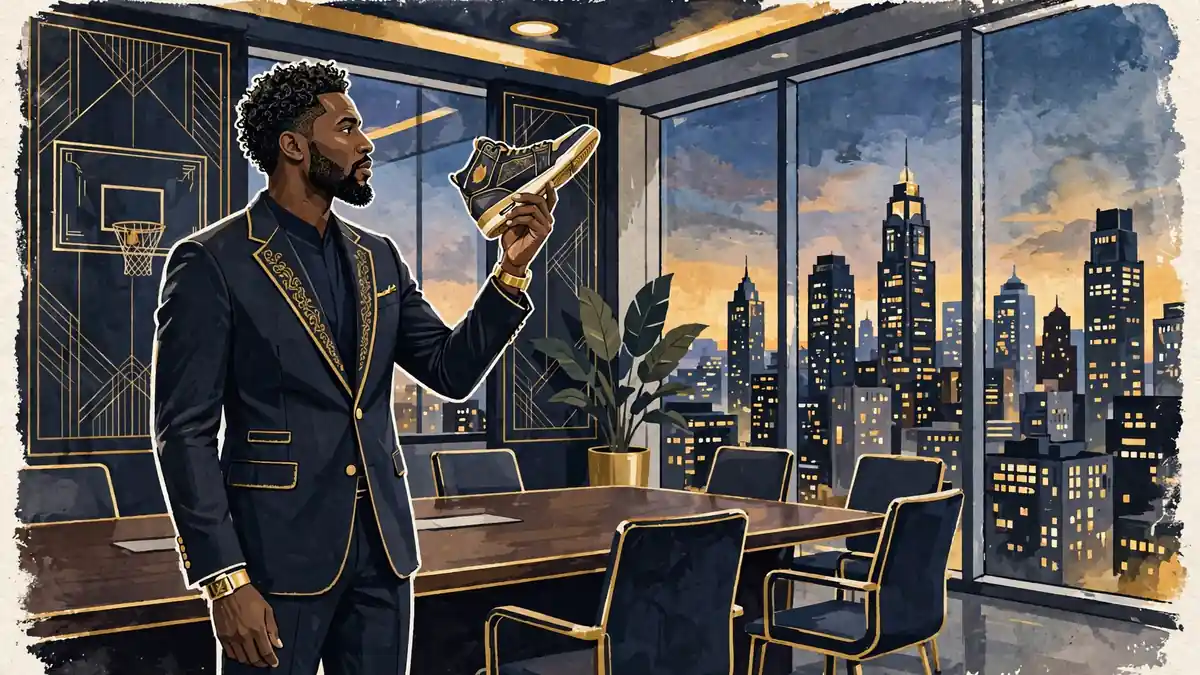
The Reebok executive chapter began on October 12, 2023, when the brand named Shaquille O’Neal its president of basketball and Iverson its vice president. It was a genuine management role, not a ceremonial title: Iverson was tasked with driving player recruitment, grassroots and community initiatives, and athlete activations such as the Iverson Classic. The brand had been acquired from Adidas by Authentic Brands Group in 2022 and was relaunching into basketball; its first major athlete signing under the new regime, LSU star Angel Reese, arrived that same month. For Iverson, it converted a lifetime endorsement into a salary and a desk.
The cannabis chapter is his most entrepreneurial move. Iverson entered a multi-year partnership with Viola, the cannabis company founded by former NBA player Al Harrington, after touring Harrington’s Detroit cultivation facility in March 2021. The collaboration produced “The Iverson Collection” of cannabis products and merchandise, including a strain called “Iverson ’01” — a nod to his MVP season — that launched in Pennsylvania through RISE dispensaries. In October 2025 the partnership expanded again: Viola teamed with Horticulture Co. to launch IVERSON, a craft THC soda, in a nationwide rollout through Circle K, Specs and Total Wine stores, with flavors named for his mythology — Bubba Chuck Berry (his childhood nickname), Cran-Apple Crossover and 96 Nectarine (his draft year).
His other ventures were shorter-lived. He joined Ice Cube’s BIG3 league as a player-captain and coach in 2017 and left before it became a real income stream. The Iverson Classic, the annual high-school showcase, doubles as brand equity and community work. He earns appearance and autograph fees on the nostalgia circuit, where a Hall of Famer with his cultural footprint commands real money. None of this replaced NBA-scale income. All of it, combined with the Reebok checks, has been enough to keep him stable — a word that would have sounded impossible in 2012.
Brand Deals and Sponsorships
The Reebok relationship is the single most important financial fact of Iverson’s life, so it deserves the detail. Reebok signed him before he played his first NBA game, and his debut signature shoe — The Question, released in 1996 — became an instant hit. After his MVP season and Finals run, the two sides tore up the old arrangement and signed a lifetime deal in 2001: a 10-year, $50 million base contract containing two provisions that look, in retrospect, like they were designed by someone who knew exactly who they were dealing with.
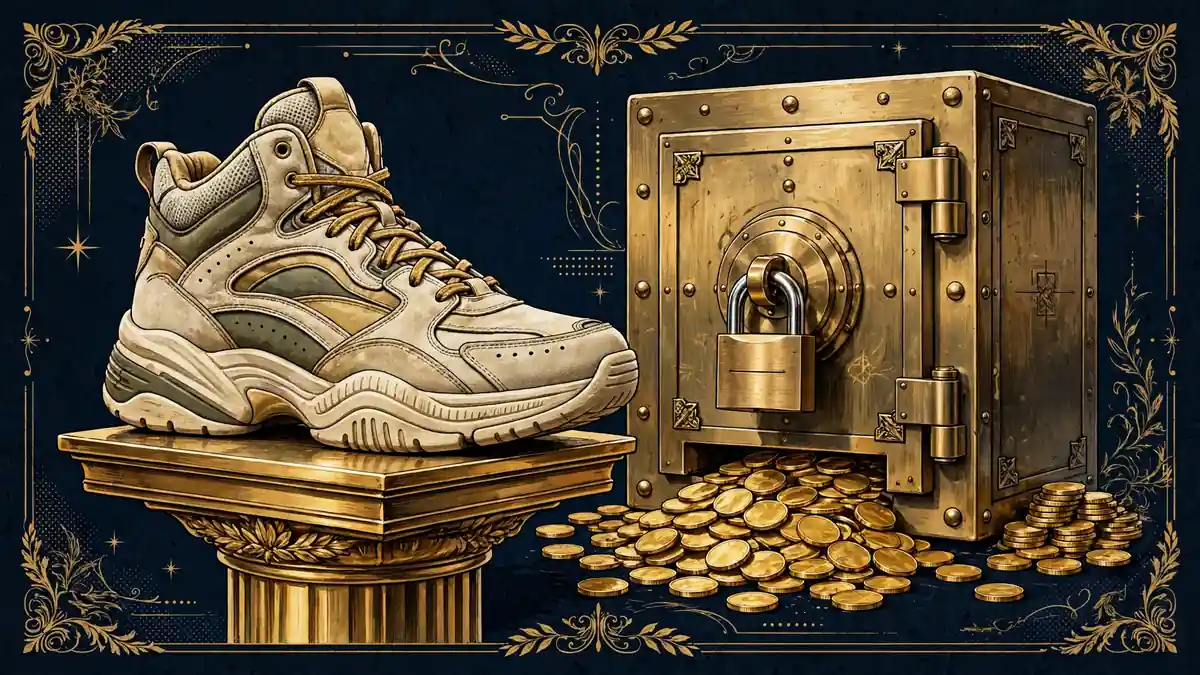
The first provision pays Iverson $800,000 a year for life, with no ongoing promotional obligations — the money arrives whether he laces up a sneaker or not. The second put $32 million into an irrevocable trust that he cannot touch until his 55th birthday on June 7, 2030. Multiple outlets report the structure was pushed either by Reebok itself or by his then-wife Tawanna Turner; either way, it was built to survive Iverson. It did: the annual payments continued straight through his post-retirement financial crisis, untouched by the garnishments and foreclosures that consumed everything else.
The trust’s fine print became a public saga during his divorce. Reports conflict on what Tawanna received — some say a percentage of the Reebok endorsement checks (which the $3 million settlement covered, per contemporary reports), others cite a postnuptial agreement, described in Washington Post sportswriter Kent Babb’s 2015 biography “Not a Game,” that could have given her half the trust. EssentiallySports reported she ultimately opted for half. The honest summary: the 2030 payout will be split in some fashion with his ex-wife, and the exact share is not public. Even half of $32 million is transformative money.
Beyond Reebok, Iverson’s endorsement portfolio was always thinner than his peers’. He had deals with Pepsi and others during his peak, but nothing approached the Reebok money, and he never built the portfolio approach of a Jordan or a LeBron. The irony is that the one deal he kept — structured as a lifetime annuity with a locked vault — outperformed all the diversification he never did.
Houses, Cars and Other Assets
At his peak, Iverson’s spending was the stuff of league legend — the jewelry, the fleet of cars, the entourages, the mansions. The paper trail of what happened to the physical assets is unusually complete, because so much of it passed through courtrooms.
The flagship property was his Atlanta mansion, a $4.5 million estate he bought in the early 2000s. In December 2012, TMZ reported he had defaulted on a $1.2 million mortgage; Iverson filed a lawsuit to stop the foreclosure auction, claiming he had never consented to the loan terms and suggesting his estranged wife’s involvement — the divorce was raging at the same time. The suit bought him a few weeks. In early 2013 the bank sold the house at auction for $2.5 million, nearly half what he had paid. His $3.8 million Denver home met a similar fate around the same period.
The jewelry tells the same story in miniature. Aydin & Company Jewelers sued him in 2010 over an unpaid $375,000 bill; Iverson never responded to the suit, and a default judgment ballooned to $859,896 with interest, court costs and attorneys’ fees. When he still did not pay, a Georgia judge in January 2012 ordered the debt collected directly from his Wells Fargo bank account — the “seized bank account” episode that cemented his broke-era headlines. Cars went the same direction; the Maybach he kept in the divorce settlement was an exception that proved the rule.
What does he own now? Public records do not give a current property inventory, and we will not invent one. What is verifiable: the untouched $32 million trust, the $800,000 annual Reebok payments, the NBA pension, and the income from his Reebok executive role and cannabis ventures. The assets column of his life is thin. The guaranteed-income column is thick. That asymmetry is the whole story of his finances.
Awards and Achievements
Iverson’s trophy case is the strongest argument that his financial story should not define him. The headline honors: NBA Most Valuable Player (2001), NBA Rookie of the Year (1997), 11-time All-Star (2000–2010), two-time All-Star Game MVP (2001, 2005), four-time scoring champion (1999, 2001, 2002, 2005), three-time steals leader (2001–2003), seven-time All-NBA selection, and a 2016 induction into the Naismith Memorial Basketball Hall of Fame. He was named to the NBA 75th Anniversary Team in 2021, and the 76ers retired his No. 3 jersey on March 1, 2014.
The numbers behind the honors: 24,368 career points at 26.7 per game — the sixth-highest scoring average in league history among retired players — plus 6.2 assists and 2.2 steals per game over 914 regular-season games. In the 2001 playoffs he averaged 32.9 points per game across 22 games, one of the great single-postseason scoring runs ever. He never won a championship, which critics hold against him; his defenders note he reached the Finals with a roster whose second-best player was Defensive Player of the Year Dikembe Mutombo, acquired midseason, and not much else.
Net Worth Growth Over the Years
No audited figures exist for any year of Iverson’s life, so the honest version of this table is a reconstruction: reported earnings, court filings and the consensus of trackers, assembled into a shape. The shape is what matters — a steep rise, a cliff, a long flat line, and a vault waiting at the end.
| Year | Estimated net worth | What was happening |
|---|---|---|
| 2001 | ~$40 million | MVP season; lifetime Reebok deal signed; peak earning years |
| 2006 | ~$35 million | Traded to Denver; salary still near peak |
| 2010 | ~$20 million | Final NBA season; Beşiktaş stint; spending outpacing income |
| 2012 | ~$5 million | Jeweler garnishment; divorce filings; $360K/month burn rate |
| 2016 | ~$2 million | Hall of Fame induction; foreclosures complete |
| 2021 | ~$1 million | Trackers converge on $1M; Viola partnership begins |
| 2026 | ~$1 million | Reebok VP role; IVERSON soda launch; trust still locked |
| 2030 (projected) | $10–17 million+ | Trust vests at 55; ex-wife’s share disputed |
Two things to note. First, the 2030 figure is the first honest “rich again” number in his story: even if Tawanna Turner receives half the $32 million — the largest share any report attributes to her — the remainder plus five years of $800,000 annual payments rebuilds an eight-figure position overnight. Second, the flat $1 million from 2021 to 2026 is not a man treading water; it is a man whose floor was engineered in 2001 by a contract clause, holding steady while his public reputation repaired itself.
For context on how unusual his outcome is, here is the peer table — career salary tallies from Spotrac-based records against current net worth estimates:
| Player | Career NBA salary (approx) | 2026 net worth (est.) |
|---|---|---|
| LeBron James | ~$581 million | ~$1.4 billion |
| Shaquille O’Neal | ~$292 million | ~$500 million |
| Kobe Bryant (estate) | ~$328 million | ~$600 million at his passing |
| Allen Iverson | ~$155 million | ~$1 million |
The gap between the rows is the cost of the 2000s. His peers turned salary into equity — businesses, media, ownership stakes. Iverson turned salary into lifestyle, and it took a shoe company thinking in decades to keep him solvent.
Social Media Presence
Iverson is a genuine social media heavyweight, with several million followers across Instagram and X, and his accounts function as a nostalgia-and-culture channel rather than a business platform. Posts mix throwback highlights, Reebok retro drops, family moments and the occasional blunt commentary on the modern game. His cultural capital online is disproportionate to his follower count — a single Iverson crossover clip routinely outperforms the engagement of active stars, because his highlights are taught to every new generation of guards.
He has monetized that attention lightly: sponsored posts around Reebok releases and the Viola partnership, appearances at the Iverson Classic, and paid autograph-show circuits. He is not an influencer in the modern sense — there is no content calendar, no brand-ambassador treadmill. The accounts are best understood as the maintenance of an asset: the most culturally potent retired-guard brand in basketball, kept warm for the days when Reebok or a sponsor needs it.
Personal Life
Iverson’s personal life has been public since high school, and the defining relationship is with Tawanna Turner, his high school sweetheart. They married in 2001 and had five children: Tiaura, Allen II, Isaiah, Messiah and Dream. The marriage was turbulent for years before the law got involved. Tawanna filed for divorce in March 2010, withdrew it, and filed again in 2011; the divorce was finalized in January 2013 after a two-year legal battle that played out in Georgia courtrooms and on TMZ in parallel.
The proceedings produced the two most quoted moments of his post-career life. In a 2012 hearing, with his finances laid bare, Iverson told the court he did not have the money his ex-wife was seeking — the session that generated the infamous “I don’t even have money for a cheeseburger” line. Tawanna, sitting nearby, reportedly reached into her purse and handed him $61. The settlement, reached in January 2013 and announced to Fulton County Superior Court judge Bensonetta Tipton Lane, gave Tawanna a $3 million lump sum plus a share of assets, a percentage of his Reebok endorsement checks and child support for their five children; Iverson kept the Georgia mansion, which was foreclosed within weeks anyway, and his Maybach. The judge used the occasion to lecture Iverson on his parenting and his drinking, ordering counseling and sobriety conditions around his visits with the children.
The story did not end in the courtroom. At his 2016 Hall of Fame induction speech, Iverson stopped to honor Tawanna by name — “my number one person in the world, hands down… twenty-four years, ups, downs, but real love” — and the two have maintained a cordial co-parenting relationship since. Whatever the postnuptial agreement said about the $32 million trust, the public record shows two people who fought bitterly over money and then chose, in the end, to be a family anyway.
Off the court, Iverson’s struggles with alcohol were documented in the divorce filings and acknowledged by Iverson himself in later years; he has spoken about losing control in retirement and the work of getting it back. He has also become an unlikely mentor figure, warning young players about entourages and spending — “learn the word no” is his standard advice — and his Crossover-era community work in Hampton has continued through charity games and youth events. In October 2026, a viral Instagram post by singer Tyrese Gibson claimed Iverson had acquired an ownership stake in the 76ers; fact-checkers found no announcement from the team, the league or any reputable outlet, and the claim was debunked within days. It was a reminder of how easily the internet still confuses wishing with reporting where Iverson is concerned.
Sources & Reporting
Reporting window: contemporary coverage 2010–2016 (divorce, garnishment, foreclosure) plus 2023–2026 reporting on the Reebok executive role, cannabis ventures and net-worth tracking. Every figure below is attributed to the outlet that published it.
- NBC Sports — the 2012 report on the Georgia judge’s garnishment order against Iverson’s bank account over the $860,000 jeweler debt; and the October 2023 announcement of Iverson as Reebok’s vice president of basketball alongside Shaquille O’Neal as president.
- Bleacher Report — the 2020 report on the $32 million Reebok trust vesting at age 55, citing Darren Rovell; and the 2023 Reebok Basketball leadership announcement with Iverson’s stated duties.
- Black Enterprise — the 2025 report detailing the 2001 lifetime deal structure: 10-year, $50 million base, $800,000 annual lifetime payments, and the $32 million trust accessible in 2030.
- TMZ (via contemporary reporting) — the Aydin & Company Jewelers lawsuit timeline ($375,000 bill to $859,896 judgment), the Wells Fargo garnishment order, and the $4.5 million Atlanta mansion foreclosure auction ($2.5 million bank sale).
- Philadelphia Inquirer — Bill Lyon’s 2012 column on the garnishment order; Reebok CEO Matt O’Toole’s 2018 comments on Iverson’s enduring brand value.
- EssentiallySports — the lifetime-deal deep dive (trust mechanics, Tawanna’s reported half-share, the postnuptial context) and the 2012 courtroom “cheeseburger” account including the $61 gesture.
- Sportscasting — the “never actually went broke” analysis citing the New York Post on the trust and the Philadelphia Inquirer on the $800,000 annual payments; Iverson’s 2015 CBS This Morning denial.
- CBS News — the October 2023 Reebok Basketball relaunch announcement (Simrin Singh).
- Sports Business Journal — the 2023 report on “Iverson ’01” cannabis strain launch in Pennsylvania via RISE dispensaries.
- AfroTech — the original Viola × Iverson multi-year partnership announcement (The Iverson Collection).
- Cannabis Business Times — the October 2025 press release on IVERSON, the nationwide craft THC soda rollout with Viola and Horticulture Co.
- Enstarz — the December 2012 foreclosure lawsuit reporting, including the $62,500/month income vs. $360,000/month expenses court figures.
- The Blast — the Georgia Department of Revenue tax lien (~$200,000 for 2012–2013) and the divorce-settlement terms.
- Celebrity Net Worth — the standing $1 million net-worth estimate used as the anchor for this article’s range.
- Basketball-Reference — career statistics: 24,368 points, 26.7 ppg, 6.2 apg, 2.2 spg, 11 All-Star selections.
- Spotrac — career NBA salary tally of $154,770,668 and the $20.84 million 2008–09 peak season figure.
Frequently Asked Questions
What is Allen Iverson’s net worth in 2026?
Allen Iverson’s net worth is estimated at $1 million in 2026. That figure covers his accessible cash and assets — it does not include the $32 million Reebok trust fund, which he cannot touch until he turns 55 on June 7, 2030. Every major net-worth tracker currently lands at the same $1 million figure, making it one of the most agreed-upon estimates in sports.
How does Allen Iverson’s Reebok trust fund work?
When Iverson signed his lifetime Reebok deal in 2001, $32 million was placed in an irrevocable trust that he cannot access until his 55th birthday on June 7, 2030. Separately, the deal pays him $800,000 a year for life with no promotional obligations. The structure — pushed by Reebok or his then-wife, depending on the report — was designed to survive his spending habits, and it did: the money sat untouched through garnishments, foreclosures and his divorce. His ex-wife Tawanna is expected to receive a share of the 2030 payout, though the exact portion is disputed.
Did Allen Iverson go bankrupt?
No bankruptcy filing for Allen Iverson appears in public court records — the “bankruptcy” label is one of the most repeated errors in his story. What actually happened: in 2012, after a jeweler won an $859,896 default judgment against him, a Georgia judge ordered the debt collected directly from his Wells Fargo bank account. He also lost two homes to foreclosure. Iverson himself called the broke rumors a myth in a 2015 CBS interview, and analysts note his Reebok annuity and locked trust kept him solvent throughout.
How much money did Allen Iverson make in the NBA?
Iverson earned approximately $154.8 million in NBA salary over 14 seasons, per Spotrac’s tally of $154,770,668. His biggest contracts were a six-year, $70.9 million extension in 1999 and a four-year extension in 2003 reported around $76.7 million. His peak single season was 2008–09 with the Detroit Pistons at $20.84 million. Including endorsements — chiefly Reebok — his total career earnings exceed $200 million.
How did Allen Iverson lose his fortune?
Divorce court filings from 2012 tell the math: about $62,500 a month in income against roughly $360,000 a month in expenses — jewelry, cars, entourages, mortgages and child-related costs. A $375,000 unpaid jeweler’s bill became an $859,896 court judgment that led to his bank account being garnished. He defaulted on a $1.2 million mortgage on his $4.5 million Atlanta mansion, which the bank auctioned for $2.5 million, and lost a $3.8 million Denver home as well. The 2013 divorce cost him a $3 million settlement plus assets and child support. The one fortune he could not spend — the Reebok trust — is why the story has a second act.
What happened between Allen Iverson and his ex-wife?
Iverson married high school sweetheart Tawanna Turner in 2001, and they had five children. She filed for divorce in 2010, withdrew it, and filed again in 2011; the divorce was finalized in January 2013 with a $3 million lump-sum settlement plus assets, a share of his Reebok checks and child support. Whether she also gets part of the $32 million Reebok trust is disputed — reports range from a percentage of the endorsement checks to half the trust. The two have since reconciled as co-parents; at his 2016 Hall of Fame induction, Iverson publicly called her “my number one person in the world.”
What is Allen Iverson doing now?
Since October 2023, Iverson has been vice president of basketball at Reebok, working under president Shaquille O’Neal on player recruitment, grassroots programs and the Iverson Classic. He has a multi-year cannabis partnership with Al Harrington’s Viola brand — “The Iverson Collection” — which expanded in October 2025 with IVERSON, a craft THC soda sold nationwide. In 2024 the 76ers honored him with a sculpture on the Legends Walk at their Camden training complex. He remains active on the appearance and autograph circuit, and his Reebok retro sneakers still sell decades after his last game.
Is Allen Iverson buying the Philadelphia 76ers?
No. In October 2026 a viral Instagram post by singer Tyrese Gibson claimed Iverson had acquired an ownership stake in the 76ers, but fact-checkers found no announcement from the team, the NBA or any reputable outlet supporting it. Iverson holds no ownership position with the franchise. The 76ers did honor him with a Legends Walk sculpture in 2024, which may have helped the rumor feel plausible — but the ownership claim is false.
Final Thoughts
Allen Iverson’s $1 million net worth is the most misleading number in sports finance. It counts what he can spend today and ignores the two things that matter most: $800,000 arriving every year for the rest of his life, and $32 million unlocking in June 2030. He earned more than $200 million and spent nearly all of it — on jewelry that ended in a garnishment order, on mansions that ended in foreclosure auctions, on a lifestyle that burned $360,000 a month against $62,500 of income. The courts documented the fall in unusual detail, and the internet turned it into a bankruptcy that never happened.
But the second half of the story is the one worth remembering. A contract clause written in 2001 — by people who understood that the hardest person to protect Allen Iverson from was Allen Iverson — held firm through everything. In 2023 the same brand that wrote that clause handed him an executive title. In 2025 he was launching a national beverage brand. In 2030, the vault opens. Plenty of athletes earn fortunes. Almost none of them get saved from themselves by their own shoe deal. That is the real answer to the question of Allen Iverson’s net worth: a small number today, a fortune in escrow, and a lesson about structure that he now spends his time teaching to players who remind him of himself.
Published on October 9, 2026. Last reviewed October 2026. Found an error? See our corrections policy.