
Andy Reid‘s net worth is estimated at $50 million as of November 2026. The Kansas City Chiefs head coach earns a reported $20 million a year on a five-year deal worth roughly $100 million, signed in April 2024, which made him the highest-paid head coach in the NFL. He built that fortune the slow way: 27 seasons as an NFL head coach, three Super Bowl titles in Kansas City, and a late-career turn as one of the league’s most recognizable television pitchmen.
Andy Reid: Quick Facts
| Estimated net worth | $50 million (range: $35 million to $60 million across published estimates) |
|---|---|
| Profession | NFL head coach, Kansas City Chiefs |
| Nationality | American |
| Born | March 19, 1958 (age 68) |
| Height | 6 feet 3 inches (commonly listed) |
| Primary income sources | NFL head-coaching contracts, endorsement deals (State Farm, Snickers) |
| Active years | 1982–present (coaching); NFL head coach since 1999 |
| Last reviewed | November 2026 |
- Early Life and Background
- Education
- Career Journey
- Rise to Fame
- Main Sources of Income
- Salary and Earnings
- Businesses and Investments
- Brand Deals and Sponsorships
- Houses, Cars and Other Assets
- Awards and Achievements
- Net Worth Growth Over the Years
- Social Media Presence
- Personal Life
- Sources & Reporting
- Frequently Asked Questions
Early Life and Background
Andrew Walter Reid was born on March 19, 1958, in Los Angeles, California. He grew up in the city and attended John Marshall High School, where his size — he would reach 6 feet 3 inches — pointed him toward the offensive line rather than the skill positions. Los Angeles in the late 1960s and 1970s gave Reid an early education in big-stage football: the Rams and Raiders dominated local conversation, and the city’s high school programs fed players into major college teams across the West.
Reid did not come from a football family with NFL connections, and he did not arrive at college as a blue-chip recruit. He started at Glendale Community College in California, playing offensive tackle and earning all-conference honors, before transferring to Brigham Young University. That two-step path — junior college, then a major program — shaped the coach he became: a teacher who values development over pedigree, and a man comfortable working his way up from the bottom of a staff.
The other early influence on Reid’s life was faith. He met his future wife, Tammy, while at BYU, and after taking discussions with missionaries he joined The Church of Jesus Christ of Latter-day Saints. The couple married in 1981, the same year Reid finished his playing career, and their marriage has now passed the 45-year mark. Friends and players routinely describe Reid as steady and even-tempered, a reputation that started in those early years and has survived three decades of NFL pressure.
Education
Reid played offensive tackle at BYU from 1978 to 1980 under head coach LaVell Edwards, whose pass-first offense was ahead of its time in college football. BYU was in the middle of a run of ten consecutive conference titles between 1976 and 1985, and Reid’s teams played in an attack that threw the ball far more than most programs of the era. Watching Edwards design passing concepts gave Reid a playbook education that would define his coaching identity: timing routes, quarterback-friendly reads, and a willingness to throw on any down.
He graduated from BYU in 1981 and stayed on as a graduate assistant for the 1982 season, his first coaching job. From there he spent nine seasons as an offensive line coach at four colleges: San Francisco State (1983–1985), Northern Arizona (1986), UTEP (1987–1988), and Missouri (1989–1991). None of those jobs paid real money by NFL standards, and none carried glamour. They did give Reid a decade of hands-on teaching — footwork, protections, run blocking — that later let him build offenses from the line outward rather than from the quarterback backward.
The Missouri stop mattered most. It put him on the radar of coaches with NFL ties, and in 1992 Mike Holmgren — a former BYU assistant under Edwards — hired Reid onto the Green Bay Packers staff. Reid had spent a full decade in college coaching before his first NFL paycheck, a longer apprenticeship than most modern head coaches ever serve.
Career Journey
Reid joined the Packers in 1992 as an assistant offensive line and tight ends coach, then moved to quarterbacks coach and assistant head coach in 1997. In Green Bay he worked directly with Brett Favre during the seasons the Packers won Super Bowl XXXI (January 1997) and lost Super Bowl XXXII a year later. The ring from XXXI remains part of Reid’s personal trophy case, and the experience of coaching a Hall of Fame quarterback in a championship offense became the foundation of his reputation around the league.
On January 11, 1999, the Philadelphia Eagles hired Reid as head coach. The hire raised eyebrows: Reid had never been an NFL coordinator, and at 40 he was younger than several of the players’ position coaches around the league. Eagles owner Jeffrey Lurie bet on the teacher rather than the résumé, and the bet paid off fast. Reid also took on the title of executive vice president of football operations in 2001, giving him control over personnel decisions — a dual role few coaches hold, and one that made him among the most powerful figures in the sport for a decade.
Philadelphia went 5–11 in Reid’s first season, then reached the playoffs nine times in the next eleven years. The Eagles won six NFC East titles, played in five NFC Championship Games, and reached Super Bowl XXXIX after the 2004 season, losing 24–21 to the New England Patriots. Reid left Philadelphia as the franchise’s winningest coach with a 130–93–1 regular-season record and a 10–9 playoff mark. The run ended after a 4–12 season in 2012, and the Eagles did not renew his contract on December 31, 2012.
He was unemployed for four days. On January 4, 2013, Reid agreed to a five-year deal to coach the Kansas City Chiefs, a franchise coming off a 2–14 season and holding the first overall pick in the draft. The Chiefs went 11–5 in his first year. They have reached the playoffs in every season since 2015, won the AFC West year after year, and turned a franchise that had not won a Super Bowl since January 1970 into the defining team of the 2020s.
The Kansas City peak came in three championships: Super Bowl LIV after the 2019 season, a 31–20 win over the San Francisco 49ers that ended the Chiefs’ 50-year title drought; Super Bowl LVII after the 2022 season, a 38–35 win over Reid’s old team, the Eagles; and Super Bowl LVIII after the 2023 season, an overtime win over the 49ers that made Kansas City the first team in two decades to repeat as champions. The Chiefs also lost Super Bowl LV to Tampa Bay and Super Bowl LIX to Philadelphia, giving Reid five Super Bowl appearances as a head coach.
Then came the correction. Kansas City finished 6–11 in 2025 and missed the playoffs for the first time since 2014, and the usual retirement questions followed a 67-year-old coach after a losing season. Reid answered them in January 2026, confirming on Sports Radio 810 in Kansas City that he would return for the 2026 season, with NFL Network’s Ian Rapoport and Tom Pelissero reporting the same. He enters 2026 in his 14th season with the Chiefs and his 28th as an NFL head coach.
Rise to Fame
Reid’s rise did not follow the usual path of a famous player turned coach. He never played in the NFL, so his name recognition came entirely from winning and from the quarterbacks he developed. In Philadelphia, Donovan McNabb became a six-time Pro Bowl selection under Reid, and the Eagles’ sustained contention made Reid one of the league’s most respected figures even before he won a title as a head coach.
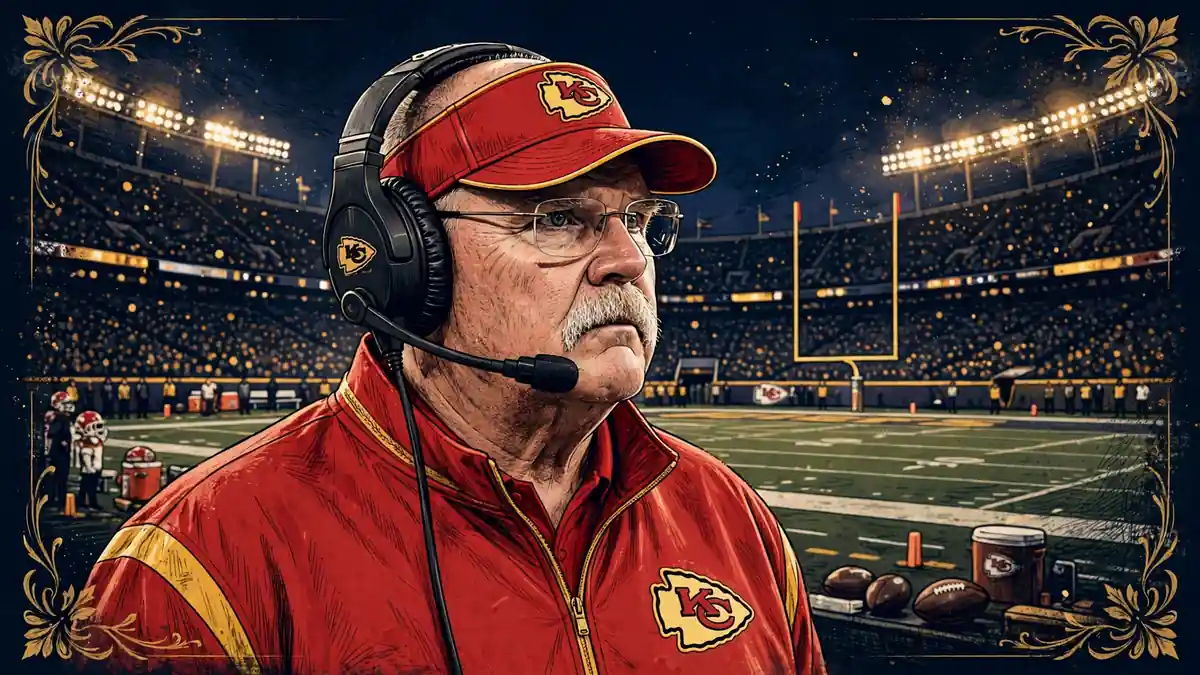
Kansas City changed the scale. Drafting Patrick Mahomes in 2017 and handing him the starting job in 2018 turned Reid’s offense into the league’s showcase, and Mahomes won league MVP honors in his first season as a starter. The pair’s partnership produced three championships and made Reid a household name well beyond football audiences. His sideline image — red visor, headset, laminated play sheet, and the white mustache fans call “Big Red” — became one of the most recognizable silhouettes in American sports.
Reid’s coaching tree widened his influence further. Assistants who worked under him went on to head-coaching jobs across the league, including Doug Pederson (who won a Super Bowl with Philadelphia), Matt Nagy, Eric Bieniemy, Sean McDermott, Ron Rivera, and John Harbaugh, who spent nine seasons on Reid’s Eagles staff. When Harbaugh signed with the New York Giants on a reported $20 million-a-year deal, he matched the salary of the man who gave him his first NFL coaching job — a neat measure of how far Reid’s former assistants have carried his market value.
By the numbers, Reid entered the 2025 season with 281 regular-season wins, fourth all time among NFL head coaches, and he is the only coach in league history to win 100 or more games with two different franchises. He also holds the record for most regular-season wins among active head coaches. Those records are the real engine of his pay: owners pay for a coach who has already proved he can rebuild two franchises and keep both winning for a decade.
Main Sources of Income
Coaching contracts supply nearly all of Reid’s wealth. He has been an NFL head coach every season since 1999, a run of job security almost unheard of in a league where most coaches last three or four years in one job. His pay climbed in steps that tracked his results: modest by today’s standards in Philadelphia, comfortable in his first Kansas City deal, and elite after the Chiefs’ championships.
Endorsements are a second, smaller stream. Reid appeared in State Farm commercials alongside Mahomes and “Jake from State Farm,” first in a 2022 spot and again in a 2023 “bundling” ad built around a fast-food combo-meal joke, and he fronted Snickers’ 2023 revival of its 1996 “Kansas City Chefs” commercial, closing with the line “Great googly moogly!” The fees for those spots are private, and industry practice puts a coach of Reid’s profile in the mid-to-high six figures per national campaign — meaningful money, but a rounding error next to a $20 million salary.
Reid has no known business empire. Unlike players who launch clothing lines, restaurants, or media companies, he has never been linked to a startup, a franchise group, or a product brand of his own. His public financial footprint is a coach’s footprint: salary, commercials, property, and presumably the conservative investments typical of a man who has earned eight figures a year for a decade without ever living like a celebrity.

Salary and Earnings
Reid’s current deal is the headline number in his financial story. In April 2024, a few months after the Chiefs’ Super Bowl LVIII win, Kansas City announced extensions for Reid, general manager Brett Veach, and team president Mark Donovan. The team disclosed no terms, as NFL clubs never do for coaches. Reporting from Parade, Sports Illustrated, and Pro Football Rumors put Reid’s extension at five years and roughly $100 million, an average of $20 million per season, running through the 2029 season and expiring after the Super Bowl in February 2029.
That figure roughly doubled his previous pay. Before the extension, Reid earned a reported $11.5 million a year, already among the league’s top coaching salaries. The new deal made him the NFL’s highest-paid head coach outright at signing; by 2026 he shares that top spot with John Harbaugh of the New York Giants, who also earns a reported $20 million a year, according to Sports Illustrated’s 2026 coaching salary list.
One structural fact explains why the number can be so large: coaching salaries do not count against the NFL salary cap. Teams must fit player pay under a cap of roughly $275 million for the 2025 season, but there is no cap at all on what an owner can pay a coach. When Chiefs owner Clark Hunt decided Reid was worth $20 million a year, he simply wrote the check — no roster move required, no cap gymnastics needed. That exemption is why coaching pay has climbed faster than most front-office salaries in the past decade.
Reid’s earlier deals show the same steady climb. His first Eagles contract in 1999 was reported at six years and $15 million. Extensions followed in 2004 (reported $20 million) and 2009 (reported $16.5 million). The Chiefs’ first deal in 2013 was reported at five years and $37.5 million, and his extension after the Super Bowl LIV win was reported at six years worth at least $10 million a season. Add those reported deal values together — $15 million, $20 million, $16.5 million, $37.5 million, roughly $60 million, and roughly $100 million — and the total gross contract value of Reid’s head-coaching career comes to about $249 million. That is not take-home pay: taxes, agents, and living costs take a large share, and later deals replaced rather than stacked on earlier ones. But the sum explains how a $50 million net worth is conservative rather than generous. A man who has been paid at an eight-figure annual rate for most of the past decade, with no public record of lavish spending or failed business ventures, would need to have spent very heavily to be worth much less.
For context, here is how Reid’s reported pay compares with other top NFL coaches in 2026:
| Coach | Team | Reported annual pay |
|---|---|---|
| Andy Reid | Kansas City Chiefs | $20 million |
| John Harbaugh | New York Giants | $20 million |
| Sean Payton | Denver Broncos | ~$18 million (reported) |
| Kyle Shanahan | San Francisco 49ers | ~$14 million (reported) |
| Bill Belichick | North Carolina (college) | ~$10 million (reported, five years, $50 million) |
The Belichick comparison is instructive. Public estimates put Belichick’s net worth near $70 million, above Reid’s $50 million, even though Reid now holds the bigger annual contract. Belichick coached 24 seasons in New England at top-of-market rates and reportedly earned around $200 million across that tenure, so his longer run at the top outweighs Reid’s current pay advantage. Salary measures a single season; net worth measures a career.
Businesses and Investments
There is no public record of Reid owning a business, holding a franchise portfolio, or investing in a startup. His name does not appear in venture funding announcements, restaurant ownership filings, or media-company launches, and no profile of him has ever described a side business. That absence is itself a data point: Reid’s wealth looks like the product of salary accumulation, not entrepreneurship.
What can be said with confidence is narrower. Coaches at Reid’s income level typically hold diversified portfolios managed by advisers, and Reid’s long, stable marriage and low public profile suggest a conservative approach to money. Beyond that, specifics are private, and this article does not guess at stock holdings, funds, or account balances that no outlet has reported.
One indirect investment deserves mention: Reid’s coaching tree. The assistants he developed now run teams and command salaries of their own, which raises the market rate for proven head coaches — including Reid himself. When owners see Reid’s former assistants earning $10 million-plus elsewhere, paying $20 million for the original looks less like an indulgence and more like the going rate for the game’s best teacher.
Brand Deals and Sponsorships
Reid’s commercial career started late and by accident. For most of his Philadelphia years he was a sideline figure, not a pitchman. The Chiefs’ dynasty changed that, and Mahomes’ marketing machine pulled Reid along with it. In October 2022, Reid appeared with Mahomes in a State Farm commercial built around a running joke: Reid confessing that he liked drawing fake mustaches on sleeping players. Mahomes later called it his best commercial yet and said Reid “stole the show.”
State Farm came back in September 2023 with the “bundling” spot, filmed at a HiBoy Drive-In in Kansas City, in which Jake from State Farm and Mahomes explain insurance bundling to Reid using a fast-food combo meal as the metaphor while Reid keeps eating the burger and fries. The ad ran heavily through the 2023 season and cemented Reid as a commercial regular rather than a one-off cameo.
Snickers followed a month later, in October 2023, reviving its 1996 “Kansas City Chefs” commercial with Reid playing the coach who catches a groundskeeper painting “CHEFS” instead of “CHIEFS” on the field. The remake copied the original beat for beat, down to Reid’s closing line, “Great googly moogly!” Sports business reporter Darren Rovell broke the news of the spot, and the ad became one of the year’s most shared football commercials.
None of the brands has disclosed what Reid was paid, and estimates for a coach in national campaigns run well below player endorsement rates. The deals matter more for what they signal than for what they add to his bank balance: by 2023, advertisers treated a 65-year-old coach as a bankable television presence, a status no NFL coach had held since John Madden’s broadcasting era.

Houses, Cars and Other Assets
Property reports link Reid to two homes. The main residence is a Kansas City-area house in the Country Club Plaza neighborhood, roughly seven miles from Arrowhead Stadium, described in property coverage as spanning more than 8,000 square feet with four bedrooms, five fireplaces, a home cinema, a 1,500-bottle wine cellar, a swimming pool, a bocce court, and a guest house and gatehouse. Reports have put its value near $2.3 million, a modest figure by celebrity standards and consistent with a man who bought in Kansas City rather than Los Angeles or Miami.
Reid is also reported to own a beach house in Dana Point, California, with some property coverage valuing it near $5 million. Dana Point sits in Orange County, within reach of the Los Angeles area where Reid grew up, and a second home there fits the pattern of a coach who spends offseasons near family on the West Coast. Both property figures come from secondary property coverage rather than public sale records tied to Reid by name, so treat them as reported rather than confirmed.
On cars, there is no reliable public record of Reid’s collection, and this article will not invent one. Coaches of his generation tend toward practical vehicles, and Reid’s public image — team-issued gear, a visor, a headset — has never included a car collection or a luxury-vehicle endorsement. If he owns notable cars, he has kept them out of the press, which is itself consistent with how little of his private spending ever surfaces.
Awards and Achievements
Reid’s trophy case starts with Super Bowl XXXI as a Packers assistant, then adds three championships as a head coach: LIV, LVII, and LVIII. He was named AP NFL Coach of the Year in 2002, Sporting News Coach of the Year in 2000, 2002, and 2018, and Maxwell Club NFL Coach of the Year in 2000, 2002, 2010, and 2018. He was also named to the Philadelphia Eagles’ 75th Anniversary Team.
The records matter more than the plaques. Reid is the only coach to win 100 or more games with two franchises, the winningest coach in Eagles history, and the winningest active coach in the NFL. He ranks fourth all time in regular-season wins, behind Don Shula, George Halas, and Bill Belichick. He has coached in five Super Bowls as a head coach and won three, and his teams have reached the conference championship game in 12 seasons across two franchises.
He also owns a quieter record: longevity. Twenty-seven consecutive seasons as an NFL head coach, with only one losing season in Kansas City before 2025, is a run of employment stability that no active coach matches. Owners pay a premium for that kind of certainty, and Reid’s contract is the market’s verdict on it.
Net Worth Growth Over the Years
Reid’s net worth grew in the same steps as his contracts, with a sharp jump after 2024. Published estimates tell the story:
| Year | Estimated net worth | What drove it |
|---|---|---|
| 2013 | ~$15–20 million | Fourteen seasons in Philadelphia; first Chiefs deal ($37.5 million over five years) |
| 2020 | ~$30–35 million | Super Bowl LIV win; extension at $10 million-plus a year |
| 2023 | ~$40 million | Back-to-back title runs; State Farm and Snickers deals |
| 2025 | ~$50 million | Five-year, ~$100 million extension at $20 million a year |
| 2026 | $50 million (range $35–60 million) | Second season of the $100 million deal; confirmed return after 6–11 season |
The early figures are approximations drawn from the contract record rather than published estimates, which only became common once Reid’s Chiefs success made his pay a public topic. The direction is not in doubt: every major step in his wealth follows a contract, not a business deal or a windfall. The 2024 extension alone added roughly $8.5 million a year to his reported pay, and two seasons into that deal his net worth has absorbed a large share of the raise even after taxes.
One caution belongs here. Some outlets still repeat older figures near $35 million, and one 2026 audit-style site puts him at $55 million. The spread exists because nobody outside Reid’s household knows his spending, tax bill, or investment returns. Our $50 million anchor sits where the most-cited estimate (Celebrity Net Worth, via Parade) and the contract math agree, and the $35–60 million range in the table above is the honest spread across published sources.
Social Media Presence
Reid keeps no public personal social media accounts, and that is a deliberate choice rather than an oversight. He does not post on X, Instagram, or TikTok, and the Chiefs’ official accounts carry his press conferences and sideline clips instead. Fans run tribute accounts in his name, but none is his.
His public presence runs through the team and his sponsors. Chiefs social channels regularly post his locker-room speeches and his deadpan press-conference answers, and State Farm and Snickers clips of Reid circulate every football season. For a net-worth profile, the absence is informative: Reid earns nothing from social media sponsorships or creator revenue, and his brand value lives entirely in television and team channels rather than personal platforms.
Personal Life
Reid married Tammy in 1981, and the couple have five children. Their marriage has lasted through every stage of his coaching climb, from graduate assistant pay to the highest salary in the profession, and Tammy has been a visible presence at Chiefs events and in the team’s community work.
The family has also endured public tragedy. Their eldest son, Garrett, died in August 2012 at age 29, during Reid’s final season in Philadelphia — a loss Reid has rarely discussed in detail and that friends say shaped the way he coaches young players. Their son Britt followed his father into coaching and worked on the Chiefs’ staff. Reid’s private life otherwise stays private: he is known for offseason time with family, for his long-standing faith, and for a work routine built around film study that players describe as relentless even by NFL standards.
Health has occasionally entered the story — Reid was taken to a hospital for dehydration after a hot September game in 2021 and has spoken about managing his weight — but he has never missed significant time, and his January 2026 decision to return for another season ended the latest round of retirement speculation.
Sources & Reporting
Parade — 2026 net worth ($50 million, via Celebrity Net Worth), the five-year $100 million extension, the $20 million annual salary, and the prior $11.5 million salary.
Sports Illustrated — 2026 highest-paid coaches list; Reid tied with John Harbaugh at $20 million a year; the 2024 extension’s reported value.
Pro Football Rumors — Reid’s January 2026 confirmation that he will return for the 2026 season; the extension believed to make him the league’s highest-paid coach at around $20 million a year.
NFL.com — Ian Rapoport and Tom Pelissero’s reporting that Reid is not planning to retire in 2026.
Celebrity Net Worth — the $50 million net worth estimate cited by Parade and other outlets.
The Times of India — Belichick comparison ($70 million vs. $50 million); 281 regular-season wins entering 2025; the extension’s reported terms.
Deseret News — career timeline: BYU playing years, college coaching stops, Packers hire, Eagles tenure, and Chiefs hire.
Sporting News — ranking of Reid’s commercials, including the State Farm spots and the “Bundlerooski” era.
Sports Business Journal — the 2022 State Farm commercial debut with Mahomes and Jake from State Farm.
Looper — the 2023 Snickers “Kansas City Chefs” remake and its 1996 original.
Writfy — the $35–60 million published-estimate range; the note that teams do not disclose coaching salaries.
Publicist Paper — reported early contract figures (1999, 2004, 2009, 2013 deals) used for the career contract-value sum.
Reporting window: contract and salary reporting from April 2024 through February 2026; career records through the end of the 2025 season; net worth estimates as published in 2025–2026.
Frequently Asked Questions
What is Andy Reid’s net worth in 2026?
Andy Reid’s net worth is estimated at $50 million in 2026. Published estimates range from $35 million to $60 million, with Celebrity Net Worth — the most widely cited source — putting the figure at $50 million. His wealth comes almost entirely from NFL head-coaching contracts, topped by his current five-year deal worth a reported $100 million.
How much does Andy Reid make per year?
Andy Reid earns a reported $20 million per year under the five-year extension he signed with the Kansas City Chiefs in April 2024. That is roughly double his previous reported salary of $11.5 million a year and ties him with New York Giants coach John Harbaugh as the highest-paid head coach in the NFL.
How long is Andy Reid’s contract with the Chiefs?
Reid’s current contract runs through the 2029 season and expires after the Super Bowl in February 2029. He signed the five-year extension in April 2024, shortly after winning Super Bowl LVIII. The Chiefs did not disclose the financial terms; the $100 million total is a reported figure, not an official one.
How many Super Bowls has Andy Reid won?
Andy Reid has won four Super Bowls in total: one as an assistant coach with the Green Bay Packers (Super Bowl XXXI) and three as head coach of the Kansas City Chiefs (Super Bowls LIV, LVII, and LVIII). He has reached the Super Bowl five times as a head coach, losing Super Bowl XXXIX with Philadelphia and Super Bowls LV and LIX with Kansas City.
How long did Andy Reid coach the Philadelphia Eagles?
Reid coached the Eagles for 14 seasons, from 1999 to 2012. He left as the franchise’s winningest coach with a 130–93–1 regular-season record, six NFC East titles, five NFC Championship Game appearances, and one Super Bowl appearance. The Eagles did not renew his contract after a 4–12 finish in 2012.
Is Andy Reid the highest-paid coach in the NFL?
Yes, jointly. Reid’s reported $20 million annual salary ties him with John Harbaugh of the New York Giants at the top of the NFL coaching pay scale in 2026, according to Sports Illustrated’s coaching salary list. Coaching salaries do not count against the salary cap, which is why teams can pay coaches at this level.
Who is Andy Reid’s wife?
Andy Reid has been married to Tammy Reid since 1981. The couple met at BYU, where Reid played offensive tackle, and they have five children together. Their eldest son, Garrett, died in August 2012 at age 29.
Is Andy Reid retiring?
No. After the Chiefs finished 6–11 in 2025 and missed the playoffs for the first time since 2014, Reid confirmed in January 2026 that he would return as head coach for the 2026 season. His contract runs through the 2029 season, and he has said nothing to suggest he plans to leave before then.
Final Thoughts
Andy Reid’s $50 million net worth is the least flashy fortune in the net worth world, and that is the point. No business empire, no product line, no social media brand — just 27 seasons of head-coaching paychecks that rose every time he proved he could rebuild a franchise and keep it winning. The 2024 extension, worth a reported $100 million over five years, pays him like the game’s best teacher because, by wins, championships, and the coaching tree he built, he is exactly that.
The honest caveats stay attached to the headline number. The Chiefs never confirmed the $100 million figure, published net worth estimates span $35 million to $60 million, and the 6–11 season in 2025 showed that even dynasties end. But Reid answered the retirement question himself in January 2026, and his contract runs through 2029. If he coaches out the deal at $20 million a year, the $50 million estimate will look conservative in hindsight — the rare net worth story where the boring path, followed for three decades, turns out to be the most lucrative one of all.
Published on November 2, 2026. Last reviewed November 2026. Found an error? See our corrections policy.