
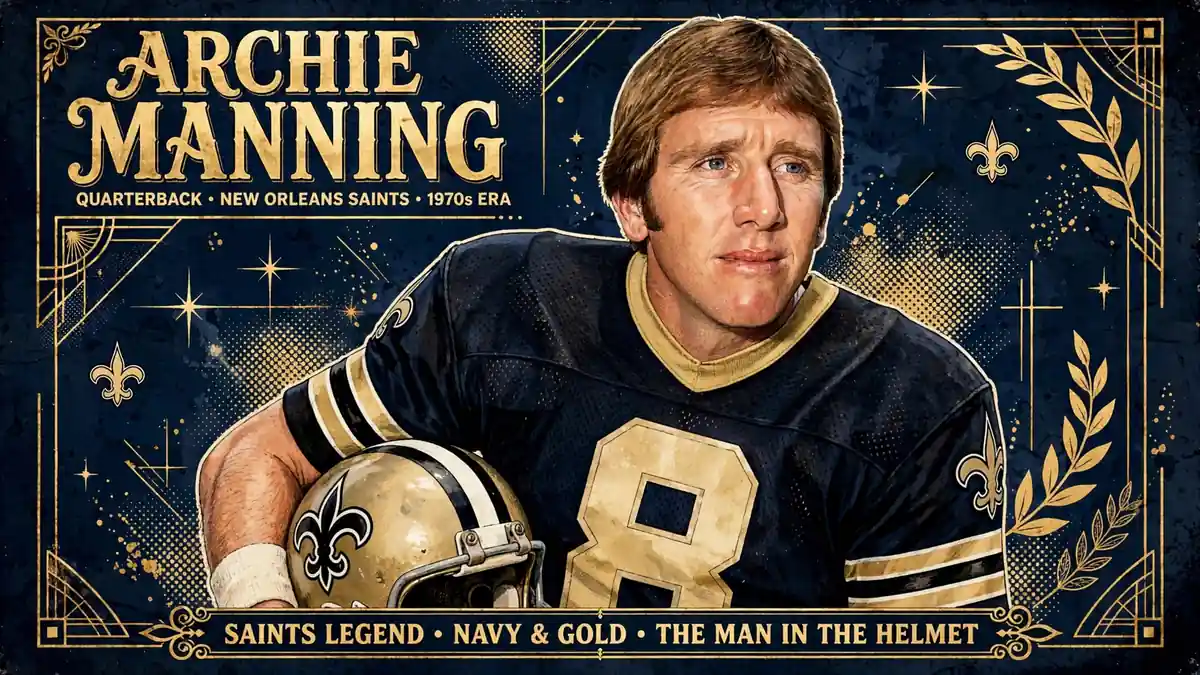
Archie Manning‘s net worth is estimated at $10 million as of November 2026. The figure looks small next to the fortunes his sons built, and that gap is the whole story: Archie played quarterback for the New Orleans Saints in an era when the highest-paid player in the league earned $600,000 a year, then spent four decades turning a famous name into steady, diversified income as a broadcaster, investment broker, speaker, consultant, restaurateur and camp founder.
Archie Manning: Quick Facts
| Estimated net worth | $10 million (range: $10 million; see the note on outlier claims below) |
|---|---|
| Profession | Former NFL quarterback, broadcaster, investment broker, speaker and consultant |
| Nationality | American |
| Born | May 19, 1949 (age 77) |
| Height | 6 feet 3 inches |
| Primary income sources | NFL salaries (1971–1984), broadcasting, speaking, consulting and endorsements, Manning Passing Academy, Manning’s restaurant |
| Active years | 1968–1984 (college and NFL); business and broadcasting career from 1985 onward |
| Last reviewed | November 2026 |
- Early Life and Background
- Education
- Career Journey
- Rise to Fame
- Main Sources of Income
- Salary and Earnings
- Businesses and Investments
- Brand Deals and Sponsorships
- Houses, Cars and Other Assets
- Awards and Achievements
- Net Worth Growth Over the Years
- Social Media Presence
- Personal Life
- Sources & Reporting
- Frequently Asked Questions
Early Life and Background
Elisha Archibald Manning III was born on May 19, 1949, in Drew, Mississippi, a small Delta town built on cotton, soybeans and rice. His father, Elisha Archibald Manning Jr., known as Buddy, and his mother, Jane Elizabeth Manning, raised him in a place where school sport was one of the few entertainments on offer, and Archie played all of them well. Football took hold first. In Drew, and across Mississippi in the 1960s, the road for a talented quarterback ran through Oxford and the University of Mississippi, and Archie never really looked anywhere else.
The defining loss of his youth came in 1969, when he was 19 and his father died by suicide. The ESPN documentary The Book of Manning, directed by Rory Karpf after more than two years of work with the family, treats that death as the wound that shaped everything that followed: a son who had wanted his father’s approval, a father who rarely said “I love you,” and a young man who carried the grief into adulthood without making a public performance of it. Archie has spoken about it rarely and plainly, and this article does the same. It matters to the money story only in one honest sense: the Manning family enterprise that later made Archie wealthy — the camp, the restaurant, the shared brand — was built by a father and sons who stayed close, and that closeness was a choice made after a fracture.
At Drew High School, Archie was a multi-sport athlete, good enough at baseball that accounts of his youth describe a genuine fork in the road: a professional baseball path with the Atlanta Braves, or a football scholarship to Ole Miss. His father told him to follow his heart, and he chose Ole Miss. That decision, made by a teenager in the Delta, set the terms of his entire financial life. A baseball career might have paid differently; a football career at Ole Miss made him a regional hero before he ever signed a professional contract, and regional heroes in Louisiana and Mississippi stay employable for life.
One detail from those years still shows up in Oxford today. Ole Miss retired Archie’s No. 18, and the campus speed limit is 18 miles an hour in his honour — a small, permanent piece of local infrastructure named for a quarterback. It is the kind of civic capital that does not appear on a balance sheet but explains why, decades after retirement, companies in Louisiana kept hiring Archie Manning to front their brands. He was not just a former player. In Mississippi and Louisiana, he was a landmark.
Education
Archie Manning played quarterback at Ole Miss from 1968 to 1970, starting for three seasons under coach Johnny Vaught. The numbers from those three years still read well: 4,753 passing yards and 823 rushing yards, in an era when college teams ran far more than they threw. He finished fourth in the Heisman Trophy voting in 1969, was named an All-American, and closed that season by winning Sugar Bowl most valuable player honours as Ole Miss beat third-ranked Arkansas. Alabama coach Bear Bryant, who had seen every great quarterback of the period, called him the most athletic quarterback he had ever seen — a line that has followed Archie ever since because it came from Bryant, not from a press release.
His college career also produced the first Manning family football myth that later became a business asset. Archie was so popular at Ole Miss that his jersey number became campus shorthand, and his sons grew up inside that story: Cooper and Eli both went to Ole Miss, and the family name became part of the university’s identity. When Archie later launched a football camp with his sons, he was not starting from scratch. He was selling access to a name that three generations of Southern football fans already knew.
He met Olivia Williams at Ole Miss. She was from Philadelphia, Mississippi, was homecoming queen in her senior year, and married Archie in 1971, the year he entered the NFL draft. The marriage has lasted more than five decades, and Olivia’s steady presence in New Orleans charity and community work — including Women of the Storm, the group of New Orleans women formed after Hurricane Katrina — became part of the family’s public standing in the city. For a man whose post-playing income depended on trust, that standing was worth real money: sponsors hire people their customers already believe in.
Archie left Ole Miss as a two-time All-American whose number was retired, and he was later inducted into the College Football Hall of Fame, the first Manning to reach it. Peyton later joined him there, making father and son the only father-son duo in that hall. That detail matters to the net-worth question because it marks the moment Archie stopped being a regional star and became a permanent part of the sport’s history — and permanent history pays speaking fees long after the last game.
Career Journey
The New Orleans Saints selected Archie Manning with the second overall pick in the 1971 NFL Draft, days after his wedding, and he arrived in a city that had barely begun to believe in its football team. The Saints, founded in 1967, were a losing franchise, and they stayed one for his entire time there. Manning played 14 NFL seasons in all, from 1971 to 1984, most of them in New Orleans, with short spells at the Houston Oilers in 1982–1983 and the Minnesota Vikings in 1983–1984. He missed the whole 1976 season after shoulder surgery, a lost year that sits in the middle of his salary history and his statistics alike.
His career totals tell a story of talent trapped on bad teams: 23,911 passing yards, 125 touchdowns against 173 interceptions, a 55.2 percent completion rate, and a win-loss record of 35 wins, 101 losses and 3 ties as a starter. He was sacked 337 times, a figure that says as much about the offensive lines in front of him as about his own mobility. He never played on a winning team and never reached the postseason — the only great quarterback of his generation who can say that, and the reason his name rarely appears in Hall of Fame debates for the professional game despite two Pro Bowl selections.
His best season came in 1980, when he threw for a career-high 3,716 yards and 23 touchdowns with an 81.8 passer rating. Two years earlier, after guiding the Saints to a 7–9 record in 1978 — a mark that counted as a breakthrough in New Orleans at the time — United Press International named him NFC Player of the Year, and he earned Pro Bowl selections in 1978 and 1979. The 7–9 season is worth pausing on, because it explains his local standing. In a city that had never seen its team win, a quarterback who got the Saints to one game below .500 was treated like a champion. The Saints later placed him in their Hall of Fame and their Ring of Honor, and they have not issued his No. 8 since he left — a quiet retirement of a number that no press release ever announced.
The end came in stages. Traded to Houston during the 1982 season, he played nine games across two seasons for the Oilers, throwing for 1,632 yards, and then finished with Minnesota in 1984. He retired at 35, having spent his prime absorbing hits for a franchise that won 35 games in the 139 he started. The contrast with his sons’ careers is stark and instructive: Peyton won two Super Bowls and five MVP awards, Eli won two Super Bowls and two Super Bowl MVP awards, and their father never played a single playoff game. That contrast is also the reason Archie’s net worth is a fraction of theirs. Playoff runs, Super Bowl bonuses and the endorsement market that follows championships never arrived for him. What arrived instead was something slower: four decades of local and national work built on reputation rather than rings.
Rise to Fame
Archie Manning was famous before he was rich, and famous in a specific, durable way. At Ole Miss he was the most exciting player in the Southeastern Conference, a dual-threat quarterback before that term existed, and his games were appointment viewing in Mississippi. In New Orleans, his introduction before the 1971 season opener against the Los Angeles Rams at old Tulane Stadium drew one of the longest, loudest cheers the stadium had heard, according to the Louisiana Sports Hall of Fame. He was 22, new to the city, and already its adopted son.
His fame changed shape after retirement. In the 1980s and 1990s he became a broadcaster and a civic figure in New Orleans, the voice Saints fans heard on WWL radio and television, and the man companies called when they wanted a trustworthy face. Network television jobs were offered, the Louisiana Sports Hall of Fame notes, and he turned them down: “When I’m in New Orleans, I’m home.” That sentence cost him national broadcast money and bought him something else — permanent local standing, which turned out to be the foundation of his post-playing income. A national analyst is replaceable. A New Orleans institution is not.
The second wave of his fame arrived through his sons. As Peyton became a star at Tennessee and then the first overall pick of the 1998 draft, and as Eli followed him to the top of the 2004 draft, television cameras kept finding Archie and Olivia in the stands. The family became a brand in its own right: a book, Manning: A Father, His Sons and a Football Legacy, written with Peyton and John Underwood in 2000; the ESPN documentary The Book of Manning in 2013; joint commercials; and, from 1996 onward, the Manning Passing Academy, where the family’s name was the product. Archie did not need to chase fame in this period. Fame, in the form of three sons and then a grandson, kept arriving at his door.
That is the honest shape of his rise: college stardom, a long professional career on a losing team that made him beloved rather than decorated, and then a second career as the patriarch of football’s most famous family. Each stage paid less than the last stage of a modern superstar’s career, but each stage lasted longer than a playing career ever does. The $10 million estimate is the sum of a long, steady second act, not a single payday.
Main Sources of Income
Archie Manning’s income falls into six streams, and the balance between them shifted over time. In the 1970s and early 1980s, NFL salaries were almost everything. From the mid-1980s onward, the mix broadened every decade: broadcasting first, then investment work, then speaking and consulting, then the camp, then the restaurant, then the family brand work that tied them together. No single stream after football ever matched a modern quarterback’s contract, but six modest streams running for forty years add up.
Broadcasting was the first post-playing pillar. Manning worked as an analyst for Saints broadcasts on WWL radio and television, staying with the team he had played for rather than moving to a national network. Local broadcast work pays less than a national studio chair, but it is steadier, and it kept his name in front of the exact audience — Louisiana football fans — that his other ventures needed. A restaurant on Fulton Street and a camp in Thibodaux both sell better when the owner is the voice fans hear every Sunday.
Investment and consulting work was the second pillar. After retirement he earned a broker’s licence, became vice-president of an investment firm, and later formed his own public relations and promotional firm. The Louisiana Sports Hall of Fame records both steps, and the Tulane Book Festival biography adds that he has served in public relations and consulting roles for local, regional and national companies. This is the least visible part of his income and the hardest to price from outside, because private consulting fees are never published. It is also, over forty years, likely to be one of the largest parts: a well-connected former quarterback with a broker’s licence and a Rolodex full of Louisiana business owners does not work for free.
Speaking engagements form the third pillar. Manning is listed by speakers’ bureaus as a keynote speaker, and his biography notes frequent speaking engagements alongside his consulting work. A former quarterback who is also the father of two Super Bowl-winning quarterbacks and the chairman of the National Football Foundation can command a corporate fee that a former player without those titles cannot. No fee schedule is public, so this article does not invent one; the direction of travel is clear enough without a number.
The Manning Passing Academy and Manning’s restaurant are the two named businesses, covered in detail below. The sixth stream is family brand work: joint endorsements and appearances with Cooper, Peyton and Eli, the book, and the documentary. None of this income belongs to Archie alone in any simple sense, and none of it should be confused with his sons’ fortunes. Peyton’s estimated $250–300 million and Eli’s estimated $160 million are theirs, built on modern contracts and endorsements Archie never had access to. Archie’s share of joint work is a slice, not the whole, and the $10 million estimate reflects that.
Salary and Earnings
Archie Manning’s playing salary is the most reported and least reliable part of his financial story, because the NFL did not publish salaries in the 1970s the way it does now, and because later net-worth pages copy each other without checking. Two versions circulate, and readers deserve to see both.
The first version, repeated by several net-worth pages, says his rookie contract in 1971 was worth roughly $400,000 over four or five years in total — not per season, despite some pages misreading it that way. The second, more detailed version, published as a year-by-year salary history, puts his rookie salary at $45,000, rising to $90,000 by 1975 and $135,000 by 1977, with the 1976 season lost to shoulder surgery, then a jump to $250,000 in 1978 under a new Saints contract, and a peak of $600,000 in 1981. That detailed history also puts his total career salary at about $2.1 million across his playing years. The two versions are not fully reconcilable, and no filing settles the question, so this article treats the year-by-year figures as reported rather than verified, and the $2.1 million total as an estimate from a secondary salary history, not a league record.
What is solid is the 1981 peak. Multiple accounts agree that Manning earned $600,000 in 1981, a figure that made him the highest-paid player in the NFL that season, and that the Saints offered him a five-year deal at that rate. In today’s money, $600,000 from 1981 is roughly $2 million — a useful correction to any reader who hears “league-high salary” and pictures a modern contract. The highest-paid player in the league in 1981 earned, in real terms, about what a mid-level backup earns for a few games now. That single comparison explains the entire gap between Archie’s wealth and his sons’ wealth better than any other number in this article.
The 1981 deal also explains why his career earnings look thin next to his fame. He signed his peak contract at 32, with his best seasons behind him, on a team that could not win. He played three more seasons after it, at lower rates in Houston and Minnesota, and retired in 1984. His whole playing career, in nominal dollars, paid roughly what a modern first-round quarterback earns before his first regular-season snap. Adjusted for inflation, the total is several times the nominal $2.1 million, but it still sits in single-digit millions — the starting capital for everything that followed, not a fortune in itself.
Post-playing earnings have no published totals at all. Broadcasting, brokerage, speaking, consulting, the camp and the restaurant are all real, and all are priced in private. The honest way to read the $10 million estimate, then, is as a compounding story: a few million dollars of playing earnings in 1970s and 1980s money, invested and supplemented by forty years of steady professional income in New Orleans, minus taxes, living costs and the cost of raising three sons, arriving at a low-eight-figure net worth at 77. It is plausible precisely because it is modest. A man with Archie’s career and Archie’s second act, who did not blow money publicly and did not land an equity windfall, would be expected to land somewhere near this figure — not at $40 million, and not at $100 million.
Those higher figures deserve a direct answer, because readers will find them. Pages claiming $40 million or $100 million for Archie Manning exist, and they should be discounted: the $40 million page misstates his career outright, describing a 17-year career and a draft year two decades late, and the $100 million page credits him with endorsement deals and a property portfolio it never evidences. A net-worth estimate built on wrong dates cannot be trusted on dollars. The consensus figure, $10 million from Celebrity Net Worth and repeated by Pro Football Network and most other pages, rests on the correct career — 14 seasons, 1971 to 1984, peak salary $600,000 — and that is why this article uses it.
Businesses and Investments
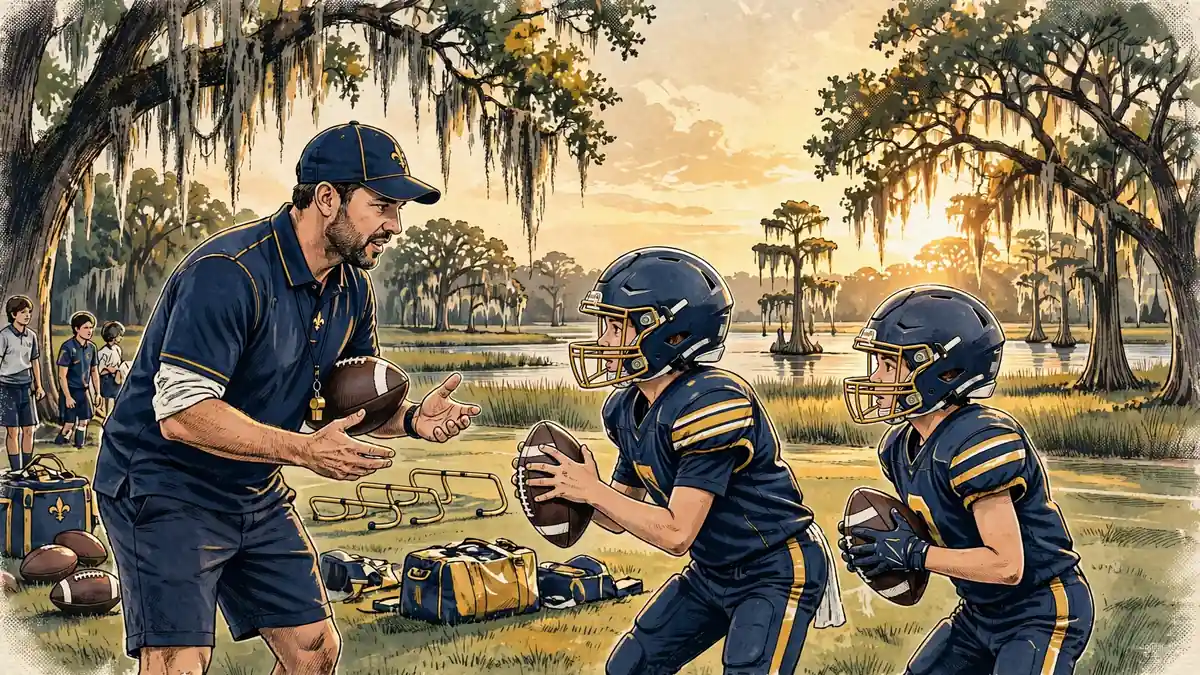
The Manning Passing Academy is Archie Manning’s most durable business, and the one with the clearest public record. He founded it in 1996 with his sons and two Tulane football figures, coach Buddy Teevens and recruiting coordinator Jeff Hawkins, after Cooper had graduated from Ole Miss, Peyton was emerging at Tennessee and Eli was a sophomore at Isidore Newman School in New Orleans. The first camp, held on the Tulane campus, drew 185 boys. Thirty years later, the academy marked its 30th edition in June 2026 at Nicholls State University in Thibodaux, Louisiana — its home since 2005 — with about 1,400 high school quarterbacks, running backs, tight ends and receivers in attendance, according to the National Football Foundation.
The growth numbers tell the business story. By its 25th edition in 2021, the camp was capped at 1,200 campers a year despite demand the Mannings estimated could have filled more than 2,000 places, and more than 26,000 young players had attended in total. By 2026 the cap had risen to 1,400. The academy also became a pipeline and a networking machine: more than half of current NFL quarterbacks attended as campers or counselors, the National Football Foundation reported in 2021, and its counselor rolls have included Heisman winners and future stars from Tim Tebow and Lamar Jackson to Joe Burrow, Patrick Mahomes, Justin Herbert and, in 2026, Arch Manning of Texas. The camp charges fees, employs staff, rents a university campus and sells merchandise, and it has done so every summer for three decades — the definition of a steady small business, even though its accounts are private and this article does not guess at its profit.
What the academy really sells, though, is access to the Manning name, and that is where its value to Archie’s net worth goes beyond ticket sales. A camp that can put a high-school quarterback on the same field as the best college quarterbacks in America, under the Manning banner, keeps the family brand current with every new generation of fans. When grandson Arch became the top-rated high-school quarterback in the class of 2023 and then a Texas Longhorn, the academy’s 2026 counselor list featured his name alongside the rest — three generations of Mannings on one staff sheet. That continuity is why sponsors and universities keep calling, and why Archie’s earning power did not fade with age the way most retired athletes’ does.
Manning’s, the sports bar and grill on Fulton Street in New Orleans, is the second named business. Archie opened it in January 2012 with Harrah’s New Orleans, in a building across Fulton Street from the Harrah’s hotel, and it carries the names and images of Archie, Cooper, Peyton and Eli. The room is built for game day: dozens of televisions, a giant screen, and rows of recliners known as the End Zone Recliners, where guests reserve premium seats for big games. As of 2026 the restaurant was still listed on OpenTable as Manning’s Sports Bar and Grill at Caesars New Orleans, open Thursday to Sunday, with reserved recliner packages for the football season. Restaurant margins are thin and the accounts are private, so this article does not put a value on Archie’s stake. Its contribution to his wealth is better understood as brand income — a physical place where the Manning name earns money every weekend — than as a property windfall.
Beyond those two ventures, his investment history is documented in outline only: a broker’s licence, a vice-presidency at an investment firm, and his own public relations and promotional firm. No property portfolio, stock holding or private-equity stake is a matter of public record for Archie Manning, and this article does not invent one. Readers who find pages crediting him with houses in San Diego or a string of luxury properties should treat those claims as unevidenced: the one home reliably attached to him is in New Orleans, covered below, and the one business reliably attached to him outside football is the camp and the restaurant. A diversified post-playing career, honestly described, is enough. It does not need an invented portfolio to reach $10 million.
His civic investments are easier to document and worth more, in reputation terms, than any single deal. He joined the board of the National Football Foundation in 1993 and became its chairman in 2007, leading a network of 120 chapters in 47 states with more than 12,000 members, according to the foundation’s award citation. He hosted four Archie Manning Cystic Fibrosis benefit golf tournaments in Louisiana and Mississippi for 25 years, worked with the Louisiana Special Olympics, the New Orleans Area Boy Scout Council, the Salvation Army and the United Way Speakers Bureau, and served on the Allstate Sugar Bowl Committee and the New Orleans Sports Foundation. The Sugar Bowl created the Manning Award, given to the nation’s best college quarterback, in honour of the family’s college achievements. None of this pays a salary in the usual sense. All of it keeps a 77-year-old former quarterback employable, credible and in demand — which, over forty years, is the same thing.
Brand Deals and Sponsorships
Archie Manning’s endorsement career divides into two eras. In the first, he was a player endorsing products as a Saints quarterback, in a market where even the league’s best-paid player earned $600,000 a year and endorsement money was a supplement, not a fortune. In the second, he became a spokesman and consultant, hired as much for his judgment and his name as for his face. The companies named in his biographies for that second era include Gatorade, DirecTV, Reebok, Nationwide, Entergy and CBS Sports, in public relations and consulting roles as well as straight endorsements. No contract values are public for any of them, and this article does not estimate them.
The family brand is the bigger story. Archie, Olivia, Cooper, Peyton and Eli have appeared together in commercials — including a well-known ESPN spot featuring the whole family — and the Manning name has been licensed across the camp, the restaurant and joint appearances for decades. The economics of joint work favour the active stars: Peyton and Eli, at their peaks, commanded the fees, and Archie’s share of a family deal was the patriarch’s share, not the star’s. That is normal, and it is another reason the $10 million figure should not be read as a share of the family’s combined wealth. Combined, the Manning family’s football earnings run into hundreds of millions. Archie’s personal portion is the smallest slice of that total, earned earliest, in the cheapest era of the sport.
One more distinction matters for readers comparing Archie with modern players. He never had a shoe deal on the scale of a modern quarterback, never had a national fast-food campaign built around a Super Bowl run, and never owned equity in a brand that went public. His endorsements were regional and corporate: a Louisiana utility, a national insurer, a sports drink, a satellite company. Those deals pay fees, not fortunes, and they end when the contract ends. The camp and the restaurant, by contrast, are assets he controls, which is why they feature more prominently in any honest account of his wealth than any single endorsement. A fee is spent. A business that runs for thirty summers keeps paying.
His book and documentary work sits in the same category: real income, modest scale. Manning: A Father, His Sons and a Football Legacy (2000), written with Peyton and John Underwood, sold on the strength of a family story that was still unfolding — Peyton was early in his NFL career when it appeared. The Book of Manning (2013), the ESPN documentary, paid in rights and exposure more than in a windfall. Both reinforced the brand that made the camp and the speaking work possible. Neither, on its own, explains $10 million. Together, with forty years of fees, they help explain it.
Houses, Cars and Other Assets
Archie and Olivia Manning’s housing history is one of the best-documented parts of their life, and it runs against the usual celebrity pattern. They did not collect houses. They lived in one New Orleans home for 39 years, then moved a few blocks.
After marrying in 1971, they first lived in Metairie, near where the Saints trained, in an apartment Archie joked was called a penthouse only because it had a patio. They then bought a historic home in New Orleans’ Garden District, where they raised Cooper, Peyton and Eli and where the house itself became a local landmark — a regular stop on neighbourhood tours, with high ceilings, a swimming pool and a garden that neighbours knew by sight. Sports Illustrated, visiting in the early 1980s, found Archie in the den of that Garden District house, looking at a picture on the wall. Forty years later, the house was still the family’s anchor.
About three years before a 2025 profile in the Shreveport-Bossier Advocate, Archie and Olivia moved out of the Garden District house they had occupied for 39 years and into a third-floor condominium on St. Charles Avenue, a few blocks away, overlooking the Mardi Gras parade route. The move reads as downsizing in the ordinary sense: a couple in their seventies trading a large family house for a smaller place in the same city, near the same friends — the profile notes neighbours including the writer Walter Isaacson. No sale price for either property is used in this article, because no verified, current sale record for the family’s homes is cited in the reporting relied on here, and guessing at a price would turn a housing anecdote into a false asset valuation. What can be said is that a 39-year hold in a historic New Orleans neighbourhood, bought decades before the area’s prices rose, is a genuine asset, and that the condo move suggests a couple managing wealth conservatively rather than spending it.
On cars, the honest answer is that no verified car collection is attached to Archie Manning in credible reporting. Net-worth pages that list luxury cars for him do so without a source, and this article does not repeat them. He is not known, as some athletes are, for a public collection or for car endorsements, and his public image — Garden District house, camp in Thibodaux, restaurant on Fulton Street — is local and low-key rather than automotive. If he owns comfortable cars, they are not part of his public wealth story, and they are not needed to explain $10 million.
The same honesty applies to other assets. No private jet, yacht, art collection or second-home portfolio is documented for Archie Manning. His assets, as far as public reporting shows, are a New Orleans home (now a condo), a stake in a restaurant, a camp business, and the intangible asset that matters most: a name that still books rooms in Louisiana. That is a smaller, plainer asset list than most celebrity net-worth pages print, and it is more believable for it. A $10 million net worth built on a house, a business, a restaurant and forty years of fees looks exactly like this.
Awards and Achievements
Archie Manning’s honours list is long, and it splits neatly into playing honours and civic honours — the second list being longer, which tells its own story about where his reputation now rests.
As a player, he was a two-time All-American at Ole Miss, finished fourth in the 1969 Heisman Trophy voting, won Sugar Bowl MVP honours for the 1969 season, and was selected to the Pro Bowl in 1978 and 1979. United Press International named him NFC Player of the Year in 1978. He was inducted into the College Football Hall of Fame, and he and Peyton are the only father-son duo in that hall. Ole Miss retired his No. 18. The Saints placed him in their Hall of Fame and Ring of Honor. He was voted Mississippi’s Greatest All-Time Athlete in 1992 and named Mississippi’s Most Popular Athlete of the Century, and he was elected to the 50-Year All-South Team covering 1940 to 1990.
The civic and hall-of-fame list runs further: the Louisiana Sports Hall of Fame (inducted 1988), the Mississippi Sports Hall of Fame, the Ole Miss Sports Hall of Fame, the Gator Bowl Hall of Fame, the Greater New Orleans Sports Hall of Fame and the National Quarterback Club Hall of Fame. In 2024 he received the American Football Coaches Association’s Tuss McLaughry Award, the association’s highest honour, in recognition of his work as chairman of the National Football Foundation. He has also received the Walter Camp Foundation’s Distinguished American Award and the Pat Summerall Award. In 2023, Archie, Cooper, Peyton and Eli were inducted together into the National High School Football Hall of Fame as part of its inaugural class — a family honour that no other family in the sport can match.
What he did not win matters too, and this article does not hide it. He was never selected for the Pro Football Hall of Fame, and his professional record — no winning season, no playoff appearance — is the reason. His college honours are secure; his professional case rests on talent and character rather than team success. For the net-worth story, the distinction is useful: civic honours and college immortality pay speaking fees and keep a name alive, while a Pro Football Hall of Fame career would have paid far more in endorsements during and after playing. Archie got the first kind of honour in abundance and the second kind not at all, and his bank balance reflects that split.
Net Worth Growth Over the Years
No year-by-year net-worth series exists for Archie Manning, and any article that prints one is inventing it. No filing tracks his wealth annually, and the $10 million figure is a current estimate, not the end of a measured curve. What can be shown honestly is a timeline of earning milestones, with the wealth story attached to each stage rather than a false annual figure.
| Period | Milestone | What it meant for his wealth |
|---|---|---|
| 1971–1984 | NFL career, Saints, Oilers, Vikings | Playing salaries reported at about $2.1 million in total nominal dollars; peak $600,000 in 1981 as the league’s highest-paid player |
| 1985 onward | Broadcasting, brokerage and consulting | Steady professional income in New Orleans replaces playing salary; broker’s licence and own PR firm |
| 1993 / 2007 | National Football Foundation board, then chairman | Civic leadership raises speaking and consulting value; no salary published |
| 1996 | Manning Passing Academy founded, 185 campers | A business asset is created; by 2021 more than 26,000 players had attended |
| 2000 / 2013 | Book with Peyton; The Book of Manning documentary | Family brand income and exposure; reinforces camp and speaking demand |
| 2012 | Manning’s restaurant opens on Fulton Street | A second business asset; still operating under Caesars New Orleans in 2026 listings |
| 2026 | Academy marks 30th edition, about 1,400 campers | Current estimate: $10 million, per Celebrity Net Worth and the consensus of net-worth pages |
The shape of that timeline is gradual accumulation, not a spike. The 1970s and 1980s supplied the capital. The 1990s and 2000s supplied the businesses. The 2010s and 2020s supplied the compounding: a camp in its third decade, a restaurant in its second, and a family brand that renewed itself with each new generation, most recently with grandson Arch at Texas. Nothing in the timeline suggests a sudden windfall, and nothing suggests a collapse either. A man who kept working, kept his name clean, and kept his businesses running for forty years would be expected to end up where the estimate puts him.
For comparison, the family table shows why Archie’s figure looks small and why that is not a puzzle:
| Family member | Estimated net worth | Main source |
|---|---|---|
| Archie Manning | $10 million | 1970s–80s NFL salaries plus four decades of broadcasting, consulting, camp and restaurant income |
| Peyton Manning | $250–300 million (sources differ) | Modern NFL contracts, endorsements and post-playing media and business work |
| Eli Manning | $160 million | Modern NFL contracts, endorsements and media work |
| Arch Manning (grandson) | About $6 million reported | Name, image and likeness era college deals, as reported — a separate fortune, not Archie’s |
Two warnings belong with that table. First, Peyton’s figure is itself a range: some pages put him at $250 million and Celebrity Net Worth’s 2026 reporting puts him at $300 million, so this article gives the range rather than picking one. Second, none of these figures should be added together into a “Manning family net worth” and attributed to Archie. Family wealth is not personal wealth, and Archie’s $10 million is his own, earned earliest and in the cheapest era of the three generations shown.
Social Media Presence
Archie Manning has no verified personal social-media presence that credible reporting identifies, and this article does not attach follower counts to him. He is 77, his public career predates social media by decades, and his public appearances run through institutions — the Manning Passing Academy, the Saints, the National Football Foundation and the Sugar Bowl — rather than through personal accounts. Readers searching for an official Archie Manning Instagram or X account will find fan pages, camp accounts and family coverage, not a verified personal feed, and any follower number attached to his name on a net-worth page should be treated as invented unless it links to a verified account.
That absence is itself a clue to his earning model. Modern athletes monetise attention directly, through sponsored posts and personal brands. Archie’s brand was monetised through rooms, not feeds: a camp dining hall in Thibodaux, a restaurant on Fulton Street, a corporate dinner, a broadcast booth. The Manning Passing Academy maintains its own presence and publicity, and the family’s younger members are active online, but Archie’s income never depended on his own posting schedule. For a net-worth estimate, the practical point is simple: there is no social-media income stream to add, and no social-media following to inflate the figure with.
Personal Life
Archie Manning married Olivia Williams in 1971, the year he was drafted, after meeting her at Ole Miss. They have three sons: Cooper, born in 1974; Peyton, born in 1976; and Eli, born in 1981. The family story is well known, but two parts of it are usually told too quickly, and both matter to understanding Archie.
Cooper, the eldest, was an All-State receiver in high school and Peyton’s top target, and he took a scholarship to Ole Miss — then, at a practice before his freshman season, was diagnosed with spinal stenosis, a narrowing of the spinal canal that ended his playing career before it began. The diagnosis rerouted the family: Cooper went into business, became a senior managing director at the hotel and real-estate firm AJ Capital Partners, and hosts a show on Fox Sports, while his son Arch became the third generation of Manning quarterbacks. Cooper’s lost career is the reason the Manning Passing Academy’s mission — making the game more enjoyable for high-school players — reads less like marketing and more like a family position. The camp was founded, in part, by a family that knew how quickly the game can be taken away.
Peyton and Eli need less introduction. Peyton played 18 NFL seasons, won two Super Bowls, won a record five MVP awards, was selected to 14 Pro Bowls and was inducted into the Pro Football Hall of Fame in 2021. Eli played 16 seasons, won two Super Bowls in 2008 and 2012, and was named MVP of both games. Both were first overall draft picks, Peyton in 1998 and Eli in 2004, when his draft-day rights were traded from San Diego to the New York Giants. Archie’s pride in them is public and uncomplicated, and his role in their careers — driving them to practice, letting them memorise his old game tapes, bringing them to Saints practices on Saturdays — is part of the family record. He did not coach them into stardom from the sideline. He gave them a house where football was the family language, and then got out of the way.
Outside football, Archie and Olivia have lived their whole married life in New Orleans, apart from their Mississippi roots, and their charity work runs through the city: the cystic fibrosis golf tournaments, Special Olympics, Boy Scouts, Salvation Army, United Way and the Sugar Bowl. Olivia’s community work, including Women of the Storm after Hurricane Katrina, is part of that record. The Mannings’ Garden District home escaped heavy damage from Katrina, and the family stayed in the city after the storm when many did not — another reason New Orleans treats them as its own rather than as celebrities who happen to live there.
At 77, Archie’s public life in 2026 still runs on the same calendar: the camp in June, Saints events in the autumn, foundation work through the year, and family occasions centred on a grandson playing quarterback at Texas. In the summer of 2025 he told Texas Monthly that he expected Arch to be at Texas in 2026, a small public statement that doubled as a reminder of his current role: not a player, not a coach, but the patriarch whose opinion still makes news. That role pays less than a quarterback’s contract and lasts longer than one. It is, in the end, the asset behind the $10 million.
Sources & Reporting
Celebrity Net Worth — the $10 million estimate anchor, plus the post-playing career summary (investment broker, broadcaster, spokesman, restaurateur, consultant, philanthropist) and the academy participation figure. Reporting window: current page, checked November 2026.
Pro Football Network — career statistics (23,911 yards, 125 touchdowns, 173 interceptions, 55.2 percent completions, 35–101–3 record, 1980 best season) and the $10 million repeat estimate. Reporting window: career retrospective, checked November 2026.
National Football Foundation — Manning Passing Academy history: founded 1996 at Tulane with 185 campers, moved to Nicholls State in 2005, 25th edition in 2021 with more than 26,000 total attendees, 30th edition in June 2026 with about 1,400 campers, and Archie’s board (1993) and chairman (2007) roles. Reporting window: 2021 and 2026 foundation releases.
Crescent City Sports — post-playing roles (investment broker, broadcaster, restaurateur, endorser, philanthropist, academy founder), consulting clients including Gatorade, DirecTV, Reebok, Nationwide, Entergy and CBS Sports, Ole Miss totals, Pro Bowl years and the 2024 AFCA Tuss McLaughry Award. Reporting window: 2024 award coverage.
Louisiana Sports Hall of Fame — Saints debut, WWL analyst work, broker’s licence and vice-presidency, own PR firm, and the decision to stay in New Orleans over national television work. Reporting window: hall of fame biography, induction year 1988.
Tulane Book Festival — consulting and PR roles, 25 years of cystic fibrosis benefit golf tournaments, charity and civic work, the Manning Award, and Manning’s restaurant ownership. Reporting window: festival author biography.
Shreveport-Bossier Advocate — the Garden District house held for 39 years and the move about three years before 2025 to a St. Charles Avenue condominium, plus the Manning Family Children’s hospital honour. Reporting window: February 2025 profile.
Secondary salary histories (year-by-year figures and the $2.1 million career total, plus the $600,000 1981 peak and its $1.81 million earlier inflation conversion) are reported, not verified from league filings, and are labelled as such in the salary section; where they conflict with the $400,000 rookie-contract account, both versions are shown. Outlier $40 million and $100 million estimates are discounted for the factual errors documented in the salary section. No figure in this article rests on a single anonymous source.
Frequently Asked Questions
What is Archie Manning’s net worth in 2026?
Archie Manning’s net worth is estimated at $10 million as of November 2026. The figure comes from Celebrity Net Worth and is repeated by most net-worth pages. It is an estimate, not a verified balance sheet, built from his NFL salaries, broadcasting, speaking, consulting, the Manning Passing Academy and Manning’s restaurant.
How much did Archie Manning earn in the NFL?
His career salary is reported at about $2.1 million in total nominal dollars across 14 seasons from 1971 to 1984, though no league filing confirms the year-by-year breakdown. His peak salary was $600,000 in 1981, which made him the highest-paid player in the NFL that season — roughly $2 million in today’s money.
Why is Archie Manning worth less than Peyton and Eli?
He played in the 1970s and early 1980s, when even the league’s highest-paid player earned $600,000 a year, and he never played in a playoff game or a Super Bowl, so the championship bonuses and endorsement market that built his sons’ fortunes never arrived for him. Peyton is estimated at $250–300 million and Eli at $160 million, both built on modern contracts his era never offered.
What teams did Archie Manning play for?
He played for the New Orleans Saints from 1971 to 1982, the Houston Oilers in 1982–1983 and the Minnesota Vikings in 1983–1984, a 14-season NFL career in which he threw for 23,911 yards. He missed the entire 1976 season after shoulder surgery.
What is the Manning Passing Academy?
It is the summer football camp Archie founded with his sons in 1996 at Tulane University, with 185 campers in its first year. It moved to Nicholls State University in Thibodaux, Louisiana, in 2005, and marked its 30th edition in June 2026 with about 1,400 high-school players attending.
Does Archie Manning own Manning’s restaurant?
He is an owner of Manning’s, the sports bar and grill on Fulton Street in New Orleans, opened in January 2012 with Harrah’s New Orleans and still operating as Manning’s Sports Bar and Grill at Caesars New Orleans in 2026 listings. The value of his stake is private and is not estimated in this article.
Where does Archie Manning live?
He and his wife Olivia live in New Orleans. They lived in a Garden District home for 39 years, then moved about three years before a 2025 profile to a third-floor condominium on St. Charles Avenue, a few blocks from their old house and overlooking the Mardi Gras parade route.
Is Archie Manning in the Pro Football Hall of Fame?
No. He is in the College Football Hall of Fame and the Saints Hall of Fame and Ring of Honor, but not the Pro Football Hall of Fame. His career record of 35 wins, 101 losses and 3 ties, with no winning season and no playoff appearance, is the reason, despite two Pro Bowl selections and the 1978 NFC Player of the Year award.
Final Thoughts
Archie Manning’s $10 million net worth is best read as a story about timing. He was a great college quarterback, a beloved professional quarterback on a terrible team, and then — for forty years — the hardest-working patriarch in American sport: broadcaster, broker, consultant, speaker, camp founder, restaurateur and foundation chairman. None of those jobs paid like a modern quarterback’s contract. All of them together, held for decades in one city, built a low-eight-figure fortune that has outlasted almost every playing career of his generation.
The comparison with his sons is not a slight on Archie. It is the measure of how much the sport changed between 1981, when $600,000 made a man the highest-paid player in the league, and the era in which Peyton and Eli signed contracts worth tens of millions a year. Archie played for love, for New Orleans, and for salaries that look small now — and then he did the unglamorous work of turning fame into a business that still runs every June in Thibodaux. Ten million dollars, honestly earned across fifty years of football, is not a small fortune. It is the right-sized fortune for the career that built it.
Published on November 3, 2026. Last reviewed November 2026. Found an error? See our corrections policy.