
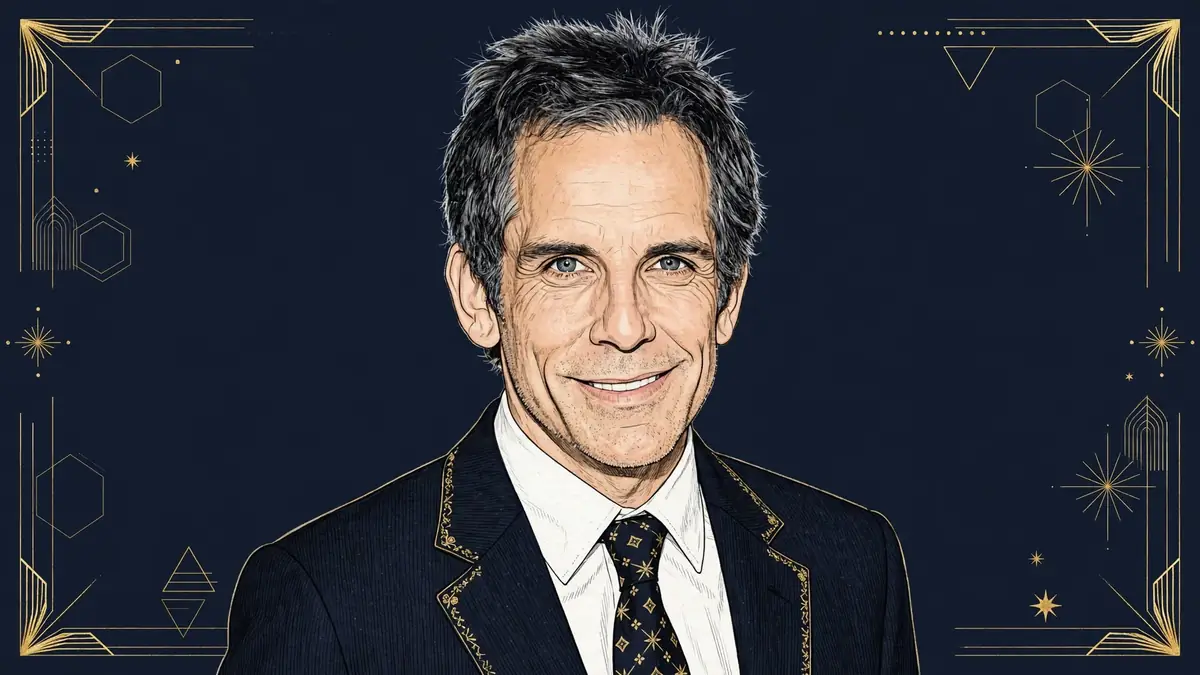
Ben Stiller‘s net worth is estimated at $200 million as of November 2026. The figure comes from Celebrity Net Worth, which still lists him at $200 million in its November 5, 2026 snapshot, and it matches Parade, Wealthy Gorilla and most other 2026 profiles. A smaller set of 2026 pages claims $250 million, but the source they cite — Celebrity Net Worth — lists $200 million, so we treat $200 million as the anchored estimate and $200 million to $250 million as the full published range. Stiller built it across four decades: $3 million for the 1998 breakout There’s Something About Mary, $10 million and then $20 million paydays inside the Meet the Parents franchise, a Forbes-recorded $53 million year in 2010, a production company that has fed him producer fees since the late 1990s, and a second act as the director behind Apple TV’s Severance — with a fourth Fockers film, Focker-in-Law, opening November 25, 2026.
Ben Stiller: Quick Facts
| Estimated net worth | $200 million (range: $200 million to $250 million) |
|---|---|
| Profession | Actor, comedian, director, producer, writer |
| Nationality | American |
| Born | November 30, 1965 (age 60) |
| Height | 5 ft 7 in (170 cm) |
| Primary income sources | Film acting salaries, franchise backend, directing and producing fees, Red Hour Productions, television (Severance), real estate |
| Active years | 1985–present |
| Last reviewed | November 2026 |
- Early Life and Background
- Education
- Career Journey
- Rise to Fame
- Main Sources of Income
- Salary and Earnings
- Businesses and Investments
- Brand Deals and Sponsorships
- Houses, Cars and Other Assets
- Awards and Achievements
- Net Worth Growth Over the Years
- Social Media Presence
- Personal Life
- Sources & Reporting
- Frequently Asked Questions
- Final Thoughts
Early Life and Background
Benjamin Edward Meara Stiller was born on November 30, 1965, in New York City, and he grew up inside the business he would later run. His parents, Jerry Stiller and Anne Meara, were a working comedy duo — Stiller & Meara — who played the variety-show and talk-show circuit for decades, and their son spent his childhood backstage, on sets and in rehearsal rooms rather than watching the industry from outside. That is the first thing most net-worth profiles skip, and it explains the shape of his fortune: Stiller never had a single breakout that made him rich and then faded. He learned the trade as a family business, and he has been paid as an actor, a writer, a director and a producer, often on the same project, for forty years.
He was born in Manhattan and raised in New York, the only son of two performers whose act mixed Borscht Belt timing with sharp character work. Jerry Stiller, later famous to a new generation as Frank Costanza on Seinfeld and Arthur Spooner on The King of Queens, and Anne Meara, a steady television and stage presence, gave their son a front-row education in how comedy pays: not from one cheque, but from residuals, touring, writing fees and owning a piece of the work. Friends and profiles of the family have long noted that the Stiller household treated show business as a craft with a payroll, not a lottery ticket — a view that shows up in every financial decision Stiller made later, from founding his own production company to negotiating backend points instead of flat fees.
By his teens Stiller was making short films with a Super 8 camera, casting friends and family, and learning to edit. The home movies were not a hobby that stayed a hobby. He shot a parody of a Martin Scorsese film, The Hustler of Money, as a teenager, and the short later became a calling card — proof that he could direct as well as perform. That double skill is the hinge of his net worth. Actors get paid per film. Actor-director-producers get paid three times on the same film, and they keep getting paid when the film earns again.
His parents’ own finances put the family’s scale in context. Celebrity Net Worth lists Jerry Stiller’s estate at $14 million at his death in 2020 and Anne Meara’s at $8 million at her death in 2015 — comfortable, working-actor money, and a long way from the $200 million their son would accumulate. The gap is the story of this article: the same industry, one generation later, with franchise salaries, backend deals, a production company and a streaming-era directing career layered on top.
Education
Stiller attended the Calhoun School in Manhattan and then enrolled at the University of California, Los Angeles, where he studied film. He left UCLA before graduating — nine months in, by most accounts — to move back to New York and pursue acting full time. The decision looks reckless on paper and turned out to be the cheapest education he ever bought: within a few years he was writing and performing on Saturday Night Live, and the film-school training he did get shows up in his directing work from the start.
The UCLA stint matters for the money story in one specific way. Stiller did not arrive in Hollywood as an actor waiting for a casting director to pick him. He arrived as a filmmaker who could write, shoot and cut his own material, and he kept that edge for his whole career. When The Ben Stiller Show was cancelled, he directed Reality Bites. When acting offers narrowed in the 2010s, he directed Escape at Dannemora and then Severance. Each pivot was a new income stream, and each one was possible because he had trained as a director as well as a performer.
Career Journey
Stiller’s professional career began in the mid-1980s with stage work and small film roles, and his first real break came in 1989, when he joined Saturday Night Live as a writer and featured performer. He lasted one season. The show’s format did not give him room to make the short films he wanted to make, so he left and took the idea to MTV, where The Ben Stiller Show ran as a sketch series — first on MTV in 1990, then on Fox in 1992–93. Fox cancelled it after thirteen episodes. It won the Primetime Emmy Award for Outstanding Writing for a Variety, Music or Comedy Program in 1993 anyway, and the cancellation turned out to be a gift: it freed Stiller to direct features.
His directorial debut, Reality Bites (1994), starred Winona Ryder and Ethan Hawke and cost about $11.5 million to make. It grossed roughly $33 million worldwide — a modest hit, but a real one, and it established Stiller as a director studios would trust with a budget. He followed it with The Cable Guy (1996), a dark Jim Carrey vehicle that grossed more than $100 million worldwide despite mixed reviews, and then with the film that changed his pay grade, There’s Something About Mary (1998), in which he starred opposite Cameron Diaz. The Farrelly brothers’ comedy grossed $369 million worldwide on a $23 million budget, and Stiller’s reported $3 million salary for it was the last time he would ever be paid that little for a hit.
The run that followed is one of the strongest commercial stretches any comedy actor has ever had. Meet the Parents (2000) grossed $330 million worldwide. Zoolander (2001), which Stiller directed, co-wrote and starred in, became a cult hit and a merchandising property. Meet the Fockers (2004) grossed $516.6 million worldwide. Madagascar (2005), in which he voiced Alex the lion, grossed more than $532 million worldwide and spawned a franchise. Night at the Museum (2006) grossed $574 million worldwide. In 2004 alone Stiller appeared in six films — Starsky & Hutch, Envy, DodgeBall: A True Underdog Story, Anchorman (an uncredited cameo), Along Came Polly and Meet the Fockers — a workload that tells you how much studios wanted him on a poster that year.
He directed Tropic Thunder (2008), which grossed $195 million worldwide and earned Robert Downey Jr. an Academy Award nomination, and The Secret Life of Walter Mitty (2013), a $188 million worldwide grosser that Stiller directed and starred in. The 2010s brought fewer leading-man roles and more directing: the Showtime limited series Escape at Dannemora (2018), which won him a Directors Guild of America Award, and then Severance (2022–present), the Apple TV science-fiction drama he executive produces and primarily directs. He has directed 11 of the show’s 19 episodes through season two, including the season-two finale, and the show’s second season — budgeted at a reported $200 million — was one of the most expensive television seasons ever made. In July 2025 he returned to acting in Happy Gilmore 2 on Netflix, reprising his role as Hal L., and in November 2026 he returns as Greg Focker in Focker-in-Law, the fourth film in the franchise that made him.
Across his film career, Stiller’s movies have grossed more than $2.6 billion in the United States and Canada, according to Wikipedia’s tally of his filmography, and more than $6 billion worldwide, according to Parade. That gross is the foundation of the net-worth figure: it is what let him command $20 million salaries, negotiate backend points, and keep a production company busy for twenty-five years.
Rise to Fame
The honest version of Stiller’s rise is that it happened twice. The first rise was as a comedy star: There’s Something About Mary in 1998 made him a leading man, and the five years after it made him one of the most bankable names in Hollywood. The second rise was as a director: Severance made him, at sixty, one of the most in-demand television directors in the business, with four Primetime Emmy nominations for his work on the show and a reputation for exacting, cinematic craft that his comedy career had never quite advertised.
The first rise had a clear financial shape. Before Mary, Stiller was a working actor-director with a cult sketch show and two features behind him. After Mary, he was a $3 million actor. After Meet the Parents, he was a $10 million actor. After Little Fockers, he was a $20 million actor. Forbes recorded the peak in 2010, when it named him the world’s second-highest-paid actor with $53 million earned in a single year, built on Night at the Museum: Battle of the Smithsonian, Little Fockers and Greenberg. The $53 million year is the single most useful number in this article, because it is a named-source, audited-style figure rather than an aggregator’s guess, and it shows how fast the money arrived once the franchise machine was running.
The Frat Pack label followed him through this period — the loose group of comedy actors including Owen Wilson, Vince Vaughn, Will Ferrell, Jack Black and Luke Wilson who traded cameos and co-starring roles through the 2000s. Stiller was the group’s most reliable box-office draw and its most prolific director, and the label mattered financially: the same faces in each other’s films kept marketing costs down and opening weekends up, and Stiller’s willingness to take a supporting role or a cameo in a friend’s film kept him in front of audiences between his own headlining jobs. Martin Lawrence’s own comedy fortune was built on a similar run of 1990s and 2000s hits, and the comparison is instructive — Lawrence peaked earlier and narrower, while Stiller kept adding income streams behind the camera.
The second rise started quietly. Escape at Dannemora (2018) won Stiller a Directors Guild Award and proved he could handle prestige drama. Severance (2022) made the proof impossible to ignore. The show, created by Dan Erickson and produced by Stiller’s Red Hour Productions alongside Fifth Season, became Apple TV’s flagship drama, drew 27 Emmy nominations for its second season, and turned Stiller from a comedy star who directs into a director who happens to be a comedy star. In February 2026 Apple TV acquired the intellectual property and all rights to the series from Fifth Season for a reported $70 million, with Apple Studios taking over as production company from season three — a deal that puts a hard market value on the show Stiller helped build. Stiller has said he will step back from directing season three to make a World War II survival film, staying on as executive producer, with Kogonada directing most of the new episodes. The Apple deal and the directing handover are both 2026 news that no older net-worth profile contains, and both matter to the estimate: the first puts a price on his television work, the second shows his time is now valuable enough to ration.
Main Sources of Income
Stiller’s wealth does not come from one job. It comes from five income streams that have overlapped for most of his career, and the mix is what makes the $200 million figure durable: when acting paydays slowed in the 2010s, directing and producing fees replaced them, and when film work thinned further, television took over.
Film acting salaries are the largest single stream. Wealthy Gorilla’s tally of his disclosed salaries reaches $80.5 million from just the half-dozen paydays that have been reported in public — $3 million for There’s Something About Mary, $2.5 million for Zoolander, $10 million for Meet the Fockers, $23 million for Night at the Museum: Battle of the Smithsonian, $20 million for Little Fockers and $10 million for Greenberg — and that tally leaves out most of his career, including the original Meet the Parents, the Madagascar voice work, DodgeBall, Tropic Thunder and Along Came Polly, whose salaries were never disclosed. The real lifetime acting total is far above $80.5 million; the disclosed figure is a floor, not a ceiling.
Franchise backend and residuals are the second stream, and the one most profiles undercount. Stiller negotiated profit participation on several films, and the Meet the Parents trilogy alone is estimated by Wealthy Gorilla to have earned him between $40 million and $50 million across the three films, once salaries and backend are combined. HeadlineFinds, a 2026 profile, puts his total personal income from the first Meet the Parents film above $50 million over its lifetime, crediting a backend deal worth roughly 10 percent of gross after breakeven — a claim we could not verify against trade reporting, so we report it as that site’s estimate rather than fact. What trade reporting does confirm is the structure: Stiller took backend on films whose grosses ran into the hundreds of millions, and backend on a $330 million film pays for decades through television, streaming and home-video windows.
Directing and producing fees are the third stream. Stiller directed Reality Bites, The Cable Guy, Zoolander, Tropic Thunder and The Secret Life of Walter Mitty, and he has producer or executive-producer credits on dozens of films and series through Red Hour, including Severance, High Desert and Focker-in-Law. Director and producer fees on studio films and prestige television run into seven figures per project for a name of his standing, and his directing fee for Severance — eleven episodes across two seasons of one of television’s most expensive shows — is the largest single directing payday of his career, even though Apple has never disclosed the number. The $200 million budget reported for Severance season two is the show’s production budget, not Stiller’s pay, and we do not present it as his income.
Voice work is the fourth stream, and the most underrated. As Alex the lion in the Madagascar franchise, Stiller anchored three films that grossed more than $1.8 billion combined worldwide, plus the Penguins of Madagascar spin-off and television specials. Voice salaries for a franchise lead are typically lower than live-action leading-man fees, but the work takes days rather than months, and the residuals run for years. No reliable source has published his Madagascar salary, so we do not guess one — but no honest accounting of his fortune can leave the franchise out.
Real estate is the fifth stream. The property record, drawn from Celebrity Net Worth’s reporting of county records, shows a pattern of buying well, holding for years, and selling at a profit: a Los Angeles home bought for $1.825 million in 1999 and sold for $7.3 million in 2011, a New York condo bought for $10 million in 2008 and sold for $9 million in 2013, and a West Village condo bought for $15.3 million in 2016 and sold for $14.5 million in October 2022. The two properties he still holds — a 14-acre bluff-top parcel in Hawaii bought for $8.5 million in 2002 and a 33-acre estate in Chappaqua, New York, bought for $10 million in 2010 — have appreciated substantially on any reasonable estimate, though no current appraisal is public, so we do not put a number on that appreciation.

Salary and Earnings
The salary record is unusually good for a comedy actor, because Forbes tracked him in its annual highest-paid lists and because several of his paydays were reported in trade coverage. The table below uses only figures with a named source; where two sources disagree, both are shown.
| Project | Year | Reported pay | Source |
|---|---|---|---|
| There’s Something About Mary | 1998 | $3 million | Parade |
| Zoolander (also directed, co-wrote) | 2001 | $2.5 million | Parade |
| Meet the Fockers | 2004 | $10 million | GOBankingRates, via Parade; Wealthy Gorilla |
| Night at the Museum: Battle of the Smithsonian | 2009 | $23 million | Wealthy Gorilla |
| Little Fockers | 2010 | $20 million | Wealthy Gorilla; Forbes reporting |
| Greenberg | 2010 | $10 million (Wealthy Gorilla); $6 million reported elsewhere | Conflicting reports — range shown |
| Tower Heist | 2011 | $15 million | Reported in salary round-ups |
The peak year was 2010. Forbes listed Stiller as the world’s second-highest-paid actor that year, with $53 million earned across three releases — Night at the Museum: Battle of the Smithsonian, Little Fockers and Greenberg. The arithmetic is worth spelling out, because it shows how a $53 million year is built: $20 million for Little Fockers is confirmed, leaving roughly $33 million split between the other two films, and Wealthy Gorilla’s $23 million figure for the Smithsonian sequel accounts for most of the rest. The Greenberg number is where sources split — Wealthy Gorilla lists $10 million, while other round-ups list $6 million — and the honest treatment is to show the conflict rather than pick the bigger number. Either way, 2010 was the year Stiller’s per-film price peaked.
The Meet the Parents franchise deserves its own accounting, because it is the single most valuable property of his career. The original film cost $55 million and grossed $330 million worldwide. Meet the Fockers grossed $516.6 million. Little Fockers grossed $310 million. Wealthy Gorilla estimates Stiller earned $40 million to $50 million from the trilogy in total, combining salary and backend. His salary for the first film was never disclosed — co-star Robert De Niro reportedly earned $13.5 million for it — and the franchise’s economics changed with each sequel: $10 million for the second film, $20 million for the third, with De Niro matching him at $20 million on the third. The fourth film, Focker-in-Law, opens November 25, 2026, with Stiller also credited as a producer, which means this time he is paid on both sides of the ledger — a salary for playing Greg Focker and a producer’s share of the film’s returns.
Peer comparison puts those numbers in context. Kevin Hart’s fortune was built later and faster, on stand-up touring and a production empire rather than studio salaries, while Stiller’s was built slower, on per-film fees that compounded over twenty-five years. Dave Chappelle’s wealth rests on a different model again — a landmark streaming deal and live touring — and the contrast shows why Stiller’s range is narrower and more stable: his money is spread across acting, directing, producing and property, so no single deal or flop can move the total very far. Gary Owen’s career shows the same comedy-club-to-screen path at a smaller scale, and the gap between Owen’s numbers and Stiller’s is a measure of what franchise backend and a production company add on top of stand-up and acting fees.
One figure that circulates widely and should not be repeated without a caveat: several 2026 pages claim Stiller earned $20 million to $25 million per leading role by 2010. The documented peak is $23 million for one film and $20 million for another in the same year, so the range is broadly right, but the “$25 million” end of it has no named source we could find, and we do not use it as a confirmed salary.
Businesses and Investments
Red Hour Productions — originally Red Hour Films — is the business at the centre of Stiller’s wealth, and it is also the part of his fortune that most net-worth pages describe worst. Stiller founded the company with producing partner Stuart Cornfeld in the late 1990s; most profiles date it to 1998, a few to 1999, and the company’s own history does not settle the year in public. The name comes from a line in the Star Trek universe — the “red hour” is a Romulan reference — and the company’s first productions were Stiller’s own films: Zoolander, Tropic Thunder, The Secret Life of Walter Mitty.
Red Hour’s model is simple and it is why the company matters more than any single salary. A production company takes a fee on every project it produces, owns a share of the backend, and employs its founder as a producer whether or not he appears on screen. Red Hour produced Severance alongside Fifth Season, produced the Apple TV series High Desert (2023) starring Patricia Arquette, and is a producer on Focker-in-Law (2026). When Apple acquired the Severance rights from Fifth Season for a reported $70 million in February 2026, the deal valued the show’s underlying production apparatus — including Red Hour’s stake and Stiller’s ongoing executive-producer role — in a way no salary ever could. No public filing values Red Hour itself, so we do not put a dollar figure on the company; but a production company with a hit Apple TV drama, a film franchise and a twenty-five-year slate is worth far more than the sum of its producer fees, and any estimate of Stiller’s wealth that counts only his acting pay is missing the point.
Beyond Red Hour, Stiller’s investment record is deliberately quiet. Unlike actors who publicise venture portfolios, he has no widely reported start-up investments, no spirits brand, no clothing line and no public crypto or tech holdings. The 2026 profile that claims a “10 percent” stake in an unnamed asset worth $7 million is unsourced and we do not repeat its details. What the record does show is concentration, not diversification: film, television and property. That concentration is a risk in theory and has been a strength in practice, because all three have risen together for most of his career. His property moves — buying in Hawaii in 2002, in Chappaqua in 2010, and in the West Village in 2016 — track the same pattern as his career moves: buy early, hold long, sell only when the next thing needs the capital.
Stiller has also put money into documentary work. In 2025 he directed and produced Stiller & Meara: Nothing Is Lost, a documentary about his parents’ lives and careers, for Apple TV. It is a passion project rather than a commercial one, but it fits the Red Hour pattern: Stiller owns the material, controls the production, and keeps the rights in the family in a literal sense.
Brand Deals and Sponsorships
Endorsements are the smallest part of Stiller’s income, and that is a deliberate choice rather than an accident. He has never fronted a long-running brand campaign, never launched a product line, and never taken the kind of seven-figure endorsement deals that fill out other actors’ net-worth pages. The one exception that search results surface repeatedly — a claim that he earns from Capital One commercials — traces to low-quality pages that confuse him with other celebrity spokespeople, and we found no credible reporting of a Capital One deal, so we do not list it as income.
What he has done instead is lend his name to causes. He is a goodwill ambassador for the United Nations High Commissioner for Refugees (UNHCR), a role he has held since 2018, and he has travelled to refugee camps and spoken publicly about displacement. The role pays nothing and costs time, and it is worth mentioning here precisely because it shows where his off-screen hours go: not to endorsement shoots, but to advocacy and to directing. His public appearances in recent years — the Apple TV birthday post that marked his sixtieth in November 2025, the Focker-in-Law press tour in autumn 2026 — are tied to his own projects, not to brands.
The absence of endorsement income is itself a data point for the estimate. A $200 million fortune built almost entirely from creative work — acting, directing, producing — is harder to assemble than one padded with brand deals, and it is also harder to lose, because it does not depend on a sponsor renewing a contract. When a profile claims endorsement millions for Stiller without naming a brand, that is a sign the profile is guessing.

Houses, Cars and Other Assets
The property record is the best-documented part of Stiller’s wealth, because county records are public and Celebrity Net Worth has tracked them for years. Four transactions and two holdings tell the story.
The Los Angeles house came first. In 1999 Stiller and Christine Taylor bought a Mediterranean-style home in the Outpost Estates neighbourhood of Los Angeles for $1.825 million. The ten-bedroom house, with a guest house, was their main residence for a decade. In 2011 they sold it to actor Jason Statham for $7.3 million — a gain of roughly $5.5 million before costs, and the single best property trade of Stiller’s career. Statham sold the house two years later for $9.2 million to The Big Bang Theory star Johnny Galecki, which suggests Stiller sold early rather than late, but a $5.5 million gain on a family home is not a mistake by any measure.
The Hawaii property is the longest hold. In 2002 the couple bought a 14-acre bluff-top parcel on Kauai, Hawaii, for $8.5 million. They married on Kauai in 2000, and the island has been their retreat ever since. Property records cited by Celebrity Net Worth show they still own the parcel, and twenty-four years of Hawaiian coastal appreciation on 14 acres makes it one of the most valuable single assets in the portfolio, even though no current appraisal is public.
The Chappaqua estate is the second long hold. In 2010 they bought a 33-acre property in Chappaqua, New York — the Westchester town where they have raised their children — for $10 million. They still own it. Chappaqua land on that scale rarely comes to market, and the estate functions as both a family home and a land bank: 33 acres an hour from Manhattan does not lose value while the owner waits.
The New York City condos show the other side of the record — that even a careful buyer sometimes sells at a small loss. In 2008 the couple bought a condo for $10 million and sold it in 2013 for $9 million. In 2016 they paid $15.3 million for a condo in the West Village and sold it in October 2022 for $14.5 million. Two sales, two modest losses, both in the same city and both after long holds. The pattern is honest rather than alarming: Stiller buys property to live in, holds it for years, and accepts that a Manhattan condo is not a guaranteed appreciating asset. The portfolio as a whole — two large land holdings kept, three city properties traded — is comfortably ahead.
Cars are a footnote. Reports of an Audi Q7 and a Jaguar XF valued together at around $2 million date to 2013 round-ups and are not credible as a current valuation; Stiller has never been a public car collector, and no reliable source has published a current inventory of his vehicles. We do not list cars as a meaningful asset class for him, and any profile that does is padding its numbers.
Awards and Achievements
Stiller’s trophy record is unusual for a comedy star: his most prestigious awards are for directing and writing, not acting. The list below covers the honours that carry weight with the industry and with audiences, and it leaves out the fan-voted listicles that fill most profiles.
He won the Primetime Emmy Award for Outstanding Writing for a Variety, Music or Comedy Program in 1993 for The Ben Stiller Show — the award that announced him as a writer-director rather than just a performer. He won a Directors Guild of America Award for Escape at Dannemora (2018), the Showtime limited series about the Clinton Correctional Facility escape, which also earned him Emmy and Golden Globe nominations as a director. His work on Severance has earned him four Primetime Emmy nominations, and the show itself won Emmys in 2025, including Outstanding Lead Actress in a Drama Series for Britt Lower and Outstanding Supporting Actor for Tramell Tillman, with 27 nominations for its second season overall.
His films have earned the kind of honours that matter at the box office rather than on a shelf. Tropic Thunder earned Robert Downey Jr. an Academy Award nomination for Best Supporting Actor. Zoolander became a cultural reference point far beyond its $60 million worldwide gross, spawning a sequel, a fashion-week moment — Stiller and Owen Wilson walked the Valentino runway in character as Derek Zoolander and Hansel in 2015 — and a permanent place in comedy history. There’s Something About Mary won the MTV Movie Award for Best Movie and is regularly ranked among the best comedies of the 1990s. The Madagascar franchise earned him an Annie Award nomination for voice acting, and his films have grossed more than $6 billion worldwide in total.
The achievement that best explains the net-worth figure is not a single award but a career shape: Stiller is one of the few comedy actors of his generation who is still being hired at the top of the industry at sixty — directing the most expensive drama on television, headlining a franchise sequel, and producing the projects he stars in. Most of his peers from the 1990s comedy boom are nostalgia acts. He is a working director with a 2026 release date.
Net Worth Growth Over the Years
No audited year-by-year record of Stiller’s wealth exists, and any table that claims exact figures for every year is inventing them. The table below uses published estimates at dated points, with the source named for each, so the reader can see what is documented and what is interpolated.
| Year | Estimated net worth | What drove it |
|---|---|---|
| 1998 | $5 million – $10 million (estimated) | There’s Something About Mary payday; early directing fees |
| 2001 | $20 million – $30 million (estimated) | Meet the Parents backend begins paying; Zoolander |
| 2005 | $60 million – $80 million (estimated) | Meet the Fockers $10M; Madagascar franchise begins |
| 2010 | $130 million – $150 million (estimated) | Forbes $53M year; Little Fockers $20M; Night at the Museum sequel |
| 2015 | $180 million – $200 million (estimated) | Franchise residuals; Walter Mitty; property appreciation |
| 2021 | $200 million | Celebrity Net Worth / Wealthy Peeps estimate |
| 2024 | $180 million – $200 million | Scintillating Stars $180M; most sources $200M |
| 2026 | $200 million (range $200M – $250M) | Celebrity Net Worth snapshot Nov 5, 2026; Severance; Focker-in-Law |
Two things stand out. First, the estimate has barely moved in a decade — $200 million in 2021 and $200 million in 2026 — which is normal for a fortune built on residuals and property rather than on a company sale or a stock windfall. Second, the $250 million figure that appears on a handful of 2026 pages has no dated source behind it: the pages that carry it cite Celebrity Net Worth, which lists $200 million. We show the range because the higher figure is genuinely in circulation, but the weight of evidence sits at $200 million, and a reader who wants the single most defensible number should use that.
Social Media Presence
Stiller is active on Instagram as @benstiller and on X, where he posts about Severance, his films, and his UNHCR work. His following runs into the millions on Instagram, and his posts during the Severance season-two run in early 2025 — behind-the-scenes photographs, episode reactions, and replies to fan theories — were part of the show’s marketing in a way that a traditional press tour could not match. Apple TV marked his sixtieth birthday in November 2025 with a dedicated post, a small sign of how central he is to the platform’s identity.
Social media is not an income stream for him in the way it is for younger stars. He does not sell sponsored posts, and his accounts function as a press office for his own projects rather than as a business. That is consistent with everything else in this article: the money comes from the work, and the public profile serves the work.
Personal Life
Stiller married actress Christine Taylor in May 2000, at a beachfront ceremony in Kauai, Hawaii — the island where they would later buy their 14-acre property. Taylor, known for The Brady Bunch Movie, Zoolander and Arrested Development, has appeared in several of Stiller’s films, and the couple have two children: Ella Olivia, born in 2002, and Quinlin Dempsey, born in 2005. Ella has begun acting, and Stiller has spoken publicly about the strangeness of watching his daughter enter the business he grew up in.
The couple announced their separation in 2017, after seventeen years of marriage, and then reconciled — a story Stiller has discussed openly, crediting the pandemic period, when the family spent extended time together, with bringing them back together. They were photographed together again from 2021 onwards, and by 2022 Stiller was describing them as reunited. The reconciliation matters to the net-worth picture in a practical way: a divorce settlement on a $200 million fortune would have been a major financial event, and none took place. The property record reflects it too — the Hawaii and Chappaqua holdings are still jointly held, and no divorce filing divided them.
In 2016 Stiller announced that he had been diagnosed with prostate cancer in 2014, at the age of forty-eight, and had undergone surgery. He went public with the diagnosis to encourage early testing, and he has been cancer-free since. Both of his parents died in the years around it — Anne Meara in 2015, Jerry Stiller in 2020 at the age of ninety-two — and his 2025 documentary Stiller & Meara: Nothing Is Lost is a direct response to those losses, built from family archive material.
He is 5 ft 7 in tall, a figure that surprises readers who only know him from films in which he stands next to Robert De Niro and Owen Wilson, and he turned sixty on November 30, 2025. He lives primarily in New York, between the Chappaqua estate and the city, and he serves as a goodwill ambassador for UNHCR, the United Nations refugee agency.
Sources & Reporting
Celebrity Net Worth — the anchored $200 million estimate (snapshot November 5, 2026) and the full property record: Los Angeles, Hawaii, Chappaqua and New York condo purchases and sales, with prices and dates drawn from county records. Reporting window: profile updated through November 2026.
Parade — the $200 million estimate, the $3 million There’s Something About Mary salary, the $2.5 million Zoolander salary, and the $6 billion worldwide box-office total for Stiller’s films. Published January 1, 2026.
Wealthy Gorilla — the $200 million estimate (updated November 9, 2026), the disclosed-salary table totalling $80.5 million, the $40 million to $50 million Meet the Parents trilogy estimate, and the Forbes 2010 $53 million year. Reporting window: 2026.
Forbes — the 2010 highest-paid actors list: $53 million earned in a single year, second-highest-paid actor in the world. Reported 2010, cited via Wealthy Gorilla’s summary.
Wikipedia — Focker-in-Law release date (November 25, 2026) and cast, Severance production details (season-two $200 million budget, 19 episodes, Apple TV’s February 2026 acquisition of the series rights for a reported $70 million), and the $2.6 billion domestic box-office total for Stiller’s films. Checked November 10, 2026.
Deadline — Ben Stiller on the Emmys, Severance season three and the Focker-in-Law reunion, August 2025 (cited via the Focker-in-Law production record).
GOBankingRates — the $10 million Meet the Fockers salary, cited via Parade.
EBSCO — career overview: Severance and High Desert executive-producer roles, the 2025 documentary Stiller & Meara: Nothing Is Lost, and the directing career arc. Accessed 2026.
Figures labelled “estimated” in the growth table are our interpolations between dated published estimates, not reported figures, and are marked as such. The $250 million headline figure appears on HeadlineFinds and a small number of 2026 pages; we include it in the range because it is in circulation, but the source those pages cite lists $200 million. The $20 million to $25 million per-role claim and the Capital One endorsement claim could not be verified against named reporting and are not presented as fact.
Frequently Asked Questions
What is Ben Stiller’s net worth in 2026?
Ben Stiller’s net worth is estimated at $200 million as of November 2026, according to Celebrity Net Worth’s snapshot of November 5, 2026. A smaller set of 2026 pages claims $250 million, but the source they cite lists $200 million, so we publish $200 million as the anchored figure and $200 million to $250 million as the full published range.
How did Ben Stiller make his money?
Mostly from film acting salaries across four decades, plus franchise backend on the Meet the Parents and Night at the Museum films, directing and producing fees through his company Red Hour Productions, voice work as Alex the lion in Madagascar, and long-held real estate in Hawaii, Chappaqua and New York City. His peak year was 2010, when Forbes recorded $53 million earned in twelve months.
How much did Ben Stiller make from Meet the Parents?
His salary for the original 2000 film was never disclosed. He earned a reported $10 million for Meet the Fockers in 2004 and $20 million for Little Fockers in 2010, and Wealthy Gorilla estimates his total earnings from the trilogy — salary plus backend — at $40 million to $50 million. The fourth film, Focker-in-Law, opens November 25, 2026, with Stiller also credited as a producer.
How much did Ben Stiller make from Night at the Museum?
He earned a reported $23 million for Night at the Museum: Battle of the Smithsonian (2009), according to Wealthy Gorilla, and $20 million was reported for the franchise around the same period. The first film grossed $574 million worldwide, and the franchise total across three films is well over $1 billion.
Is Ben Stiller still married to Christine Taylor?
Yes. Stiller and Christine Taylor married in May 2000 in Kauai, Hawaii, announced a separation in 2017, and reconciled during the pandemic period; they have been publicly together again since 2021. They have two children, Ella Olivia (born 2002) and Quinlin Dempsey (born 2005), and still jointly hold their Hawaii and Chappaqua properties.
How old is Ben Stiller and how tall is he?
Ben Stiller was born on November 30, 1965, in New York City, and turned 60 on November 30, 2025. He is 5 ft 7 in (170 cm) tall.
What is Ben Stiller’s production company?
Red Hour Productions (originally Red Hour Films), which Stiller founded with producing partner Stuart Cornfeld in the late 1990s. The company produced Zoolander, Tropic Thunder, The Secret Life of Walter Mitty and Severance, and is a producer on Focker-in-Law (2026).
Is Ben Stiller directing Severance season 3?
No — he is stepping back from directing for season three to make a World War II survival film, and Kogonada is set to direct most of the new episodes. Stiller remains an executive producer and has said he is deeply involved in the show, which Apple TV renewed for a third season in March 2025. He directed 11 of the first 19 episodes, including the season-two finale.
Final Thoughts
Ben Stiller’s $200 million is the most old-fashioned fortune in modern Hollywood, and that is a compliment. There is no viral moment behind it, no brand empire, no single windfall. There is a child actor who learned the trade from his parents, a sketch-show writer who became a director, a comedy star who turned three franchises into backend cheques, and a sixty-year-old who reinvented himself as a prestige television director while his peers were cashing nostalgia cheques. The 2010 Forbes list caught the peak of the acting money — $53 million in one year. The 2026 Apple deal caught the value of the directing money — $70 million for the rights to a show he helped build. Between those two dates, the fortune barely moved, because it was built to last: property held for decades, residuals that pay every year, and a production company that earns whether or not its founder is on screen. Focker-in-Law opens on November 25, 2026, and it will add a fourth franchise payday to a career that has already survived three reinventions. The next one, whatever it is, will probably be behind the camera.
Published on November 10, 2026. Last reviewed November 2026. Found an error? See our corrections policy.