
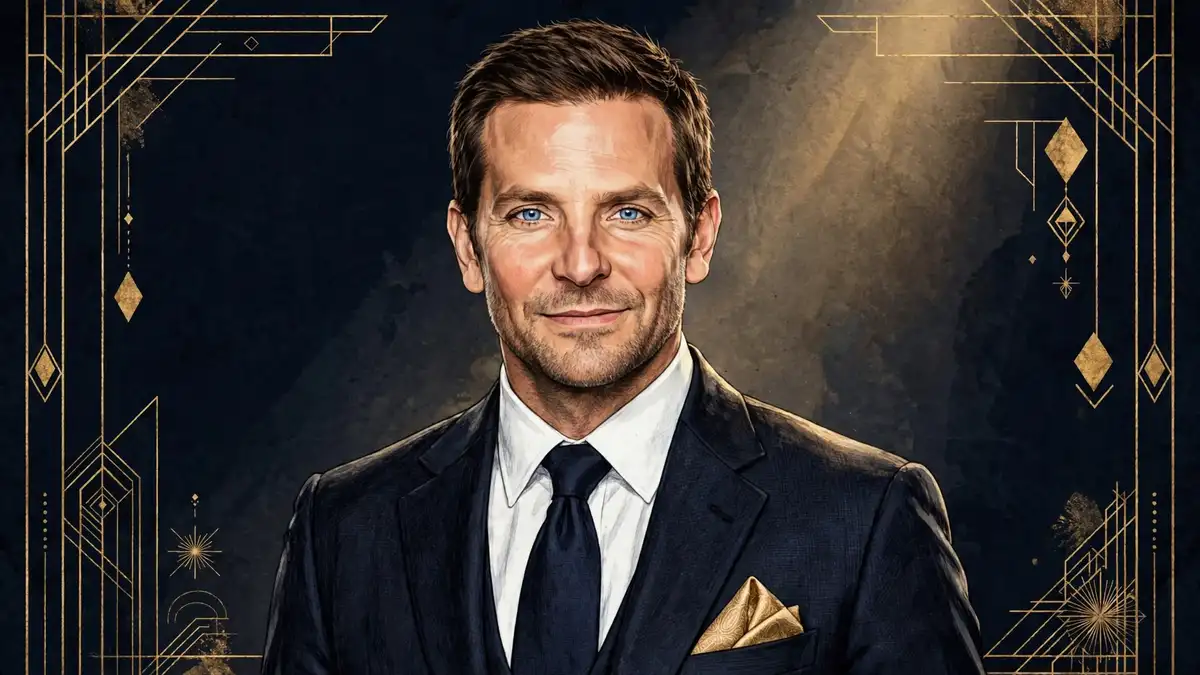
Bradley Cooper‘s net worth is estimated at $100 million to $125 million as of November 2026. The figure most often cited is $120 million, the number Celebrity Net Worth has carried since its February 2026 update, and Parade lands in the same place. Cooper built that fortune the slow way, then the fast way: a decade of small television and supporting film parts, a $600,000 payday for the first Hangover, then a run of backend deals — close to $50 million from American Sniper, an estimated $40 million from A Star Is Born — that turned an actor into a director-producer with a real stake in his own films.
Bradley Cooper: Quick Facts
| Estimated net worth | $120 million (range: $100 million to $125 million) |
|---|---|
| Profession | Actor, director, producer |
| Nationality | American |
| Born | January 5, 1975 (age 51) |
| Height | 6 feet 1 inch (1.85 m) |
| Primary income sources | Film acting salaries, backend profit participation, directing and producing fees, Marvel voice work, brand endorsements, real estate |
| Active years | 1999–present |
| Last reviewed | November 2026 |
- Early Life and Background
- Education
- Career Journey
- Rise to Fame
- Main Sources of Income
- Salary and Earnings
- Businesses and Investments
- Brand Deals and Sponsorships
- Houses, Cars and Other Assets
- Awards and Achievements
- Net Worth Growth Over the Years
- Social Media Presence
- Personal Life
- Sources & Reporting
- Frequently Asked Questions
Early Life and Background
Bradley Charles Cooper was born on January 5, 1975, in Philadelphia, Pennsylvania, and grew up in the nearby suburbs of Jenkintown and Rydal. His father, Charles Cooper, worked as a stockbroker for Merrill Lynch; his mother, Gloria Campano, worked for the local NBC affiliate. His mother’s family is Italian-American, his father’s side Irish-American, and Cooper has talked in interviews about a childhood split between two strong family cultures — big Sunday dinners on one side, a quieter, bookish household on the other. He has one older sister, Holly.
Cooper was not a child actor and did not come from show-business money. He has described himself as a shy, anxious kid who found his footing through school theatre at Germantown Academy, the private school in Fort Washington, Pennsylvania, where he studied. A broken ankle in his teens, sustained while playing basketball, kept him off the court and pushed him further toward the stage. He has also spoken openly about an ear condition — cholesteatoma, a growth in the middle ear — that required surgery as a child and left him with reduced hearing in one ear, a detail that rarely makes it into profiles but shaped how he learned to listen and watch other people, a skill that shows up in his directing.
Philadelphia stayed with him. He still talks about the city as home, and in 2024 he bought a 33-acre farmhouse property in New Hope, Pennsylvania, about 70 miles from Manhattan — a purchase property reports priced at $6.5 million — putting down roots in the same part of the state where he grew up. The move also put him close to his partner Gigi Hadid’s family farm in the same county, a detail that gossip columns noted and that Cooper has never commented on directly.
His father’s death in 2011, from lung cancer, is the hinge event of Cooper’s adult life. He has said in interviews that losing his father at 36 changed how he chose work — he stopped taking jobs for the paycheck alone and started chasing projects he could pour himself into, including directing. That shift is visible in the money story too: the biggest paydays of his career all came after 2011, and almost all of them came from projects where he took a smaller upfront fee in exchange for a share of the profits.
Education
Cooper graduated from Germantown Academy in 1993 and enrolled at Villanova University before transferring to Georgetown University in Washington, D.C., where he majored in English and graduated in 1997. At Georgetown he rowed on the crew team — he has credited the discipline of early-morning rowing practice with teaching him the work ethic he later brought to film sets — and he performed with the university’s improv troupe, Nomadic Theatre. He also spent a semester as an exchange student at the University of Aix-Marseille in France, where he became fluent enough in French to later conduct interviews in the language and to direct scenes in it.
After Georgetown, Cooper moved to New York and enrolled at the Actors Studio Drama School at The New School, earning an MFA in acting in 2000. The program’s famous “Inside the Actors Studio” interviews were part of his training — he has joked that he was in the audience the night Robert De Niro was interviewed, taking notes. The MFA mattered in a practical way too: it gave him a classical grounding in voice, movement and text work that casting directors noticed, and it put him in New York at exactly the moment television was looking for clean-cut, articulate young men for network dramas.
Education shows up in Cooper’s career in a second way. He is one of the few A-list actors who regularly writes and directs his own material, and the English degree is visible in the scripts: A Star Is Born and Maestro are both adaptations and reconstructions of existing stories, built from research rather than from a single original idea. He has said he reads constantly on set, and crew members on Maestro described him arriving with binders of Bernstein research — letters, scores, rehearsal footage — the habits of a student, not a star dropping in for a few weeks.
Career Journey
Cooper’s first screen credit was a 1999 guest spot on Sex and the City, playing Jake, a one-episode boyfriend. His film debut followed in 2001 with Wet Hot American Summer, the cult summer-camp comedy where he played Ben, a small role in an ensemble that also included Paul Rudd and Amy Poehler. The film flopped on release and became a cult hit later — a pattern that would repeat in Cooper’s early career, where the work was often better than the box office suggested.
Television gave him his first steady income. From 2001 to 2006 he played Will Tippin, the best friend of Jennifer Garner’s Sydney Bristow, on J.J. Abrams’ spy drama Alias. He was a series regular for the first two seasons, then recurring, and he has been candid that he asked to be written out because he felt sidelined — a rare admission from an actor about a hit show. The Alias years paid the rent and taught him how a long-running production works, but they did not make him famous. Around the same time he appeared in the short-lived Fox sitcom Kitchen Confidential (2005) and did a stint on Nip/Tuck, building a résumé of reliable, likeable supporting men.
The film roles that followed were mostly the handsome rival or the comic best friend: Wedding Crashers (2005), where he played Sack Lodge, the arrogant fiancé, opposite Owen Wilson and Vince Vaughn; Failure to Launch (2006); Yes Man (2008). Wedding Crashers grossed $288 million worldwide on a $40 million budget, and it put Cooper on casting lists for studio comedies — but it did not put his name above the title. He was 30, working steadily, and still waiting for the role that would let him carry a film.
That role arrived in 2009. But before it did, Cooper made a decision that looks, in hindsight, like the first business move of his career: he turned down a string of similar “handsome jerk” parts and held out for a lead. He has said the gap between jobs in 2007 and 2008 was frightening — he was living in Los Angeles, his marriage to Jennifer Esposito had ended after four months, and he was questioning whether the career would ever break open. The answer came from a low-budget comedy about a bachelor party gone wrong in Las Vegas.
From 2012 onward, the career split into two tracks that have run side by side ever since: the movie star and the filmmaker. Silver Linings Playbook (2012) earned him his first Oscar nomination for Best Actor. American Hustle (2013) earned a Supporting Actor nomination. American Sniper (2014) earned nominations for Best Actor and Best Picture, the second as a producer. Then came A Star Is Born (2018), which he directed, co-wrote, produced and starred in alongside Lady Gaga, collecting three more nominations — Best Actor, Best Adapted Screenplay and Best Picture — and a win for the film’s song “Shallow.” Maestro (2023) added three more nominations, bringing his career total to 12 Oscar nominations without a win, a statistic that has become part of his public story.
Between the prestige films, Cooper kept a second income stream running: voice work as Rocket Raccoon in the Marvel Cinematic Universe, starting with Guardians of the Galaxy (2014) and running through Guardians of the Galaxy Vol. 3 (2023) and the two Avengers films. It is the kind of work that pays well, takes days rather than months to record, and keeps an actor’s name in front of the largest audience on earth. It also explains a quirk of his box-office record: the films Cooper has appeared in have grossed more than $13 billion worldwide, according to Wealthy Gorilla’s tally — a number inflated by the Marvel ensemble films, but a real measure of how often his name has been attached to the biggest releases of the last decade.
Rise to Fame
The Hangover opened in June 2009 with modest expectations. Warner Bros. had a $35 million budget, four leads who were not yet movie stars, and a director, Todd Phillips, who had to give up part of his own salary to get the film made. It grossed $469 million worldwide and became the highest-grossing R-rated comedy of its time. Cooper played Phil Wenneck, the smooth, married schoolteacher who holds the group together — the straight man in a cast of chaos agents — and audiences remembered him. He was 34, a decade into his career, and suddenly a leading man.
The sequel economics tell the real story of his rise. For the first film, Cooper was reportedly paid $600,000, the most of the four leads but a modest sum for a studio comedy. For The Hangover Part II (2011), the four leads renegotiated together: a $5 million upfront salary each plus 4% of the backend gross. The film made $587 million worldwide, and each actor’s total payday came to roughly $25 million by most estimates, including backend. For Part III (2013), the group asked for $15 million upfront plus backend, and again walked away with roughly $25 million apiece, according to Wealthy Gorilla’s breakdown. Across the trilogy, Cooper earned an estimated $50 million — more than 80 times his first-film fee — and the lesson stuck: in Hollywood, the backend is where the money is.
Limitless (2011), released between the two Hangover sequels, proved he could open a film on his own name. It cost $27 million and made $161 million worldwide, and it gave him a second franchise-adjacent property — he later executive-produced the CBS television adaptation. Silver Linings Playbook (2012) did something different: it proved he could act. Playing Pat Solitano, a man rebuilding his life after a mental-health crisis, Cooper earned his first Academy Award nomination and a new reputation as a serious actor, rather than only a comedy lead. Director David O. Russell cast him again immediately in American Hustle (2013), where he played FBI agent Richie DiMaso opposite Christian Bale and Amy Adams, and where he earned his second nomination, this time as a supporting actor. His Silver Linings Playbook co-star was Jennifer Lawrence, who won the Best Actress Oscar for the film.
By 2014, the rise was complete. American Sniper, directed by Clint Eastwood, was the highest-grossing film of the year in North America, earning $547 million worldwide on a $58 million budget. Cooper had produced it as well as starred in it, and he had made the same bet he would repeat on A Star Is Born: he gave up his upfront acting fee in exchange for a share of the profits. Parade reports the move earned him close to $50 million — his single biggest payday. It also earned him his third and fourth Oscar nominations, for acting and for producing, and it put him on the cover of the business conversation in Hollywood: here was an actor who understood the deal memo as well as the script.
The A Star Is Born years, 2018 to 2019, were his peak as an earner. The film grossed $434 million worldwide, its soundtrack topped charts, and Forbes put Cooper’s earnings for the year ending June 2019 at $57 million, tied for sixth among the world’s highest-paid actors. Celebrity Net Worth rounds the same period to $60 million — the difference is a matter of which fees and dates each outlet counts, and the $57 million Forbes figure is the one tied to a published list with a defined window, so we use it as the headline number. Either way, it was the year Cooper stopped being a well-paid actor and became one of the best-paid people in the business.
Main Sources of Income
Cooper’s income comes from five streams, and the balance between them has shifted over time. Acting salaries were the whole story before 2014; since then, producing and directing fees plus profit participation have mattered at least as much. The five streams, in rough order of lifetime contribution:
1. Acting salaries. The foundation. Cooper can command up to $20 million per film for a straight acting fee, according to Celebrity Net Worth and Market Realist, and his per-film rate has sat in the $10 million to $20 million band since the mid-2010s. The early years were leaner — $600,000 for the first Hangover, a reported $2 million for Limitless — but the rate rose with each hit, and the Hangover sequels reset it permanently.
2. Backend profit participation. The biggest single source of his wealth. On American Sniper and A Star Is Born, Cooper traded upfront salary for a percentage of the profits, and both films were far more profitable than anyone expected. The two deals together account for an estimated $90 million of his career earnings — close to $50 million from American Sniper and an estimated $40 million from A Star Is Born, where Forbes reported he took a share of the film’s $150 million in profit. It is a high-risk, high-reward model: it only works when the film is a hit, and both times it was.
3. Directing and producing fees. As a director, Cooper earns a fee separate from his acting salary, plus a producer’s fee and a share of any producing profits. On A Star Is Born he was credited as writer, director, producer and star — four paydays on one film, before the backend. On Maestro he repeated the pattern for Netflix, where the pay structure is different: streaming films pay large upfront sums rather than backend points, and Parade estimates he took home somewhere in the $20 million to $30 million range for the film, reflecting his combined roles as writer, director and star.
4. Voice work. Rocket Raccoon is the most profitable character Cooper has ever played, measured in dollars per day of work. He has voiced the character in six Marvel films, and estimates put his total Marvel earnings at $25 million to $30 million, including a reported $5 million for Avengers: Infinity War alone. Voice sessions take days, not months, and the films have grossed billions — a combination that makes the hourly rate extraordinary by any standard.
5. Endorsements and brand work. The smallest of the five streams, but a steady one. Cooper has served as an ambassador for Swiss watchmaker IWC Schaffhausen, appearing in campaigns and at brand events, and he has done select luxury-brand work over the years. He is picky about endorsements — there is no long list of product deals attached to his name, and no reported nine-figure brand contract. The restraint is deliberate: his brand is the work, and he has protected it by saying no more often than yes.
What Cooper does not have is also worth noting. He has no reported restaurant chain, no fashion label, no spirits brand, no venture-capital portfolio splashed across press releases. His production company, Joint Effort, is the closest thing to a business empire, and it is a film company, not a lifestyle brand. That narrow focus is part of why his net worth sits at $120 million rather than $300 million: he has made his money inside the film business, not by lending his name to businesses outside it.

Salary and Earnings
The table below collects the best-reported salary for each major project. Figures marked “estimated” come from trade reporting and entertainment outlets rather than from studio disclosures, which are almost never public. Where two outlets give different numbers for the same film, we give the range and name the disagreement in the notes.
| Project | Year | Reported pay | Notes |
|---|---|---|---|
| Wedding Crashers | 2005 | $250,000 | Supporting role; figure widely cited in salary roundups |
| The Hangover | 2009 | $600,000 | Highest-paid of the four leads, per Wealthy Gorilla |
| Limitless | 2011 | $2 million | First solo leading-man salary |
| The Hangover Part II | 2011 | $25 million | $5 million upfront plus 4% backend; film grossed $587 million |
| Silver Linings Playbook | 2012 | $5 million | First Oscar nomination for Best Actor |
| American Hustle | 2013 | $2.5 million | Supporting role; Oscar nomination |
| The Hangover Part III | 2013 | $25 million | $15 million upfront plus backend, per Wealthy Gorilla |
| American Sniper | 2014 | Close to $50 million | No upfront fee; backend share, per Parade |
| Avengers: Infinity War | 2018 | $5 million | Voice role as Rocket Raccoon |
| A Star Is Born | 2018 | $40 million | No upfront salary; share of $150 million profit, per Forbes |
| Maestro | 2023 | $20–30 million | Parade estimate; Netflix upfront deal, no backend |
Add the headline figures and the total lands near $180 million in gross career pay before tax, agents’ fees, managers and lawyers — the standard 10%, 15% and 5% cuts that Forbes notes it does not deduct from its earnings lists. That gap between gross pay and net worth is the first thing to understand about a $120 million fortune: Cooper has earned far more than $120 million in his career, and he has kept a fraction of it after tax, fees, living costs and property purchases. The second thing is timing. The two biggest paydays, American Sniper and A Star Is Born, landed within four years of each other, and both were backend deals — money that arrived in lump sums after the films’ releases, not in steady annual instalments.
His peak earning year was the twelve months to June 2019, when Forbes recorded $57 million in pre-tax earnings, tied with Adam Sandler for sixth place on its highest-paid actors list. The list’s own note explains the number: about 70% of it came from A Star Is Born, with the rest from his Marvel voice work in Avengers: Endgame. Celebrity Net Worth’s $60 million figure for the same period appears to round up the same earnings and add fees that fell just outside Forbes’ window — the two outlets are describing the same year, not two different years, and the $57 million Forbes number is the one with a published methodology behind it.
Since 2019, Cooper’s earnings have slowed in public view, because his work has slowed: Maestro took years to develop and shoot, and Is This Thing On? (2025) was a smaller, $15 million-budget comedy-drama that grossed a reported $10.1 million in theatres — a critical success and a commercial disappointment, and a reminder that the backend model cuts both ways. A director who bets on profit participation earns nothing extra when the film does not profit. Cooper’s next projects, including a reported new film he is developing in Paris, will determine whether the 2018–2019 peak was a one-off or the start of a second act as a director who also happens to be a movie star.
Businesses and Investments
Cooper’s main business vehicle is Joint Effort, the production company he founded with director Todd Phillips in 2012. The company’s name is a fair description of how it works: Cooper and Phillips develop projects together, share producing credits, and split the producing fees and any backend. Joint Effort’s credits include American Sniper, A Star Is Born, Maestro, War Dogs (2016) and, most lucratively, Joker (2019), the $1.07 billion-grossing comic-book drama that Cooper produced alongside Phillips. Joker is the film most people forget Cooper was involved in — he does not appear in it — and it is a useful reminder that his producing income extends beyond the films he stars in. The company also produced Joker: Folie à Deux (2024), which performed far worse than its predecessor, a reminder that producing is a hits business too.
Joint Effort’s value is hard to pin down, and no outlet has published a valuation. It owns no studio lot and employs a small staff; its assets are its development slate, its library of producing credits and its first-look relationships with Warner Bros. and Netflix. That is worth something — a producing deal with a major studio is a real asset — but it is not the kind of asset that shows up in a net-worth estimate as a line item, which is why most trackers value Cooper on his film earnings and property alone. The honest way to say it: Joint Effort is the engine that produced his two biggest paydays, and its future value depends entirely on the next film it makes.
Beyond Joint Effort, Cooper’s investment record is quiet. He has not announced venture investments, startup stakes or a fund, and there is no reliable reporting of a stock portfolio or a crypto position. That may mean he invests privately and keeps it private — the most likely explanation for a 51-year-old with nine figures — or it may mean he keeps his money in property and cash. Either way, we do not invent an investment portfolio for him. What is documented is the property portfolio, covered in the assets section below, and the film library: as a producer on A Star Is Born and American Sniper, Cooper holds a continuing interest in two films that still earn from streaming, television licensing and soundtrack sales. The A Star Is Born soundtrack, featuring “Shallow,” has sold millions of copies and streams in the billions — and Cooper sings on it, which means a share of the music royalties flows to him as a performer as well as a producer.
One more investment deserves a mention because it is unusual for an actor: time. Cooper spent years developing Maestro — learning to conduct, studying Bernstein’s letters and recordings, working with the Bernstein family — before a single frame was shot. He spent a similar stretch on A Star Is Born, which he first discussed directing in 2016 and released in 2018. In a business where most stars take the next available job, Cooper’s willingness to spend years on one project, unpaid, is a form of investment, and it is the reason his directing career has produced two films that earned a combined 15 Oscar nominations.
Brand Deals and Sponsorships
Cooper’s best-documented brand relationship is with IWC Schaffhausen, the Swiss luxury watchmaker, for whom he has served as a brand ambassador, appearing in campaigns and at events including the brand’s presence at film festivals. Watch ambassadorships at this level typically pay in the high six figures to low seven figures a year, but no outlet has published Cooper’s fee, and we will not guess at one. The partnership fits his public image — understated, precise, old-school — and it has lasted years, which in the endorsement business is the strongest signal that both sides are happy.
Other brand work is thinner and harder to verify. A 2026 roundup attributed a $2 million to $3 million annual Louis Vuitton contract to Cooper, but the figure traces to a single low-authority source and no major outlet has confirmed it, so we note it here as unconfirmed rather than as a fact. What is confirmed is the pattern: Cooper does very few endorsements, and the ones he does are with heritage luxury brands rather than mass-market products. There is no reported sneaker deal, no beverage deal, no video-game deal and no Super Bowl commercial on his résumé — a contrast with peers such as Leonardo DiCaprio, whose brand work is broader, and with Brad Pitt, who has built businesses around his name.
The restraint has a cost in forgone income and a benefit in credibility. When Cooper does appear in a campaign, it reads as a choice rather than a paycheque, and that credibility feeds back into the film career: studios trust a director whose name still means something. It also means endorsements are a minor line in his net worth — probably a few million dollars over his career, not tens of millions — and any estimate that leans heavily on brand deals to explain his fortune is overcounting.

Houses, Cars and Other Assets
Property is the most visible part of Cooper’s wealth outside film, and the paper trail is unusually complete, because most of his purchases were reported in the Wall Street Journal, Mansion Global and The Real Deal at the time they happened.
The anchor property is the Greenwich Village townhouse at 224 West 10th Street in Manhattan, bought in May 2018 for $13.5 million, according to the Wall Street Journal as reported by Mansion Global and 6sqft. The house spans five floors and roughly 4,000 square feet, with six bedrooms, reclaimed barn-wood floors, a remote-controlled fireplace, a hidden wet bar and a 1,100-square-foot garden. Cooper registered the purchase under a trust, “Cool Trust,” to keep the sale quiet — a common move that did not work for long. It is his main home, the house where he spent the pandemic with his mother and his young daughter, and the property he returns to between films. Some later roundups put the price at $18 million or $18.5 million; the $13.5 million figure comes from the original Wall Street Journal reporting and is the one we use.
In Los Angeles, Cooper owns two homes in Pacific Palisades. The first, in the Rustic Canyon neighbourhood, was bought in 2009 for $4.7 million, according to Dirt as reported by The Real Deal. The second, on West Sunset Boulevard less than a mile away, was bought off-market in 2021 for $4.8 million — a 4,400-square-foot house with four bedrooms, three bathrooms, a detached two-car garage and a two-bedroom guesthouse. Together the two Palisades homes cost $9.5 million and give him a base on both coasts without ever needing a hotel.
His first Los Angeles home was a bungalow in Venice, bought in 2004 for about $1.2 million. He listed it in April 2023 for $2.4 million, after nearly 20 years of ownership, and Market Realist reports it sold later that year for $3.13 million — a tidy profit on a house he bought before he was famous, and a useful illustration of how long-held property compounds quietly in the background of a film career.
The newest addition is the New Hope, Pennsylvania property: a 33-acre farmhouse bought in 2024, reported at $6.5 million. It sits about 70 miles from Manhattan and close to the Hadid family farm in Bucks County, and it is the property that has drawn the most speculation, because it sits near his partner’s family. Cooper has not commented on the purchase, and the price should be treated as reported rather than confirmed — but the purchase itself is consistent with a pattern: he buys houses he actually lives in, holds them for years, and rarely sells.
On cars, Cooper is famously low-key for a man worth $120 million. He has been photographed driving a Toyota Prius — a car that costs about $25,000 — and he owns a Mercedes-Benz G-Wagen (around $200,000), a Maserati GranTurismo (around $100,000) and a 1965 Ford Mustang (around $40,000), according to vehicle roundups. The collection is modest by celebrity standards and it tells the same story as the endorsement record: Cooper spends on houses and on films, not on a garage full of supercars.
Put together, the property portfolio is worth roughly $30 million at purchase prices, before appreciation — the Village townhouse alone would likely sell for substantially more than $13.5 million today — and it represents about a quarter of his estimated net worth. That is a high share for an actor, and it reflects a preference for tangible assets over the paper wealth of stock options and startup equity.
Awards and Achievements
Cooper has been nominated for 12 Academy Awards and has won none — a record that has become a running story in awards coverage, and one that understates his standing in the industry. The nominations span four categories: acting (four nominations), producing (four, for Best Picture), writing (two, for adapted screenplay) and, in the case of A Star Is Born, all three at once. Only a handful of people in Oscar history have been nominated as an actor, a writer, a director and a producer, and Cooper did it before his 50th birthday.
The full list, by film: Silver Linings Playbook (2012) — Best Actor. American Hustle (2013) — Best Supporting Actor. American Sniper (2014) — Best Actor and Best Picture. A Star Is Born (2018) — Best Actor, Best Adapted Screenplay and Best Picture. Joker (2019) — Best Picture, as a producer. Nightmare Alley (2021) — Best Picture, as a producer. Maestro (2023) — Best Actor, Best Original Screenplay and Best Picture. That is 12 nominations across seven films, with three films earning him nominations in more than one category.
He has won elsewhere. A Star Is Born won the BAFTA for Best Film Music, and “Shallow” won the Academy Award for Best Original Song, the Grammy for Best Pop Duo/Group Performance and the Golden Globe for Best Original Song — awards that went to the songwriters, but that Cooper shares as the film’s director and as a vocalist on the track. He won a Grammy as a performer, and the film’s soundtrack topped the Billboard 200. He has also been named to the Time 100 list of the world’s most influential people (2015) and appeared on the Forbes Celebrity 100 list three times.
The commercial achievements matter as much as the trophies. A Star Is Born grossed $434 million worldwide; American Sniper $547 million; the Hangover trilogy more than $1.4 billion combined; the Marvel films he voiced in grossed billions. Joker, which he produced, grossed $1.07 billion on a $55 million budget — one of the most profitable films ever made relative to its cost. And Is This Thing On?, his third film as a director, closed the New York Film Festival in October 2025, a slot that festivals reserve for films they want the industry to take seriously.
One achievement that rarely appears in net-worth profiles is worth recording: Cooper is one of the few actors of his generation who has been taken seriously as a director by both critics and the Academy, with two directing efforts earning Best Picture nominations. That is a second career, not a hobby, and it is the reason his earning power is likely to outlast his years as a leading man.
Net Worth Growth Over the Years
Cooper’s wealth grew in steps, not in a straight line, and each step maps to a film. The table below uses the figures most commonly cited by Celebrity Net Worth and Market Realist for each year; they are estimates, and the year-to-year numbers should be read as a shape rather than an audit.
| Year | Estimated net worth | What moved it |
|---|---|---|
| 2009 | $2 million | First Hangover payday; Alias and supporting-film years behind him |
| 2011 | $10 million | Hangover Part II backend; Limitless opens on his name |
| 2013 | $25 million | Hangover Part III; Silver Linings Playbook and American Hustle nominations |
| 2015 | $60 million | American Sniper backend lands; producing fees begin |
| 2017 | $80 million | Marvel voice work; Guardians Vol. 2; property appreciation |
| 2019 | $100 million | A Star Is Born backend; $57 million Forbes earnings year |
| 2021 | $110 million | Second Palisades home; Joker producing residuals |
| 2023 | $120 million | Maestro deal; Venice bungalow sale at $3.13 million |
| 2026 | $120 million | Plateau: Is This Thing On? underperforms; no major new payday yet |
The shape is the story. From 2009 to 2015, the line rises steeply, driven by the Hangover sequels and then by American Sniper. From 2015 to 2019 it rises again, driven by A Star Is Born. Since 2019 it has flattened, because Cooper has spent those years directing rather than taking the $20 million acting fees that would have kept the line climbing. That is a choice, and it is a defensible one: the directing career is the asset that will still be paying in ten years, when the leading-man roles thin out.
How does he compare with his peers? The table below puts Cooper’s $120 million next to the actors he is most often measured against. The peer figures are the estimates carried by the same trackers — Celebrity Net Worth and its peers — for 2026, and they are estimates too, not audited accounts.
| Actor | Estimated net worth (2026) | Note |
|---|---|---|
| Leonardo DiCaprio | $300 million | Bigger backend history; environmental investing on top |
| Brad Pitt | $400 million | Plan B producing plus acting; business ventures |
| Tom Cruise | $600 million | Decades of backend on the Mission: Impossible franchise |
| Keanu Reeves | $380 million | Matrix backend; John Wick franchise |
| Ben Affleck | $150 million | Acting plus directing; Artists Equity venture |
| Adam Sandler | $440 million | Netflix deal; Happy Madison producing |
| Bradley Cooper | $120 million | Backend-led; directing career still building |
Cooper sits below the $300 million-plus tier, and the gap is explained by volume: DiCaprio, Pitt, Cruise and Sandler each have more films, more franchises and more producing credits behind them, and most of them started earning backend money a decade earlier than Cooper did. What Cooper has that most of them do not is a directing career that is still accelerating — and if his next film as a director repeats the A Star Is Born pattern, the gap will narrow fast.
Social Media Presence
Cooper has no public social media accounts. He does not run an Instagram, X or TikTok profile, and he has said in interviews that he has never had one. Fan accounts and impersonators exist on every platform, but none of them is him, and none of them should be treated as a source for anything about his life or his money.
The absence is a deliberate choice, and it is unusual enough to be part of his brand. In an era when most stars monetise their following directly — sponsored posts, product launches, paid partnerships — Cooper has opted out of the entire economy. The cost is real: a star with his profile could earn seven figures a year from sponsored posts alone. The benefit is control: there is no feed for tabloids to mine, no old post to resurface, and no incentive to perform his private life for an audience. His partner Gigi Hadid, by contrast, is one of the most-followed people on Instagram, and the contrast between the two — one of the most private actors in Hollywood dating one of the most visible models in the world — is a regular subject of coverage, most of it speculative.
For readers, the practical point is simple: if you see a “Bradley Cooper” account posting about a new film, a product or a giveaway, it is not him. Genuine news about his work comes through studio announcements, festival programmes and interviews — the old channels, which is fitting for a filmmaker who learned his craft before social media existed.
Personal Life
Cooper married actor Jennifer Esposito in October 2006; the marriage ended in divorce the following year, after four months. He has spoken little about it since, and Esposito has said more — the split was, by both accounts, a case of two people marrying too young and too fast. There were no children from the marriage and no reported financial settlement of note.
From 2015 to 2019 he was in a relationship with model Irina Shayk. Their daughter, Lea de Seine Shayk Cooper, was born in March 2017. The couple separated in 2019 and have shared custody since, co-parenting in New York, where both live. Cooper has described fatherhood as the most important thing in his life, and he has said that becoming a father changed the way he works — he takes fewer jobs, and he takes them closer to home, so that he can be present for his daughter. Lea has appeared with him at public events, including the Maestro premiere, but Cooper keeps her out of the press as much as he can.
Since October 2023 he has been dating supermodel Gigi Hadid. The relationship was first reported when the two were photographed together in New York, and it has been covered steadily since: Hadid told Vogue in a March 2025 interview that the relationship was romantic and happy, and that Cooper had given her a more normal dating life than she had known before. In 2026, photographs of the two wearing matching gold rings prompted widespread speculation about an engagement — and conflicting reports about whether the rings were wedding bands, promise rings or simply jewellery. Neither Hadid nor Cooper has confirmed a marriage, and the honest position is that the rings are unconfirmed: a rumour, not a fact. What is confirmed is that the couple have been together for more than two years, that their daughters have spent time together, and that people close to both families describe the relationship as serious.
Cooper’s mother, Gloria, remains a central figure in his life. She lived with him in the Village townhouse during the pandemic, and she accompanies him to premieres and awards ceremonies — she was his date at the 2019 Oscars, a detail that charmed the coverage and that Cooper has never tried to play down. His father died in 2011, and Cooper has credited his father’s illness with teaching him what matters: family first, work second, and never the other way around.
He is also open about his sobriety. Cooper has said he has been sober since the age of 29, after recognising that alcohol was damaging his work and his relationships, and he has described the decision as the foundation of everything that came after it — the career, the directing, the fatherhood. It is a rare thing for a Hollywood star to talk about so plainly, and it is part of why the “serious actor” reputation has stuck.
Sources & Reporting
Celebrity Net Worth — the $120 million net-worth anchor, updated February 14, 2026; the $20 million per-film ceiling; the June 2018–June 2019 earnings figure of $60 million for the same period Forbes lists at $57 million.
Parade — the $120 million 2026 estimate; the close-to-$50 million American Sniper backend figure; the $20 million to $30 million Maestro estimate; the $40 million A Star Is Born profit-share figure and the detail that Cooper took no upfront salary on that film.
Forbes — the 2019 highest-paid actors list: $57 million in earnings for the year to June 2019, tied sixth, with about 70% coming from A Star Is Born; the $150 million profit figure for A Star Is Born.
Wealthy Gorilla — the $100 million alternate estimate (updated November 20, 2026); the Hangover trilogy salary breakdown ($600,000, then $25 million and $25 million); the $25 million to $30 million Marvel total; the $13.05 billion career box-office tally.
Mansion Global and 6sqft — the Greenwich Village townhouse purchase: $13.5 million, May 2018, 224 West 10th Street, six bedrooms, 1,100-square-foot garden, per the Wall Street Journal.
The Real Deal — the second Pacific Palisades purchase: $4.8 million in 2021, and the 2009 Rustic Canyon purchase at $4.7 million.
Galerie Magazine — the Venice bungalow listing: $2.4 million in April 2023, bought in 2004 for about $1.2 million.
Market Realist — the $120 million estimate; the Venice sale price of $3.13 million; the year-by-year net-worth series used in the growth table.
TheWrap and Men’s Journal — Forbes’ 2019 list as published: Cooper tied sixth at $57 million, with A Star Is Born supplying the bulk of it.
PhillyVoice — Is This Thing On? (2025): Cooper’s comments on how his relationships informed the film; the New York Film Festival closing-night slot and December 19 theatrical release.
Vogue — Gigi Hadid’s March 2025 interview describing the relationship as romantic and happy. Reporting window for this article: February 2026 to November 2026, with historical figures drawn from the outlets above. Where sources disagreed — the $100 million to $125 million net-worth spread, the $57 million versus $60 million 2019 earnings figure — we published the range and named both sides.
Frequently Asked Questions
What is Bradley Cooper’s net worth in 2026?
Bradley Cooper’s net worth is estimated at $120 million in 2026, according to Celebrity Net Worth and Parade. Other trackers give lower or higher numbers — Wealthy Gorilla says $100 million, some outlets say $110 million or $125 million — so the honest range is $100 million to $125 million, with $120 million as the most commonly cited figure.
How much did Bradley Cooper make from A Star Is Born?
An estimated $40 million. Cooper directed, co-wrote, produced and starred in the film and took no upfront salary, instead taking a share of the film’s profits. Forbes reported he earned a share of the film’s $150 million profit, and the $40 million figure is the estimate most outlets carry. The film grossed $434 million worldwide.
How much did Bradley Cooper make from American Sniper?
Close to $50 million, according to Parade. Cooper produced and starred in the Clint Eastwood film and gave up his upfront acting fee in exchange for backend points. The film made $547 million worldwide on a $58 million budget, making the backend deal one of the most profitable bets of his career.
How much was Bradley Cooper paid for The Hangover?
He was paid $600,000 for the first Hangover in 2009 — the most of the four leads, but a modest fee. The sequels paid far more: about $25 million each for Part II and Part III, once backend points were counted, bringing his total from the trilogy to an estimated $50 million.
How much did Bradley Cooper make from Maestro?
An estimated $20 million to $30 million, according to Parade. Maestro was a Netflix film, so there was no box-office backend to share; instead Cooper was paid a large upfront sum reflecting his combined roles as writer, director and star. The exact figure has not been disclosed by Netflix.
Who is Bradley Cooper’s girlfriend?
Bradley Cooper has been dating supermodel Gigi Hadid since October 2023. Hadid described the relationship as romantic and happy in a Vogue interview in March 2025. In 2026, photographs of matching gold rings prompted engagement speculation, but neither of them has confirmed a marriage.
How many Oscar nominations does Bradley Cooper have?
Twelve nominations and no wins, as of the 2024 ceremony. The nominations span acting, producing and writing: Silver Linings Playbook, American Hustle, American Sniper, A Star Is Born, Joker, Nightmare Alley and Maestro. A Star Is Born won the Oscar for Best Original Song for “Shallow,” a song Cooper performs on.
Does Bradley Cooper have children?
Yes, one daughter: Lea de Seine Shayk Cooper, born in March 2017, his child with his former partner Irina Shayk. The couple separated in 2019 and share custody. Cooper has said fatherhood changed how he chooses work, taking fewer jobs and keeping them closer to home in New York.
Final Thoughts
Bradley Cooper’s $120 million fortune is a case study in a single decision repeated twice: give up the safe upfront fee and take a share of the profits instead. It worked on American Sniper, where it earned him close to $50 million, and it worked on A Star Is Born, where it earned him an estimated $40 million. Those two bets, plus the Hangover sequels and six Marvel films as Rocket Raccoon, account for almost all of the money. The rest — the Village townhouse, the two Palisades homes, the farmhouse in Pennsylvania — is what happens when a man who made his money in one business spends it on the only other thing he trusts: houses he actually lives in.
The honest range is $100 million to $125 million, and the plateau since 2019 is real: Cooper has spent the last few years directing rather than collecting $20 million acting fees, and his latest film as a director, Is This Thing On?, did not make money in theatres. But the directing career is the point. At 51, with 12 Oscar nominations and two Best Picture nominations as a director-producer, Cooper has built a second career that does not depend on his face holding up or his name opening a film. If the next film lands the way A Star Is Born did, the $120 million figure will look, in hindsight, like the middle of the story rather than the end of it.
Published on November 21, 2026. Last reviewed November 2026. Found an error? See our corrections policy.