
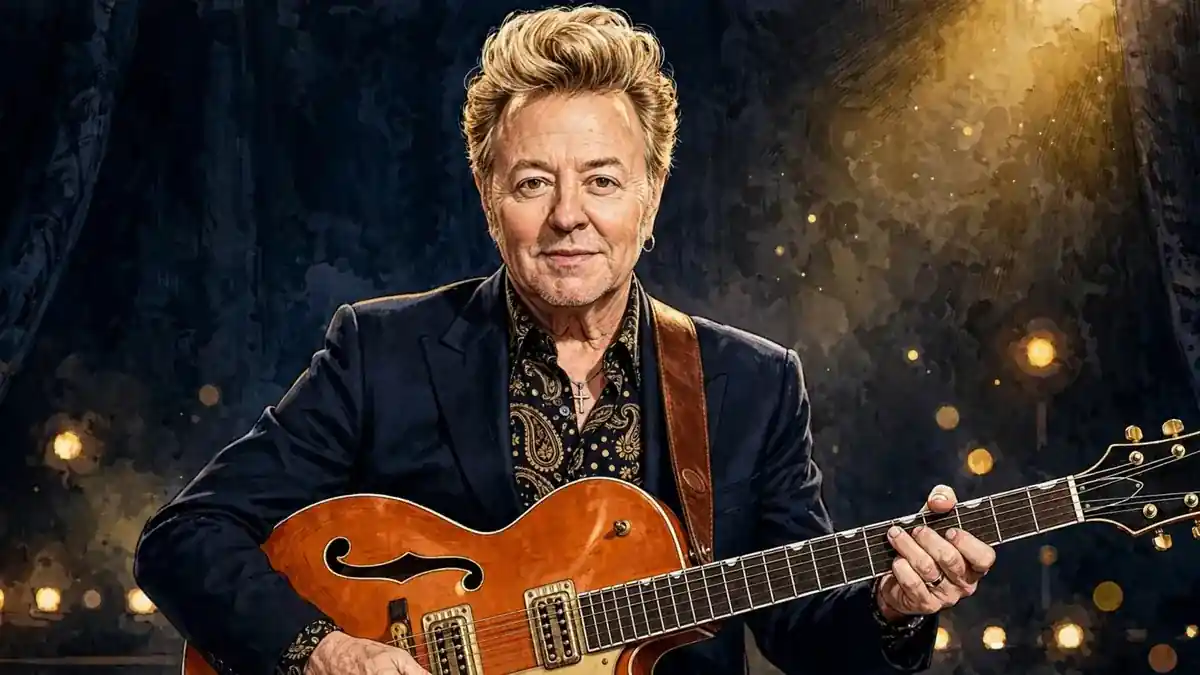
Brian Setzer‘s net worth is estimated at $8 million to $10 million as of November 2026. The rockabilly guitarist built that fortune twice over — first as the frontman who took the Stray Cats from a Long Island garage to 15 weeks at No. 2 on the Billboard 200, then as the bandleader whose 17-piece Brian Setzer Orchestra turned a 1950s swing revival into a double-platinum album and three Grammy Awards. His 2025 decision to sell dozens of vintage guitars through Reverb, followed by a serious health scare and a March 2026 comeback announcement, put a fresh spotlight on what four decades of hit records, touring, and a signature Gretsch guitar line are actually worth.
Brian Setzer: Quick Facts
| Estimated net worth | $8 million – $10 million (range: $8 million to $10 million) |
|---|---|
| Profession | Guitarist, singer, songwriter, bandleader |
| Nationality | American |
| Born | April 10, 1959 (age 67) |
| Height | 1.78 m (5 ft 10 in) per most listings; some profiles give 6 ft 2 in |
| Primary income sources | Stray Cats and Brian Setzer Orchestra record royalties, touring, Gretsch signature guitars, Reverb gear sales |
| Active years | 1979–present |
| Last reviewed | November 2026 |
- Early Life and Background
- Education
- Career Journey
- Rise to Fame
- Main Sources of Income
- Salary and Earnings
- Businesses and Investments
- Brand Deals and Sponsorships
- Houses, Cars and Other Assets
- Awards and Achievements
- Net Worth Growth Over the Years
- Social Media Presence
- Personal Life
- Sources & Reporting
- Frequently Asked Questions
- Final Thoughts
Early Life and Background
Brian Robert Setzer was born on April 10, 1959, in Massapequa, New York, a Long Island town that sat close enough to Manhattan for a curious kid to slip into the city’s jazz clubs. His parents were working-class, and the household ran on the records his generation inherited: Elvis Presley, the Sun Records generation, and the Beatles records that made him ask for a guitar at age six. He started on the euphonium in school — the brass instrument that trained his ear for the horn arrangements he would write decades later for a 17-piece big band — before the guitar took over completely.
Massapequa in the late 1970s was an unlikely launchpad for a rockabilly revival. Punk ruled the New York clubs, disco ruled the charts, and the music of 1950s Memphis felt like ancient history to most teenagers. Setzer went the other way. With his older brother Gary on drums, he formed the Bloodless Pharaohs, a local band that played the Long Island circuit, and he spent nights sneaking into Manhattan jazz shows at the Village Vanguard with Gary. The twin pulls of jazz harmony and raw rock and roll shaped everything that followed: the swing chords under the rockabilly snap, the horn charts behind the guitar solos.
By 19, Setzer was on stage at CBGB, the Bowery club that served as ground zero for punk, wearing a green silk suit and blue suede shoes and playing an orange Gretsch while the room expected three-chord punk. The look was deliberate. Setzer understood early that rockabilly was as much a visual language as a sound — pompadour, hollow-body guitar, upright bass — and he has never really changed the uniform since. That visual consistency later became a commercial asset: the silhouette on a Gretsch signature guitar box is instantly his.
The early years were lean. Setzer has described the period as scraping by on club gigs and odd jobs, and the financial turning point of his young life came in 1980, when he and two Massapequa friends decided the band’s future lay in London rather than New York. The three sold their instruments to a music shop on 48th Street to buy one-way plane tickets — a detail that matters to the money story because it shows how little capital the Stray Cats started with. They arrived in England with almost nothing and, within a year, had a record deal.
Education
Setzer’s formal schooling ended at Massapequa High School, where he played in school jazz bands on euphonium and guitar. No college degree figures in his story, and that absence is part of why his career reads the way it does: his education came from the bandstand. The euphonium training gave him something most rock guitarists never get — a working knowledge of brass voicings and big-band arranging. When he built the Brian Setzer Orchestra in the 1990s, he was not hiring an arranger to translate his ideas for horns; he was writing charts himself, in the language he had learned as a teenager.
His other classroom was the record collection. Setzer has spent a career citing the same teachers: Chet Atkins for fingerstyle precision, Eddie Cochran and Gene Vincent for rockabilly attack, Louis Prima for jump-blues showmanship, and Django Reinhardt for the idea that a guitarist could lead a band the way a horn player could. He later played Eddie Cochran in the 1987 film La Bamba, a casting choice that only made sense because Setzer had spent his teens studying Cochran’s records note for note.
The practical lesson for the net worth picture is simple. Setzer’s two careers — rockabilly revivalist and swing bandleader — both rest on repertoire knowledge that costs nothing to acquire and pays for decades. Songs he learned as a teenager became the catalog that still generates royalties in 2026, and the arranging skill he picked up in a school jazz band became the second act that saved his career when the first one stalled.
Career Journey
Setzer’s career breaks into three acts, each with its own revenue engine. Act one was the Stray Cats. After the 1980 move to London, the trio — Setzer on guitar and vocals, Lee Rocker on upright bass, Slim Jim Phantom on drums — found a city in the middle of a Teddy Boy revival, where 1950s American rock and roll was treated as living culture rather than nostalgia. Producer Dave Edmunds signed on, and the band’s self-titled debut album arrived on Arista Records in February 1981. It produced three British hits in a single year: “Runaway Boys,” “Rock This Town,” and “Stray Cat Strut.” The follow-up, Gonna Ball, landed in November 1981 to a cooler reception and no hits, but the combined sales of the two records convinced EMI America to compile the best tracks for the American market.
That compilation, Built for Speed, released in June 1982, became the band’s commercial peak. It reached No. 2 on the Billboard 200 on November 27, 1982, and stayed at No. 2 for 15 consecutive weeks — a record run at the runner-up spot that American Songwriter revisited in April 2026 — without ever reaching No. 1. The album went platinum in the United States in December 1982, certifying one million copies, and double platinum in Canada. Its singles did the heavy lifting: “Rock This Town” peaked at No. 9 on the Billboard Hot 100, and “Stray Cat Strut” climbed to No. 3 in early 1983. The Rock and Roll Hall of Fame later listed “Rock This Town” among the songs that shaped rock and roll.
The band’s third album, Rant N’ Rave with the Stray Cats (1983), produced one more top-ten hit, “(She’s) Sexy + 17,” but could not match Built for Speed, and the trio split in 1984 at what looked like the top of their game. Setzer’s solo records followed — The Knife Feels Like Justice in 1986 and Live Nude Guitars in 1988 — and they sold modestly. By the early 1990s, the rockabilly revival he had led was a memory, and Setzer was a working musician without a hit.
Act two began in 1992, when Setzer went back to the music of his school years and assembled the Brian Setzer Orchestra, a 17-piece big band built around jump blues and swing. The debut album arrived in 1994 and Guitar Slinger followed in 1996, but the breakthrough was The Dirty Boogie in June 1998. A Gap advertising campaign had put Louis Prima’s original “Jump, Jive an’ Wail” back on the radio, and Setzer’s cover rode that wave to a Grammy Award. The album peaked at No. 9 on the Billboard 200 and went double platinum in the United States — two million copies — with a further platinum certification in Canada. The follow-up, Vavoom! (2000), reached No. 62, and Setzer settled into the touring rhythm that defined the next two decades: a spring and summer rockabilly run, then the annual Christmas Rocks! holiday tour with the Orchestra, which became one of the most reliable recurring dates on the American live calendar.
Act three is the reunion era. The Stray Cats reformed for tours and records across the 2000s and 2010s, releasing 40 in 2019 to mark four decades since the band’s formation, and touring behind it that summer. The 2019 run ended badly: tinnitus forced Setzer to cancel the Orchestra’s annual holiday shows that December. The health story then dominated 2025. In February of that year Setzer disclosed that an autoimmune disease had taken his ability to play guitar — his hands felt, in his words, as if he were wearing gloves — and he began treatment at the Mayo Clinic near his Minneapolis home. A fall Stray Cats tour announced for October 2025 was cancelled in full on October 28, 2025, all 21 dates, after the opening two shows were scrapped for what the band called a serious illness. Then, in March 2026, Setzer announced he had recovered, and the Stray Cats booked a summer 2026 tour opening July 24 in Las Vegas. A November 2026 interview with Guitar Player had him describing himself as fully recovered and ready to tour.
Rise to Fame
Setzer’s rise was unusually fast and unusually public. Eighteen months separated the plane tickets bought with sold instruments from a British top-ten album. The Stray Cats’ 1981 breakthrough worked because the band arrived in London at the exact moment the city’s Teddy Boy scene wanted an American band that looked and sounded the part, and because Dave Edmunds knew how to record a rockabilly trio so the slap bass and the Gretsch filled a room. “Rock This Town” and “Stray Cat Strut” were not slow growers; they were hits in Britain within months of the band’s arrival, and the American release of Built for Speed turned them into MTV-era staples. The videos — pompadour, orange Gretsch, upright bass — made Setzer one of the most recognizable guitarists of the early 1980s.
The second rise, sixteen years later, was harder to predict and more valuable in the long run. The swing revival of the late 1990s had several contenders, but Setzer was the only one who could actually play the guitar parts, write the horn charts, and front a 17-piece band without it looking like a costume act. The Dirty Boogie sold two million copies in the United States, and the two Grammy Awards it produced in 1999 — Best Pop Performance by a Duo or Group with Vocals for “Jump, Jive an’ Wail” and Best Pop Instrumental Performance for “Sleep Walk” — gave Setzer the industry credential the Stray Cats years never had. A third Grammy followed in 2001 for his arrangement of “Caravan.”
What ties the two rises together is ownership. Setzer wrote or co-wrote the Stray Cats’ signature songs, so the publishing income from “Rock This Town” and “Stray Cat Strut” flows to him as songwriter as well as performer. Every film placement, every commercial sync, every streaming playlist that uses those songs pays twice over — once for the recording, once for the composition. That dual income is the quiet engine of the $8 million to $10 million estimate, and it is why the figure has held up across four decades of changing fashions.
Main Sources of Income
Setzer’s income comes from five streams, and the balance between them has shifted with his health and his age. Record royalties come first. The Stray Cats catalog — anchored by a platinum album and two top-ten American singles — and the Orchestra catalog — anchored by a double-platinum album — generate publishing and recording royalties every time a song is streamed, licensed, or played on radio. Surfdog Records, his longtime label home, puts his career record sales at 13 million, a figure that covers the Stray Cats, the Orchestra, and his solo records combined.
Touring comes second and, in a normal year, is the largest cash stream. The Stray Cats’ reunion tours play theaters and casinos across the United States, and the Orchestra’s annual Christmas Rocks! tour ran for more than a decade as a seasonal institution, with the same cities booking the same December dates year after year. The 2025 cancellations show the risk in that model: when the frontman cannot play, the entire touring business stops at once, with refunds due at the point of purchase. The March 2026 comeback tour restores the stream, but the episode explains why Setzer has been converting physical assets into cash.
The third stream is the Gretsch signature line. Setzer was the first guitarist since Chet Atkins to carry a signature Gretsch model, and the line has run for decades: the G6120T-HR Brian Setzer Signature Hot Rod Hollow Body with Bigsby lists at about $3,199.99 on Gretsch’s own site, with street prices near $2,999.99 at Sweetwater and Musician’s Friend, while the G6120T-BSNSH Nashville model lists near $3,299.99. Artist signature deals pay the artist a royalty on each unit sold, so a line that has sold steadily for years at roughly $3,000 a guitar is a durable income source that does not depend on Setzer being on stage.
The fourth stream is gear and memorabilia sales. In September 2025, Setzer restocked the Official Brian Setzer Reverb Shop with dozens of pieces from his private collection, including a 1959 D’Angelico New Yorker, a 1964 Firebird in cardinal red, a 1961 Gibson ES-175, a Hot Rod guitar played on The Tonight Show with Jay Leno, and stage-worn clothing. Vintage instruments of that caliber change hands for five figures, and a shop of that size would reasonably clear several hundred thousand dollars. It was the first time the public got a look at the scale of a collection built over five decades.
The fifth stream is the smaller, steadier work: session guitar, production, and film appearances. Setzer executive-produced Drake Bell’s Ready Steady Go! in 2014 and played on two of its tracks, has contributed guitar to other artists’ records, and has taken acting and soundtrack work — including his turn as Eddie Cochran in La Bamba — across his career. None of these is a fortune on its own, but together they fill the gaps between tours and album cycles.

Salary and Earnings
Setzer has never had a salary in the conventional sense — no record label ever paid him a weekly wage — so the honest way to read his earnings is by era, using the public numbers that exist. The Stray Cats’ peak years, 1982 and 1983, were the highest-grossing period of his life. Built for Speed sold a million copies in the United States within six months of release, and the band toured arenas and large theaters on the back of two top-ten singles. The record business of that era paid artists a royalty of roughly 10 to 15 percent of the wholesale price on albums, split three ways in a band, plus a separate publishing royalty for the songwriter. Setzer, as the writer of the band’s two biggest songs, took the larger share on both sides. Nobody has published the band’s tour grosses from 1982, and this article does not invent them, but a platinum album plus a No. 3 single in the pre-streaming era was the kind of year that funded a house and a guitar collection.
The Orchestra years paid differently. The Dirty Boogie sold two million copies in the United States, double the Stray Cats’ best, but the economics were tougher: a 17-piece band costs far more to keep on the road than a trio, and the money was spread across many more musicians. The Grammy wins raised Setzer’s fee as a live act and kept the Christmas tour selling out, which mattered more than the album royalty checks. By the 2010s, the touring model had settled into a pattern — summer rockabilly dates with a small band, winter big-band dates with the Orchestra — and that pattern produced steady, repeatable income rather than windfalls.
Streaming changed the mix again. The Stray Cats’ hits are permanent fixtures on rockabilly and 1980s playlists, and “Rock This Town” appears in films, games, and commercials — it turned up in the Pixar film Cars and in the game Guitar Hero II — each placement paying a sync fee on top of the streaming royalty. Sync fees for a recognizable hit in a major film or game run into five figures per placement, and Setzer’s catalog has been placed repeatedly across four decades.
What Setzer does not earn is also worth stating. He has never had a Las Vegas residency, a reality television deal, or a celebrity product line outside music, and he has never sold his publishing catalog — the kind of nine-figure deal that has remade the fortunes of some of his peers. His wealth is the slow kind: decades of royalties, touring fees, and guitar royalties, accumulated rather than cashed in. That is the main reason the published estimates cluster in a narrow band instead of swinging wildly.
A peer comparison puts the figure in context. Setzer’s contemporaries in guitar-driven rock built far larger fortunes on bigger catalogs and longer stadium runs, while the rockabilly pioneers he grew up idolizing mostly died before the modern royalty economy existed. The table below compares Setzer with five fellow guitar heroes whose NetWorthCraft profiles trace the same arc from hit records to touring to signature gear.
| Artist | Signature act | Career peak | Signature song |
|---|---|---|---|
| Jerry Lee Lewis | Solo piano rock and roll | 1950s Sun Records era | “Great Balls of Fire” |
| Mick Jagger | The Rolling Stones | 1960s–1970s stadium era | “(I Can’t Get No) Satisfaction” |
| Tom Petty | Tom Petty and the Heartbreakers | 1970s–2010s American rock | “Free Fallin'” |
| Ozzy Osbourne | Black Sabbath, solo | 1970s–2000s metal | “Crazy Train” |
| Dave Grohl | Nirvana, Foo Fighters | 1990s–2020s rock | “Everlong” |
Setzer sits in the middle of that group as a craftsman rather than a stadium act: three Grammys, a catalog that never stopped earning, and a touring business built on theaters rather than arenas. His fortune is smaller than the stadium headliners’ because his audiences were always smaller — and steadier, because his fans never left.
Businesses and Investments
Setzer has never run a business empire, and the record should be clear about that. There is no restaurant chain, no clothing label, no record label bearing his name. His business life is the music business itself: a publishing catalog, a signature guitar line, and a touring operation. That narrow focus is a choice, and it has served him well — every dollar he has made comes from something he can play, write, or sign.
The publishing catalog is the most valuable asset he owns. As the writer or co-writer of “Rock This Town,” “Stray Cat Strut,” “(She’s) Sexy + 17,” and much of the Stray Cats’ catalog, Setzer holds songwriter shares that pay whenever those songs are used. The catalog’s value is hard to pin down without a sale, but the structure of the modern market gives a sense of scale: legacy catalogs with a handful of evergreen hits have sold for multiples of their annual royalty income, and Setzer’s two signature songs have been in continuous commercial use for more than forty years. He has not sold, so the income keeps arriving in smaller, regular payments instead of one large check.
The Gretsch relationship is the closest thing Setzer has to a business partnership. The signature line has run for decades across several models — the Hot Rod, the Nashville, the ’59 “Smoke” — and Gretsch markets them as its flagship artist guitars. A signature guitar deal typically pays the artist a per-unit royalty plus an annual guarantee, and a line that stays in the catalog for decades at a $3,000 price point is the kind of annuity most musicians never get. The Smithsonian Institution asked Setzer to donate a replica of his original 1959 Gretsch 6120 in 2006, a sign of how closely his name is now tied to the brand.
The guitar collection itself is an investment, whether Setzer thinks of it that way or not. Vintage instruments have appreciated sharply over the past two decades: a 1959 D’Angelico New Yorker or a 1961 Gibson ES-175 — both items in his September 2025 Reverb sale — are the kind of pieces that trade for tens of thousands of dollars. Setzer has collected for five decades, favoring vintage hollow-body guitars, and the collection’s size only became public when he started selling it. The Reverb sale was not a fire sale; it was a man in his late sixties deciding he did not need a hundred guitars to keep his sound. The cash it released, and the collection that remains, both count toward the $8 million to $10 million range.
Real estate is the quietest part of the picture. Setzer lives in Minneapolis, Minnesota, where he moved with his wife Julie — a long way from the coastal property markets where celebrity real estate usually makes headlines. No public record of a headline-grabbing purchase or sale attaches to his name, and Minneapolis prices are far below Los Angeles or New York levels, so property is a modest share of his wealth rather than a driver of it. That modesty fits the rest of the financial picture: a working musician’s fortune, held in songs, guitars, and a home, rather than a portfolio of trophy assets.
Brand Deals and Sponsorships
Gretsch is the deal that defines Setzer’s commercial life. He endorses Gretsch guitars, plays them exclusively on stage, and lends his name to a signature line that Gretsch promotes as a flagship artist series. The relationship dates back to his Stray Cats breakthrough — the orange 6120 was his stage guitar from the start — and it has lasted longer than most celebrity endorsements because it is not really an endorsement. Setzer actually plays the instrument, in the style it was built for, and Gretsch’s marketing leans on that fact. The current Hot Rod models carry TV Jones Brian Setzer Signature Filter’Tron pickups, built to his specification, and the line spans several finishes and price points around $3,000.
The second brand relationship of note is Reverb. The Official Brian Setzer Reverb Shop, restocked in September 2025 after a five-year gap, is a commercial partnership as much as a clear-out: Reverb is the largest online marketplace for music gear, and a shop bearing a three-time Grammy winner’s name draws the site’s most serious buyers. Surfdog Records announced the restock, and the shop’s inventory — stage-played guitars, pedals, cabinets, cases, and stage-worn clothing — was marketed with the provenance of each piece. For Setzer, the shop converts a collection into cash without an auction house taking a large commission. For Reverb, it is a traffic event.
Beyond those two, Setzer’s sponsorship footprint is small. He has appeared in guitar gear campaigns and instructional material, and his association with TV Jones pickups — the pickups in his signature Gretsch models — is a genuine technical partnership rather than a logo deal. He has never fronted a car commercial, a watch campaign, or a fashion line, and the absence is telling: Setzer’s brand value lives entirely inside the guitar world, where his name still opens doors that a broader celebrity endorsement never could.
Houses, Cars and Other Assets
Setzer’s home is in Minneapolis, Minnesota, where he has lived for years with his wife Julie. The choice of city says something about his priorities. Minneapolis put him minutes from the Mayo Clinic, the hospital he credited by name in his February 2025 health disclosure — “the best hospital in the world down the block from me” — and the clinic’s role in his recovery from the autoimmune disease that took his hands is now part of his public story. The house itself has never been the subject of a celebrity real-estate feature, and no sale price or square footage is on the public record, so this article does not invent one. What can be said is that a longtime home in a mid-priced American city is a stable asset, not a speculation.
The car collection is better documented than the house, and it runs to the same taste as the guitars: American, vintage, and loud. Setzer is a known hot rod enthusiast, and his collection of classic American cars has been written about as often as his guitars. Hot rods, like vintage guitars, are assets that appreciate when they are rare and well kept, and a collection built over decades in that market is worth a meaningful sum — though, again, no inventory or valuation is public, so no figure is attached here.
The guitars remain the headline asset. The collection spans decades and brands — D’Angelico, Gibson, Fender, Martin, and Gretsch — with the vintage hollow-body guitars at its core. The September 2025 Reverb sale listed a 1959 D’Angelico New Yorker, a 1940 D’Angelico New Yorker in his wider collection, a 1938 D’Angelico Excel, a 1956 Martin D-28, a 1957 Fender Stratocaster in turquoise, and multiple 1950s Gretsch models including a 1955 Round Up and a 1958 Duo Jet. Individual pieces of that quality trade in the five-figure range, and a collection of that depth is worth several hundred thousand dollars even after the 2025 sales. The 1959 Gretsch 6120 “Stray Cat” — the guitar on the Built for Speed era records — is the single most valuable piece by association, and its replica sits in the Smithsonian.
One more asset deserves a mention because it is easy to miss: the Christmas Rocks! tour itself. A recurring annual tour with a loyal audience is a business asset, more than a run of gigs. The Orchestra’s holiday show ran for more than a decade in the same cities, and that kind of repeatable, branded live event has a value beyond any single year’s ticket sales. The tinnitus cancellation of 2019 and the illness cancellation of 2025 both showed how fragile that asset is when it depends on one man’s hands — and the March 2026 comeback restored it.
Awards and Achievements
Setzer’s trophy shelf is small and specific, which suits him. He has won three Grammy Awards, all with the Brian Setzer Orchestra. At the 41st Grammy Awards in 1999, “Jump, Jive an’ Wail” won Best Pop Performance by a Duo or Group with Vocals, and his arrangement of Santo & Johnny’s “Sleep Walk” won Best Pop Instrumental Performance. A third Grammy followed for his arrangement of “Caravan,” awarded for Best Pop Instrumental Performance at the 2001 ceremony. The Stray Cats years, for all their commercial success, produced no Grammy wins — the recognition came later, for the swing work.
The other honors fill out the picture of a musician’s musician. He received the Orville H. Gibson Lifetime Achievement Award, named for the founder of Gibson Guitars, and he is a member of the Long Island Music Hall of Fame. The Smithsonian Institution’s request for a replica of his 1959 Gretsch 6120 in 2006 put his guitar in a national museum collection. And the Rock and Roll Hall of Fame’s inclusion of “Rock This Town” among the songs that shaped rock and roll put his songwriting in the canon, even though the Stray Cats themselves have not been inducted.
The commercial achievements are the ones that pay. Built for Speed spent 15 weeks at No. 2 on the Billboard 200 and went platinum in the United States and double platinum in Canada. The Dirty Boogie reached No. 9 on the Billboard 200 and went double platinum in the United States. Career record sales stand at 13 million, according to Surfdog Records. Those are the numbers that turn a respected guitarist into a wealthy one: not the awards themselves, but the sales and the touring fees that the awards made possible.
Net Worth Growth Over the Years
The published estimates for Setzer tell a story of slow, steady accumulation rather than sudden wealth. NetWorthPost, looking back at his career in mid-2016, put the figure at $6.5 million. Wealthy Persons and Popular Net Worth reported $10 million in 2021, at the end of a decade in which the Stray Cats reunion tours and the Orchestra’s Christmas runs had both been running at full tilt. Celebrity Net Worth, the most widely cited source, lists $8 million, a figure it last updated in July 2024. The spread between those numbers is the reason this article publishes a range — $8 million to $10 million — instead of picking one site’s number and presenting it as fact.
| Year | Published estimate | Source | What was happening |
|---|---|---|---|
| 2016 | $6.5 million | NetWorthPost | Post-reunion touring; Orchestra Christmas runs established |
| 2021 | $10 million | Wealthy Persons / Popular Net Worth | Stray Cats 40 album and 40th anniversary tour (2019) |
| 2024 | $8 million | Celebrity Net Worth | Figure last updated July 2024; touring continuing |
| 2026 | $8 million – $10 million | NetWorthCraft estimate | Reverb gear sale; health scare and March 2026 comeback; summer tour booked |
The shape of that table matters more than any single row. Setzer’s wealth did not spike on a catalog sale or a viral moment; it rose with the reunion tours, held steady through the pandemic-era touring shutdown, and now faces its first real test. The 2025 health crisis cost him a 21-date tour and the Orchestra’s holiday season, and the 2025 Reverb sale converted guitars into cash at the same time. The March 2026 recovery and the summer tour put the touring income back on track, but the episode is a reminder that a fortune built on one man’s hands is more fragile than a fortune built on a catalog alone. The catalog, at least, keeps paying whether he is on stage or not.
Social Media Presence
Setzer keeps a lighter social media footprint than most legacy acts, and the numbers show it. His official Instagram account, @briansetzer59, carries tour announcements, guitar photos, and health updates — including the February 2025 post in which he first disclosed the autoimmune disease — rather than the daily content churn of a younger artist. His Bandsintown following stands at 203,324, a figure that tracks concert demand more honestly than a social follower count: those are people who asked to be told when he plays near them.
The health updates are the clearest example of how he uses the platforms. The February 2025 disclosure, the progress reports from the Mayo Clinic through the spring, the October 2025 tour cancellation, and the March 2026 recovery announcement all went out through his own channels first, in his own words. For a fan base built over four decades, that direct line matters more than any algorithm. The Stray Cats’ own accounts carried the October 2025 cancellation statement, and the comments on that post — from fans and fellow musicians — showed how much of his audience’s year is built around his shows.
Setzer’s website, briansetzer.com, remains the hub for tour dates and the Reverb shop links, and the Orchestra’s Christmas tour pages have historically driven the December ticket sales. He does not run a YouTube channel as a business, does not sell merchandise through social storefronts, and does not appear to monetize his following directly. The social presence supports the touring business rather than replacing it, which is consistent with everything else in his financial life.
Personal Life
Setzer has been married three times. His first marriage, to DeAnna Madsen, ran from 1984 to 1992 and produced his son Cody. His second, to Christine Schmidt, ran from 1994 to 2002 and produced two children. In 2005 he married Julie Reiten, a former singer with the Dustbunnies, whom he met when she auditioned for a backup singer’s spot in the Brian Setzer Orchestra. The couple live in Minneapolis, Minnesota. Setzer keeps his children’s lives private — Cody is the only child named in public profiles — and this article follows that lead rather than digging for details his family has not shared.
Health has been the dominant personal story of the past two years. In February 2025, Setzer told fans he had an autoimmune disease that left him unable to play guitar, describing the sensation as playing while wearing gloves and noting that he could not hold a pen or tie his shoes. Treatment at the Mayo Clinic brought gradual progress — first holding a pen, then tying his shoes, then holding a guitar pick — and by March 2026 he announced he had recovered and the Stray Cats would resume touring. A November 2026 interview with Guitar Player filled in the detail: at his worst he could not button his own trousers, and after almost a year of treatment he was, in his words, fully recovered and ready for the summer 2026 tour. An earlier health problem, tinnitus, had already forced him to cancel the Orchestra’s 2019 holiday shows, and it remains a factor in how much he tours.
Outside music, Setzer’s public passions are the ones his collections advertise: vintage guitars, hot rods, and the 1950s American style he has worn since he was 19. He is a private man by the standards of his fame — no memoir, no reality show, no public feuds — and the interviews he gives tend to be about gear, songs, and the road. That privacy is part of why the net worth estimates vary: there is very little public financial information to work from, and the range in this article reflects that honestly.
Sources & Reporting
Celebrity Net Worth — the $8 million net worth figure, last updated July 12, 2024; the most widely cited estimate for Setzer. Reporting window: profile published 2023, updated 2024.
Wealthy Persons — the $10 million figure as of 2021, plus biographical details (birth date, marriages, height listing of 1.78 m). Reporting window: October 2021, page updated July 2026.
NetWorthPost — the $6.5 million estimate as of mid-2016, the earliest published figure in the growth table. Reporting window: 2016 estimate, page updated May 2026.
Wikipedia — career timeline and discography (Stray Cats, Brian Setzer, The Dirty Boogie, Built for Speed pages): chart positions, RIAA and Music Canada certifications, Grammy wins, the February 2025 autoimmune disclosure, the October 2025 tour cancellation, and the March 2026 recovery announcement. Reporting window: pages updated through October–November 2026.
Rolling Stone — original reporting of the February 2025 autoimmune disease disclosure, cited in Setzer’s own statement about his hands feeling as if he wore gloves. Reporting window: February 2025.
Parade — the October 28, 2025 cancellation of the 21-date Stray Cats fall tour and the March 9, 2026 announcement of the summer 2026 return tour. Reporting window: October 2025 – March 2026.
Ultimate Classic Rock — details of the October 2025 cancellations, the Mayo Clinic treatment, and the 2019 tinnitus cancellation of the Orchestra’s holiday shows. Reporting window: October 2025, updated March 2026.
American Songwriter — Built for Speed‘s record 15 weeks at No. 2 on the Billboard 200 and its December 1982 platinum certification. Reporting window: April 15, 2026.
AllMusic — The Dirty Boogie at No. 9 on the Billboard 200, Vavoom! at No. 62, and the Grammy Awards table. Reporting window: artist profile accessed November 2026.
Surfdog Records — the September 17, 2025 Reverb shop announcement: the 1959 D’Angelico New Yorker, 1964 Firebird, 1961 Gibson ES-175, stage-worn clothing, and the career totals of 13 million records sold and three Grammy Awards. Reporting window: September 2025.
Gretsch Guitars — G6120T-HR Brian Setzer Signature Hot Rod list price of $3,199.99 and model specifications, including TV Jones Brian Setzer Signature Filter’Tron pickups. Reporting window: listings accessed November 2026.
Musician’s Friend and Sweetwater — street prices for the Setzer Hot Rod models, $2,834.99–$2,999.99 at retail in November 2026. Reporting window: November 2026.
Hypebot / Bandsintown — 203,324 Bandsintown followers for Brian Setzer and the 2026–2027 tour listings. Reporting window: November 2026.
Research for this article was conducted in November 2026. Figures that no source has published — tour grosses, per-show fees, the value of Setzer’s remaining guitar collection, and his real-estate holdings — are not estimated here. Where sources disagreed, notably on the net worth figure itself and on Setzer’s height, the disagreement is stated in the text rather than smoothed over.
Frequently Asked Questions
What is Brian Setzer’s net worth in 2026?
Brian Setzer’s net worth is estimated at $8 million to $10 million as of November 2026. Celebrity Net Worth lists $8 million (updated July 2024), while Wealthy Persons reported $10 million in 2021. The range reflects that split. His wealth comes from Stray Cats and Brian Setzer Orchestra record royalties, touring, his Gretsch signature guitar line, and the sale of vintage guitars from his collection.
How old is Brian Setzer?
Brian Setzer is 67 years old. He was born Brian Robert Setzer on April 10, 1959, in Massapequa, New York, and he turned 67 in April 2026.
What happened to Brian Setzer’s hands, and can he still play guitar?
In February 2025, Setzer disclosed that an autoimmune disease had left him unable to play guitar — his hands felt as if he were wearing gloves, and at his worst he could not hold a pen, tie his shoes, or button his trousers. He was treated at the Mayo Clinic in Minneapolis, regained his fine motor skills over the following year, and announced in March 2026 that he had recovered. A November 2026 interview had him describing himself as fully recovered and ready to tour with the Stray Cats in summer 2026.
Is Brian Setzer still touring in 2026?
Yes. After cancelling the Stray Cats’ 21-date fall 2025 tour on October 28, 2025, Setzer announced in March 2026 that the band had recovered and would resume touring, with a summer 2026 run opening July 24 in Las Vegas. The tour continues through August 2026 with his longtime bandmates Lee Rocker and Slim Jim Phantom.
Who is Brian Setzer’s wife?
Brian Setzer is married to Julie Reiten, a former singer with the Dustbunnies. They married on May 21, 2005, after she auditioned for a backup singer’s spot in the Brian Setzer Orchestra, and they live in Minneapolis, Minnesota. It is his third marriage: he was previously married to DeAnna Madsen (1984–1992), with whom he has a son, Cody, and to Christine Schmidt (1994–2002), with whom he has two children.
What guitar does Brian Setzer play?
Setzer’s signature instrument is the orange 1959 Gretsch 6120 hollow-body electric, the guitar he played through the Stray Cats’ breakthrough and donated a replica of to the Smithsonian Institution in 2006. Gretsch sells several signature models in his name, including the G6120T-HR Hot Rod, which lists at about $3,199.99, fitted with TV Jones Brian Setzer Signature Filter’Tron pickups. His wider collection includes vintage D’Angelico, Gibson, Fender, and Martin guitars, dozens of which he sold through Reverb in September 2025.
How many Grammy Awards has Brian Setzer won?
Brian Setzer has won three Grammy Awards, all with the Brian Setzer Orchestra. “Jump, Jive an’ Wail” won Best Pop Performance by a Duo or Group with Vocals in 1999, his arrangement of “Sleep Walk” won Best Pop Instrumental Performance the same year, and his arrangement of “Caravan” won Best Pop Instrumental Performance in 2001. He was the first guitarist since Chet Atkins to have a signature Gretsch model and has also received the Orville H. Gibson Lifetime Achievement Award.
Are the Stray Cats still together?
Yes. The Stray Cats — Setzer, bassist Lee Rocker, and drummer Slim Jim Phantom — never formally split for good after their 1984 breakup, reuniting for tours and records across the decades, including the album 40 in 2019 and a 40th anniversary tour. After the health-enforced cancellation of their fall 2025 tour, they announced a return in March 2026, with summer 2026 dates across the United States.
Final Thoughts
Brian Setzer’s $8 million to $10 million fortune is the product of doing one thing — playing the guitar — better than almost anyone else, in two different styles, across five decades. The Stray Cats made him famous and gave him two songs that will pay publishing royalties for the rest of his life. The Brian Setzer Orchestra made him respected, gave him three Grammys, and built the Christmas tour that became a yearly institution. The Gretsch signature line turned his taste in guitars into a business that pays whether he is on stage or not.
The 2025 health crisis was the first real threat to that structure, because so much of it depends on his hands. The cancelled tour cost him a season of income, and the Reverb sale that preceded it now reads as a man quietly converting the tools of his trade into cash while he still could. The March 2026 recovery and the summer tour restored the picture, but the lesson stands: Setzer’s wealth is durable because the songs keep earning, and fragile because the touring does not happen without him. For a guitarist who sold his instruments to buy a plane ticket in 1980, that is a fitting place to land — the fortune is real, it is smaller than the stadium acts around him, and it was earned one gig at a time.
Published on November 17, 2026. Last reviewed November 2026. Found an error? See our corrections policy.