
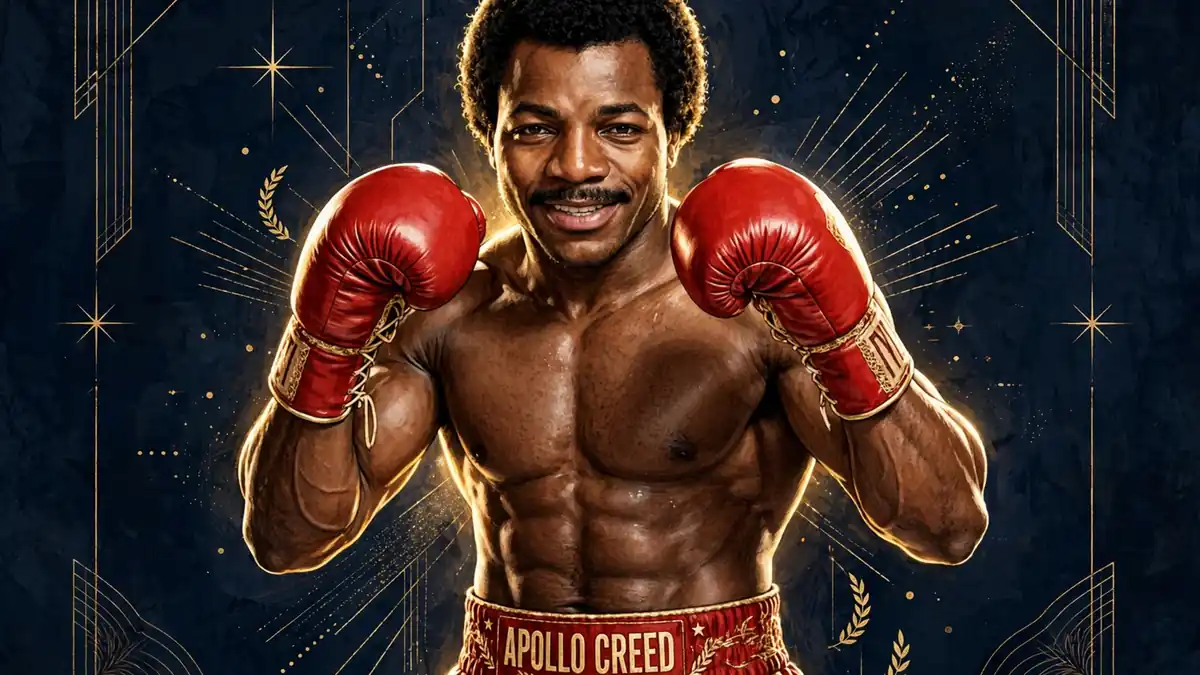
Carl Weathers‘s net worth is estimated at $6 million to $10 million as of November 2026. The figure most often cited is the $8 million reported by Celebrity Net Worth, and it sits in the middle of the published range: a handful of outlets put him at $6 million, one puts him at $10 million, and the $18 million number floating around a few content farms has no named source behind it and does not survive a check. Weathers died on February 2, 2024, at 76, so this is a final-estate estimate rather than a moving number — built from five decades of work that ran from the Oakland Raiders’ defensive line to Apollo Creed, from Predator to Chubbs Peterson, and finally to Greef Karga on The Mandalorian, where he closed his career as an Emmy-nominated actor and a working director.
Carl Weathers: Quick Facts
| Estimated net worth | $8 million (range: $6 million to $10 million) |
|---|---|
| Profession | Actor, director, former professional football player |
| Nationality | American |
| Born | January 14, 1948 (died February 2, 2024, aged 76) |
| Height | 6 feet 2 inches (188 cm) |
| Primary income sources | Film salaries, television salaries, directing fees, residuals and royalties, voice work, real estate |
| Active years | 1970–2024 (football 1970–1974; acting 1973–2023) |
| Last reviewed | November 2026 |
- Early Life and Background
- Education
- Career Journey
- Rise to Fame
- Main Sources of Income
- Salary and Earnings
- Businesses and Investments
- Brand Deals and Sponsorships
- Houses, Cars and Other Assets
- Awards and Achievements
- Net Worth Growth Over the Years
- Social Media Presence
- Personal Life
- Sources & Reporting
- Frequently Asked Questions
- Final Thoughts
Early Life and Background
Carl Weathers was born on January 14, 1948, in New Orleans, Louisiana, and grew up in the city’s Seventh Ward. His father worked as a day laborer, and the household ran on modest means — a detail that matters when you look at the shape of his career, because Weathers spent his working life moving between jobs that paid by the game, by the picture, and by the episode, and he never had the cushion of family money behind him. New Orleans in the 1950s and 1960s was a segregated city, and the path out that presented itself to a big, athletic teenager was sport. Football gave him a scholarship, a degree, and eventually a professional contract, and it also gave him the physical presence — 6 feet 2 inches, around 220 pounds in his playing days — that casting directors would later pay for.
He attended St. Augustine High School, the all-boys Catholic school in New Orleans known for its football program, where he played as a defensive lineman. Teammates and coaches from those years remembered him as disciplined rather than flashy, a player who showed up, did the work, and hit hard. That reputation followed him to college and into the pros, and it is worth keeping in mind because the same steadiness shows up again and again in his acting career: Weathers was rarely the highest-paid person on a call sheet, but directors kept hiring him for fifty years, and that kind of longevity is what a $6 million to $10 million estate is actually built from — not one jackpot payday, but five decades of steady cheques.
One thing worth clearing up early: a surprising number of net-worth pages still describe Weathers as alive, or list him as 77 or 78 years old in 2026. He is not. His family announced on February 2, 2024, that he had died peacefully in his sleep, and his death certificate records the time as 12:18 a.m. on February 2 at his home in Venice, California. The cause was atherosclerotic cardiovascular disease — heart disease he had been living with for years, according to the certificate obtained by The Blast and reported by ET Online and the Hollywood Reporter. He was 76. The confusion between February 1 and February 2 comes from the overnight timing: he died just after midnight, so the family statement said February 1 and the official record says February 2. Any site that still lists him as alive in 2026 is working from stale copy, and its net-worth number deserves the same scepticism.
Education
Weathers left New Orleans for California, enrolling first at Long Beach City College and then at San Diego State University, where he played defensive end for the Aztecs. He graduated from San Diego State in 1974 with a bachelor’s degree in theatre arts — a combination that looks prophetic in hindsight but was, at the time, simply a football player hedging his bets. The theatre degree matters to the money story in a concrete way: while most of his NFL peers were planning second careers in coaching or sales, Weathers had formal training and a stated interest in acting before his football career ended. He did not stumble into Hollywood after football failed; he had been preparing for it while he was still playing.
The timing of the degree is also part of the financial picture. He finished college in 1974, the same year his professional football career was winding down, which meant there was no gap year and no lost income while he retrained. He went straight from the Canadian Football League into acting classes and auditions in Los Angeles, and within two years he was on screen in feature films. For a working actor, those early years are usually the lean ones — small parts, day rates, waiting tables — and Weathers’ version of that period was shorter than most, because he arrived with a degree, a pro athlete’s discipline, and a look that casting directors immediately understood.
Career Journey
Weathers’ professional life divides cleanly into three acts, and the money follows the same shape. Act one was football: undrafted out of San Diego State, he signed with the Oakland Raiders in 1970 and played linebacker for two seasons, appearing in eight games, then moved north to the Canadian Football League, where he played for the BC Lions from 1971 to 1973. NFL money in 1970 was nothing like it is now — a fringe roster player earned a low five-figure salary, and there were no signing bonuses worth the name for undrafted free agents. Football gave Weathers a living and a platform, not a fortune, and he has been open about the fact that he retired from the game because acting paid better and lasted longer. The comparison is instructive: a modern NFL linebacker earns millions a year, but in 1970 the league minimum was $12,000, and Weathers’ football earnings across four seasons likely totalled less than a single episode fee from his later television work.
Act two was the film career, and it began while he was still technically a football player. His first screen credits came in 1973 and 1974 with small television roles, and his first film parts arrived in the blaxploitation wave: Bucktown (1975) and Friday Foster (1975), both opposite Pam Grier. Guest spots on The Six Million Dollar Man, Kung Fu, Starsky and Hutch, and Good Times followed. The work was steady but unremarkable, and the pay reflected it — day-player and supporting rates that kept him working without making him rich. Then, in 1976, came the audition that changed everything, and it is the best-known story of his life for a reason. Reading opposite Sylvester Stallone for the role of Apollo Creed in Rocky, Weathers told the unknown writer-star that he could do a better job acting than Stallone was doing. Stallone, instead of throwing him out, laughed — and the director John G. Avildsen saw the arrogance the part needed. Weathers got the role. The film cost less than $1 million to make and grossed $225 million worldwide, won the Academy Award for Best Picture, and turned both men into stars.
Act three was the long tail: forty years of working-actor employment after the Rocky sequels ended. There were leading-man attempts — Action Jackson in 1988 was built entirely around him — and there were the roles that made him a familiar face to new generations: the golf coach Chubbs Peterson in Happy Gilmore (1996), the voice of Combat Carl in Toy Story 4 (2019), the fictionalised version of himself on Arrested Development, and Greef Karga on The Mandalorian from 2019 to 2023. He also built a second career behind the camera, directing episodes of Silk Stalkings, Renegade, and finally two episodes of The Mandalorian itself. The through-line is durability: very few actors who peaked in the 1970s were still booking prestige television in the 2020s, and that durability is the single biggest reason his estate landed where it did. Like fellow athlete-turned-action-star Dave Bautista, Weathers proved that a sports career can be a launchpad rather than a peak — but unlike Bautista, he did it in an era when the pay for that transition was far smaller, which is why the final numbers look modest next to today’s action stars.
Rise to Fame
Apollo Creed was the role, but the way Weathers played him is what made the money. Creed was written as a showman — a heavyweight champion who treats a title defence against an unknown club fighter as a publicity stunt — and Weathers gave him charm, menace, and a physical authority that no amount of dialogue could fake. He had actually been hit for a living, and it showed in how he moved. The film’s $225 million worldwide gross on a sub-$1 million budget made it one of the most profitable films ever made, and the sequels turned Creed from an opponent into a friend and then into a martyr: Rocky II (1979) grossed roughly $200 million worldwide, Rocky III (1982) roughly $270 million, and Rocky IV (1985) roughly $300 million, with Creed dying in the ring against Ivan Drago in the fourth film — a death scene that still anchors the entire Creed spin-off franchise today. The three Creed films starring Michael B. Jordan have grossed more than $660 million worldwide combined, and every one of them is built on the character Weathers created in 1976.
The sequels also changed Weathers’ pay. Nobody publishes the exact figure he earned for the first Rocky — the film’s whole budget was under $1 million, and Stallone himself took just $23,000 for writing and starring — so the honest statement is that his first Creed cheque was small by any modern measure. By Rocky III and Rocky IV, he was a returning franchise player negotiating from strength, and his fees rose accordingly, though the precise numbers were never made public. What is documented is the pattern: each sequel paid more than the last, and each one kept his name in front of audiences for a decade. That is the economics of a franchise supporting player, and it is a good living rather than a lottery win — which is exactly what the $8 million anchor figure reflects.
Between the Rocky films, Weathers worked constantly. Semi-Tough (1977), Force 10 from Navarone (1978) with Harrison Ford, and Death Hunt (1981) with Charles Bronson and Lee Marvin kept him in studio films. Then came Predator in 1987, his second signature role: Colonel Al Dillon, the CIA man who leads Arnold Schwarzenegger’s team into the jungle. The film cost $15–18 million and grossed $98.3 million worldwide, and it gave Weathers the most famous handshake in action-movie history — the arm-wrestle greeting with Schwarzenegger that became a meme thirty years later and introduced him to audiences who had never seen a Rocky film. The following year he got his own vehicle, Action Jackson (1988), a Cannon Films action picture built around him as Detroit detective Jericho Jackson. It grossed about $20.6 million domestically on a roughly $7 million budget — profitable, but not the franchise launch Cannon wanted, and Weathers never headlined another studio action film. The lesson of Action Jackson is part of the net-worth story too: leading-man money went to Stallone and Schwarzenegger, while Weathers’ value was as the most reliable supporting presence in the genre, and supporting players get paid accordingly.
The 1990s brought the pivot that saved his career financially. As the action-hero market narrowed, Weathers moved into television and comedy. He starred as Detective Adam Beaudreaux in Street Justice (1991–1993), a syndicated series that ran 44 episodes — and syndicated television, with its per-episode fees and residual structure, was steadier income than feature films ever were. He had a recurring role as Police Chief Hampton Forbes on In the Heat of the Night. And in 1996 he took the part that a whole generation now knows him by: Chubbs Peterson, the one-handed golf pro who coaches Adam Sandler’s Happy Gilmore. Happy Gilmore cost $12 million and grossed $41.2 million worldwide, and it has earned far more than that in the decades since through cable, streaming, and home video — every one of those windows paying residuals to the cast. Weathers paid a physical price for the role: during a stunt he fell and fractured two vertebrae, an injury that required years of rehabilitation and that he spoke about candidly in later interviews. He came back from it, and the role kept paying him long after the injury healed.
The final act began in 2019, when he joined The Mandalorian as Greef Karga, the magistrate of Nevarro who hires and then befriends the bounty hunter played by Pedro Pascal. He appeared across all three seasons, and the part earned him a Primetime Emmy nomination in 2021 for Outstanding Guest Actor in a Drama Series — his first Emmy nomination, at 73. Just as important, the show let him direct: he helmed “Chapter 12: The Siege” in season two and “Chapter 20: The Foundling” in season three, adding directors’ fees to his acting income and giving him a craft he could have kept practising into his eighties. The Mandalorian’s first season reportedly cost about $10 million per episode to produce, which puts the scale of the production in context, though Disney has never disclosed what it paid its supporting cast. What is certain is that a three-season run on the flagship show of the world’s biggest streaming platform, plus directing fees, was the most lucrative stretch of Weathers’ later career.
Main Sources of Income
Weathers’ money came from six streams, and the balance between them shifted with each decade of his career. Film salaries were the biggest single source in the 1970s and 1980s: four Rocky films, Predator, Action Jackson, and dozens of supporting parts, each paying a negotiated fee that rose with his profile. Television salaries took over in the 1990s and 2000s — Street Justice as a series lead, recurring work on In the Heat of the Night and Chicago Justice, and the three-season Mandalorian run — and television has the advantage of volume: a 44-episode series pays 44 times, while a film pays once. Residuals and royalties formed the third stream, and for Weathers they were unusually durable: Rocky and Predator never leave television, Happy Gilmore plays on cable constantly, and the Creed films keep Apollo Creed in the cultural conversation, which keeps the original films selling. Directing fees were the fourth stream, smaller but real — episodic television directing pays a flat fee per episode, and his two Mandalorian episodes were prestige credits that commanded the top of that scale. Voice work was the fifth: Combat Carl in the Toy Story franchise, including Toy Story 4 (2019), which grossed $1.07 billion worldwide, plus animation work on Star vs. the Forces of Evil. And real estate was the sixth — a Venice, California, home that appreciated sharply over twenty years, discussed in the assets section below.
The shape of that income matters because it explains why the estimate is $6 million to $10 million rather than $50 million. Weathers was a working actor for fifty years, not a backend-points mogul. He did not own a piece of Rocky — Stallone himself famously did not own a piece of Rocky either — and he did not launch a production company or a tequila brand. His wealth is the accumulation of fees, residuals, and one well-chosen property, minus three divorces and the ordinary costs of a life lived in Los Angeles. That is a respectable fortune, and it is also a useful corrective to the $18 million figure that some content farms publish: nothing in the public record — no business sale, no franchise windfall, no disclosed investment — supports a number that high.
One more stream deserves a mention because it is easy to miss: convention and appearance fees. In his later years Weathers was a regular on the fan-convention circuit, where Rocky, Predator, and Star Wars fandoms overlap, and those appearances — autographs, photo sessions, panels — paid appearance fees that working actors treat as meaningful income. It was never his main living, but it was steady, and it kept coming right up to his final year, when he was still promoting The Mandalorian and still being asked to sign Apollo Creed gloves.

Salary and Earnings
The honest version of Carl Weathers’ salary history starts with an admission: most of his individual paychecks were never made public. Unlike today’s stars, whose deals leak to the trades within days, a supporting actor in the 1970s and 1980s negotiated privately, and the studios had no reason to publish the numbers. What follows is what can be documented, and where a number is not documented, this article says so rather than inventing one.
Football paid the least. The NFL minimum salary in 1970 was $12,000 a year, and an undrafted linebacker on the Oakland Raiders’ roster would have earned at or near that level; the Canadian Football League paid less. Across four professional seasons, his football earnings were almost certainly under $100,000 in total — a solid working wage in 1970, and a rounding error next to what came later. The value of football was not the salary but the springboard: it put him in Los Angeles, it gave him a body and a bearing that casting directors wanted, and it gave him the confidence to walk into the Rocky audition and criticise the star.
Rocky paid little up front and everything in career terms. The film’s total budget was under $1 million, Stallone took $23,000 for writing and starring, and the supporting cast worked for scale-plus rates that would look like pocket money today. Weathers has never disclosed his fee, and no credible source has published it, so any site that prints a specific Rocky salary for him is guessing. What is documented is the escalation: by the time of Rocky III and Rocky IV, he was a returning franchise actor on films grossing $270 million and $300 million worldwide, and his fees reflected that. Industry practice for a supporting player in a hit sequel of that era would put his per-film fee in the low-to-mid six figures by the mid-1980s — a reasonable inference from the budgets and his billing, not a reported fact, and labelled as such here.
Predator (1987) was a $15–18 million production, and as second-billed support to Schwarzenegger — then the highest-paid action star alive — Weathers would have commanded a strong six-figure fee, though again the exact number is not public. Action Jackson (1988) was his one shot at leading-man money, and while the fee is undisclosed, a Cannon Films headliner in 1988 typically earned in the mid-to-high six figures. The film’s $20.6 million domestic gross on a $7 million budget meant it turned a profit without making him a bankable lead, and the leading-man offers stopped coming.
Television paid differently, and in the long run it paid better. As the lead of Street Justice (1991–1993), Weathers earned a per-episode fee for 44 episodes — syndicated action series of that era paid their leads in the tens of thousands per episode, which adds up to a seven-figure run across two seasons, plus residuals on reruns. His Mandalorian deal is undisclosed, as Disney keeps its supporting-cast salaries private, but the show’s $10-million-per-episode production budget and his Emmy-nominated, three-season status put him at the top end of the supporting scale, and his two directing assignments added separate episodic directors’ fees on top. Voice work on Toy Story 4 — a film that grossed $1.07 billion — paid a session fee plus residuals, modest beside the film’s gross but real money for a few days in a recording booth.
Put together, the pattern is clear: no single payday made Carl Weathers rich, and no single payday needed to. Fifty years of fees, layered with residuals from films that never stop playing, is how a working actor reaches $8 million. The year-by-year table in the growth section below shows how that accumulation looked over time.
Businesses and Investments
Weathers was not a businessman in the way some of his peers were. There is no Carl Weathers production company with a slate of films, no restaurant chain, no clothing line, and no disclosed venture-capital portfolio. What he had, instead, was a property and a pension of residuals — and for a man who started life in a working-class New Orleans household, that counts as a deliberate, conservative investment strategy rather than a failure of ambition. The public record shows a man who invested in his craft and his home, and who let the work compound.
The one documented investment is real estate. Weathers owned a home in Venice, California, that Celebrity Net Worth valued at $1.365 million in 2004; later reporting put its value at $3 million to $4 million as Venice prices climbed. That appreciation — roughly tripling over two decades — is the single largest capital gain in his financial life, and it is worth more, in wealth terms, than most of his individual acting fees. Venice was a smart buy at the time: a beachside neighbourhood that was still affordable to working actors in the 1990s and early 2000s, and that has since become one of the most expensive postcodes in Los Angeles. The house was also where he died, in February 2024, and its value at death would have formed a substantial part of his estate. Note the sourcing here: the $1.365 million figure comes from Celebrity Net Worth’s property reporting, and the $3 million to $4 million estimate comes from later coverage citing that same reporting — it is a reported estimate, not an appraisal, and it is presented as one.
Beyond property, his investments were the unglamorous kind: a SAG-AFTRA pension built from fifty years of union work, residuals that kept arriving as long as Rocky and Happy Gilmore kept airing, and the directing career he was building in his seventies. The pension point is easy to overlook and genuinely important. A SAG-AFTRA member with five decades of qualifying earnings receives a pension and health benefits that function as a private annuity, and for an actor whose peak earning years were in the 1980s, that pension was a meaningful part of his retirement income. It does not show up in net-worth estimates, which count assets rather than income streams, but it explains how he could keep working by choice rather than necessity in his final years.
The contrast with his peers is instructive, and it is where the peer table below earns its place. Dwayne Johnson turned an acting career into a business empire with tequila, energy drinks, and a production company; John Cena layered endorsements and a production deal onto his wrestling fame. Weathers belonged to an earlier generation, one that treated acting as a trade rather than a platform for brand-building, and his $8 million reflects that trade done well for a very long time. There is no evidence he ever sought the empire, and no evidence he needed it.
Brand Deals and Sponsorships
Endorsement money was never a major pillar of Carl Weathers’ income, and that is itself a data point. The big endorsement paydays of his era went to the leading men — Stallone with his own deals, Schwarzenegger with his — while supporting players were rarely offered national campaigns. Weathers did appear in commercials early in his career, including a well-remembered spot for the soft drink Slice in the 1980s, and he lent his image to Rocky-related merchandise and video games over the years, but these were one-off fees rather than the multi-year, eight-figure partnerships that define modern celebrity endorsement.
What changed in his later years was the convention and licensing economy. The Rocky franchise’s licensing machine — action figures, posters, video games, the Creed spin-offs — kept Apollo Creed’s likeness in the market for fifty years, and Weathers’ participation in that economy came through likeness fees and appearance work rather than a headline endorsement contract. The famous Predator handshake became a meme, and memes do not pay, but they do keep a face in circulation, which is what keeps the convention invitations coming. His most visible late-career commercial work was his self-parodying turn on Arrested Development, where he played a fictionalised, comically cheap version of himself — a performance that doubled as a brand statement, telling the industry he was in on the joke and available for comedy. That willingness to laugh at his own image was, in commercial terms, a smart move: it widened the range of parts he was offered in his sixties and seventies, and it is part of why he was still booking prestige television at 75.

Houses, Cars and Other Assets
The Venice home is the asset that matters most. Weathers lived for many years in Venice, California, the beachside Los Angeles neighbourhood where he died in February 2024. As noted above, Celebrity Net Worth valued the property at $1.365 million in 2004, and later estimates put it at $3 million to $4 million — a gain driven by Venice’s transformation from a scruffy artists’ enclave into one of the priciest markets in the city. The house was his home rather than an investment property: he lived there, he died there, and there is no record of him flipping homes or holding a portfolio of rental properties. The $18 million net-worth figure that some sites publish appears to rest on invented real-estate claims — one low-quality page credits him with a portfolio of properties generating passive income, without naming a single address, sale, or record. No property record supports that, and it is not repeated here as fact.
On cars, the record is thin, and thin is what this article will report. Weathers was not known as a car collector, and no credible outlet has published a list of his vehicles or their values. He drove, like most working actors in Los Angeles, without making a public display of it, and the absence of a garage inventory in the press is itself the story: his spending was private and unshowy. What can be said is that his lifestyle, as described by friends and colleagues after his death, was comfortable rather than lavish — a beachside home, a working actor’s routine, and a late-career focus on directing rather than display. That fits the $8 million figure: enough for security and comfort, not enough for the conspicuous consumption that fills other net-worth pages.
Other assets follow the same pattern. His estate would have included the usual working-actor holdings: SAG-AFTRA pension entitlements, residual income streams from a fifty-year filmography, personal property, and the Venice home. No probate filing has been made public, and no outlet has reported the size of the estate or how it was divided between his two sons, Jason and Matthew Weathers. This article does not speculate on the split. What the record supports is the range — $6 million to $10 million, anchored at $8 million — and the composition: mostly property and accumulated earnings, not business equity or brand value.
Awards and Achievements
Weathers’ trophy shelf was modest beside his filmography, and the gap between the two is part of what makes his career interesting. He was never nominated for an Oscar, and Rocky‘s ten nominations in 1977 went to Stallone, Avildsen, and the film itself rather than to its supporting cast. His first major nomination came 45 years into his career: a Primetime Emmy nomination in 2021 for Outstanding Guest Actor in a Drama Series for The Mandalorian, for his work as Greef Karga. He did not win — the award went to Courtney B. Vance for Lovecraft Country — but the nomination itself was the recognition, and it arrived at 73, when most actors have been retired for a decade.
The honours that did come were the kind that arrive after a career rather than during it. On August 29, 2024, six months after his death, he was honoured with a star on the Hollywood Walk of Fame, in a ceremony attended by his family and his Rocky colleagues. It was a posthumous honour, and the timing says something about how the industry valued him: not as a star of the first magnitude, but as a presence whose absence was felt. The tributes after his death filled that picture in. Sylvester Stallone posted that Apollo Creed was “the best friend I ever had” in character terms and that Weathers’ death left “a hole in the world”. Adam Sandler, his Happy Gilmore co-star, called him “a true great man” and a “great dad, great actor, great athlete”. Giancarlo Esposito, his Mandalorian co-star, called him “one of the most wonderful human beings I have had the honor and pleasure of spending time with”. Those are not the words people use for a difficult colleague; they are the words they use for a professional who showed up, knew his lines, and treated people well for fifty years.
His achievements outside awards are easier to count and arguably more meaningful. He played professional football in two countries, appeared in four Rocky films across nine years, carried a studio action film as its lead, starred in a 44-episode television series, voiced a character in a billion-dollar animated franchise, played himself on one of the most acclaimed comedies of the century, earned an Emmy nomination at 73, and directed episodes of the flagship Star Wars series at 74 and 75. He also survived a broken back on a film set and kept working for another 28 years. Any one of those would be a career; together, they are the reason his name still draws a search volume of 1,800 a month two years after his death.
Net Worth Growth Over the Years
No year-by-year balance sheet for Carl Weathers exists in the public record, and this table is an honest reconstruction rather than a ledger: each figure is the best available estimate for that period, drawn from the outlets named in the sources section, and the early numbers are necessarily approximate. The shape is what matters — slow growth through the franchise years, a plateau during the television decades, and a late lift from The Mandalorian and the Venice property market.
| Year | Estimated net worth | What drove it |
|---|---|---|
| 1974 | Under $100,000 | End of football career; first small acting roles; San Diego State degree in hand |
| 1977 | $250,000–$500,000 | Rocky (1976) makes him a known name; supporting fees rise |
| 1985 | $1 million–$2 million | Four Rocky films complete; Predator on the way; franchise fees accumulate |
| 1990 | $2 million–$3 million | Action Jackson lead fee; steady film and television work |
| 1996 | $3 million–$4 million | Happy Gilmore and Street Justice residuals begin; Venice home appreciating |
| 2005 | $4 million–$5 million | Television and voice work; Venice property valued at $1.365 million in 2004 |
| 2015 | $5 million–$6 million | Creed revives Apollo’s legacy; residuals and appearances steady |
| 2020 | $6 million–$8 million | The Mandalorian begins; directing fees start; property value climbs |
| 2024 | $6 million–$10 million | Final estimate at death; Celebrity Net Worth reports $8 million |
Two things stand out in that table. First, the growth is steady rather than explosive — roughly doubling every decade, which is what a working actor’s compounding looks like when the income is fees and residuals rather than equity. Second, the range widens at the end rather than narrowing, because the later estimates disagree: Celebrity Net Worth says $8 million, several other outlets say $6 million, and Wealtholino says $10 million. The disagreement is not a failure of research; it is the honest consequence of estimating a private estate from public sources. This article’s anchor of $8 million is the middle of the credible range, and the range itself is the finding.
For comparison, here is how Weathers’ reported fortune sits beside the peers his career is most often measured against. The figures are Celebrity Net Worth estimates, and the gap between them is the gap between a supporting player and a franchise owner.
| Actor | Reported net worth | Why the comparison fits |
|---|---|---|
| Carl Weathers | $8 million | Apollo Creed; four Rocky films; Predator; The Mandalorian |
| Sylvester Stallone | $400 million | Rocky creator and star; owns a share of the franchise’s success |
| Arnold Schwarzenegger | $450 million | Predator co-star; action lead who built businesses beyond film |
| Adam Sandler | $440 million | Happy Gilmore co-star; Netflix production empire |
| Dwayne Johnson | $800 million | Fellow athlete-turned-action-star who built a brand empire |
The table is not meant to diminish Weathers — it is meant to explain the mechanics. Stallone wrote Rocky; Schwarzenegger and Sandler built production companies; Johnson built a drinks empire. Weathers acted, and acted well, for fifty years. The $392 million gap between him and Stallone is, in large part, the difference between owning a franchise and starring in one.
Social Media Presence
Weathers was active on social media in his later years, and his accounts became the place where his death was announced and mourned. His X (formerly Twitter) account, @TheCarlWeathers, was where he promoted The Mandalorian, shared behind-the-scenes photographs from the set, and interacted with fans of Rocky and Predator. His Instagram account carried the same mix: set photographs, convention appearances, and tributes to colleagues. Follower counts from his lifetime are now stale — one 2020 report put his Instagram following at just under 21,000 and his X following at about 59,000, but those numbers predate the surge of attention that followed The Mandalorian‘s later seasons and his death, and they are quoted here only as a dated snapshot, not as a current figure.
What matters more than the counts is how the accounts were used after his death. His family announced his passing through his social channels on February 2, 2024, writing that he “died peacefully in his sleep” — the statement that every major outlet then quoted. In the days that followed, the accounts filled with tributes from Stallone, Sandler, Esposito, and thousands of fans, and the posts remain as a public record of how widely he was liked. The accounts have not been deleted; they stand as a memorial, which is now the common practice for public figures’ profiles. For a net-worth researcher, the social record is useful in one narrow way: it confirms that Weathers had no paid-influencer sideline. He did not sell detox tea or crypto; he posted about his work, and the work was the business.
Personal Life
Weathers was married three times and had two sons, and the plain facts of that life are part of the financial story because divorce is expensive and Weathers went through it three times. His first marriage was to Mary Ann Castle, from 1973 to 1983; their two sons, Jason Weathers and Matthew Weathers, were born during that marriage, and Matthew was the son who notified authorities of his father’s death in 2024. His second marriage was to Rhona Unsell, from 1984 to 2006 — a 22-year marriage that covered the Predator, Action Jackson, and Street Justice years. His third marriage was to Jennifer Peterson, from 2007 to 2009. No reliable source has published the financial terms of any of the three divorces, and this article does not guess at them; the point is simpler and documented, which is that three marriages ending in divorce across a fifty-year career are a real cost, and they are part of why a man who earned steadily for five decades finished with $8 million rather than $20 million.
Outside the marriages, Weathers kept his private life private. He rarely gave interviews about his family, and his sons have stayed out of the public eye. What friends and colleagues described after his death was a man who loved the work itself: he was still taking acting classes in his seventies, still talking about directing, and still showing up early to set. He was also, by several accounts, a mentor to younger actors on The Mandalorian, including the show’s guest stars, and he spoke in interviews about the discipline football had taught him — showing up, being prepared, and never assuming the next job was guaranteed. He lived in Venice for many years, close to the beach, and he died at home, in his sleep, at 76, after a long illness he had never discussed publicly. His body was cremated, and his family asked for privacy, which the press largely respected.
Sources & Reporting
Celebrity Net Worth — the $8 million net-worth anchor and the Venice property valuation of $1.365 million in 2004. Reporting window: profile maintained through 2024.
Wikipedia — career filmography and chronology, football career with the Oakland Raiders and BC Lions, education at San Diego State, death on February 2, 2024, Emmy nomination, directing credits, and the posthumous Hollywood Walk of Fame star on August 29, 2024. Reporting window: page updated through November 2026.
The Hollywood Reporter — obituary reporting on February 2, 2024, confirming the death, the family’s statement, and the career summary. Reporting window: February 2024.
ET Online — cause of death reporting on February 10, 2024, from the death certificate obtained by The Blast: atherosclerotic cardiovascular disease, death at 12:18 a.m. on February 2 at his Venice home, manner of death natural. Reporting window: February 2024.
The Most 10 — the $6 million estimate for 2026, used as the low end of the published range. Reporting window: 2025–2026.
Wealtholino — the $10 million estimate, used as the high end of the published range. Reporting window: 2025.
Box Office Mojo — worldwide grosses for the Rocky films, Predator ($98.3 million), Happy Gilmore ($41.2 million), and Toy Story 4 ($1.07 billion). Reporting window: figures as listed through 2024.
Animated Times — the Venice property’s later estimated value of $3 million to $4 million and the $8 million net-worth figure, cited here as a secondary source and labelled as reported rather than verified. Reporting window: February 2024.
UVA Health — medical context on atherosclerotic cardiovascular disease and confirmation of the February 2, 2024 death at 76. Reporting window: February 2024.
Figures in the growth table are estimates compiled from the outlets above; where a figure is an inference from industry practice rather than a reported number — such as the per-film fee ranges in the salary section — the text says so. No audited estate filing for Carl Weathers is public.
Frequently Asked Questions
What was Carl Weathers’ net worth when he died?
Carl Weathers’ net worth was estimated at $6 million to $10 million at his death in February 2024, with $8 million — the figure reported by Celebrity Net Worth — the most widely cited number. The range exists because his estate was private: several outlets report $6 million, Wealtholino reports $10 million, and the $18 million figure on some content-farm pages has no named source and is not credible.
How did Carl Weathers die?
Carl Weathers died in his sleep at his home in Venice, California. His family announced the death on February 2, 2024, and his death certificate records the time as 12:18 a.m. on February 2, at age 76. The official cause, reported by ET Online from the certificate obtained by The Blast, was atherosclerotic cardiovascular disease — heart disease he had lived with for years. The manner of death was listed as natural.
How much did Carl Weathers make from Rocky?
His exact Rocky pay was never made public. The first film’s whole budget was under $1 million — Sylvester Stallone took $23,000 for writing and starring — so Weathers’ first Apollo Creed cheque was small. His fees rose with each sequel as the franchise grew: Rocky II grossed about $200 million worldwide, Rocky III about $270 million, and Rocky IV about $300 million. By the mid-1980s he was earning low-to-mid six figures per film, an inference from budgets and billing rather than a published figure.
Was Carl Weathers a real football player?
Yes. He played linebacker for the Oakland Raiders in the NFL in 1970 and 1971, appearing in eight games, then played for the BC Lions in the Canadian Football League from 1971 to 1973. He went undrafted out of San Diego State University, where he played defensive end. He retired from football in 1974 to pursue acting full time.
How tall was Carl Weathers?
Carl Weathers was 6 feet 2 inches tall (188 cm). His height and build — around 220 pounds in his playing days — were part of why he was cast as Apollo Creed, a heavyweight champion who had to look like he could genuinely threaten Rocky Balboa.
Did Carl Weathers direct episodes of The Mandalorian?
Yes. He directed two episodes of The Mandalorian: “Chapter 12: The Siege” in season two (2020) and “Chapter 20: The Foundling” in season three (2023). He also earned a Primetime Emmy nomination in 2021 for Outstanding Guest Actor in a Drama Series for his performance as Greef Karga — his first Emmy nomination, at age 73.
Was Carl Weathers married, and did he have children?
He was married three times: to Mary Ann Castle (1973–1983), Rhona Unsell (1984–2006), and Jennifer Peterson (2007–2009). He had two sons, Jason and Matthew Weathers, with his first wife. Matthew was the son who notified authorities of his father’s death in February 2024.
What was Carl Weathers’ last role?
His last major role was Greef Karga in The Mandalorian, which he played across all three seasons from 2019 to 2023, including directing two episodes. His final film voice role was Combat Carl in Toy Story 4 (2019). Six months after his death, on August 29, 2024, he was honoured with a posthumous star on the Hollywood Walk of Fame.
Final Thoughts
Carl Weathers’ $8 million fortune is the record of a working actor who never stopped working. He did not own a franchise, launch a brand, or cash in a single jackpot role — he collected fifty years of fees, residuals, and one well-bought house in Venice, and he kept the standard high enough that Disney was still hiring him to act and direct at 75. The range around the number — $6 million to $10 million — is not a weakness in the reporting; it is the honest shape of a private estate, and any site that prints a single precise figure without naming its source is selling certainty it does not have.
The more interesting number is 50: the years between his first professional football game and his last episode of The Mandalorian. Very few performers survive one career change, let alone two, and Weathers managed football to film to prestige television to directing without ever becoming a nostalgia act. Apollo Creed made him famous; the decades after Creed made him rich enough, and respected enough, that his death filled the news for a week and his Walk of Fame star drew his old co-stars out to celebrate him. That is a fortune measured in more than dollars — but in dollars, $6 million to $10 million, anchored at $8 million, is the figure the evidence supports.
Published on November 14, 2026. Last reviewed November 2026. Found an error? See our corrections policy.